Masters of Geometric Form, Painter Bridget Riley and Sculptor Alexander Calder on view at Goodman Gallery’s pop-up in France
Goodman Gallery’s seasonal residency at Galerie Podgorny in Saint-Paul-de-Vence includes work by two of the art world’s most influential artistic authorities in form, rhythm and balance from opposite sides of the Atlantic: British painter Bridget Riley and American sculptor Alexander Calder.
Riley, now 95 years old, is a master of colour, geometry and abstraction. With a career spanning over six decades, she has focused almost exclusively on geometric forms since the 1960s. Upon first inspection, her canvas work and wall paintings may appear to be the use of simple shapes, lines and colours. However, the longer one sits with each work, the more one is able to be engulfed by the scale of Riley’s pieces, or experience the dynamism she produces through the clever compositional use of these shapes. The ability to achieve movement in the simplicity and the assumed rigidity of circles, squares, curves and solid colour is no small feat.
Born in London in 1931, part of her childhood was spent in Cornwall and Lincolnshire during World War 2. She studied at Goldsmiths' College (1949–52), alongside Robert Hodgins, a prominent artist in the Goodman Gallery in the 1990s and 2000s, and at the Royal College of Art (1952–55). In these early years she began painting figures, drawing on impressionist approaches, followed by landscapes and experimentation in pointillism. By the 1960s, Riley began to develop and settle into a style described as ‘Op-art’ which involved merging geometric forms to create optical effects. She produced multiple black-and-white works, with one of her most well-known works of that period being ‘Fall’ from 1963, and now with the Tate. Her dedication to striking optical phenomena earned her recognition through The Responsive Eye exhibition at the Museum of Modern Art in New York in 1965. By the late 60s, colour made an appearance in her practice. Throughout her career Riley has continued to develop and eventually master her use of shapes, light, perception, colour and abstraction.
Riley’s “optical mastery” as described by The Guardian’s Adrian Searle is captivating and hypnotic. You are compelled to follow each line, to fixate on how the lines that at first glance were still, begin to dance, vibrate or wiggle on the canvas. The artist’s 2025 solo exhibition Learning to See at Turner Contemporary in Margate, UK can be seen as a celebration of the artist’s career spanning over six decades. The show included the painter’s works from the late 1960s, wall paintings from the last decade and the artist's most recent canvases. Conceived in close collaboration between the artist and senior curator Melissa Blanchflower, the 26 works that were on view until 4 May 2026 offered a survey of her work, exploring Riley’s close connection with nature, her career-long study of sensory experience and how drawing is the foundation of her practice. Frieze’s James Chaill described the exhibition as a “bold, uncomplicated testament to the consistency of her vision”, pointing to the show as highlighting both the artist’s technical precision and her ongoing process to see, understand and translate that into artwork.
Riley’s ‘Yellow, Red, Blue, Turquoise, Black and White’ (1981) on view at Goodman Gallery’s residency displays the artist’s established preoccupation with seeing and ability to distill observation into basic forms with immense emotional capacity. This belongs to a period influenced by her travels in Egypt, where the vivid palette of ancient Egyptian art inspired her return to simple vertical stripe compositions in which colour became the principal source of rhythm and sensation. The signed and inscribed work of gouache on paper is composed of yellow, red, blue, turquoise, black, and white vertical lines of the same thickness arranged with precise intervals, a remarkable demonstration of the artist’s signature techniques and dynamic composition.
Another master of medium and geometry on view at the gallery’s residency in France is that of sculptor Alexander Calder. Born in 1898 to a family of artists, Calder transitioned in 1923 from mechanical engineering to studying art at New York’s Art Students League where his father Alexander Stirling Calder was an instructor.
This background in engineering and growing up around artists would inform his work. Moving to Paris in 1926, his precise yet enchanting use of metal saw him create wire sculptures, specifically ‘Cirque Calder’. Here, the artist combined wire and found materials while taking influence from his introduction to the Parisian avant-garde. He presented his innovative wire and wood sculptures at Galerie Billiet-Pierre Vorms in 1929, the same year South African painter Irma Stern held a solo exhibition with the Paris gallery. He continued to explore this medium and form, seeing his work as three-dimensional drawings of circus themes, people and animals.
In the 1930s Calder combined his mastery of metal with movement, making his name now synonymous with the mobile: a moving sculpture made with components suspended in the air. His visit to fellow artist Piet Mondrian’s studio in 1930 in which he describes seeing how the light entered the space and experimental stunts with colored rectangles of cardboard tacked on as the moment in which a light switched for him, inspiring thoughts of making work oscillate. This is also the period in which Calder begins to experiment with and develop a strong inclination to wholly abstract work. The gouache paintings he produced worked hand-in-hand with his exploration of space, colour and geometry in his mobiles. The paintings were two-dimensional translations of the visual language expressed in these sculptures. In these paintings, one can recognise investigations in rhythm, balance and composition.
Calder has been recognised on the international stage throughout his career, with significant early moments including the artist's major show in 1946 at Galerie Louis Carré in Paris, the first in Europe since World War 2, for which Jean-Paul Sartre wrote a seminal essay canonising the artist’s impact on the art world. Another earlier achievement was representing the United States at the Venice Biennale in 1952, winning the grand prize for sculpture. Since then, his impact and acknowledgement has been memorialised through texts, exhibitions and artworks existing in prominent institutional collections across the world.
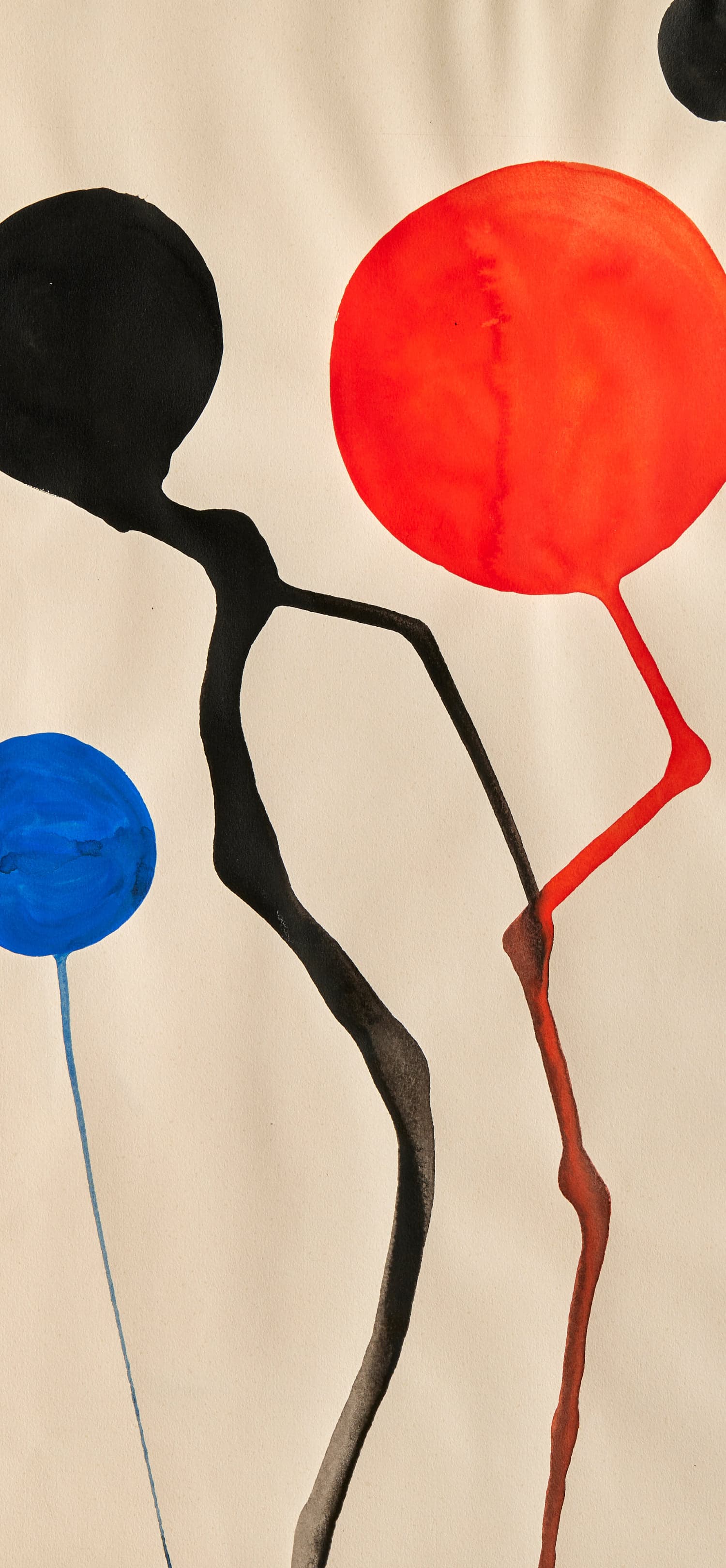
A hundred years since Calder’s arrival in France is celebrated in the 2026 show Calder. ‘Rêver en Equilibre’ at Fondation Louis Vuitton with works from the 1920s all the way to his monumental public sculptures from the 1960s and 1970s. This is serendipitous with Goodman Gallery’s residency in France which showcases Calder’s 1974 painting Cercles. In this work is an arrangement of large black circles that to balance a vibrant red circle at the centre, while a smaller cobalt blue circle introduces a contrasting accent that stabilises the composition. Long lines extend out from each circle, recalling the wire structures of his sculptures and creating a rhythmic movement that guides the viewer’s eye across the page. The white background pushes these forms forward, giving the impression they have been captured at the moment they begin to ascend into space.
View these works until 23 August 2026 at Galerie Podgorny, Saint-Paul-de-Vence.