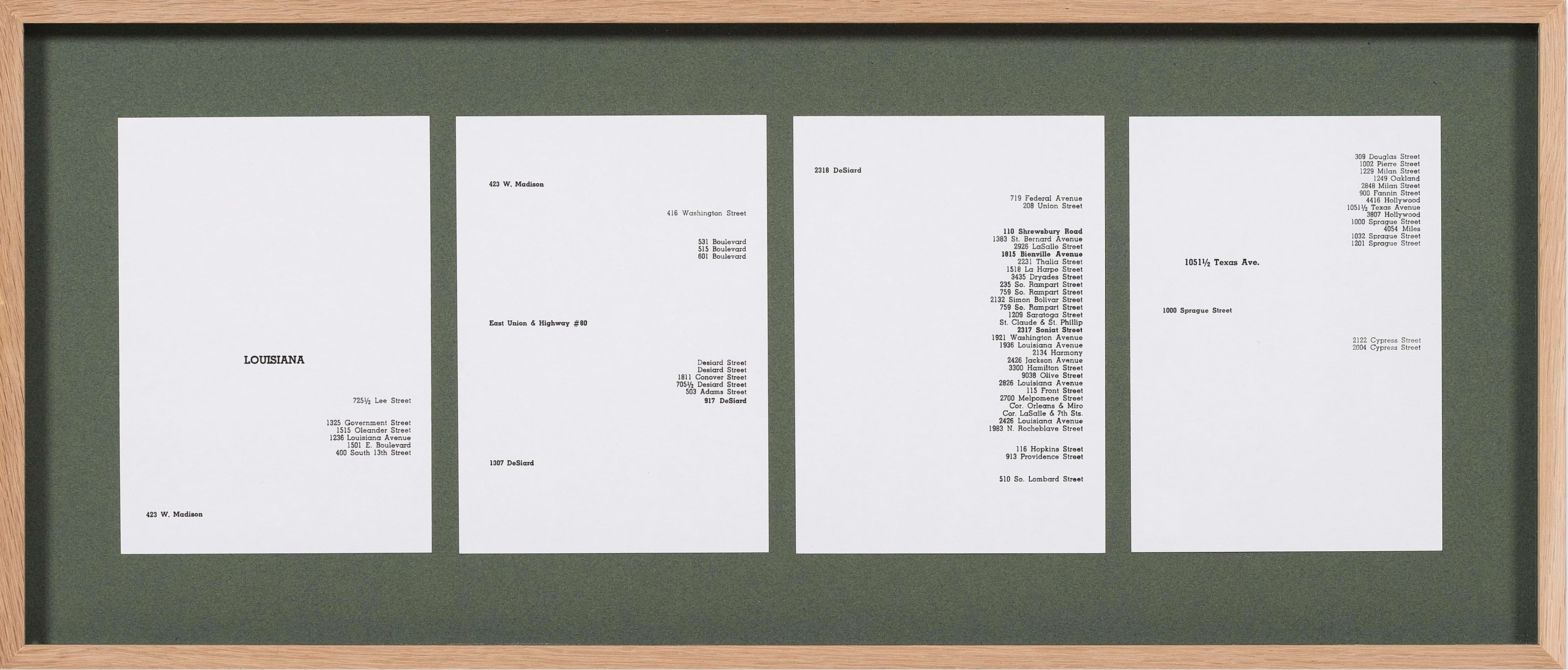
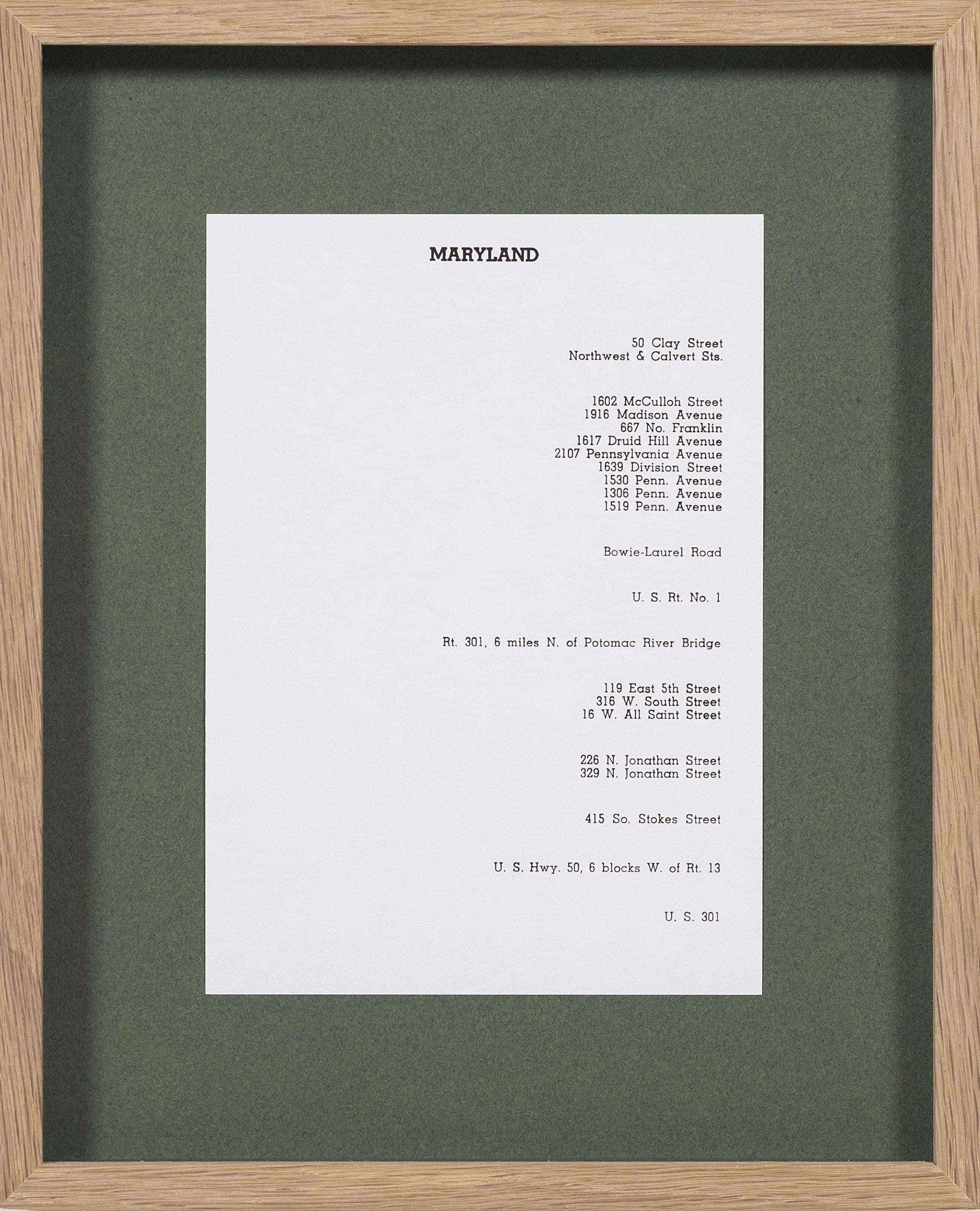
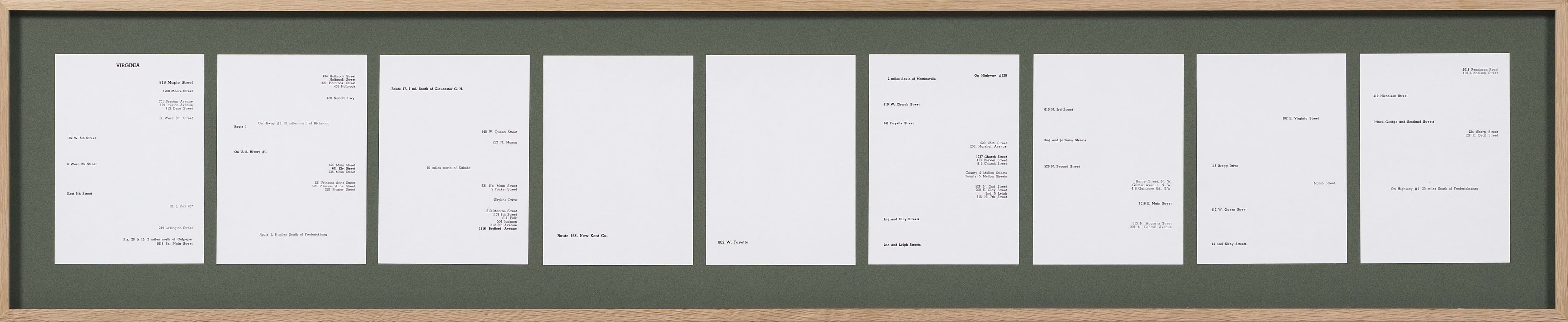
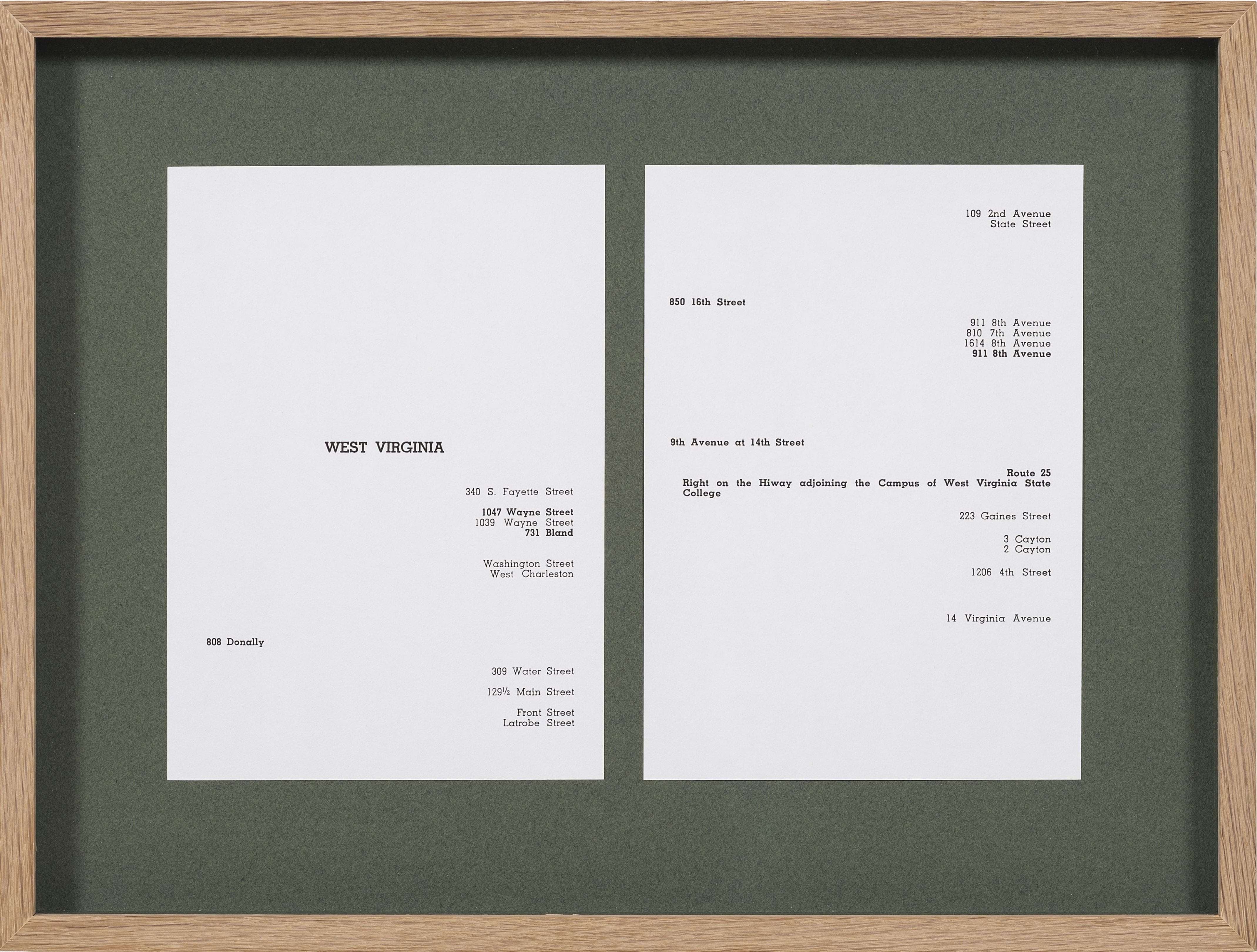
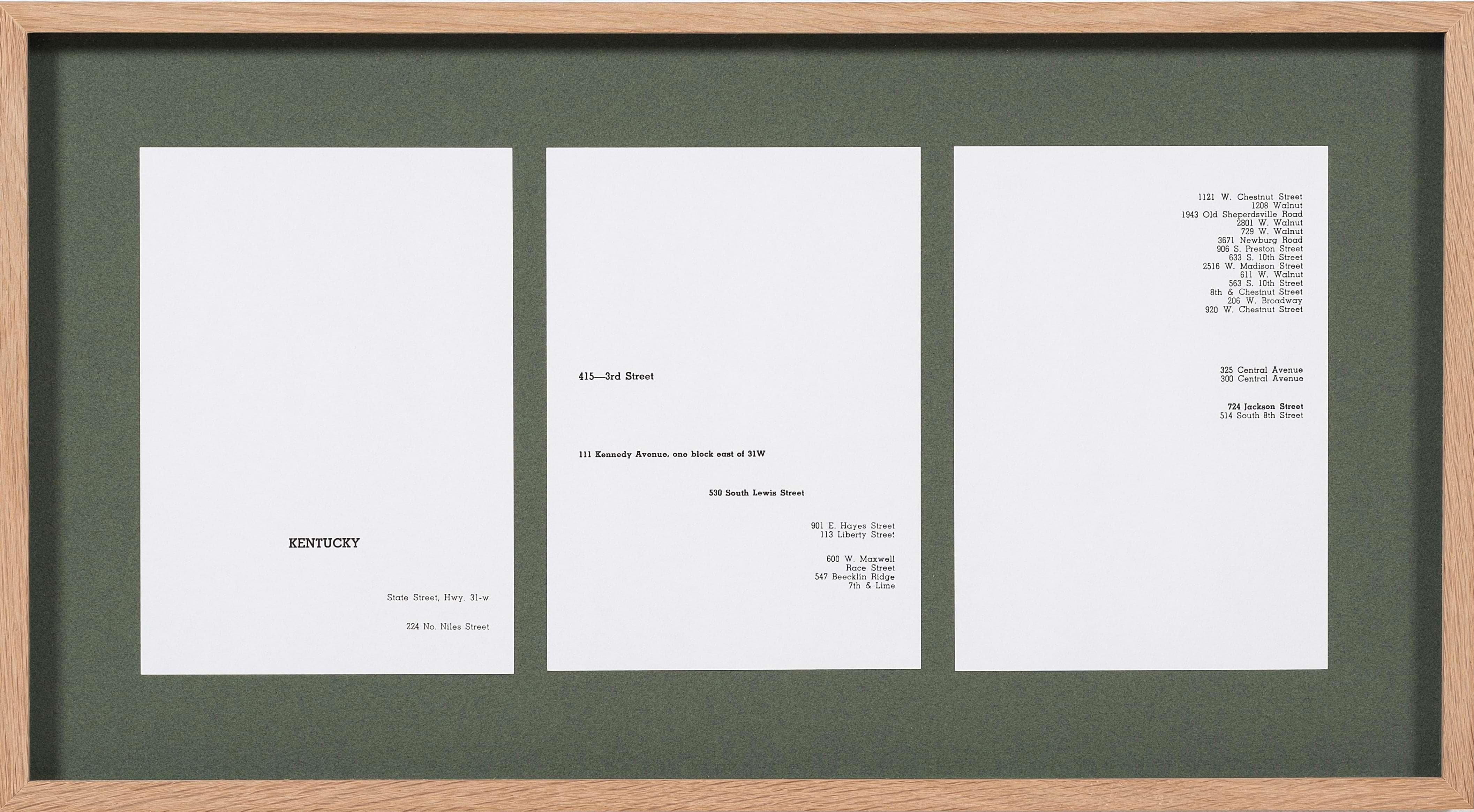
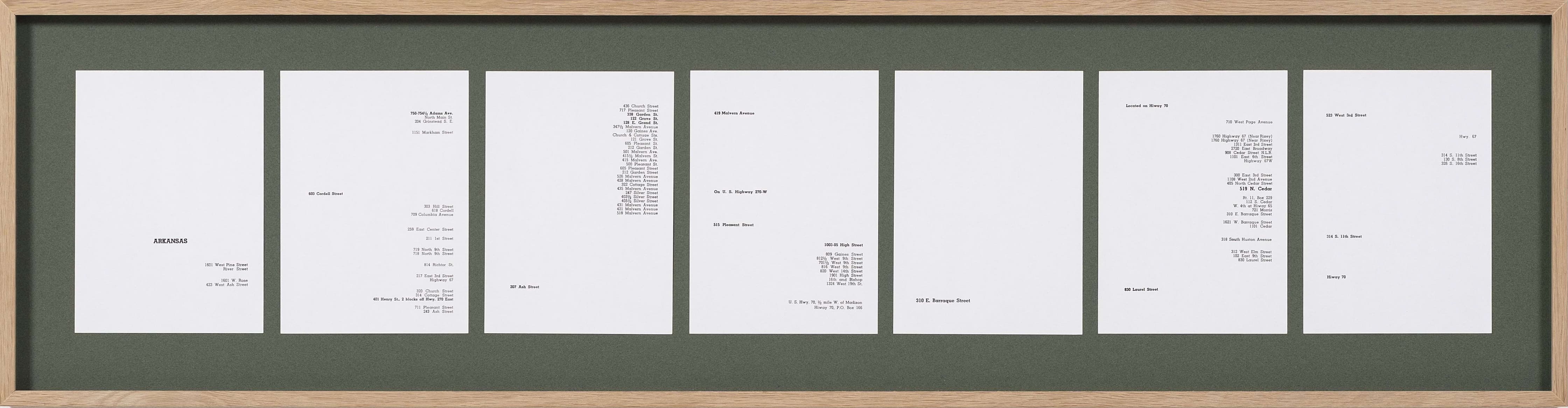
The Greenbook 1961 is a suite of 52 framed works. The source material comes from the 1961 issue of The Traveler’s Green Book; an annual state-by-state listing printed from 1936-1966. The publication served as a resource for African-American motorists travelling across the USA providing safe at which to stop whether they be lodgings, restaurants, or service stations. Kiwanga focuses on 1961,the year in which the Freedom Riders, a group of civil rights activists rode public interstate buses from Washington D.C. into the south to challenge the unconstitutional standard of keeping public buses segregated. Kiwanga erases information from archival scans with the exception of the state name and address. The resulting prints generate a minimal topography of a particular space and time.
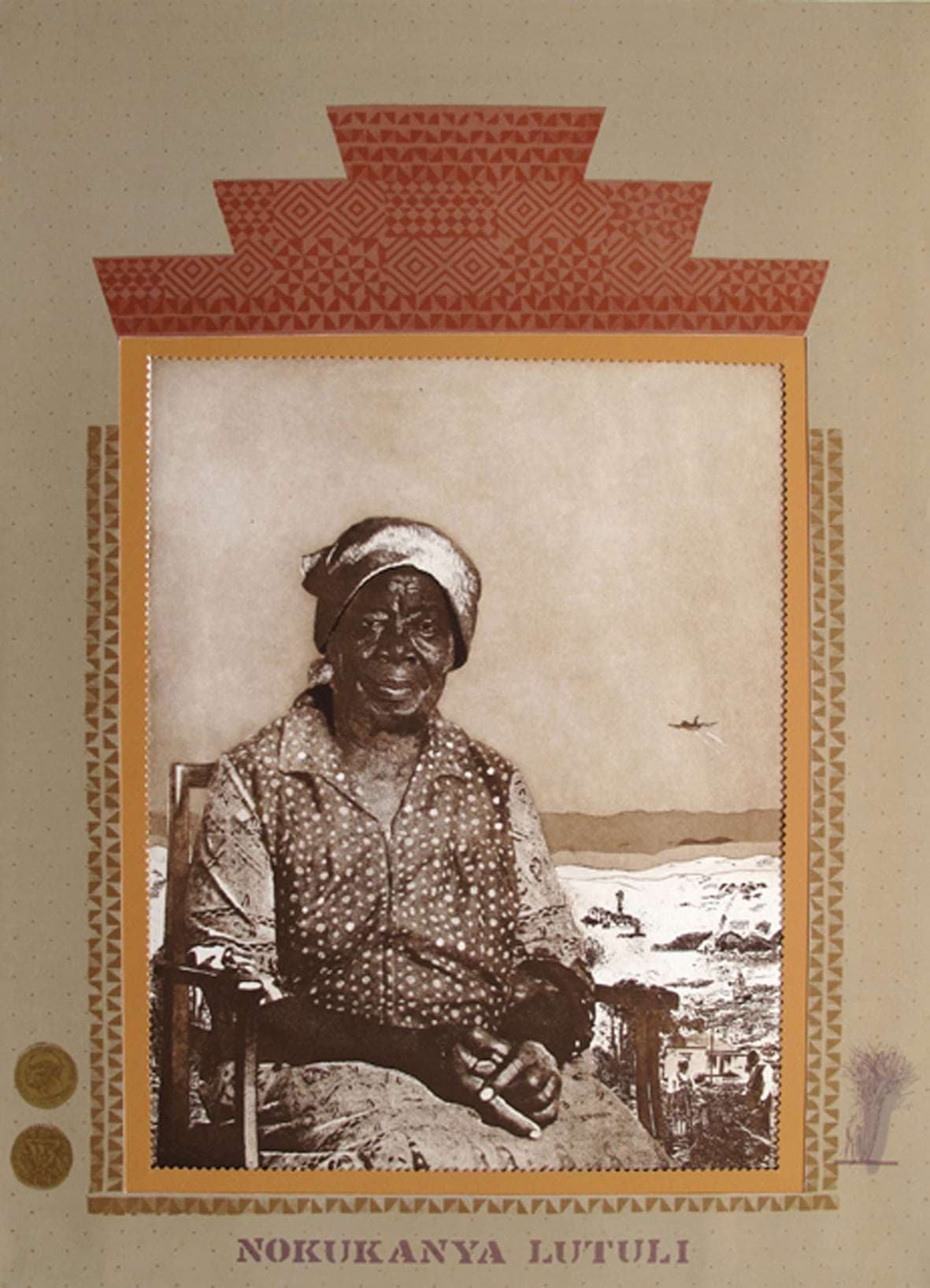
In 1982, Sue Williamson spent much of her time in Crossroads, an informal Cape Town community marked for destruction by the apartheid state. She was working with residents on strategies to oppose the demolitions. It was there that she first encountered the image of Elizabeth Paul – a Xhosa faith healer whose faded photo adorned the walls in many homes. This repetition marked Elizabeth as an important figure in the community, a person to be honoured and remembered.
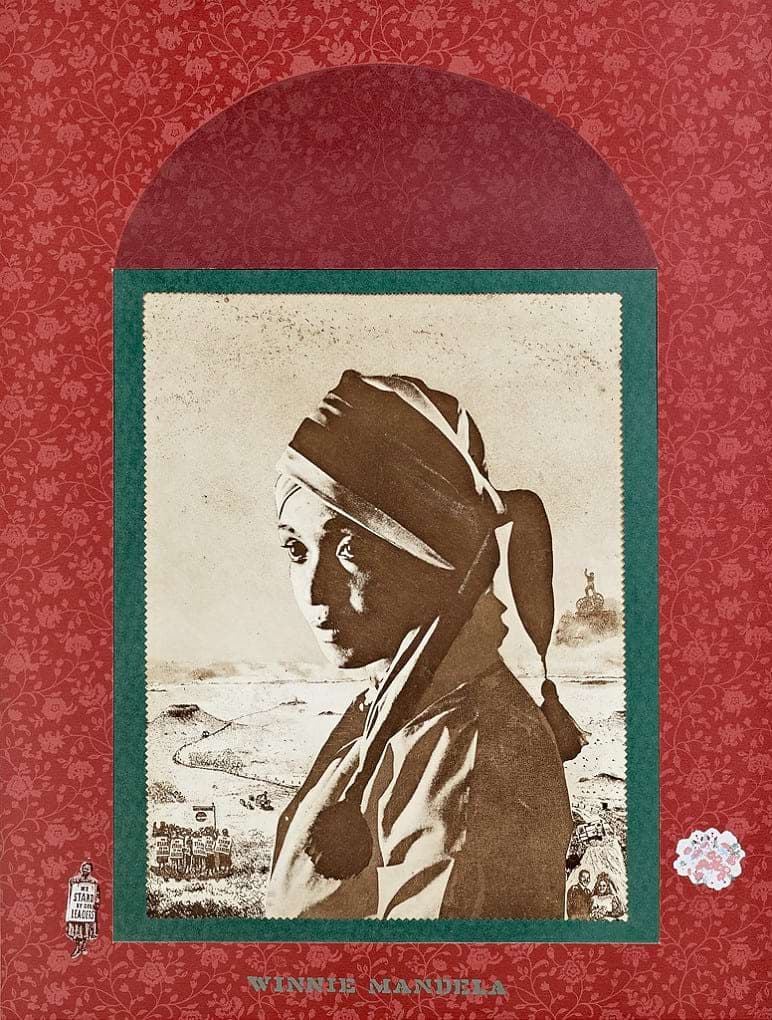
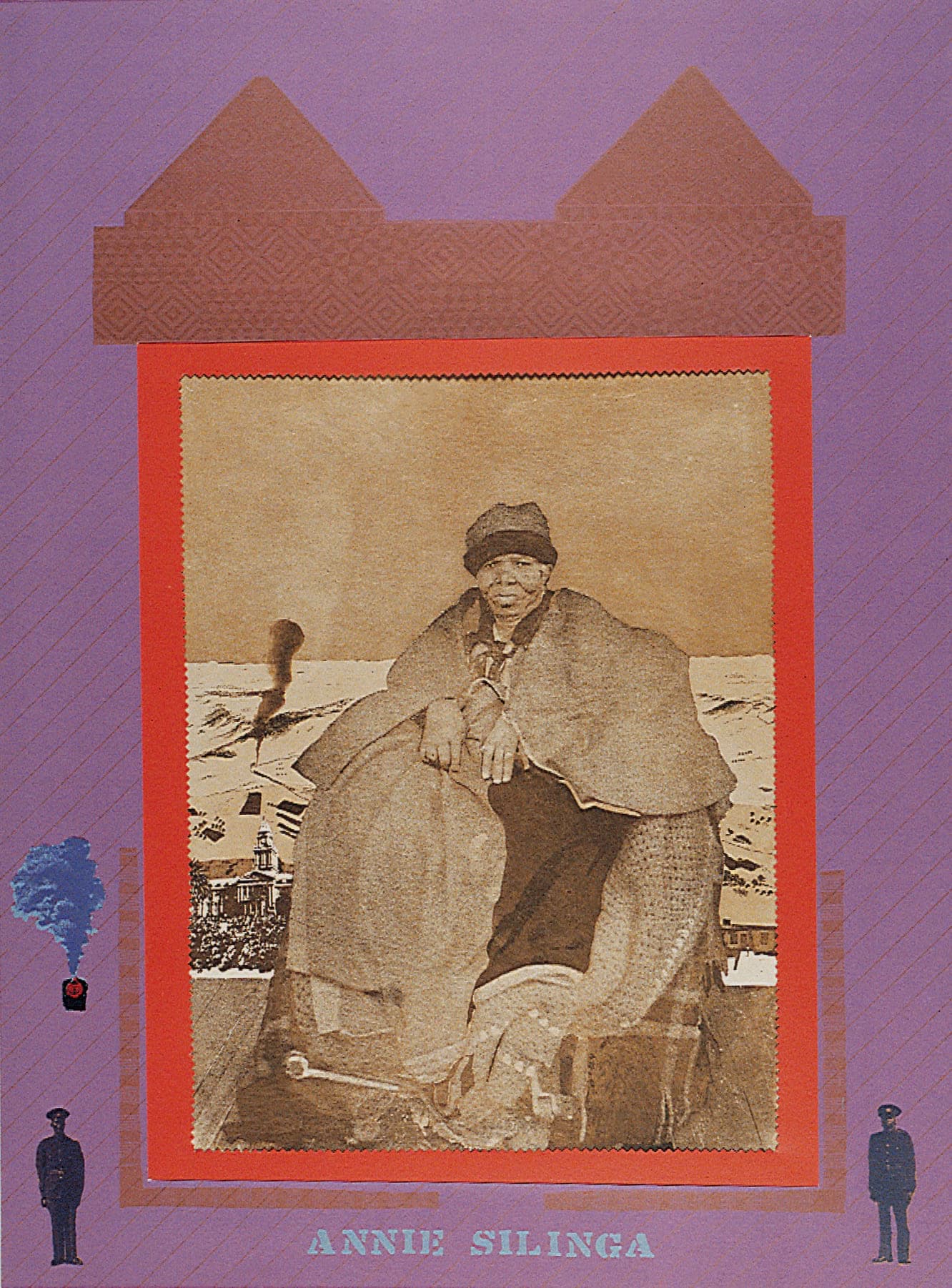
Williamson began a series of photo-etched portraits with screen-printed frames, with the first in the series, a portrait of Elizabeth Paul. Each was a tribute to a woman who inspired others through her leadership, often in the struggle for liberation: Helen Joseph, Winnie Mandela, Annie Silinga, Mamphela Ramphele. Their names are familiar today, but in the 1980s they were largely invisible. Williamson’s work sought to give them visibility, and to honour them.
Her influences were many. Renaissance portraiture offered structure; the inventive frames of Crossroads homes provided texture. But more than technique, it was the desire to make these women known that shaped the work. In mass- producing and distributing postcard versions of the portraits, Williamson made the series portable, ensuring that these stories could travel, unbound by gallery walls.
Tula, tula Winnie tula
Tula Winnie tula
Bamtatha bamtatha bambeka e Brandfort
Wamku Wakala wathi amandla
Winnie, keep quiet
They took you and put you in Brandfort And you shouted and cried out ‘Power!’
This song of tribute marks the deep feeling of the people for Nomzamo Winnie Mandela, wife of the great political leader, Nelson Mandela.
In over 20 years of marriage, the Mandelas have had only about two years together – when he was not in prison, Nelson Mandela was underground. Winnie herself has been free of all restrictions for only 11 months of the 19 years since her husband was imprisoned. A key person in many black organizations now banned, she has been repeatedly subject to detention, house arrest and imprisonment.
Since 1977 she had been banished to the small, dusty Afrikaner dorp of Brandfort in the Orange Free State, where she lived in house No. 802 in the treeless location outside the town. Perpetual harassment has extended even to the confiscation of a bedspread in the colours of the African National Congress, and a conviction on a charge of contravening her banning orders when called at a neighbour’s house regarding a chicken.
But nothing had been able to crush the indomitable Winnie Mandela, or prevent her from speaking out fearlessly when she has been able to.
She remained a powerful symbol of the African struggle.
- Sue Williamson 1983
In 1982, Sue Williamson spent much of her time in Crossroads, an informal Cape Town community marked for destruction by the apartheid state. She was working with residents on strategies to oppose the demolitions. It was there that she first encountered the image of Elizabeth Paul – a Xhosa faith healer whose faded photo adorned the walls in many homes. This repetition marked Elizabeth as an important figure in the community, a person to be honoured and remembered.
Williamson began a series of photo-etched portraits with screen-printed frames, with the first in the series, a portrait of Elizabeth Paul. Each was a tribute to a woman who inspired others through her leadership, often in the struggle for liberation: Helen Joseph, Winnie Mandela, Annie Silinga, Mamphela Ramphele. Their names are familiar today, but in the 1980s they were largely invisible. Williamson’s work sought to give them visibility, and to honour them.
Her influences were many. Renaissance portraiture offered structure; the inventive frames of Crossroads homes provided texture. But more than technique, it was the desire to make these women known that shaped the work. In mass- producing and distributing postcard versions of the portraits, Williamson made the series portable, ensuring that these stories could travel, unbound by gallery walls.
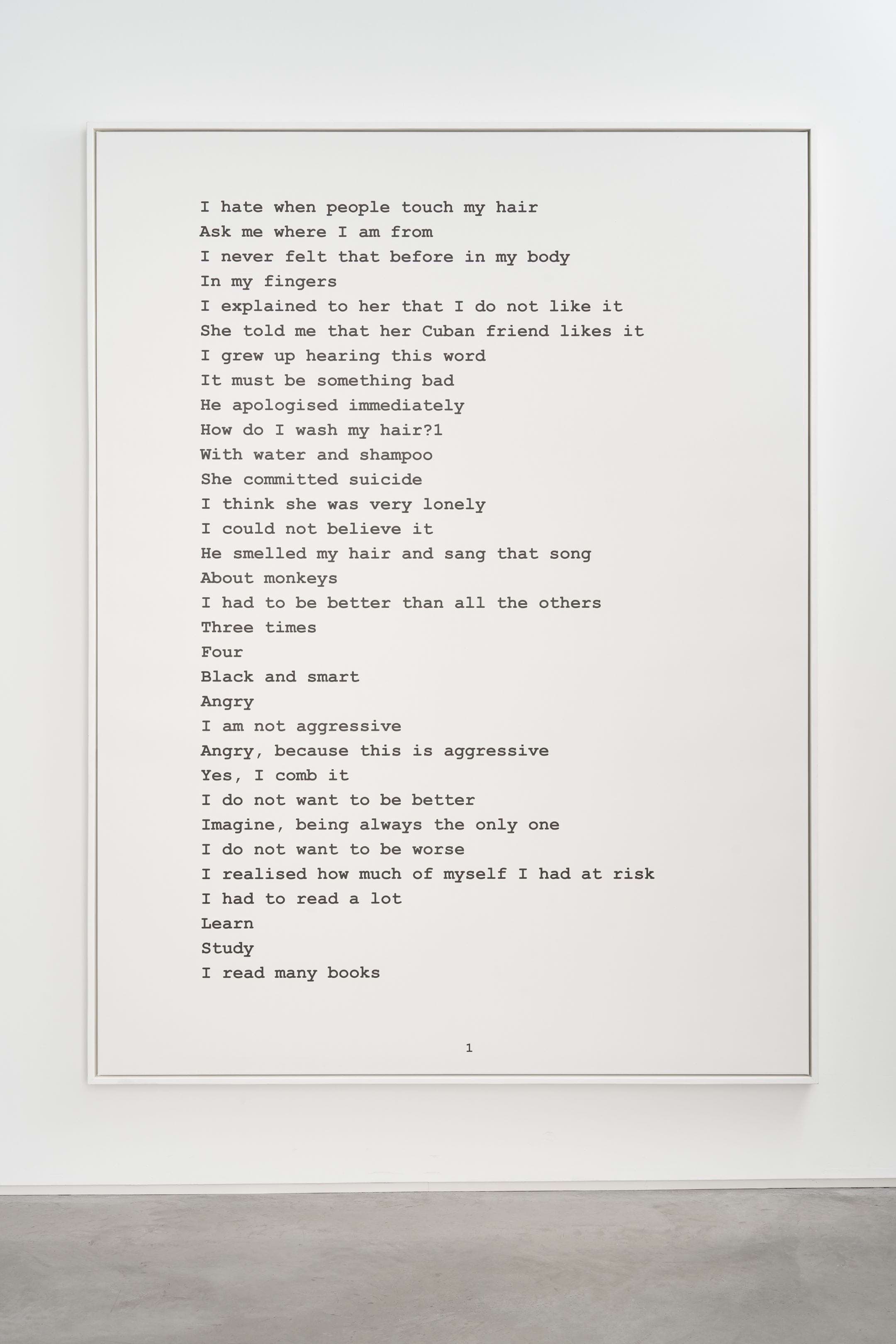
'The Chorus' (2017) is a wall installation based on the artist's previous literary work and her very unique practice of exploring the performative aspects of her texts. This piece is the result of an experimental work with actors from the African Diaspora, during rehearsals for a staged reading, in Berlin. Kilomba developed the repetition of the most emotional and evocative phrases for the actors, and composed the chorus.
Playing with the idea of a manifesto, the final poem is printed on a large wall, exposing the most subtle, but traumatic and violent forms of everyday racism.
“Her work underlines the perpetuation of colonialism. A proud and irreducible political and feminist interpellation, and it explodes in lucid writing.”- Visão Magazine
n 1982, Sue Williamson spent much of her time in Crossroads, an informal Cape Town community marked for destruction by the apartheid state. She was working with residents on strategies to oppose the demolitions. It was there that she first encountered the image of Elizabeth Paul – a Xhosa faith healer whose faded photo adorned the walls in many homes. This repetition marked Elizabeth as an important figure in the community, a person to be honoured and remembered.
Williamson began a series of photo-etched portraits with screen-printed frames, with the first in the series, a portrait of Elizabeth Paul. Each was a tribute to a woman who inspired others through her leadership, often in the struggle for liberation: Helen Joseph, Winnie Mandela, Annie Silinga, Mamphela Ramphele. Their names are familiar today, but in the 1980s they were largely invisible. Williamson’s work sought to give them visibility, and to honour them.
Her influences were many. Renaissance portraiture offered structure; the inventive frames of Crossroads homes provided texture. But more than technique, it was the desire to make these women known that shaped the work. In mass- producing and distributing postcard versions of the portraits, Williamson made the series portable, ensuring that these stories could travel, unbound by gallery walls.
“I will carry a pass the day the Prime Minister’s wife carries a pass.” Annie Silinga told the huge crowd gathered outside the Cape Town City Hall during the Defiance Campaign in 1952. And to this day, neither of them do.
For her steadfast refusal to submit to the indignity of the hated pass, Annie was arrested many times and sent away from her family back to the Transkei. “My children are orphans whose mother still lives and my husband is a widower though his wife is alive,” she declared, before returning to Cape Town once more to take her place in her family home and wait to be arrested again.
“Mayibuye iAfrika” – Africa must come back – she cried good humouredly as white policemen came to arrest her for sitting on a Whites Only railway station bench. She was fearless in her fight for justice, and today, old and bedridden in her house in Jungle Walk, Langa, she has not changed. Although officials have urged her to take a pass so she may qualify for a pension, she laughs them away. “After all these years? No thank you.”
A founder member of the South African Federation of Women, one of the 20 000 who marched to Pretoria on August 9, 1956 to protest the carrying of passes by women, and one of those who was to spend over a year in court as an accused in the Treason Trial, Annie’s cheerfulness, clarity of vision and refusal to submit to oppression have always directed her life. She remains a source of strength and inspiration to women everywhere.
“Annie Silinga aknal’o ipasi Akalifundi, akanatyala”
Annie Silinga hasn’t got a pass And she doesn’t need it.
She’s not guilty.
Note:
Annie Silinga died in her home at Langa in 1984. The love felt for her by the community was attested to by the enormous crowd at her funeral.
The Greenbook 1961 is a suite of 52 framed works. The source material comes from the 1961 issue of The Traveler’s Green Book; an annual state-by-state listing printed from 1936-1966. The publication served as a resource for African-American motorists travelling across the USA providing safe at which to stop whether they be lodgings, restaurants, or service stations. Kiwanga focuses on 1961,the year in which the Freedom Riders, a group of civil rights activists rode public interstate buses from Washington D.C. into the south to challenge the unconstitutional standard of keeping public buses segregated. Kiwanga erases information from archival scans with the exception of the state name and address. The resulting prints generate a minimal topography of a particular space and time.
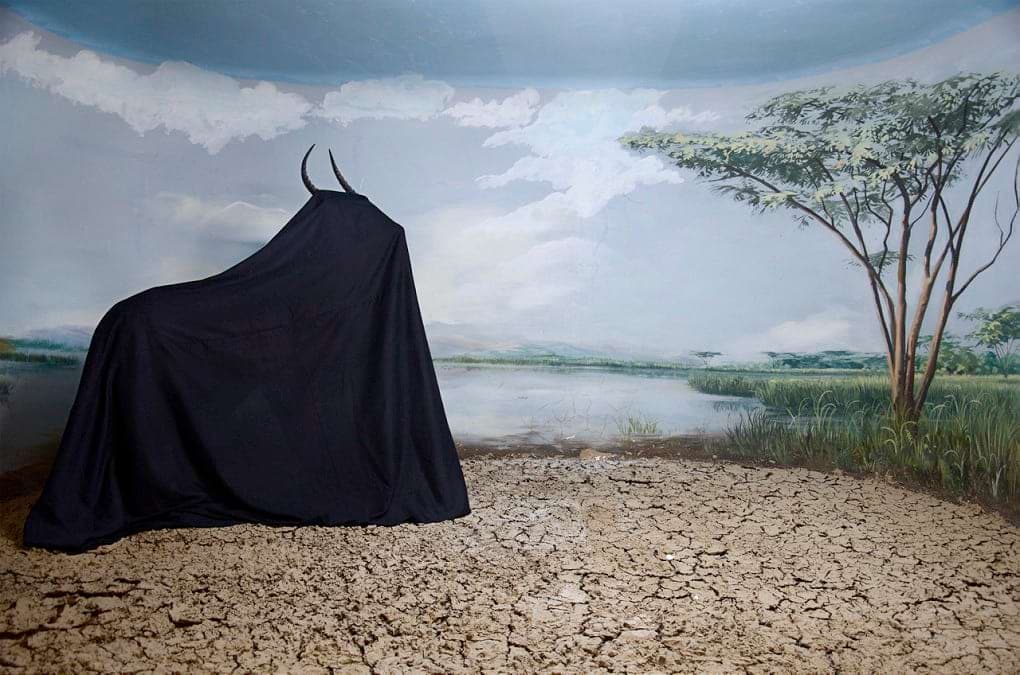
As a series, In the Days of a Dark Safari combines historical research with artistic photography to reflect the ideals projected onto the image of a stuffed giant sable antelope (Palanca). In this series, the artist attempts to unveil a fictitious element of ‘official history’, showing that there are two sides to every narrative, but he is particularly critical of the position of the colonialist who ‘collects information in the forest and lays it out in museum display cases’. For Kia Henda, ‘the effort to create a Museum of Natural History is a process similar to the creation of hostile narratives from the perspective of the foreigner who colonises by maintaining distance, consigning an entire continent to a Place of Darkness.’
In so doing, Kia Henda turns his focus towards the dual ideas of colonialism and African dictatorships and how these converge on projections of Africa as ‘dark continent’ and ‘paradise lost’ respectively. Depicting various museological taxidermy animal dioramas, covered in black shrouds which might seem equal parts absurdist and apocalyptic, serves to draw attention to the staged theatricality of the dioramas. They are visual riffs on the colonial idea of darkness as per Joseph Conrad: an othering agent which allows separation, distance and a sense of moral justification for all manner of imposed douchebaggery. Overlaying these complex narratives in an effortlessly accessible and enjoyably absurd presentation, Kia Henda's series turns an incisive critical eye to the volatile muddles of the present with an optimistic glimpse towards a brighter decolonised future.