Mikhael SubotzkyA Johannesburg Landscape (or Thirteen Tons Settled to Brick)
Twenty years after his first exhibition with Goodman Gallery, Mikhael Subotzky returns with A Johannesburg Landscape, a layered portrait of the city assembled from new and reconfigured images that find form in paintings, photographs and Sticky-tape Transfers. Johannesburg – fragmented, contradictory, continually reinventing itself – is both the exhibition’s subject and its structure: a complex set of interlocking typologies that Subotzky dismantles and reconstructs.
In 2005, when Subotzky – a recent fine art graduate – was introduced to Goodman founder Linda Givon, she insisted on taking his photographic works to Art Basel that year, where everything sold. A year later, Die Vier Hoeke and Umjiegwana, his unflinching study of South Africa’s prison system, was presented at Goodman Gallery in Johannesburg alongside a satellite exhibition at the Women’s Jail on Constitution Hill. This marked the beginning of a global career that has seen his work enter the collections of, among many others, the Museum of Modern Art, Metropolitan Museum and Guggenheim in New York, the Tate and V&A Museums in London and Centre Pompidou in Paris. Following Liza Essers’ acquisition of the gallery in 2008, artist and gallery matured alongside one another. Throughout these two decades Subotzky’s practice has remained defined by a sustained enquiry into what images do rather than simply what they depict – into time and its effects, and the ever-present possibility of revision.

Featured Artworks
Create a Goodman Gallery account to view our full selection of available works, access pricing and check out online.
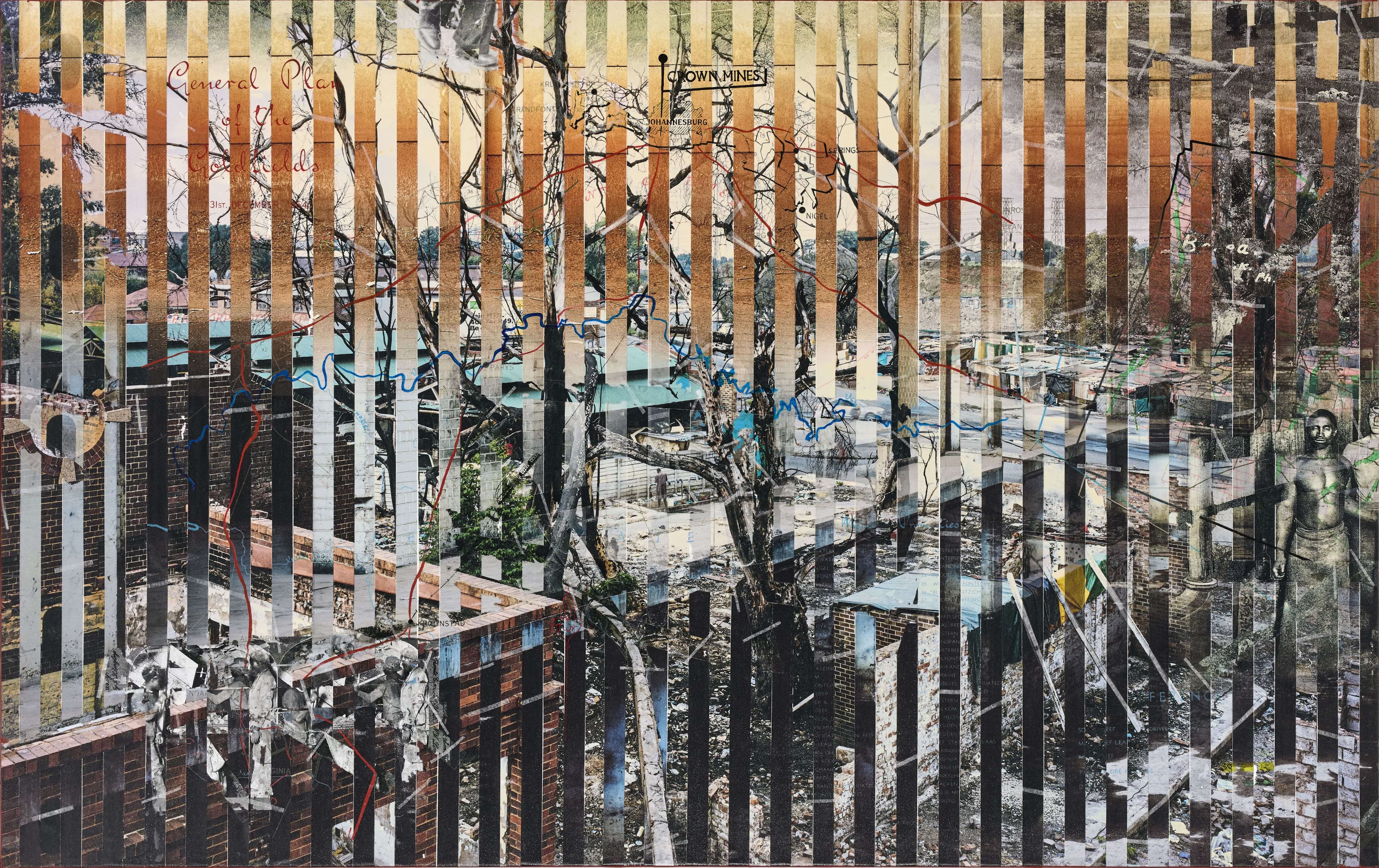
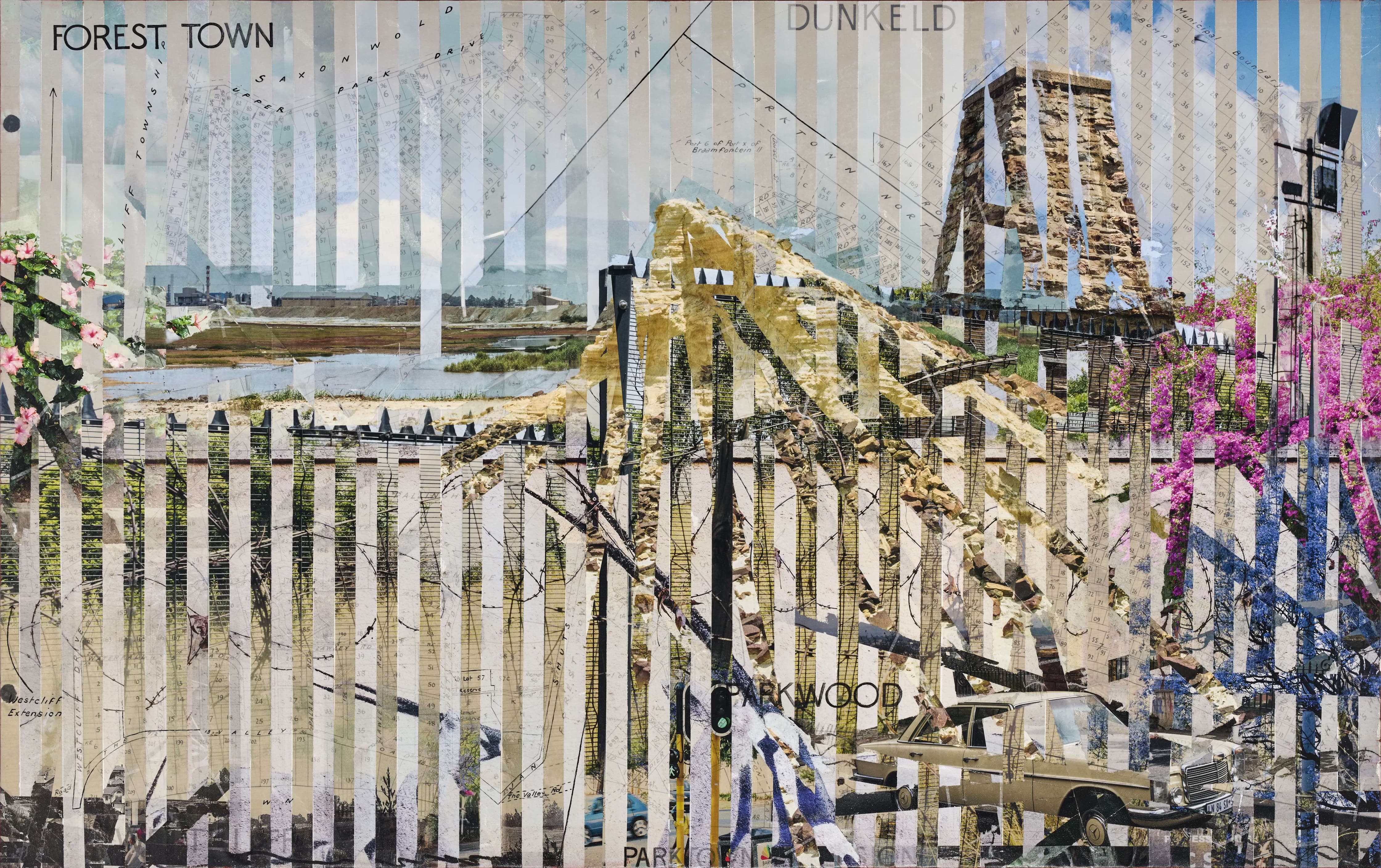
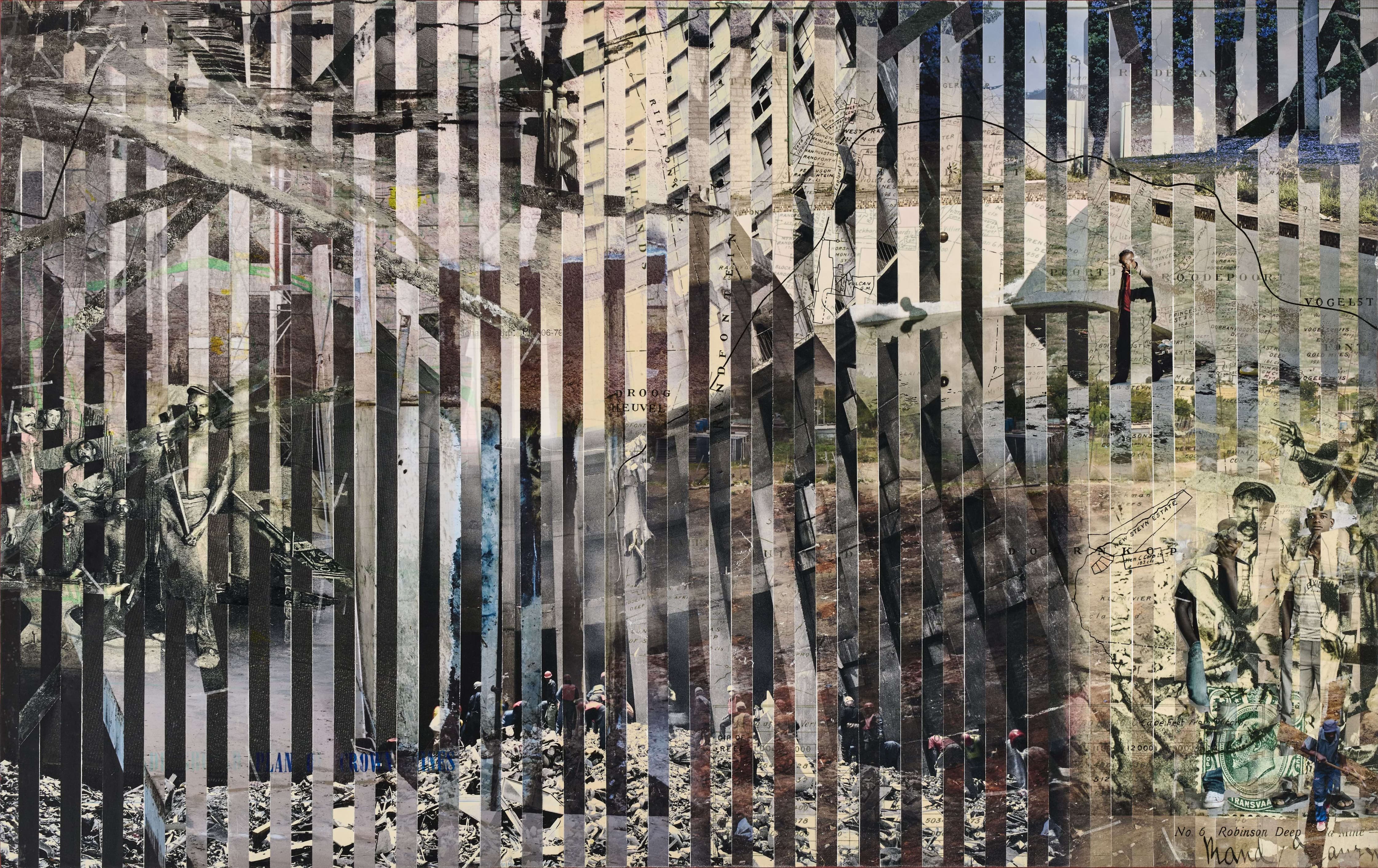
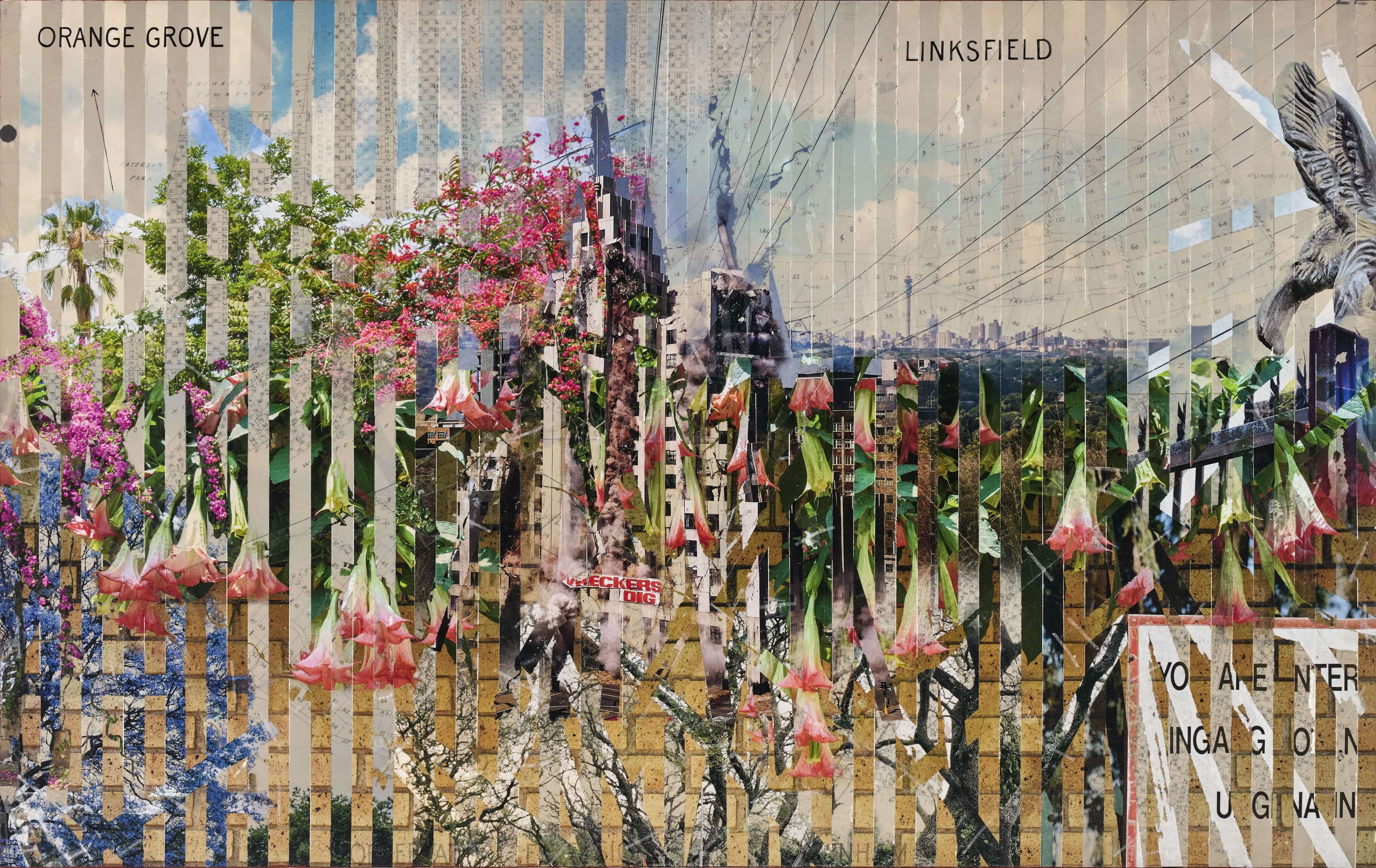
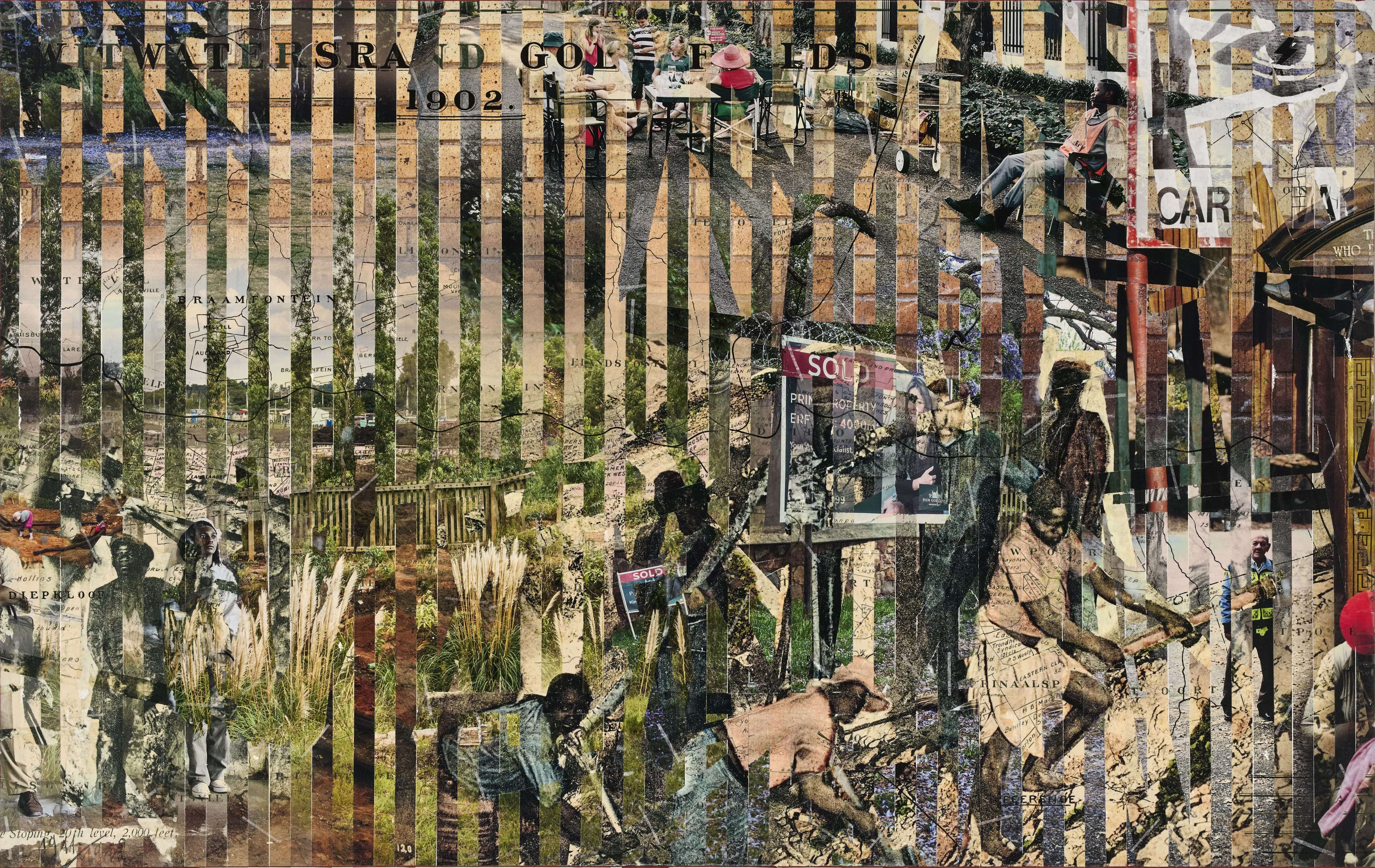
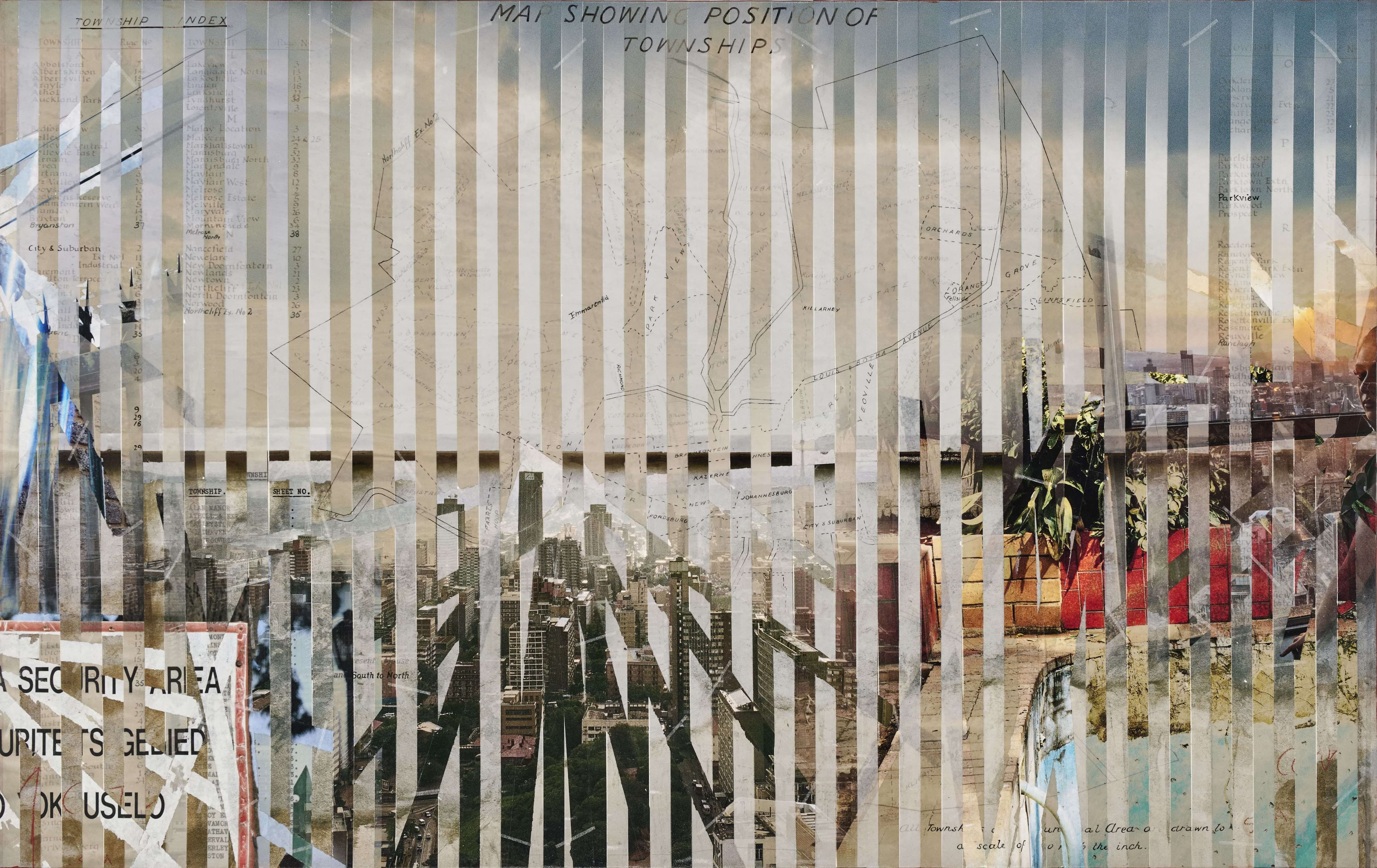
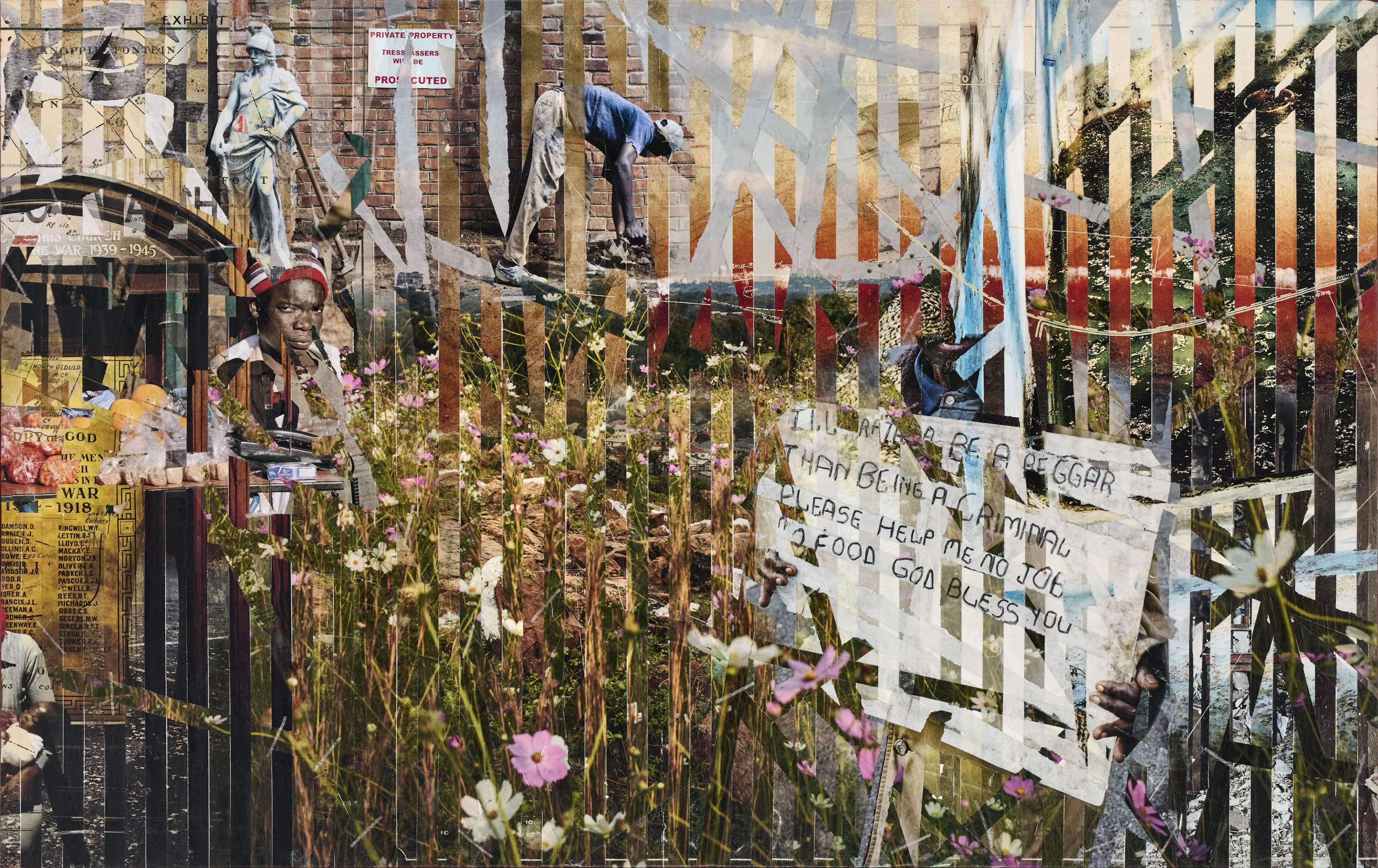
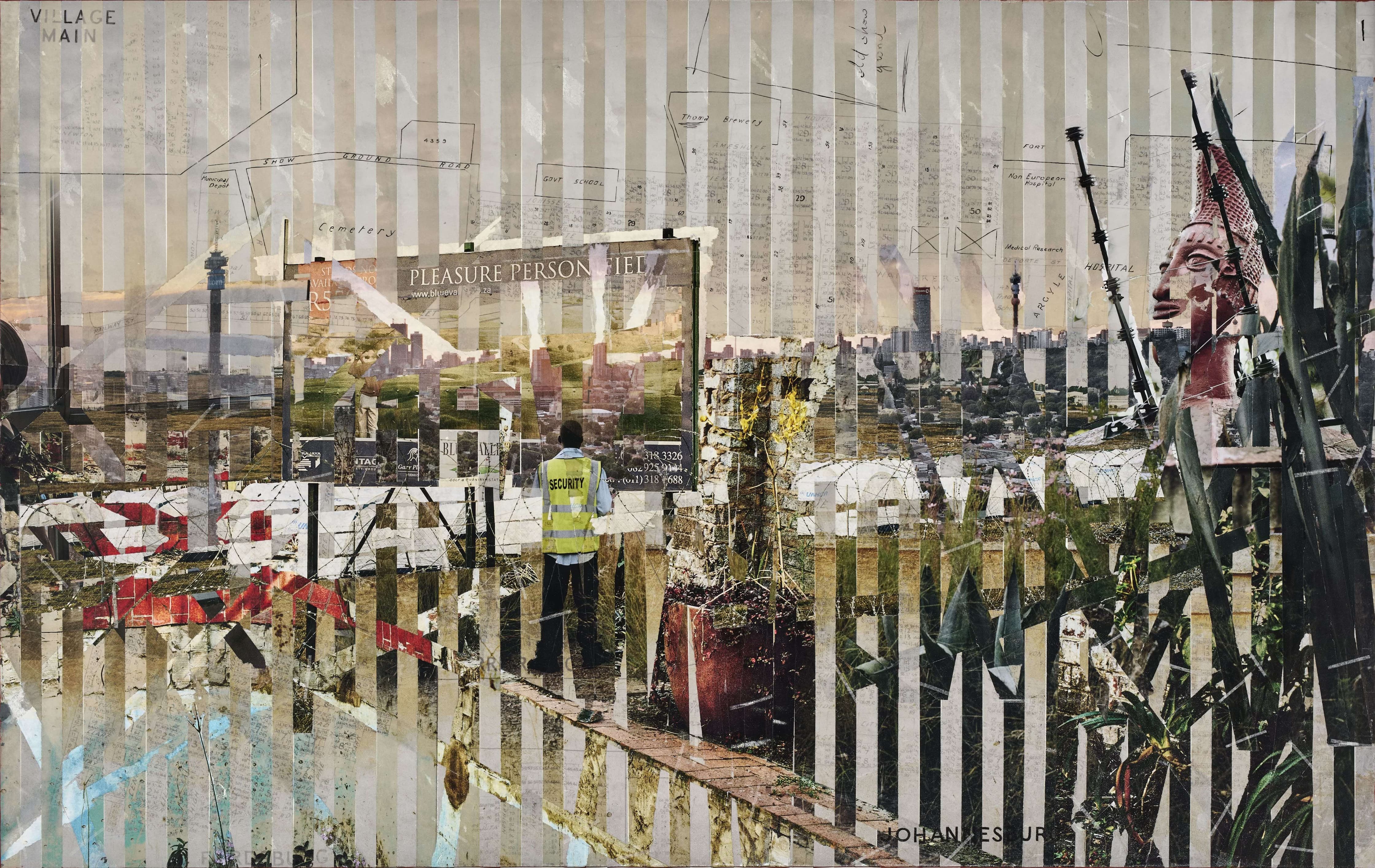

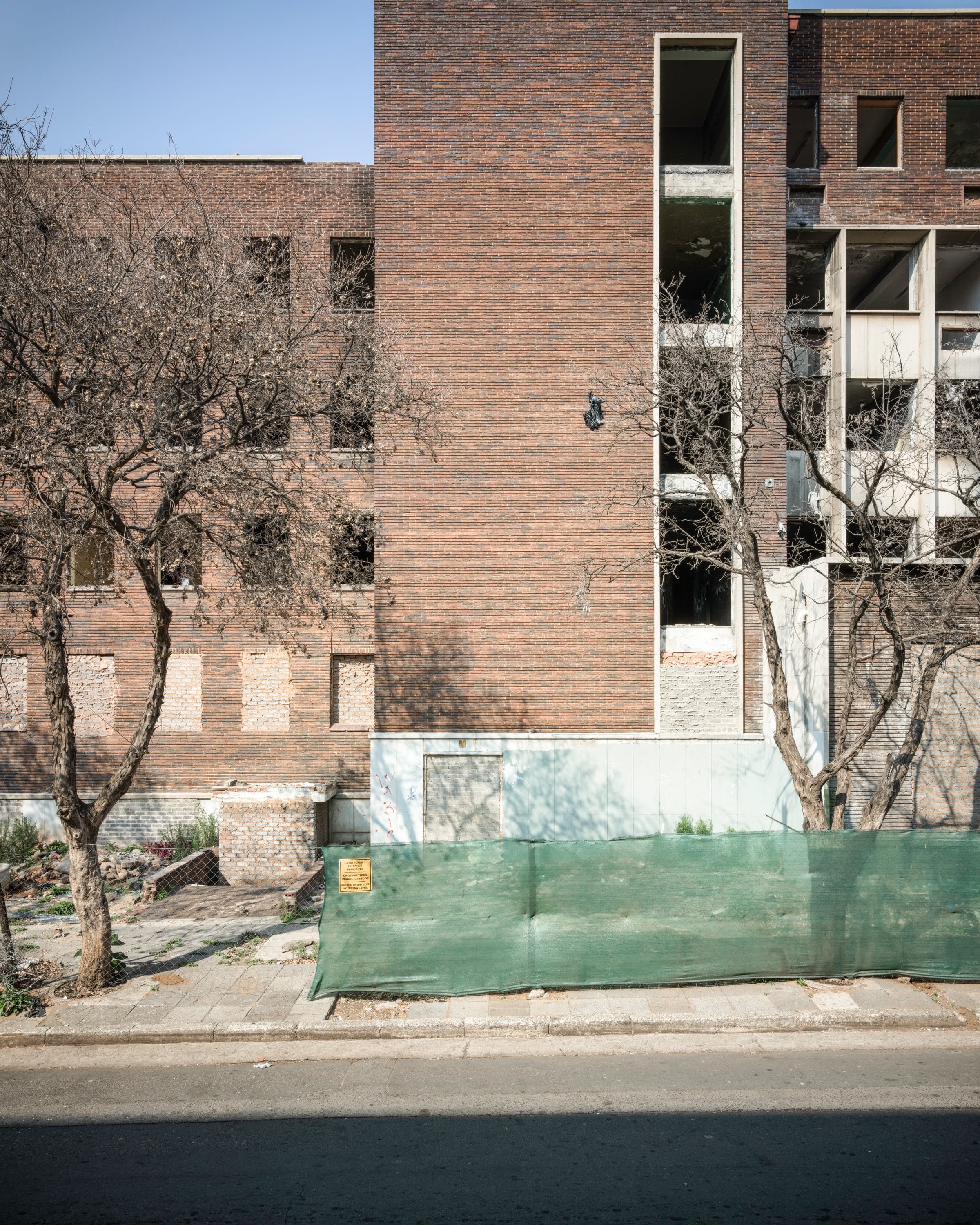
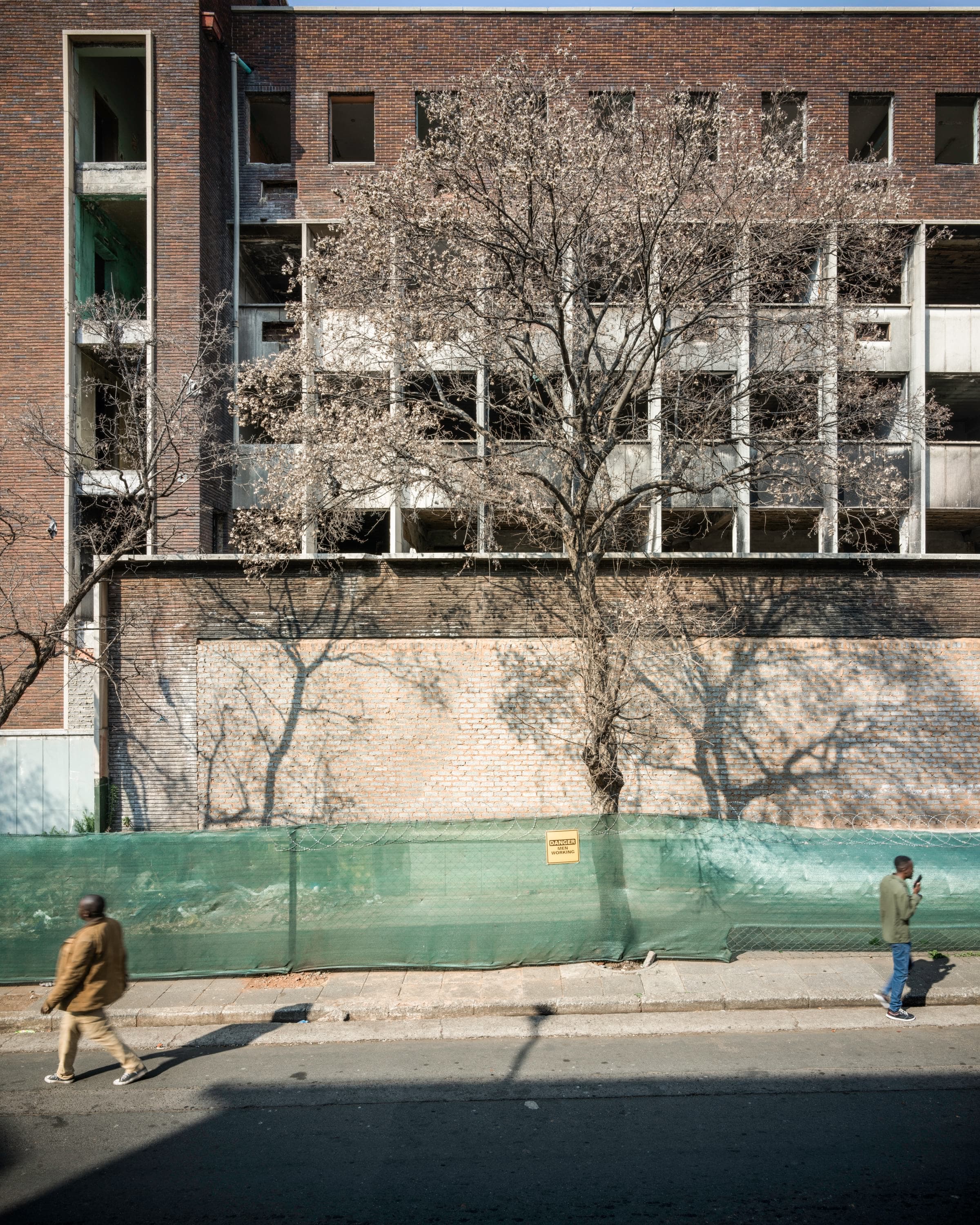
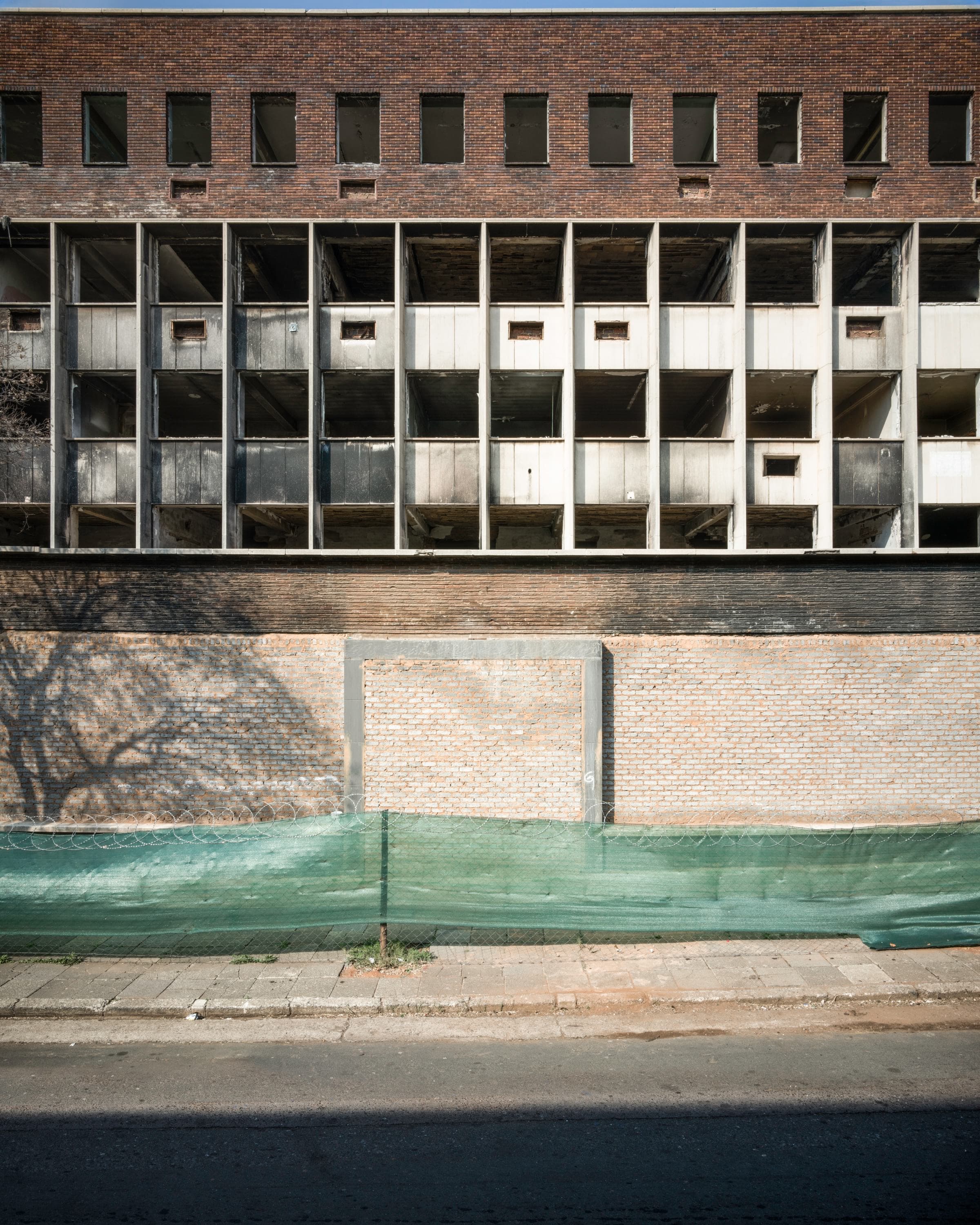
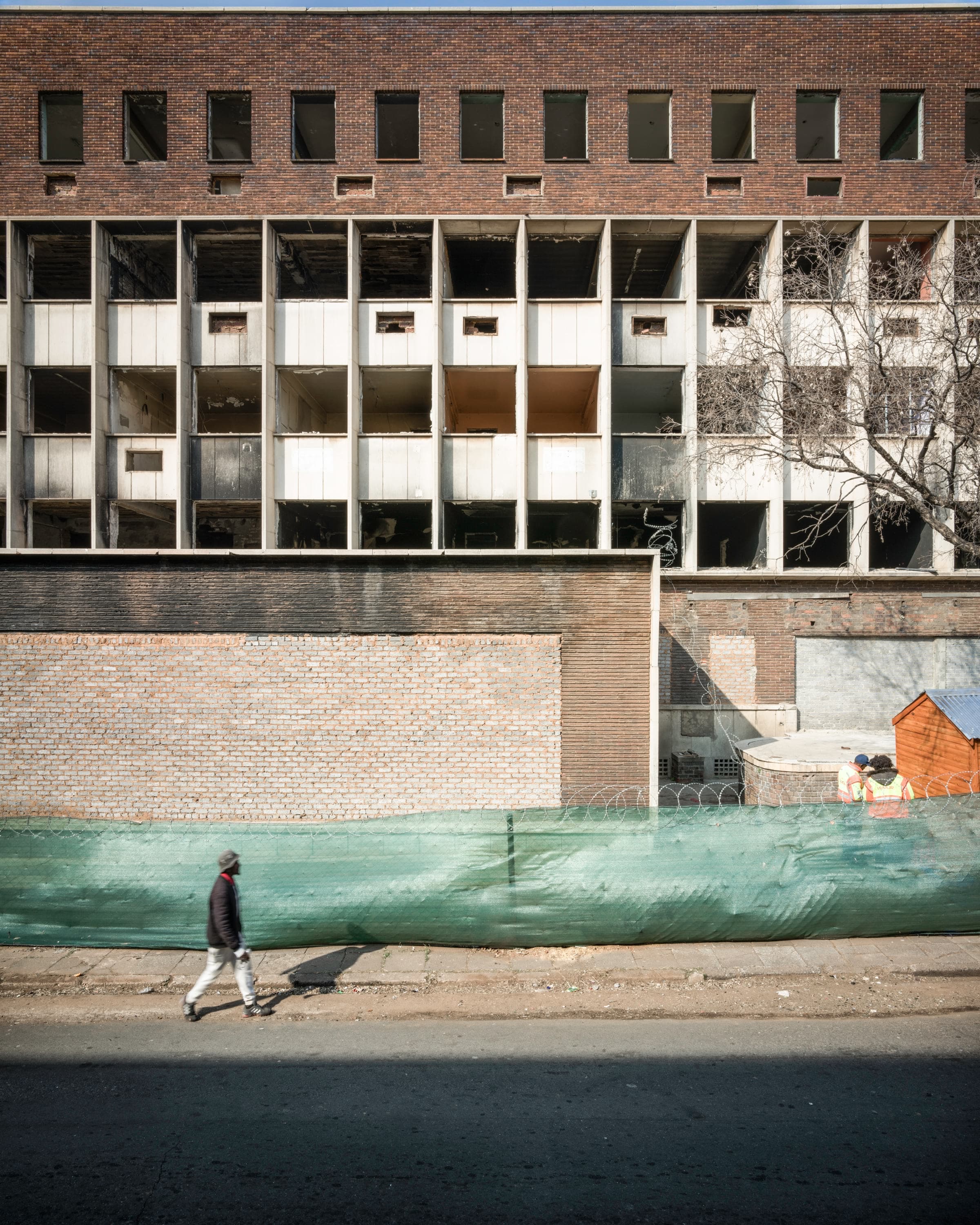
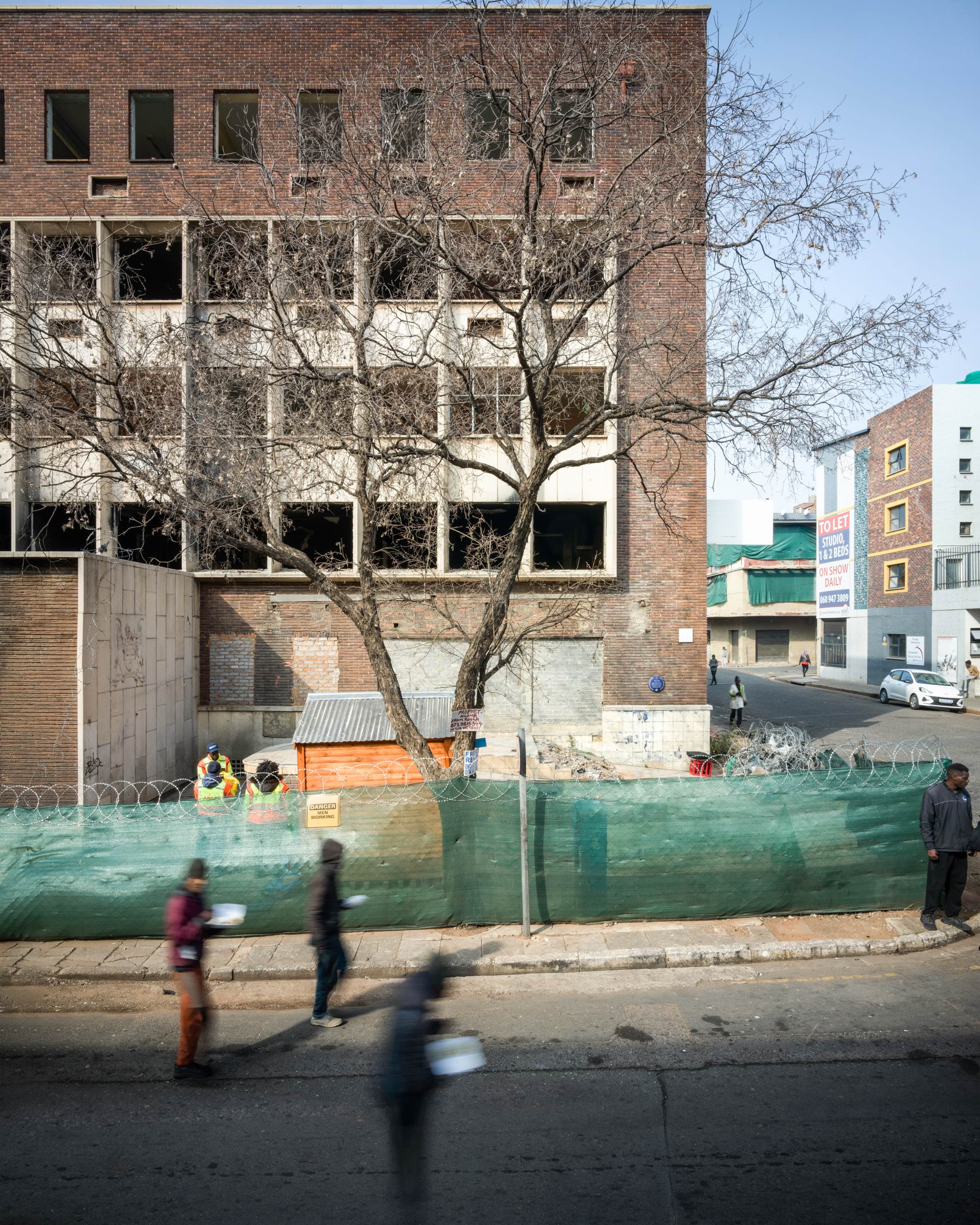
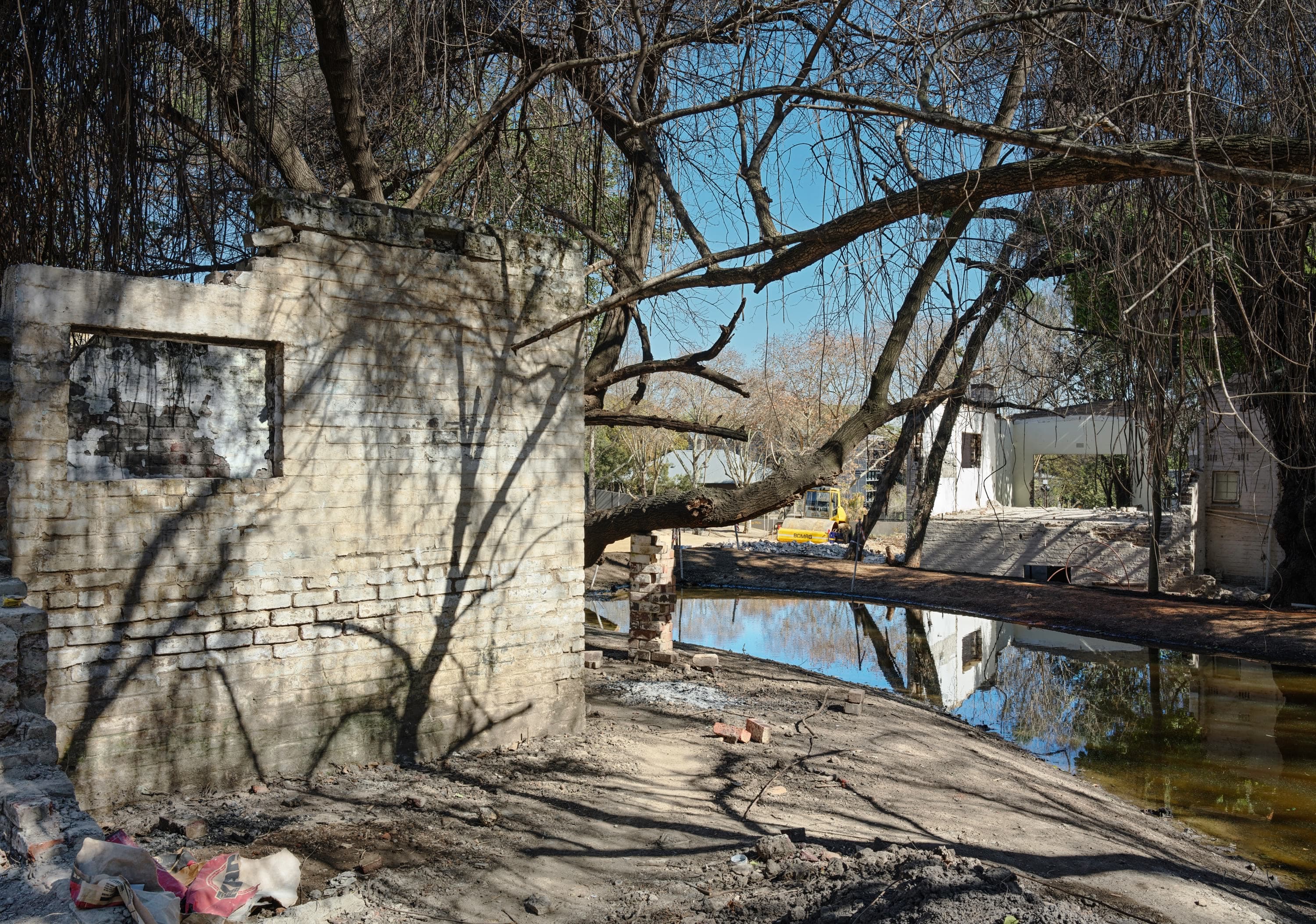
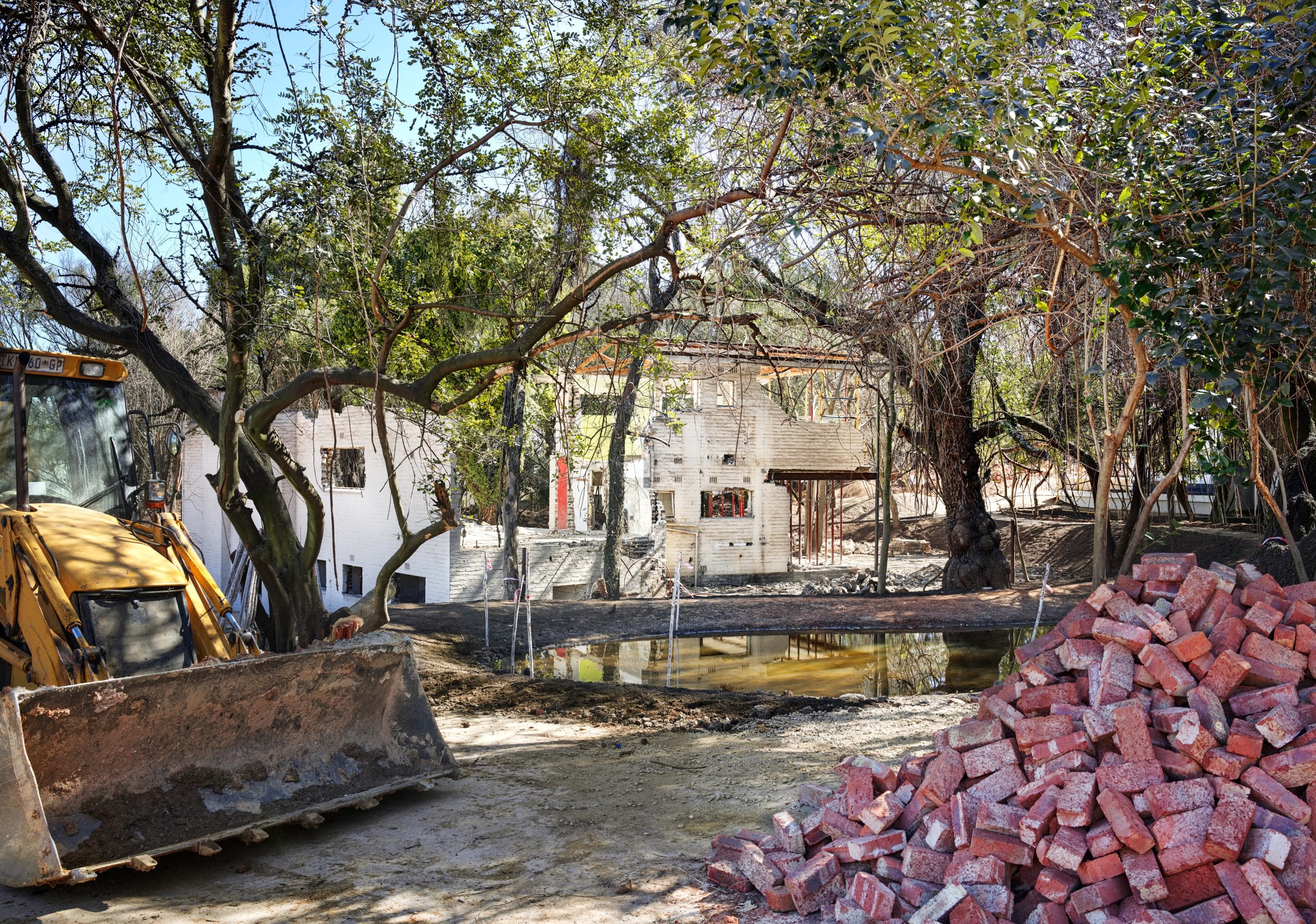
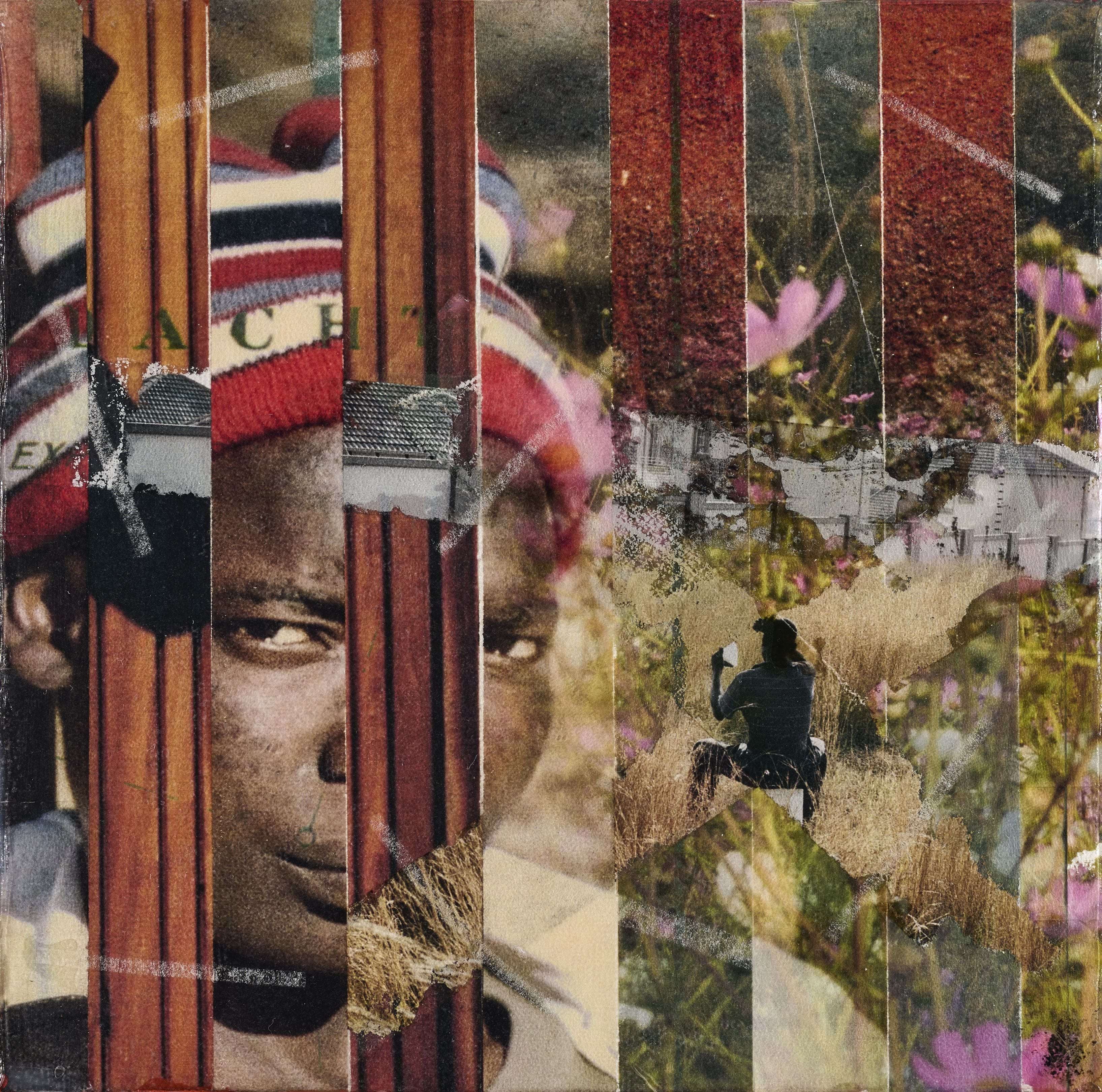
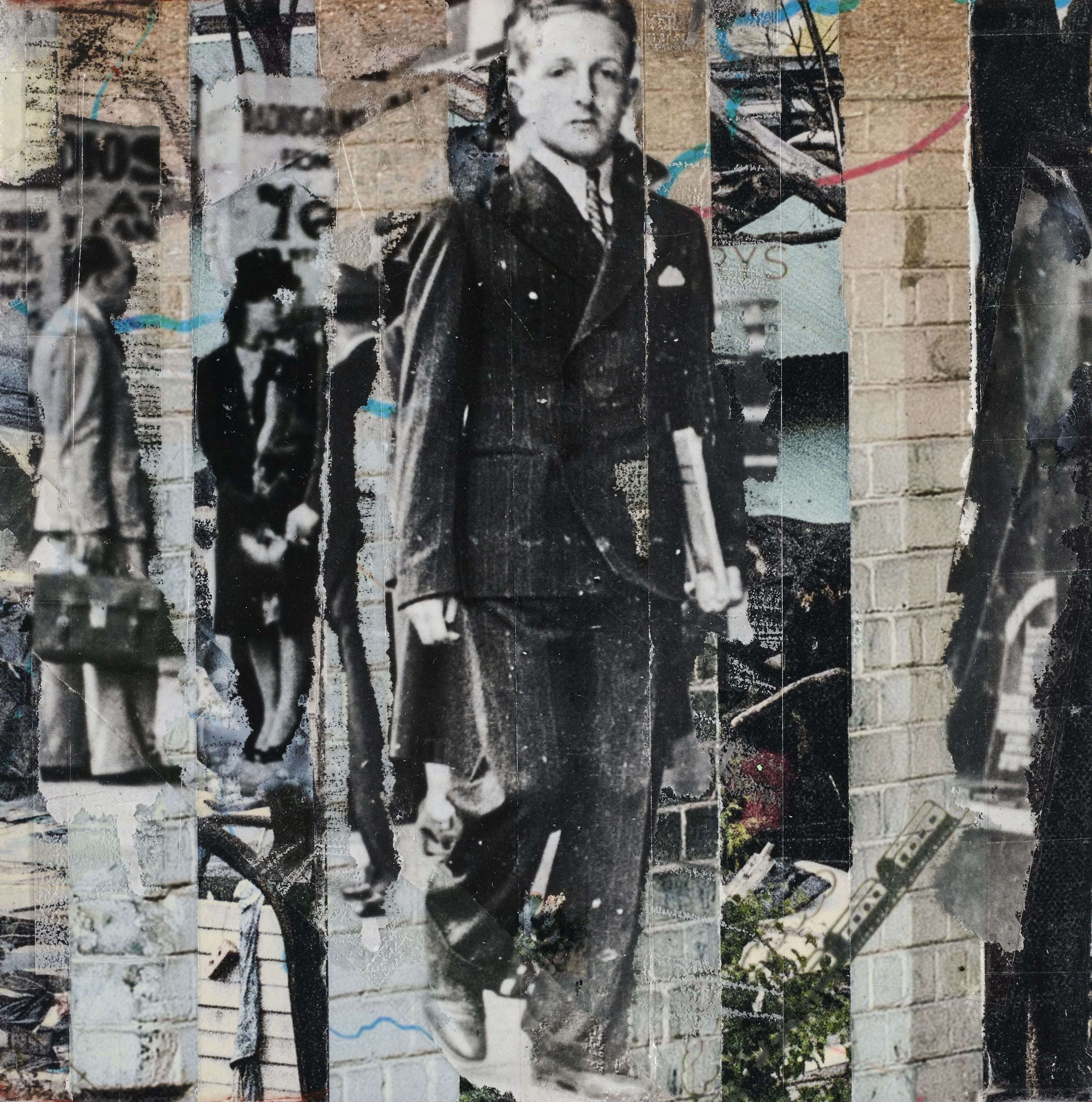
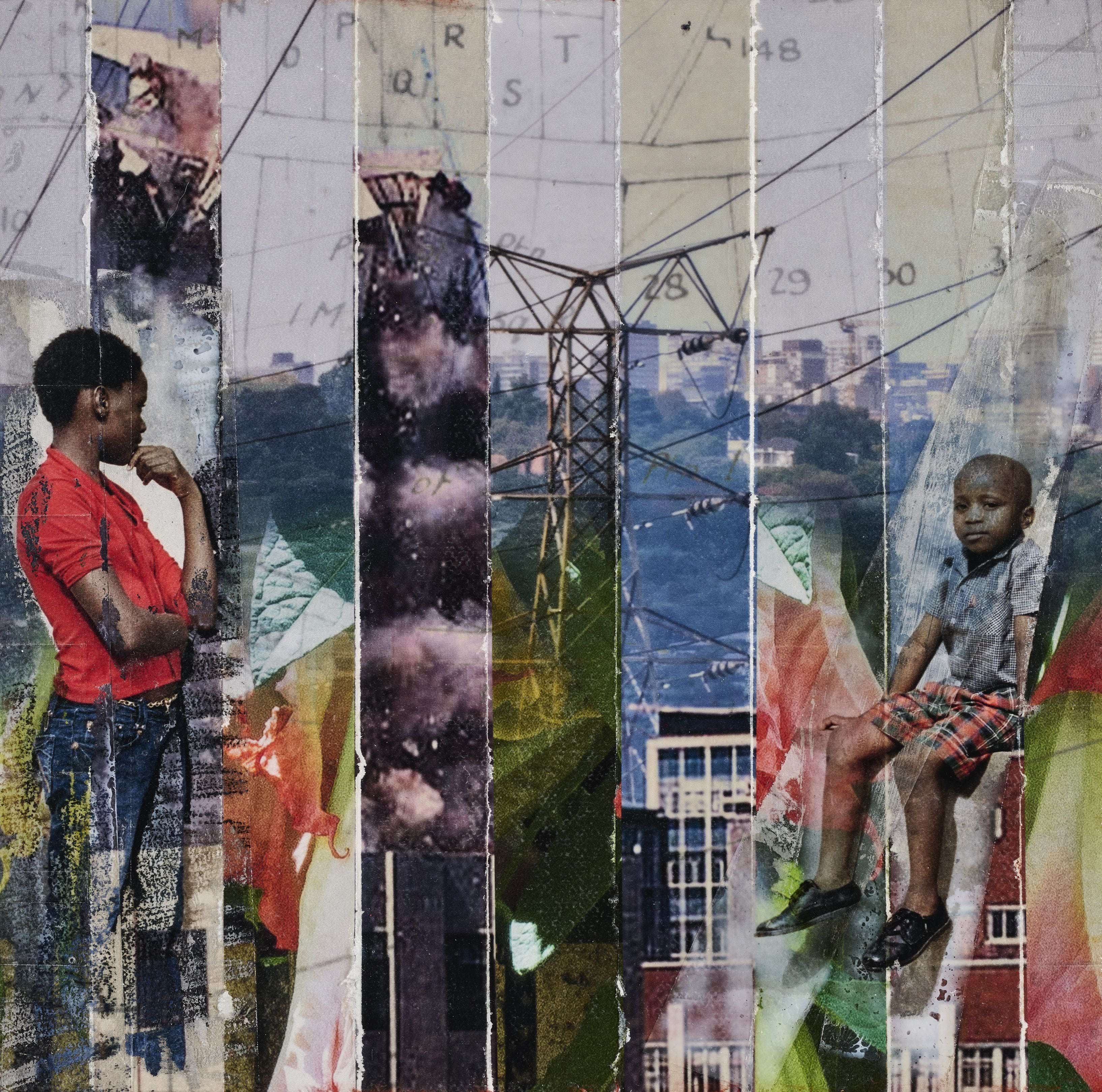
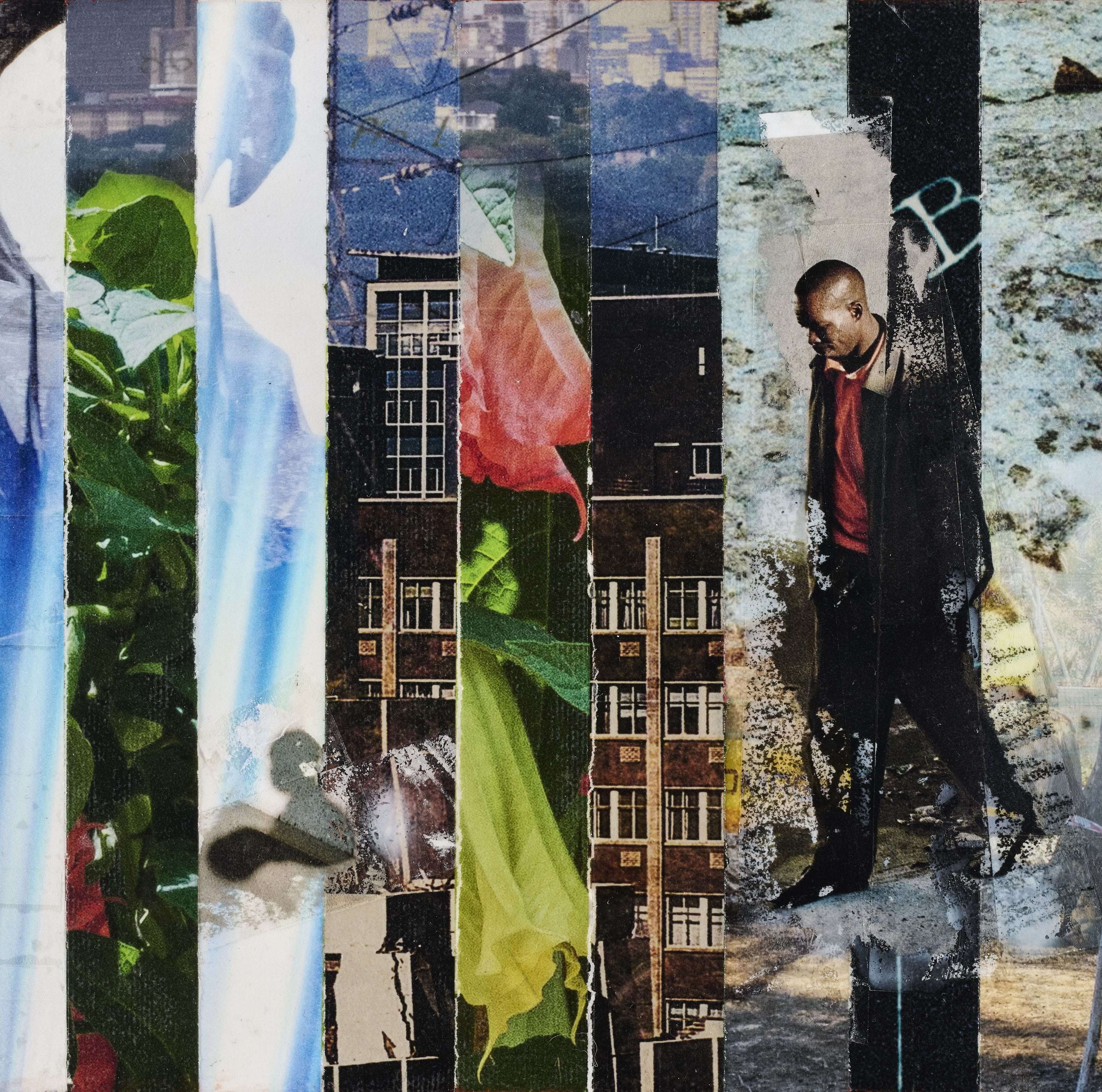
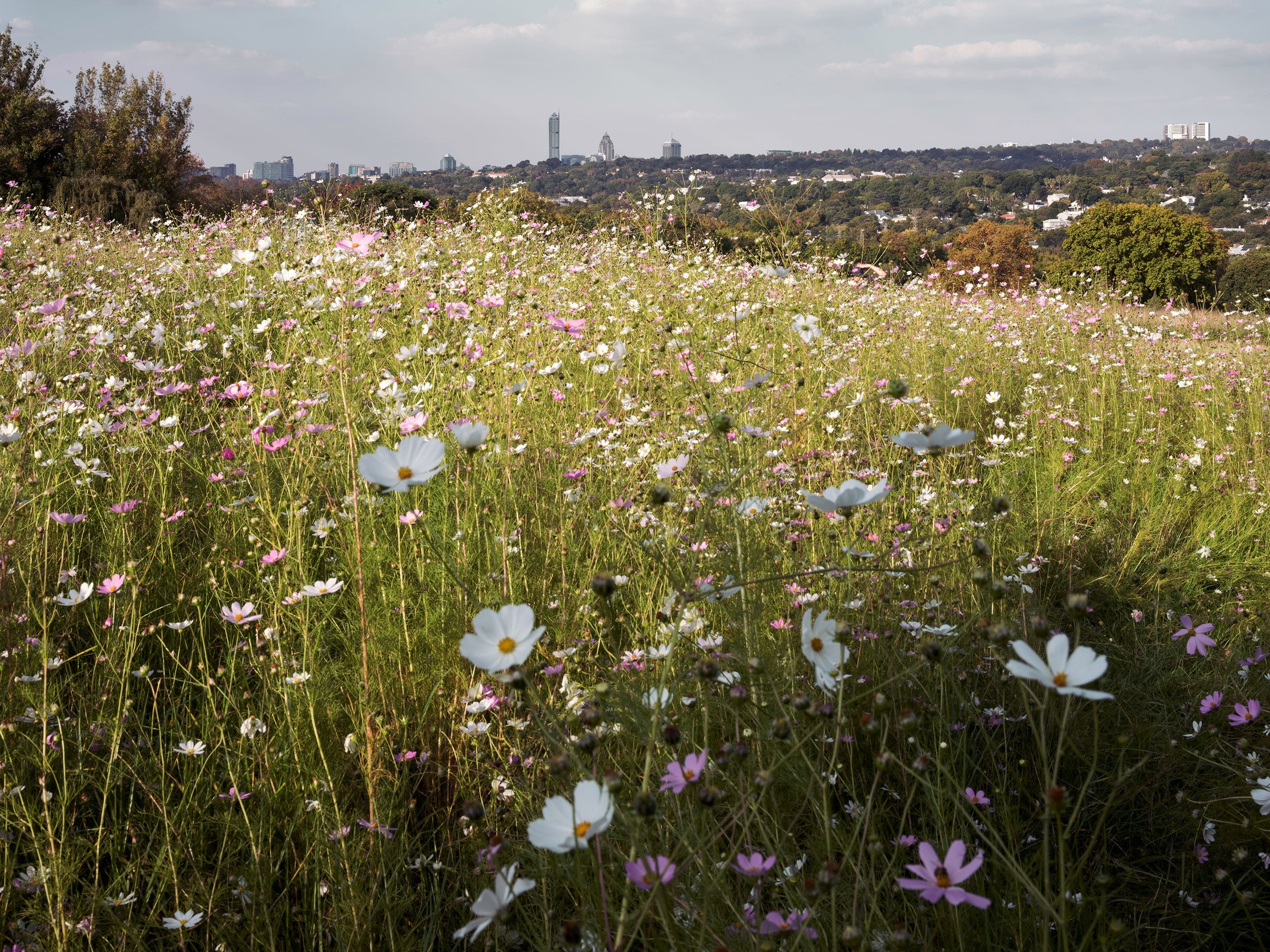
Mikhael Subotzky returns with 'A Johannesburg Landscape'
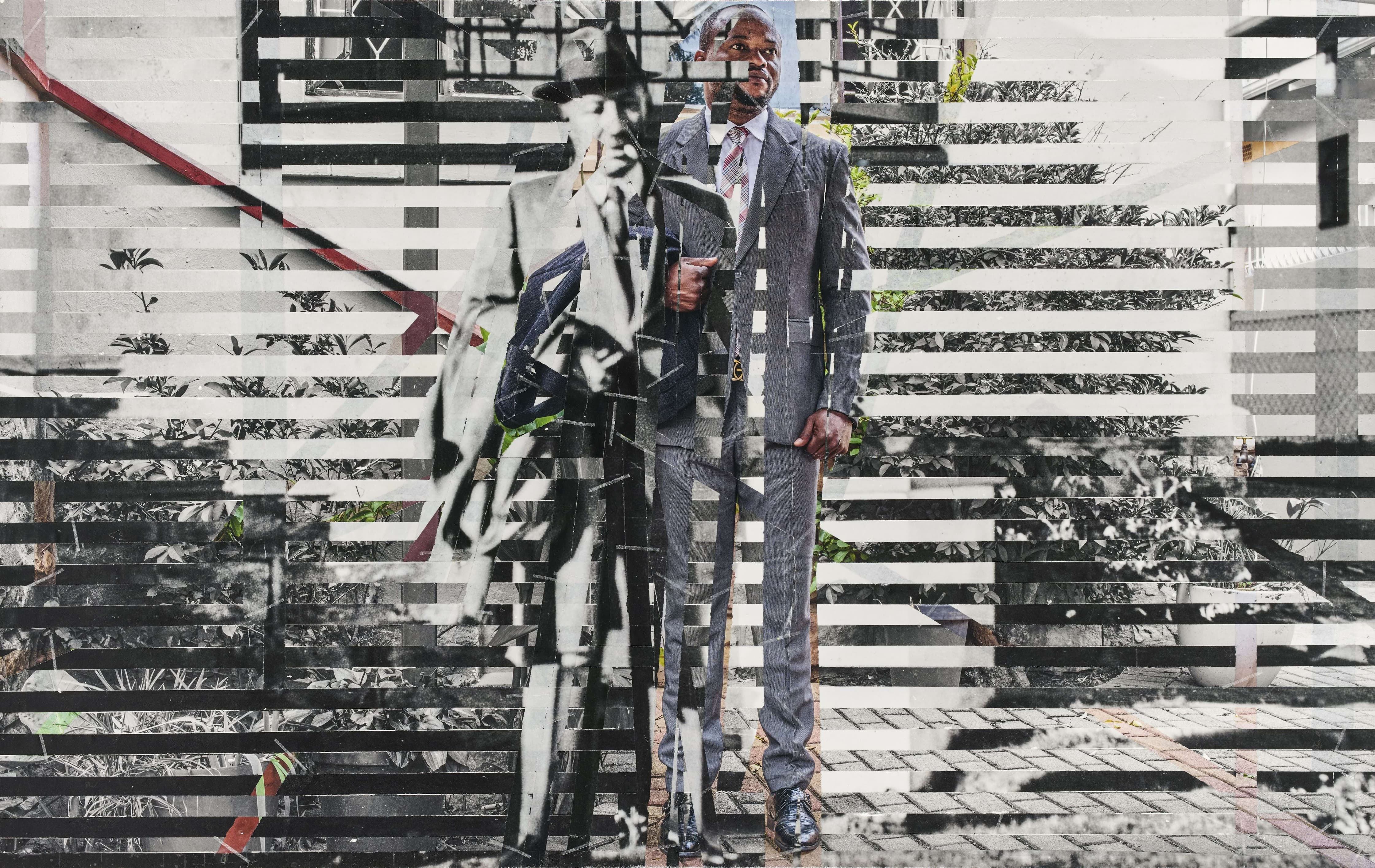
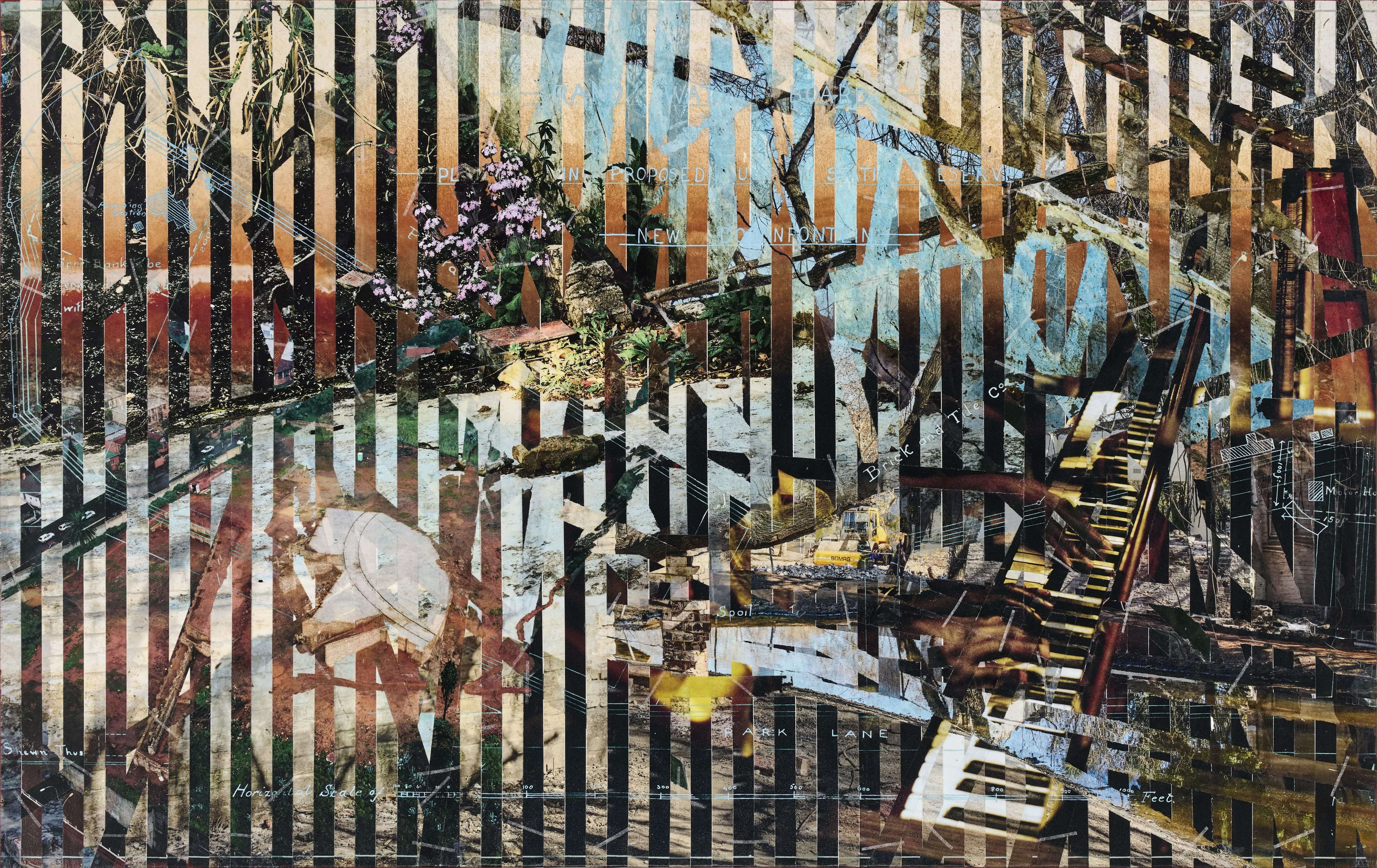
This impulse to dismantle and reconstruct has evolved into a multidisciplinary practice spanning photography, painting, film and his distinctive Sticky-tape Transfers. Developed over more than a decade, the process involves lifting pigment from photographs using adhesive tape before reassembling fragments into new layered compositions. “The collage and the sticky tape process is a way to literally open up images and try to get inside them,” he explains.
Before entering A Johannesburg Landscape, visitors encounter a vintage 1976 Mercedes parked inside the gallery’s bookshop and café. Built in South Africa exactly fifty years ago, in the year of the Soweto uprising, the Mercedes is itself a loaded symbol – both an emblem of apartheid industry and an object of aspiration across the city’s many communities. With its doors open to fragments of film footage and a Johannesburg-inspired playlist, the car serves as a prelude to Subotzky’s upcoming film project, 24-Hour Joburg. Shot over the course of a year, the film will ride with the artist as he drives the Mercedes through the city with a range of guests, the vehicle serving as both camera dolly and moving site for conversation. This gesture acknowledges both his own position within Johannesburg and the impossibility of any singular understanding of a city so stratified that one part can be a world away from another.
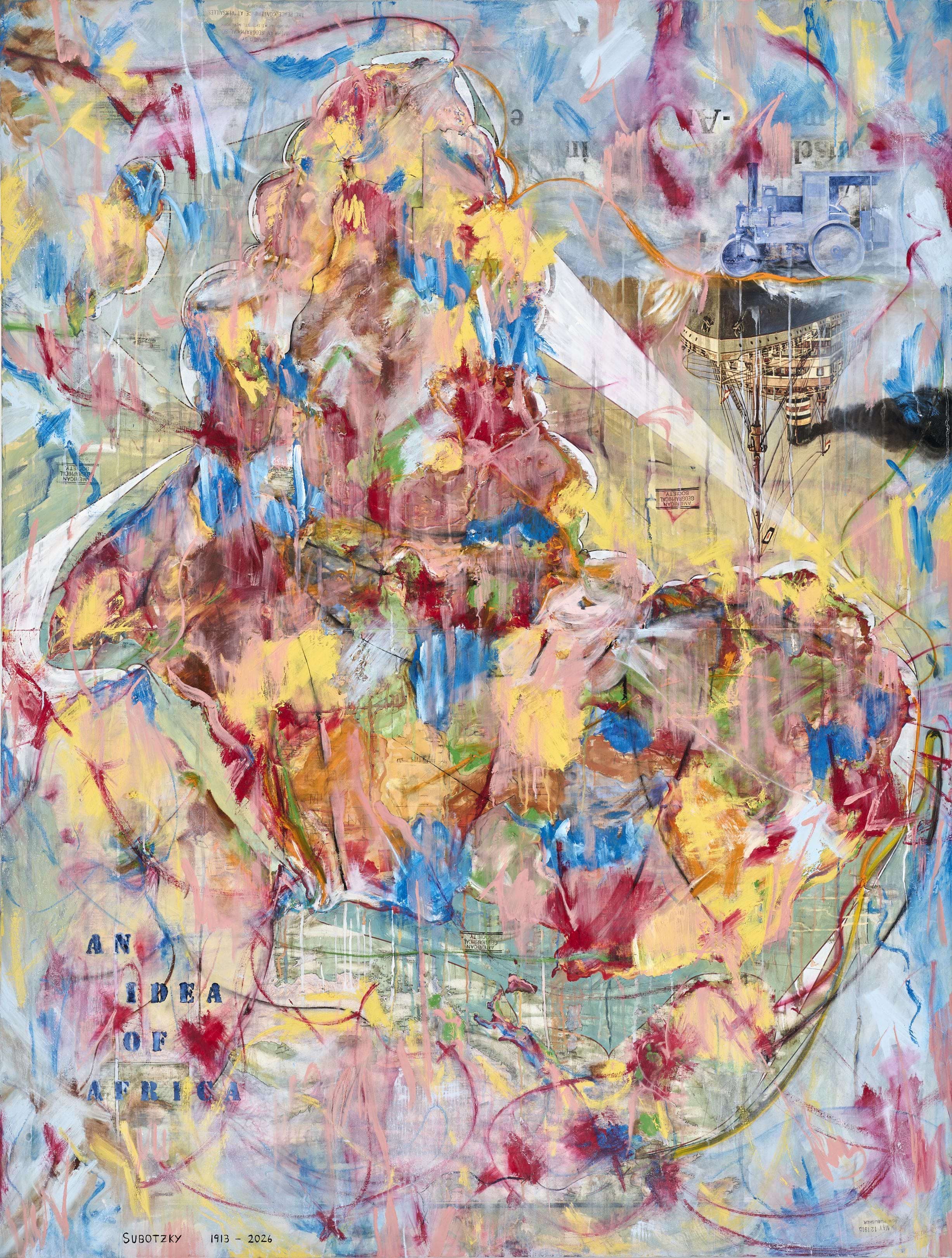
Inside the gallery proper, viewers are first confronted by An Idea of Africa (2023–2026), a painting that has occupied the artist for several years. Continuing his long-standing interest in the failures of map-making – that inherently colonial way of seeing – Subotzky inverts the African continent from its supposedly correct orientation and frays its construction as a self-contained landmass. Instead, lines of movement and exchange extend across the surface, tracing migrations from prehistory to speculative futures while following the trajectory of his own maternal family.


The work draws on the story of Subotzky’s German-Jewish great-grandfather, who was unable to carry money out of Nazi Germany. He worked for a road-building company that helped him convert his remaining assets into a thirteen-ton steamroller he shipped with him to Cape Town and sold upon arrival, providing the funds that eventually enabled the family to settle in Johannesburg. For Subotzky, this unusual story becomes emblematic of transmutation: money becomes industrial machinery; machinery becomes a house; German identity becomes Jewish refugeehood before ultimately becoming white South African identity. These successive acts of translation and displacement underpin the work’s broader meditation on migration, belonging and the unstable nature of identity. The painting is accompanied by a poem by the artist, set in vinyl on the adjacent wall, whose phrases – “my birthright hibernating in cold steel” – unfold the specific family history into a lyrical reflection on the transmutation of people, objects and identities as global crisis sets them in motion. Across the many dimensions of their lines and narrative forms, the poem and painting function as an introduction and guide to what follows – a wayfinder of sorts, describing “how I got to here”.

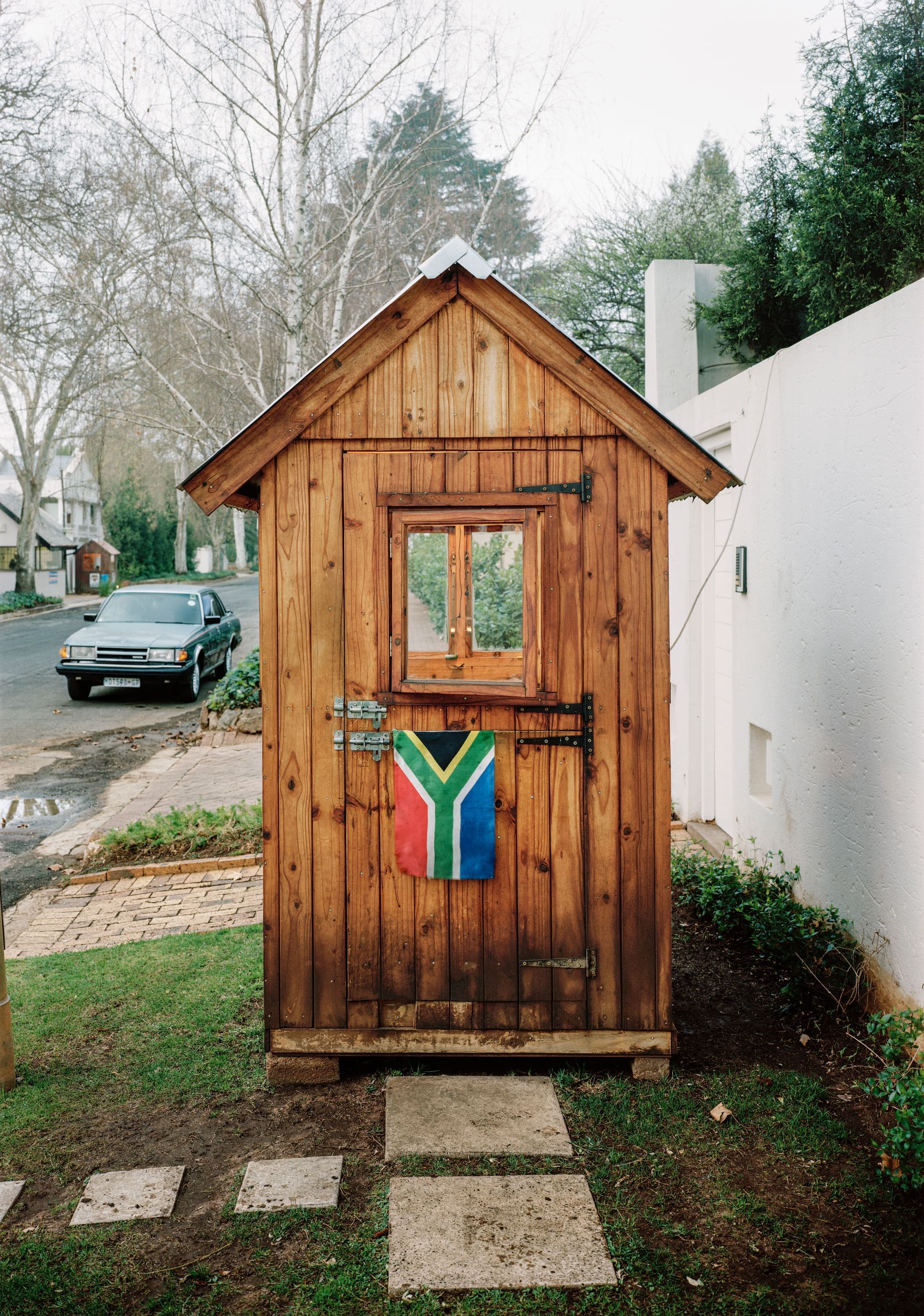
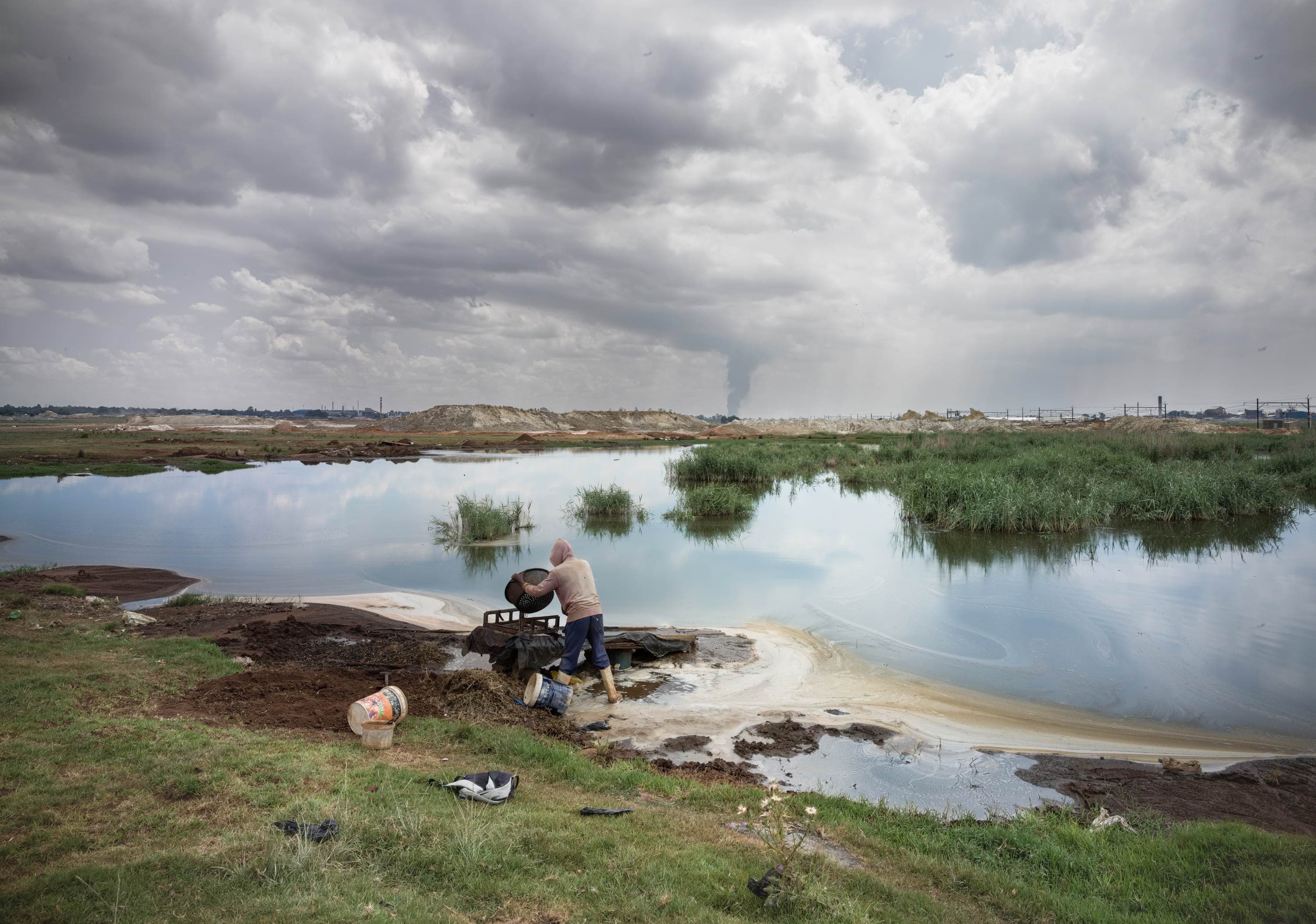
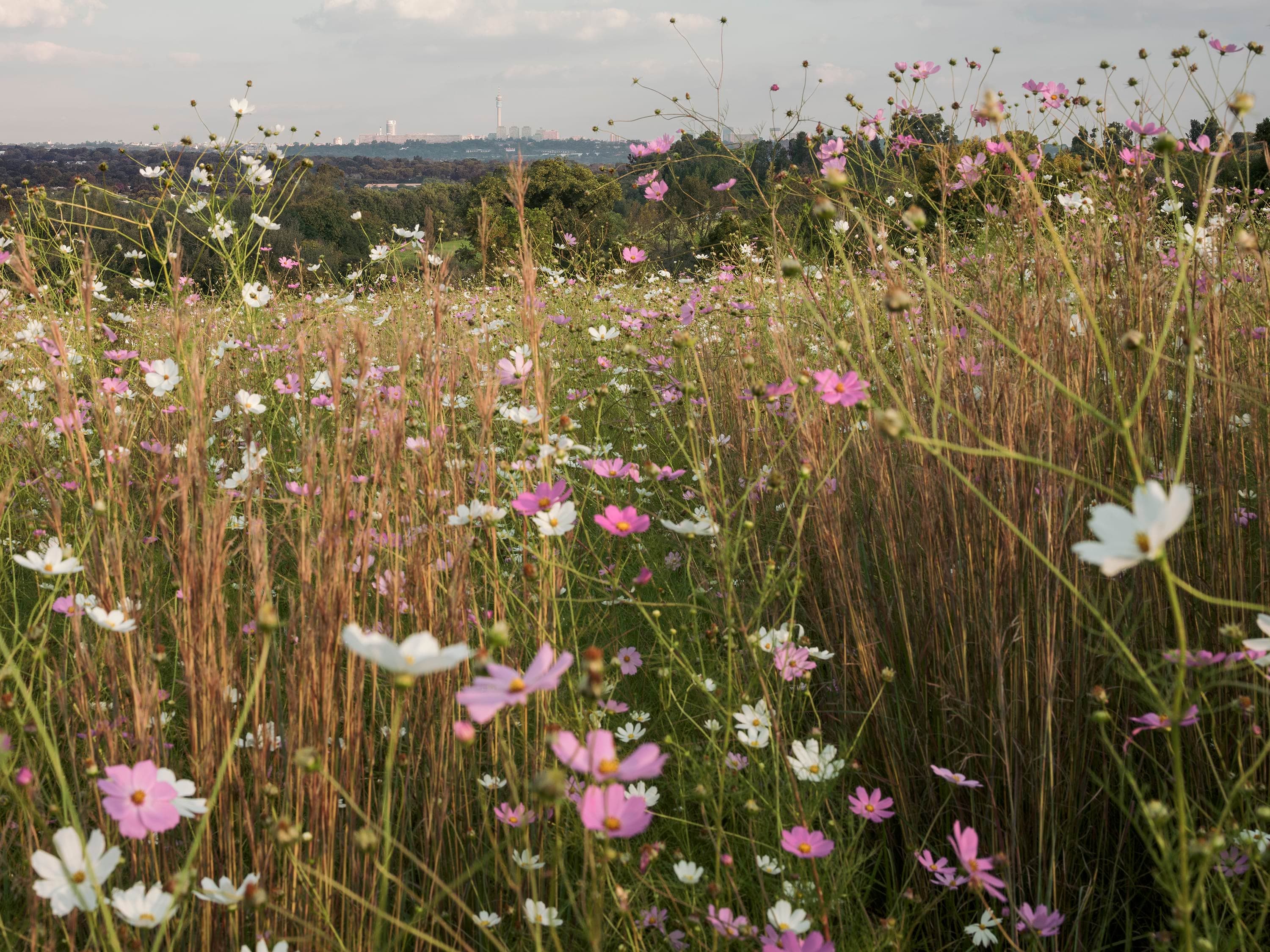
Progressing through the exhibition, viewers encounter photographs Subotzky has taken since moving to Johannesburg in 2008 – together, a portrait of the city’s guarded pastoral. A diptych shows the estranged twin cities of Sandton and the CBD from a distance, cosmos fields in the foreground. Security huts and electrified fences sit alongside a view across Bolton Road to the 9 Yards development mid-construction. Further on, a lone artisanal miner in a vast landscape pans for gold with the same method used by those who first struck the reef that would build this city, exactly 140 years ago.
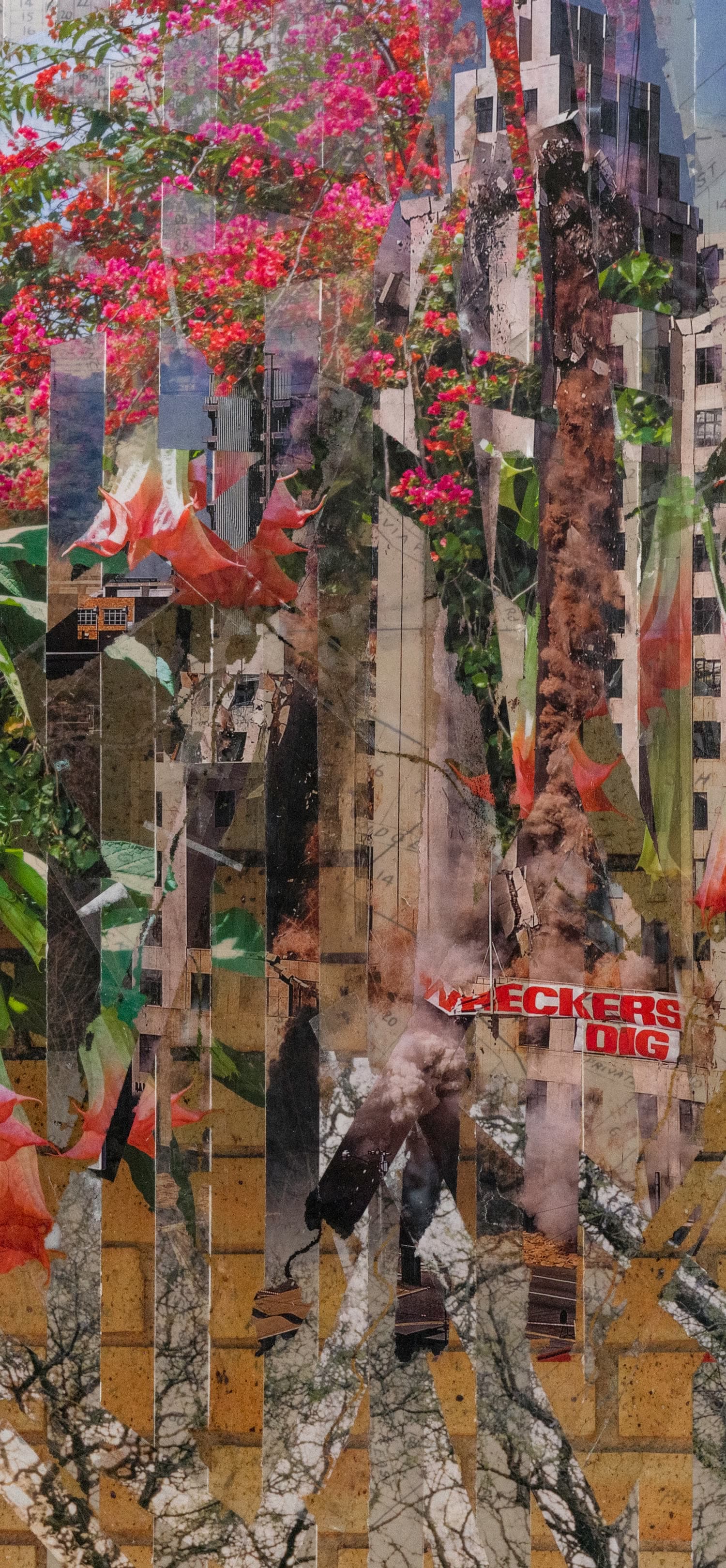
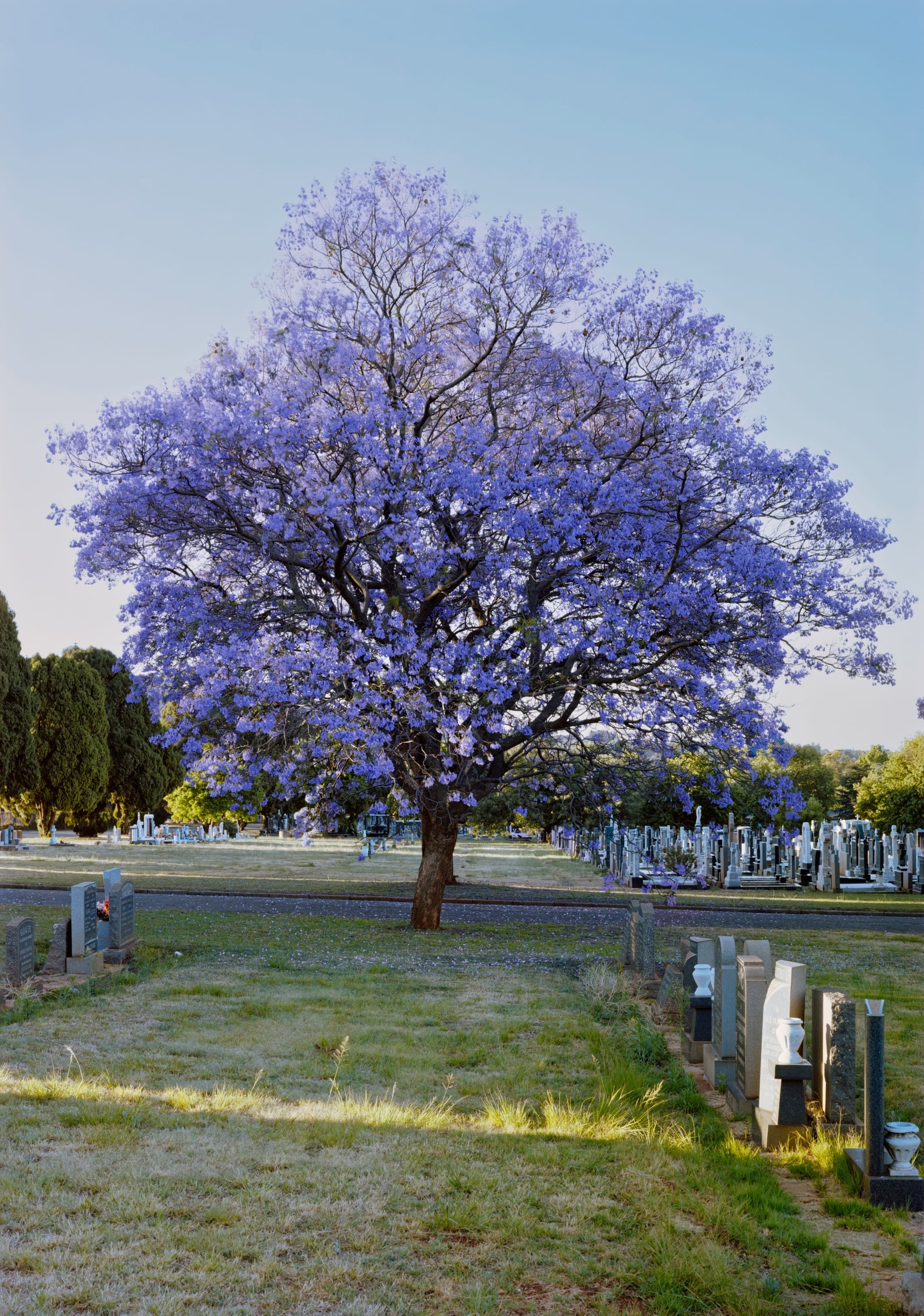
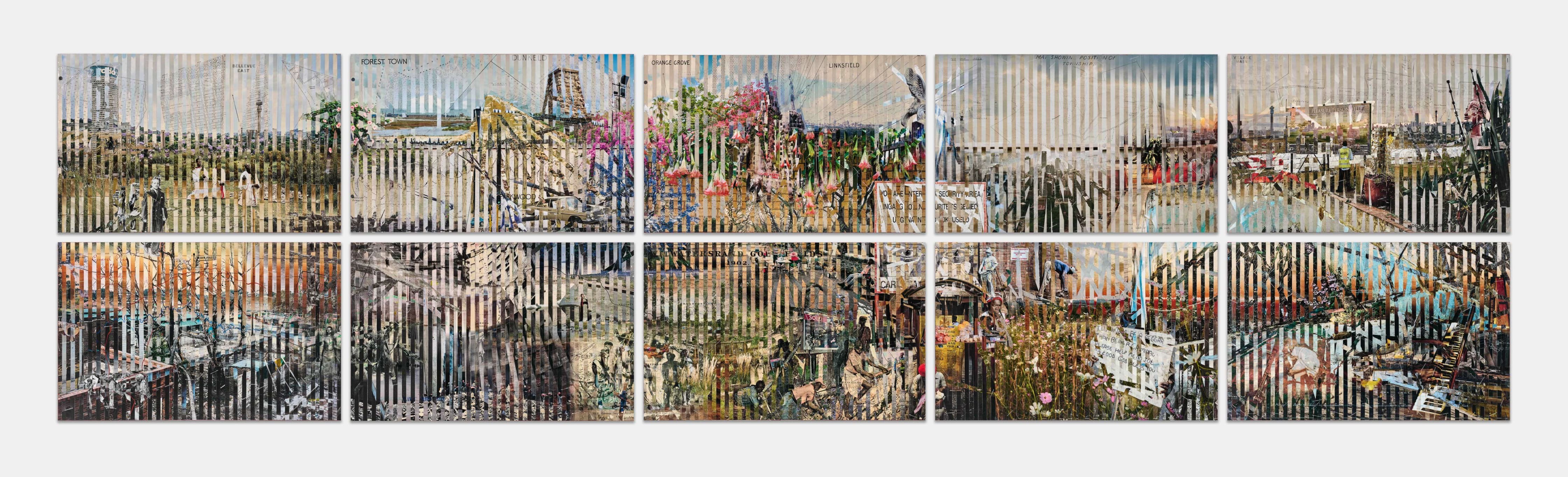
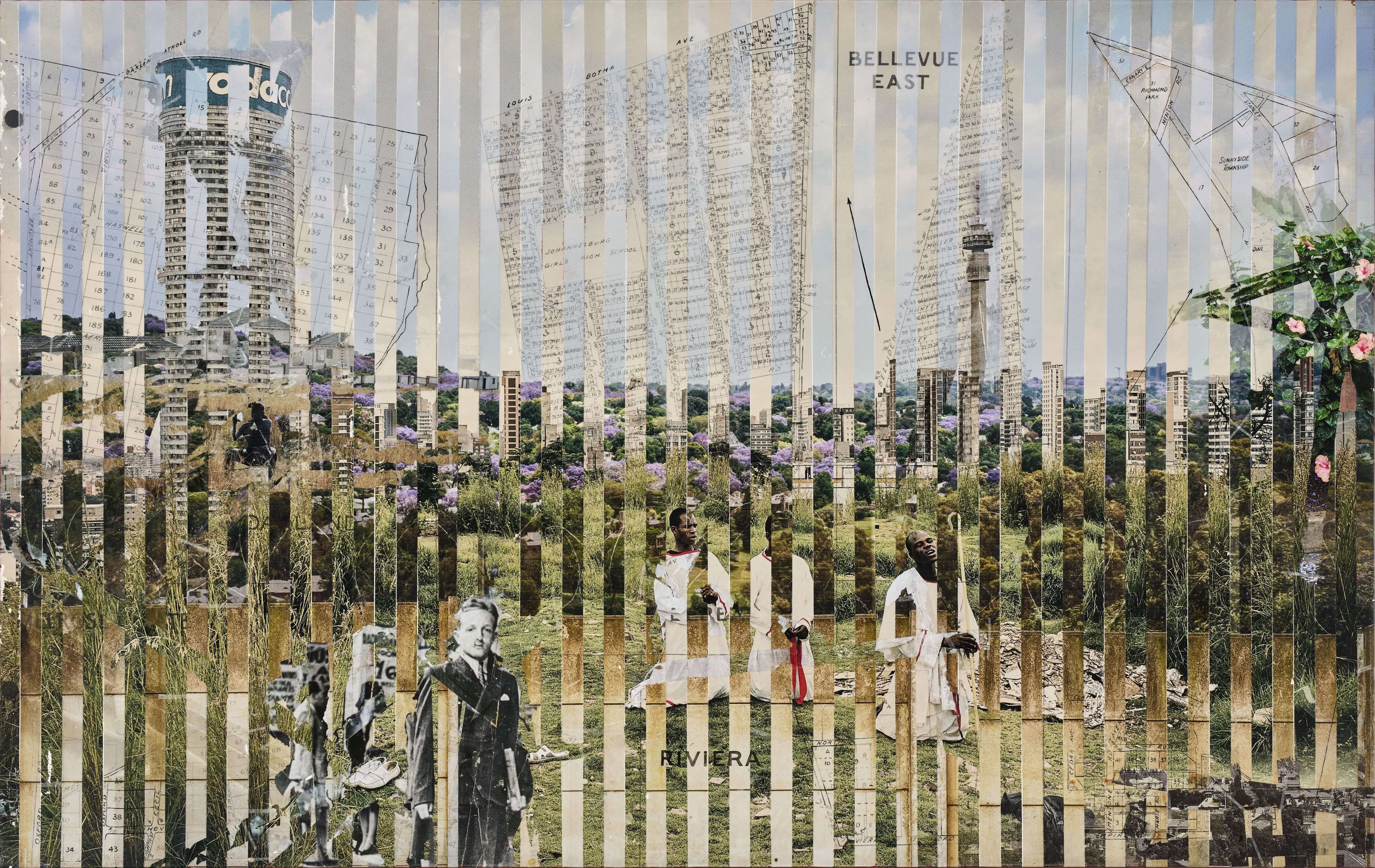
At the centre of the exhibition is its namesake, the 10-panel Sticky-tape Transfer, A Johannesburg Landscape, where Subotzky’s stratified vision of the city reaches its fullest expression. Vertical strips weave together archival maps, mining imagery, photographs from inside and outside Ponte City and other scenes drawn from his photographic archive. These are interspersed with Johannesburg’s distinctive vegetation: moonflowers draped across brick walls, magenta bougainvillea and the acid-purple bloom of jacarandas. History, infrastructure and ecology collapse into a sequence of images that refuses linear narrative. The panels read like a drive through the strata of the city – window-framed views blurred by the jitter of a rolling shutter, as if seen from the Mercedes parked at the exhibition’s entrance.
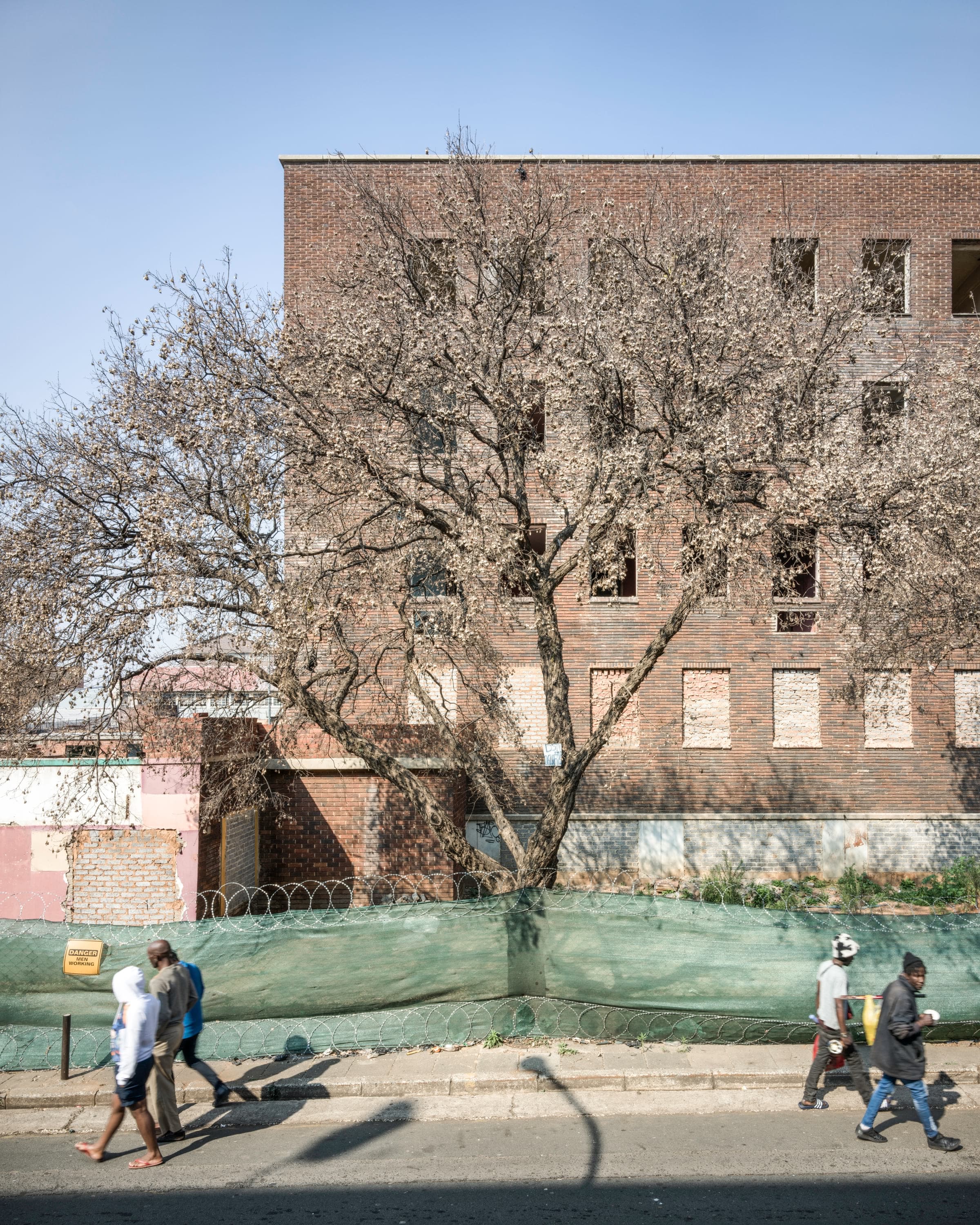
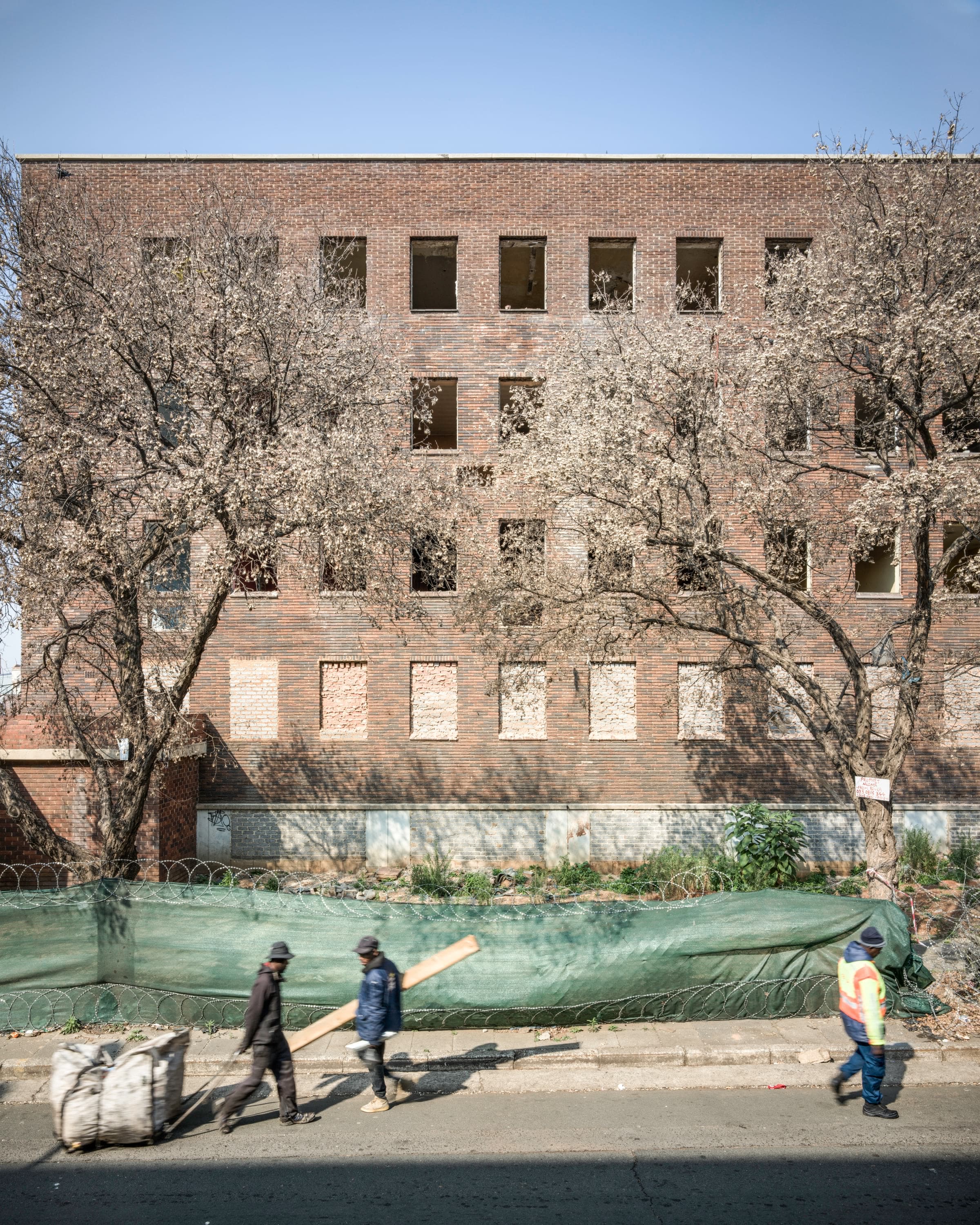
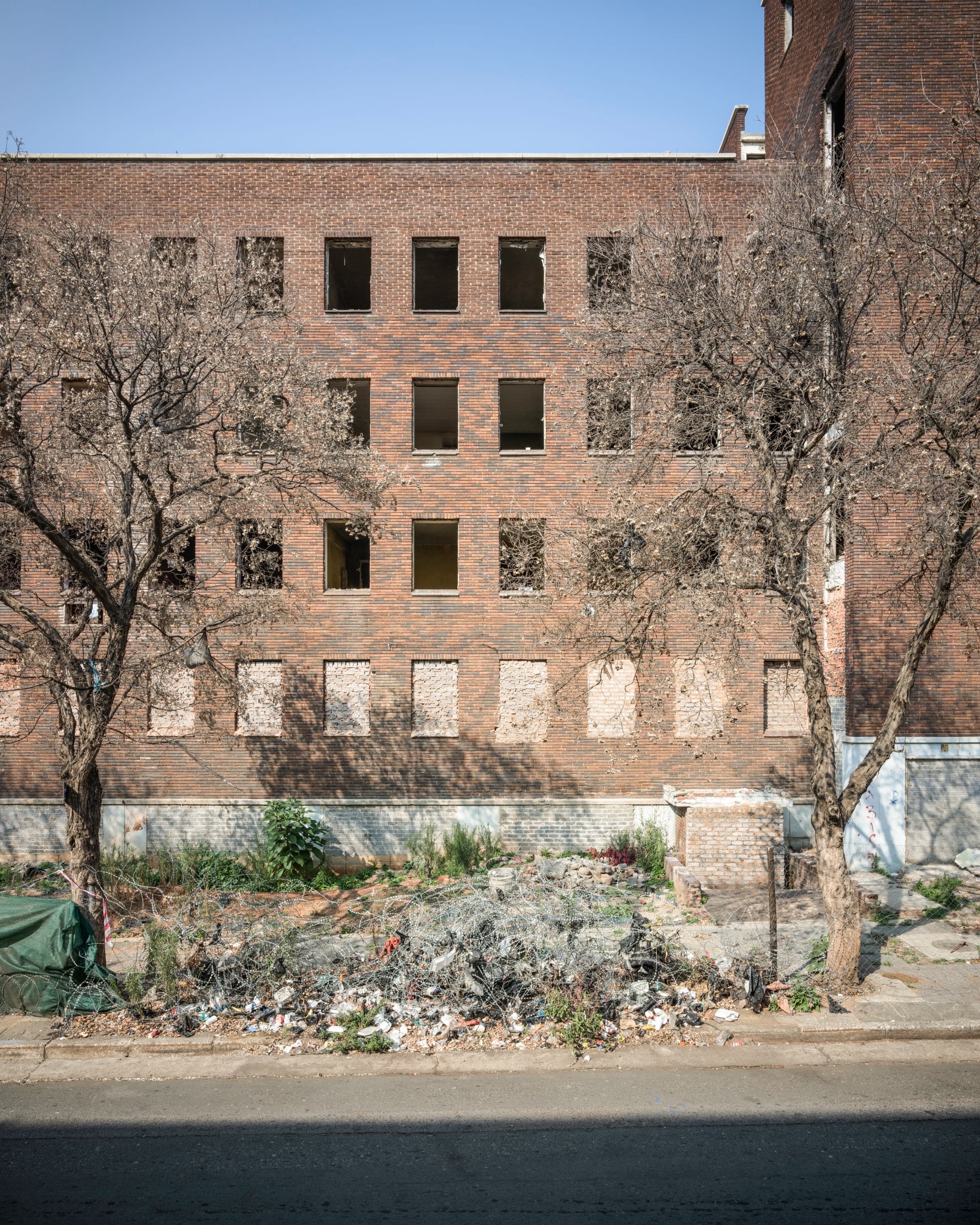
The exhibition does not avoid Johannesburg’s ruptures. In the eight-panel photograph 80 Albert Street (2026), Subotzky documents the facade of a building marked by tragedies of both the apartheid and democratic eras. Once home to the most notorious apartheid-era pass office and later a shelter for unhoused women, it suffered one of South Africa’s deadliest urban fires in 2023, when 77 people lost their lives – many of them foreign nationals, economic migrants and asylum seekers. The empty shell of the building stands as an uneasy monument to overlapping histories of segregation, migration, neglect and displacement. More broadly, the work speaks to a South Africa marked by growing social fracture, in which undocumented migrants have increasingly become scapegoats for the country’s economic hardship and decline.
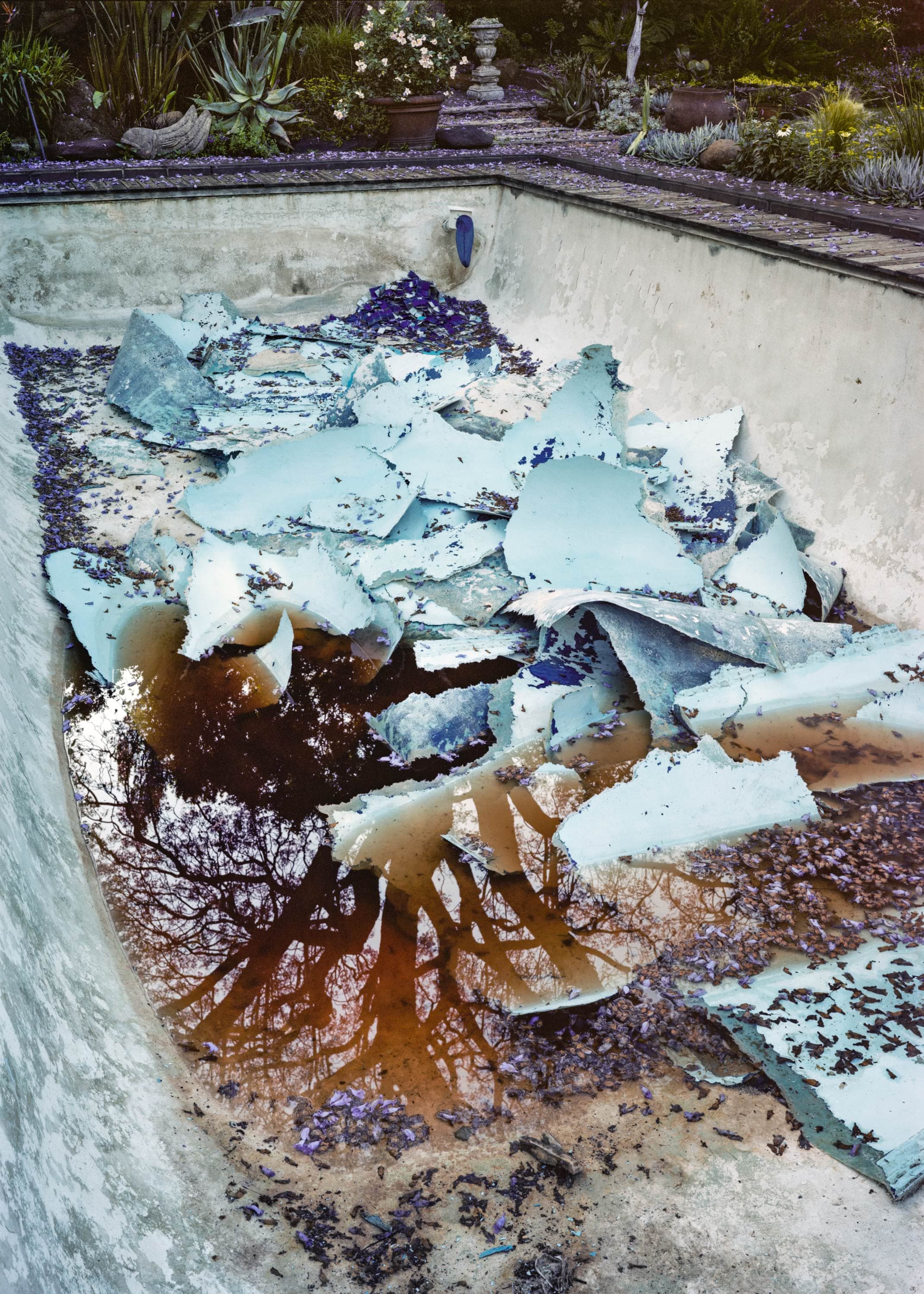
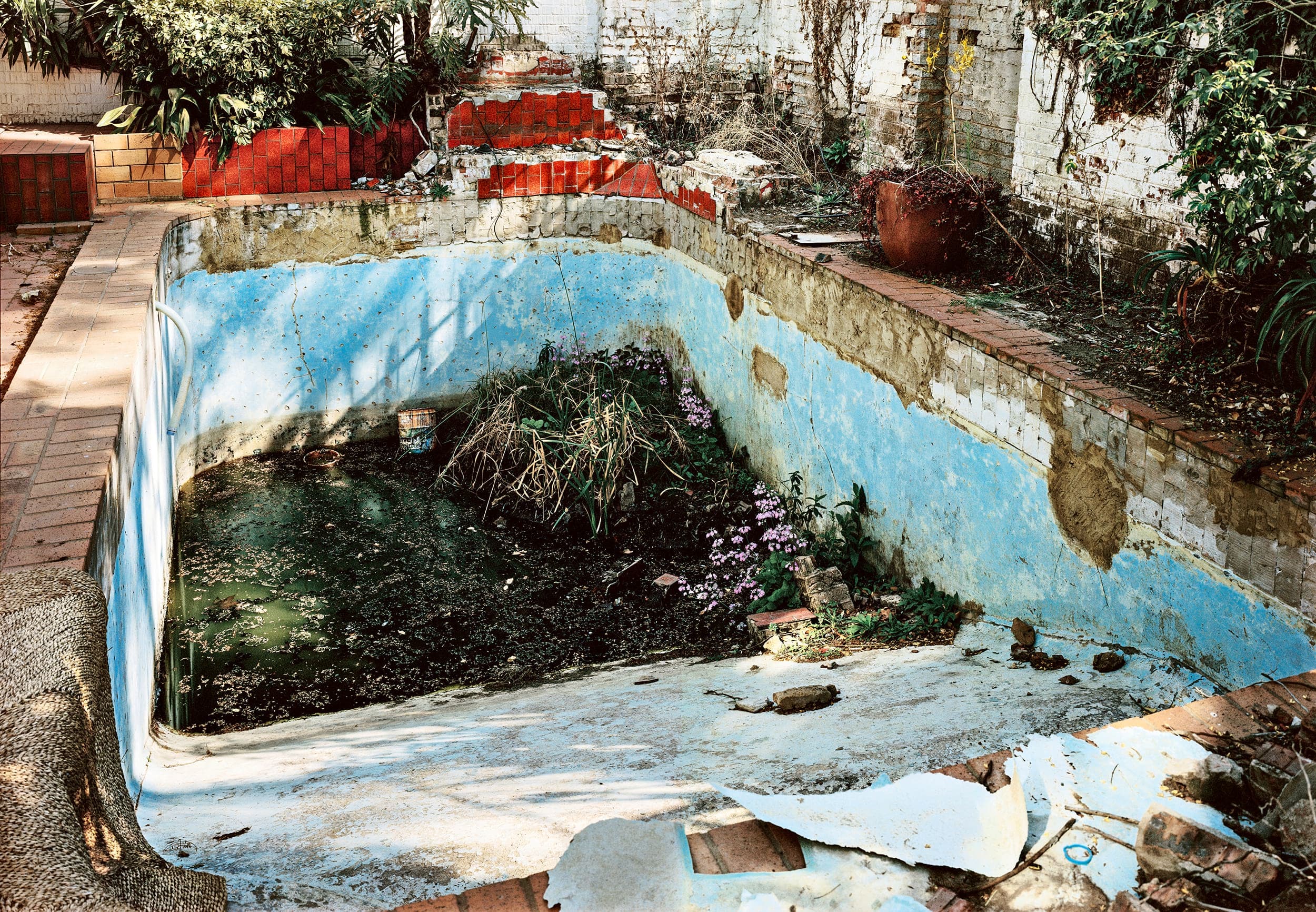
Yet alongside these stark realities, Subotzky uncovers moments of unexpected lyricism. An earlier photograph of an empty concrete swimming pool in an abandoned garden appears, at first glance, to depict another fragment of urban decline. For the artist, however, it recalls T. S. Eliot’s Burnt Norton, where a ray of reflected light briefly turns “water out of sunlight” before returning to emptiness. Such images open a poetic dialogue between past, present and future, suggesting that fragmentation need not signify loss alone but may also contain the possibility of renewal.


*A number of the found images in these works are sourced from the Mendel Family Archive. This collection of family photographs and documents has been organised and preserved by Mikhael’s uncle Gideon and cousin Elias Mendel, both of whom have made significant artworks through their interventions in the archive. The artist thanks them for the use of these images and for their many years of work in preserving their shared familial memories. Other images draw from Ponte City, a body of work created in collaboration with Patrick Waterhouse. The artist thanks Patrick for his continued collaboration and commitment to the project.
Installation Images


Artist Bio
Mikhael Subotzky’s (b. 1981, Cape Town) works are the results of his fractured attempts to place himself in relation to the social, historical, and political narratives that surround him. As an artist working in film, video installation and photography, as well as more recently in collage and painting, Subotzky engages critically with contemporary politics of images and their making. “At the heart of my work is a fixation with revealing the gap between what is presented (and idealised) and what is hidden, coupled with a desire to pull apart and reassemble the schizophrenia of contemporary existence,” he says.
Subotzky’s first body of photographic work, 'Die Vier Hoeke (The Four Corners),' was an in-depth study of the South African penal system. 'Umjiegwana (The Outside)' and, 'Beaufort West' extended this investigation to the relationship between everyday life in post-apartheid South Africa and the historical, spatial, and institutional structures of control. 'Retinal Shift' was produced by Subotzky on the occasion of the Standard Bank Young Artist Award 2012 and toured South Africa’s major museums and critically engaged with his ambivalence towards the processes of representation and image construction. 'Ponte City,' a collaboration with artist Patrick Waterhouse, focuses on a single 54-story building that dominates the Johannesburg skyline. The building is cast as the central character in a myriad of interweaving narratives that, through photographs, commissioned texts, historical documents, and urban myths, chart the convoluted histories of both the building and Johannesburg itself. The 'Ponte City' exhibition, which consists of a single installation of thousands of photographs and documents, has been acquired by the San Francisco Museum of Modern Art and the accompanying publication won the 2015 Deutsche Borse Photography Prize.
Subotzky’s work has been exhibited in recent museum presentations, 'The Struggle of Memory' at Palais Populaire, Berlin (2024) and, 'Fragile Beauty: Photographs from the Sir Elton John and David Furnish Collection' at Victoria & Albert Museum, London (2024).
Notable solo and two-person exhibitions include, Ponte City Book Box Project (with Patrick Waterhouse) A4 Foundation, Cape Town (2026). 'Home Building Ideas for South Africa (or A Cape Town Landscape),' Goodman Gallery Cape Town (2024); 'Epilogue,' Goodman Gallery, London (2022); 'Tell It To The Mountains,' (with Lindokuhle Sobekwa) A4 Foundation, Cape Town (2021); 'Mikhael Subotzky: WYE,' Sherman Contemporary Art Foundation, Sydney (2016); 'Ponte City' (with Patrick Waterhouse), National Galleries, Scotland, UK, then travelled to Le Bal, Paris and FOMU, Antwerp (2014).
His work was included in the 12th Cairo Biennale (2010), The Unexpected Guest, Liverpool Biennial (2012), Rencontres Picha Biennale de Lubumbashi, Lubumbashi (2013) and the 56th Venice Biennale: All the World’s Futures, Venice (2015).
Public collections include SFMoMA, San Francisco; Museum of Modern Art, New York; Solomon R Guggenheim Museum, New York; the National Gallery of Art, Washington; Tate, London; Centre Pompidou, Paris; and the South African National Gallery; Helsinki Art Museum, Helsinki,; Deutsche Bank Collection, Frankfurt among others.
Subotzky lives and works in Johannesburg, South Africa.
To view available artworks and access prices.