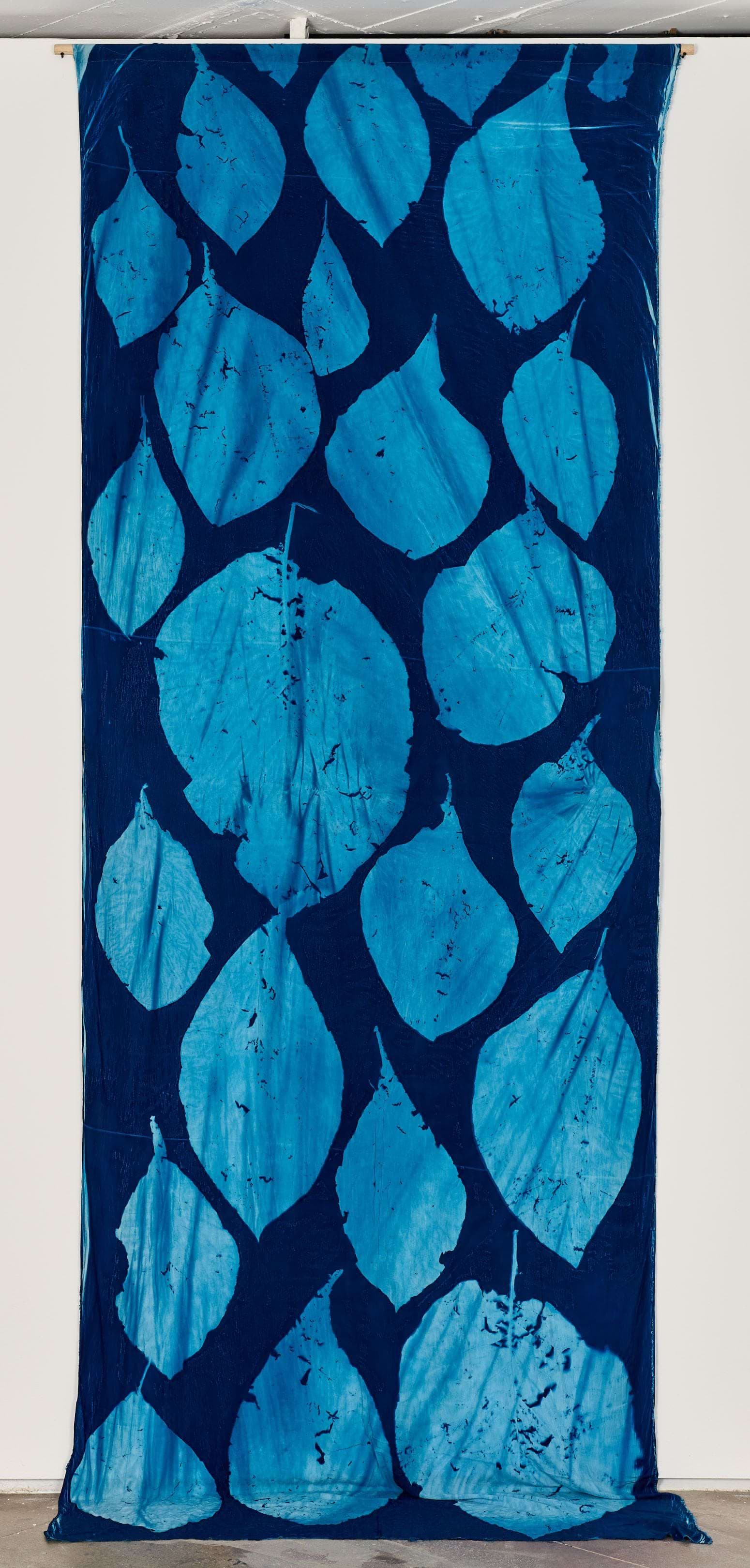
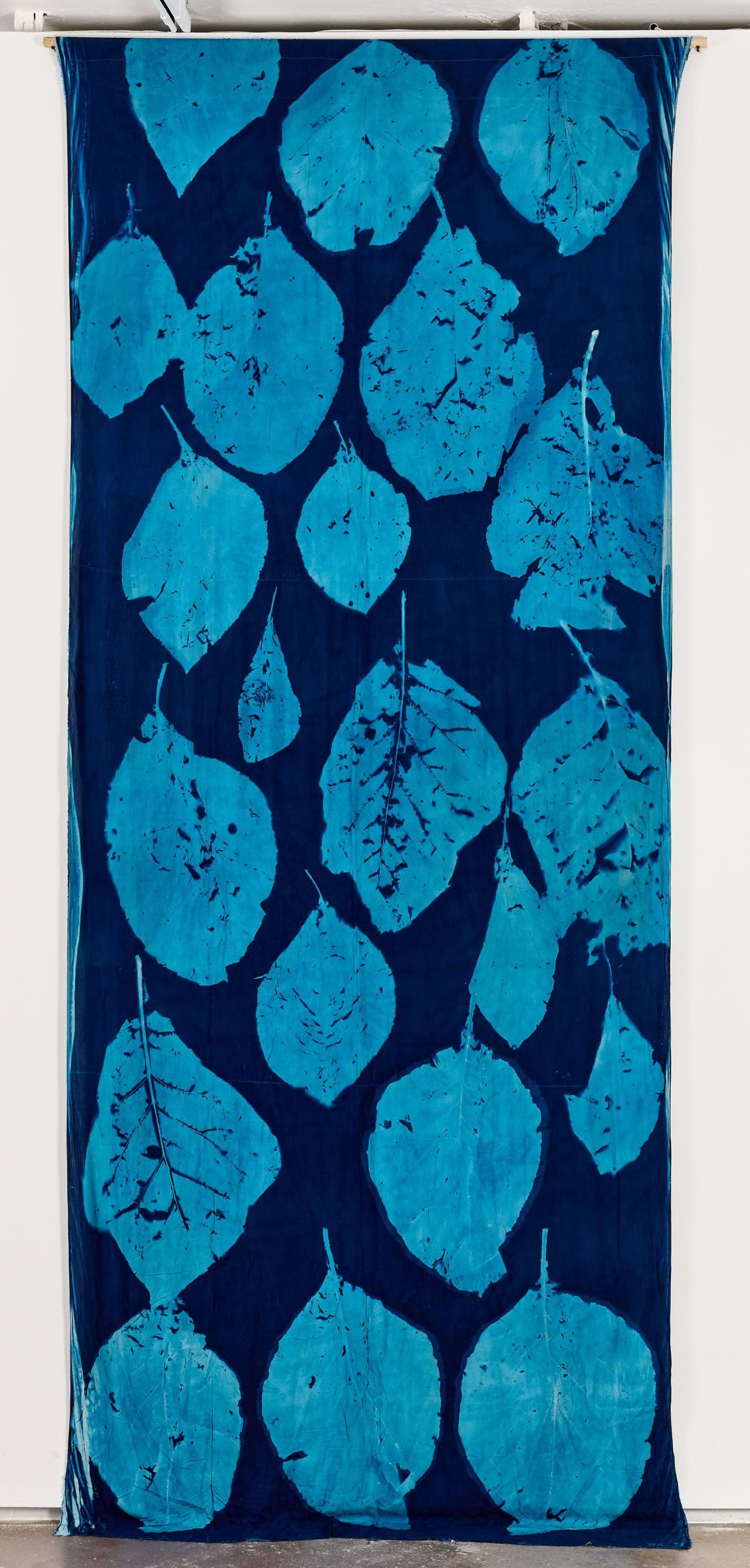
The teak plant can be found in almost every region in Ghana. Ubiquitous as it is, no clear account exists of its initial entry into the country.
While some records hint at the 1930’s, others (mostly oral and visual) point to an earlier introduction, between 1905 and 1911. This earlier account is allegedly tied to a German forester, Herr Metzger who is said to have embarked on an afforestation program in the then German Togoland, an area encompassing sections of the western and eastern parts of present day Togo and Ghana respectively. Teak was introduced then in addition to plants like Mango in a mono cropping /plantation project.
The project, “Teak atlas: From where do we begin”, is an exercise in waiting actively. Focusing mostly on the leaves of the plant, the work consists of cotton fabrics treated with both teak pigment and later with photo emulsion. The two over time are meant to respond/react with each other. This is done as a means towards understanding the very material nature of the plant using photography as a starting point.
The teak plant can be found in almost every region in Ghana. Ubiquitous as it is, no clear account exists of its initial entry into the country.
While some records hint at the 1930’s, others (mostly oral and visual) point to an earlier introduction, between 1905 and 1911. This earlier account is allegedly tied to a German forester, Herr Metzger who is said to have embarked on an afforestation program in the then German Togoland, an area encompassing sections of the western and eastern parts of present day Togo and Ghana respectively. Teak was introduced then in addition to plants like Mango in a mono cropping /plantation project.
The project, “Teak atlas: From where do we begin”, is an exercise in waiting actively. Focusing mostly on the leaves of the plant, the work consists of cotton fabrics treated with both teak pigment and later with photo emulsion. The two over time are meant to respond/react with each other. This is done as a means towards understanding the very material nature of the plant using photography as a starting point.
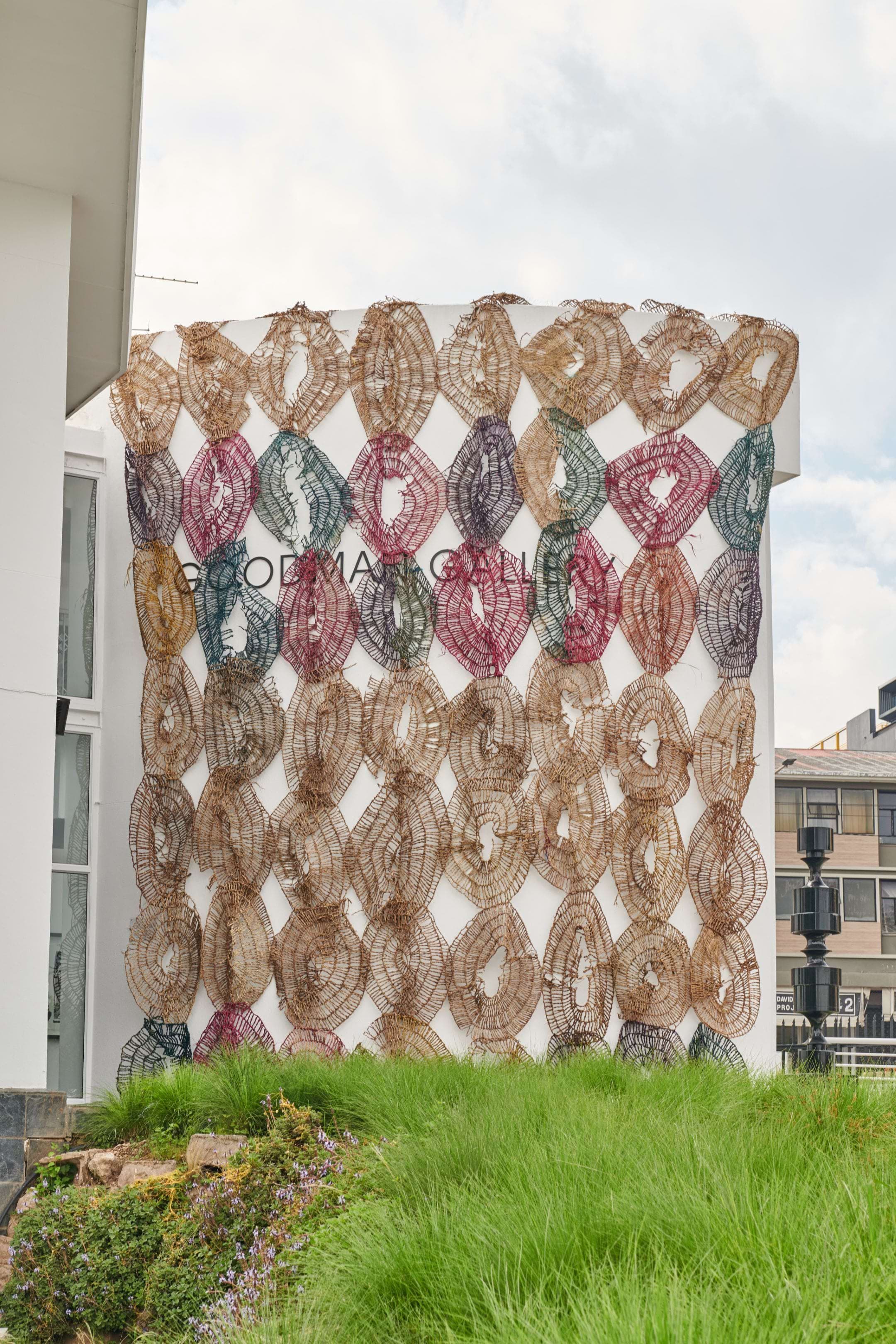
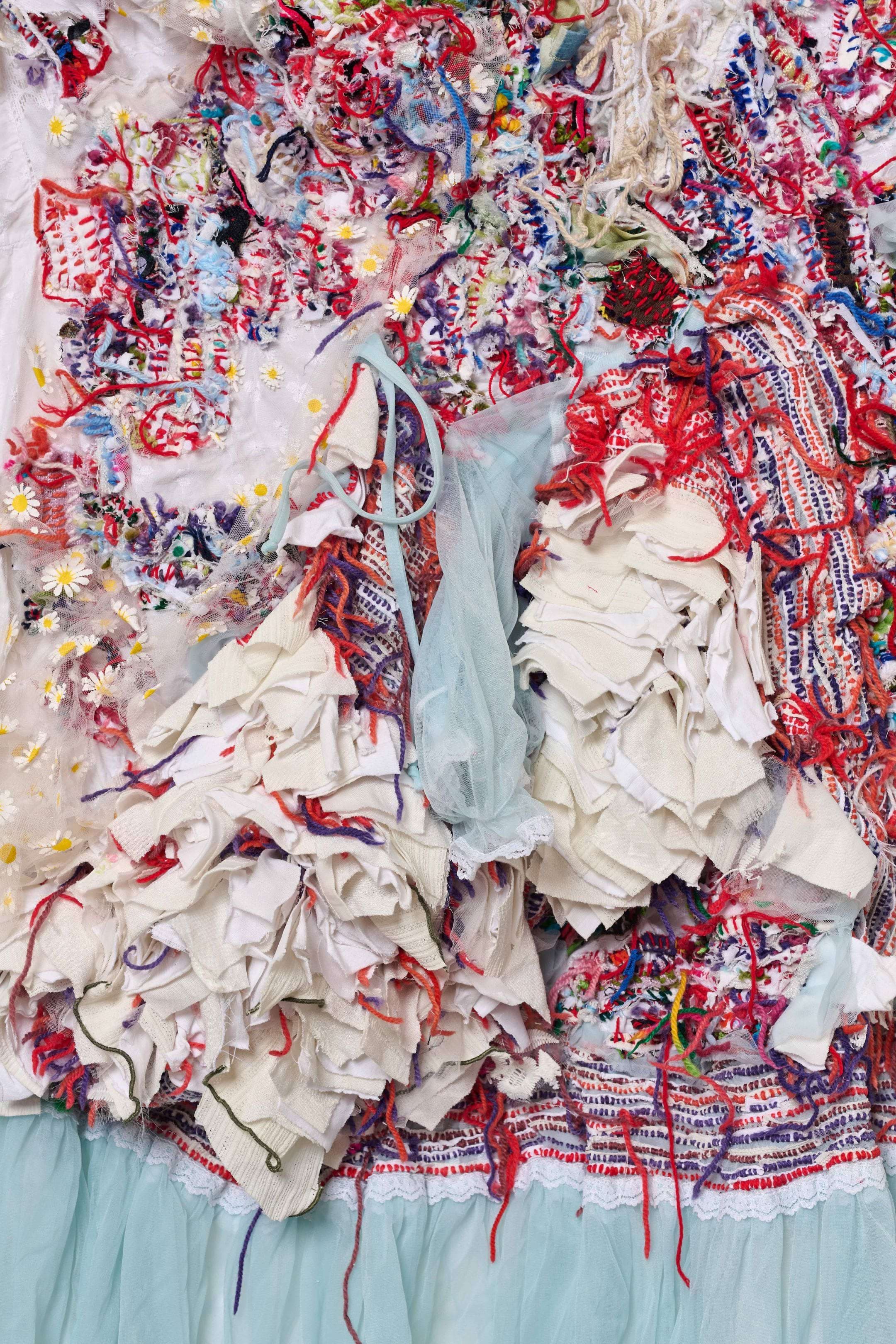
Memories of the Present expands Ankomah’s investigation into climate change, material culture and art practice. The artist has recently been investigating the effects of urban weather through her work. Her interest lies in the sustainability of the materials she uses in the face of the alarming climate crisis by creating circular kenaf forms as a metaphor for life cycles. This is particularly resonant with contemplations and aspirations of a post-pandemic future whilst grieving for lives lost. Naturally, during the course of the exhibition, colours will fade and these material objects will slowly disintegrate as they react to changing environmental elements. Key questions posed through this work include: What new histories or narratives are formulated when fragile material objects encounter varied weather conditions? What sustainable futures can be forecast for these material objects and by extension her practice as an artist?
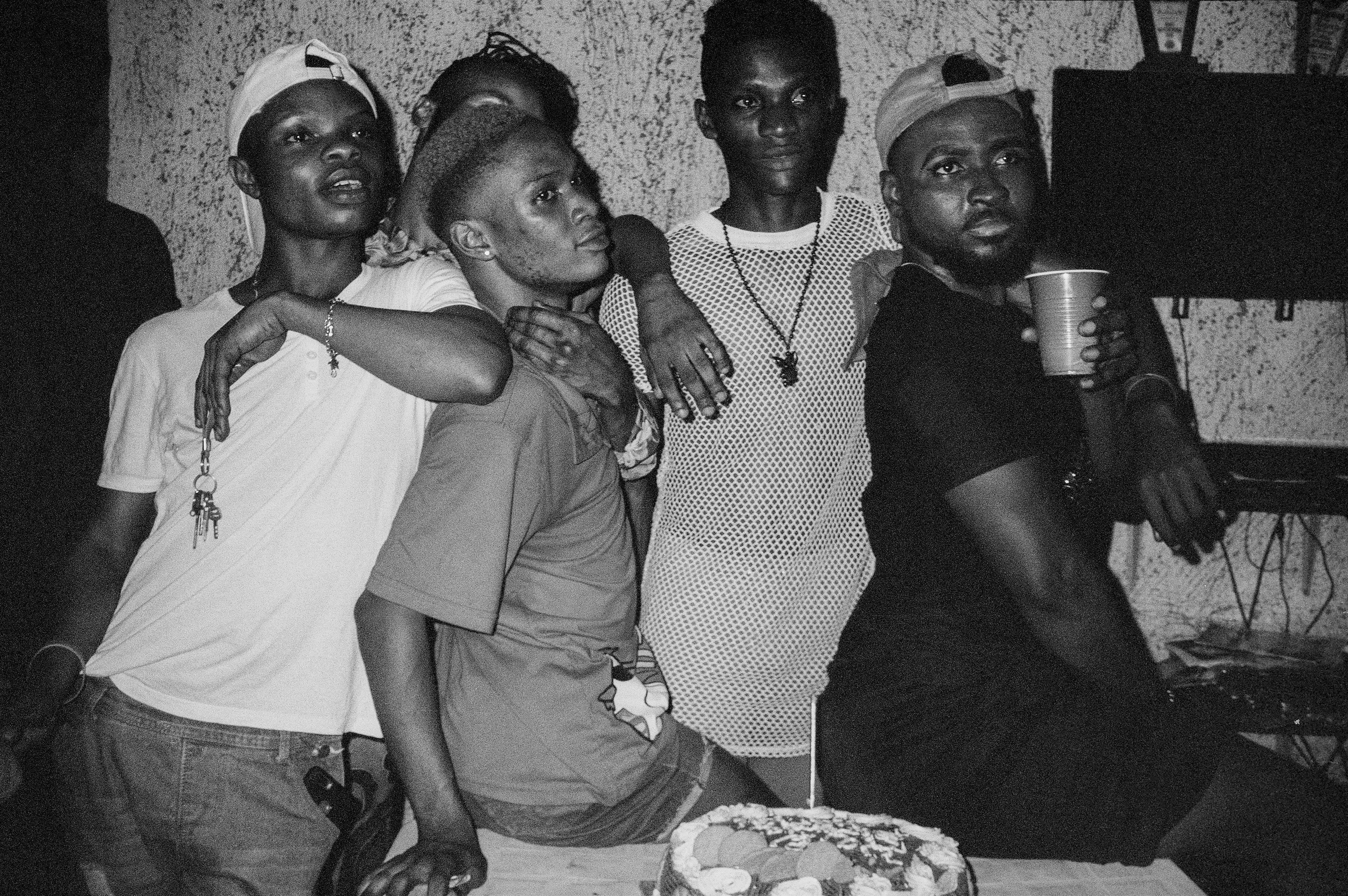
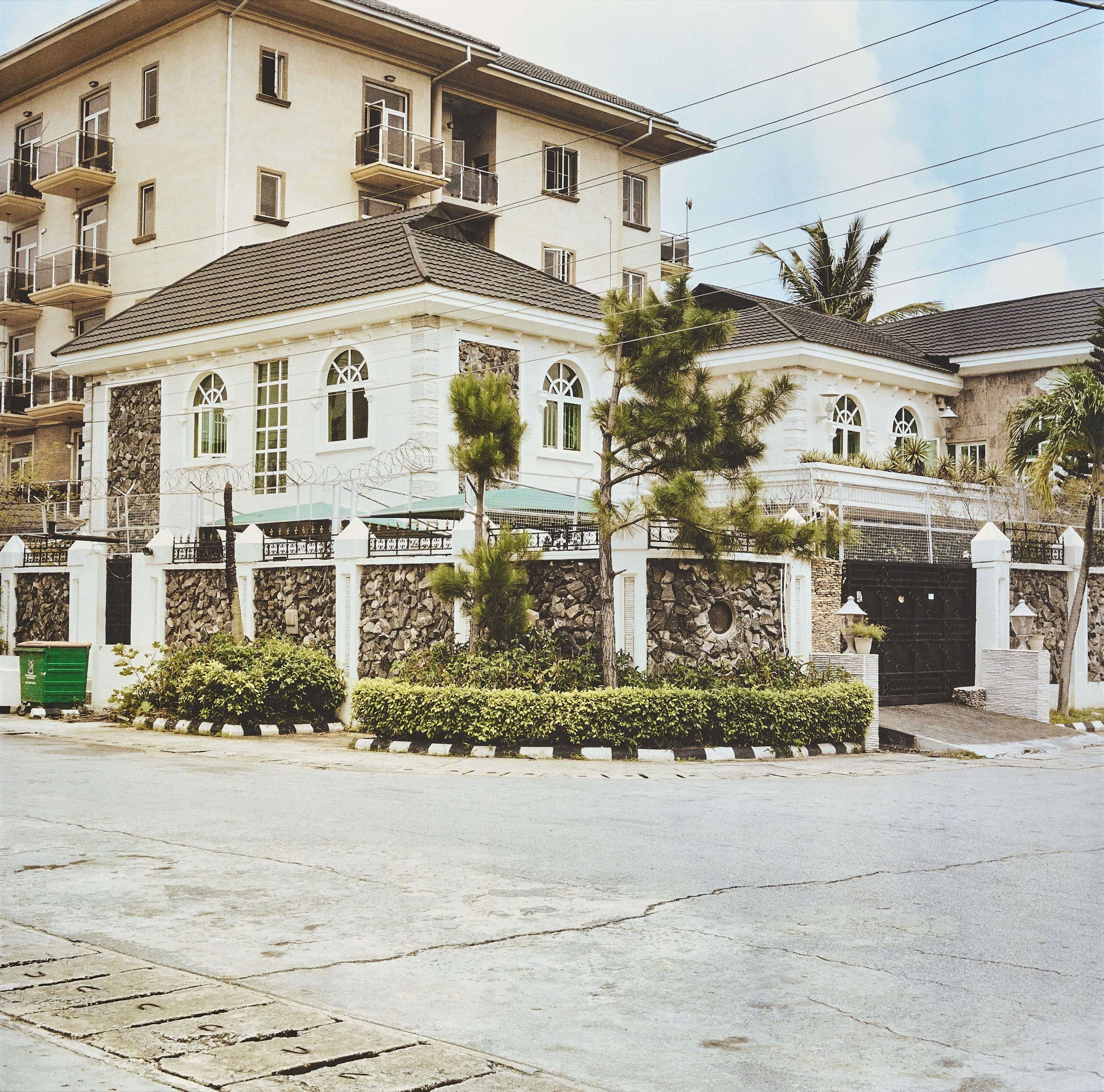
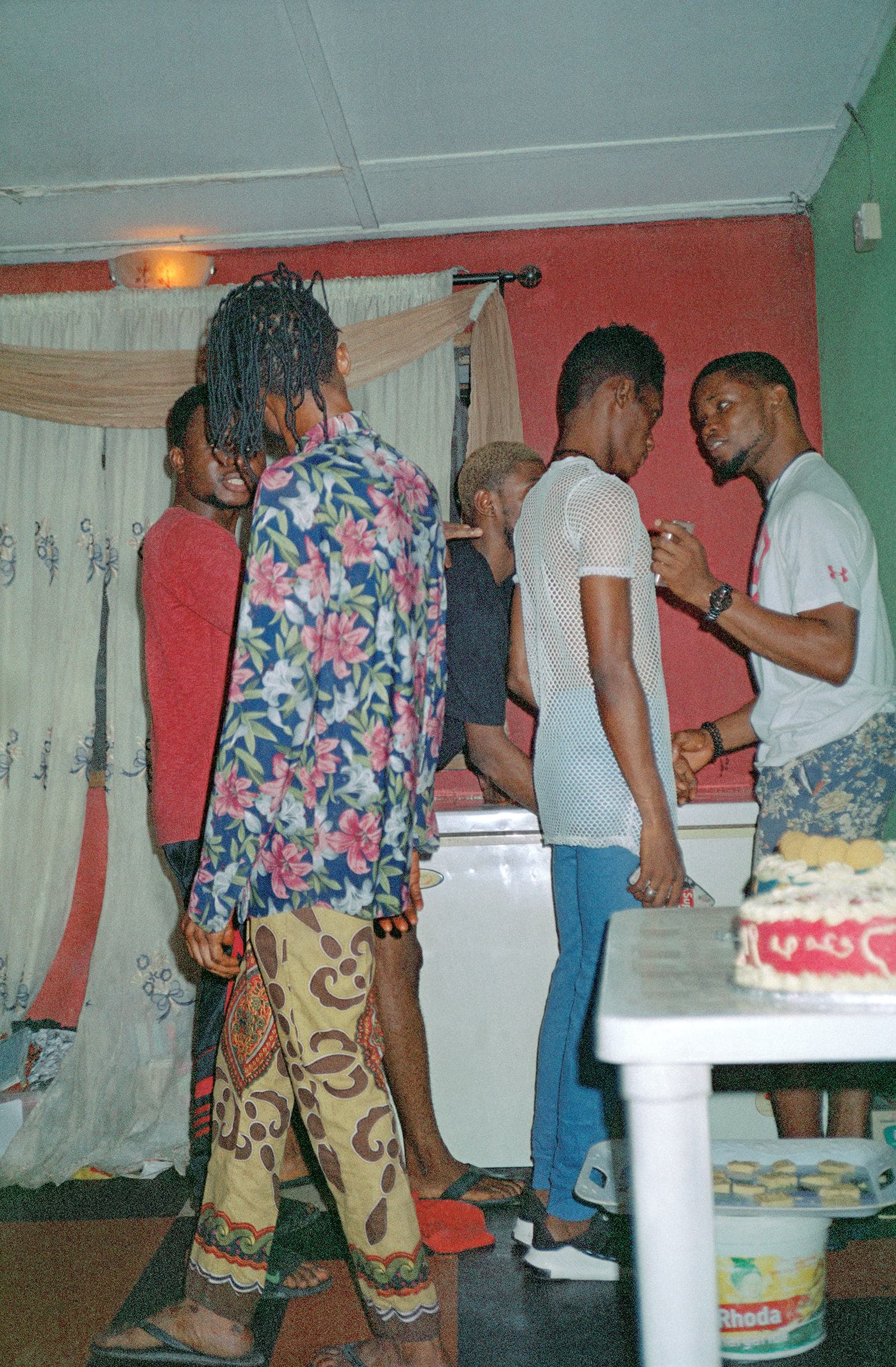
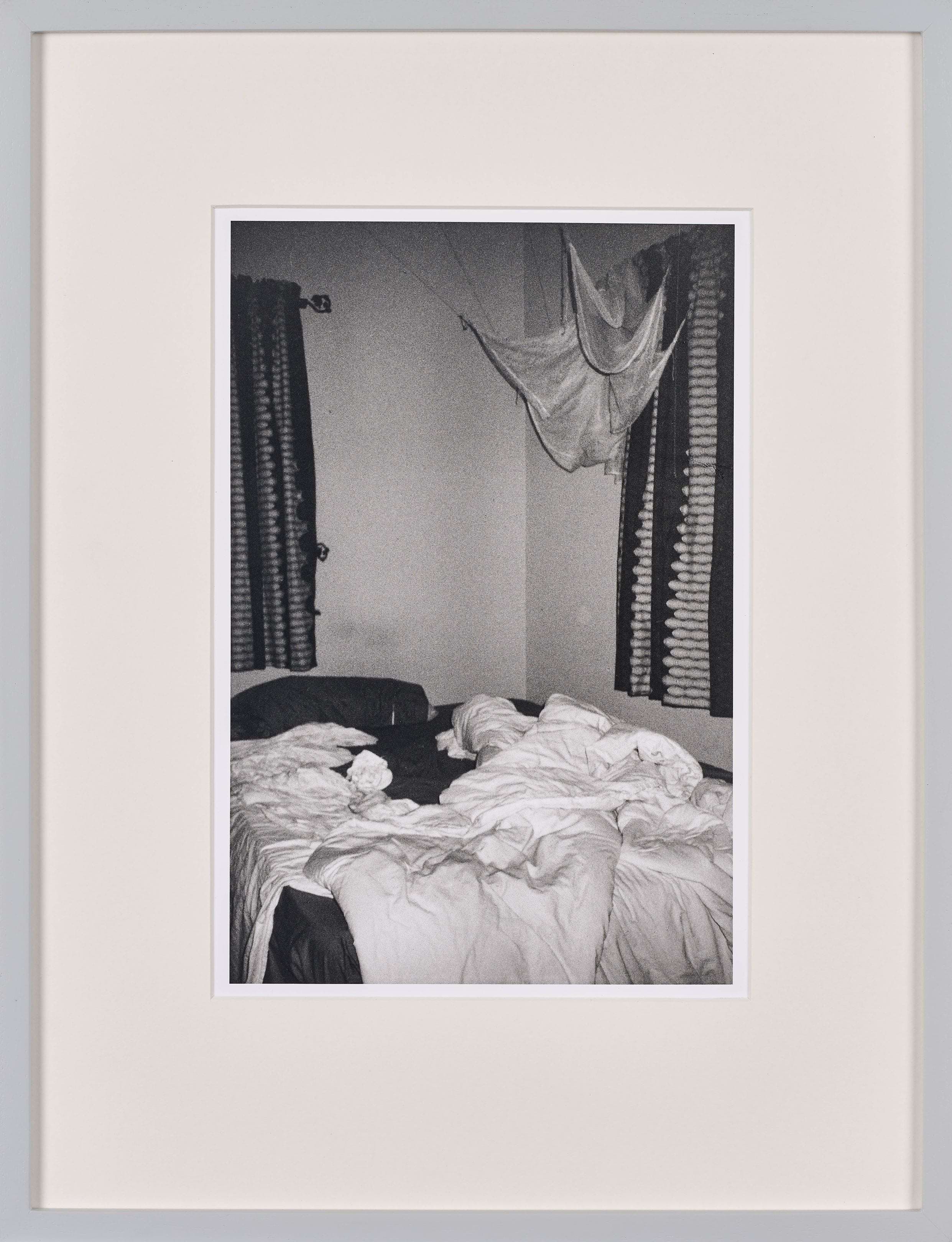
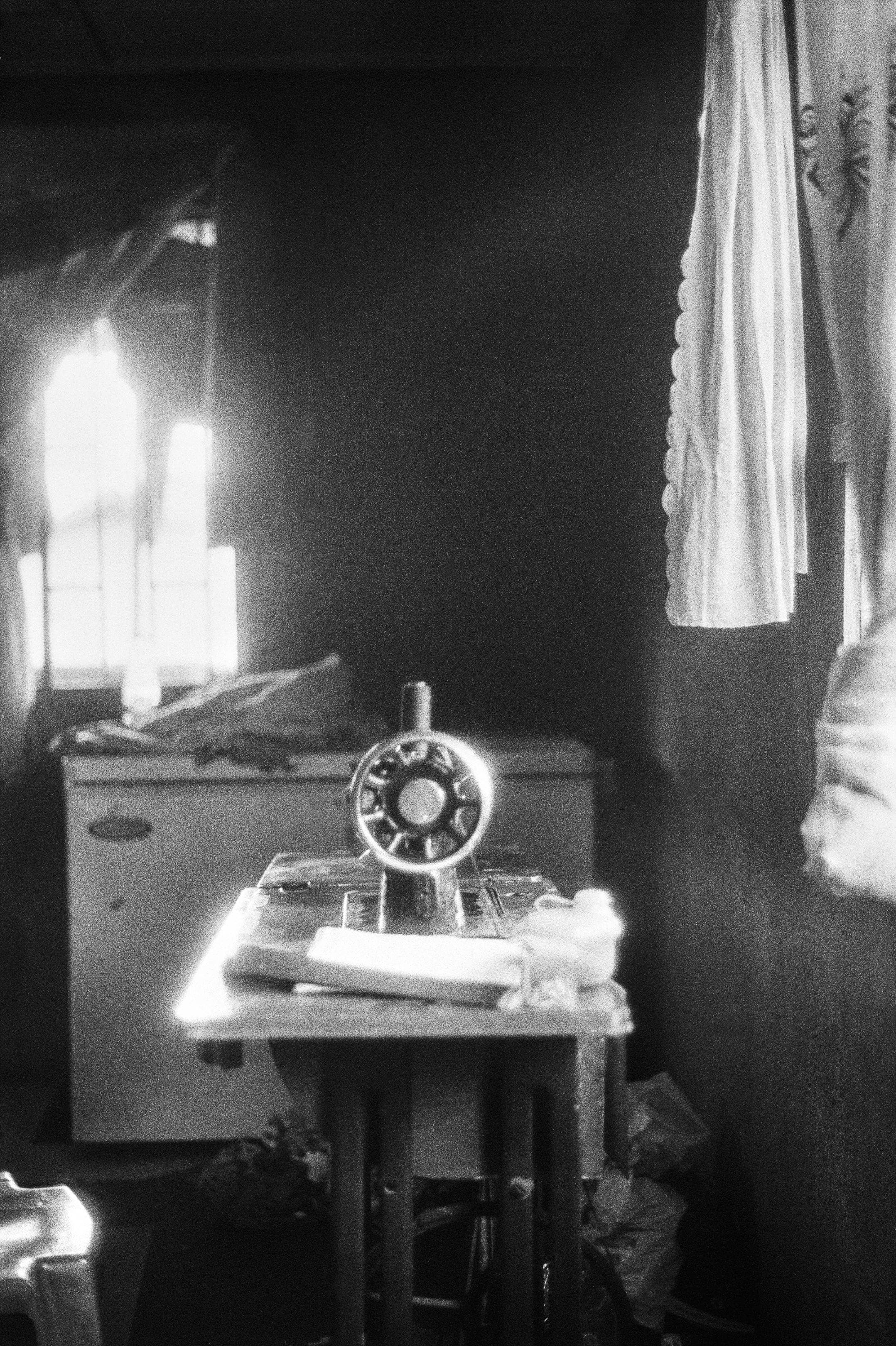
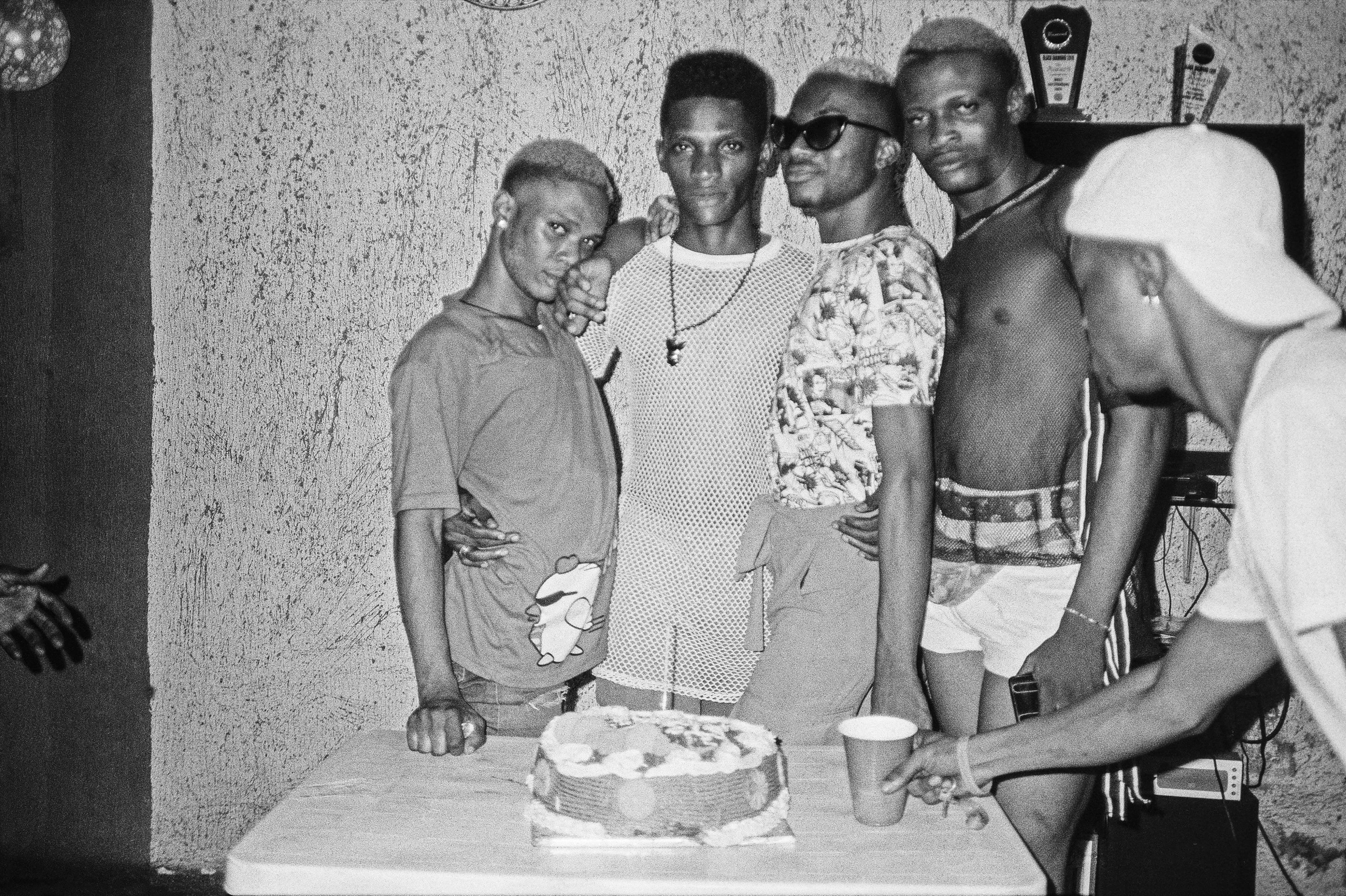
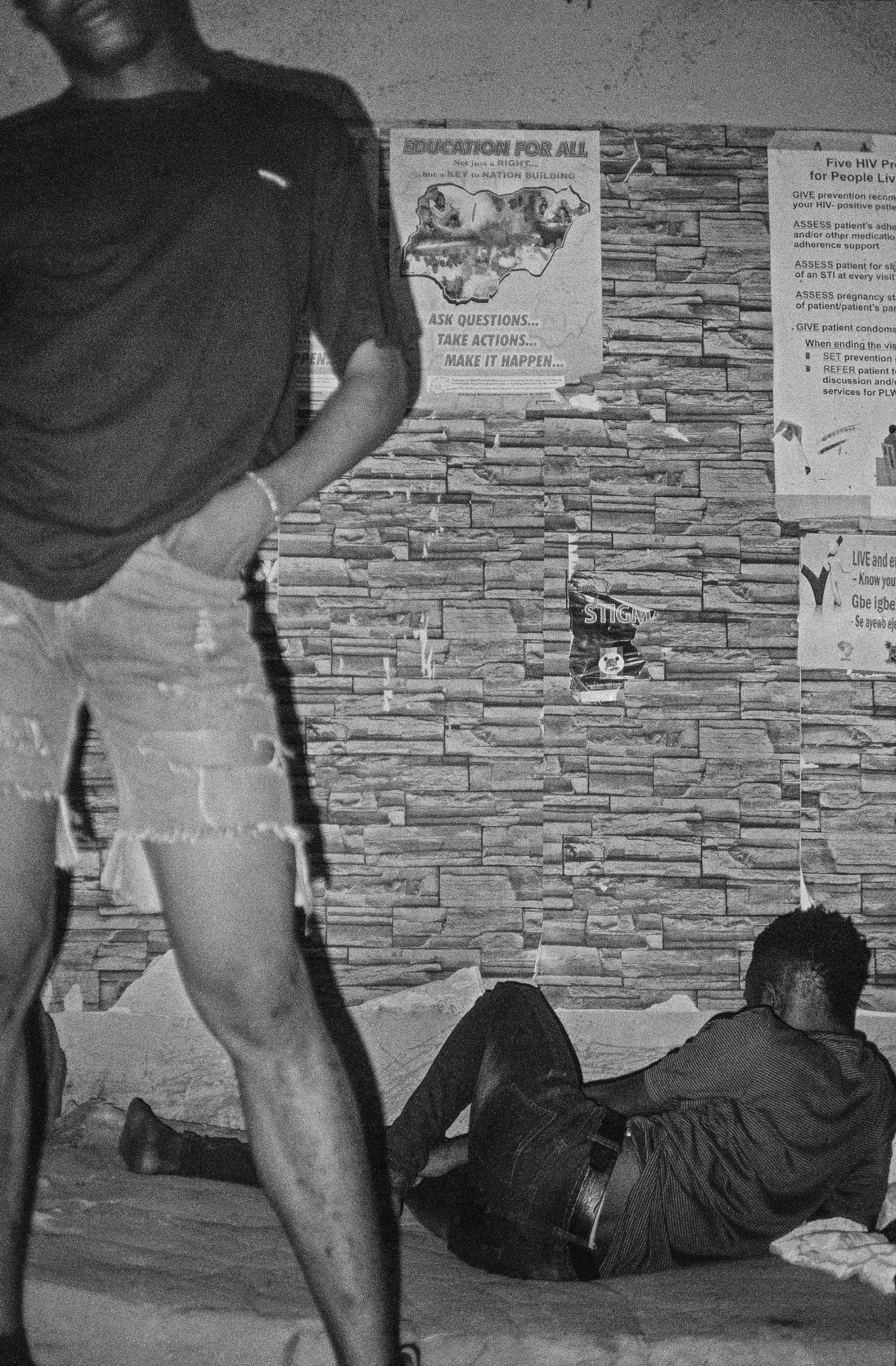
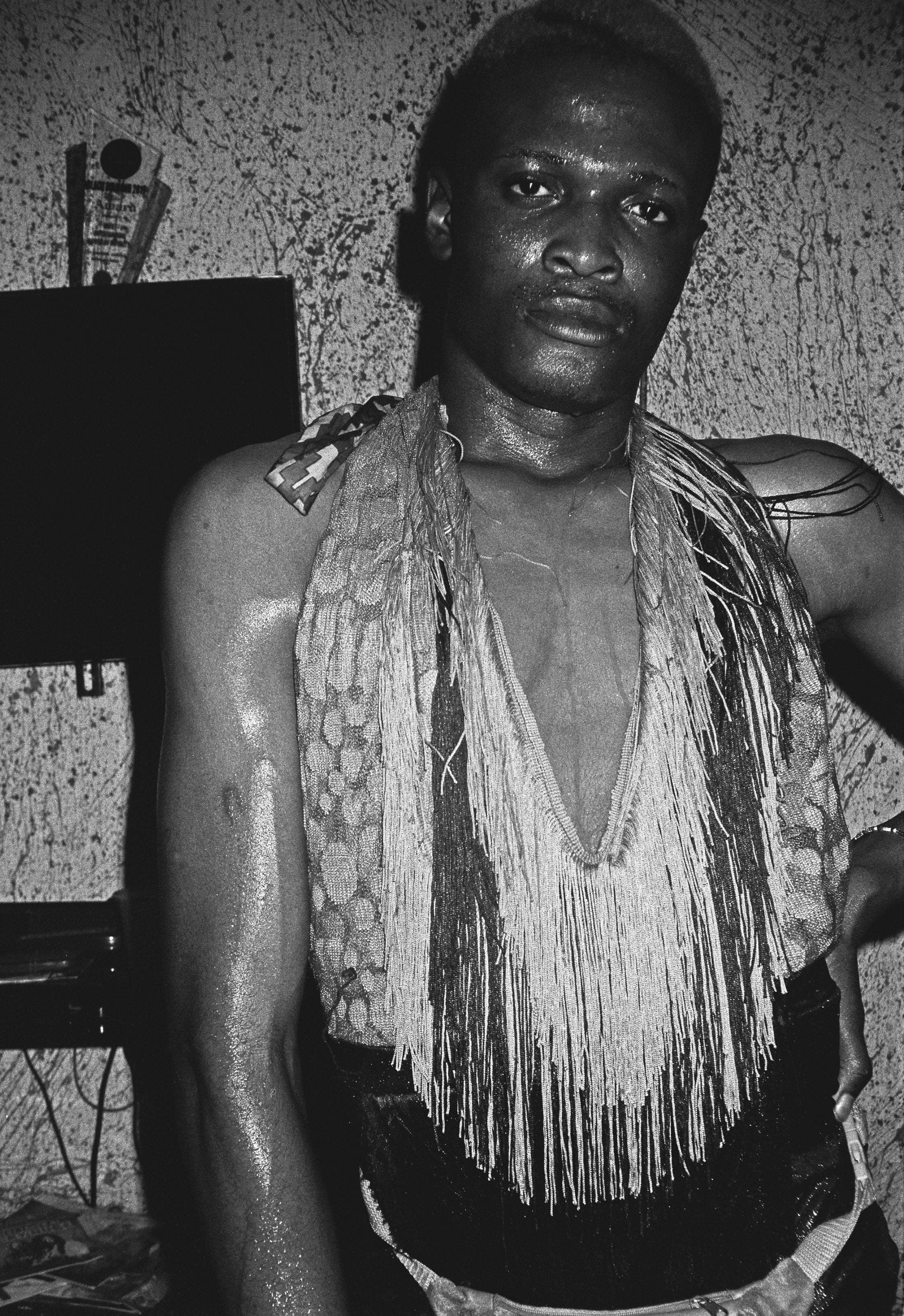
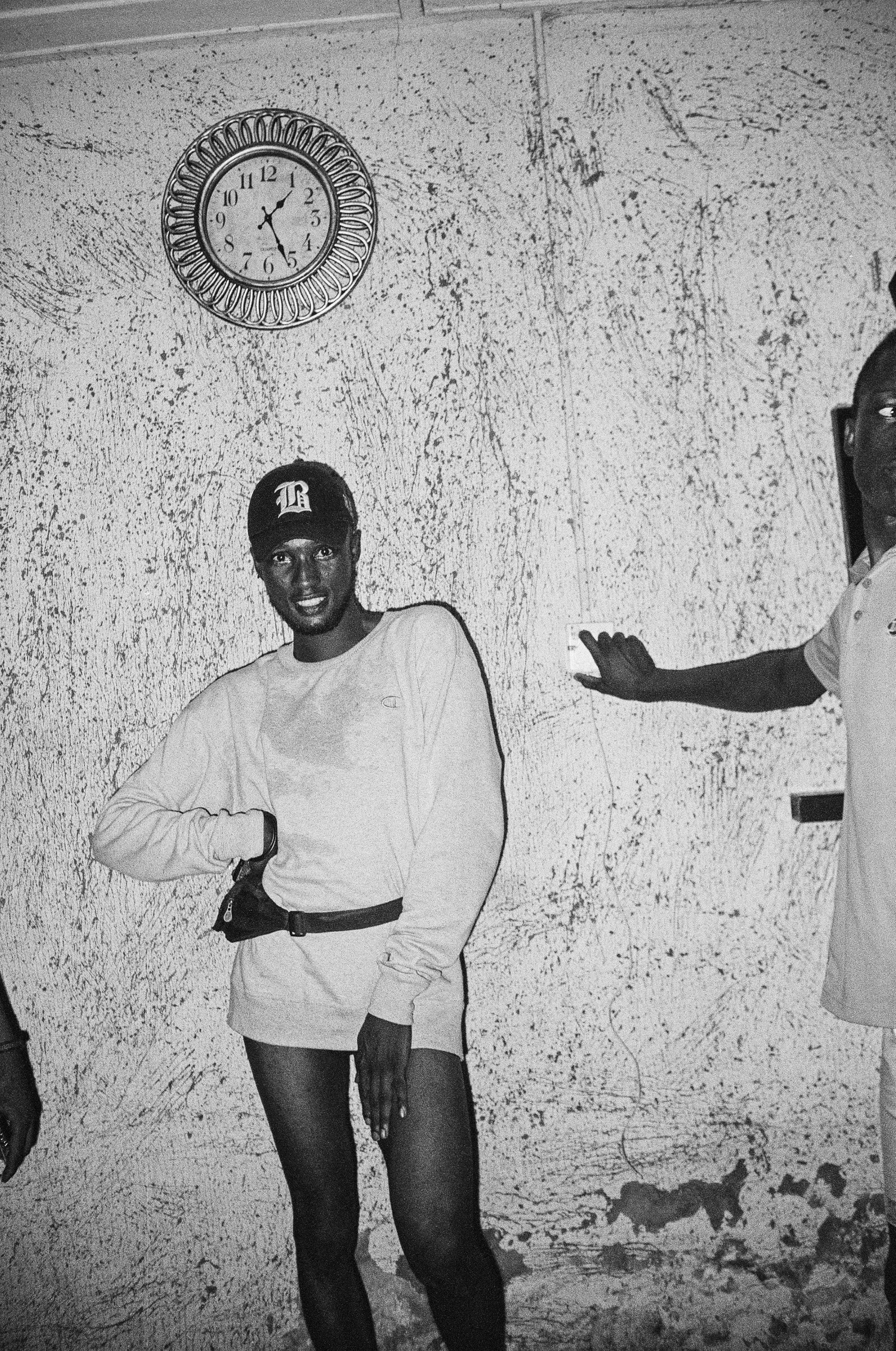
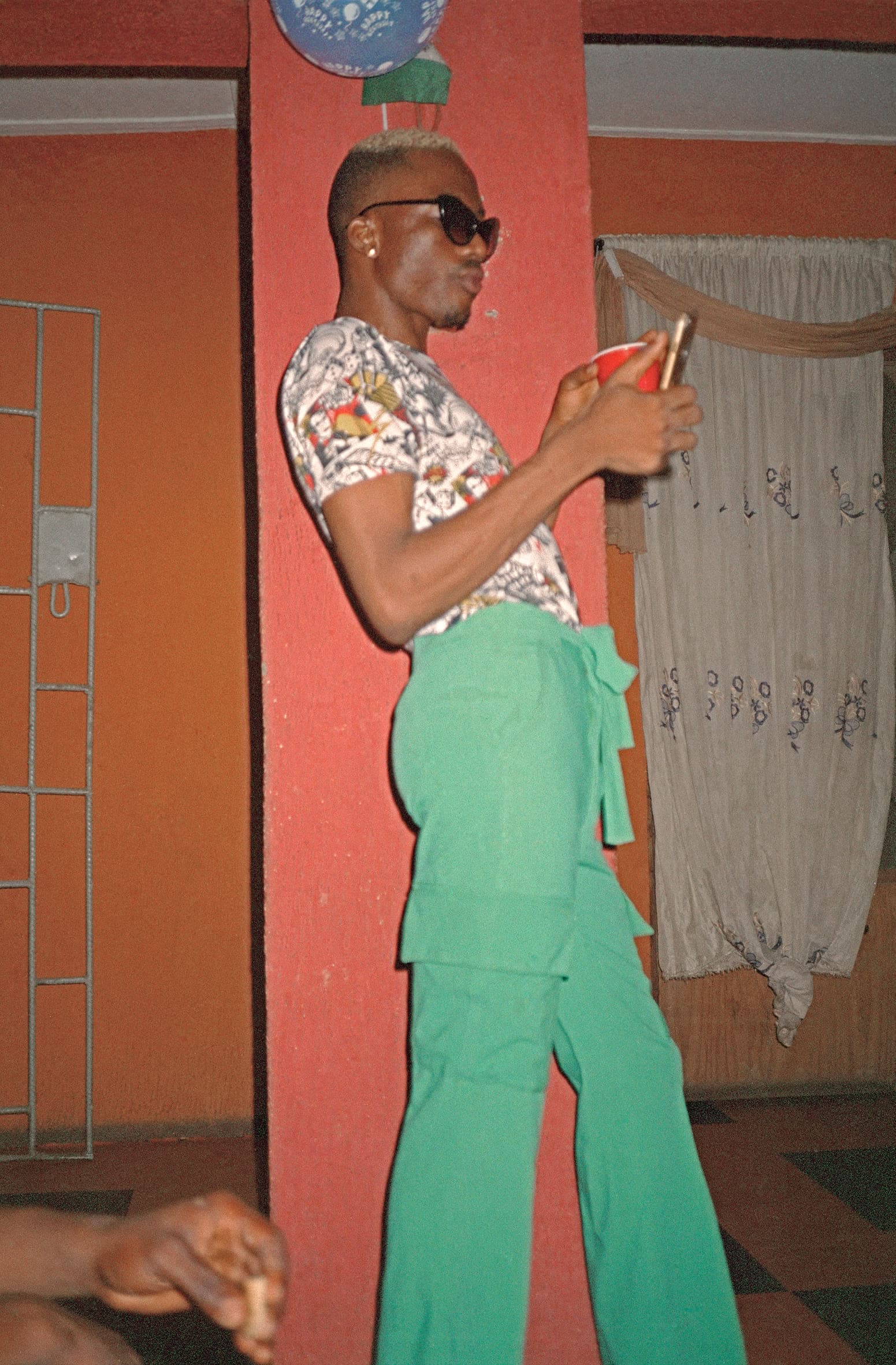
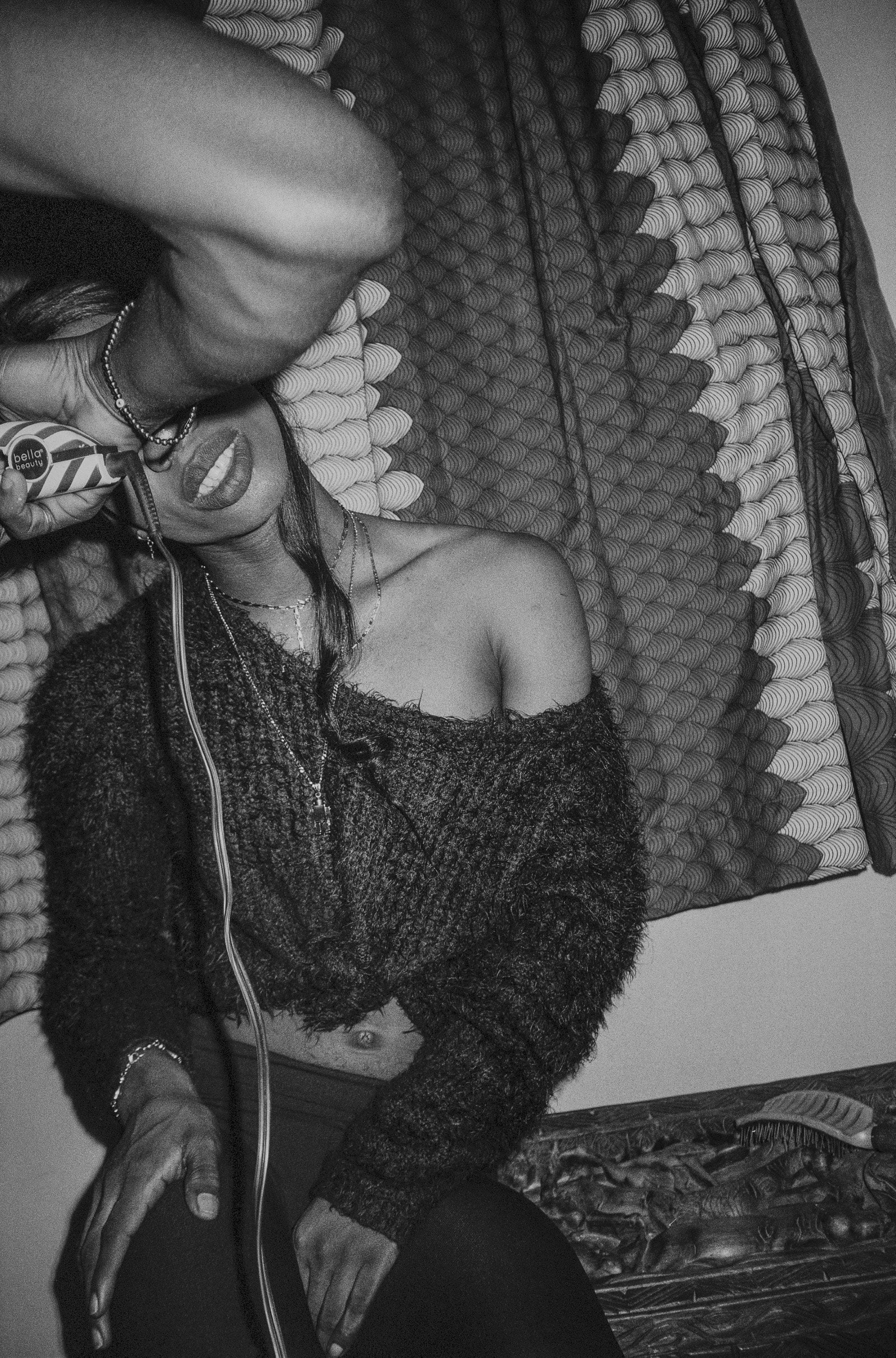
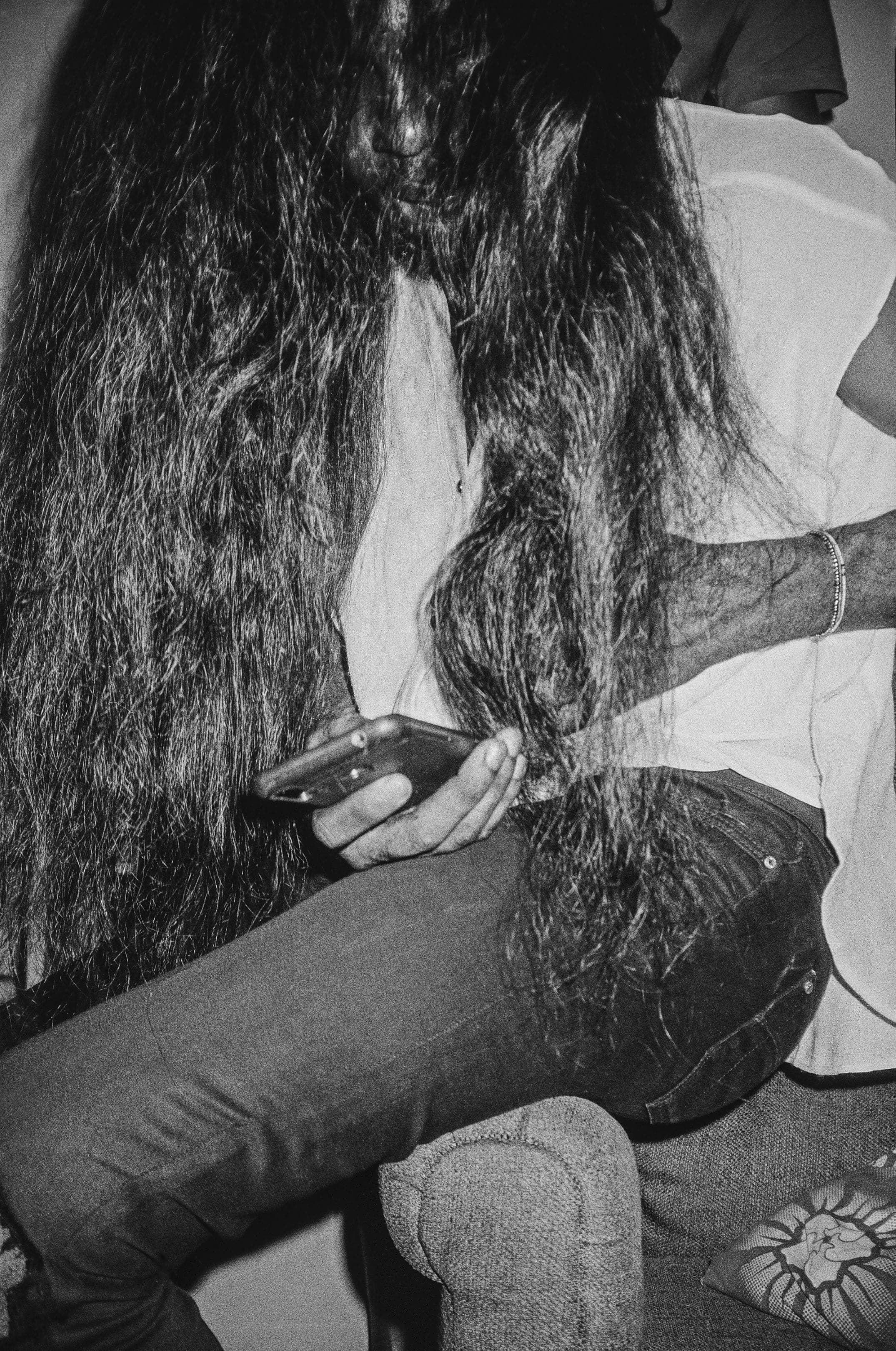
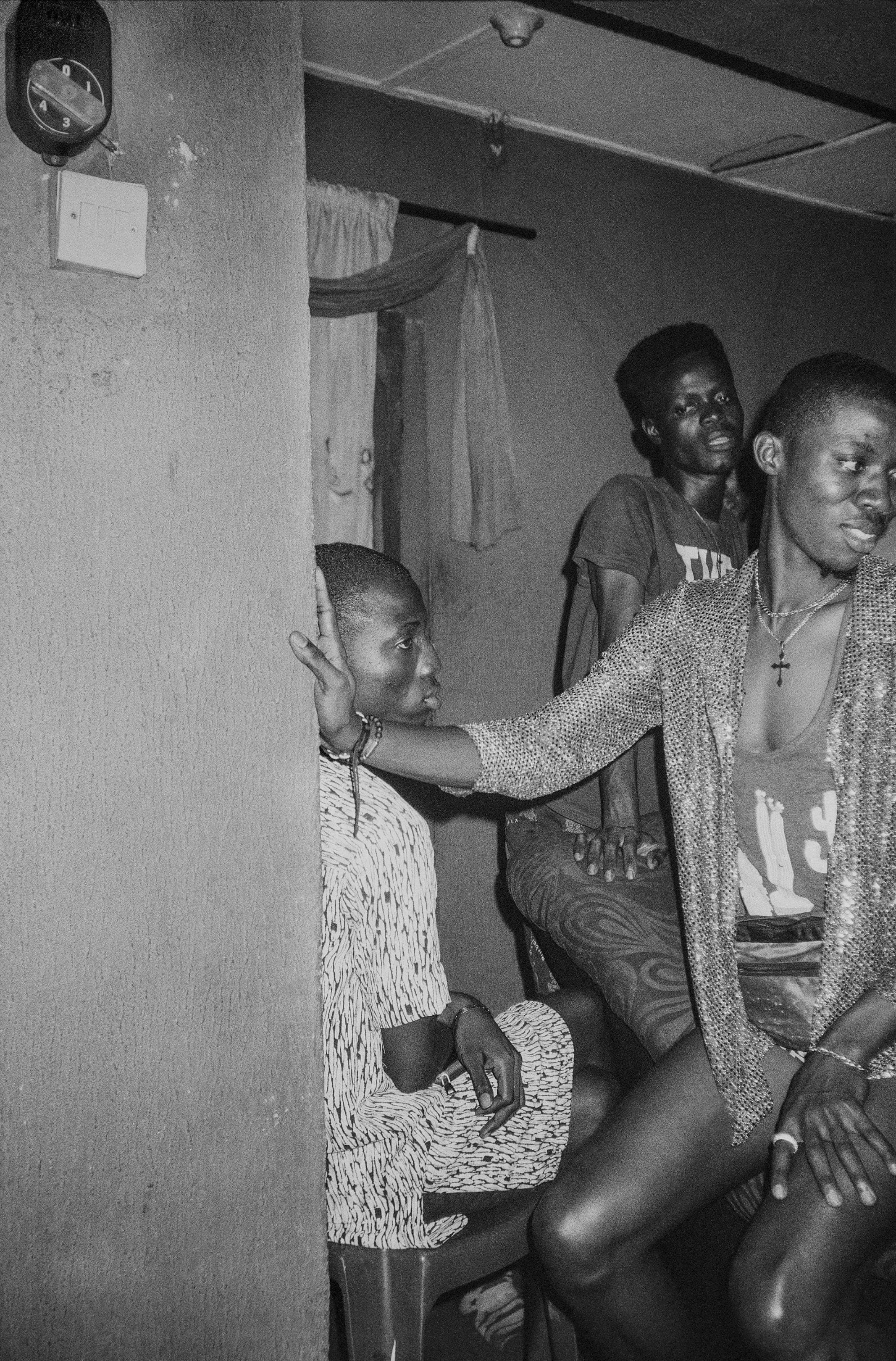
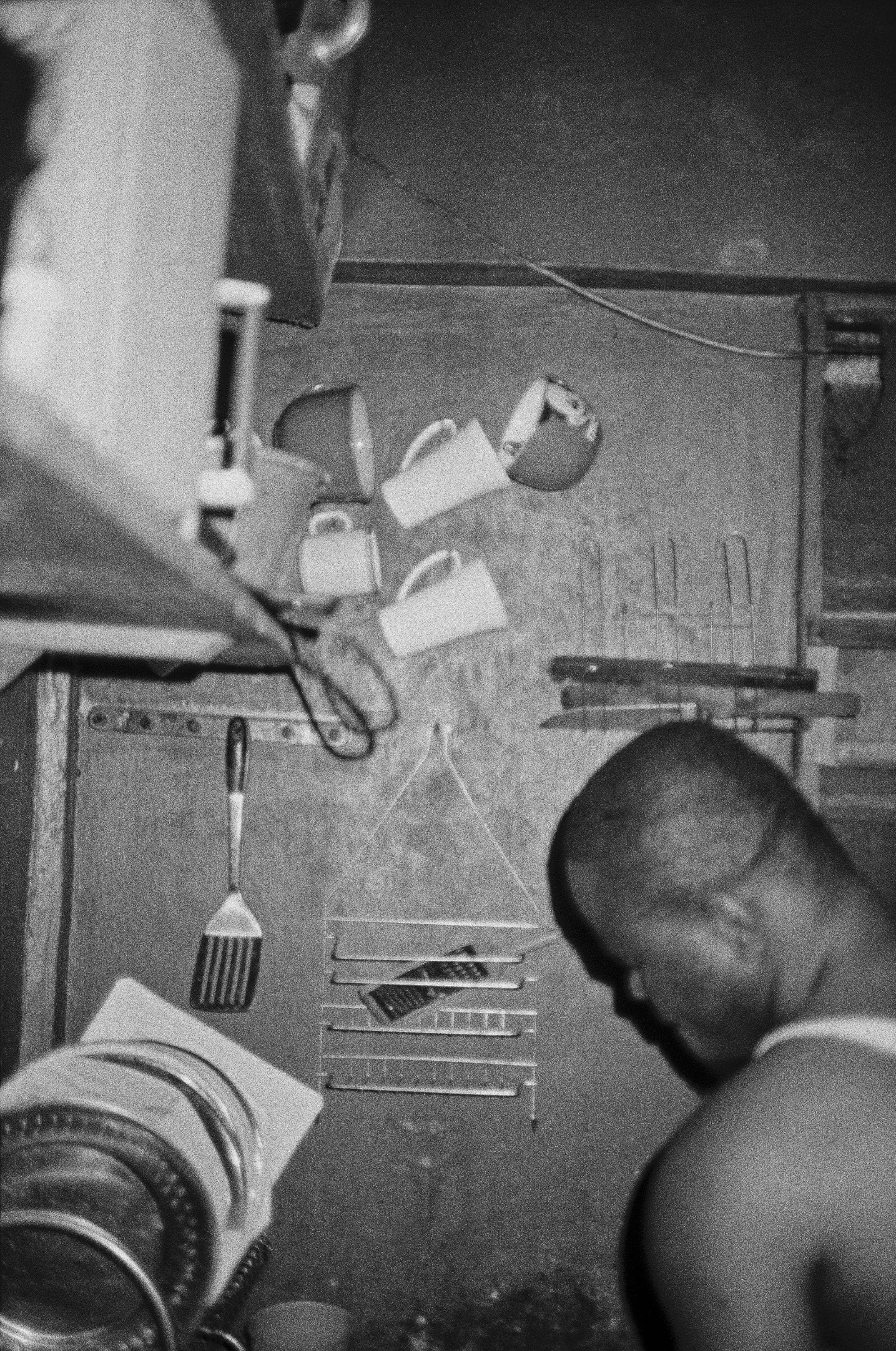
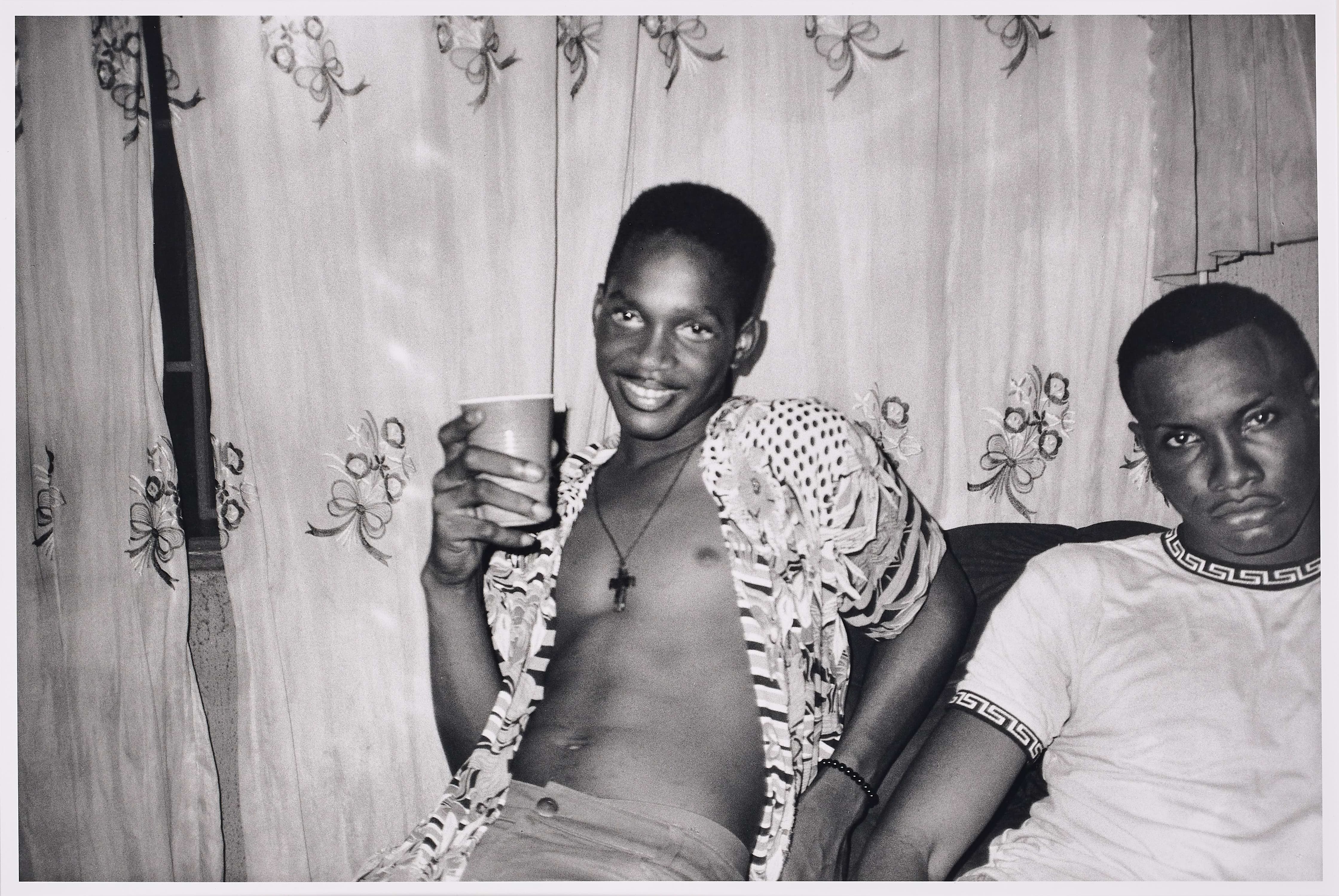
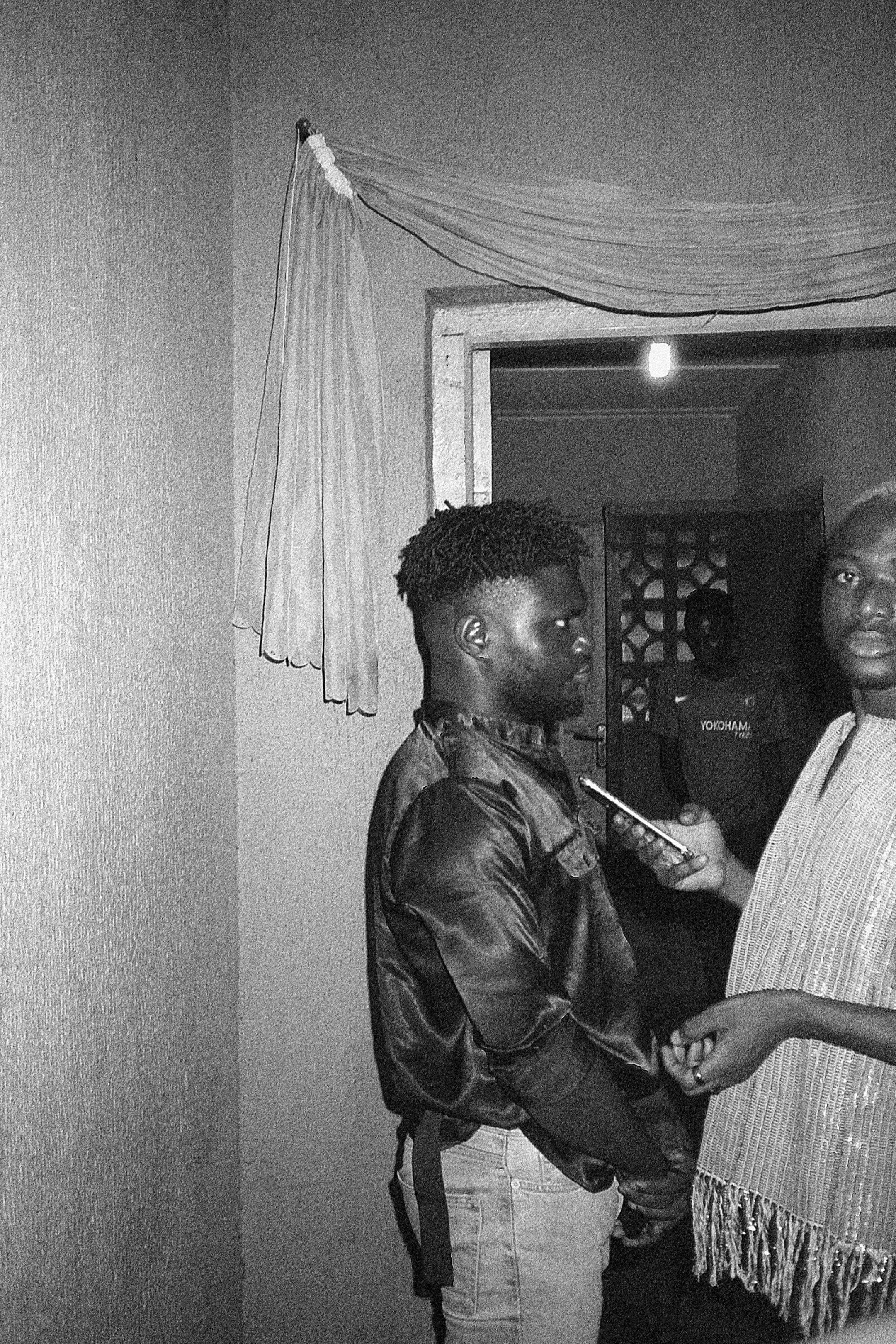
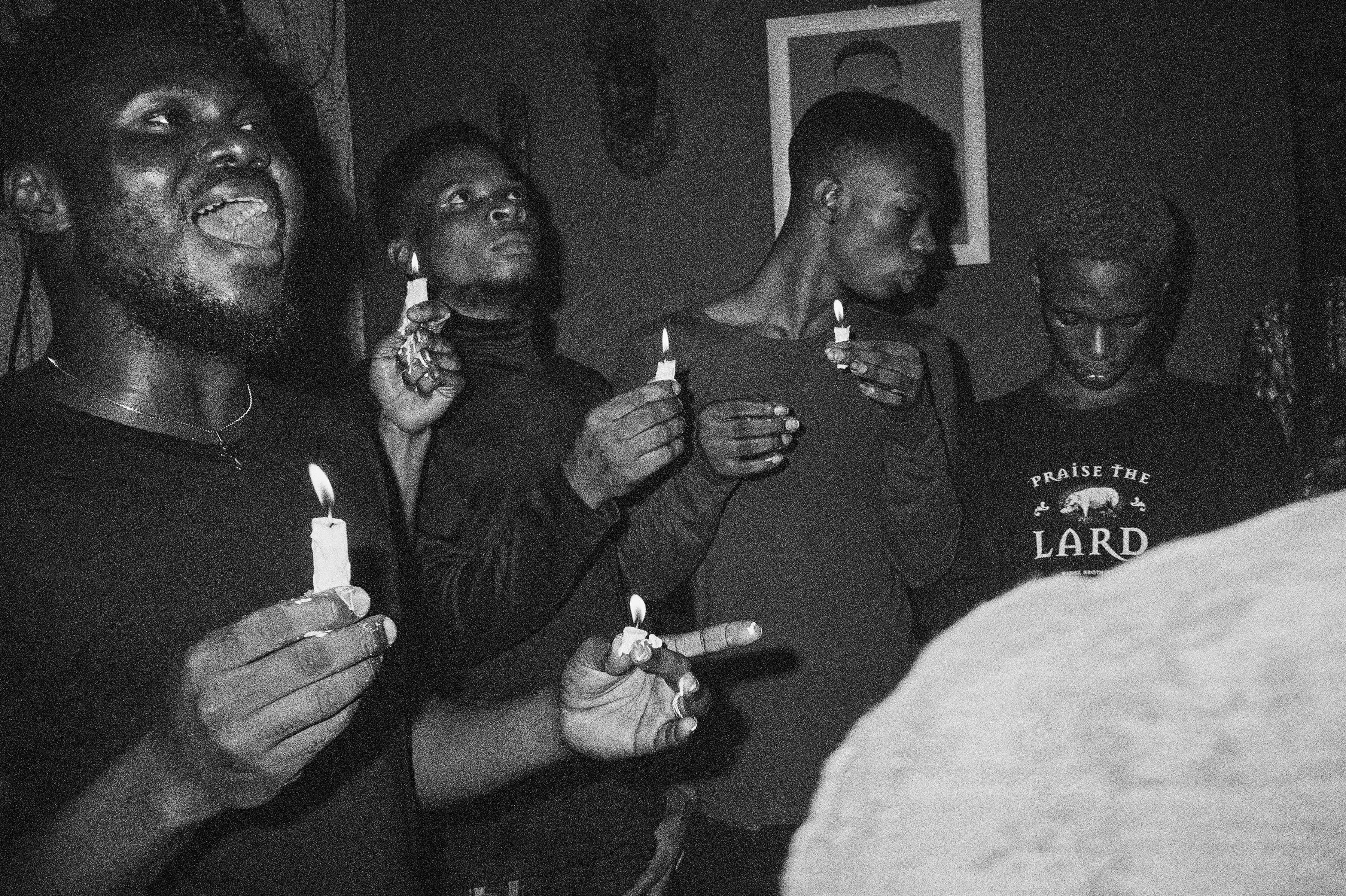
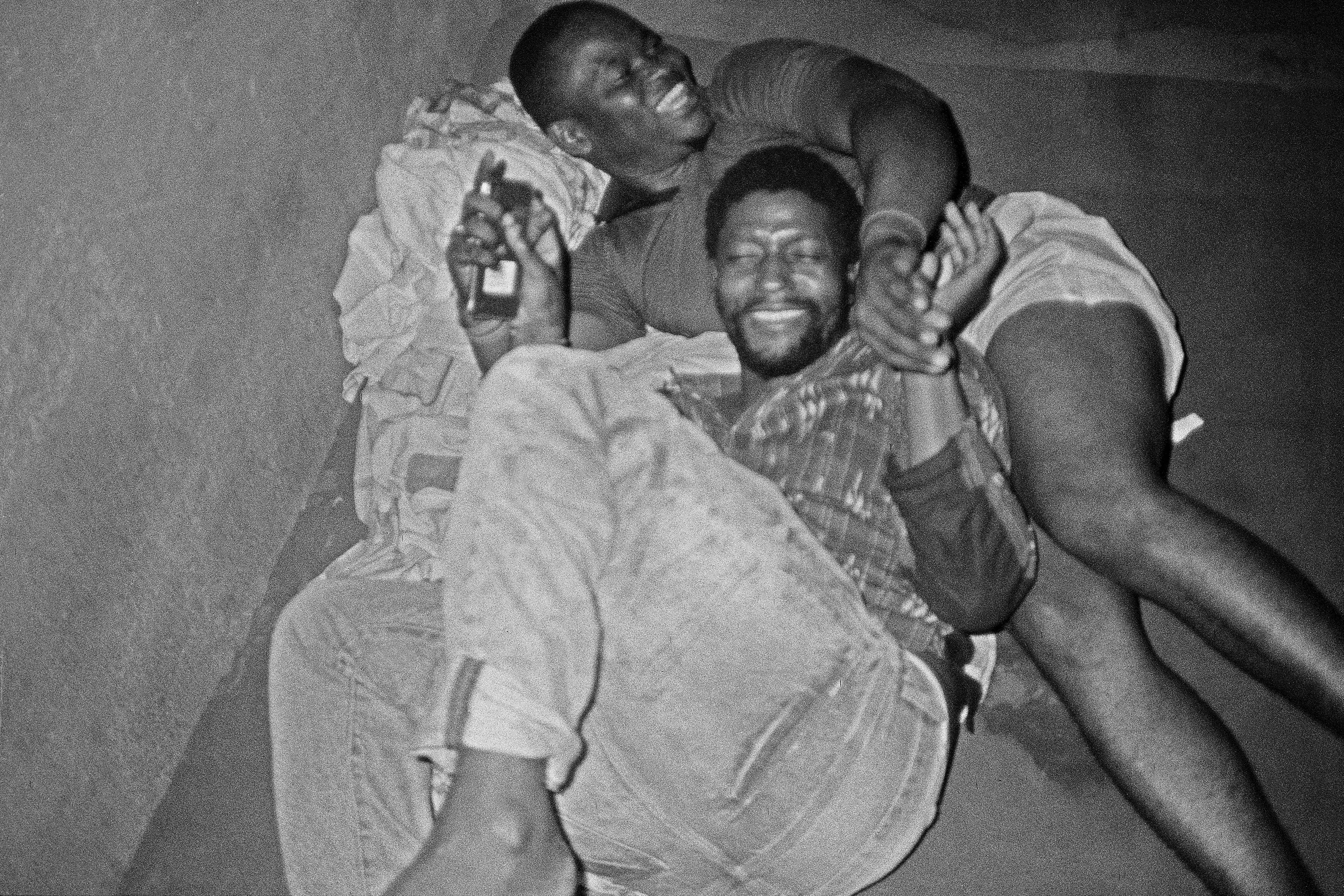
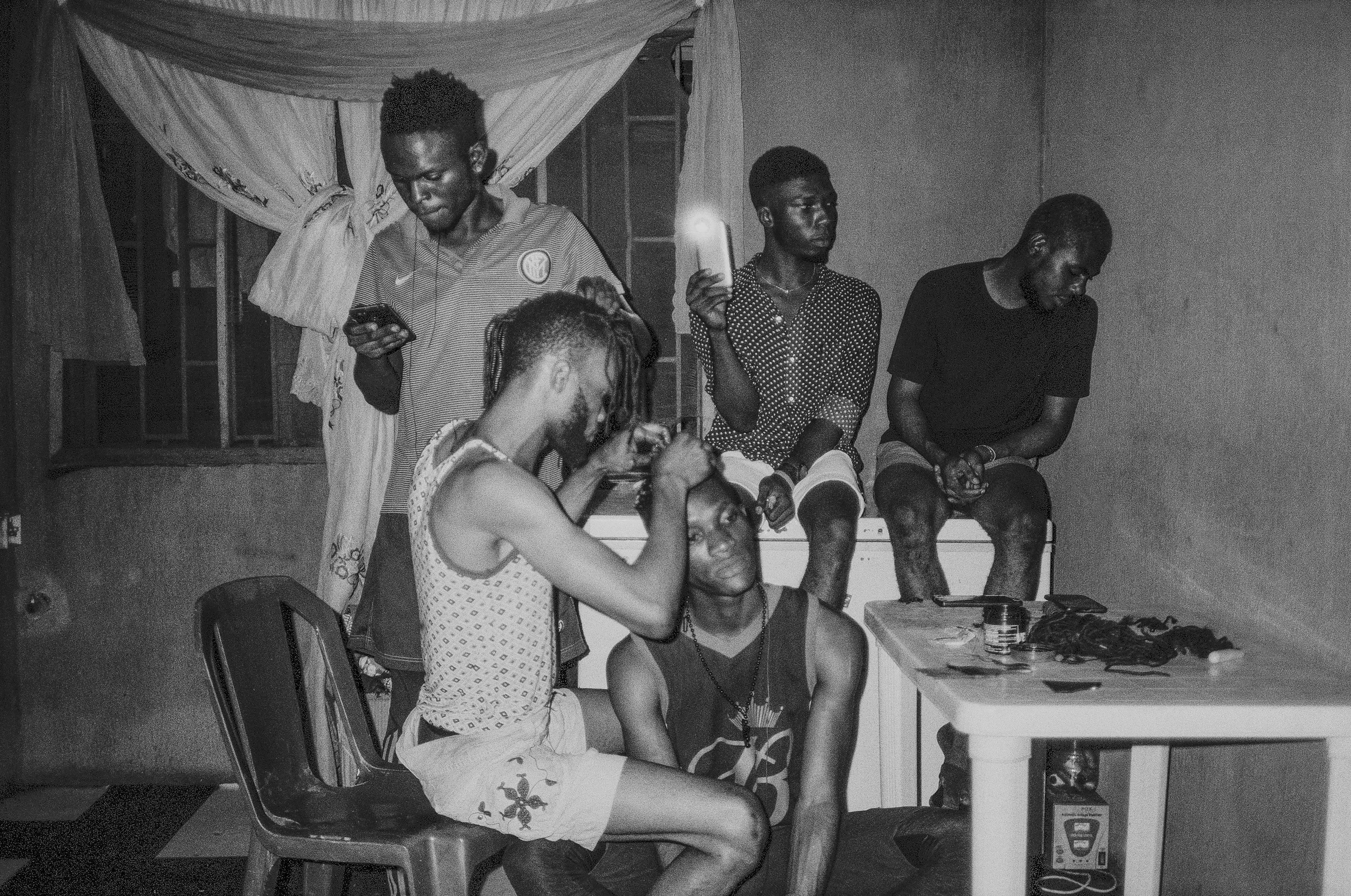
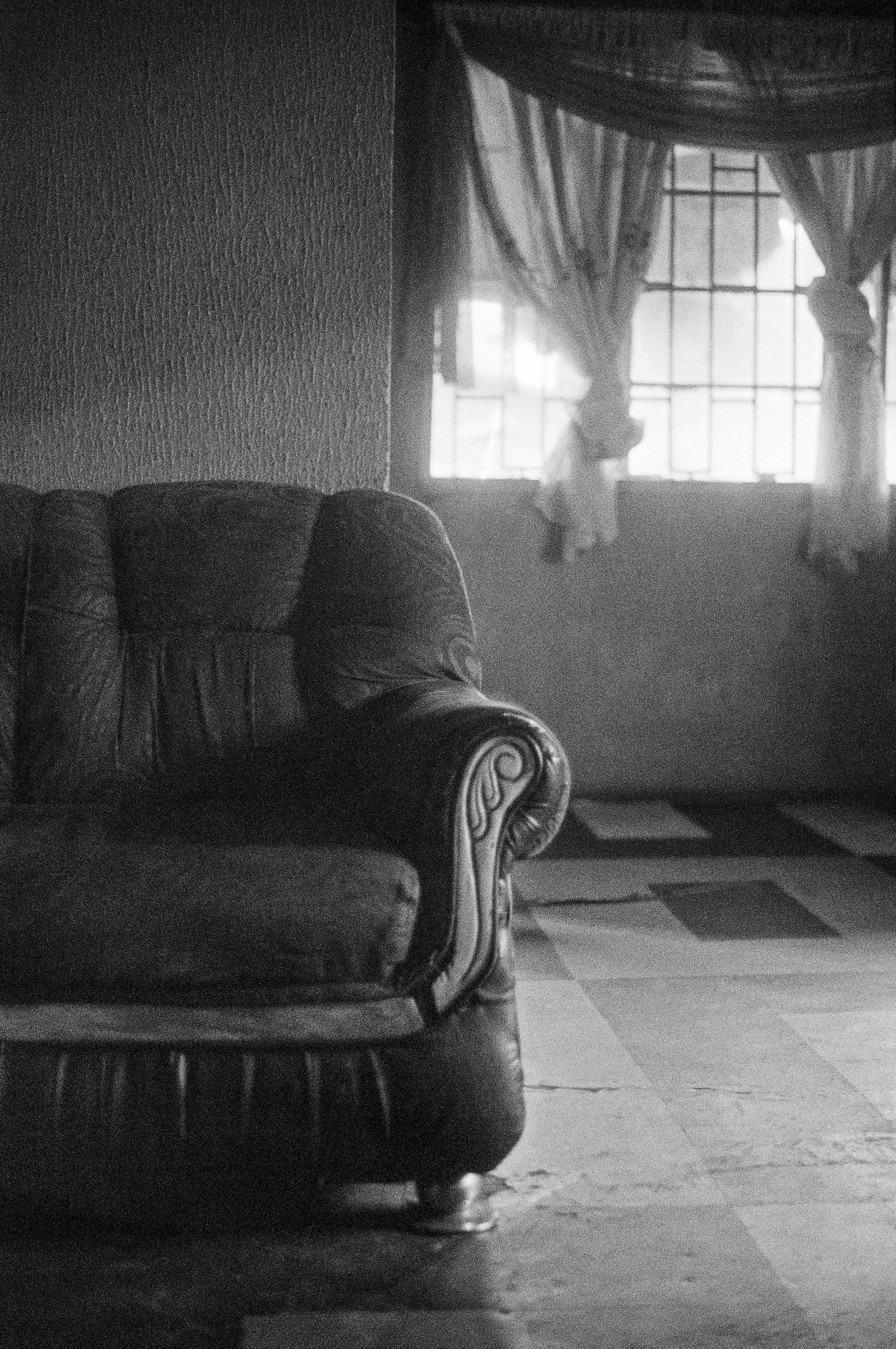
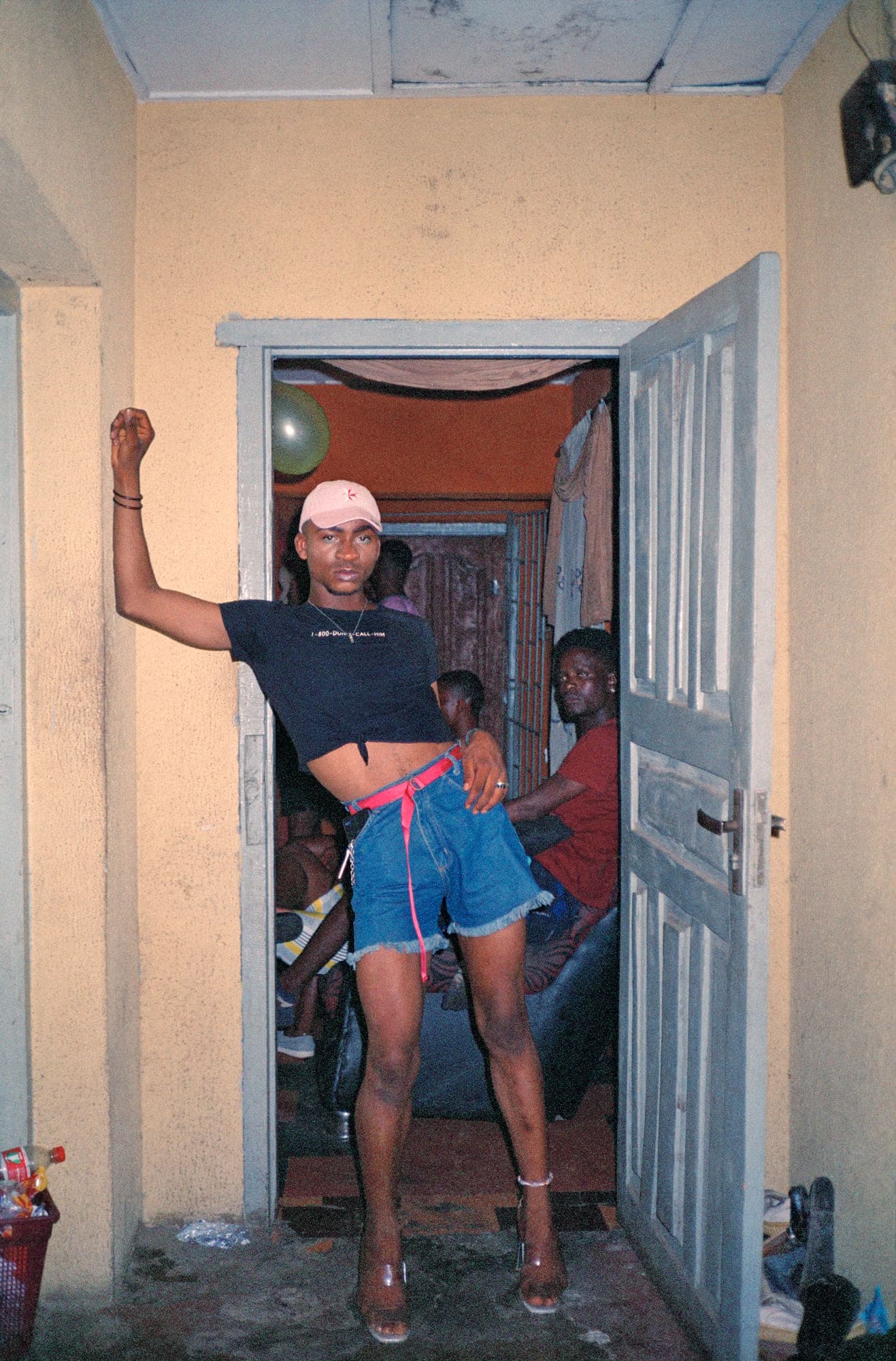
The Royal House of Allure is the name of a (safe) House on mainland Lagos where members of the queer community in need of boarding (due to various circumstances) live together. Mlangeni spent six weeks in Lagos photographing the queer community in this house. This resulted in a series of images bearing the same name. The series sits firmly within Mlangeni’s continuing survey of the most challenging, beautiful and confounding aspects of the human experience. The Royal House of Allure contains images that may at first appear simple, whereas a longer and deeper perusal reveals nuanced prompts that urge us towards complexities behind representation. The images diverge at a single specific point; those that display fantasy through glamour where subjects actively pose for the camera and those that offer quieter banal moments where subjects are simply going on about their day at the house.
The Royal House of Allure forms part of Mlangeni’s broader practice of (re)imaging and (re) imagining vulnerable bodies as safe, seen and worthy of protection and celebration.
The Royal House of Allure is the name of a (safe) House on mainland Lagos where members of the queer community in need of boarding (due to various circumstances) live together. Mlangeni spent six weeks in Lagos photographing the queer community in this house. This resulted in a series of images bearing the same name. The series sits firmly within Mlangeni’s continuing survey of the most challenging, beautiful and confounding aspects of the human experience. The Royal House of Allure contains images that may at first appear simple, whereas a longer and deeper perusal reveals nuanced prompts that urge us towards complexities behind representation. The images diverge at a single specific point; those that display fantasy through glamour where subjects actively pose for the camera and those that offer quieter banal moments where subjects are simply going on about their day at the house.
The Royal House of Allure forms part of Mlangeni’s broader practice of (re)imaging and (re) imagining vulnerable bodies as safe, seen and worthy of protection and celebration.
The Royal House of Allure is the name of a (safe) House on mainland Lagos where members of the queer community in need of boarding (due to various circumstances) live together. Mlangeni spent six weeks in Lagos photographing the queer community in this house. This resulted in a series of images bearing the same name. The series sits firmly within Mlangeni’s continuing survey of the most challenging, beautiful and confounding aspects of the human experience. The Royal House of Allure contains images that may at first appear simple, whereas a longer and deeper perusal reveals nuanced prompts that urge us towards complexities behind representation. The images diverge at a single specific point; those that display fantasy through glamour where subjects actively pose for the camera and those that offer quieter banal moments where subjects are simply going on about their day at the house.
The Royal House of Allure forms part of Mlangeni’s broader practice of (re)imaging and (re) imagining vulnerable bodies as safe, seen and worthy of protection and celebration.
The Royal House of Allure is the name of a (safe) House on mainland Lagos where members of the queer community in need of boarding (due to various circumstances) live together. Mlangeni spent six weeks in Lagos photographing the queer community in this house. This resulted in a series of images bearing the same name. The series sits firmly within Mlangeni’s continuing survey of the most challenging, beautiful and confounding aspects of the human experience. The Royal House of Allure contains images that may at first appear simple, whereas a longer and deeper perusal reveals nuanced prompts that urge us towards complexities behind representation. The images diverge at a single specific point; those that display fantasy through glamour where subjects actively pose for the camera and those that offer quieter banal moments where subjects are simply going on about their day at the house.
The Royal House of Allure forms part of Mlangeni’s broader practice of (re)imaging and (re) imagining vulnerable bodies as safe, seen and worthy of protection and celebration.
The Royal House of Allure is the name of a (safe) House on mainland Lagos where members of the queer community in need of boarding (due to various circumstances) live together. Mlangeni spent six weeks in Lagos photographing the queer community in this house. This resulted in a series of images bearing the same name. The series sits firmly within Mlangeni’s continuing survey of the most challenging, beautiful and confounding aspects of the human experience. The Royal House of Allure contains images that may at first appear simple, whereas a longer and deeper perusal reveals nuanced prompts that urge us towards complexities behind representation. The images diverge at a single specific point; those that display fantasy through glamour where subjects actively pose for the camera and those that offer quieter banal moments where subjects are simply going on about their day at the house.
The Royal House of Allure forms part of Mlangeni’s broader practice of (re)imaging and (re) imagining vulnerable bodies as safe, seen and worthy of protection and celebration.
The Royal House of Allure is the name of a (safe) House on mainland Lagos where members of the queer community in need of boarding (due to various circumstances) live together. Mlangeni spent six weeks in Lagos photographing the queer community in this house. This resulted in a series of images bearing the same name. The series sits firmly within Mlangeni’s continuing survey of the most challenging, beautiful and confounding aspects of the human experience. The Royal House of Allure contains images that may at first appear simple, whereas a longer and deeper perusal reveals nuanced prompts that urge us towards complexities behind representation. The images diverge at a single specific point; those that display fantasy through glamour where subjects actively pose for the camera and those that offer quieter banal moments where subjects are simply going on about their day at the house.
The Royal House of Allure forms part of Mlangeni’s broader practice of (re)imaging and (re) imagining vulnerable bodies as safe, seen and worthy of protection and celebration.
The Royal House of Allure is the name of a (safe) House on mainland Lagos where members of the queer community in need of boarding (due to various circumstances) live together. Mlangeni spent six weeks in Lagos photographing the queer community in this house. This resulted in a series of images bearing the same name. The series sits firmly within Mlangeni’s continuing survey of the most challenging, beautiful and confounding aspects of the human experience. The Royal House of Allure contains images that may at first appear simple, whereas a longer and deeper perusal reveals nuanced prompts that urge us towards complexities behind representation. The images diverge at a single specific point; those that display fantasy through glamour where subjects actively pose for the camera and those that offer quieter banal moments where subjects are simply going on about their day at the house.
The Royal House of Allure forms part of Mlangeni’s broader practice of (re)imaging and (re) imagining vulnerable bodies as safe, seen and worthy of protection and celebration.
The Royal House of Allure is the name of a (safe) House on mainland Lagos where members of the queer community in need of boarding (due to various circumstances) live together. Mlangeni spent six weeks in Lagos photographing the queer community in this house. This resulted in a series of images bearing the same name. The series sits firmly within Mlangeni’s continuing survey of the most challenging, beautiful and confounding aspects of the human experience. The Royal House of Allure contains images that may at first appear simple, whereas a longer and deeper perusal reveals nuanced prompts that urge us towards complexities behind representation. The images diverge at a single specific point; those that display fantasy through glamour where subjects actively pose for the camera and those that offer quieter banal moments where subjects are simply going on about their day at the house.
The Royal House of Allure forms part of Mlangeni’s broader practice of (re)imaging and (re) imagining vulnerable bodies as safe, seen and worthy of protection and celebration.
The Royal House of Allure is the name of a (safe) House on mainland Lagos where members of the queer community in need of boarding (due to various circumstances) live together. Mlangeni spent six weeks in Lagos photographing the queer community in this house. This resulted in a series of images bearing the same name. The series sits firmly within Mlangeni’s continuing survey of the most challenging, beautiful and confounding aspects of the human experience. The Royal House of Allure contains images that may at first appear simple, whereas a longer and deeper perusal reveals nuanced prompts that urge us towards complexities behind representation. The images diverge at a single specific point; those that display fantasy through glamour where subjects actively pose for the camera and those that offer quieter banal moments where subjects are simply going on about their day at the house.
The Royal House of Allure forms part of Mlangeni’s broader practice of (re)imaging and (re) imagining vulnerable bodies as safe, seen and worthy of protection and celebration.
The Royal House of Allure is the name of a (safe) House on mainland Lagos where members of the queer community in need of boarding (due to various circumstances) live together. Mlangeni spent six weeks in Lagos photographing the queer community in this house. This resulted in a series of images bearing the same name. The series sits firmly within Mlangeni’s continuing survey of the most challenging, beautiful and confounding aspects of the human experience. The Royal House of Allure contains images that may at first appear simple, whereas a longer and deeper perusal reveals nuanced prompts that urge us towards complexities behind representation. The images diverge at a single specific point; those that display fantasy through glamour where subjects actively pose for the camera and those that offer quieter banal moments where subjects are simply going on about their day at the house.
The Royal House of Allure forms part of Mlangeni’s broader practice of (re)imaging and (re) imagining vulnerable bodies as safe, seen and worthy of protection and celebration.
The Royal House of Allure is the name of a (safe) House on mainland Lagos where members of the queer community in need of boarding (due to various circumstances) live together. Mlangeni spent six weeks in Lagos photographing the queer community in this house. This resulted in a series of images bearing the same name. The series sits firmly within Mlangeni’s continuing survey of the most challenging, beautiful and confounding aspects of the human experience. The Royal House of Allure contains images that may at first appear simple, whereas a longer and deeper perusal reveals nuanced prompts that urge us towards complexities behind representation. The images diverge at a single specific point; those that display fantasy through glamour where subjects actively pose for the camera and those that offer quieter banal moments where subjects are simply going on about their day at the house.
The Royal House of Allure forms part of Mlangeni’s broader practice of (re)imaging and (re) imagining vulnerable bodies as safe, seen and worthy of protection and celebration.
The Royal House of Allure is the name of a (safe) House on mainland Lagos where members of the queer community in need of boarding (due to various circumstances) live together. Mlangeni spent six weeks in Lagos photographing the queer community in this house. This resulted in a series of images bearing the same name. The series sits firmly within Mlangeni’s continuing survey of the most challenging, beautiful and confounding aspects of the human experience. The Royal House of Allure contains images that may at first appear simple, whereas a longer and deeper perusal reveals nuanced prompts that urge us towards complexities behind representation. The images diverge at a single specific point; those that display fantasy through glamour where subjects actively pose for the camera and those that offer quieter banal moments where subjects are simply going on about their day at the house.
The Royal House of Allure forms part of Mlangeni’s broader practice of (re)imaging and (re) imagining vulnerable bodies as safe, seen and worthy of protection and celebration.
The Royal House of Allure is the name of a (safe) House on mainland Lagos where members of the queer community in need of boarding (due to various circumstances) live together. Mlangeni spent six weeks in Lagos photographing the queer community in this house. This resulted in a series of images bearing the same name. The series sits firmly within Mlangeni’s continuing survey of the most challenging, beautiful and confounding aspects of the human experience. The Royal House of Allure contains images that may at first appear simple, whereas a longer and deeper perusal reveals nuanced prompts that urge us towards complexities behind representation. The images diverge at a single specific point; those that display fantasy through glamour where subjects actively pose for the camera and those that offer quieter banal moments where subjects are simply going on about their day at the house.
The Royal House of Allure forms part of Mlangeni’s broader practice of (re)imaging and (re) imagining vulnerable bodies as safe, seen and worthy of protection and celebration.
The Royal House of Allure is the name of a (safe) House on mainland Lagos where members of the queer community in need of boarding (due to various circumstances) live together. Mlangeni spent six weeks in Lagos photographing the queer community in this house. This resulted in a series of images bearing the same name. The series sits firmly within Mlangeni’s continuing survey of the most challenging, beautiful and confounding aspects of the human experience. The Royal House of Allure contains images that may at first appear simple, whereas a longer and deeper perusal reveals nuanced prompts that urge us towards complexities behind representation. The images diverge at a single specific point; those that display fantasy through glamour where subjects actively pose for the camera and those that offer quieter banal moments where subjects are simply going on about their day at the house.
The Royal House of Allure forms part of Mlangeni’s broader practice of (re)imaging and (re) imagining vulnerable bodies as safe, seen and worthy of protection and celebration.
The Royal House of Allure is the name of a (safe) House on mainland Lagos where members of the queer community in need of boarding (due to various circumstances) live together. Mlangeni spent six weeks in Lagos photographing the queer community in this house. This resulted in a series of images bearing the same name. The series sits firmly within Mlangeni’s continuing survey of the most challenging, beautiful and confounding aspects of the human experience. The Royal House of Allure contains images that may at first appear simple, whereas a longer and deeper perusal reveals nuanced prompts that urge us towards complexities behind representation. The images diverge at a single specific point; those that display fantasy through glamour where subjects actively pose for the camera and those that offer quieter banal moments where subjects are simply going on about their day at the house.
The Royal House of Allure forms part of Mlangeni’s broader practice of (re)imaging and (re) imagining vulnerable bodies as safe, seen and worthy of protection and celebration.
The Royal House of Allure is the name of a (safe) House on mainland Lagos where members of the queer community in need of boarding (due to various circumstances) live together. Mlangeni spent six weeks in Lagos photographing the queer community in this house. This resulted in a series of images bearing the same name. The series sits firmly within Mlangeni’s continuing survey of the most challenging, beautiful and confounding aspects of the human experience. The Royal House of Allure contains images that may at first appear simple, whereas a longer and deeper perusal reveals nuanced prompts that urge us towards complexities behind representation. The images diverge at a single specific point; those that display fantasy through glamour where subjects actively pose for the camera and those that offer quieter banal moments where subjects are simply going on about their day at the house.
The Royal House of Allure forms part of Mlangeni’s broader practice of (re)imaging and (re) imagining vulnerable bodies as safe, seen and worthy of protection and celebration.
The Royal House of Allure is the name of a (safe) House on mainland Lagos where members of the queer community in need of boarding (due to various circumstances) live together. Mlangeni spent six weeks in Lagos photographing the queer community in this house. This resulted in a series of images bearing the same name. The series sits firmly within Mlangeni’s continuing survey of the most challenging, beautiful and confounding aspects of the human experience. The Royal House of Allure contains images that may at first appear simple, whereas a longer and deeper perusal reveals nuanced prompts that urge us towards complexities behind representation. The images diverge at a single specific point; those that display fantasy through glamour where subjects actively pose for the camera and those that offer quieter banal moments where subjects are simply going on about their day at the house.
The Royal House of Allure forms part of Mlangeni’s broader practice of (re)imaging and (re) imagining vulnerable bodies as safe, seen and worthy of protection and celebration.
The Royal House of Allure is the name of a (safe) House on mainland Lagos where members of the queer community in need of boarding (due to various circumstances) live together. Mlangeni spent six weeks in Lagos photographing the queer community in this house. This resulted in a series of images bearing the same name. The series sits firmly within Mlangeni’s continuing survey of the most challenging, beautiful and confounding aspects of the human experience. The Royal House of Allure contains images that may at first appear simple, whereas a longer and deeper perusal reveals nuanced prompts that urge us towards complexities behind representation. The images diverge at a single specific point; those that display fantasy through glamour where subjects actively pose for the camera and those that offer quieter banal moments where subjects are simply going on about their day at the house.
The Royal House of Allure forms part of Mlangeni’s broader practice of (re)imaging and (re) imagining vulnerable bodies as safe, seen and worthy of protection and celebration.
The Royal House of Allure is the name of a (safe) House on mainland Lagos where members of the queer community in need of boarding (due to various circumstances) live together. Mlangeni spent six weeks in Lagos photographing the queer community in this house. This resulted in a series of images bearing the same name. The series sits firmly within Mlangeni’s continuing survey of the most challenging, beautiful and confounding aspects of the human experience. The Royal House of Allure contains images that may at first appear simple, whereas a longer and deeper perusal reveals nuanced prompts that urge us towards complexities behind representation. The images diverge at a single specific point; those that display fantasy through glamour where subjects actively pose for the camera and those that offer quieter banal moments where subjects are simply going on about their day at the house.
The Royal House of Allure forms part of Mlangeni’s broader practice of (re)imaging and (re) imagining vulnerable bodies as safe, seen and worthy of protection and celebration.
The Royal House of Allure is the name of a (safe) House on mainland Lagos where members of the queer community in need of boarding (due to various circumstances) live together. Mlangeni spent six weeks in Lagos photographing the queer community in this house. This resulted in a series of images bearing the same name. The series sits firmly within Mlangeni’s continuing survey of the most challenging, beautiful and confounding aspects of the human experience. The Royal House of Allure contains images that may at first appear simple, whereas a longer and deeper perusal reveals nuanced prompts that urge us towards complexities behind representation. The images diverge at a single specific point; those that display fantasy through glamour where subjects actively pose for the camera and those that offer quieter banal moments where subjects are simply going on about their day at the house.
The Royal House of Allure forms part of Mlangeni’s broader practice of (re)imaging and (re) imagining vulnerable bodies as safe, seen and worthy of protection and celebration.
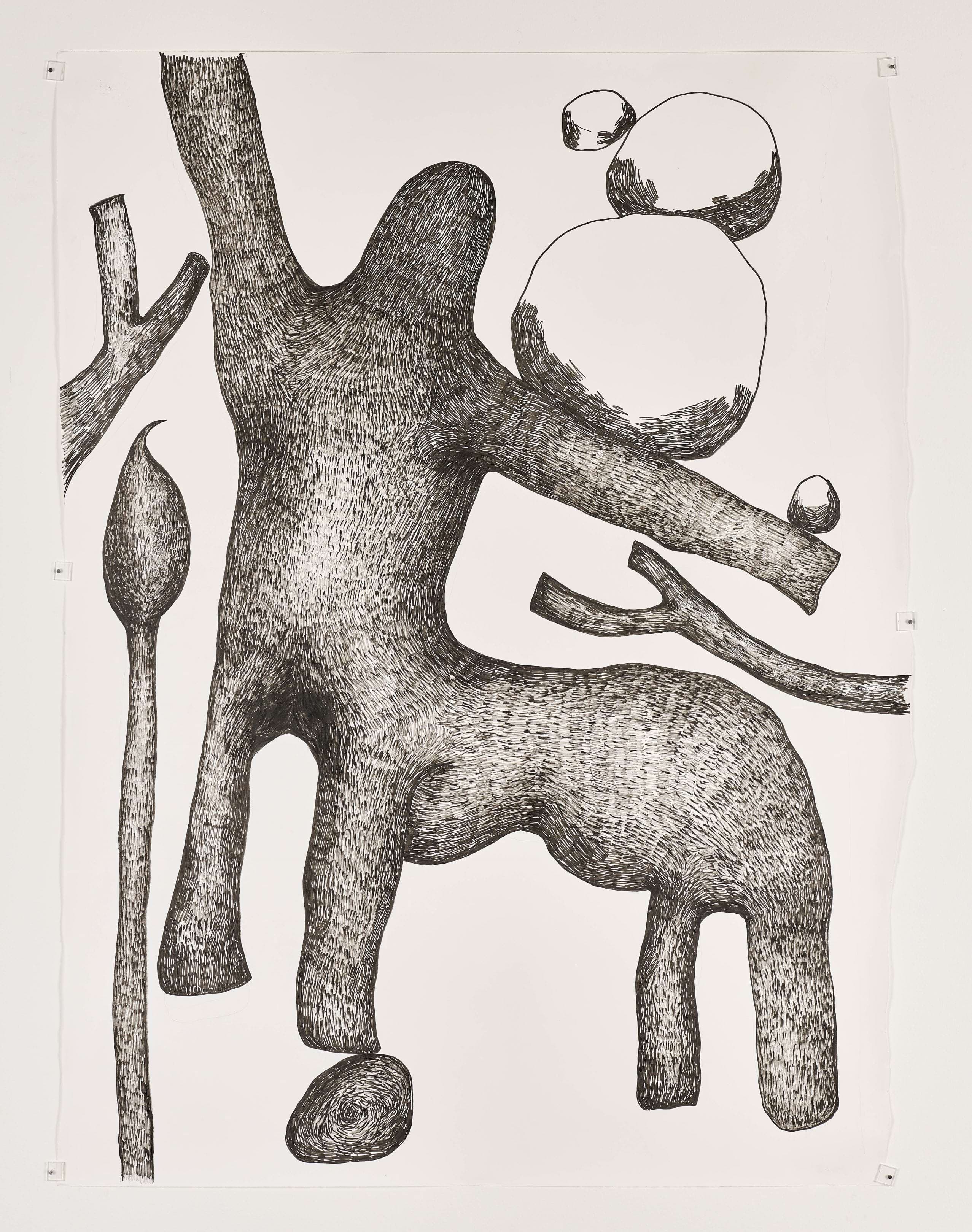
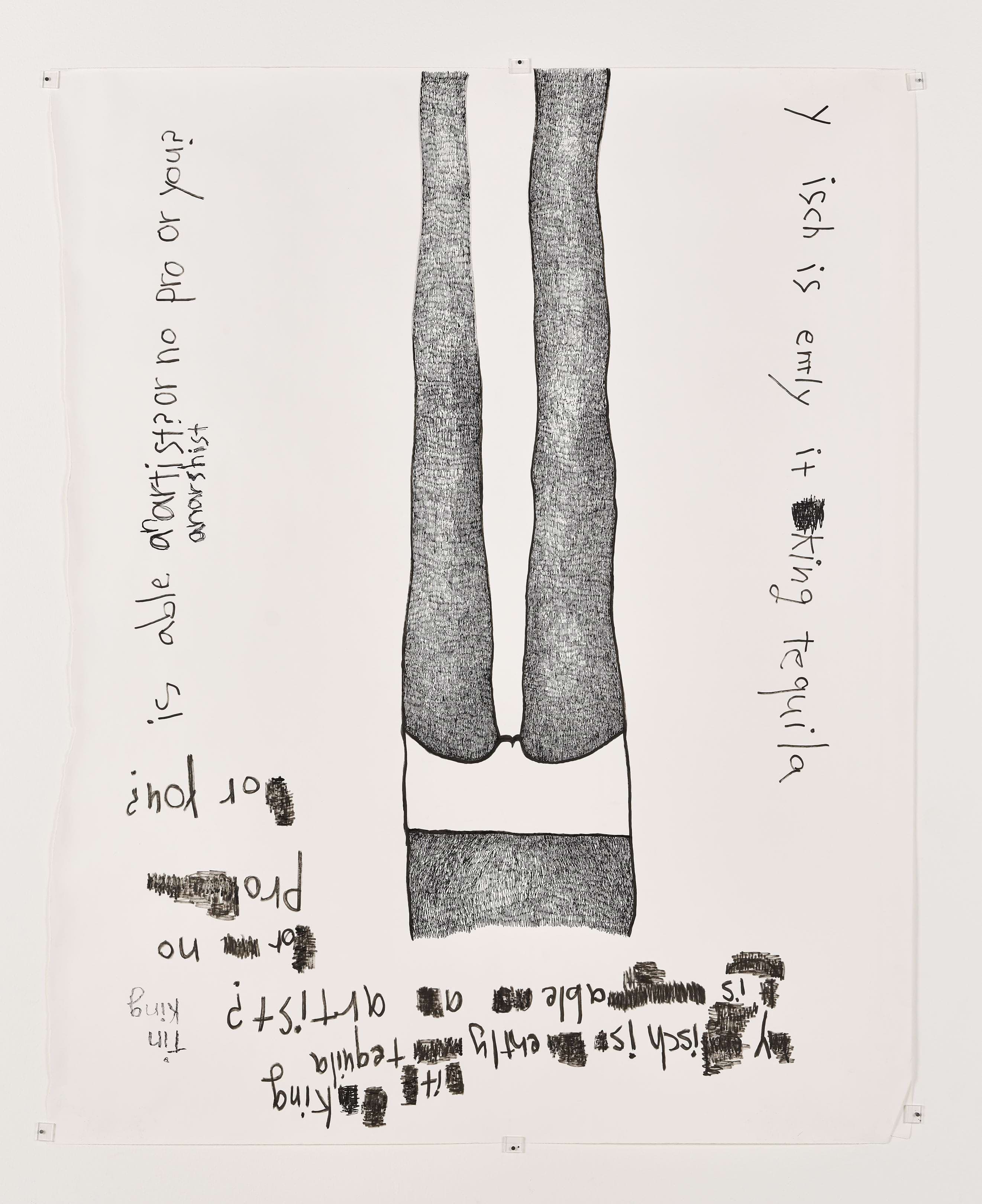
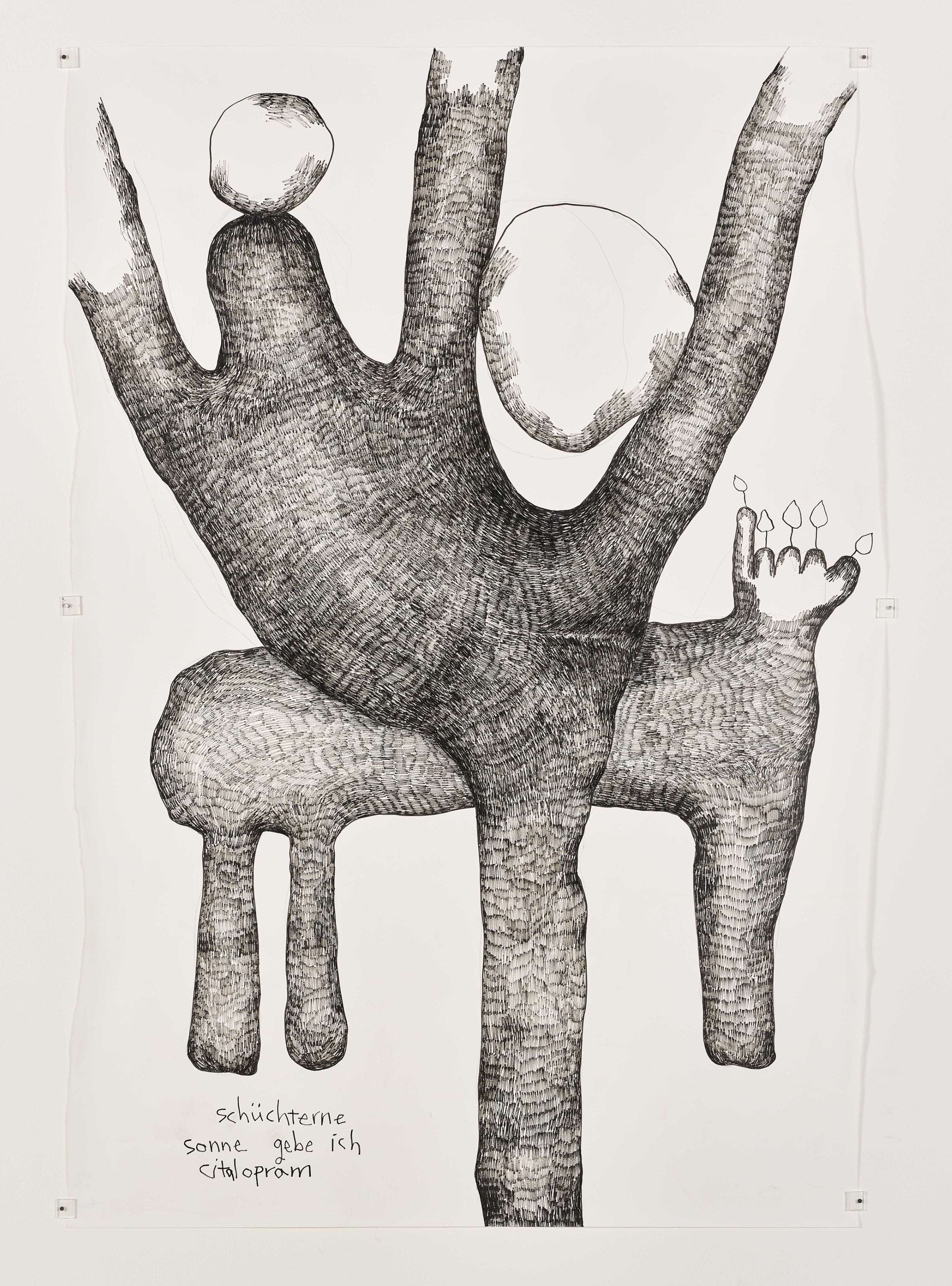
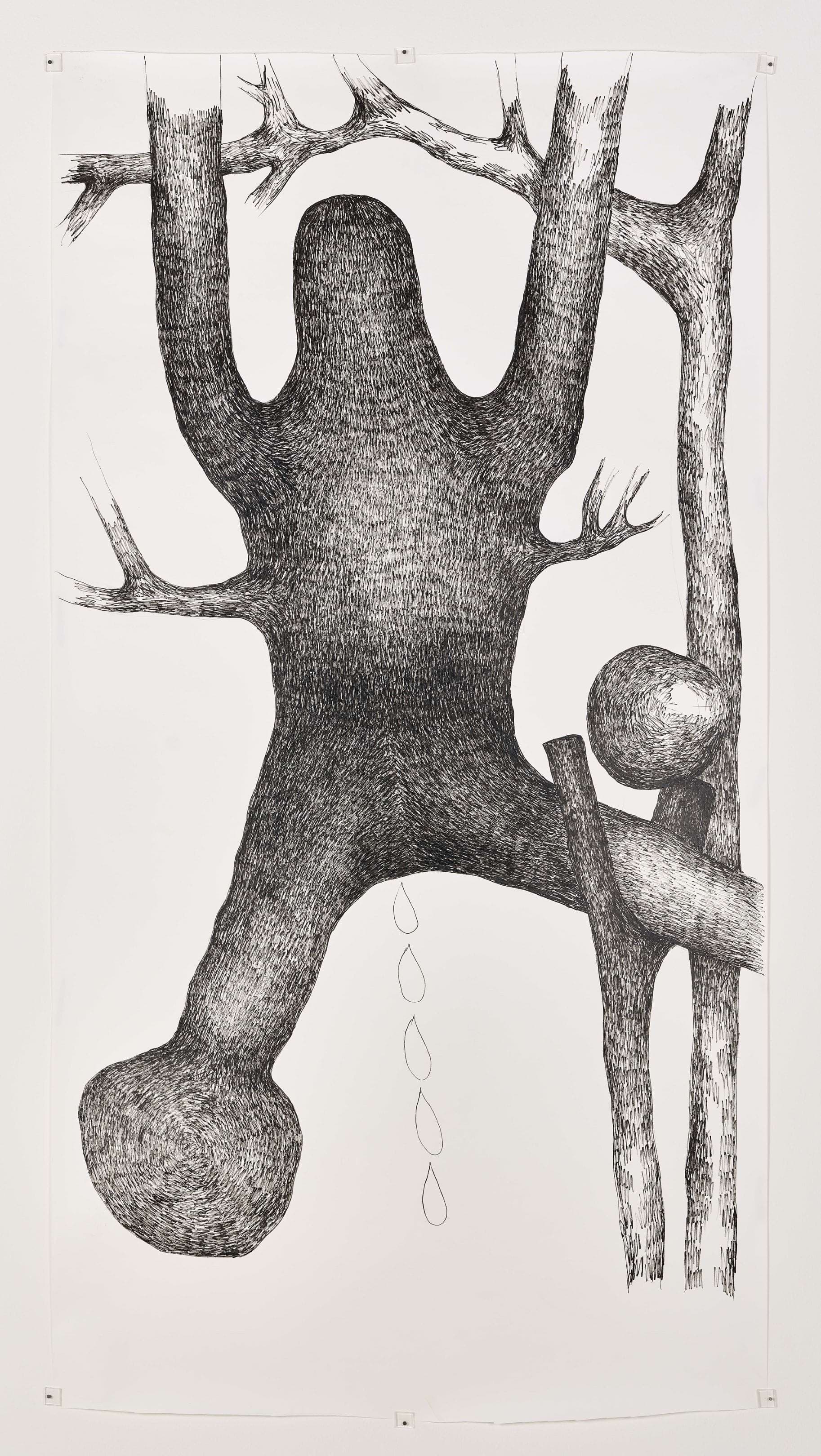
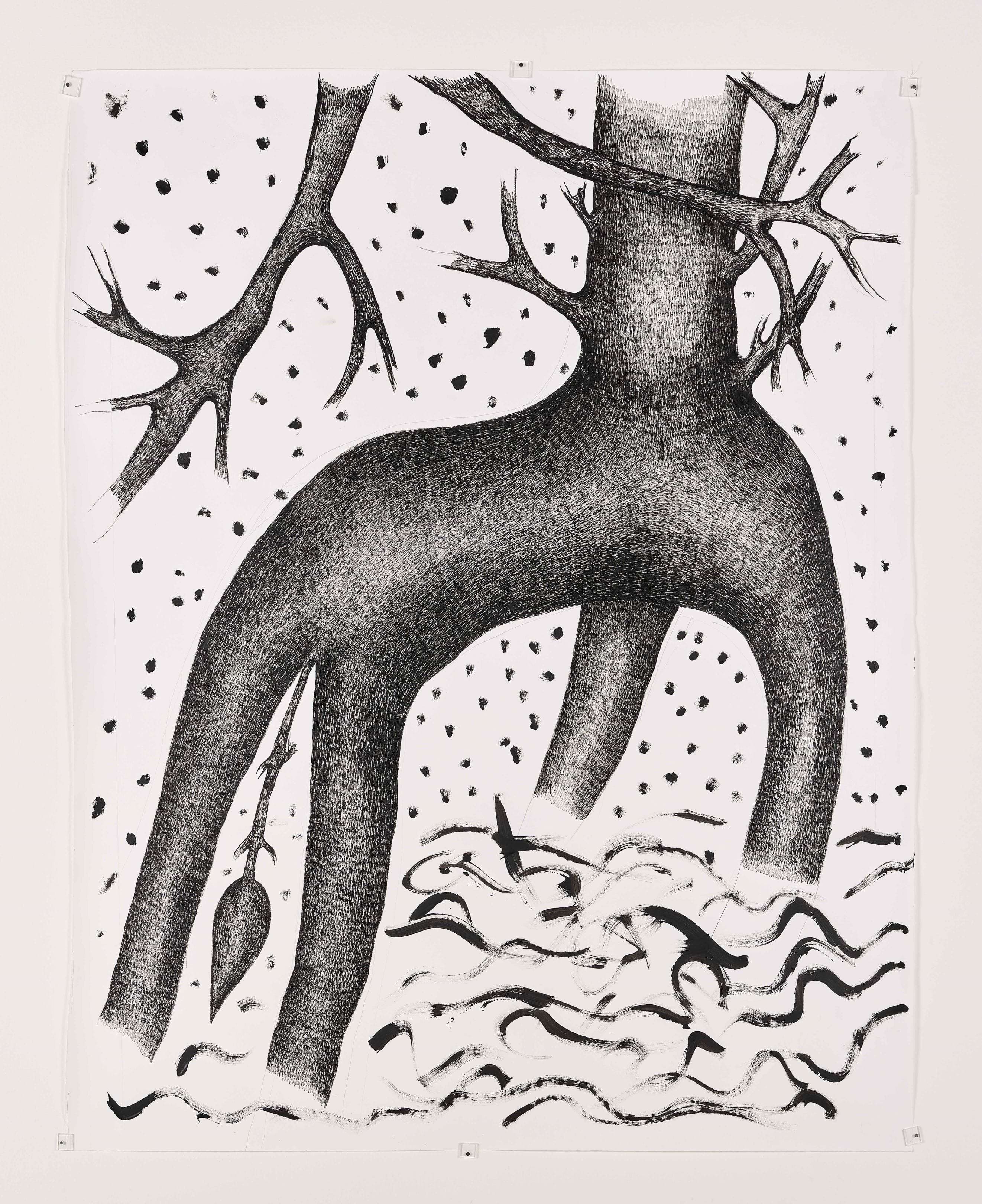
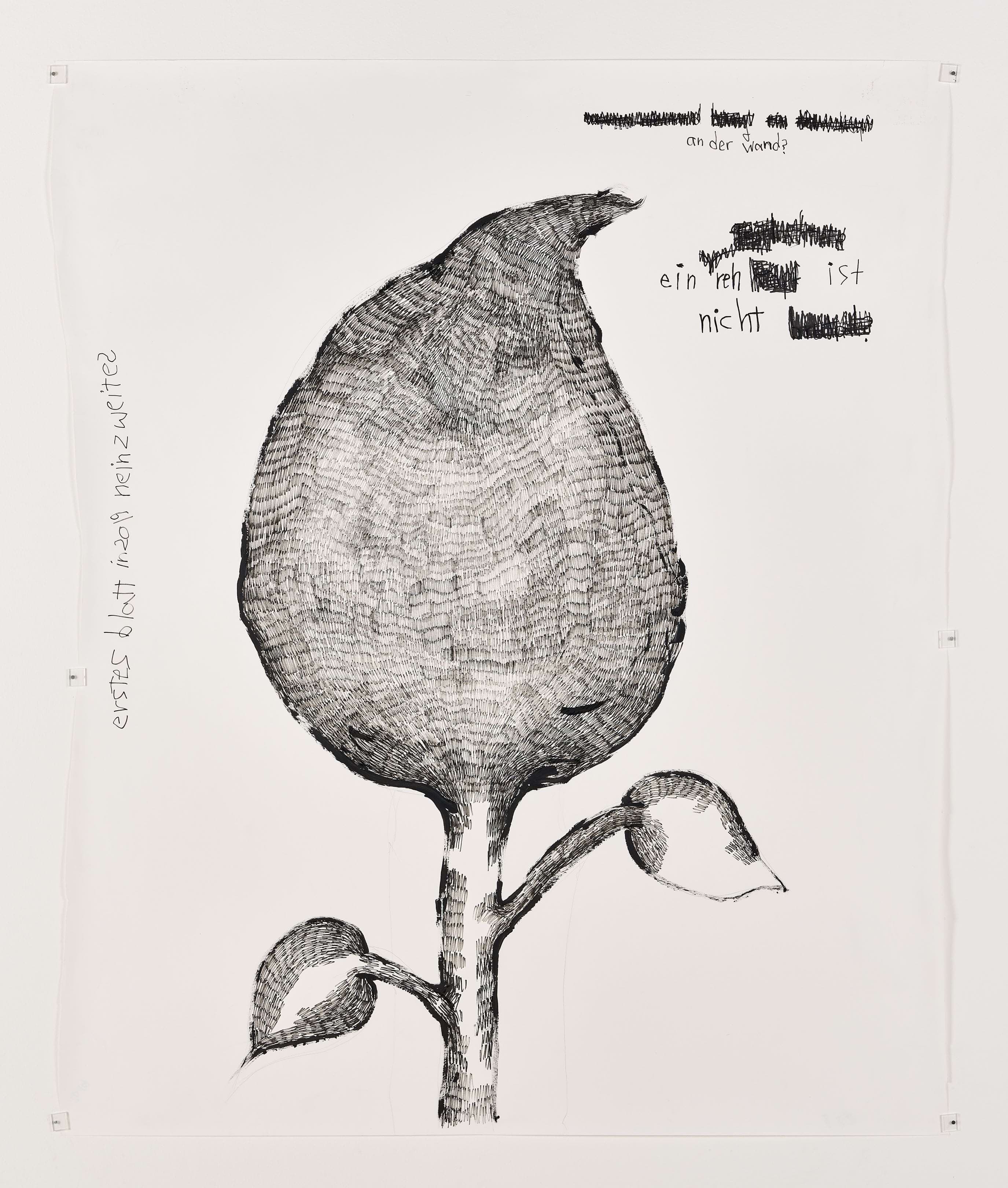
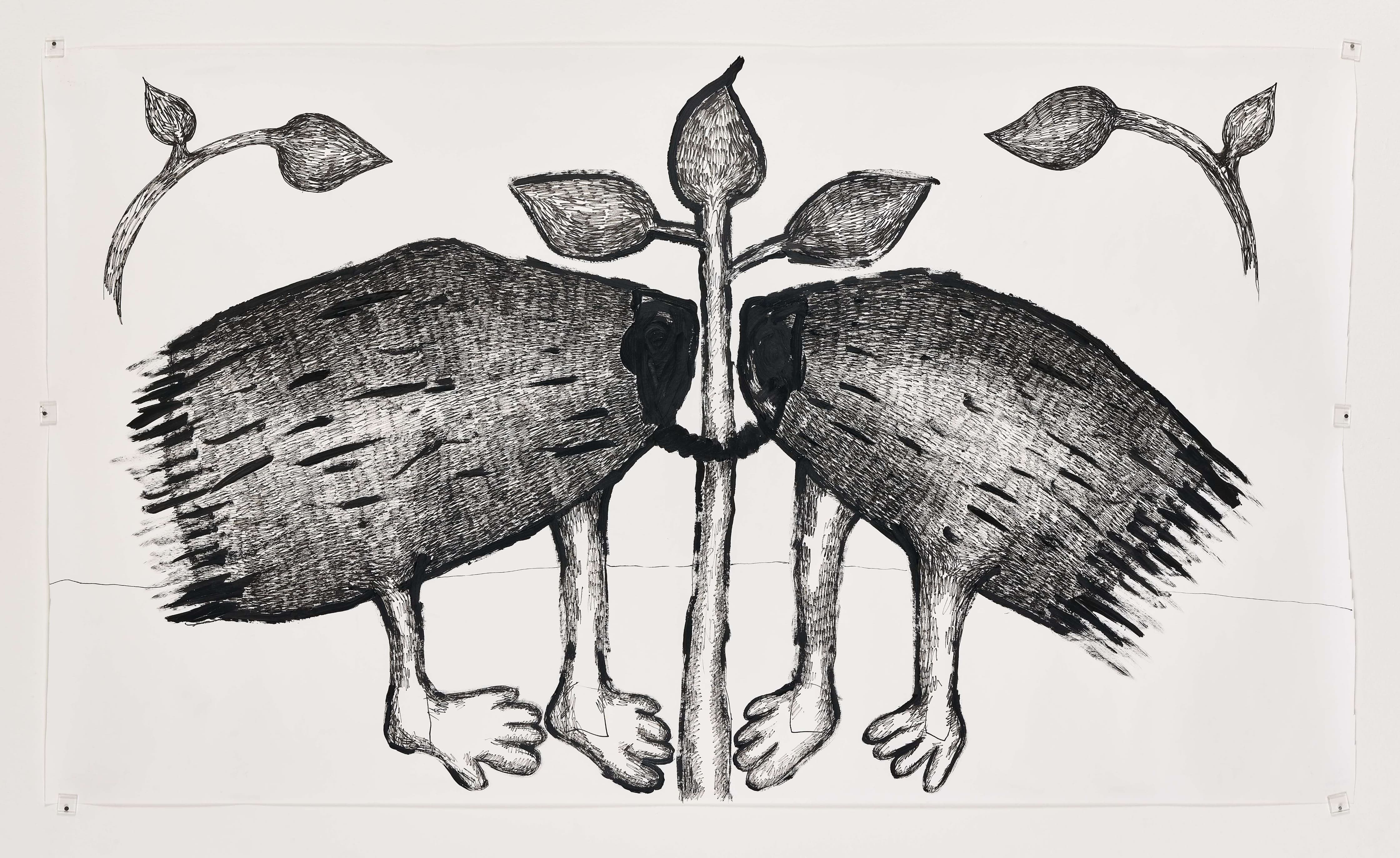
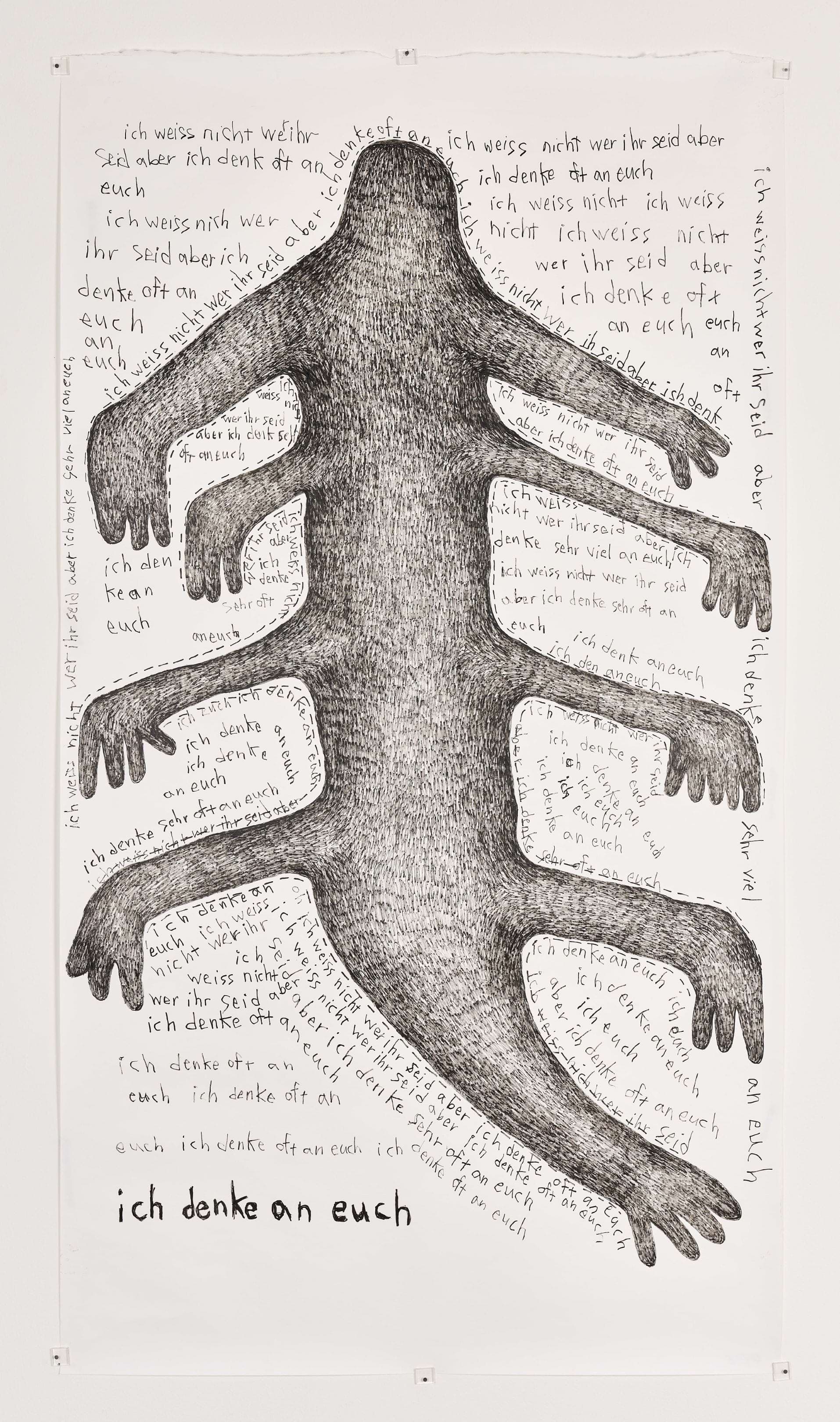
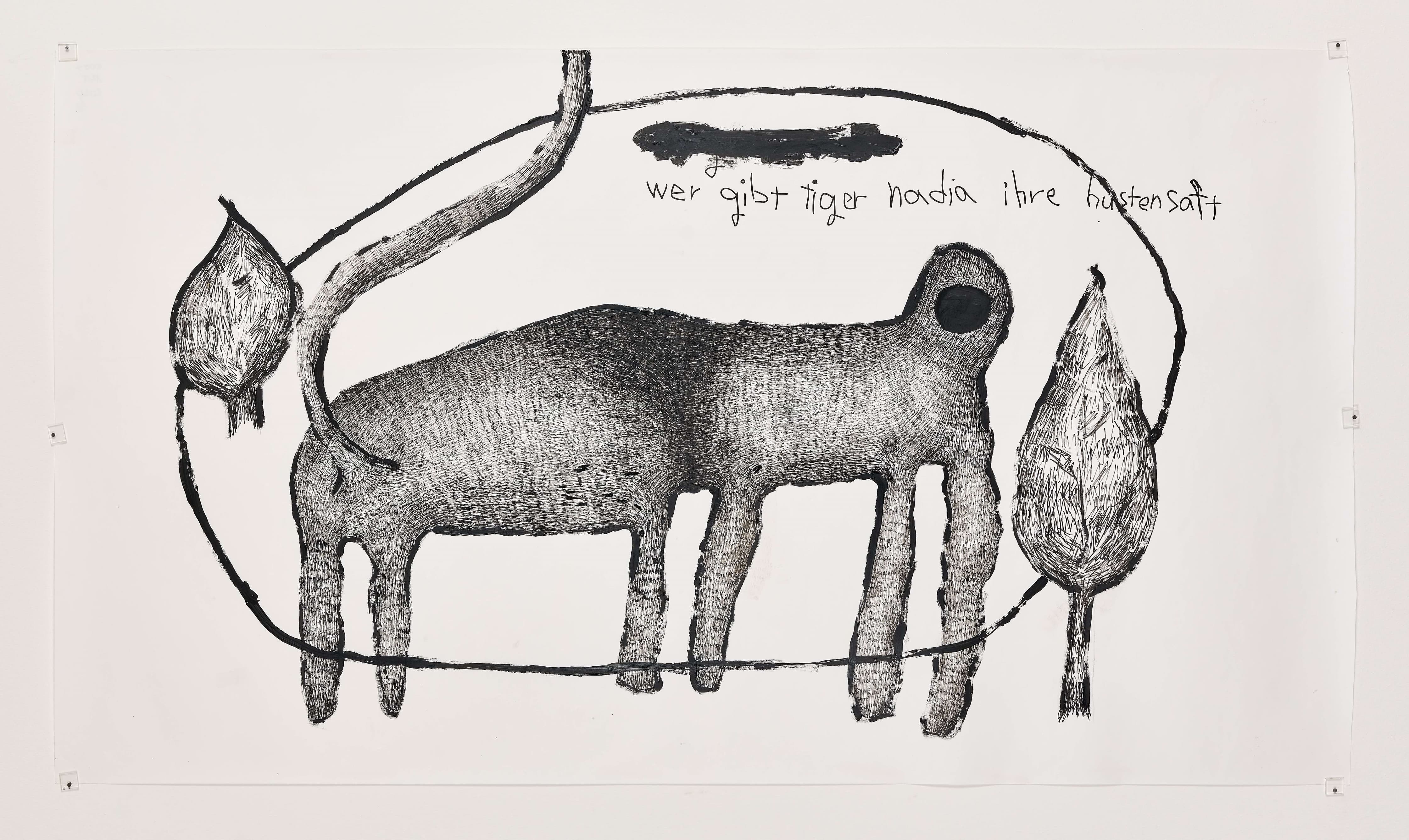
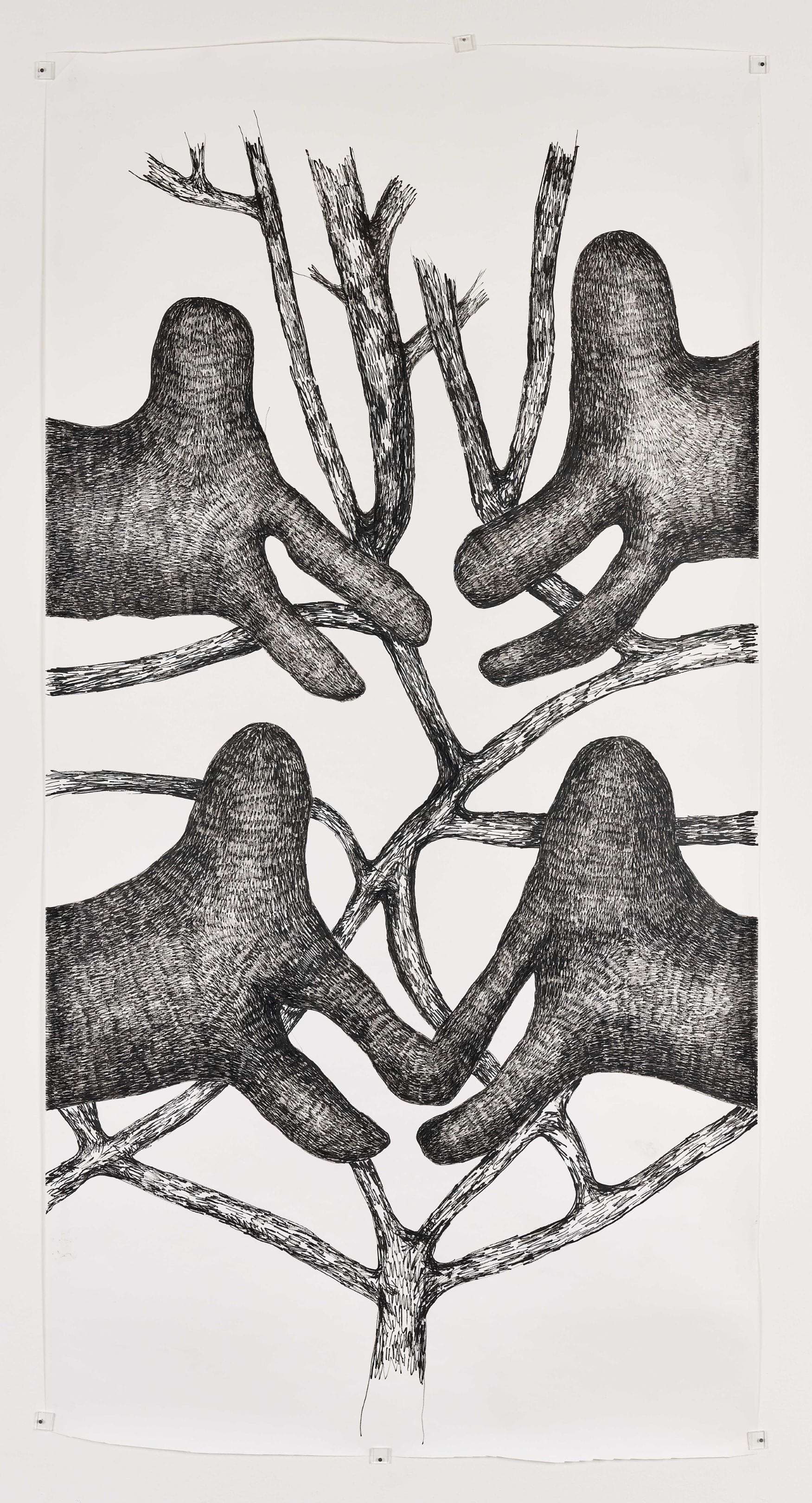
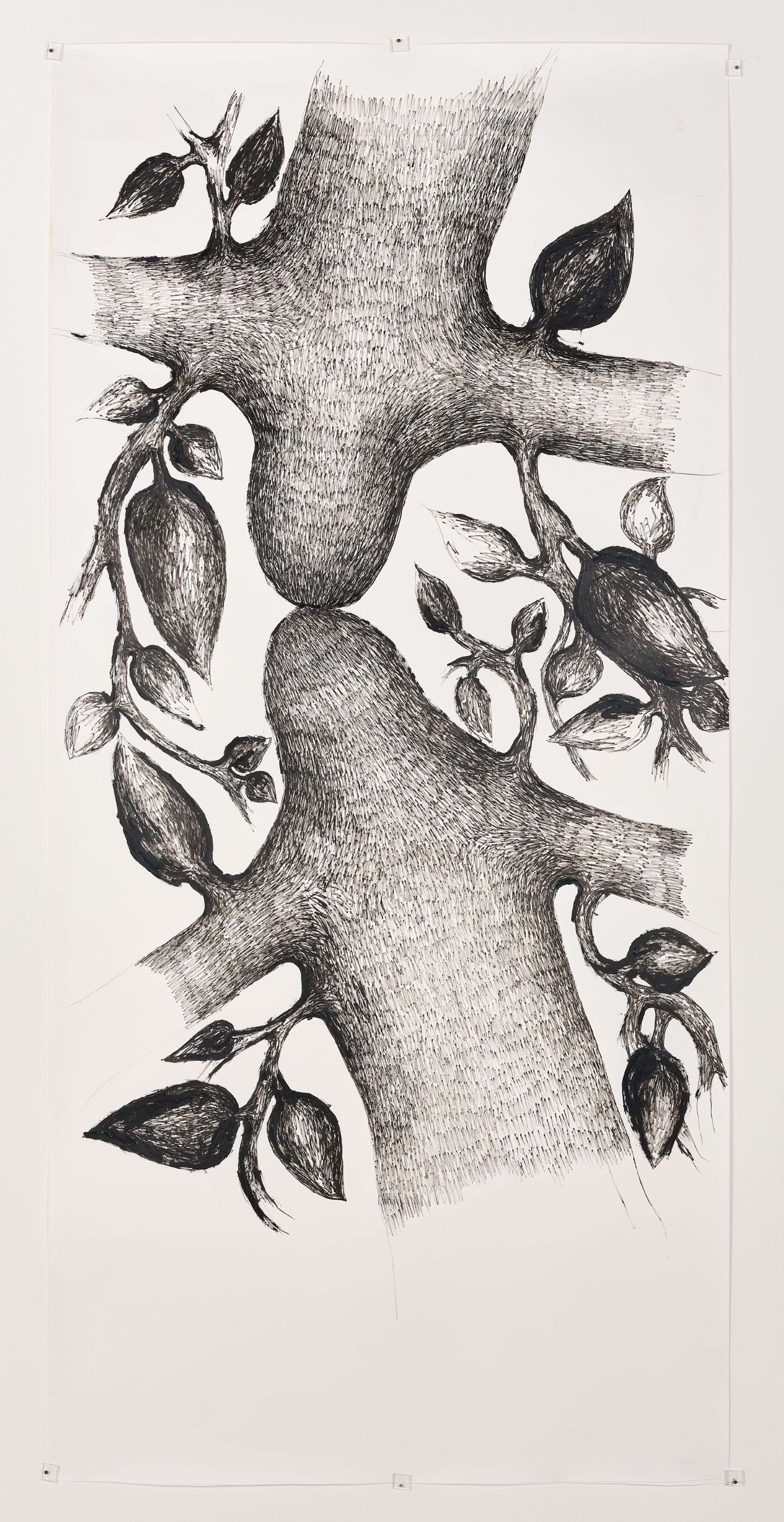
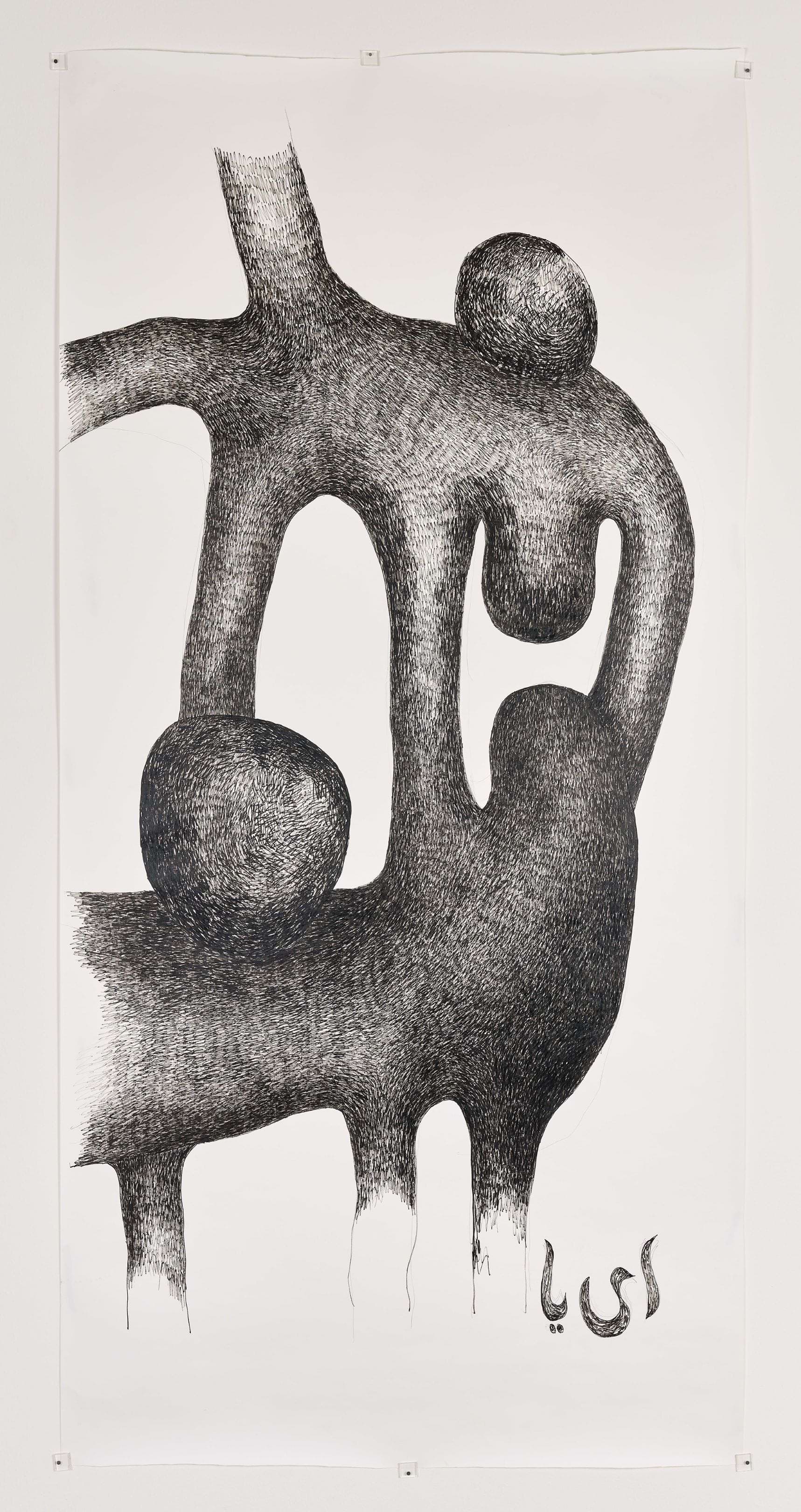
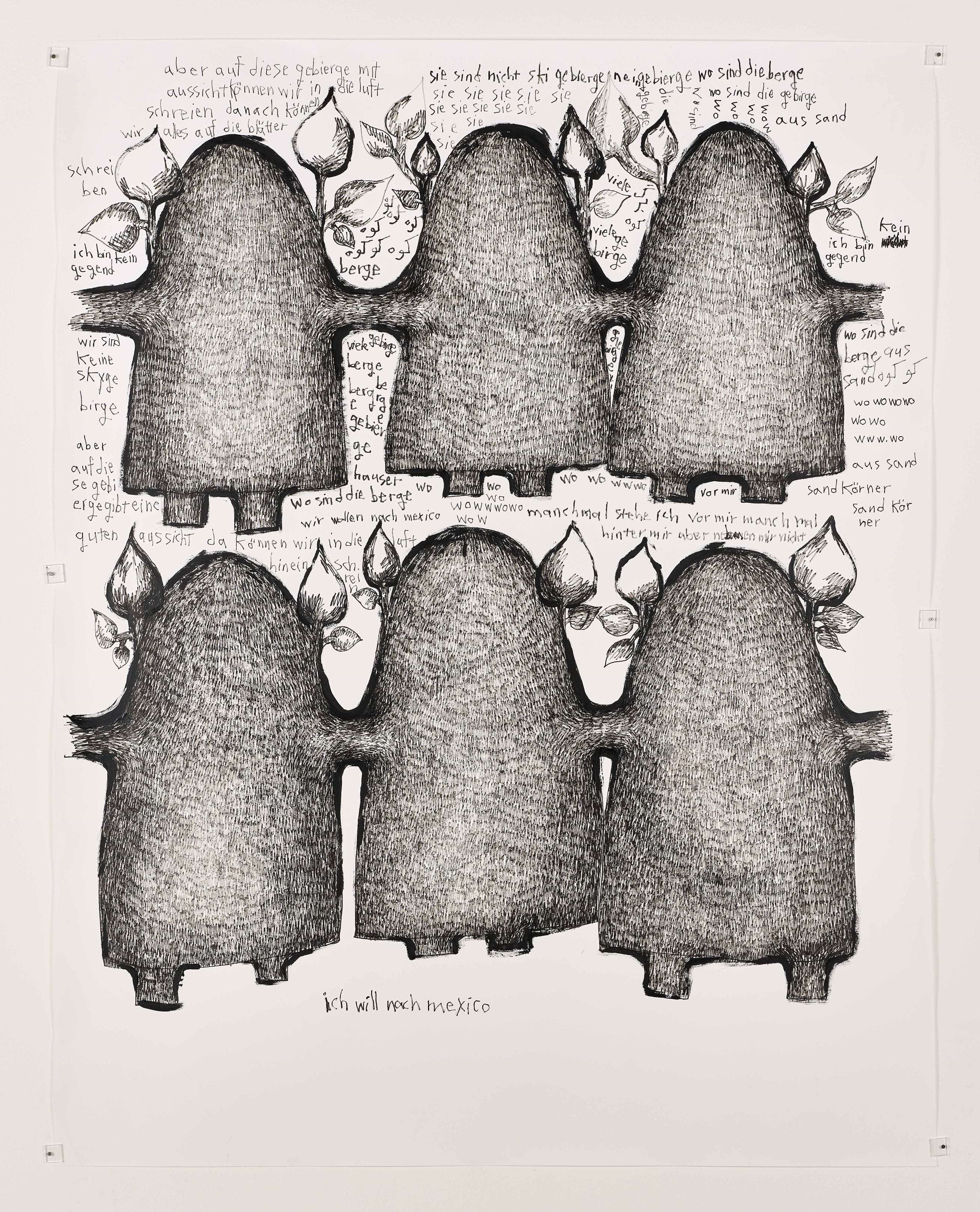
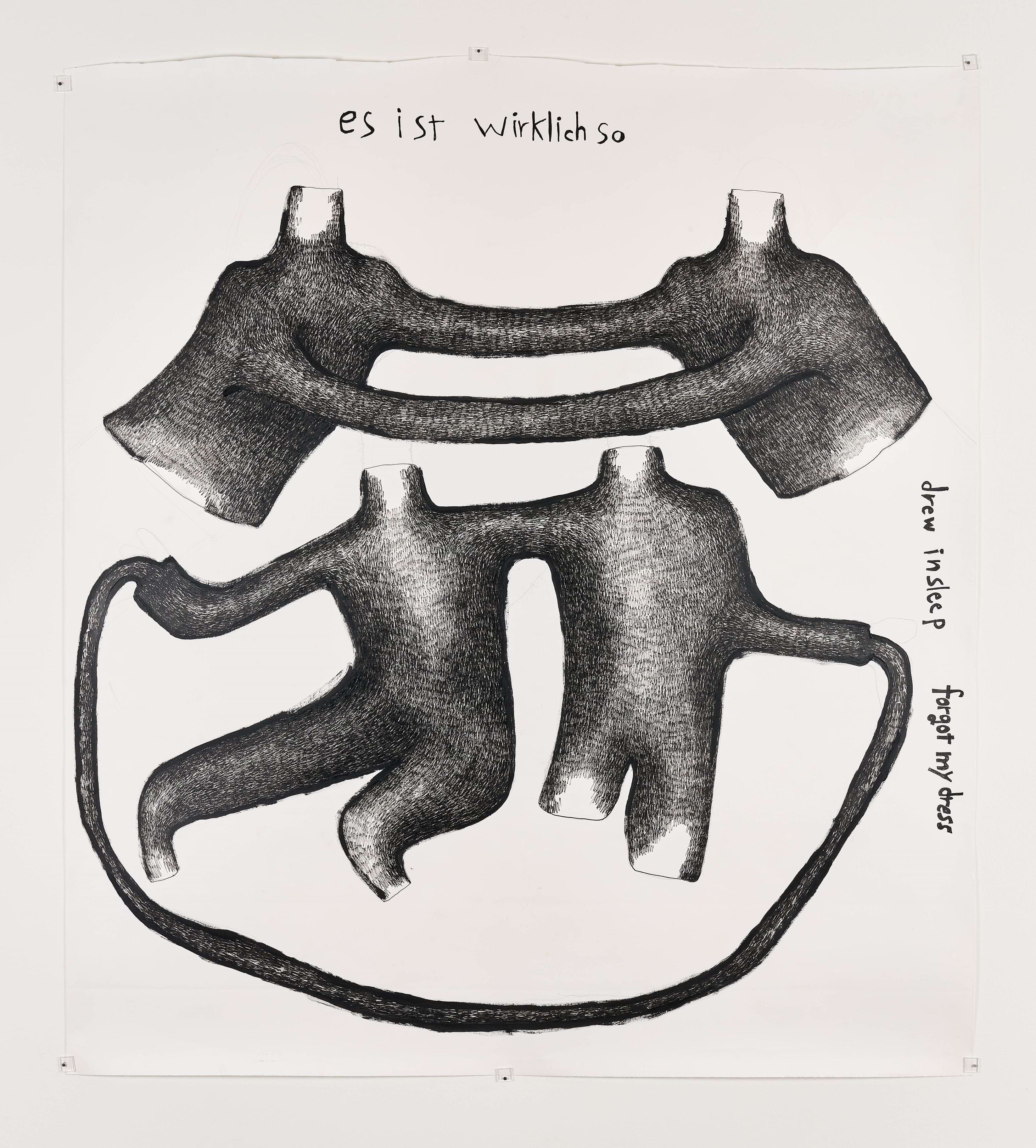
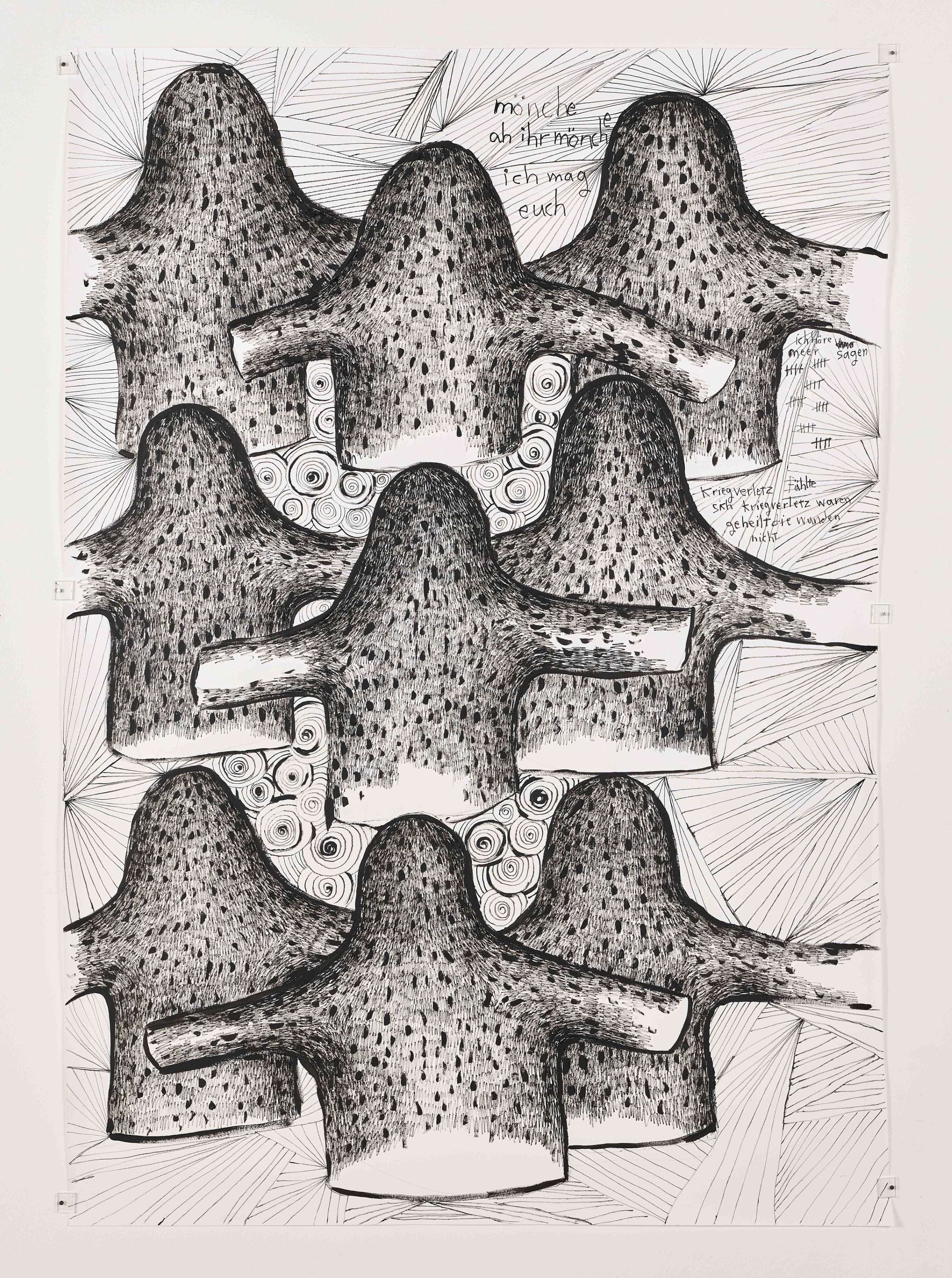
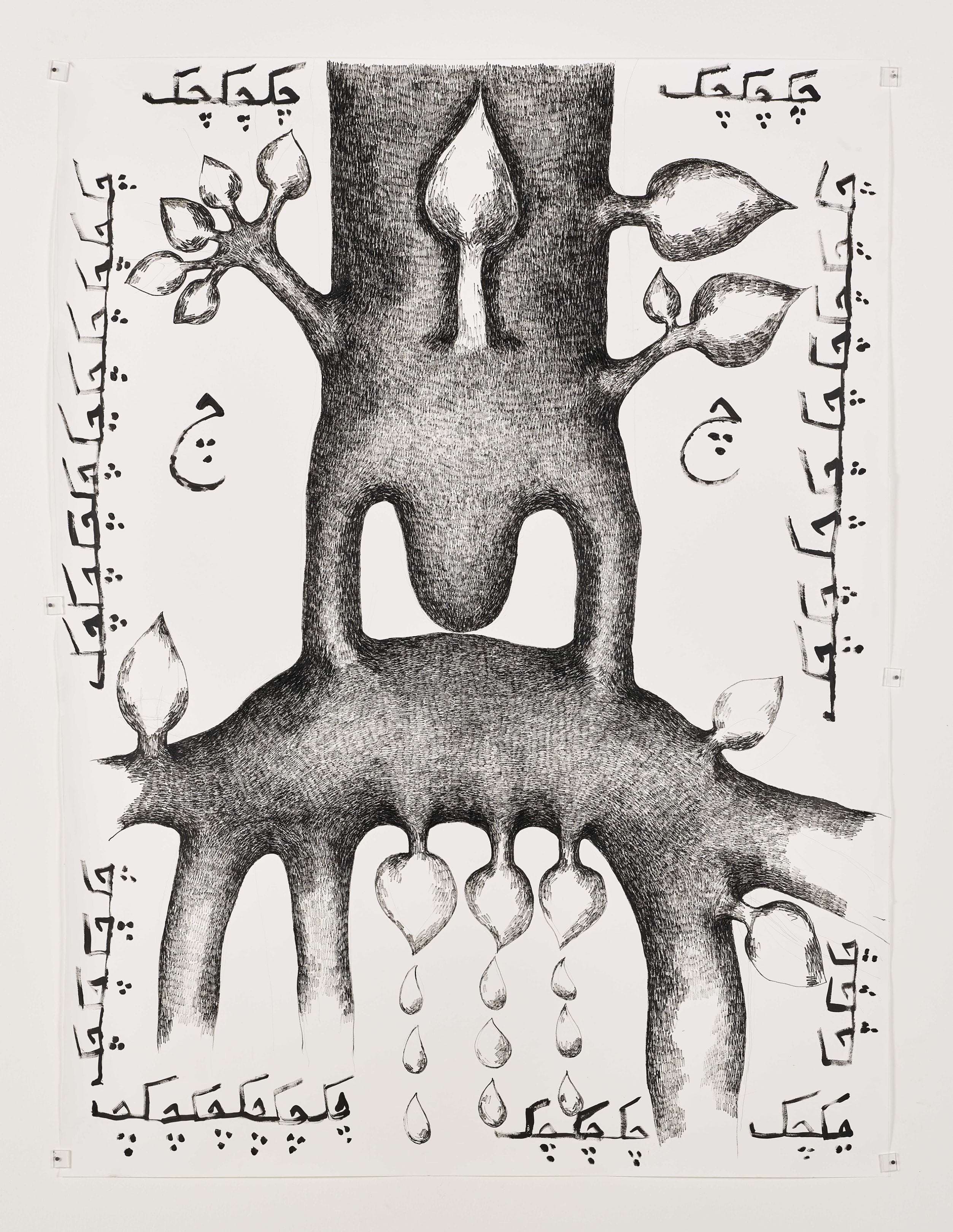
Shahroudi’s drawings have a close relationship with her artist books and fabric artist book creatures made of fabric. Sharing seemingly anthropomorphic and animal features, these hybrid creatures appear to either be floating or grounded to the earth, interacting with plant life. They are in constant communication with themselves and their environment. The dynamic composition of the drawings animate the figures and their surroundings, allowing them to take on the ability to sing, morph and multiply in one’s mind’s eye. The energy in these works can be drawn from the way in which they are created. Shahroudi does not always stand vertically in front of her paper. She sometimes lies on it, walks on it and sleeps on it, producing a playful relationship with the line work that manifests the images.
Shahroudi’s drawings have a close relationship with her artist books and fabric artist book creatures made of fabric. Sharing seemingly anthropomorphic and animal features, these hybrid creatures appear to either be floating or grounded to the earth, interacting with plant life. They are in constant communication with themselves and their environment. The dynamic composition of the drawings animate the figures and their surroundings, allowing them to take on the ability to sing, morph and multiply in one’s mind’s eye. The energy in these works can be drawn from the way in which they are created. Shahroudi does not always stand vertically in front of her paper. She sometimes lies on it, walks on it and sleeps on it, producing a playful relationship with the line work that manifests the images.
Shahroudi’s drawings have a close relationship with her artist books and fabric artist book creatures made of fabric. Sharing seemingly anthropomorphic and animal features, these hybrid creatures appear to either be floating or grounded to the earth, interacting with plant life. They are in constant communication with themselves and their environment. The dynamic composition of the drawings animate the figures and their surroundings, allowing them to take on the ability to sing, morph and multiply in one’s mind’s eye. The energy in these works can be drawn from the way in which they are created. Shahroudi does not always stand vertically in front of her paper. She sometimes lies on it, walks on it and sleeps on it, producing a playful relationship with the line work that manifests the images.
Shahroudi’s drawings have a close relationship with her artist books and fabric artist book creatures made of fabric. Sharing seemingly anthropomorphic and animal features, these hybrid creatures appear to either be floating or grounded to the earth, interacting with plant life. They are in constant communication with themselves and their environment. The dynamic composition of the drawings animate the figures and their surroundings, allowing them to take on the ability to sing, morph and multiply in one’s mind’s eye. The energy in these works can be drawn from the way in which they are created. Shahroudi does not always stand vertically in front of her paper. She sometimes lies on it, walks on it and sleeps on it, producing a playful relationship with the line work that manifests the images.
Shahroudi’s drawings have a close relationship with her artist books and fabric artist book creatures made of fabric. Sharing seemingly anthropomorphic and animal features, these hybrid creatures appear to either be floating or grounded to the earth, interacting with plant life. They are in constant communication with themselves and their environment. The dynamic composition of the drawings animate the figures and their surroundings, allowing them to take on the ability to sing, morph and multiply in one’s mind’s eye. The energy in these works can be drawn from the way in which they are created. Shahroudi does not always stand vertically in front of her paper. She sometimes lies on it, walks on it and sleeps on it, producing a playful relationship with the line work that manifests the images.
Shahroudi’s drawings have a close relationship with her artist books and fabric artist book creatures made of fabric. Sharing seemingly anthropomorphic and animal features, these hybrid creatures appear to either be floating or grounded to the earth, interacting with plant life. They are in constant communication with themselves and their environment. The dynamic composition of the drawings animate the figures and their surroundings, allowing them to take on the ability to sing, morph and multiply in one’s mind’s eye. The energy in these works can be drawn from the way in which they are created. Shahroudi does not always stand vertically in front of her paper. She sometimes lies on it, walks on it and sleeps on it, producing a playful relationship with the line work that manifests the images.
Shahroudi’s drawings have a close relationship with her artist books and fabric artist book creatures made of fabric. Sharing seemingly anthropomorphic and animal features, these hybrid creatures appear to either be floating or grounded to the earth, interacting with plant life. They are in constant communication with themselves and their environment. The dynamic composition of the drawings animate the figures and their surroundings, allowing them to take on the ability to sing, morph and multiply in one’s mind’s eye. The energy in these works can be drawn from the way in which they are created. Shahroudi does not always stand vertically in front of her paper. She sometimes lies on it, walks on it and sleeps on it, producing a playful relationship with the line work that manifests the images.
Shahroudi’s drawings have a close relationship with her artist books and fabric artist book creatures made of fabric. Sharing seemingly anthropomorphic and animal features, these hybrid creatures appear to either be floating or grounded to the earth, interacting with plant life. They are in constant communication with themselves and their environment. The dynamic composition of the drawings animate the figures and their surroundings, allowing them to take on the ability to sing, morph and multiply in one’s mind’s eye. The energy in these works can be drawn from the way in which they are created. Shahroudi does not always stand vertically in front of her paper. She sometimes lies on it, walks on it and sleeps on it, producing a playful relationship with the line work that manifests the images.
Shahroudi’s drawings have a close relationship with her artist books and fabric artist book creatures made of fabric. Sharing seemingly anthropomorphic and animal features, these hybrid creatures appear to either be floating or grounded to the earth, interacting with plant life. They are in constant communication with themselves and their environment. The dynamic composition of the drawings animate the figures and their surroundings, allowing them to take on the ability to sing, morph and multiply in one’s mind’s eye. The energy in these works can be drawn from the way in which they are created. Shahroudi does not always stand vertically in front of her paper. She sometimes lies on it, walks on it and sleeps on it, producing a playful relationship with the line work that manifests the images.
Shahroudi’s drawings have a close relationship with her artist books and fabric artist book creatures made of fabric. Sharing seemingly anthropomorphic and animal features, these hybrid creatures appear to either be floating or grounded to the earth, interacting with plant life. They are in constant communication with themselves and their environment. The dynamic composition of the drawings animate the figures and their surroundings, allowing them to take on the ability to sing, morph and multiply in one’s mind’s eye. The energy in these works can be drawn from the way in which they are created. Shahroudi does not always stand vertically in front of her paper. She sometimes lies on it, walks on it and sleeps on it, producing a playful relationship with the line work that manifests the images.
Shahroudi’s drawings have a close relationship with her artist books and fabric artist book creatures made of fabric. Sharing seemingly anthropomorphic and animal features, these hybrid creatures appear to either be floating or grounded to the earth, interacting with plant life. They are in constant communication with themselves and their environment. The dynamic composition of the drawings animate the figures and their surroundings, allowing them to take on the ability to sing, morph and multiply in one’s mind’s eye. The energy in these works can be drawn from the way in which they are created. Shahroudi does not always stand vertically in front of her paper. She sometimes lies on it, walks on it and sleeps on it, producing a playful relationship with the line work that manifests the images.
Shahroudi’s drawings have a close relationship with her artist books and fabric artist book creatures made of fabric. Sharing seemingly anthropomorphic and animal features, these hybrid creatures appear to either be floating or grounded to the earth, interacting with plant life. They are in constant communication with themselves and their environment. The dynamic composition of the drawings animate the figures and their surroundings, allowing them to take on the ability to sing, morph and multiply in one’s mind’s eye. The energy in these works can be drawn from the way in which they are created. Shahroudi does not always stand vertically in front of her paper. She sometimes lies on it, walks on it and sleeps on it, producing a playful relationship with the line work that manifests the images.
Shahroudi’s drawings have a close relationship with her artist books and fabric artist book creatures made of fabric. Sharing seemingly anthropomorphic and animal features, these hybrid creatures appear to either be floating or grounded to the earth, interacting with plant life. They are in constant communication with themselves and their environment. The dynamic composition of the drawings animate the figures and their surroundings, allowing them to take on the ability to sing, morph and multiply in one’s mind’s eye. The energy in these works can be drawn from the way in which they are created. Shahroudi does not always stand vertically in front of her paper. She sometimes lies on it, walks on it and sleeps on it, producing a playful relationship with the line work that manifests the images.
Shahroudi’s drawings have a close relationship with her artist books and fabric artist book creatures made of fabric. Sharing seemingly anthropomorphic and animal features, these hybrid creatures appear to either be floating or grounded to the earth, interacting with plant life. They are in constant communication with themselves and their environment. The dynamic composition of the drawings animate the figures and their surroundings, allowing them to take on the ability to sing, morph and multiply in one’s mind’s eye. The energy in these works can be drawn from the way in which they are created. Shahroudi does not always stand vertically in front of her paper. She sometimes lies on it, walks on it and sleeps on it, producing a playful relationship with the line work that manifests the images.
Shahroudi’s drawings have a close relationship with her artist books and fabric artist book creatures made of fabric. Sharing seemingly anthropomorphic and animal features, these hybrid creatures appear to either be floating or grounded to the earth, interacting with plant life. They are in constant communication with themselves and their environment. The dynamic composition of the drawings animate the figures and their surroundings, allowing them to take on the ability to sing, morph and multiply in one’s mind’s eye. The energy in these works can be drawn from the way in which they are created. Shahroudi does not always stand vertically in front of her paper. She sometimes lies on it, walks on it and sleeps on it, producing a playful relationship with the line work that manifests the images.
Shahroudi’s drawings have a close relationship with her artist books and fabric artist book creatures made of fabric. Sharing seemingly anthropomorphic and animal features, these hybrid creatures appear to either be floating or grounded to the earth, interacting with plant life. They are in constant communication with themselves and their environment. The dynamic composition of the drawings animate the figures and their surroundings, allowing them to take on the ability to sing, morph and multiply in one’s mind’s eye. The energy in these works can be drawn from the way in which they are created. Shahroudi does not always stand vertically in front of her paper. She sometimes lies on it, walks on it and sleeps on it, producing a playful relationship with the line work that manifests the images.
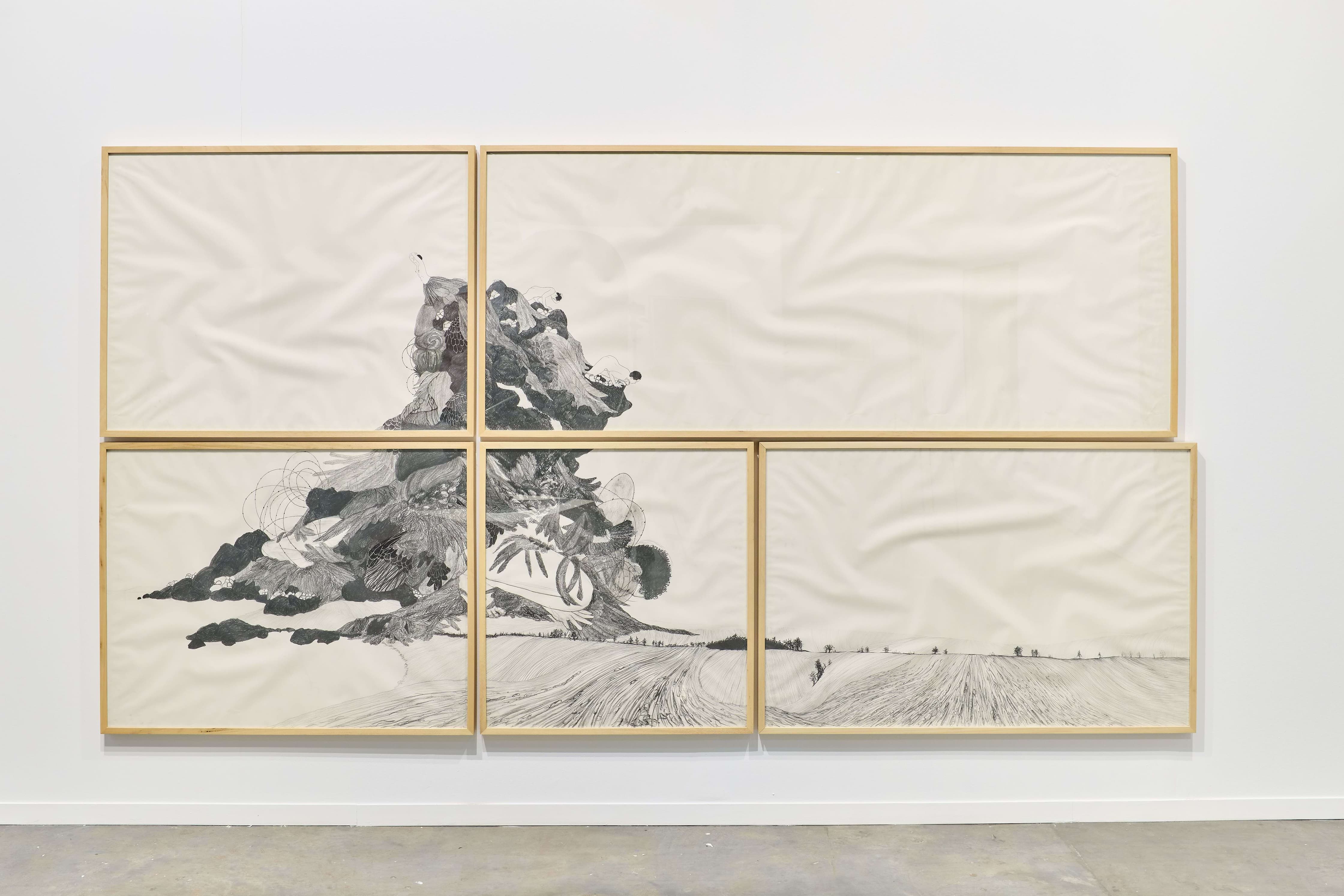
Pamela Phatsimo Sunstrum’s (b. 1980, Mochudi, Botswana) multidisciplinary practice encompasses drawing, painting, installation and animation. Her work alludes to mythology, geology and theories on the nature of the universe. Sunstrum’s drawings take the form of narrative landscapes that appear simultaneously futuristic and ancient, shifting between representational and fantastical depictions of volcanic, subterranean, cosmological and precipitous landscapes.
Sunstrum’s multidisciplinary practice encompasses drawing, painting, installation and animation. Epic draws on the larger thematic considerations of her practice. Her work alludes to mythology, geology and theories on the nature of the universe. Sunstrum’s drawings take the form of narrative landscapes that appear simultaneously futuristic and ancient, shifting between representational and fantastical depictions of volcanic, subterranean, cosmological and precipitous landscapes.
Sunstrum currently has her first UK solo exhibition at a public institution, with her work The Pavilion (2023) on view at London Mithraeum Bloomberg SPACE. Other Key exhibitions and performances include All my seven faces at Contemporary Art Center, Cincinnati, OH, USA (2019); Zeitz MOCAA, Cape Town, South Africa; The Wiels, Brussels, Belgium (2019); Kunsthaus Zürich (2019); The Nest, The Hague (2019); Michaelis School for the Arts at the University of Cape Town (2018); Artpace, San Antonio, TX, USA (2018); and The Phillips Museum of Arts, Lancaster (2018)
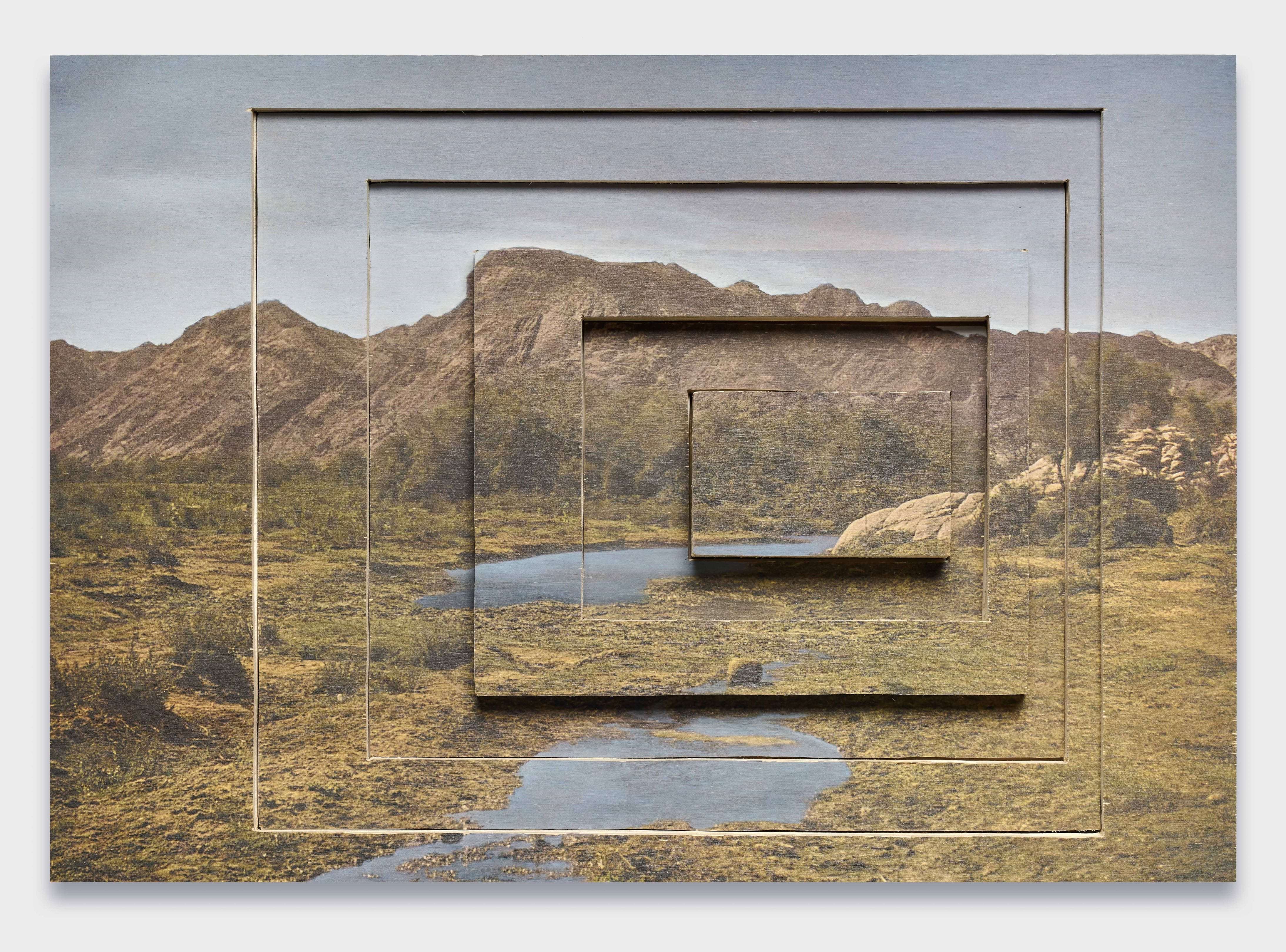
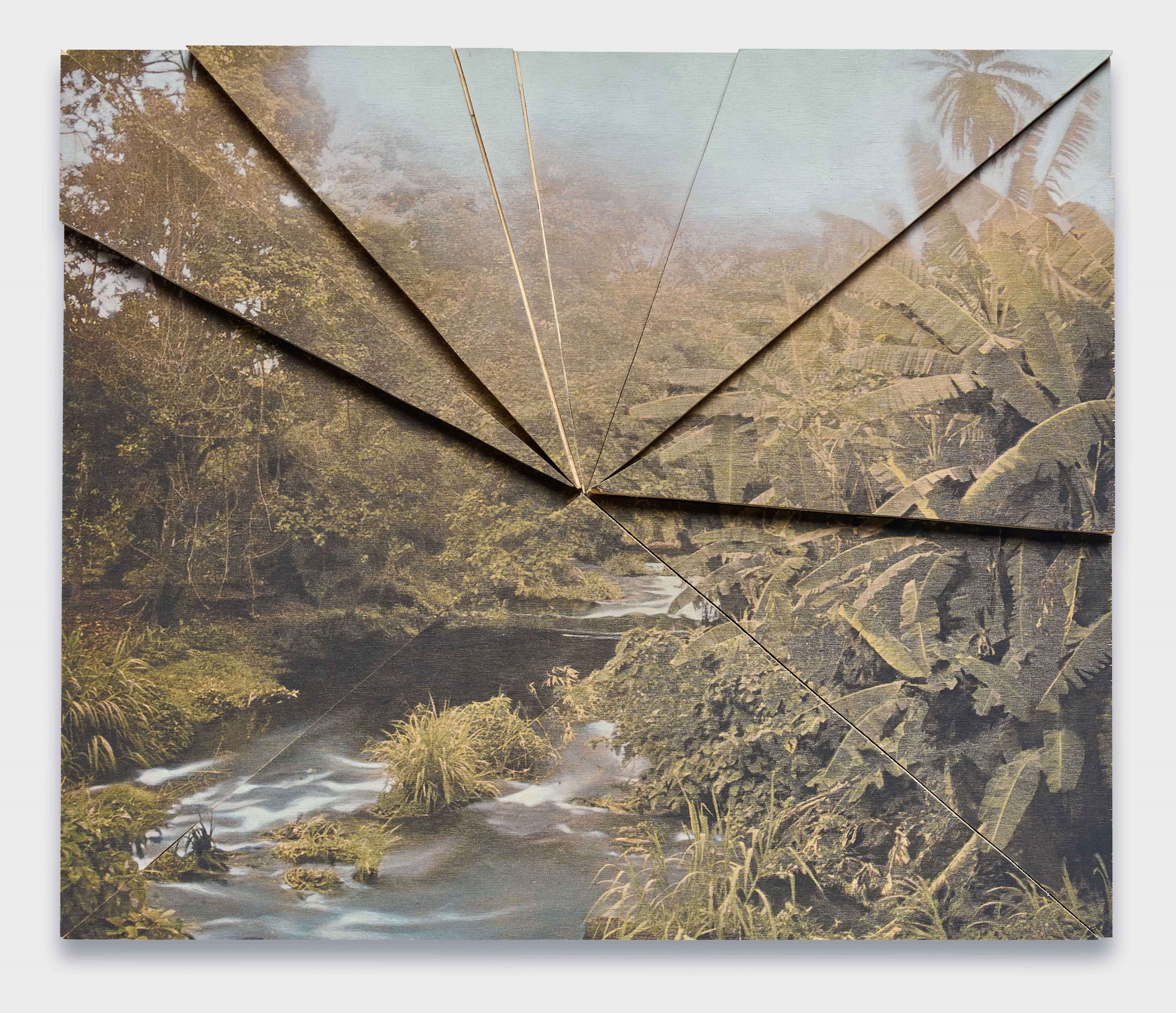
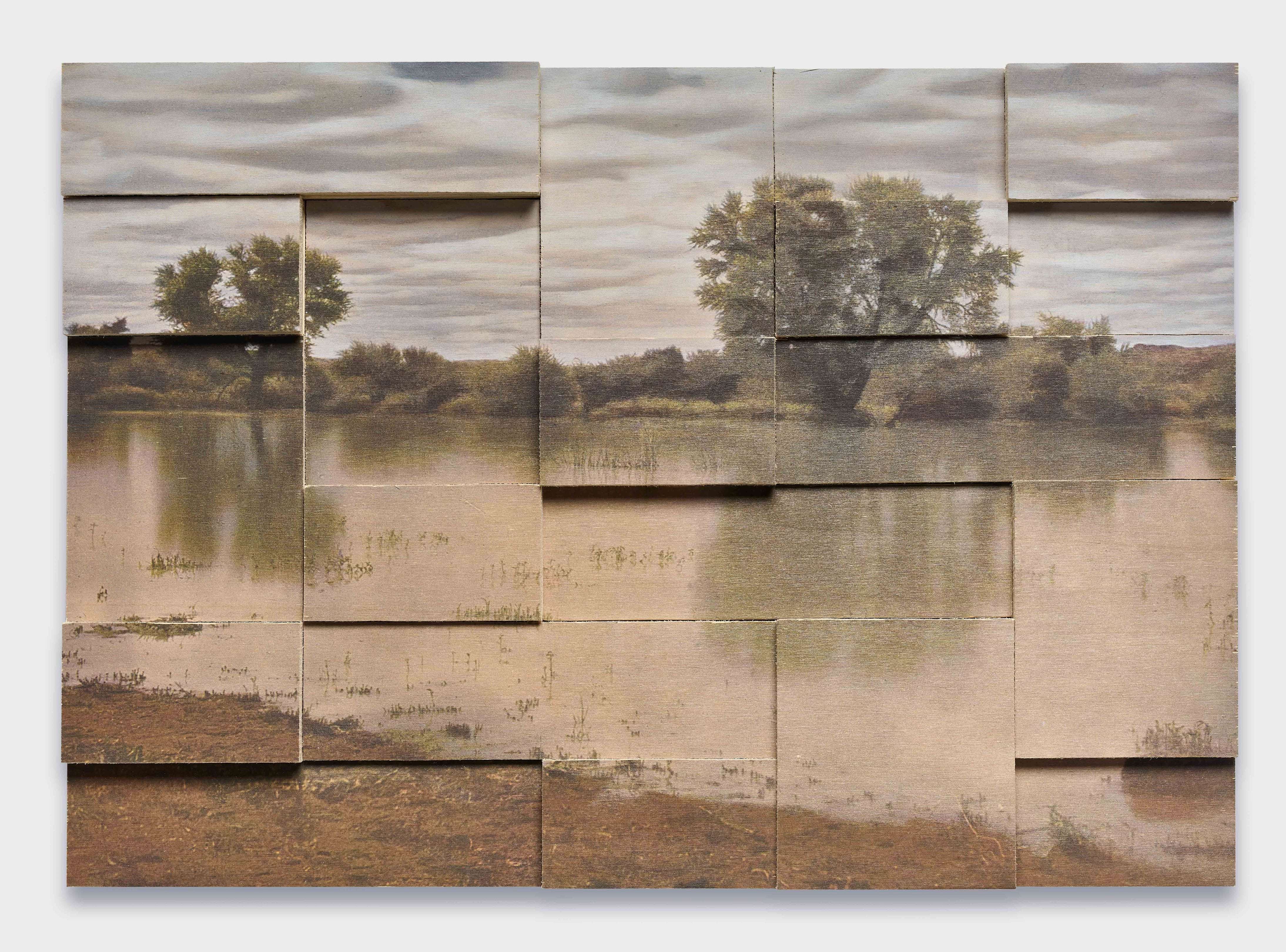
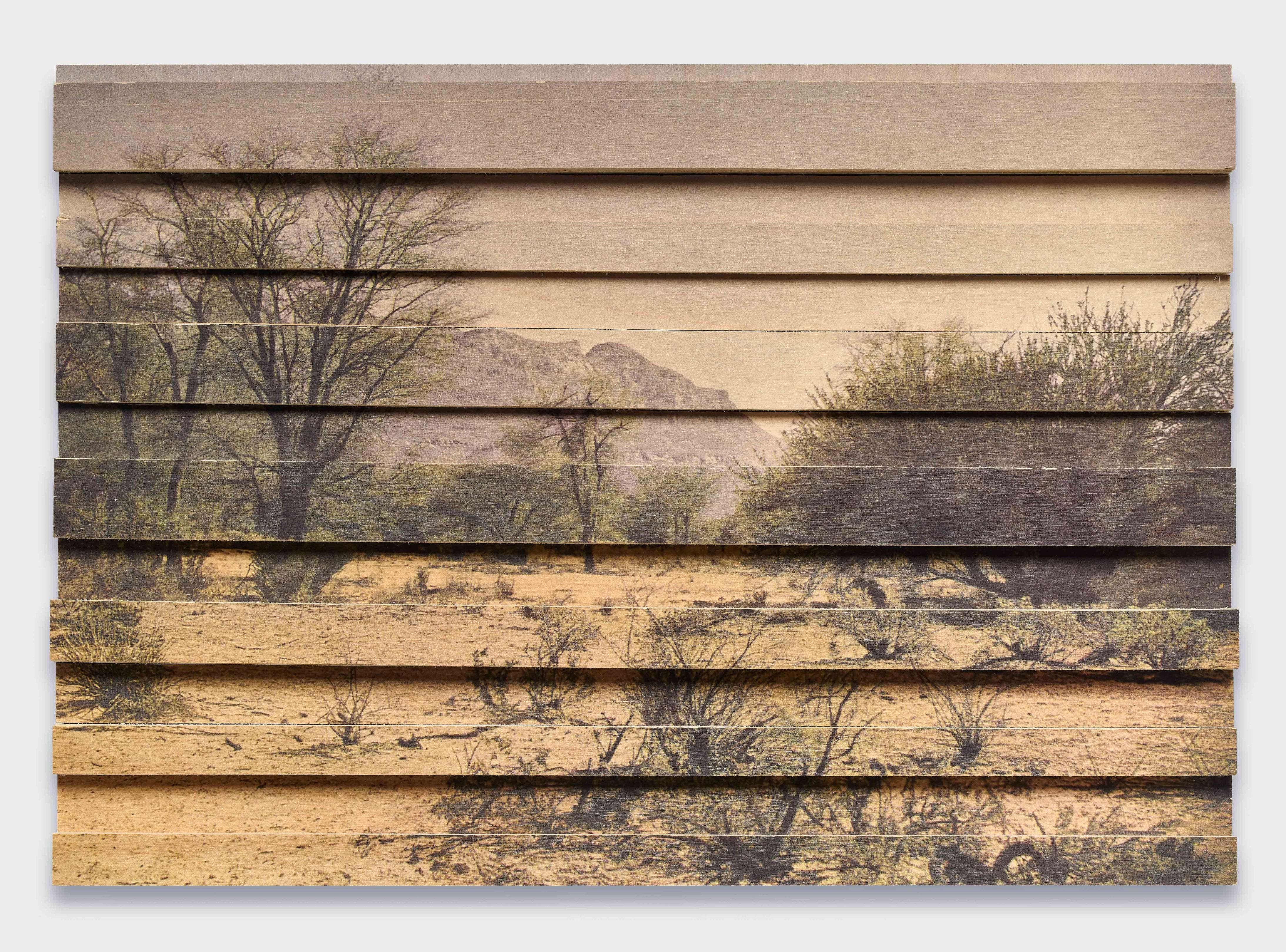
This series addresses the power of mis/representation and erasure. It also considers ways of seeing and imagining space, deconstructing and unveiling the epistemic and aesthetic traditions upon which we have constructed our relationship with nature. This is done through an exploration of the relationship between sentimental colonial aesthetics in landscape photography.
The works investigate how landscape photography forged and cemented the colonial relationship to nature as an enclosed space to be controlled and exploited. This reframing of nature as landscape produced a perception of nature as “idyllic, paradisiac, empty, wild, barren, unorganised and unproductive”, according to the artist. The myth of emptiness - echoing the racist myth of Indigenous peoples as a “people without history” - underpins the narrative of colonialism as a natural, necessary and civilisational system. This is linked to the erasure of Indigenous languages, knowledge and practices as well as land dispossessions, forced migrations and genocides of the Indigenous peoples living on and with that land before colonisation.
The original photographs are by Eduard Kiewning and Robert Lohmeyer, taken during two different colonial expeditions into the former German colonies “Deutsch-Südwest-Afrika (today’s Namibia) and Cameroon, the first in 1907 by Robert Lohmeyer, the second in 1909 by Eduard Kiewning. First published in: “Die Deutschen Kolonien”, Carl Weller Verlag für Farbfotografie, 1910 Berlin.
This series addresses the power of mis/representation and erasure. It also considers ways of seeing and imagining space, deconstructing and unveiling the epistemic and aesthetic traditions upon which we have constructed our relationship with nature. This is done through an exploration of the relationship between sentimental colonial aesthetics in landscape photography.
The works investigate how landscape photography forged and cemented the colonial relationship to nature as an enclosed space to be controlled and exploited. This reframing of nature as landscape produced a perception of nature as “idyllic, paradisiac, empty, wild, barren, unorganised and unproductive”, according to the artist. The myth of emptiness - echoing the racist myth of Indigenous peoples as a “people without history” - underpins the narrative of colonialism as a natural, necessary and civilisational system. This is linked to the erasure of Indigenous languages, knowledge and practices as well as land dispossessions, forced migrations and genocides of the Indigenous peoples living on and with that land before colonisation.
The original photographs are by Eduard Kiewning and Robert Lohmeyer, taken during two different colonial expeditions into the former German colonies “Deutsch-Südwest-Afrika (today’s Namibia) and Cameroon, the first in 1907 by Robert Lohmeyer, the second in 1909 by Eduard Kiewning. First published in: “Die Deutschen Kolonien”, Carl Weller Verlag für Farbfotografie, 1910 Berlin.
This series addresses the power of mis/representation and erasure. It also considers ways of seeing and imagining space, deconstructing and unveiling the epistemic and aesthetic traditions upon which we have constructed our relationship with nature. This is done through an exploration of the relationship between sentimental colonial aesthetics in landscape photography.
The works investigate how landscape photography forged and cemented the colonial relationship to nature as an enclosed space to be controlled and exploited. This reframing of nature as landscape produced a perception of nature as “idyllic, paradisiac, empty, wild, barren, unorganised and unproductive”, according to the artist. The myth of emptiness - echoing the racist myth of Indigenous peoples as a “people without history” - underpins the narrative of colonialism as a natural, necessary and civilisational system. This is linked to the erasure of Indigenous languages, knowledge and practices as well as land dispossessions, forced migrations and genocides of the Indigenous peoples living on and with that land before colonisation.
The original photographs are by Eduard Kiewning and Robert Lohmeyer, taken during two different colonial expeditions into the former German colonies “Deutsch-Südwest-Afrika (today’s Namibia) and Cameroon, the first in 1907 by Robert Lohmeyer, the second in 1909 by Eduard Kiewning. First published in: “Die Deutschen Kolonien”, Carl Weller Verlag für Farbfotografie, 1910 Berlin.
This series addresses the power of mis/representation and erasure. It also considers ways of seeing and imagining space, deconstructing and unveiling the epistemic and aesthetic traditions upon which we have constructed our relationship with nature. This is done through an exploration of the relationship between sentimental colonial aesthetics in landscape photography.
The works investigate how landscape photography forged and cemented the colonial relationship to nature as an enclosed space to be controlled and exploited. This reframing of nature as landscape produced a perception of nature as “idyllic, paradisiac, empty, wild, barren, unorganised and unproductive”, according to the artist. The myth of emptiness - echoing the racist myth of Indigenous peoples as a “people without history” - underpins the narrative of colonialism as a natural, necessary and civilisational system. This is linked to the erasure of Indigenous languages, knowledge and practices as well as land dispossessions, forced migrations and genocides of the Indigenous peoples living on and with that land before colonisation.
The original photographs are by Eduard Kiewning and Robert Lohmeyer, taken during two different colonial expeditions into the former German colonies “Deutsch-Südwest-Afrika (today’s Namibia) and Cameroon, the first in 1907 by Robert Lohmeyer, the second in 1909 by Eduard Kiewning. First published in: “Die Deutschen Kolonien”, Carl Weller Verlag für Farbfotografie, 1910 Berlin.
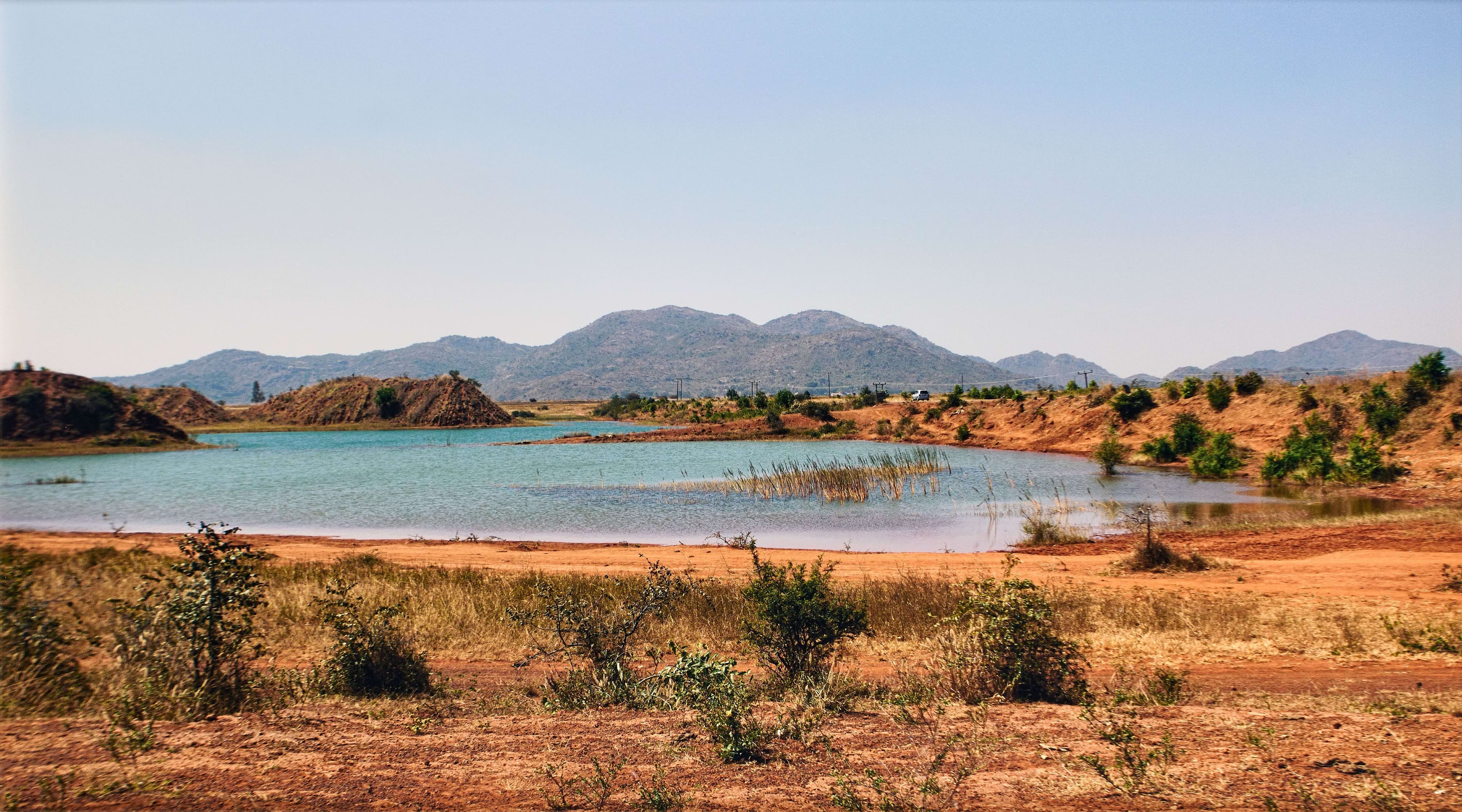
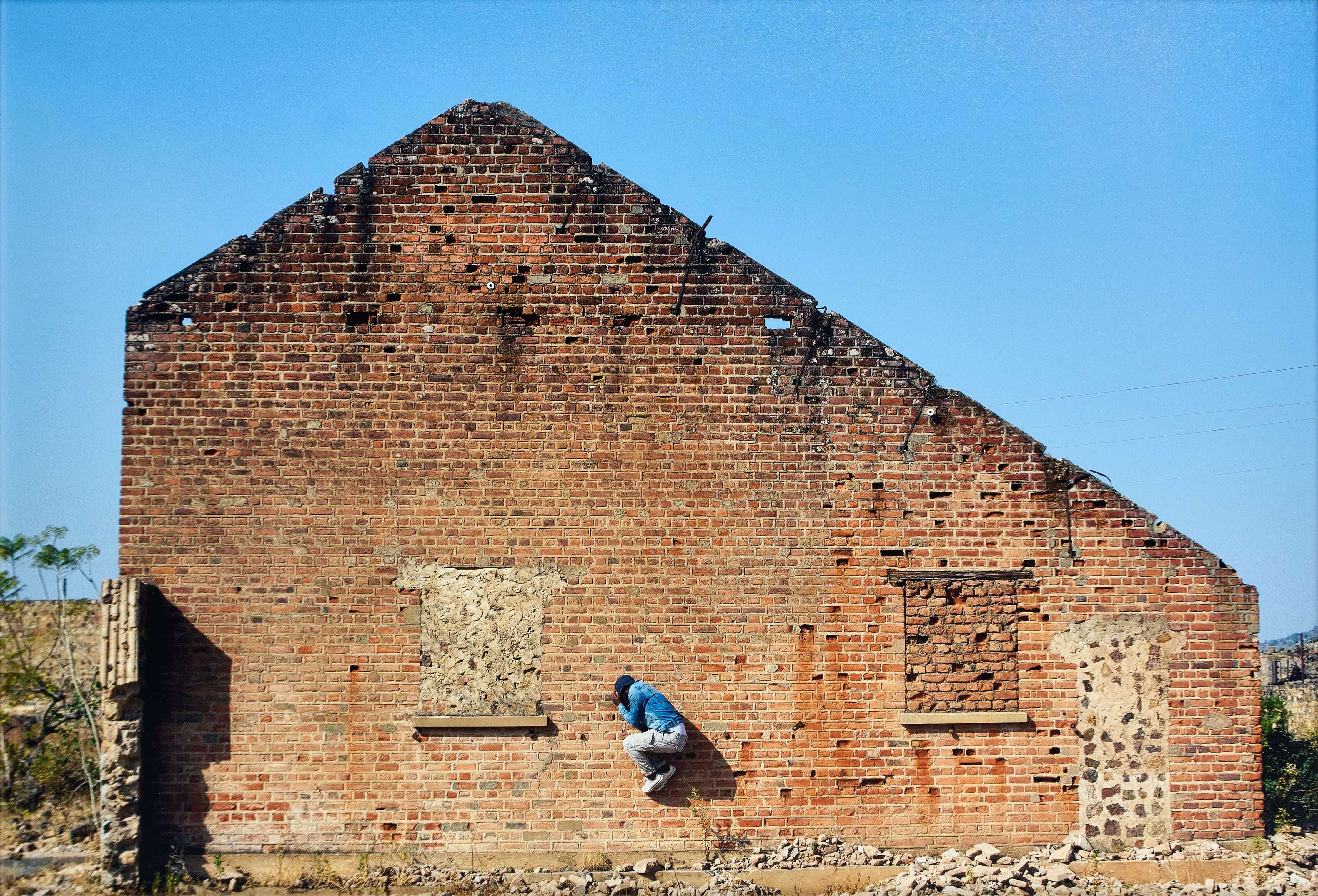
In late 2016, Oghobase traveled to Jos Plateau in Centreal Nigeria to seek out residues of British colonial mining activity in the region, which began in the early twentieth century and ceased in the decade following Nigeria’s discovery of oil in 1956, and independence shortly after. A central approach to this investigation entailed surveying ‘mining ponds’ resembling pristine lakes, depleted landscapes and rock formations—all of which testify to exploitative human pursuits, past and present. Traveling alone and equipped with his camera, Oghobase’s movements across the landscape were unplanned and intuitive. The photographs he produced show various aspects of this spontaneous dialogue with the natural environment. They speak of his attempts to integrate his body with the body of the land. Anatomy of Landscape - Jos (2018) reflects this instinctive response to the land. The series captures my chance encounter with the quiet vistas fraught with histories of exploitation.
In late 2016, Oghobase traveled to Jos Plateau in Centreal Nigeria to seek out residues of British colonial mining activity in the region, which began in the early twentieth century and ceased in the decade following Nigeria’s discovery of oil in 1956, and independence shortly after. A central approach to this investigation entailed surveying ‘mining ponds’ resembling pristine lakes, depleted landscapes and rock formations—all of which testify to exploitative human pursuits, past and present. Traveling alone and equipped with his camera, Oghobase’s movements across the landscape were unplanned and intuitive. The photographs he produced show various aspects of this spontaneous dialogue with the natural environment. They speak of his attempts to integrate his body with the body of the land. Anatomy of Landscape - Jos (2018) reflects this instinctive response to the land. The series captures my chance encounter with the quiet vistas fraught with histories of exploitation.
In late 2016, Oghobase traveled to Jos Plateau in Centreal Nigeria to seek out residues of British colonial mining activity in the region, which began in the early twentieth century and ceased in the decade following Nigeria’s discovery of oil in 1956, and independence shortly after. A central approach to this investigation entailed surveying ‘mining ponds’ resembling pristine lakes, depleted landscapes and rock formations—all of which testify to exploitative human pursuits, past and present. Traveling alone and equipped with his camera, Oghobase’s movements across the landscape were unplanned and intuitive. The photographs he produced show various aspects of this spontaneous dialogue with the natural environment. They speak of his attempts to integrate his body with the body of the land. Anatomy of Landscape - Jos (2018) reflects this instinctive response to the land. The series captures my chance encounter with the quiet vistas fraught with histories of exploitation.
In late 2016, Oghobase traveled to Jos Plateau in Centreal Nigeria to seek out residues of British colonial mining activity in the region, which began in the early twentieth century and ceased in the decade following Nigeria’s discovery of oil in 1956, and independence shortly after. A central approach to this investigation entailed surveying ‘mining ponds’ resembling pristine lakes, depleted landscapes and rock formations—all of which testify to exploitative human pursuits, past and present. Traveling alone and equipped with his camera, Oghobase’s movements across the landscape were unplanned and intuitive. The photographs he produced show various aspects of this spontaneous dialogue with the natural environment. They speak of his attempts to integrate his body with the body of the land. Anatomy of Landscape - Jos (2018) reflects this instinctive response to the land. The series captures my chance encounter with the quiet vistas fraught with histories of exploitation.
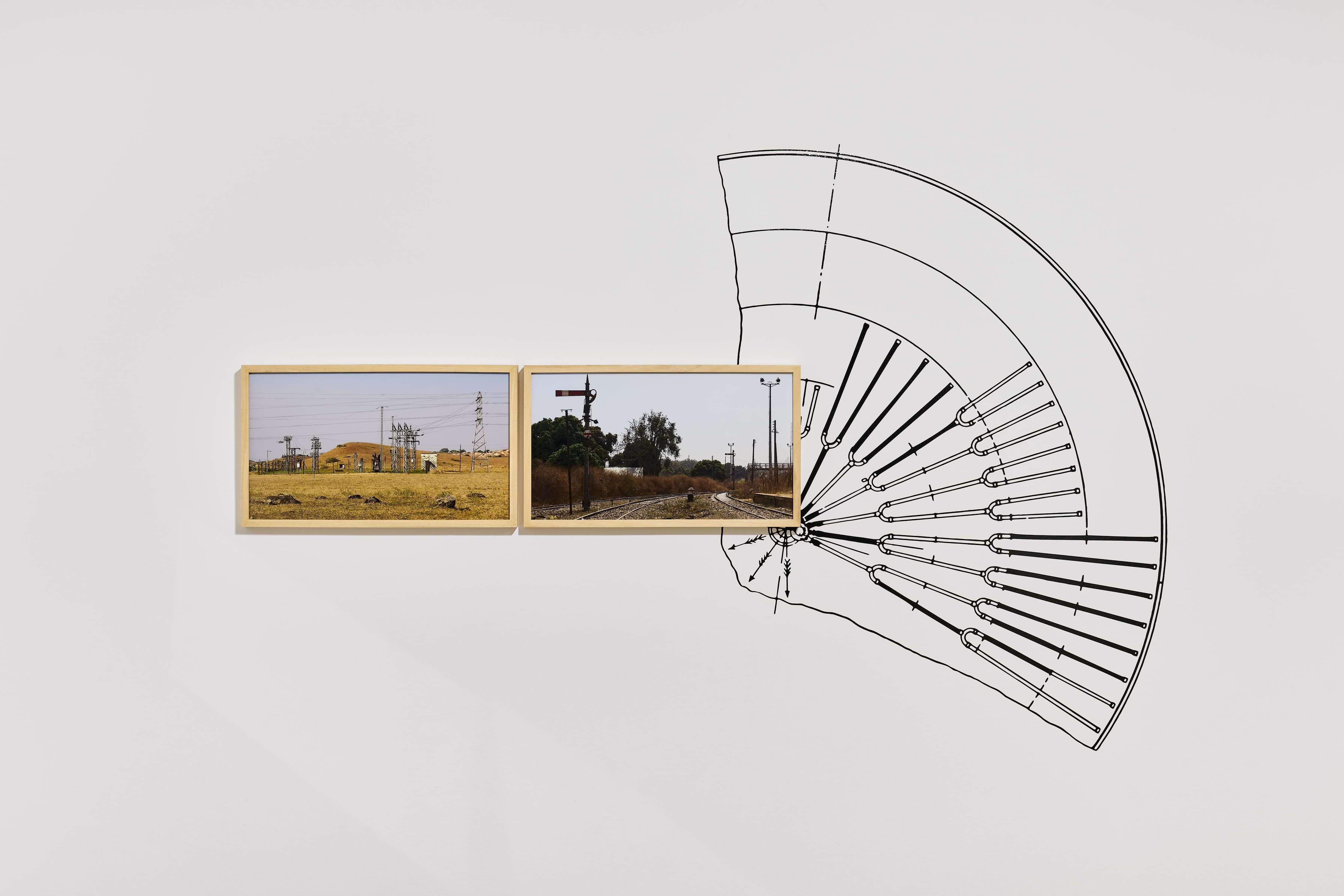
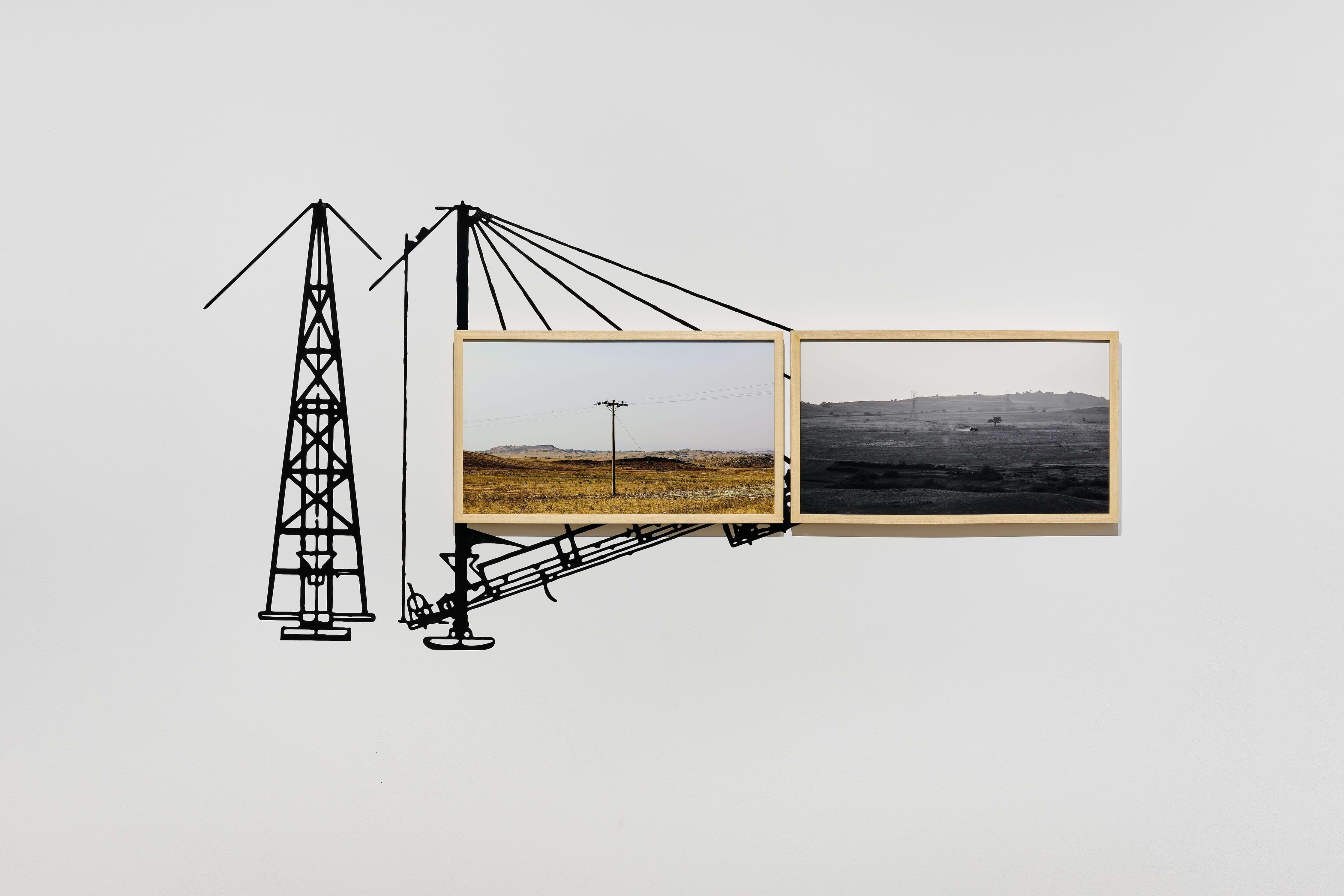
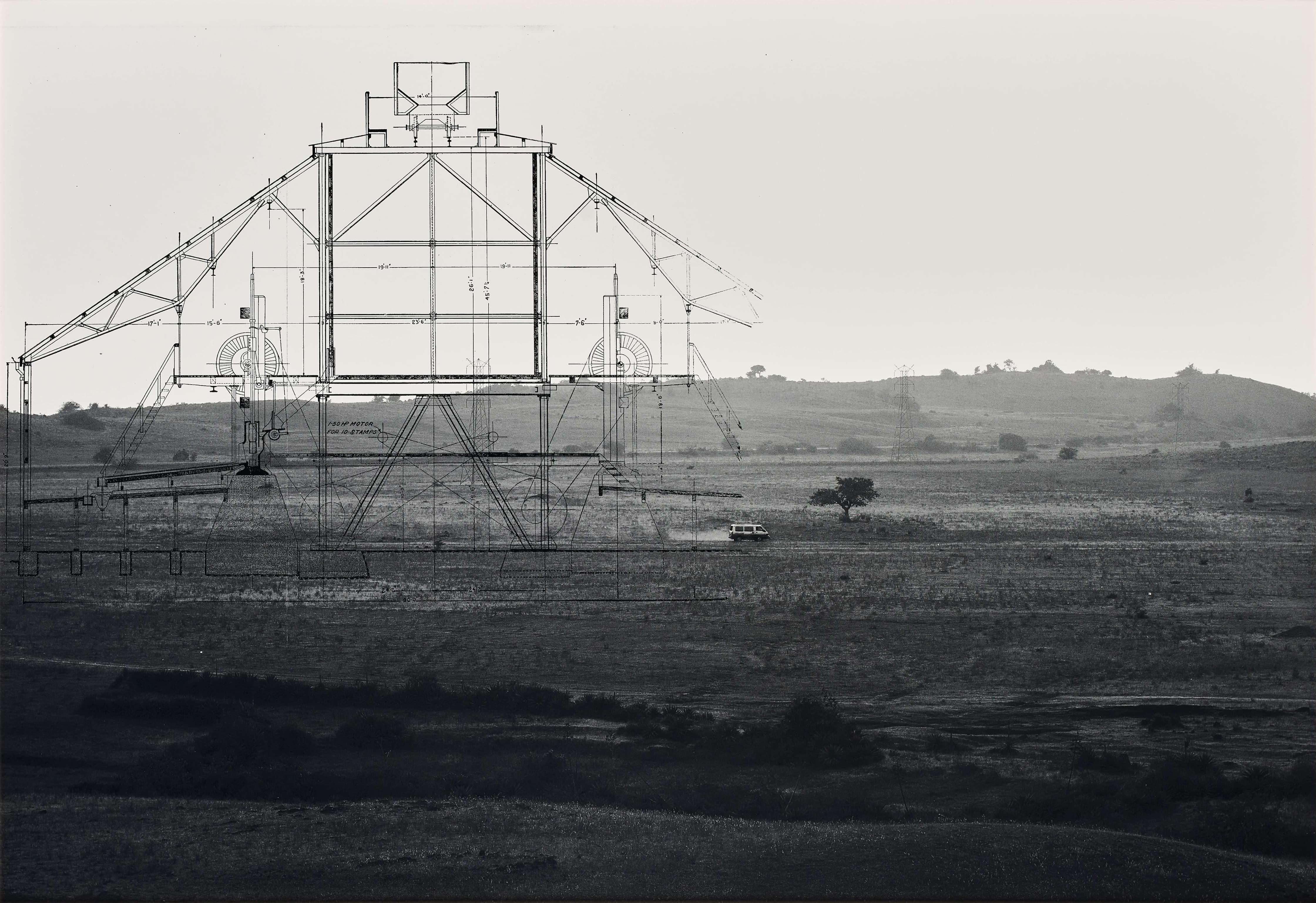
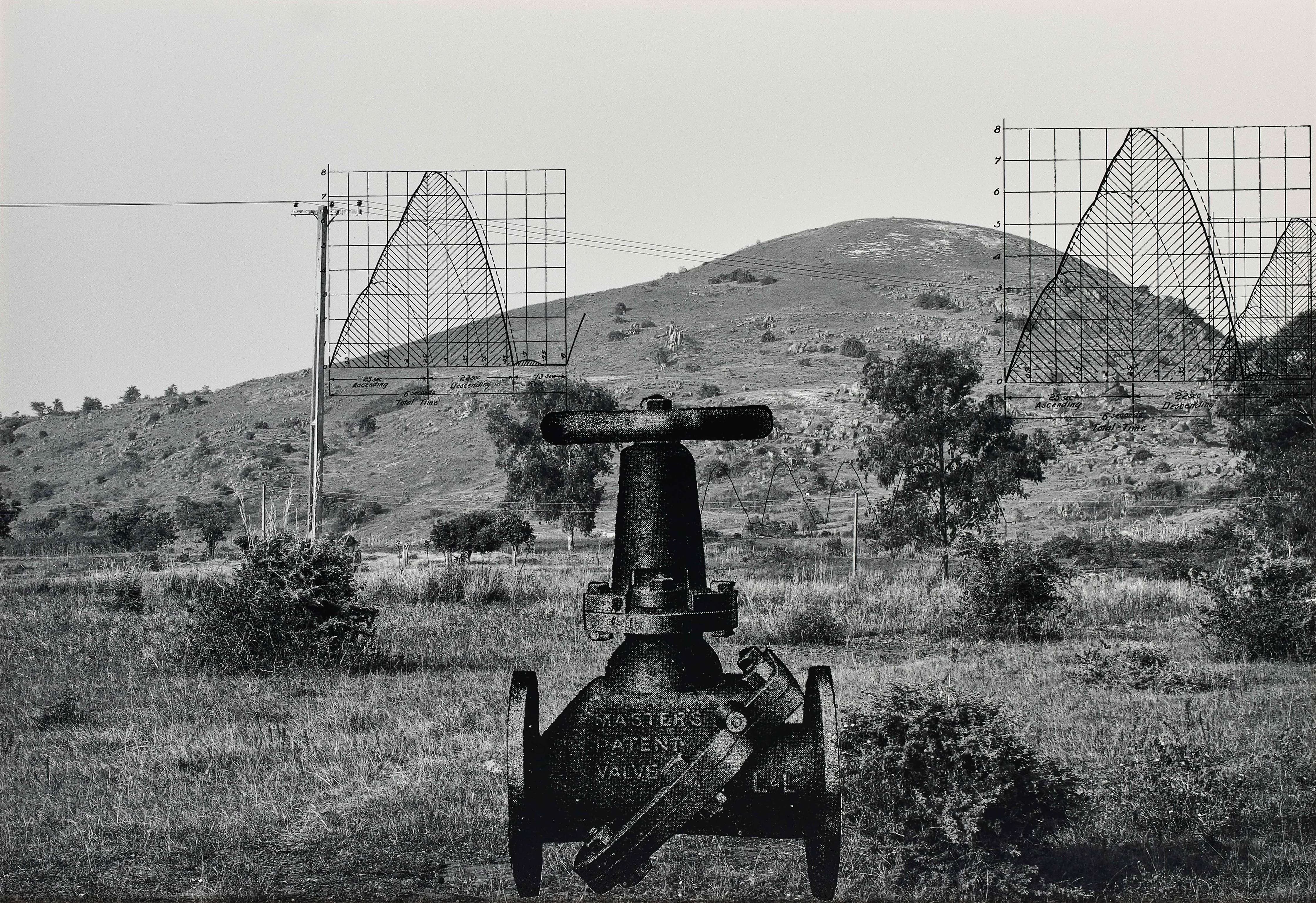
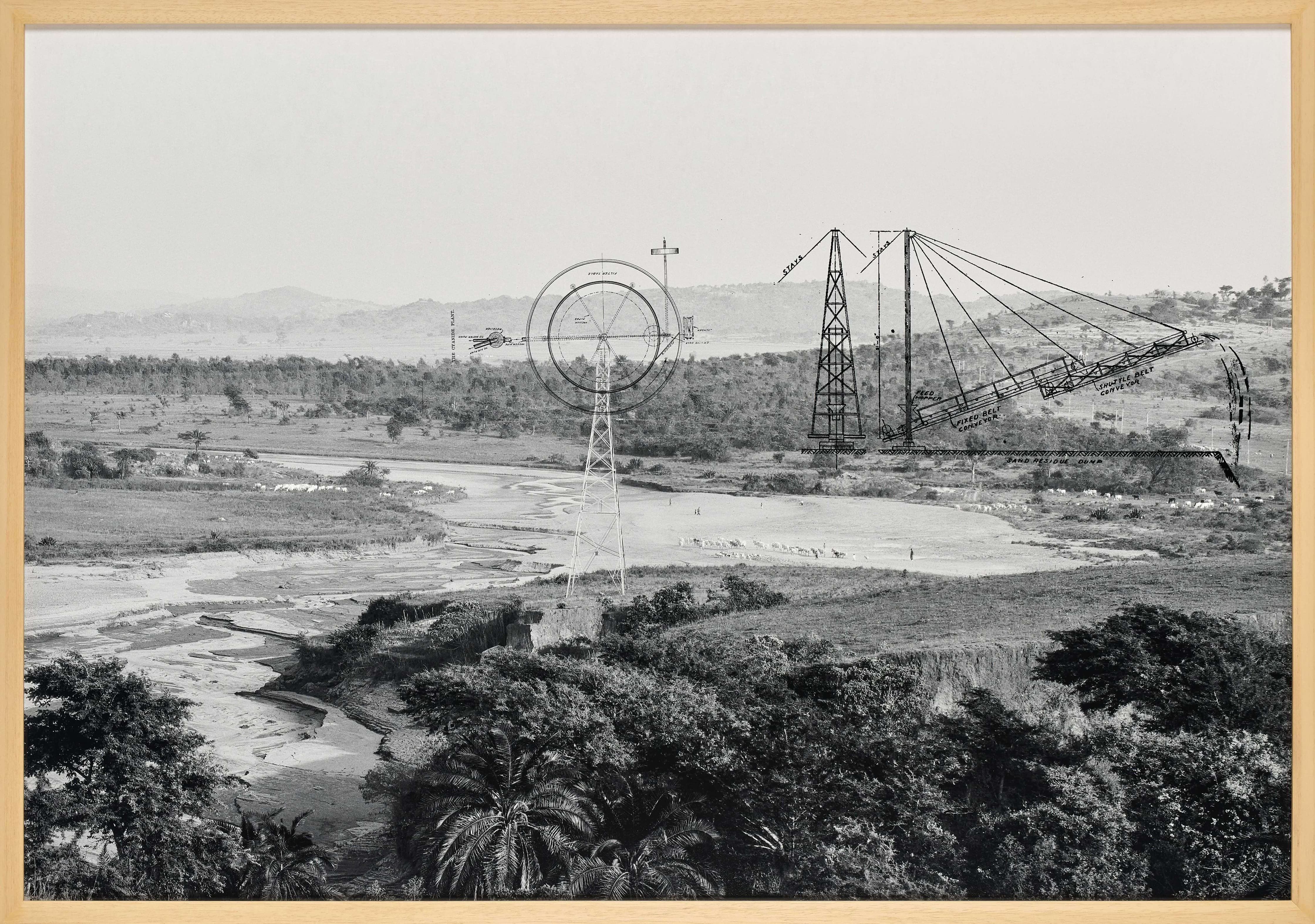
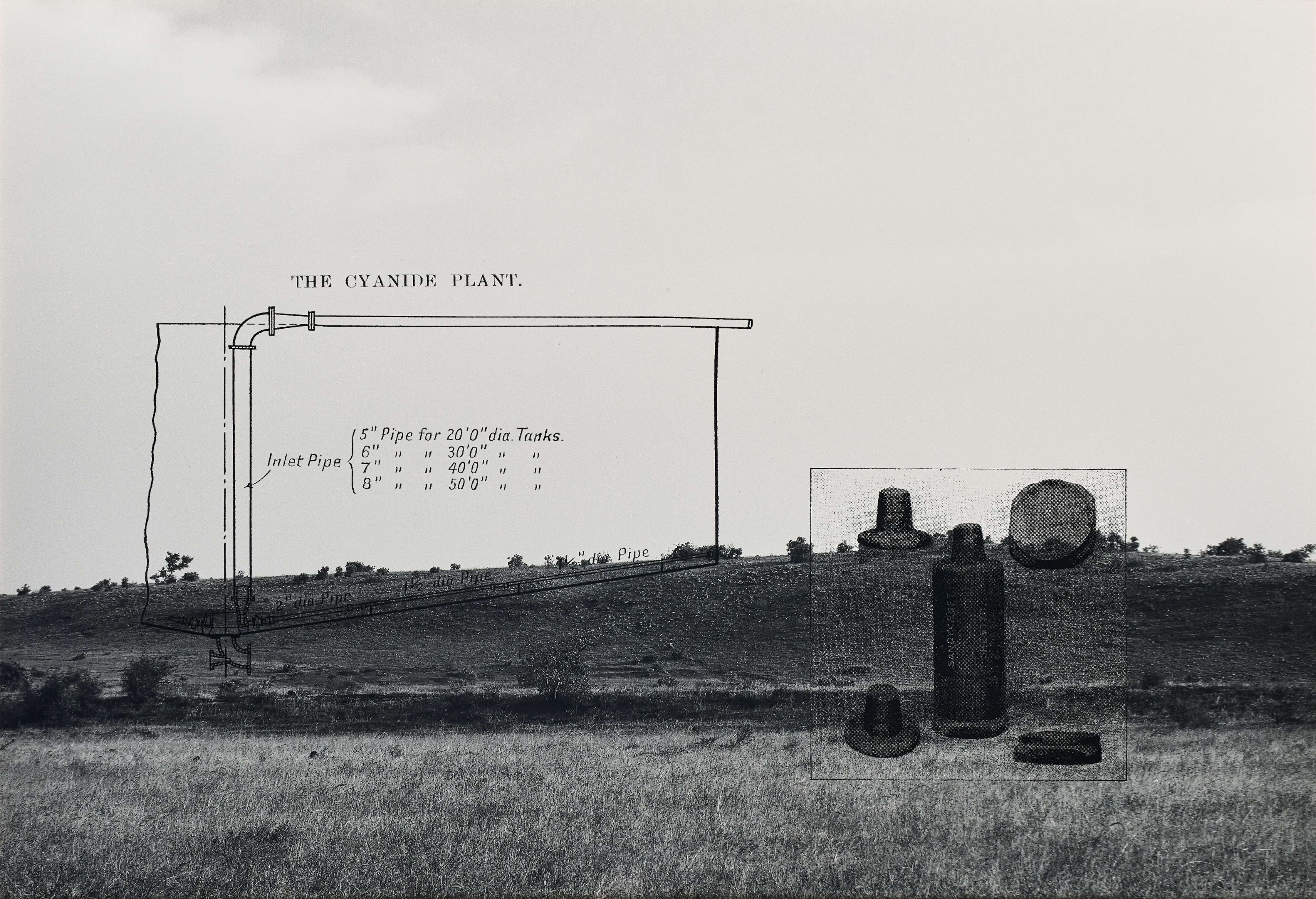
Metallurgical Practice: Landscape (2019) and Metallurgical Practice: Miners (2019) are part of a long-term body of work presenting a cross-sectional study of Oghobase’s experiences in Jos Plateau region in north-central Nigeria. The work, made up of several sub-series, begins to excavate the metaphoric strata of the landscape, revealing multiple layers beneath the surface of his personal encounter with the unique topography and history of Jos - bare grasslands and ancient rock formations indelibly scarred by human pursuits, past and present.
In this series, mining diagrams from A Text-book of Rand Metallurgical Practice: Designed as a "working Tool" and Practical Guide for Metallurgists Upon the Witwatersrand and Other Similar Fields (London, C. Griffin Limited, 1912) are superimposed on images of the Jos landscape. Just as the land and people today bear witness to the detrimental impacts and legacy of colonialism, the early twentieth-century technical drawings provide an illustrated guide to natural resource exploitation. They serve as a testament to European imperialist pursuits across the African continent, from the Witwatersrand ridge in South Africa to the Jos Plateau in Nigeria.
Metallurgical Practice: Landscape (2019) and Metallurgical Practice: Miners (2019) are part of a long-term body of work presenting a cross-sectional study of Oghobase’s experiences in Jos Plateau region in north-central Nigeria. The work, made up of several sub-series, begins to excavate the metaphoric strata of the landscape, revealing multiple layers beneath the surface of his personal encounter with the unique topography and history of Jos - bare grasslands and ancient rock formations indelibly scarred by human pursuits, past and present.
In this series, mining diagrams from A Text-book of Rand Metallurgical Practice: Designed as a "working Tool" and Practical Guide for Metallurgists Upon the Witwatersrand and Other Similar Fields (London, C. Griffin Limited, 1912) are superimposed on images of the Jos landscape. Just as the land and people today bear witness to the detrimental impacts and legacy of colonialism, the early twentieth-century technical drawings provide an illustrated guide to natural resource exploitation. They serve as a testament to European imperialist pursuits across the African continent, from the Witwatersrand ridge in South Africa to the Jos Plateau in Nigeria.
Metallurgical Practice: Landscape (2019) and Metallurgical Practice: Miners (2019) are part of a long-term body of work presenting a cross-sectional study of Oghobase’s experiences in Jos Plateau region in north-central Nigeria. The work, made up of several sub-series, begins to excavate the metaphoric strata of the landscape, revealing multiple layers beneath the surface of his personal encounter with the unique topography and history of Jos - bare grasslands and ancient rock formations indelibly scarred by human pursuits, past and present.
In this series, mining diagrams from A Text-book of Rand Metallurgical Practice: Designed as a "working Tool" and Practical Guide for Metallurgists Upon the Witwatersrand and Other Similar Fields (London, C. Griffin Limited, 1912) are superimposed on images of the Jos landscape. Just as the land and people today bear witness to the detrimental impacts and legacy of colonialism, the early twentieth-century technical drawings provide an illustrated guide to natural resource exploitation. They serve as a testament to European imperialist pursuits across the African continent, from the Witwatersrand ridge in South Africa to the Jos Plateau in Nigeria.
Metallurgical Practice: Landscape (2019) and Metallurgical Practice: Miners (2019) are part of a long-term body of work presenting a cross-sectional study of Oghobase’s experiences in Jos Plateau region in north-central Nigeria. The work, made up of several sub-series, begins to excavate the metaphoric strata of the landscape, revealing multiple layers beneath the surface of his personal encounter with the unique topography and history of Jos - bare grasslands and ancient rock formations indelibly scarred by human pursuits, past and present.
In this series, mining diagrams from A Text-book of Rand Metallurgical Practice: Designed as a "working Tool" and Practical Guide for Metallurgists Upon the Witwatersrand and Other Similar Fields (London, C. Griffin Limited, 1912) are superimposed on images of the Jos landscape. Just as the land and people today bear witness to the detrimental impacts and legacy of colonialism, the early twentieth-century technical drawings provide an illustrated guide to natural resource exploitation. They serve as a testament to European imperialist pursuits across the African continent, from the Witwatersrand ridge in South Africa to the Jos Plateau in Nigeria.
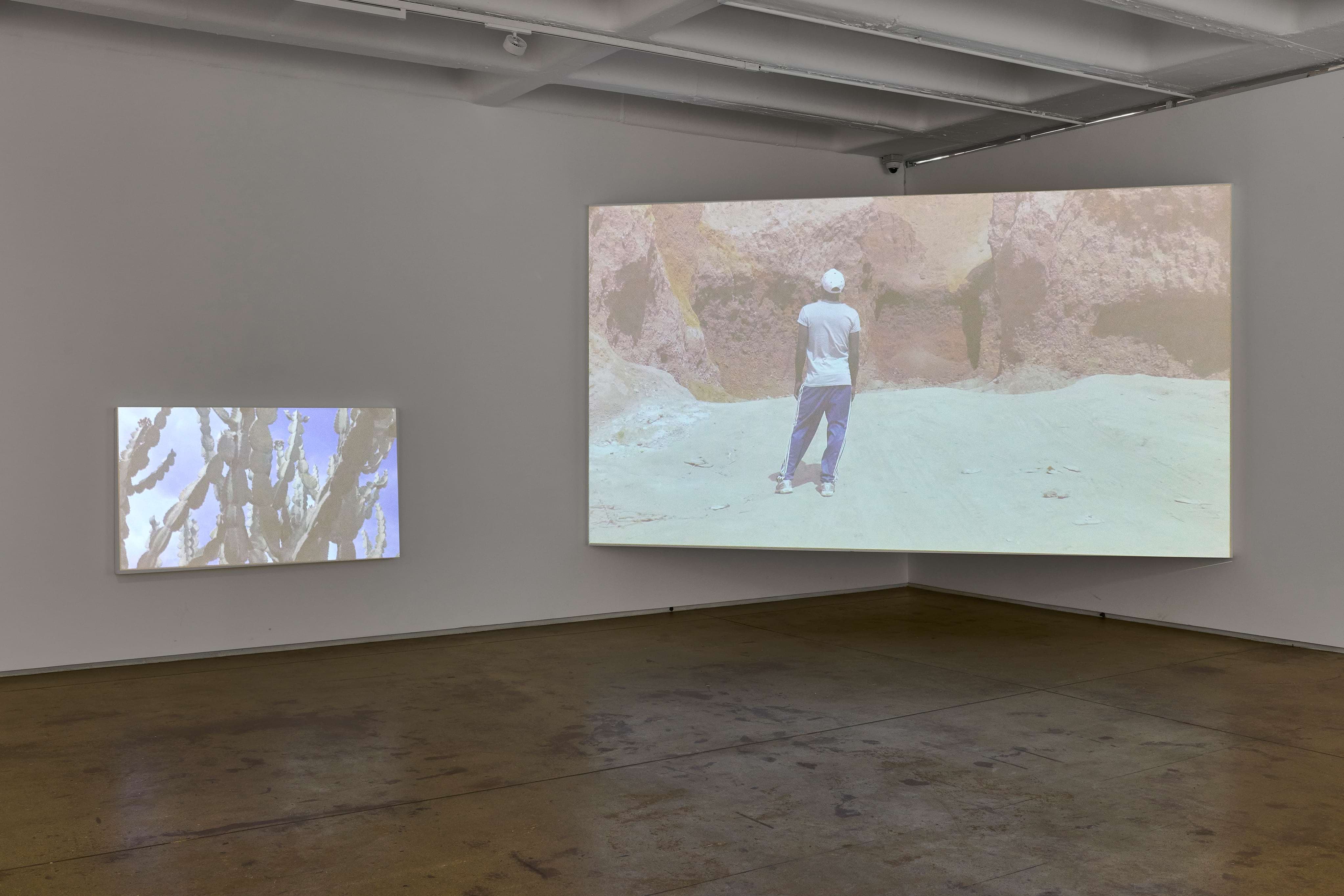
Plateau profiles a group of undocumented tin-miners in Nigeria’s Jos Plateau state and explores the socio-economic implications of their activities. Before Nigeria’s independence in the 1960s, Plateau State was central to the mining of minerals such as tin and columbite. The British colonial regime at the time enabled foreign companies to exploit the area. In the late 70’s and 80’s post-colonialism, many of these companies ceased and workers became redundant. These workers formed small communities and began digging the land for mineral deposits as a way towards their independence. They passed their skills on to future generations. Present day, mining continues with a whole host of complications. Without adequate machinery, the process is rudimentary and unmonitored, posing grave challenges to miners, inhabitants of Jos-Plateau state and the surrounding ecosystem. Plateau questions notions of independence and the detrimental impact of forgotten industries.
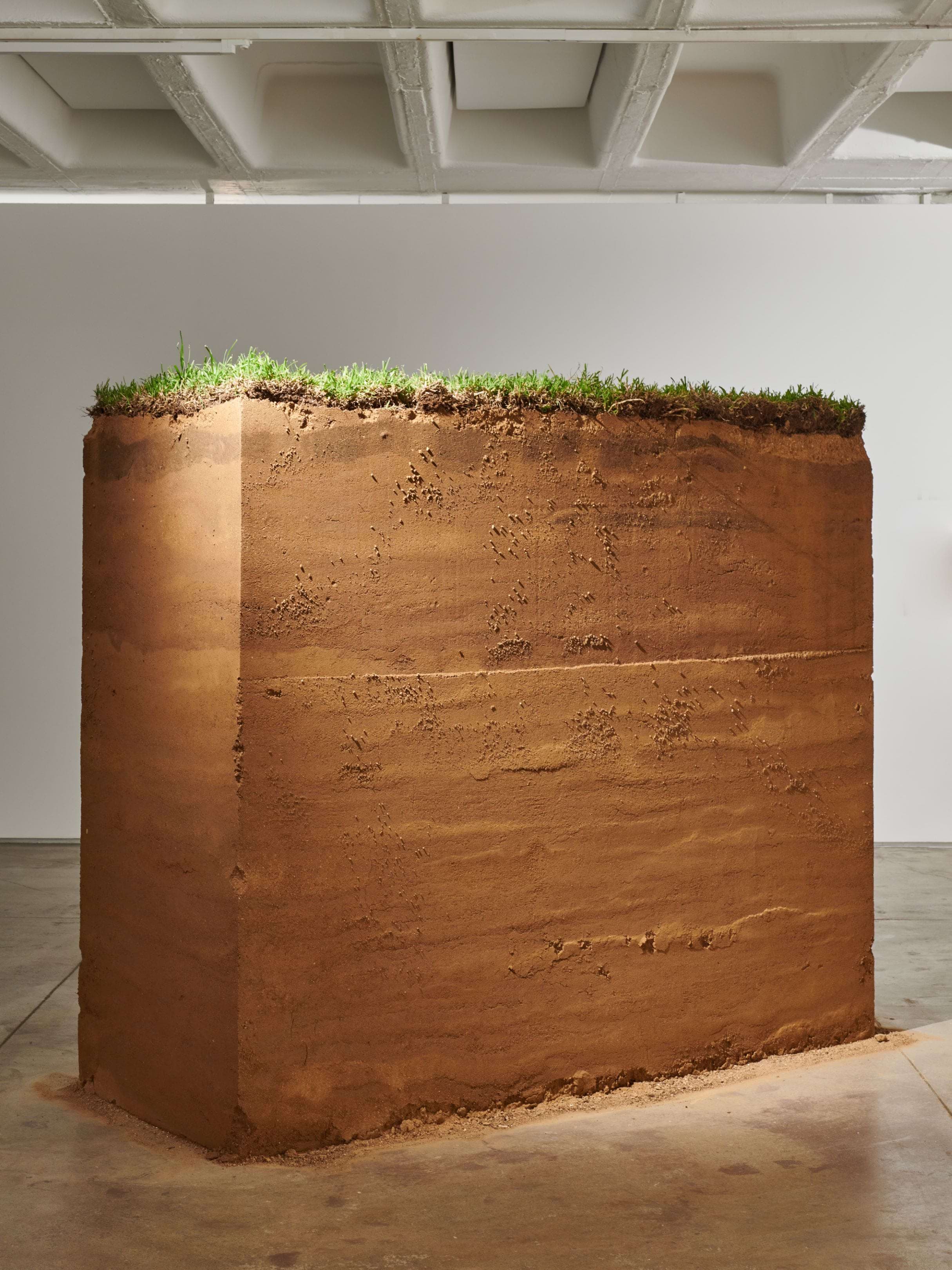
The title Outofor is taken from the phrase “out to of for”. This new site-specific installation is an allegory of the exhibition projects' overall thematic concerns and its site-specificity - South Africa. Outofor II, presented in the gallery garden, manifests as an adult-sized grave dug according to the South African state-mandated dimensions as outlined in the Cemeteries and Crematoria By-law of 2004. The grave is filled with King Proteas; the country’s national flower and one that is indigenous to the land. The inclusion of this flower offers a complexity given how expensive it is to purchase despite its native roots. “Protea” is derived from Proteus of Greek Mythology, who was a shape-shifting god of the sea, and son of Poseidon, god of the Oceans. Proteus had a gift of prophecy, and can determine the prospect in all things past in the present but took on different forms in order to avoid prophesying.
Outofor I uses the earth from the dug grave and places it within the gallery space. This extension of the installation produces a positive opposition to Outofor II and converts the external installation’s references to death into considerations of new beginnings.
The Royal House of Allure is the name of a (safe) House on mainland Lagos where members of the queer community in need of boarding (due to various circumstances) live together. Mlangeni spent six weeks in Lagos photographing the queer community in this house. This resulted in a series of images bearing the same name. The series sits firmly within Mlangeni’s continuing survey of the most challenging, beautiful and confounding aspects of the human experience. The Royal House of Allure contains images that may at first appear simple, whereas a longer and deeper perusal reveals nuanced prompts that urge us towards complexities behind representation. The images diverge at a single specific point; those that display fantasy through glamour where subjects actively pose for the camera and those that offer quieter banal moments where subjects are simply going on about their day at the house.
The Royal House of Allure forms part of Mlangeni’s broader practice of (re)imaging and (re) imagining vulnerable bodies as safe, seen and worthy of protection and celebration.