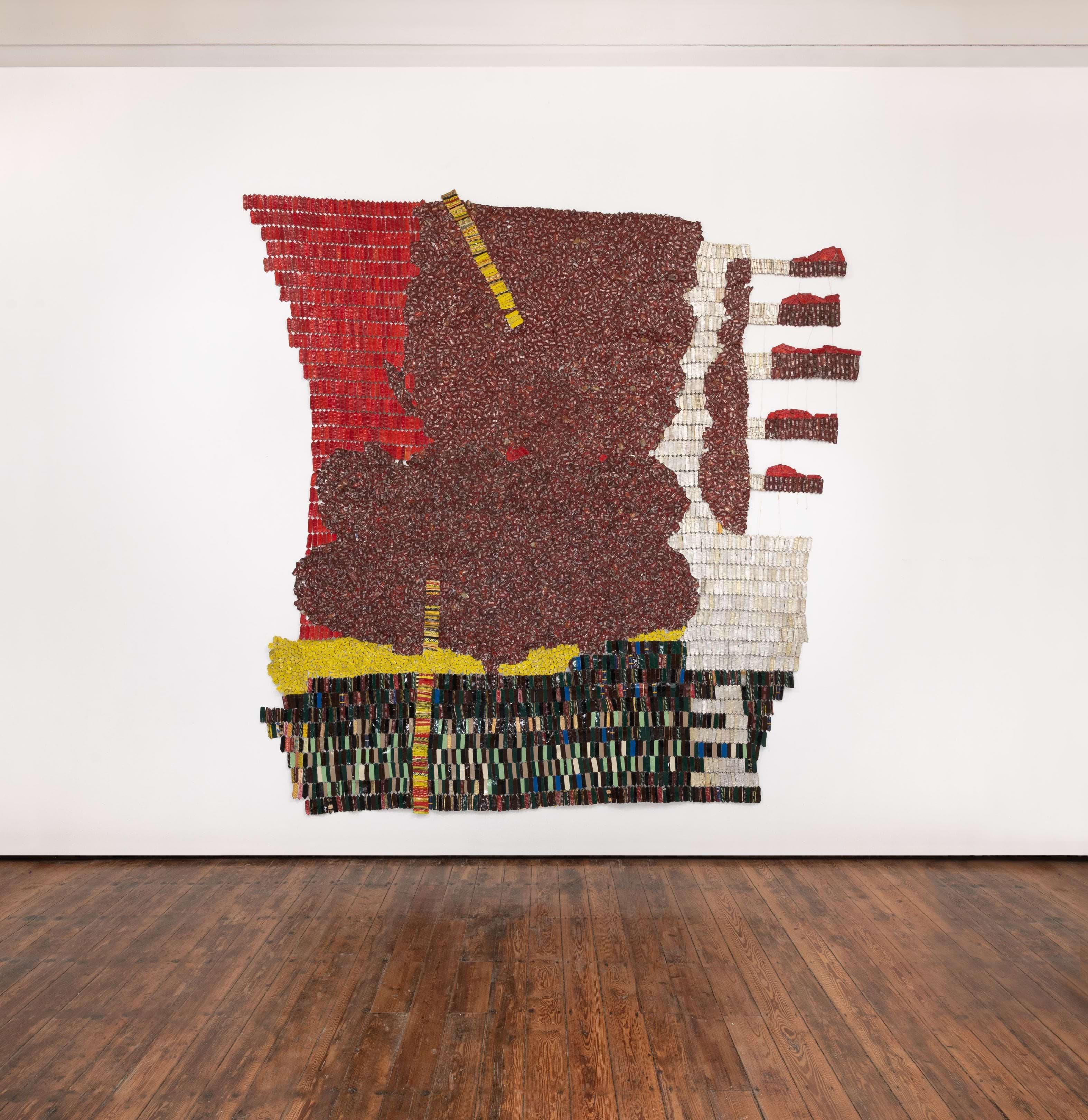
Sovereignty uses a combination of biotic, non-linear and ordered lines chaotically tangled to reflect the violently established laws that organise the flow of humans through restrictions, while also drawing attention to natural pathways and channels.
Video
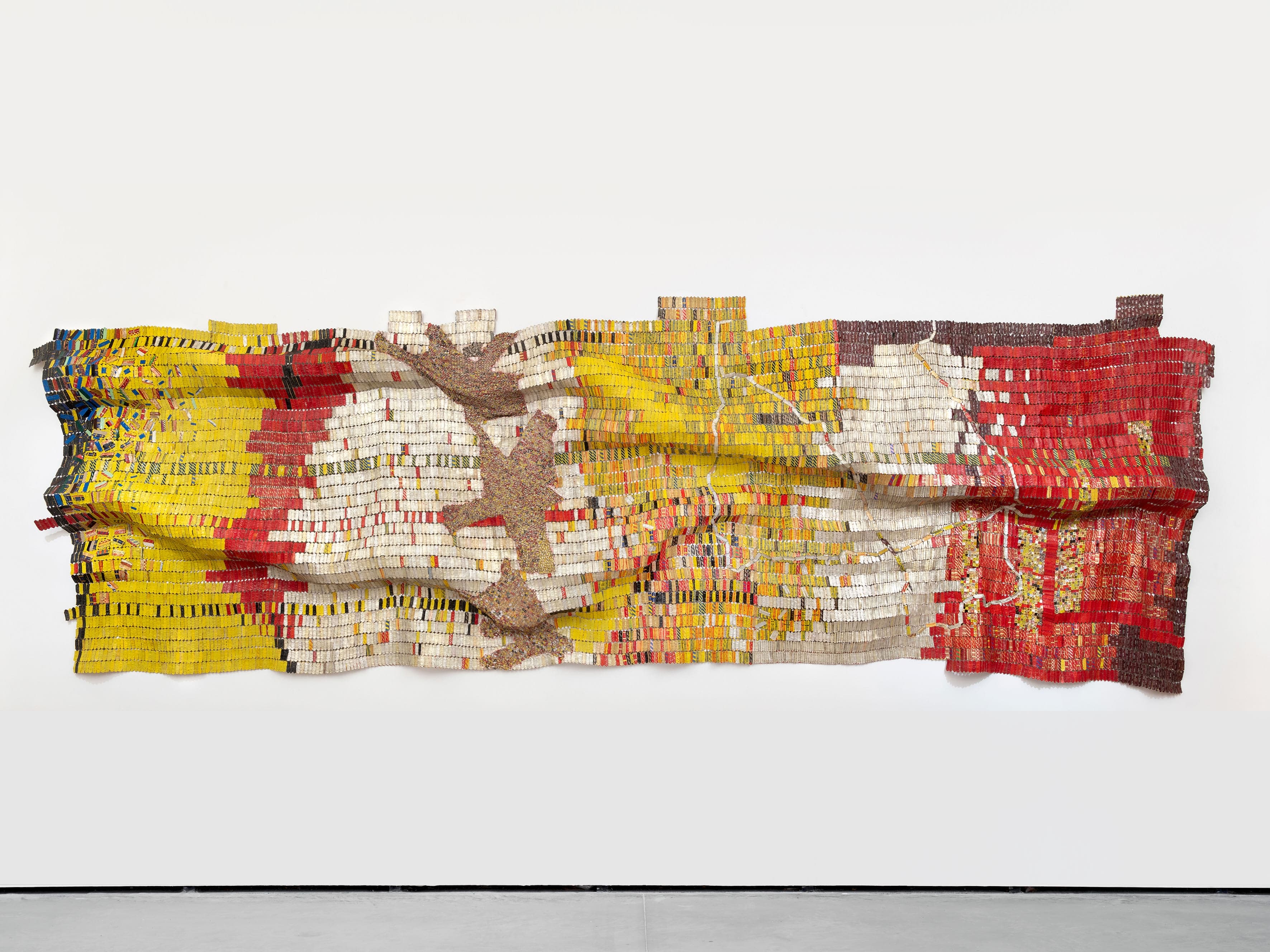
In ‘Freedom’, El Anatsui brings his signature approach to material and scale into sharp focus, using found aluminium, copper wire, and nylon string to create a vast, topographical composition. Intricate traces and woven outlines form layered networks that recall maps or aerial landscapes visualising pathways, borders, and the entangled histories they carry. Anatsui’s use of everyday materials, drawn from his immediate environment, grounds the work in the language of reuse, while also destabilising fixed ideas of place and belonging.
The surface of ‘Freedom’ is alive with tension and fluidity. Lines loop and intersect, challenging spatial hierarchies and resisting containment. Amid this complex web, three birds emerge – what Anatsui calls “birds of freedom” or “birds with the freedom to soar.” Their presence suggests a quiet defiance: a refusal to be hemmed in by the borders and bureaucracies that restrict human movement. As with much of his practice, Anatsui’s engagement with abstraction serves a deeply political function. ‘Freedom’ does not offer a single, resolved image, but rather a space of possibility where direction is uncertain, flight is still imaginable, and the contours of liberation are continually redrawn.
Video
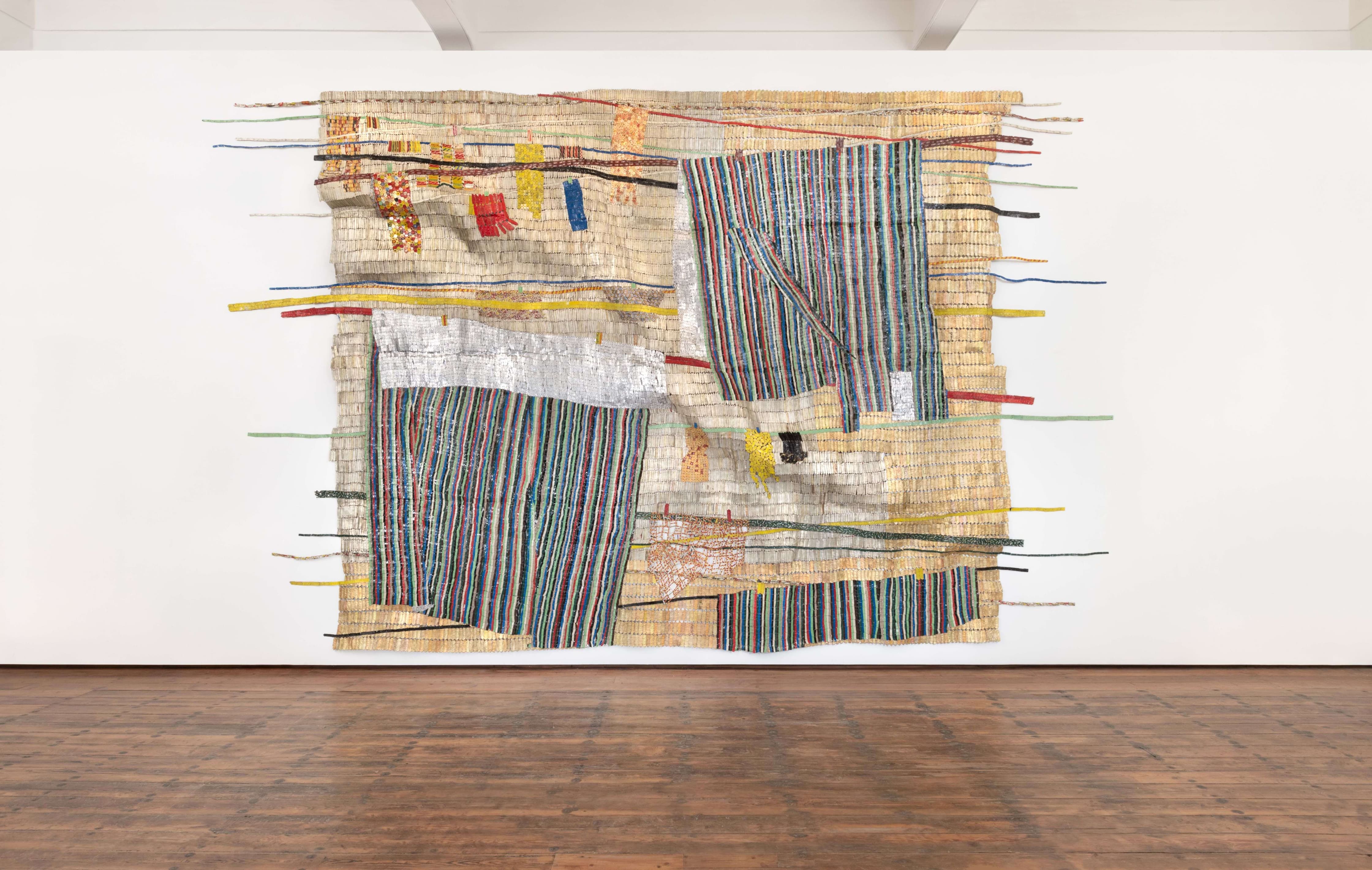
In ‘Drying Line’, El Anatsui departs from the dense, tightly woven surfaces of his signature metal tapestries to embrace a looser, more open composition. Strands extend outward from the body of the work, evoking the casual geometry of laundry hung to dry – an everyday scene reimagined through sculptural abstraction. These free-flowing lines offer a sense of ease and release, contrasting with the more structured, grid-like compositions found in many of his earlier pieces. The interplay of form here mirrors a shift in tempo: a softening of rhythm, and an openness to air, space, and movement.
Colour plays a central role in balancing the work’s emotional register. A dialogue unfolds between warm and cooler tones – vibrant reds and golds give way to silvers and blues – creating a dynamic surface that oscillates between intensity and stillness. With ‘Drying Line’, Anatsui reflects on the contrasts he observes from his studio in Tema, Ghana: the vibrant energy of daytime activity giving way to the stillness of night. This tension – between vigour and quietude, presence and absence – is embedded in the work’s shifting textures and sprawling lines. As with his broader practice, ‘Drying Line’ resists closure, instead offering a form in flux that is alive to its surroundings, and charged with the rhythms of daily life.
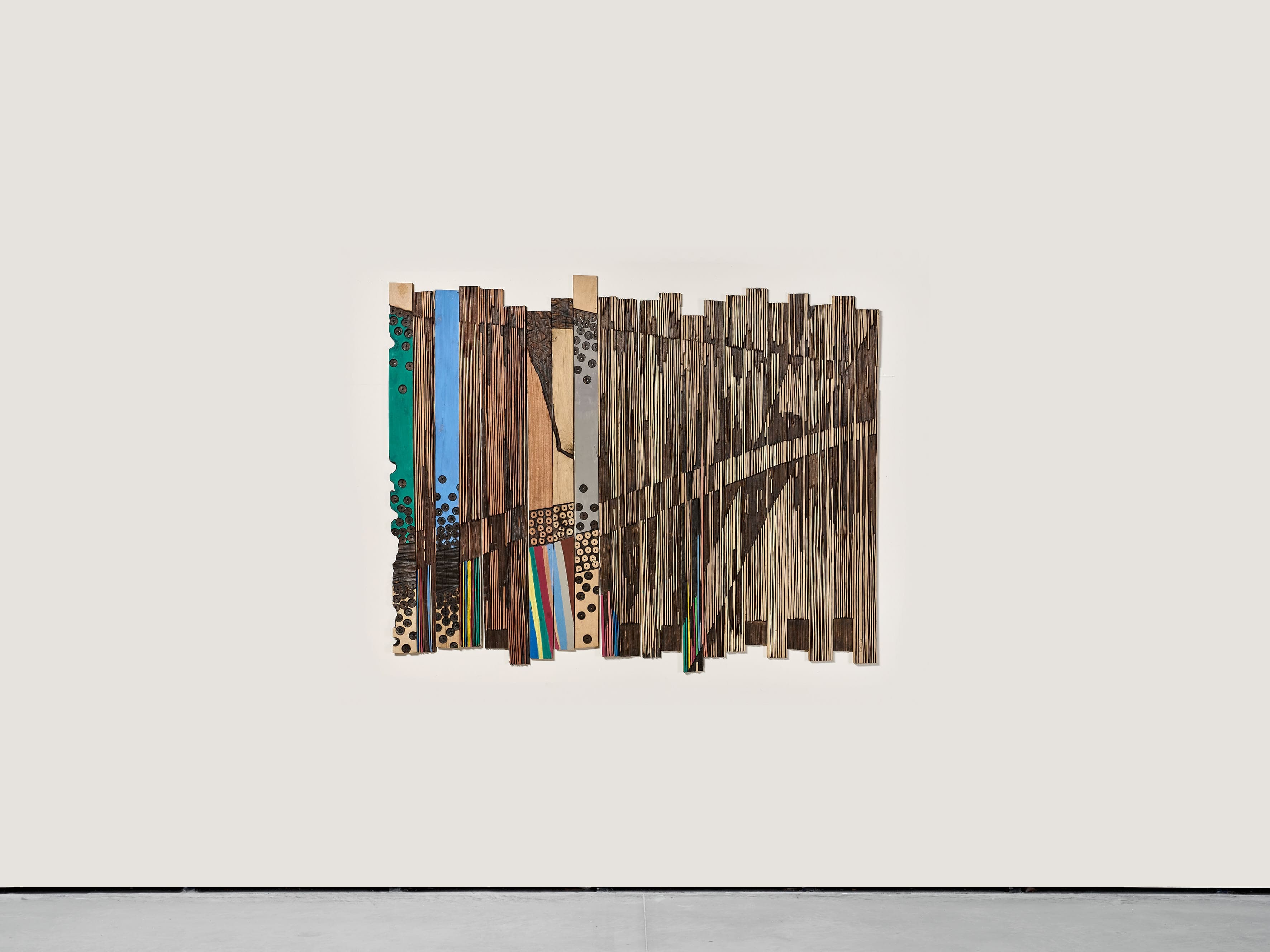
El Anatsui’s wooden sculptures form a pivotal part of his practice and conceptual thinking. Working with indigenous hardwoods sourced in Ghana and Nigeria, he employed carving, burning, painting, and staining to transform the surface of the wood. These treatments created layered textures and rich tonal variations, revealing a deep sensitivity to material and form. Many of the works are modular in structure, composed of panels that can be rearranged, introducing a sense of mutability and open-endedness that would later become central to his practice.
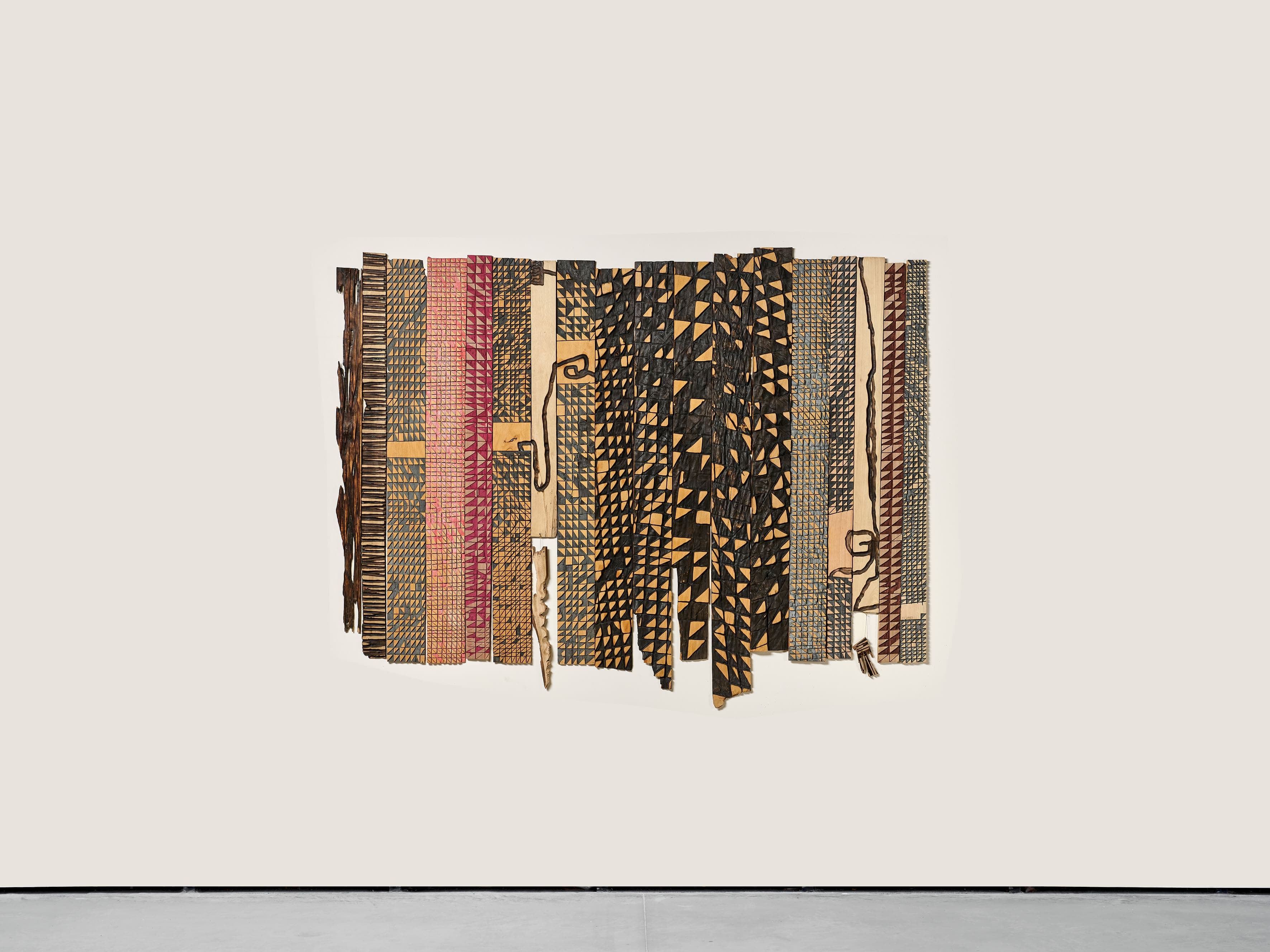
Through works such as ‘National Identity Card’, El Anatsui subtly gestures at the different things that make up and break apart an identity – fingerprints, a connection to heritage and folkloric traditions as well as more contemporary tools of identification such as DNA recognition. By embracing one’s identity with and without its limits, Anatsui reflects his principle of thinking about life as “a beautiful phenomenon to be experienced and not a problem to be solved.”
El Anatsui’s wooden sculptures form a pivotal part of his practice and conceptual thinking. Working with indigenous hardwoods sourced in Ghana and Nigeria, he employs carving, burning, painting, and staining to transform the surface of the wood. These treatments created layered textures and rich tonal variations, revealing a deep sensitivity to material and form. Many of the works are modular in structure, composed of panels that can be rearranged, introducing a sense of mutability and open-endedness that would later become central to his practice.
These works are not simply static wall pieces but carry sculptural presence and conceptual depth. Their modularity, emphasis on surface, and engagement with repetition anticipate the formal strategies Anatsui would later amplify in his iconic bottle-cap installations. In both bodies of work, the interplay between fragment and whole, permanence and change, remains a defining concern.
Arranged in vertical fixed panels that are carved into rich patterns and textures, ‘Routes to Discovery’ reflects the artist’s early practice which incorporated cut wood and lumber often sourced from the Nsukka Market in Nigeria. In ‘Routes to Discovery’ Anatsui emphasises borders that mankind have placed to curtail the freedom of others. The straight and structured lines are interrupted by organic rings that offer a sense of reprieve.