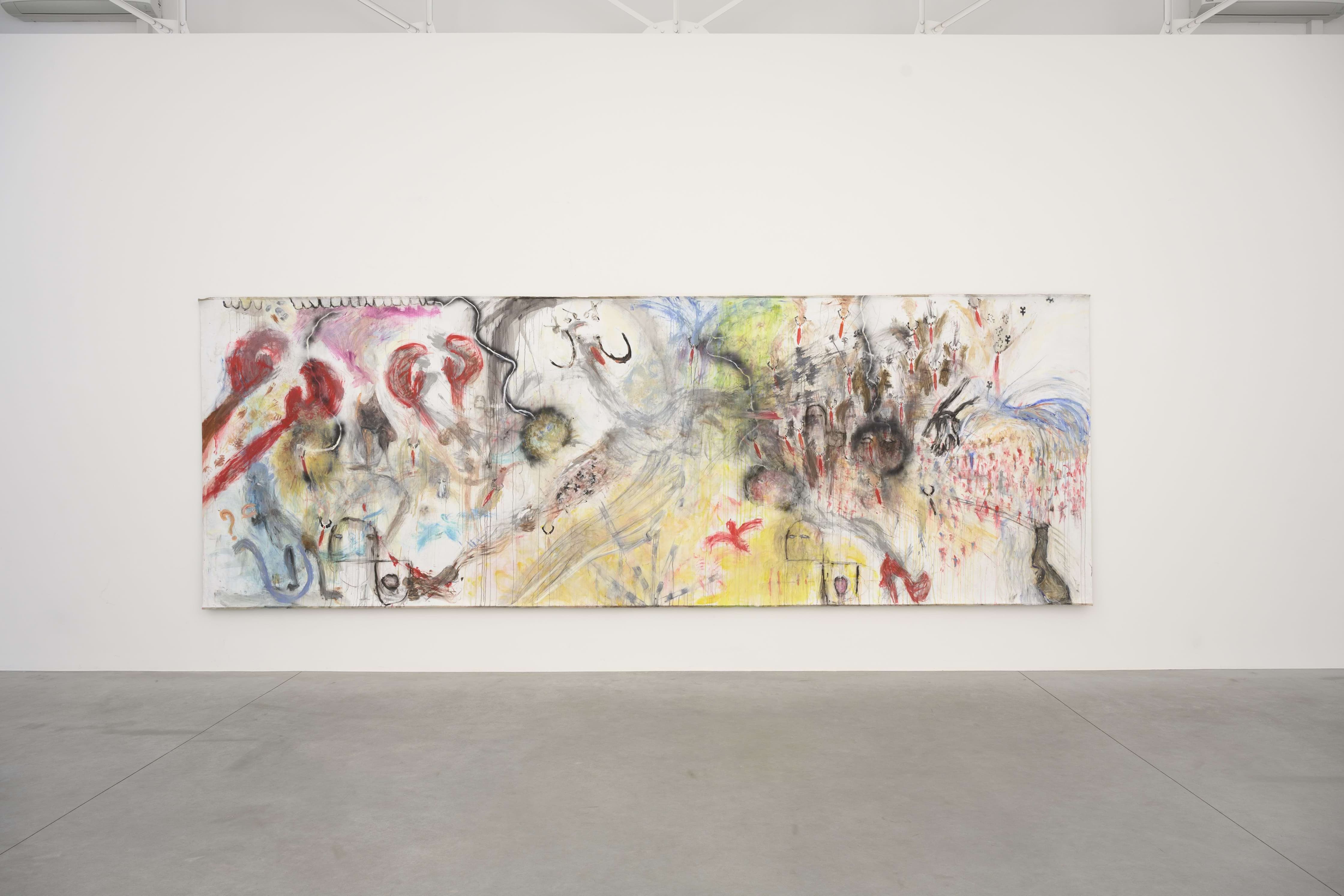
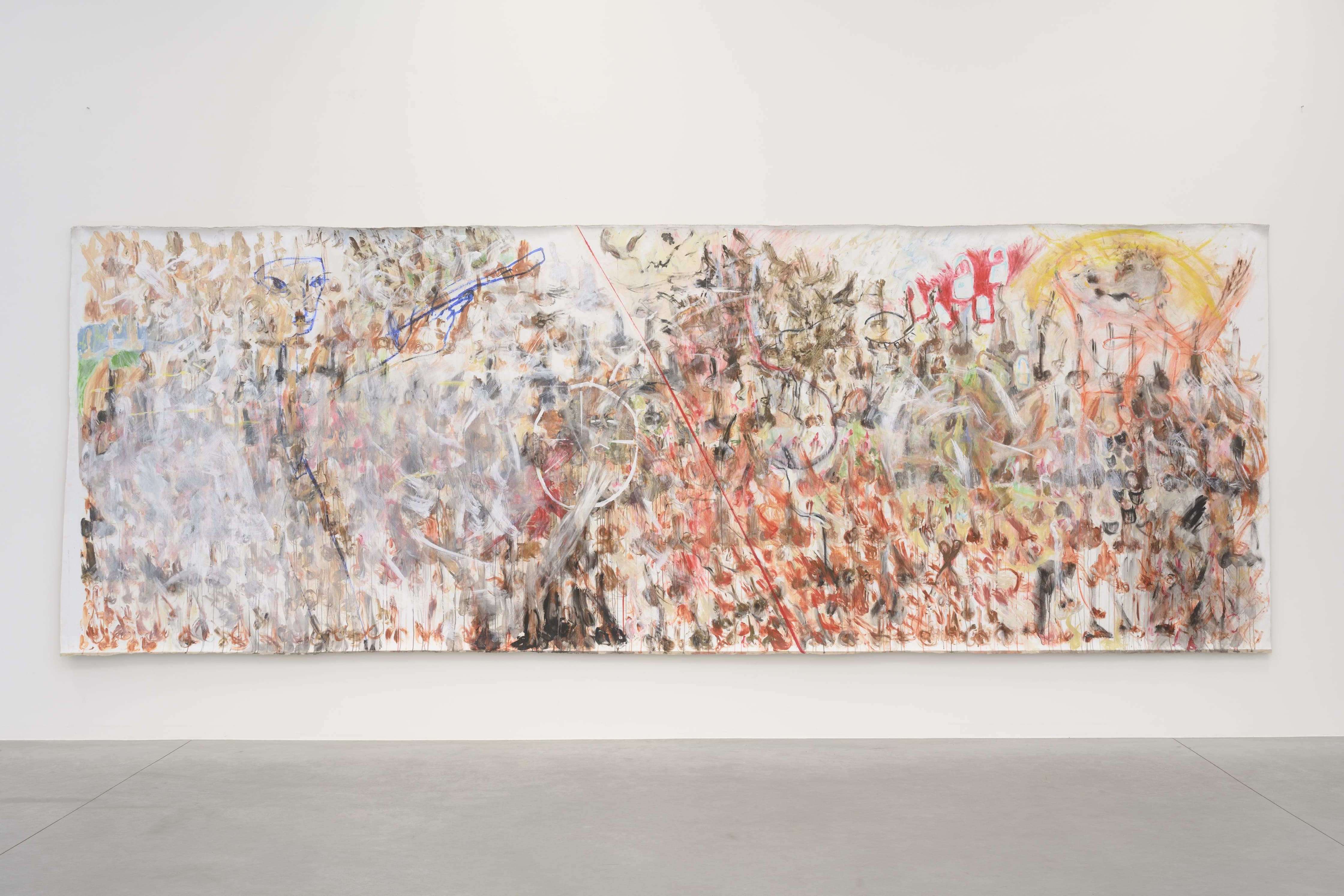
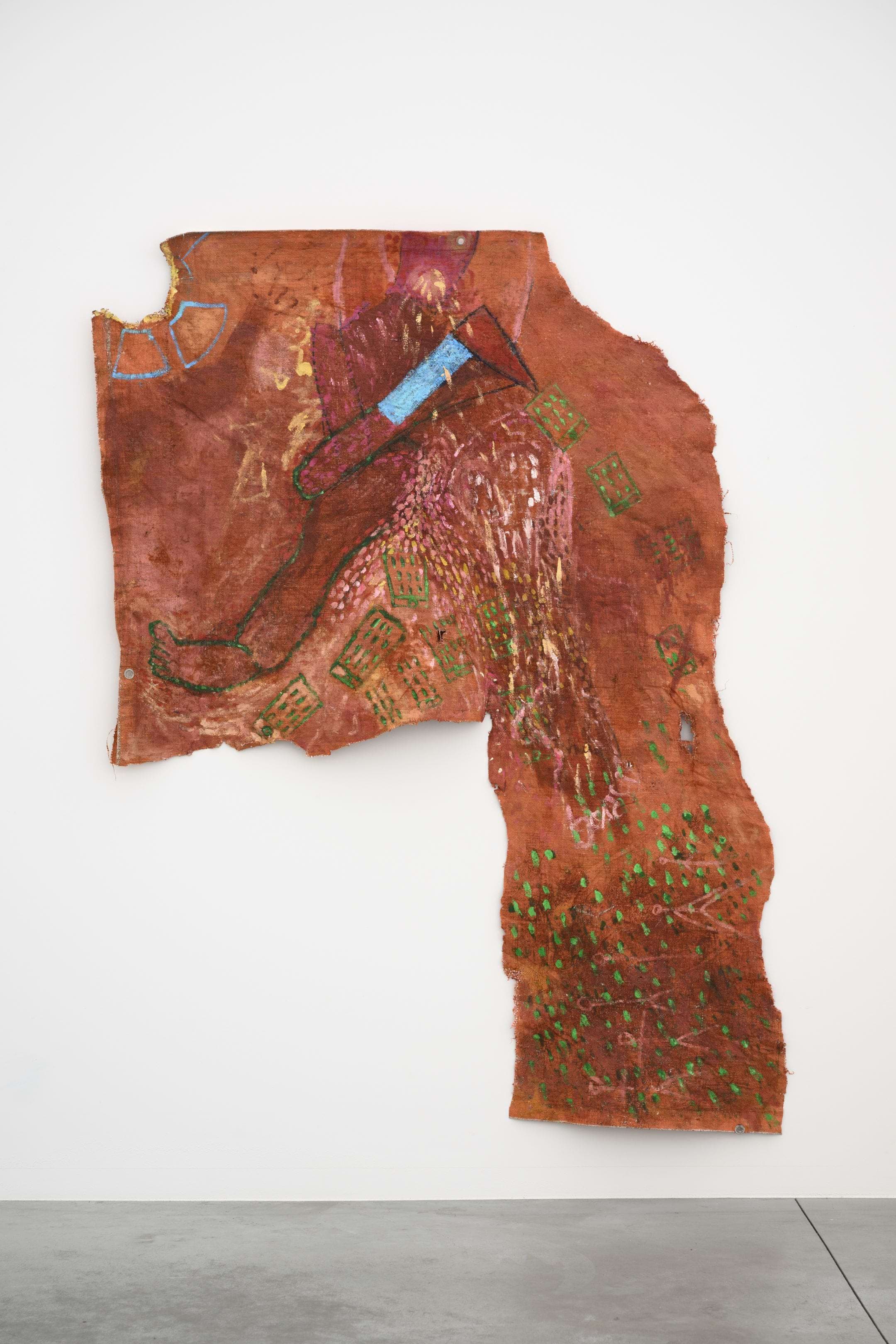
Pélagie Gbaguidi’s work incorporates paintings, drawings and mixed media works in an exploration of the “big and small stories that take our beings towards the burning questions of the world, urging us to go beyond the surface” - Pélagie Gbaguidi
Gbaguidi’s candid and sometimes tongue-in-cheek creations depict splintered figures in different forms and settings - moving, contorting, shapeshifting. As riotous colour erupts alongside subtle hues, creatures lay next to other creatures, they merge with animal and plant life and other objects, breaking the hard edges between me/us/them/it.
Often using natural pigments, alongside paint, ink, pencil, wool, wax and crayons and materials such as flour sacks and tarpaulin, Gbaguidi confronts colonial histories by repurposing discarded materials and integrating them into new contexts. She questions legacies of colonialism that continue to impact migration, trade and the environment.
Her practice, phenomenological and embodied, involves a performative element where the body serves as a medium. She often uses own body to paint and make marks on the surfaces (instead of brushes or other tools). These scratches and smudges become imprints that allow the work to absorb memory into form, she explains; “thus, the body becomes a language that translates sociopolitical issues into a poetic choreography composed of paintings, drawings and textiles....”
Gbaguidi confronts histories of oppression, particularly through women’s experiences, exposing how history, (un)recorded and remembered, continues to impact on women’s lives. Her practice can be understood through several key thematic threads — assemblage, fragmentation and intersections reflected through a focus on the female body; how the body is encountered and read, alongside its relationship with the environment, in a technological age. Seeing herself as a modern day griot and carrying on a long tradition of lyrical storytelling she engages in transgenerational and intercontinental dialogue, particularly between her birth place in West Africa and Europe.
Pélagie Gbaguidi’s work incorporates paintings, drawings and mixed media works in an exploration of the “big and small stories that take our beings towards the burning questions of the world, urging us to go beyond the surface” - Pélagie Gbaguidi
Gbaguidi’s candid and sometimes tongue-in-cheek creations depict splintered figures in different forms and settings - moving, contorting, shapeshifting. As riotous colour erupts alongside subtle hues, creatures lay next to other creatures, they merge with animal and plant life and other objects, breaking the hard edges between me/us/them/it.
Often using natural pigments, alongside paint, ink, pencil, wool, wax and crayons and materials such as flour sacks and tarpaulin, Gbaguidi confronts colonial histories by repurposing discarded materials and integrating them into new contexts. She questions legacies of colonialism that continue to impact migration, trade and the environment.
Her practice, phenomenological and embodied, involves a performative element where the body serves as a medium. She often uses own body to paint and make marks on the surfaces (instead of brushes or other tools). These scratches and smudges become imprints that allow the work to absorb memory into form, she explains; “thus, the body becomes a language that translates sociopolitical issues into a poetic choreography composed of paintings, drawings and textiles....”
Gbaguidi confronts histories of oppression, particularly through women’s experiences, exposing how history, (un)recorded and remembered, continues to impact on women’s lives. Her practice can be understood through several key thematic threads — assemblage, fragmentation and intersections reflected through a focus on the female body; how the body is encountered and read, alongside its relationship with the environment, in a technological age. Seeing herself as a modern day griot and carrying on a long tradition of lyrical storytelling she engages in transgenerational and intercontinental dialogue, particularly between her birth place in West Africa and Europe.
Pélagie Gbaguidi’s work incorporates paintings, drawings and mixed media works in an exploration of the “big and small stories that take our beings towards the burning questions of the world, urging us to go beyond the surface” - Pélagie Gbaguidi
Gbaguidi’s candid and sometimes tongue-in-cheek creations depict splintered figures in different forms and settings - moving, contorting, shapeshifting. As riotous colour erupts alongside subtle hues, creatures lay next to other creatures, they merge with animal and plant life and other objects, breaking the hard edges between me/us/them/it.
Often using natural pigments, alongside paint, ink, pencil, wool, wax and crayons and materials such as flour sacks and tarpaulin, Gbaguidi confronts colonial histories by repurposing discarded materials and integrating them into new contexts. She questions legacies of colonialism that continue to impact migration, trade and the environment.
Her practice, phenomenological and embodied, involves a performative element where the body serves as a medium. She often uses own body to paint and make marks on the surfaces (instead of brushes or other tools). These scratches and smudges become imprints that allow the work to absorb memory into form, she explains; “thus, the body becomes a language that translates sociopolitical issues into a poetic choreography composed of paintings, drawings and textiles....”
Gbaguidi confronts histories of oppression, particularly through women’s experiences, exposing how history, (un)recorded and remembered, continues to impact on women’s lives. Her practice can be understood through several key thematic threads — assemblage, fragmentation and intersections reflected through a focus on the female body; how the body is encountered and read, alongside its relationship with the environment, in a technological age. Seeing herself as a modern day griot and carrying on a long tradition of lyrical storytelling she engages in transgenerational and intercontinental dialogue, particularly between her birth place in West Africa and Europe.
Pélagie Gbaguidi’s work incorporates paintings, drawings and mixed media works in an exploration of the “big and small stories that take our beings towards the burning questions of the world, urging us to go beyond the surface” - Pélagie Gbaguidi
Gbaguidi’s candid and sometimes tongue-in-cheek creations depict splintered figures in different forms and settings - moving, contorting, shapeshifting. As riotous colour erupts alongside subtle hues, creatures lay next to other creatures, they merge with animal and plant life and other objects, breaking the hard edges between me/us/them/it.
Often using natural pigments, alongside paint, ink, pencil, wool, wax and crayons and materials such as flour sacks and tarpaulin, Gbaguidi confronts colonial histories by repurposing discarded materials and integrating them into new contexts. She questions legacies of colonialism that continue to impact migration, trade and the environment.
Her practice, phenomenological and embodied, involves a performative element where the body serves as a medium. She often uses own body to paint and make marks on the surfaces (instead of brushes or other tools). These scratches and smudges become imprints that allow the work to absorb memory into form, she explains; “thus, the body becomes a language that translates sociopolitical issues into a poetic choreography composed of paintings, drawings and textiles....”
Gbaguidi confronts histories of oppression, particularly through women’s experiences, exposing how history, (un)recorded and remembered, continues to impact on women’s lives. Her practice can be understood through several key thematic threads — assemblage, fragmentation and intersections reflected through a focus on the female body; how the body is encountered and read, alongside its relationship with the environment, in a technological age. Seeing herself as a modern day griot and carrying on a long tradition of lyrical storytelling she engages in transgenerational and intercontinental dialogue, particularly between her birth place in West Africa and Europe.
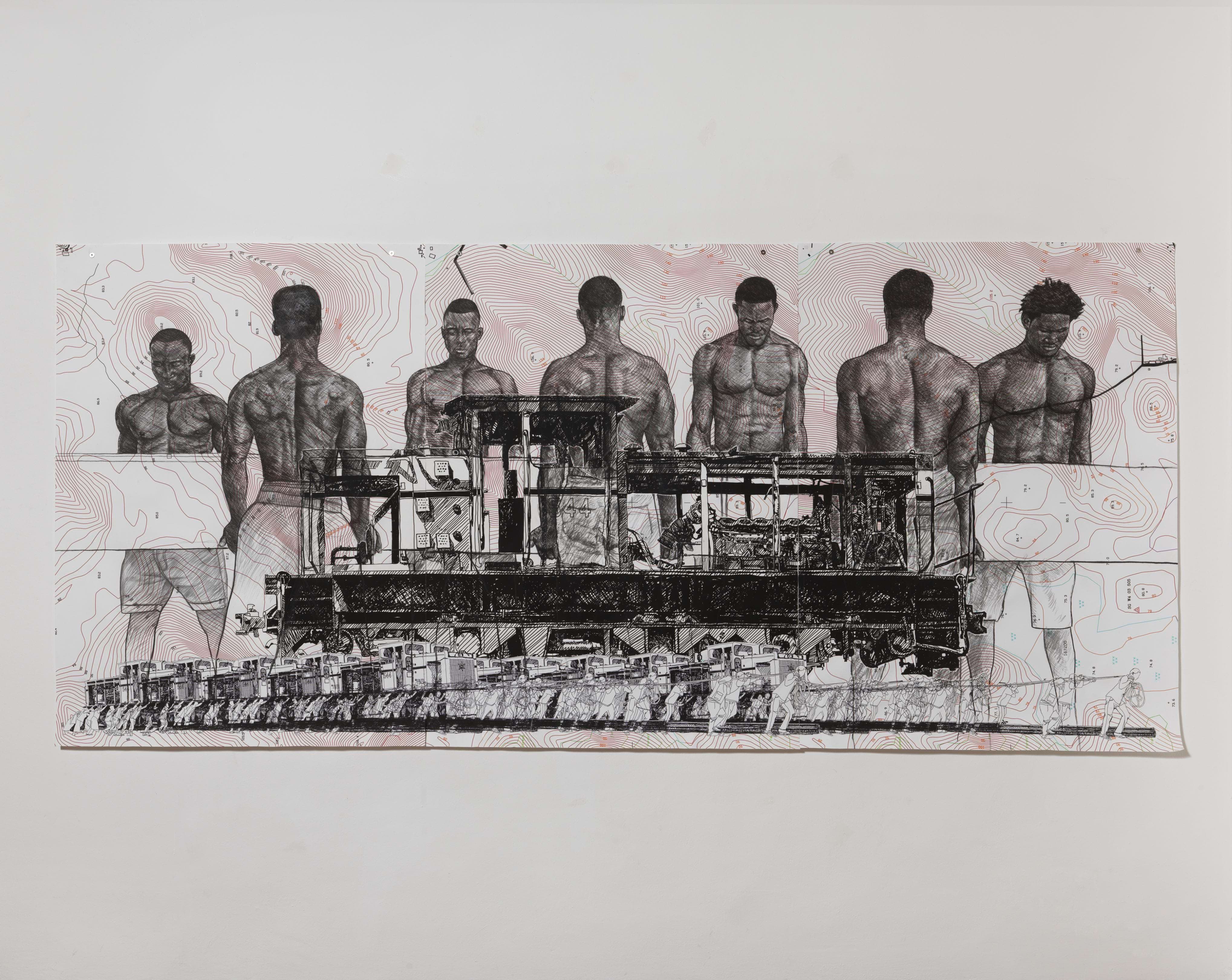
In the tryptich, 'Walking Down The Street (2024), Mahama returns to depict his collaborators, young men engaged in holding heavy objects. Here, unlike in the photographic collages, the artist favours a monochromatic tone; the grey scale of the different layers of drawing is alternated solely by the red of the level curves of the topographical maps, the isohypses, which the artist has begun to collect in recent years. The bodies of the collaborators are partly obscured by cutouts of drawings of old locomotives dismantled and taken apart in the studio, whose internal structures can be seen. In the lower part of the work, almost as if it were a long frieze, the artist has added a long cutout that depicts dozens of helpers, men and women, dragging parts of trains.
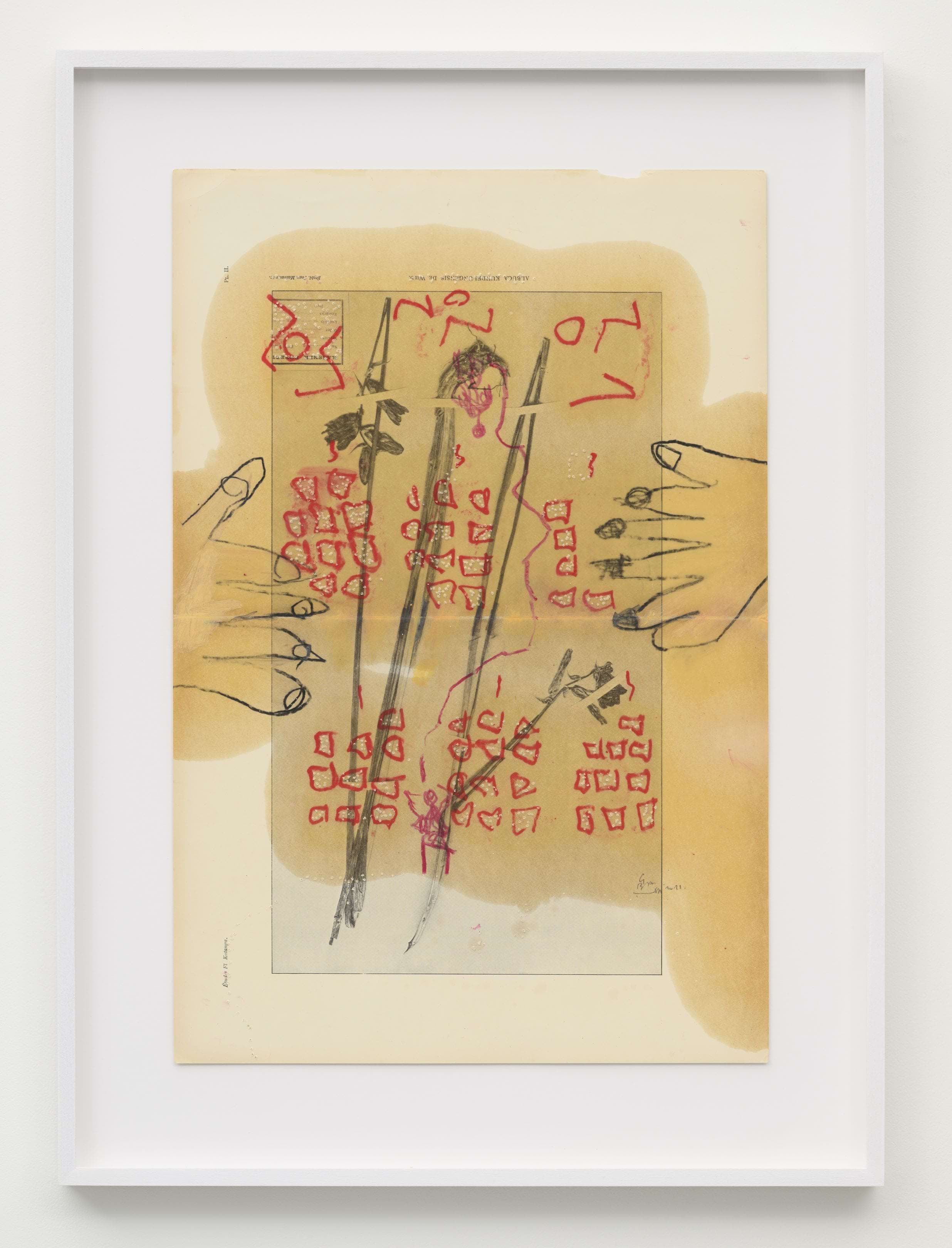
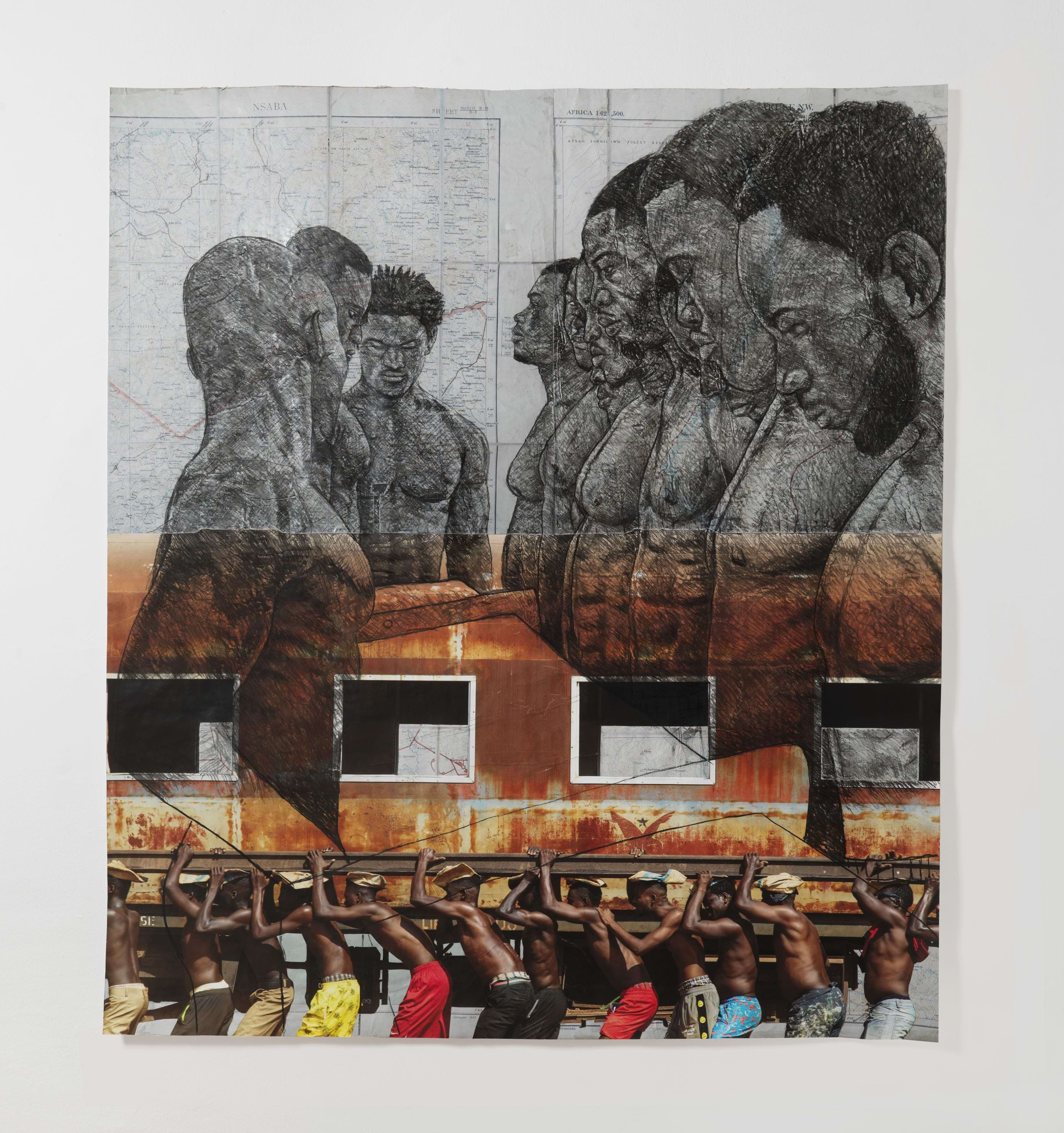
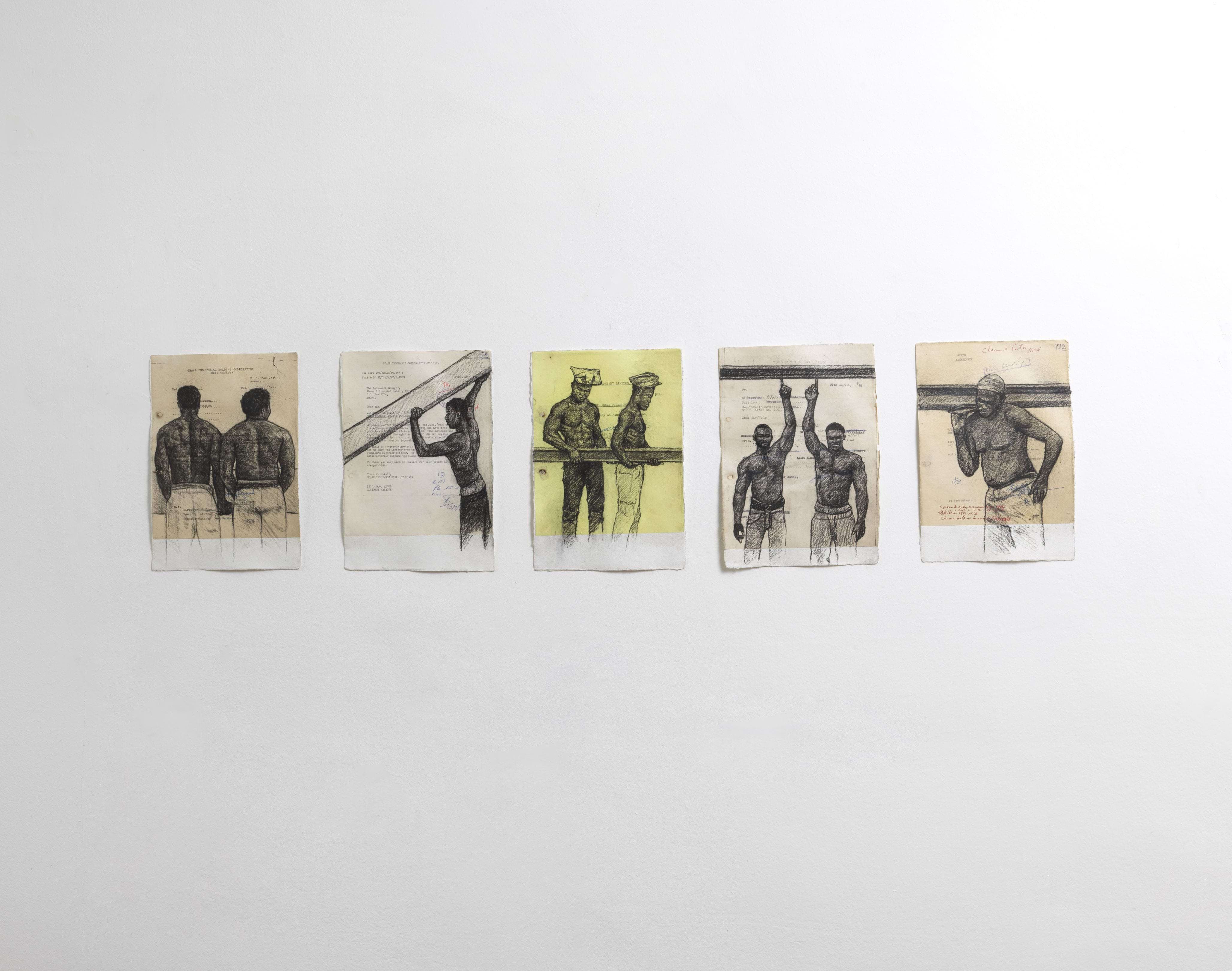
"I Dont Know Why", forms part of a recent body of work from 2023 which marked Mahama’s return to drawing, where he combines hand-drawn figures with collaged photographs on recycled papers sourced from abandoned Ghanaian workshops—trade bills, archival documents, and colonial maps. These layered works, scarred by folds and imperfections, evoke both physical and metaphorical traces of history, connecting past and future. Rooted in research on the colonial-era railway network, Mahama reactivates this history by enlisting local men to transport disused carriages and tracks to his Red Clay studio, echoing the labor once extracted from the north of Ghana for a system that served only the south. Through this reenactment and material transformation, the work creates a hinge between memory and present, making visible the scars and continuities of collective experience.
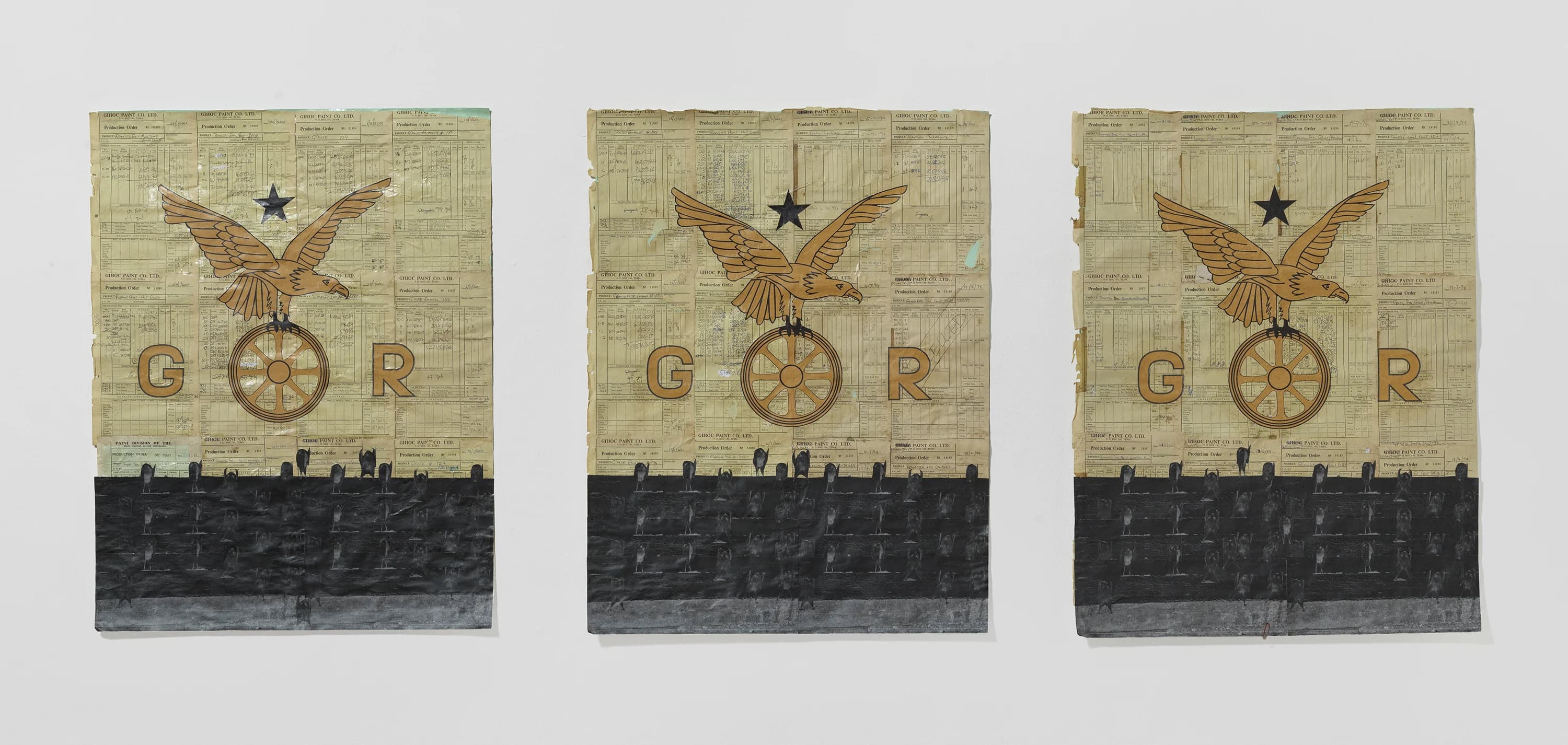
Ibrahim Mahama’s Rock and Sand, GRC (2020–2021) brings together photo cut-outs and archival materials on paper, weaving personal and institutional memory into a fragile yet charged surface. By incorporating insignia from the Ghana Railways Corporation (GRC) alongside discarded documents, Mahama highlights the railway as both a symbol of post-independence aspiration and a marker of infrastructural decline. The archival fragments—creased, stamped, and stained—function like living documents, bearing the weight of use and obsolescence. In their reassembly, they form a collage that is less a static record than a dynamic mapping of labor, migration, and collective memory. The medium—an interplay of archival residue and photographic traces—extends Mahama’s ongoing interest in material histories, where objects once tied to commerce and bureaucracy are reactivated within a new visual economy, simultaneously memorializing and reimagining the possibilities of Ghana’s past and future.
In the Untitled series, the drawings, the smallest in the exhibition, have been made on old shipping notes, now yellowed by time, where the stamps and signatures are concealed by the bodies of the men dragging, lifting and carrying what appears to be a long track. In fact, the different groups of sheets have been arranged by the artist like domino tiles, connected to create a sole composition, a single story unfolding on the white walls.
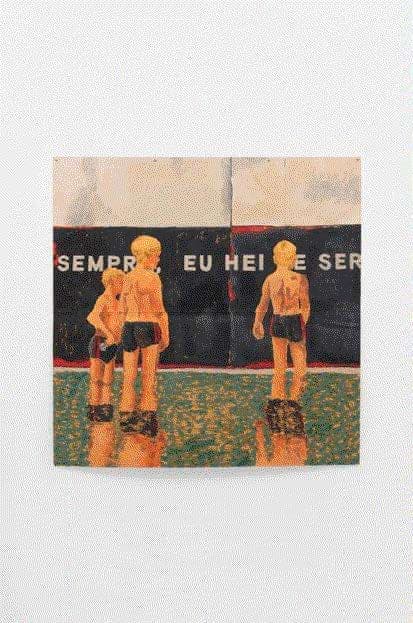
The series “Clube” was created in 2020 when Maxwell Alexandre became a member of Flamengo Club to practice swimming. It was there that he developed an interest in the “Gávea bathers” and chose them as the new central subject of his painting.
In the Brazilian context, the figure of the Gávea bather carries layered associations: rooted in the affluent Rio de Janeiro neighborhood of Gávea and its proximity to rivers, waterfalls, and beaches, it evokes a tradition of leisure and bathing culture central to the city’s identity. In art history, bathers have long served as a modernist motif—transposed into tropical light by Brazilian painters to explore questions of the body, sensuality, and national identity. Within this frame, the Gávea bather embodies both idyllic freedom and social distinction, reflecting who has access to Rio’s spaces of leisure while standing as a broader cultural symbol of Brazil’s landscape, people, and myths of belonging.
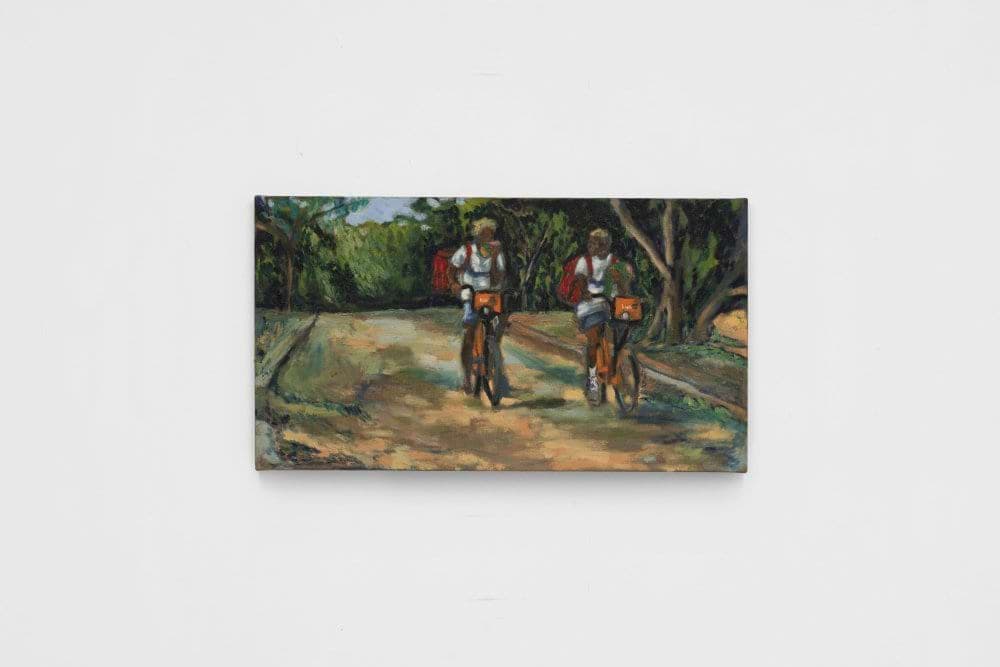
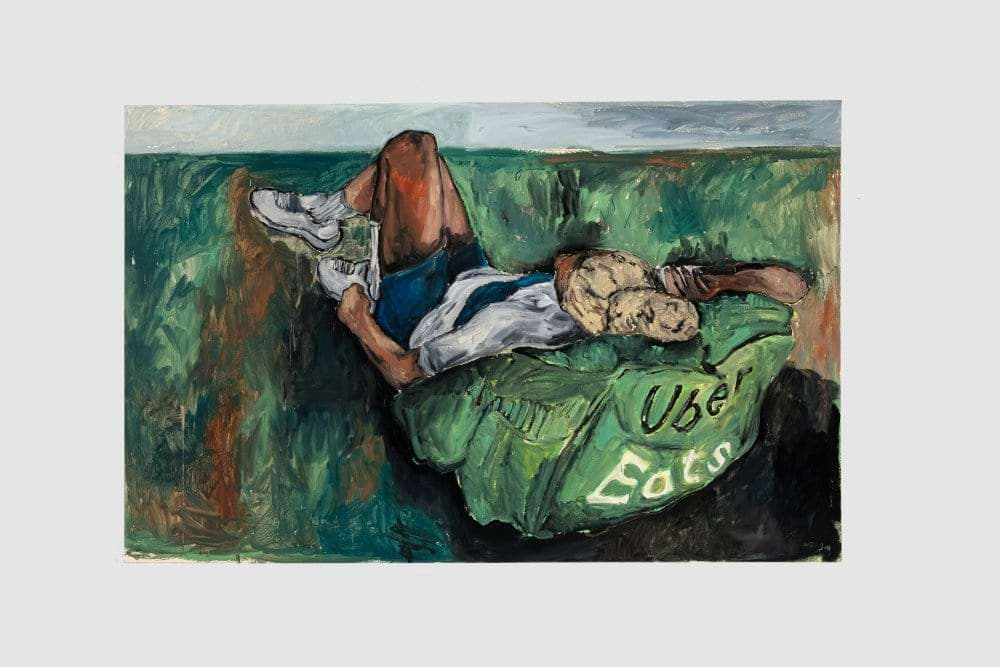
A fictional look at a group of public school students in uniform who work as food delivery couriers, prematurely confronting their social destiny within a highly complex and deregulated labor market.
In Brazil, students in uniform are increasingly visible working as app-based couriers, balancing school with the demands of precarious labor and revealing the social conditions that shape their daily lives.
A fictional look at a group of public school students in uniform who work as food delivery couriers, prematurely confronting their social destiny within a highly complex and deregulated labor market.
In Brazil, students in uniform are increasingly visible working as app-based couriers, balancing school with the demands of precarious labor and revealing the social conditions that shape their daily lives.