
Video
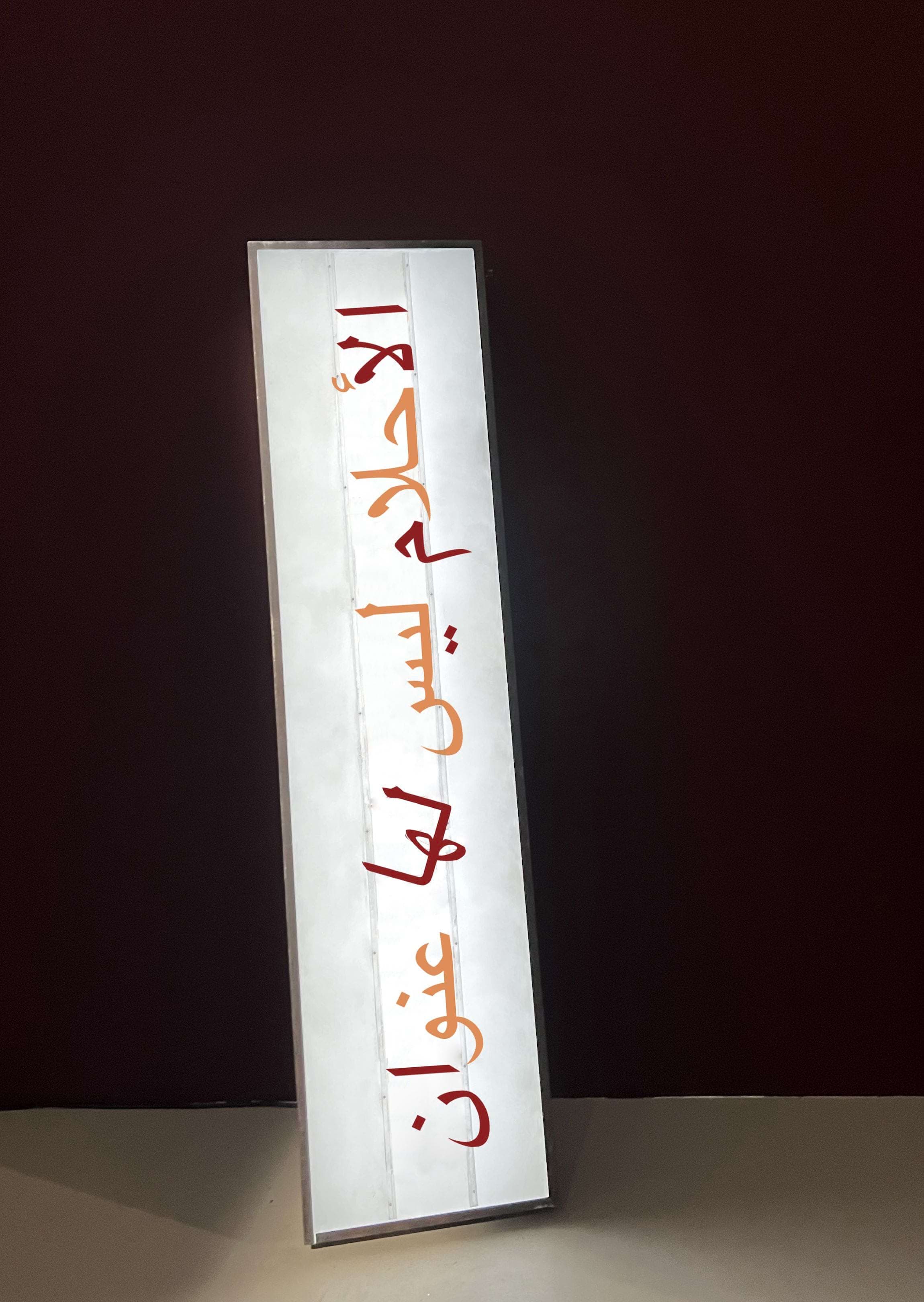
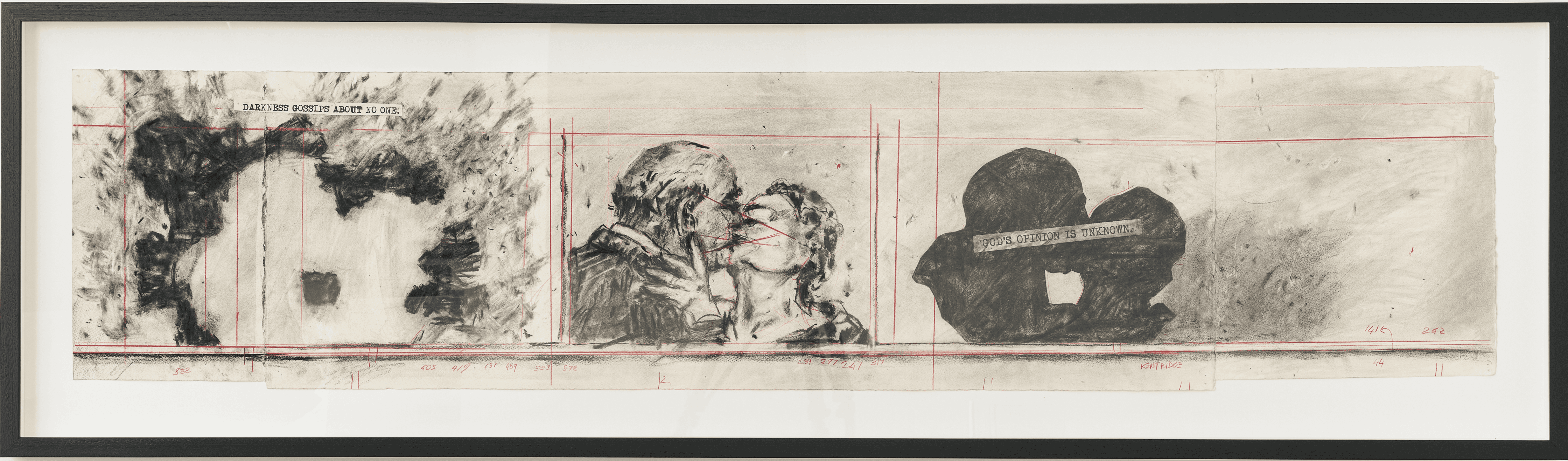
The ‘Dreams Have No Titles’ lightbox exists in four languages (French, Italian, English and Arabic), echoing Zineb Sedira’s multilingual heritage and highlighting post-independence cinema of the 1960s and 1970s in France, Italy and Algeria especially. The English lightbox was created as part of Zineb Sedira’s exhibition in the French Pavilion during the 59th International Venice Biennial. It featured at the entrance of the cinema room, announcing the film’s title in a vintage cinema lightbox style.
In 1966 Gerard Sekoto visited Dakar with his friend, the Brazilian artist Wilson Tiberio, to participate in the Congress of Negro Artists. According to his diaries and journals, Sekoto’s time in Senegal was a mix of experiences. The prominence of Islam and the challenges of understanding the French dialect heightened his sense of being a tourist and an outsider. During his stay, Leopold Senghor, the president of Senegal, loaned Sekoto his car, enabling him to explore the Casamance region in southern Senegal.
Sekoto remarked, "This part is called Casamance, where people have remained in their old African customs. They are much more welcoming to foreigners and are living in various ethnic groups with their vernacular dialects. They would go out of their way to do well to a visitor, but without the intention to extract material gain. In this way, they differed much from those people in big cities."
During his two-month stay in Casamance, Sekoto documented traditional dances and ceremonies through sketches. He described one event:
"This is a particular dance of the women in Casamance. There was a gathering over the death of a young man bitten by a snake. A cow and a bull were sacrificed with a few chickens during this dance of the women. The whole ceremony lasted a day and a great part of the night. All the gestures and structures in the build of these people are very different from our women in South Africa."
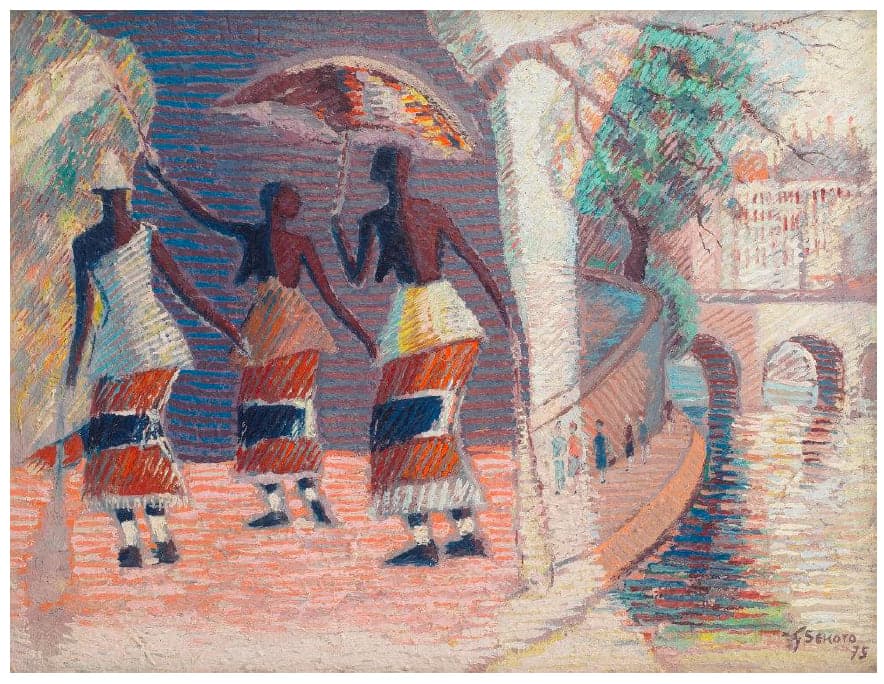
Although Sekoto had left Senegal by the time he painted "The Casamance Dancers and the River Seine" in 1975, his time in Casamance left a lasting impression on his work. The painting combines African cultural elements with European influences, depicting dancers from Casamance alongside the River Seine, a representation of Paris and Western culture. This blend of influences reflects Sekoto’s dual identity as an African artist living in exile.
Created in a post-impressionist style, this painting features bold brushstrokes and vibrant colours that convey movement. Warm earth tones highlight the dancers, while cooler blues and greens frame the Seine, creating a balance between the figures and the background. The composition draws the viewer’s focus from the dancers in the foreground to the bridge’s arches and the tranquil river beyond.
This painting demonstrates Sekoto’s mastery of integrating personal, cultural, and geographic themes. His memories and sketches from Senegal continued to influence his art throughout his career, emphasising the deep connection he had to his African heritage and his adaptability as an artist in exile.
Sydney Kumalo’s Madala IV (1967) demonstrates his exceptional ability to merge African cultural traditions with the modernist aesthetic championed by Egon Guenther in the 1960s. This period represented a pinnacle in South African modernism, with Kumalo’s bronzes achieving widespread critical and commercial success. Characterised by elongated forms, hand-rasped textures, and rich patinas, these works cemented Kumalo’s reputation through groundbreaking exhibitions in Johannesburg, London, and European cities such as Rome, Venice, Florence, and Milan. And his participation in the Venice Biennale in 1966 established him as a leading figure in African modernism.
By the mid-1960s, Kumalo had transitioned from teaching at the Polly Street Art Centre to focusing exclusively on his own career. Between 1966 and 1968, he created the celebrated Madala Series, a collection of twelve small but monumental works centred on the motif of the male elder. The term Madala, meaning “elder” or “old man” in Zulu, conveys reverence for wisdom, memory, and cultural continuity. These bronzes transcend their physical form to become vessels of contemplation, deeply imbued with ancestral and spiritual significance. Madala IV, created at the height of this series, is an extraordinary example of Kumalo’s thematic and technical mastery.
The figure is depicted crouched, its weight resting on a bent right knee while the left leg remains poised with the heel raised. This posture creates a dynamic tension between rest and potential movement, a signature feature of Kumalo’s work. The scarified and textured torso is compact yet monumental, with the arms held close in a gesture of introspection or devotion. The oversized, elongated head—featuring Kumalo’s distinctive long, barrelled nose, pursed lips, and deeply set, contemplative eyes—tilts upward as though absorbing sunlight or caught in a moment of memory. This positioning imbues the figure with an aura of dignity and introspection. The richly textured surface, achieved through meticulous hand-rasping and laceration, adds a tactile quality, while the patina enhances its earthy, timeless appeal.
Kumalo drew heavily from traditional African sculpture, particularly its ability to convey spiritual and symbolic depth. The seated or crouching posture in African art often signifies reverence and devotion, themes Kumalo reinterpreted to reflect his own cultural and personal experiences. In Madala IV, the interplay of stability and motion represents a delicate balance between contemplation and action, stillness and vitality—forces held in perfect harmony.
During this era, Kumalo’s work was closely supported by Egon Guenther, who championed his vision and oversaw the casting of his sculptures. While early works like Seated Woman (1962) and St. Francis of Assisi (1962) demonstrated his technical brilliance, the Madala Series solidified his reputation as a sculptor capable of monumental expression within intimate forms.
Madala IV is a profound example of Kumalo’s ability to elevate African themes within a modernist framework, creating works that are both deeply rooted in African identity and universally resonant. These sculptures are not mere representations; they are meditations on dignity, courage, and the enduring strength of the human spirit.
First exhibited in 1967 at the Transvaal Academy in Pretoria, Madala IV continues to captivate audiences and collectors. It stands as a tribute to Kumalo’s artistic vision and his unwavering dedication to portraying the cultural and spiritual essence of African identity within the broader context of modernism. This sculpture is a timeless testament to Kumalo’s legacy, seamlessly blending reverence, artistry, and profound humanity.
David Koloane (1938 – 2019) was born in Alexandra, Johannesburg, South Africa. Koloane spent his career making the world a more hospitable place for black artists during and after apartheid. Koloane achieved this through his pioneering work as an artist, writer, curator, teacher and mentor to young and established artists at a time when such vocations were restricted to white people in South Africa.
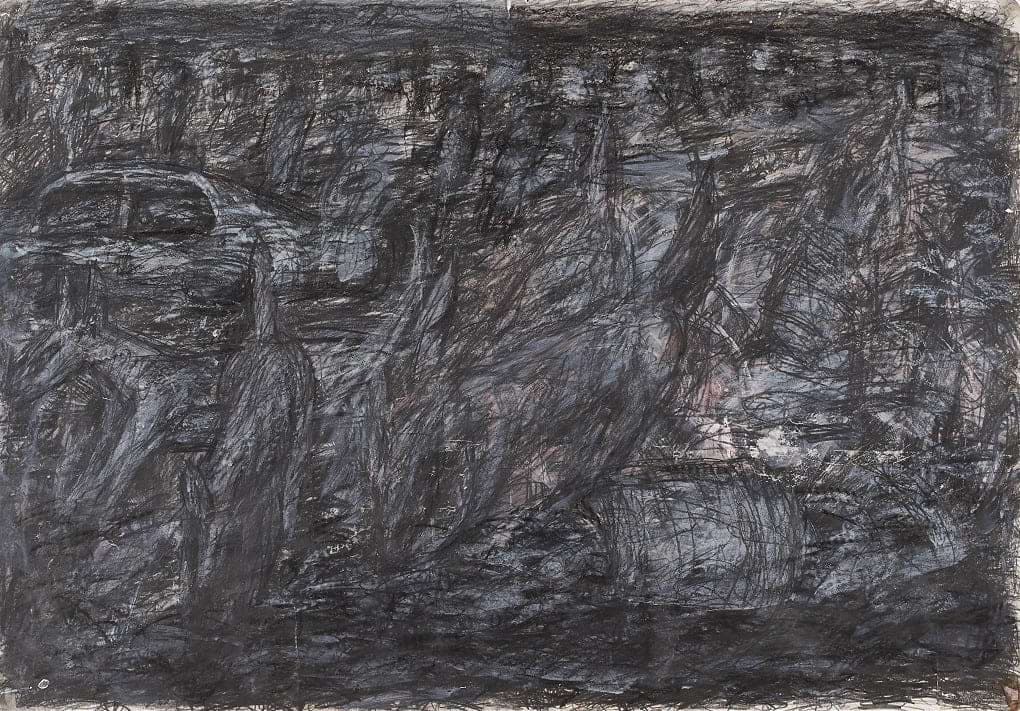
Through his expressive, evocative and poetic artwork, Koloane interrogated the socio-political and existential human condition, using Johannesburg as his primary subject matter. Koloane’s representations of Johannesburg are populated with images of cityscapes, townships, street life, jazz musicians, traffic jams, migration, refugees, dogs, and birds among others. Imaginatively treated, through the medium of painting, drawing, assemblage, printmaking and mixed media, Koloane’s scenes are a blend of exuberant and sombre, discernible and opaque pictorial narratives.