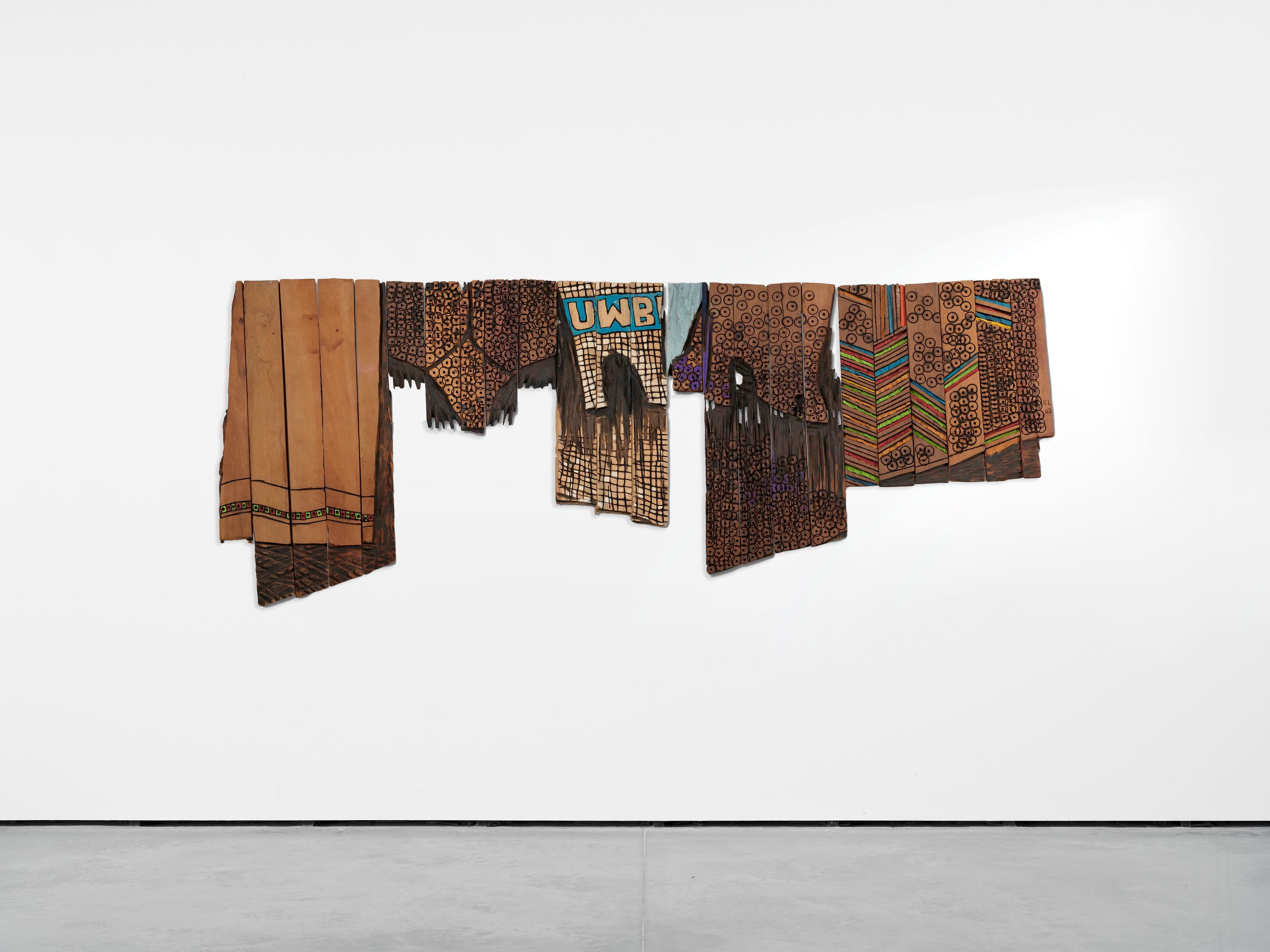

With a career spanning five decades, El Anatsui (b. 1944, Ghana) is one of the most important contemporary artists today — awarded the prestigious Praemium Imperiale alongside Iranian visual artist Shirin Neshat in 2017, as well as the Golden Lion for Lifetime Achievement, the Venice Biennale’s highest honour, in 2015. He was also included in TIME magazine’s 100 most influential people of 2023. Anatsui’s Hyundai Commission at Tate Modern's Turbine Hall was on view from October 2023 to April 2024. This work is touring across the globe, with the first stop at Museum of Art Pudong (MAP), Shanghai under the title ‘After the Red Moon’. In 2019, ‘El Anatsui: Triumphant Scale’, a major career survey curated by Okwui Enwezor, opened at Haus der Kunst and travelled to Mathaf: Arab Museum of Modern Art in Doha, Kunstmuseum Bern and Guggenheim Bilbao in 2020.
Anatsui, well-known for his large-scale sculptures composed of discarded materials, transforms these simple materials into complex assemblages that create distinctive visual impact. Anatsui’s use of these materials reflects his interest in reuse, transformation, and an intrinsic desire to connect to his continent while transcending the limitations of place. His work interrogates the history of colonialism and draws connections between consumption, waste and the environment.
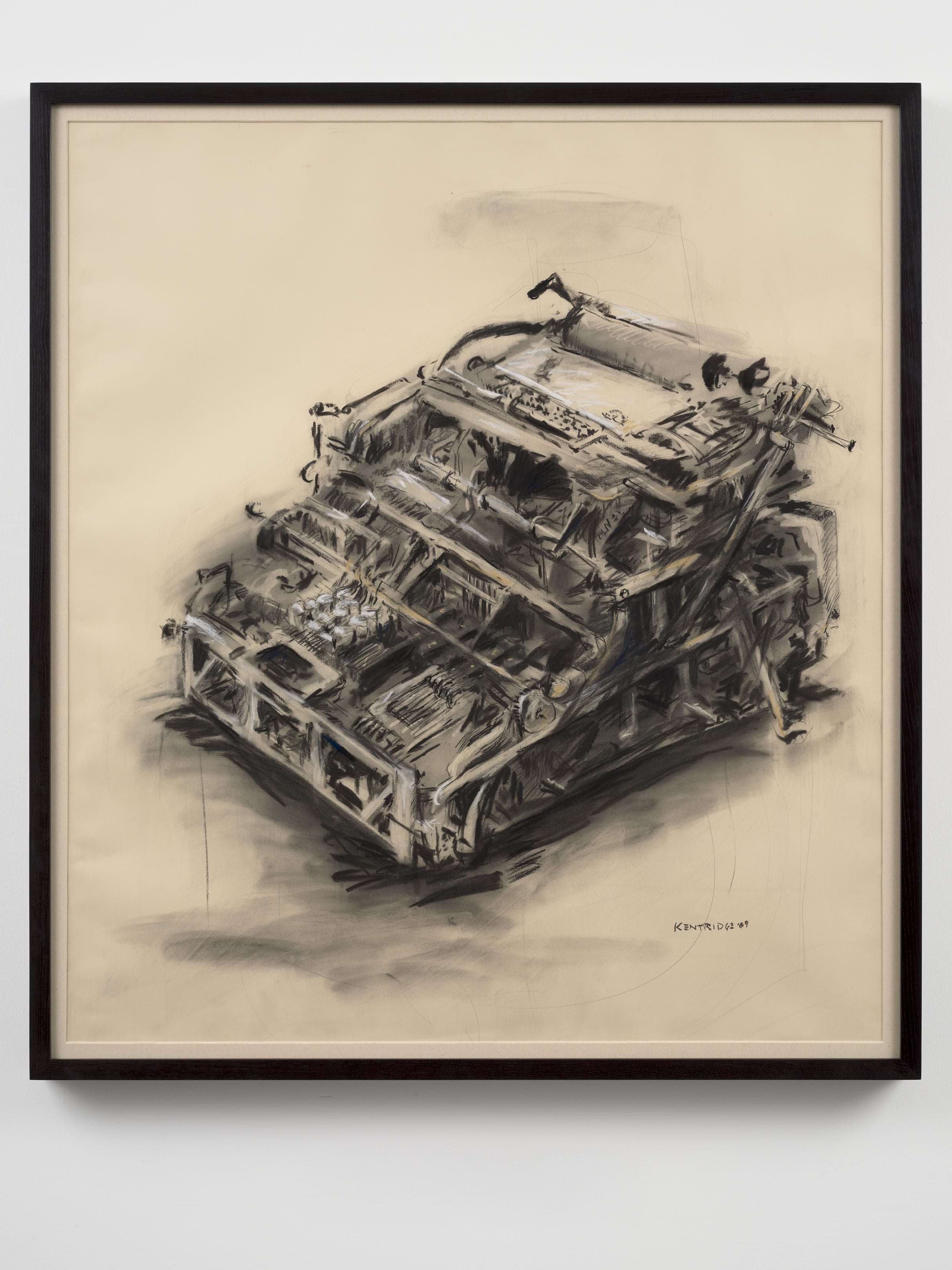
William Kentridge’s early drawings such as 'Untitled (Adding Machine)' from the late 1980s mark a formative period in his development of a distinctive visual language, where themes of memory, power, and bureaucracy are articulated through a deliberately fragmentary and layered approach. Executed primarily in charcoal and pastel, these works are notable for their stark, often cinematic composition and their interplay of image and erasure.
Within this body of work, the recurring inclusion of typewriters and adding machines points to a deep interest in the machinery of bureaucracy and the impersonal systems that underpin political and economic control. These mechanical objects, both antiquated and symbolic, act as metaphors for the rationalised violence and dehumanisation characteristic of apartheid-era administration. Their presence evokes the clerical apparatus of state control, echoing the paper trails of surveillance, bookkeeping, and sanctioned brutality.
At the same time, Kentridge does not treat these objects as static symbols. Often skewed, shadowed, or embedded in more ambiguous scenes, the typewriters and adding machines also signal a breakdown in meaning, a slippage between logic and disorder. This tension mirrors Kentridge’s broader formal strategy: to render visible the instability of history and the fragility of truth. In this way, these early drawings lay the groundwork for his later animated films, where such objects come to life in haunting, metamorphic sequences.
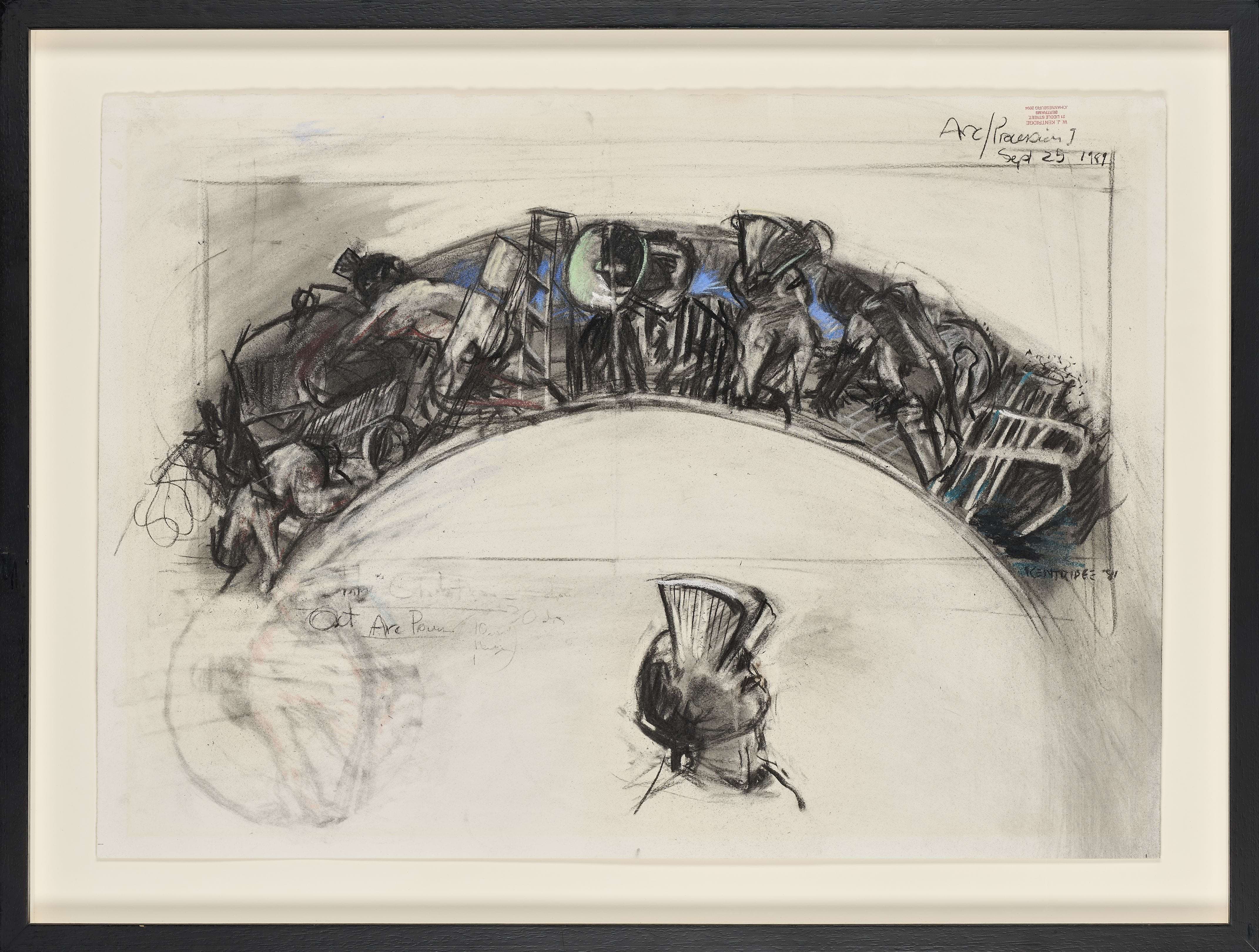
This work is part of Kentridge’s larger 'Arc/Procession' series, each of which examines a section of a crowd. The composition implies continuation beyond the limits of the drawing - a slice of 'thick time', encompassing the near past, present and future. The curve also frustrates an attempt to view the entire composition at once, reproducing the fragmented experience of looking at or being part of a large crowd.
Gerard Sekoto (b. 1913, Botshabelo, South Africa - d. 1993, Paris, France) is one of the most influential painters in South African history. He achieved early prominence with his nuanced, painterly depictions of black urban life in South Africa’s major cities, before the formal advent of high apartheid. In 1947, seeking to further his career prospects, Sekoto moved to Paris, never returning to South Africa.
Sekoto initially struggled in Paris: his finances were precarious, his lodgings were inadequate, and he was without a studio. His fortunes changed when he met Marthe Bailon, a muse to poet René Maria Rilke and associate of the sculptor Rodin, who rented Sekoto a room in her Saint-Germain-des-Prés apartment. Its previous occupant was American writer James Baldwin. Sekoto and Bailon later became romantically involved.
Sekoto’s post-1947 work varies in subject, theme and formal style. His Paris output includes various depictions of the city’s vibrant post-war café society. An acute observer, this work possesses a documentary immediacy. In 1959, the year Sekoto produced ‘Le Café Parisien’, the Saint-Germain-des-Prés quarter was the beating heart of Paris’s bohemian, intellectual and cultural life. Far from being a mere bystander, Sekoto’s allegiance to, and immersion in, the quarter’s lively cafés and smoky jazz bars was absolute. An accomplished pianist who for decades earned a second income playing in jazz ensembles, in 1959 Sekoto released a vinyl single of negro spirituals on Roger Fasnacht’s Deva label.
The convivial subject matter of ‘Le Café Parisien’ directly corresponds with Sekoto’s earlier, pre-exile works portraying bar scenes in Cape Town and Johannesburg. Compositionally, it showcases Sekoto’s transforming style, when the umber tones of his earlier post-impressionist works were replaced by a more zestful palette. The predominance of blue, here skilfully used in variegated tones to describe the modish patrons and their milieu, is a notable hallmark of Sekoto’s later work.
PROVENANCE
Gifted by the artist to Monsieur Fortier, Paris
Thence by descent
Sold: Bonhaams, London, 18 February 2009, lot 68.
EXHIBITED
Wits Art Museum in conjunction with the Gerard Sekoto Foundation, Johannesburg, Song for Sekoto, 26 April- 2 June 2013.
LITERATURE
Lindop, B. (Ed.). 2013. Song for Sekoto – Gerard Sekoto 1913-2013. Gerard Sekoto Foundation. Craighall. Illustrated on p.63.
*Available subject to South African Heritage Resource Agency permanent export license approval
Sam Nhlengethwa (1955, South Africa) is part of a pioneering generation of late 20th century South African artists whose work reflects the sociopolitical history and everyday life of their country. Through his paintings, collages and prints Nhlengethwa has depicted the evolution of Johannesburg through street life, interiors, jazz musicians and fashion. His oeuvre, approach to artmaking and involvement in institutions such as Bag Factory Artist Studios has contributed greatly to the South African arts landscape, making him one of the country’s seminal artists.
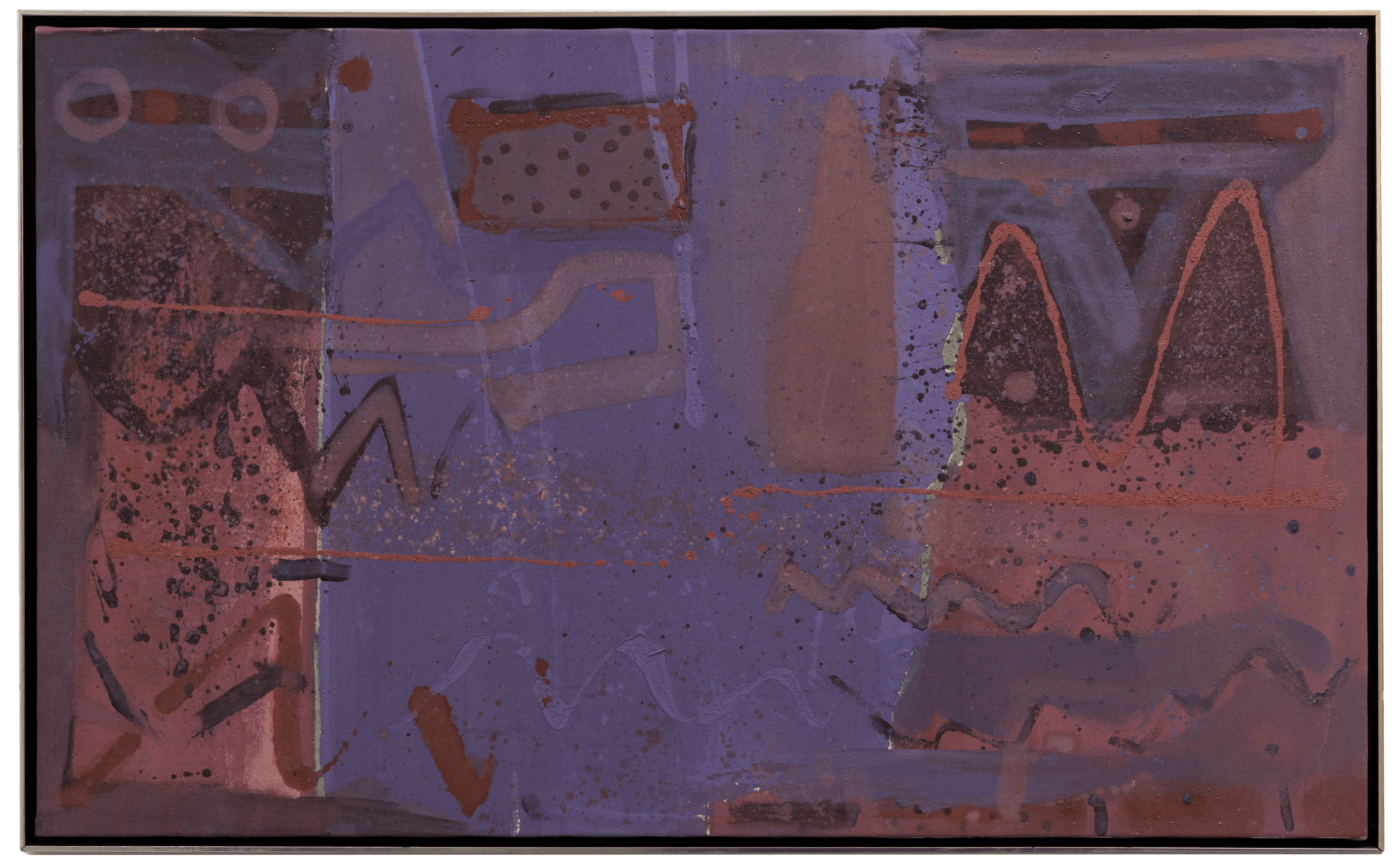
In the 1980s Nhlengethwa first began to experiment with colour and non-figurative forms following his inclusion in The Triangle International Artists’ Workshop in New York (1983) and the Thupelo Art Project workshops, first initiated in 1985. Work of this period displayed his natural and intuitive sense of formal elements of colour and composition. ‘The Mural Painting Under Process’ follows this introduction of non-figurative forms into the artist’s practice.
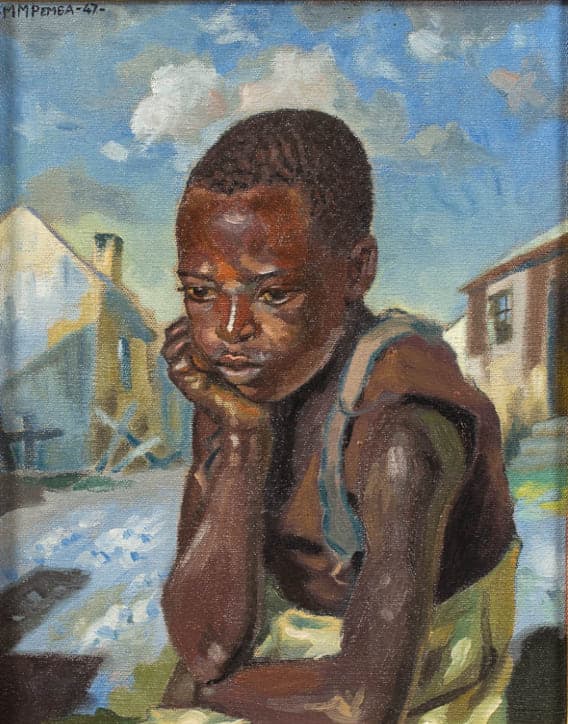
George Milwa Mnyaluza Pemba (b. 1912, Port Elizabeth, South Africa - d. 2001)
holds a distinctive place in South African art, celebrated for his empathetic depictions of everyday people.
Painted in 1947, ‘Portrait of a Pensive Boy’ is an early by the artist and work shows his growing mastery of social realism, capturing a moment of deep introspection with both technical skill and emotional depth. Created as Pemba prepared for his first solo exhibition in 1948, this painting is a rare example of his early style, transforming ordinary scenes into profound reflections on the human condition.
The central figure is a young boy, resting his face on his hand with a pensive expression. The modest township backdrop anchors him in a familiar environment. Pemba’s skillful oil technique gives the boy's skin a tactile quality, emphasising the quiet tension in his pose. Details such as his furrowed brow and subtle curve of his lips evoke longing and quiet resignation, while his slumped posture imparts a sombre maturity beyond his years.
With this painting, Pemba not only immortalises a moment but also challenges the viewer to engage with the emotional and social undercurrents of his world. It is a work that transcends its time, offering a reflection on the resilience and dignity of the human spirit.
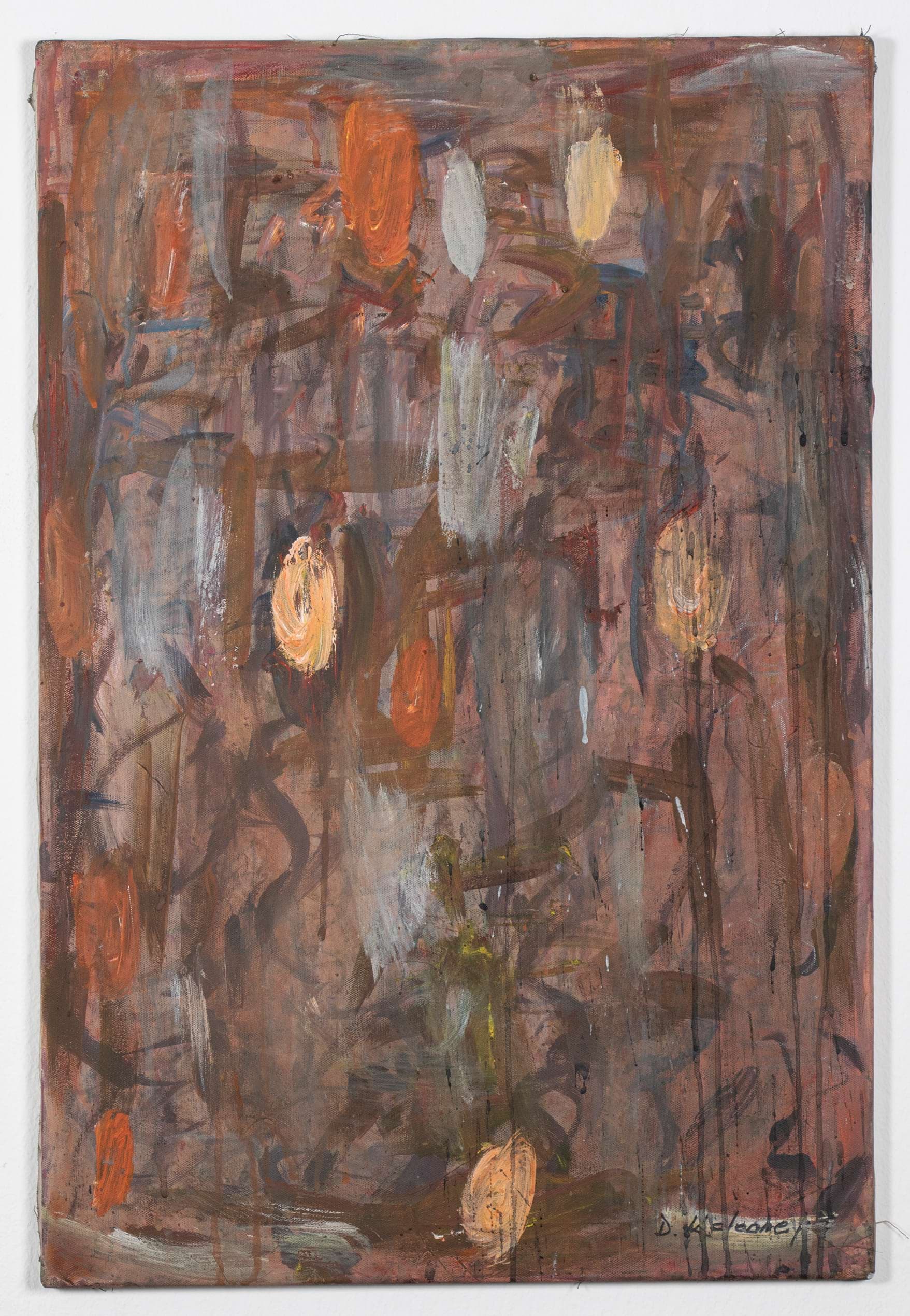
David Koloane’s works featuring traffic and city lights explore the vibrant, often chaotic energy of urban life capturing the pulse and rhythm of Johannesburg’s streets. These works convey a sense of constant motion and connectivity, reflecting the city’s ceaseless flow and the interplay between light and shadow. Koloane’s traffic works reveal his fascination with the urban environment as a living, breathing entity shaped by human activity and movement.
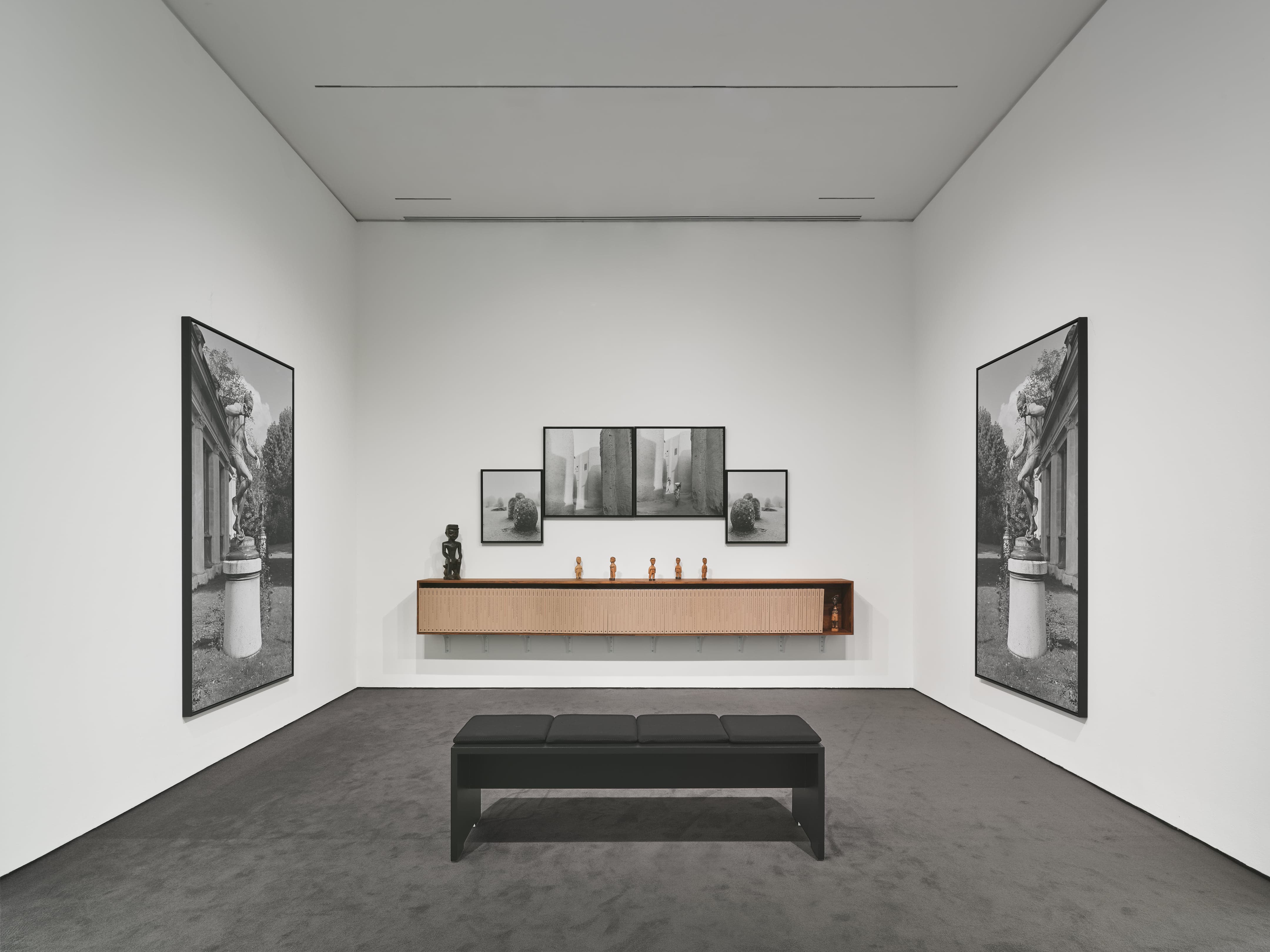
The multimedia installation ‘The In-Between’ (2022–2023) pays homage to the life and work of the late Okwui Enwezor (1963-2019). Enwezor was a Nigerian curator, critic, poet, and educator. He was known for his rigorous and influential curatorial practice, which challenged institutions to be more inclusive of non-Western artists and histories. He was the first non-European curator of documenta in 2002 and the first African-born curator of the Venice Biennale in 2015. Before his passing, he was director of Haus der Kunst in Munich. Weems titled the installation ‘The In-Between’, underscoring Enwezor's commitment to addressing the gaps in the art world as well as the widespread grief around his premature death. The ‘in between’ is a space of neither here nor there, between leaving and arriving, a point of departure with a destination imagined but unknown. It was in these lacunae that Enwezor sought to make cultural institutions and art canonical histories more inclusive and representative of non-western identities. Weems presents her own version of Enwezor's extensive collected works, comprising one hundred books he wrote or edited and representing the magnitude of his contributions to curatorial and scholarly praxis.
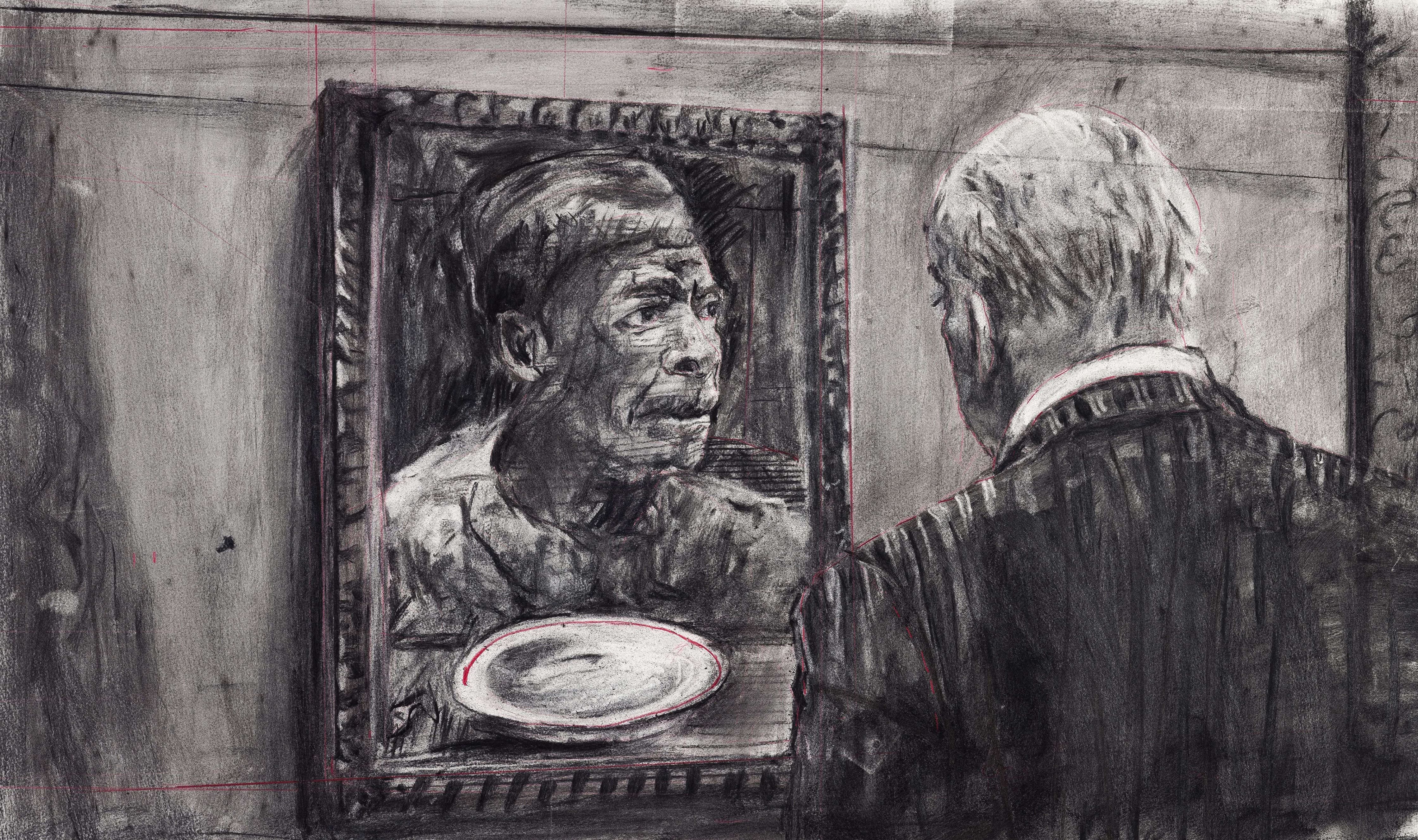
"City Deep is the eleventh in the series of Soho Eckstein films, started in 1989. In 1990 there was the film Mine, which had images of deep level industrial mining. 19 years later deep level mining has moved to the surface mining of the "zama zama" miners - the informal mine work taking place in abandoned mines - manual labour replacing large machines. This activity is set against images of the Johannesburg Art Gallery, itself built on the basis of the heyday of gold mining in Johannesburg. During the course of the film, images of the landscapes and the miners become the artworks in the gallery, viewed by Soho Eckstein."
William Kentridge
Vetkoek / Fête Galante (1986) is one of the artist’s earliest films made in his studio at home, featuring characteristic references to Mime and performance that would later become hallmarks of his work.
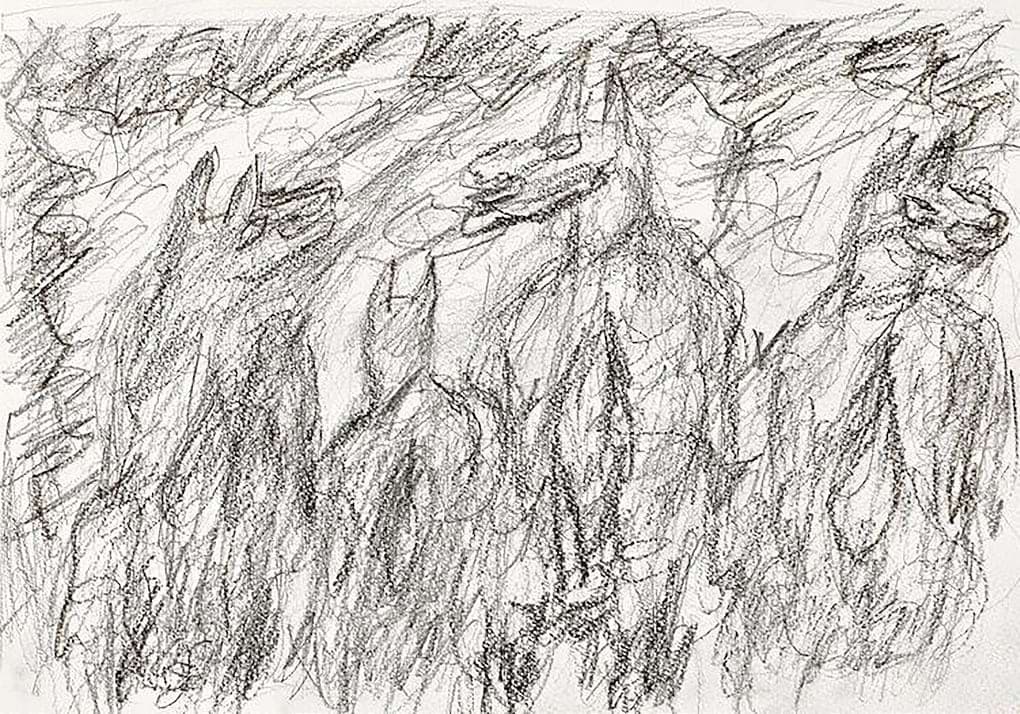
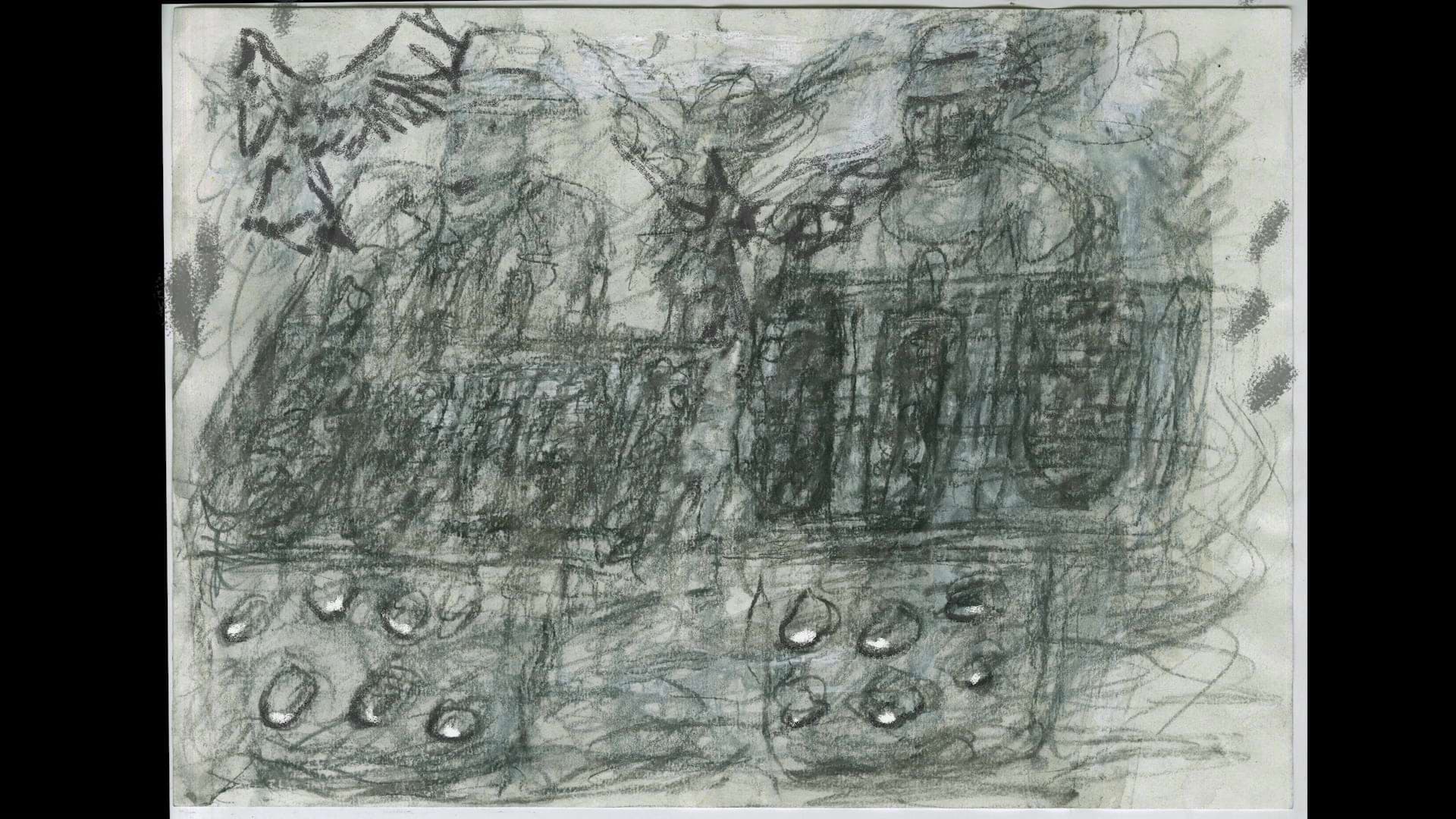
The Takeover is made up of a series of detailed pencil drawings using a stop-motion filming technique in which the drawings are photographed in a series of slightly different positions creating the appearance of animated movement. The Takeover, which finds artistic representation in an achromatic palette of greys, is a work that explores the idea and importance of community through the fable narrative commonly associated with African story-telling practice. The fable is set in a township on the periphery of Johannesburg where a pack of wild dogs have inhabited a deserted school; one evening, after a community vigil, a resident is attacked and killed by the pack. This act brings the community together and empowers them to drive the dogs away from the school. In the work, the dogs take on human thought processes and mannerisms, thereby suggesting that The Takeover can be read as ‘a metaphor about the dangers of free-living and the redemptive power of community’ (Contemporary And, David Koloane: In the City, July 2016)