




Fred Wilson is renowned for his interdisciplinary practice that challenges assumptions of history, culture, race, and conventions of display. By reframing objects and cultural symbols, he alters traditional interpretations, encouraging viewers to reconsider social and historical narratives.
At the onset of the twenty-first century, Wilson began to place more focus on his object-based work. In collaboration with the prominent American glass blower Dante Marioni, he began producing his first glass artworks in 2001—ambiguous black-colored forms that assert a multifaceted political undercurrent. “The color black represents African American people because it’s been placed on us as a representation,” Wilson says. “Of course, the color black—the absence of light—really has nothing to do with African Americans. But there’s a whole other layer of meaning.”
Wilson continued his exploration of glass with Speak of Me As I Am, his exhibition for the United States pavilion at the 2003 Venice Biennale. Much of this work developed from Wilson’s observation that numerous Venetian history paintings contained black figures, though he had difficulty locating them in written histories. Wilson began a relationship with the Murano glass company, located on the Venetian island of the same name, and created chandeliers and mirrors in a traditional Venetian style embellished with black glass.
In 2009 Fred Wilson began work with Berengo Studios in Venice to develop a process for layering mirrors together while preserving the intricate details of a traditional 18th-century Murano mirror. The idea was to create a dark reflection, with the backside of the mirror coloured black instead of silver. Wilson further differentiated his mirror from the Venetian style of etching the back of the by choosing to etch his design on the front of the glass, “so that it would be more ghostly”.
Sorry For Real_Sorrow For ... (2015) is a series of five light boxes inspired by Rezaire’s holographic apology on behalf of the Western world titled Sorry For Real (2015). Through a fantasized smart-phone conversation, the work questions the power imbalances within the apology-forgiveness narrative. What is the function of an apology? Who benefits from the apology? What are the power structures hidden behind our apologetic age? The work seeks to virtually capture the violent histories of slavery, colonialism, and the continued exploitation of African and indigenous bodies, lands and knowledge. Unapologetically, this cyber exchange addresses the politics of ‘reparations’, and the need to decolonize our technologies and reconciliation. ‘Seneb is a House of extraordinary babes invested in healing’, says Rezaire.
Sorry For Real_Sorrow For ... is a series of five lightboxes inspired by Rezaire’s holographic apology on behalf of the Western world titled Sorry For Real (2015). Through a fantasised smart-phone conversation, the works questions the power imbalances within the apology- forgiveness narrative. What is the function of an apology? Who benefits from the apology? What are the power structures hidden behind our apologetic age? The work seeks to virtually capture the violent histories of slavery, colonialism, and the continued exploitation of African and indigenous bodies, lands and knowledge. Unapologetically, this cyber exchange addresses the politics of ‘reparations’, and the need to decolonise our technologies and reconciliation.
Biko.Dialogues
The works in the series simulate dialogues between Bantu Steve Biko (the leader of the South African black consciousness movement ) and other liberation theorists from the black consciousness tradition. These works are digital and physical systems designed to perform poetic conversations between Biko and his intellectual and spiritual counterparts based on a series of keywords extracted from the archive’s these now dead activists left behind, in the form of interviews, autobiographies, academic theory, poems and court transcripts.
The conscious always operates in relation to its own unconscious. These dialogue works are automated systems for approximating a kind of black liberation dreaming. These simple systems take the archive of black consciousness thought as an archive of black subconsciousness.
These artworks perform various automatic readings and writing operations on datasets pulled from the archive, in order to algorithmically reach toward a place of collective dreaming.
These systems use the archive of black conscious literature (from these various activists) as source material for a dataset which is algorithmically recombined to produce new dialogues between Biko and his counterparts, which are then printed in real time as an endless receipt. The receipt acts as a record of these impossible conversations. These works also stage another dream, where Biko had a chance to meet and talk and dream together with other activists in a global black radical tradition.
There are 5 dialogues in this series:
two versions of the Biko.Fanon dialogue (with revolutionary French-Algerian psychiatrist Franz Fanon) ;
A Biko.Cesaire dialogue (with negritude poet Aime Cesaire) ;
A Biko.Shabazz dialogue (with African American radical activist El-Hajj Malik El-Shabazz - better known as Malcolm X);
A Biko.Cabral dialogue (with Guinean revolutionary Amilcar Cabral)
In his retroreflective prints, Hank Willis Thomas explores the act of making and viewing images, bringing to light the way in which they function in society to document and reveal historic events. Images are screen printed on retroreflective vinyl with a technique that allows another layer to be revealed when the work is exposed to a direct light. Viewers are invited to activate the work through their own camera flash or flashlight, commissioning the viewers to become the discoverers and creators of what they see. The effect is a series of images that appear to change and invert depending on the viewer’s perspective, creating an instability and impermanence that brings attention to the important role that a viewer plays in the life cycle of an image.
Recalling the silkscreen prints of Robert Rauschenberg and Andy Warhol, Thomas stresses the repetition of images in popular culture as a vehicle for creating value in society. In the series of retroreflective prints made for South Africa, Thomas focuses on apartheid era photographs. These images record South Africa’s violent and brutal past as well as the brave people who use their creativity, courage, and community to inspire change. Thomas’ works focus on the importance of remembering the past in order to understand where we are now and where we might be going.He states: “For me it’s a way of finding, navigating our way throughout history, finding signposts, I like to say the past is present and the road to progress is always under construction. We need to be oriented towards where we are coming from and where we are going.”
The source image for Give us back our parents was taken from a 1960s issue of the South African publication The Golden City Post and was captioned Detainees Children Demonstrate.
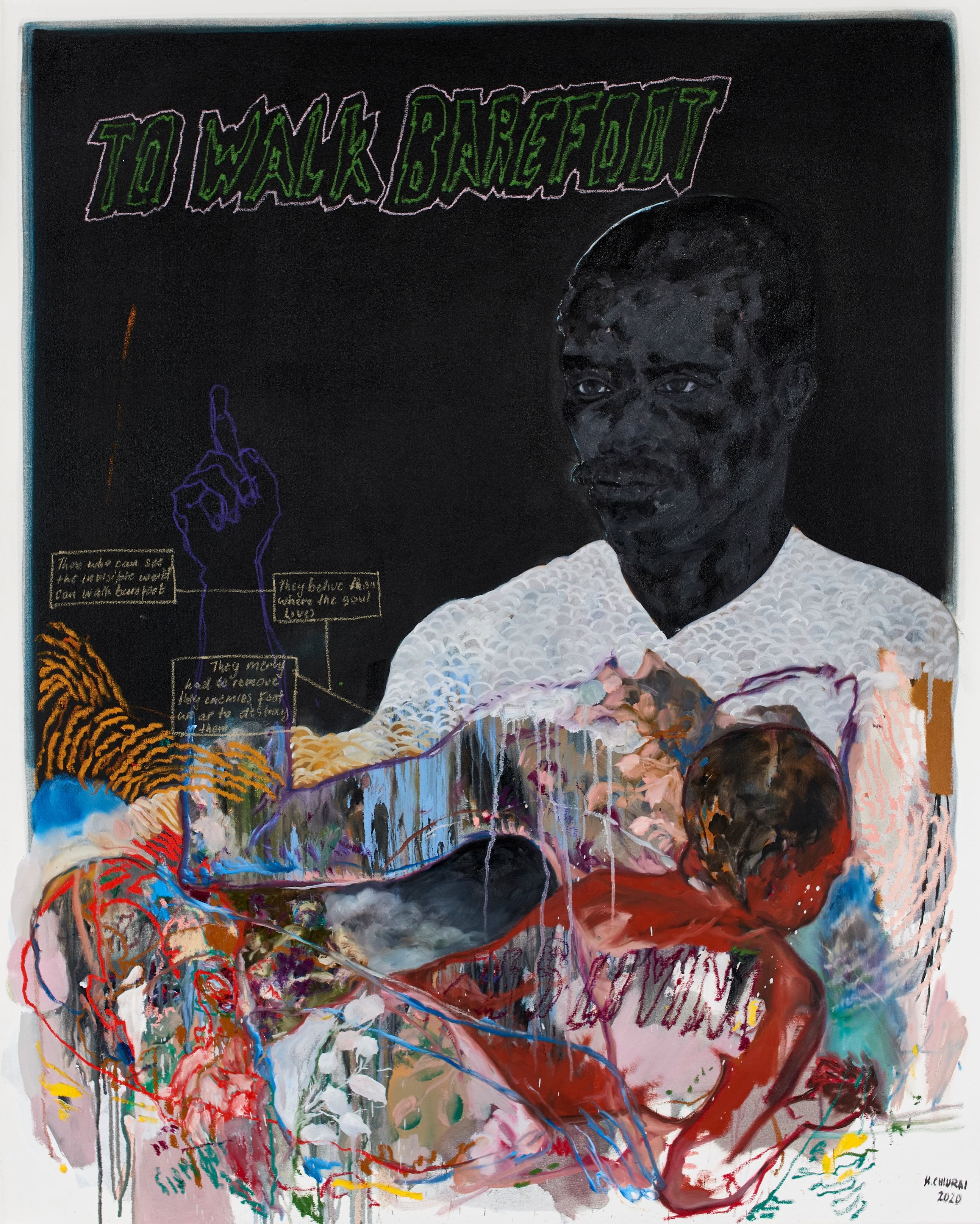
Kudzanai Chiurai’s practice engages a revisionist strategy to confront and disrupt what he refers to as “colonial futures,” embedding counter-histories that address the omissions and distortions of the colonial archive. His work offers a renewed lens through which to view visual culture in Africa, contributing to decolonial discourse by foregrounding political realities, social complexity, and the voices historically pushed to the margins.
‘To Walk Barefoot’ exemplifies Chiurai’s use of painting as a tool for critical reflection, questioning the lingering structures of colonial power and their influence on contemporary African experience. Through expressive figuration and carefully orchestrated symbolism, the work examines how inherited systems – whether political, cultural, or spiritual – continue to shape life in the postcolonial present. Rather than reproducing accepted historical narratives, Chiurai’s painting challenges their authority, creating space for alternative ways of seeing, knowing, and remembering.
“What if history has not been told properly? What if only some of its characters have been revealed as part of the narrative? And what if our history is haunted by cyclical vi- olence precisely because it has not been buried properly?” Grada Kilomba asks.
In her series of photographic works 'Heroines, Birds and Monsters' (2020), Kilomba carefully captures the complexities of the characters in her video trilogy 'A World of Illusions' (2019); a series of filmic installations in which the artist brings the African oral tradition of storytelling into a contemporary context to illuminate memories and realities of the postcolonial world.
This elongated silhouette of Number 231 is like that of a simple skyscraper as well as like a tablet. Made in Drew’s signature technique, featuring neatly stacked pieces of cut lumber in a dynamic, gridded sculptural relief, Number 231 is finished with a matte black wash with a white ‘zip’ in the center of each panel, which creates contrast and emphasizes vertical rhythm and adds an element of detail, intentionality and fine linearity. Drew’s long-standing interest in lifecycles and how human labor leaves traces of life behind is one aspect of the materiality and appearance of the work. The white element amidst the black is like a code or a written language –like Braille, a micro-text to decipher. But it is also like a macro view of a densely built city. Drew says: “I think of it as making chaos legible.”
Cutting Out CONYT (1977/2017) returns to Lorraine O’Grady’s 1977 series, Cutting Out The New York Times (CONYT), which consisted of 26 found newspaper poems made between
June 5 and November 20, 1977 from successive editions of the Sunday Times . Building on the successful transformation of public language into private in CONYT, in Cutting Out CONYT O’Grady repurposes the work to achieve a failed goal of the earlier series: the creation of what she terms “counter-confessional” poetry.
Cutting Out CONYT culls the original poems and reshapes the remains into 26 new works that adopt a form the artist refers to as “haiku diptychs.” Each of the haiku takes as its source a single poem from CONYT . Produced following a similarly rigorous set of rules as those that dictated CONYT, Cutting Out CONYT isolates and rearranges panels from the 1977 work without altering them in any way. Newly combined, the resulting compositions are eloquent in their brevity, while their printed, collaged forms evoke the materiality of the original series.
Reflecting on this new body of work, O’Grady writes, “I stuck to the idea of memorializing the original 26 weeks spent cutting out The New York Times, but not too literally. I did not take ‘one diptych per poem.’ I took only the best diptychs I could find since I was creating a totally new work, which had to succeed aesthetically on its own terms.” Concentrating and refining the voice of CONYT through the elegance of its haiku-like presentation, Cutting Out CONYT serves as a bridge between O’Grady’s early and later works. As she explains, “Making it has allowed me to maintain the tensions between my more explicit voice and my less explicit voice in a way that feels fruitful to me.”
These two voices, which O’Grady has alternately identified as “narrative/political,” “expressive/ argumentative,” “inner-directed/outer-directed,” and “post-black/black,” inform all of her work. With the quip, “I was ‘post-black’ before I was ‘black,’” she characterizes her artistic trajectory from the 1970s into the 1980s as an evolution from producing deeply personal works imbued with her identity to more overtly politically-motivated ones. As a result, like its CONYT source material, Cutting Out CONYT references what O’Grady describes as “a diaspora mind, a diaspora experience.” O’Grady expands, “Produced with 40 more years of life and aesthetic experience, I feel that it [Cutting Out CONYT] embraces the mysterious intertwinings of narrative and politics, post-blackness and blackness in a way that Cutting Out The New York Times could not accomplish or even imagine.”
Cutting Out CONYT engages with the counter-confessionalism of O’Grady's 1977 poems and transforms it via its diptych format into something distinctly other, refuting hierarchical binaries through its two-panel presentation—a recurring device in the artist’s work that insists on “both/ and” rather than “either/or.” This structure allows O’Grady to question apparent oppositions between her voices while maintaining their productive tensions, siting her work in the interstitial space between the personal and political, inner and outer, post-black and black. Ultimately, O’Grady summarizes, “There was no extrication of the personal from the political, because these qualities were not opposites but obverse and reverse of the same coin.”
Woman Free Yourself is one of four posters made by Ringgold in the early 1970s as a form of black feminist activism. The posters were intended for public meetings and spontaneous protest, distributed as free art in keeping with the spirit of the times. Ringgold’s posters incorporate design elements from the Kuba region of the Congo, as well as popular protest slogans and words such as ‘Freedom’, ‘Woman’ and ‘Now’.
In Things Are Looking Native, Natives Are Looking Whiter, Galanin juxtaposes two iconic images. One image is of a Hopi woman wearing her hair in the squash blossom, or butterfly whorl style worn by unmarried Hopi women. This Edward Curtis photo documented Indigenous people throughout the West in the early 1900s and supported the false notion that Indigenous people and ways of life were disappearing. The second image is taken from a promotional photo for Star Wars, depicting a Caucausian female, science fiction character wearing her hair in a style mimicking the squash blossom or butterfly whorl. As Galanin asserts, “In borrowing from an Indigenous aesthetic, the image projects settler claims to Indigenous culture into the future. The title speaks to consumer culture’s desire to claim ‘Native inspired’ looks, while simultaneously refusing Indigenous people the agency to define Indigenous culture in an increasingly hybrid world.”
These imagined amalgam heads atop glossy pearlised off-white automotive spray painted bases are cast in white acrylic composite, a pale, almost ghostly
plaster-like material that simultaneously evokes the luxury of marble surfaces and the more provisional, layered history of raw plaster as a material for the
casting of statues.
These works draw upon commonly understood hierarchies between materials to explore social power structures and the way in which status is ascribed
within them.
These imagined amalgam heads atop glossy pearlised off-white automotive spray painted bases are cast in white acrylic composite, a pale, almost ghostly
plaster-like material that simultaneously evokes the luxury of marble surfaces and the more provisional, layered history of raw plaster as a material for the
casting of statues.
These works draw upon commonly understood hierarchies between materials to explore social power structures and the way in which status is ascribed
within them.
These imagined amalgam heads atop glossy pearlised off-white automotive spray painted bases are cast in white acrylic composite, a pale, almost ghostly
plaster-like material that simultaneously evokes the luxury of marble surfaces and the more provisional, layered history of raw plaster as a material for the
casting of statues.
These works draw upon commonly understood hierarchies between materials to explore social power structures and the way in which status is ascribed
within them.
The making of The Audition took place at Cornerhouse arts centre (now called HOME) in 1997 as part of a residency by Sonia Boyce at The University of Manchester. An open call invited participants to the Cornerhouse to try on an afro wig. Each individual was photographed with and without the wig and 900 photographs were taken in one single day. For the participants, the act of putting on the wig was a performance, with the introduction of an imagined 'otherness', thus opening up a space for discussion and the exploration of identities and how it can shape our perception. Half of the images, those in black and white have been printed as a one-off installation measuring 17 metres wide (now in Tate collection). The remaining images are in colour and a selection from each of the sitters (one with the afro, one without) will eventually be made to comprise The Audition in Colour.
Kiluanji Kia Henda lives and works between Luanda and Lisbon. Practicing in the fields of photography, video, and performance, the arist employs a surprising sense of humour to unpack perceptions of postcolonialism and modernism in Africa. His conceptual edge has been sharpened by immersing himself in music, avant-garde theatre, and collaborating with a collective of emerging artists in Luanda’s art scene.
In ‘Redefining the Power’, Kia Henda creates a series of photographs of people striking poses on the empty plinths of Luanda where colonial statues once stood. Taking the form of statues of colonial and historical figures placed in a transit-zone in Luanda, the artist questions just how Africa wishes to position itself historically; possibly inventing a history.
As the series demonstrates, Kia Henda’s work predominantly operates in the liminal space between fiction and reality. Neither a classical nor documentary photographer, Kia Henda appropriates and subverts the context of existing forms in order to create a fiction whose reality can never be entirely divorced from the real world.
Faith Ringgold is renowned for her colorful figurative works that address issues of gender and racial equality. While employing and ultimately elevating media associated with the domestic realm such as dolls and quilts, Ringgold has also exhibited large- scale paintings and written and illustrated numerous award- winning children's books. Her first and perhaps best-known book,"Tar Beach," tells the magical tale of a small girl in Harlem who discovers that through her imagination she is free to fly anywhere in the world. The partially autobiographical and inherently universal story was derived firstly from this story quilt in which the artist silkscreened a detailed scene of the imaginary rooftop beach from which the plot unfolds. Above the Harlem skyline, characters fly joyfully among the stars. This work embodies the best of Ringgold's style incorporating quilted patterning that is seamlessly melded with narrative and figurative imagery in a layered yet succinct composition.