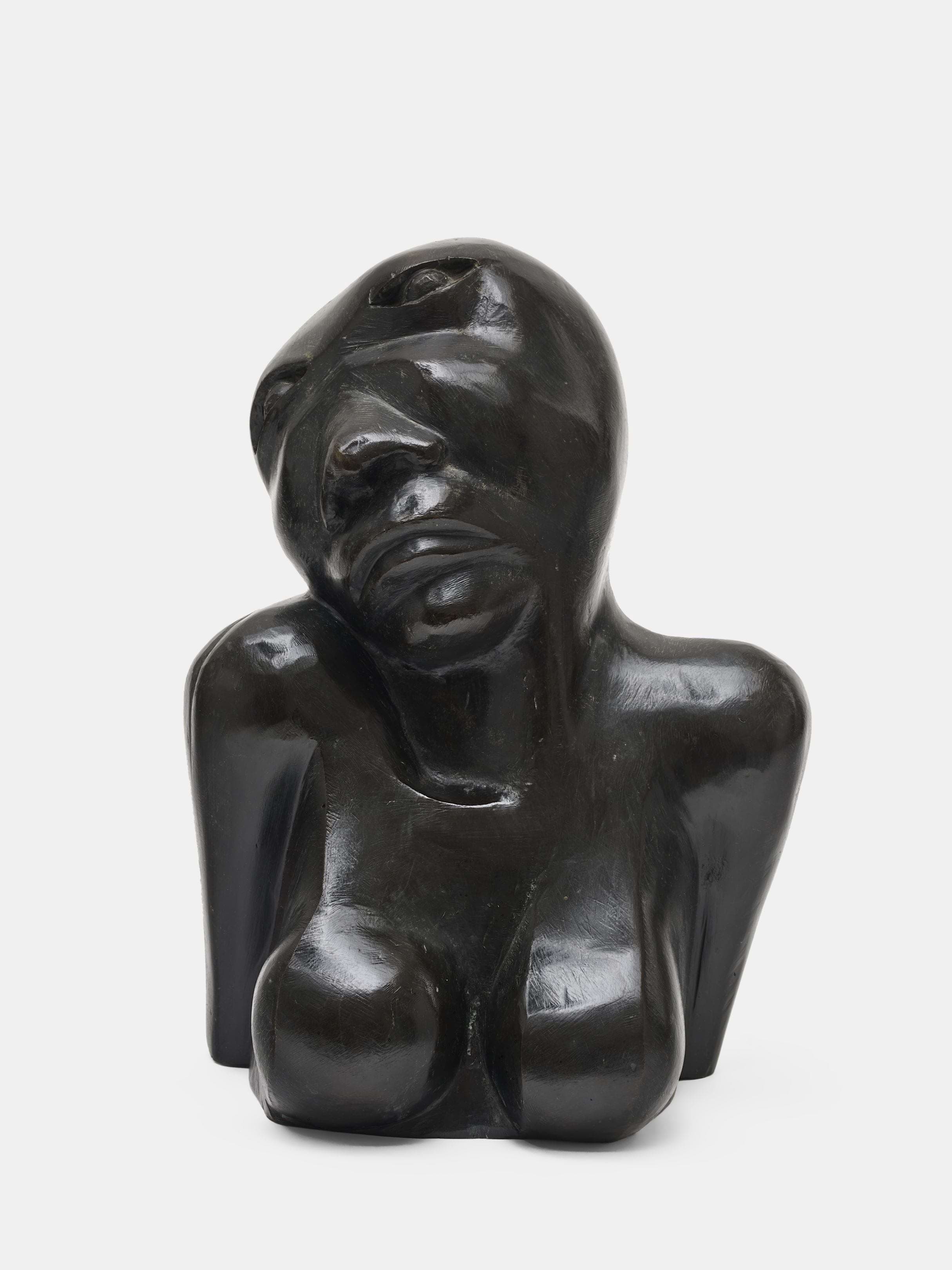
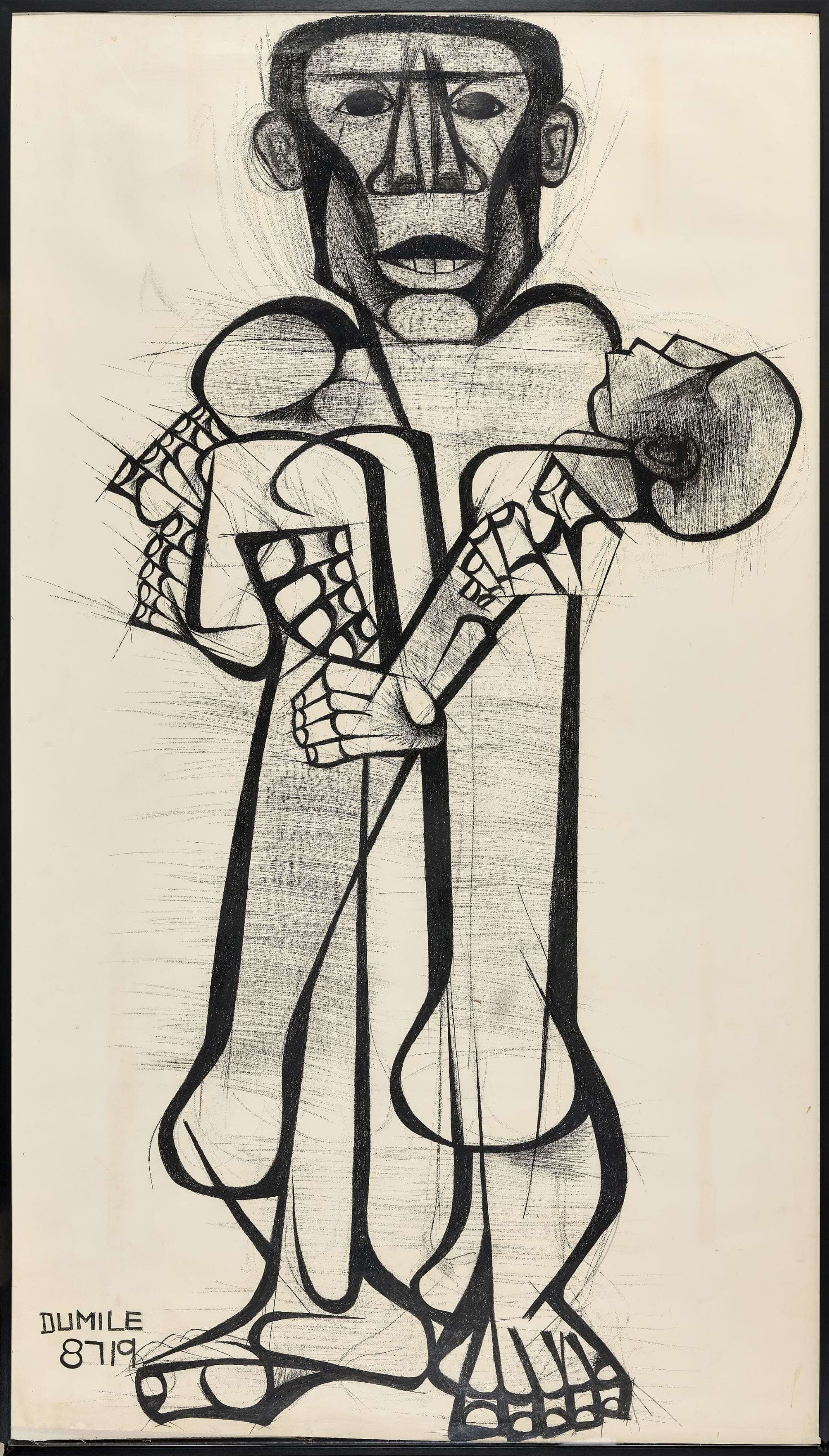
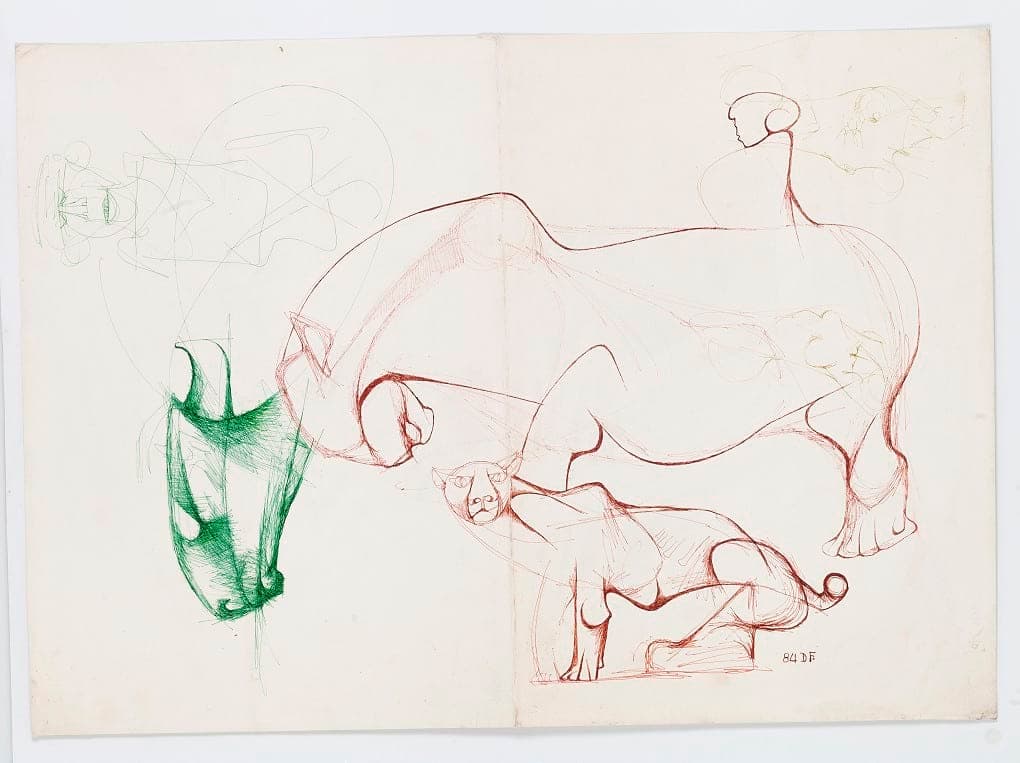
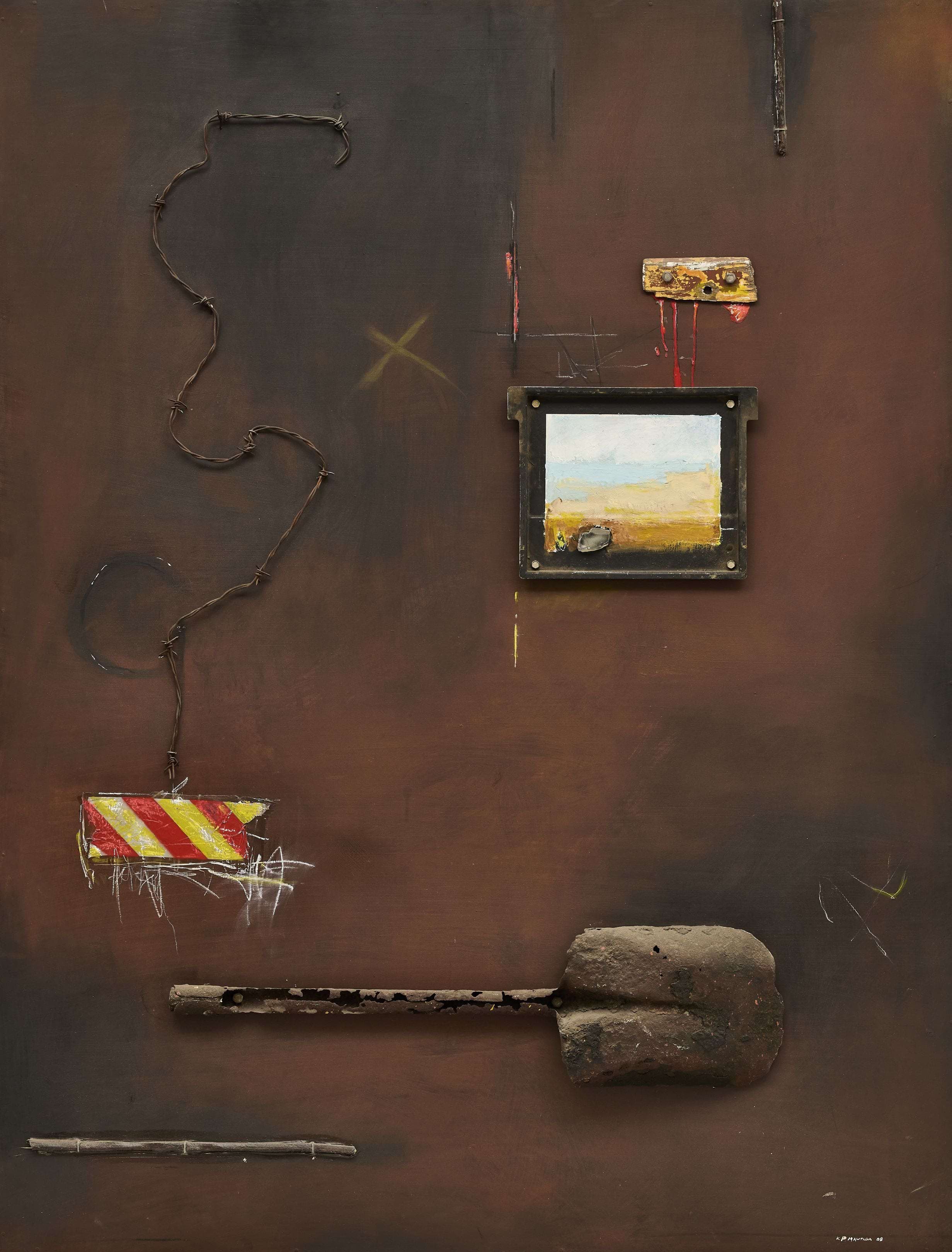
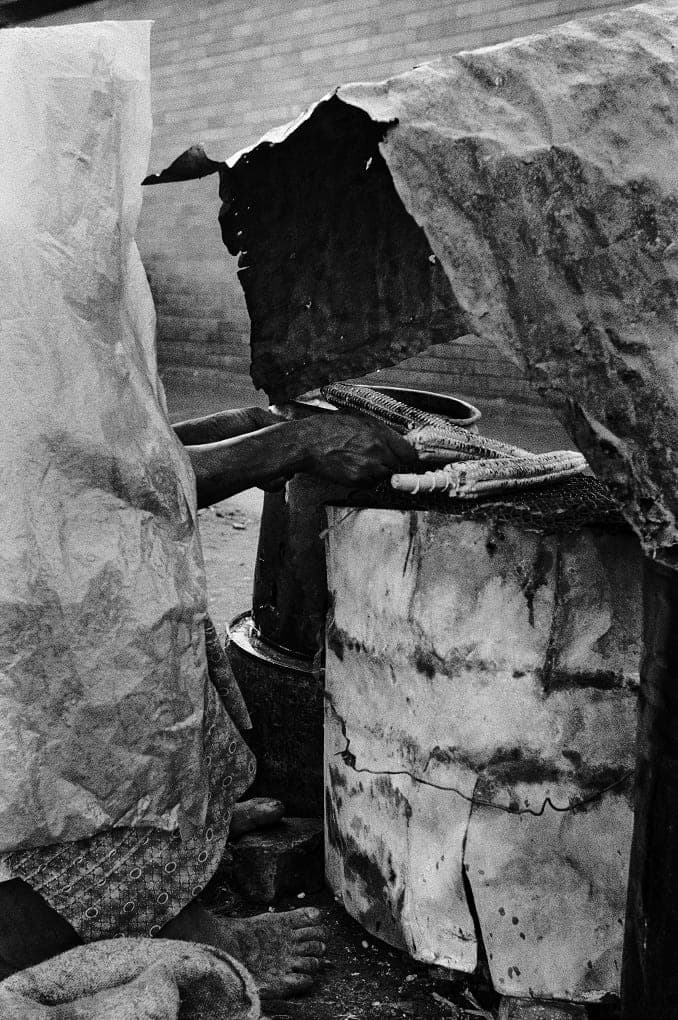
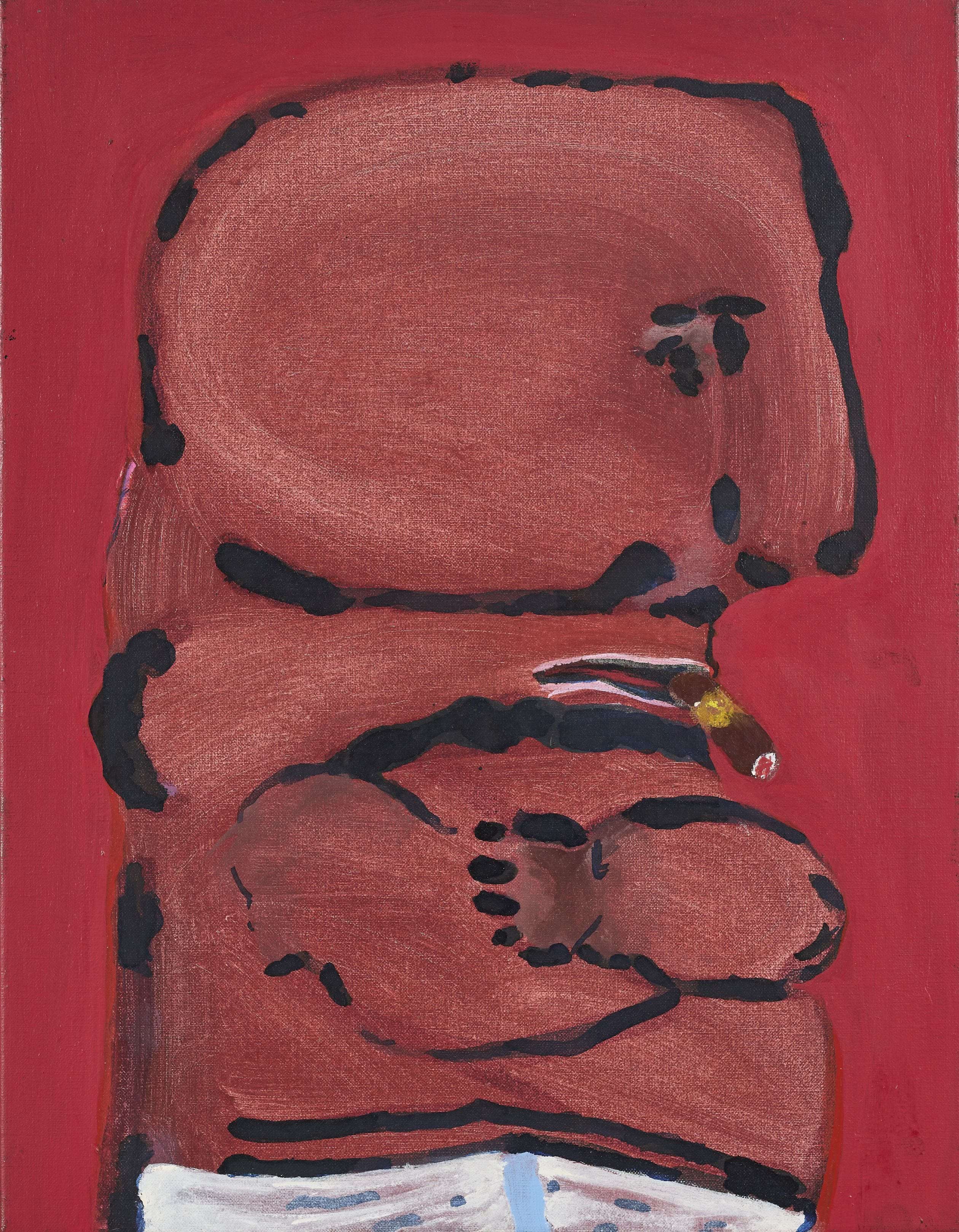
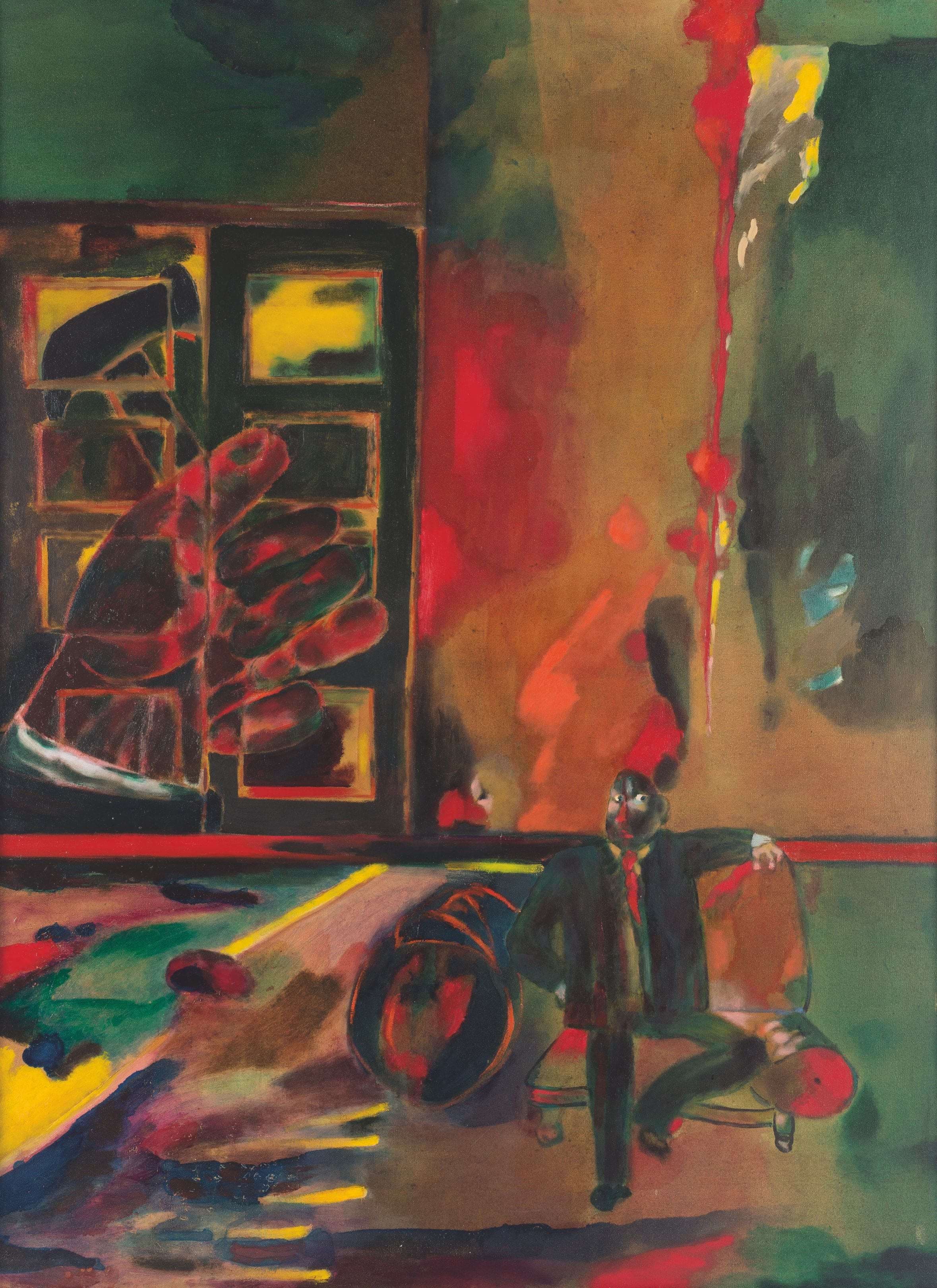
Peter Clarke producing the work. (SEE IMAGES)
Taken from Philippa Hobbs and Elizabeth Rankin (eds.) (2011). Listening to Distant Thunder: The Art of Peter Clarke, Johannesburg: Standard Bank of South Africa. Page 145.
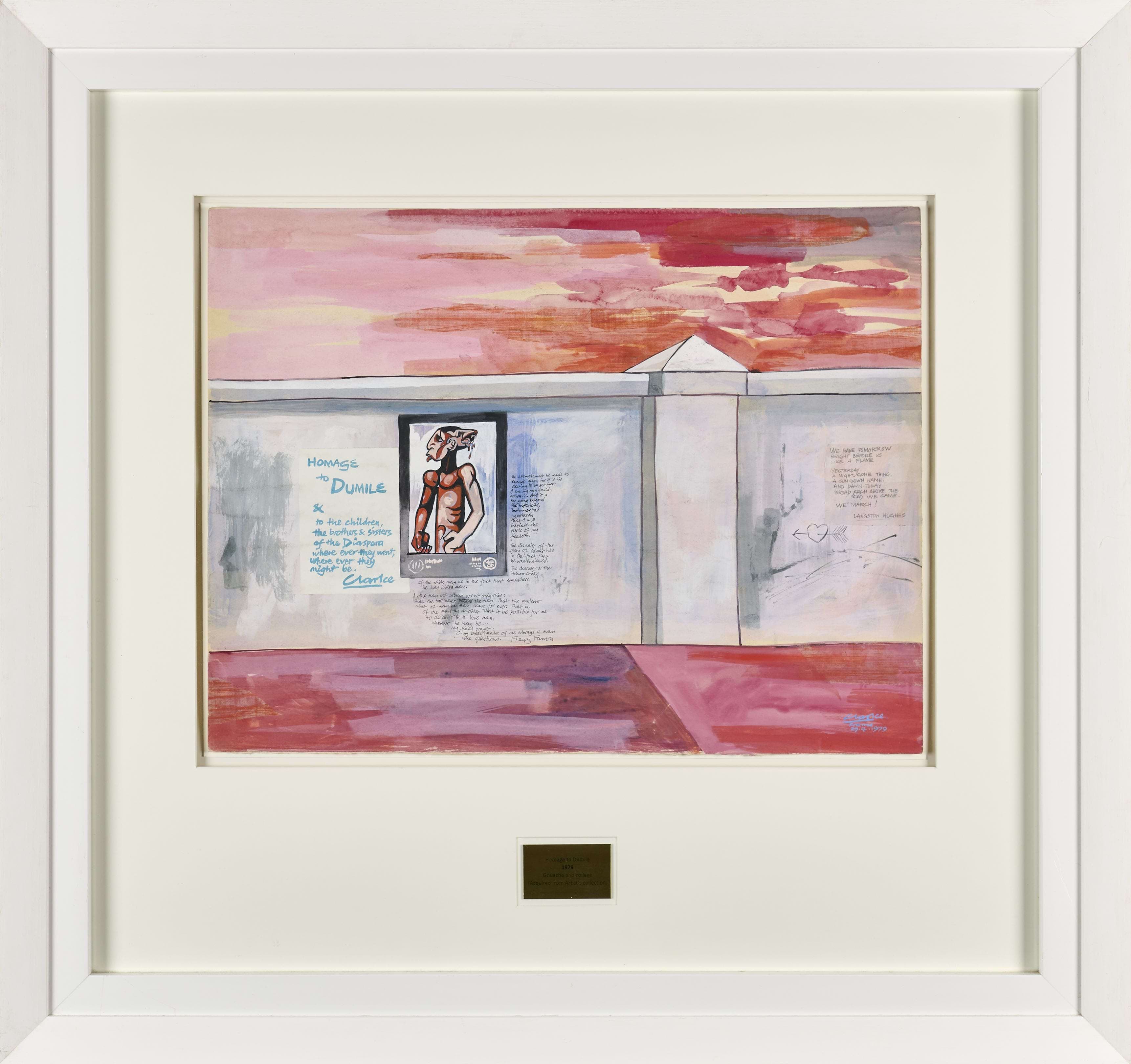
This was produced in 1979 while Dumile was in exile in New York and was painted at the home of photographer Peter Hallett in Boule d’Amont in the Spring of 1979. Hallet showed Clarke a UNESCO poster in which this image was used. Clarke’s work effectively acts as a veritable poster on a wall that could well have announced some sort of political rally during the Struggle. The image is surrounded by a dedication written graffiti-like on a wall by Clarke to Feni, as well as by quotes from Langston Hughes and Frantz Fanon. Clarke, who was first introduced to the work of Feni by Hallett, subsequently saw and greatly admired Feni’s work.
Poem on back of artwork, need inscription details from framers
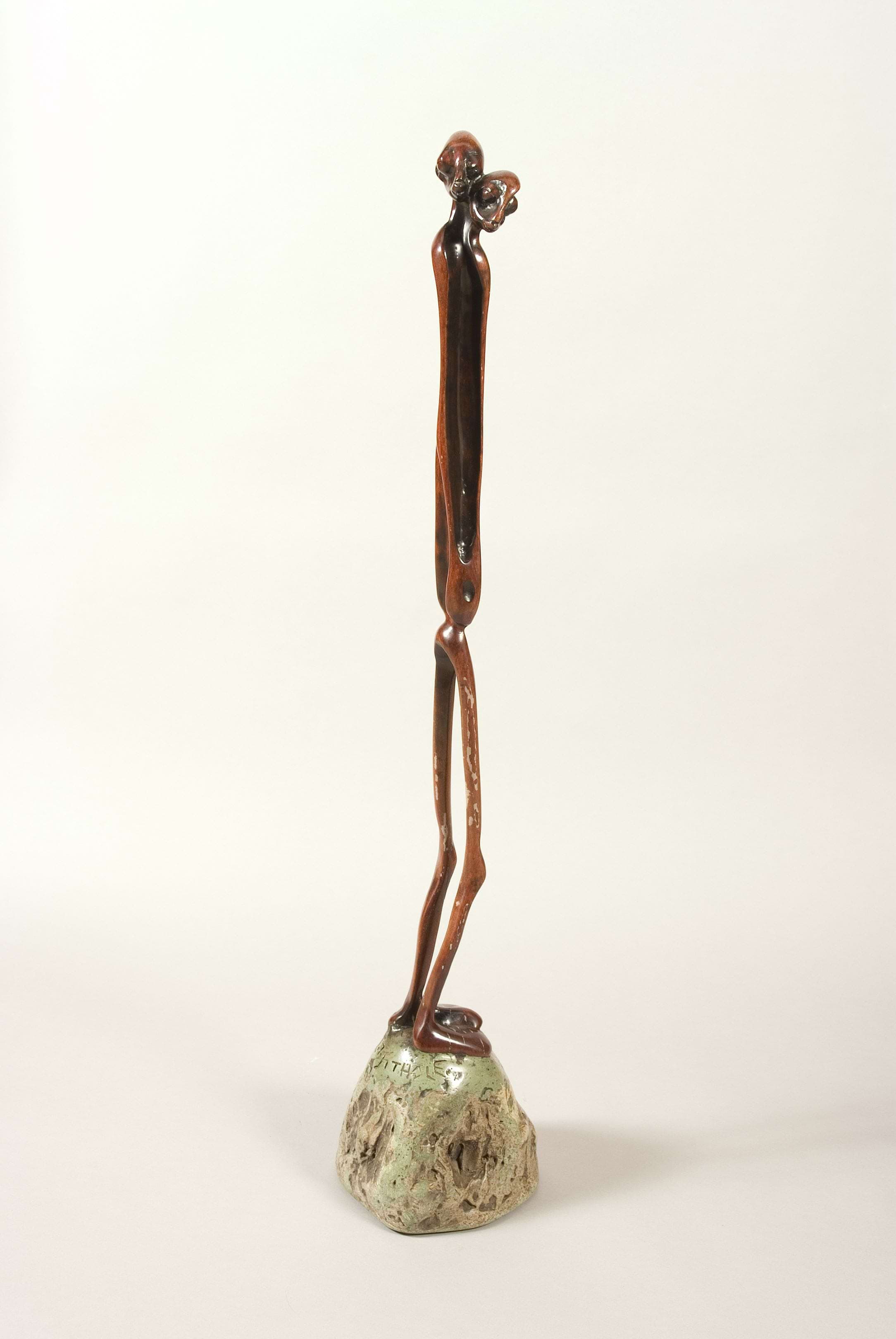
Sithole’s representations of human forms as simplified yet graceful elongated figures, were
carved from a single piece of wood and mounted on a modest base (usually wood, stone or
liquid steel). These figures reflect Sithole’s remarkable ability to depict human emotion and
social realism through his carving, allowing the wood to reveal an emotional form. Only a
handful of these elongated figures were carved with separate legs. In most, the legs are
fused or at most a small parting can be seen close to the base. Perhaps often the wood did
not allow for it, but presumably too Sithole could carve a more stable and taller figure by
retaining the legs as a unified piece. Winter II, with its distinctly separate long legs, as well
as the double head, makes this figure unusual in his oeuvre. 1 http://sithole.com/SITHOLE-
LS7503.html
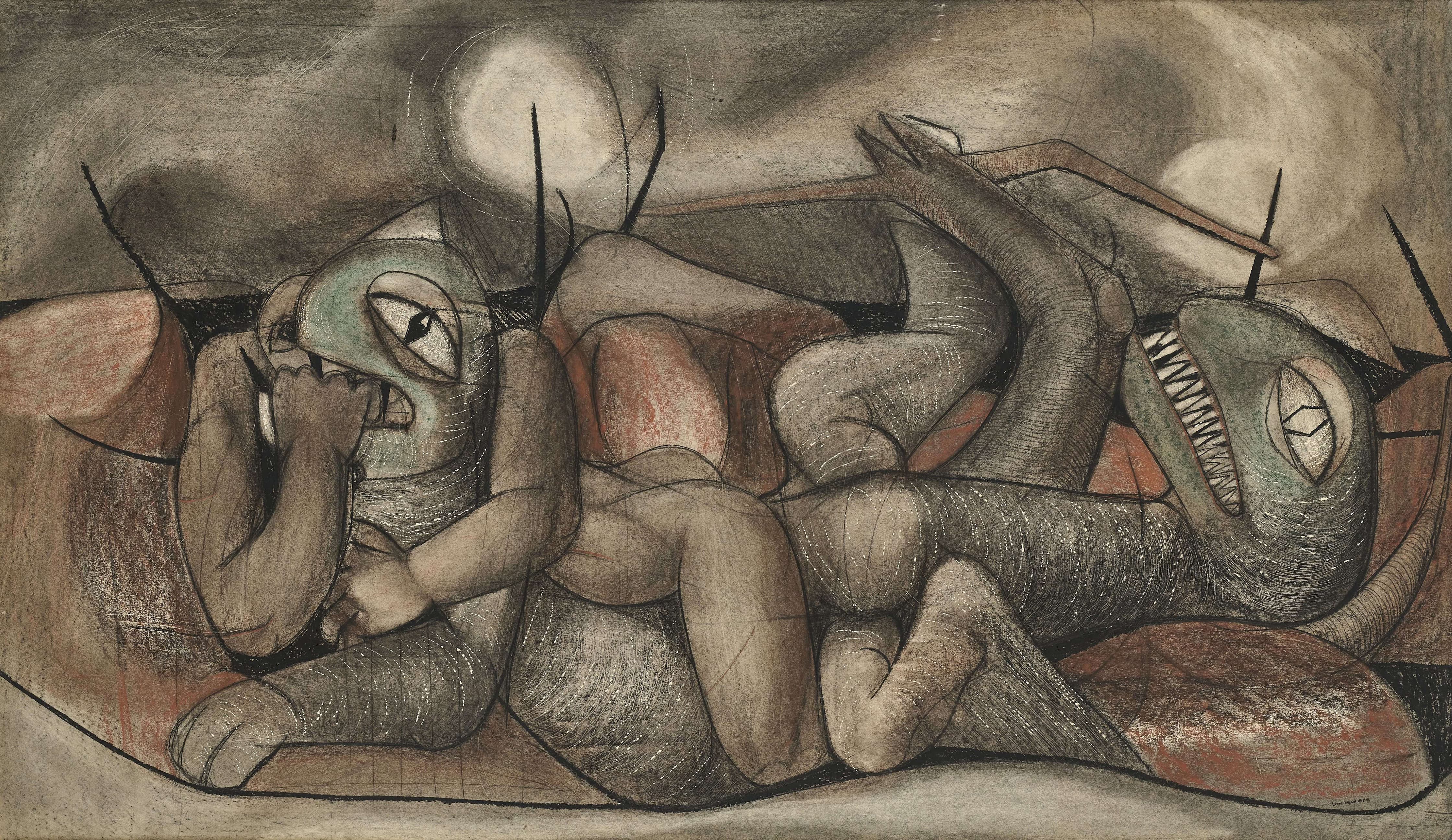
Feni was in New York when this work was produced.The killing of Hector Pieterson by the South African police on 16th June 1976 was recorded by the photographer Sam Nzima. This iconic image was published around the world and brought the struggle against apartheid in South Africa to international attention.
It is very similar in style to the auction record artwork titled Children Under Apartheid which was produced the same year.
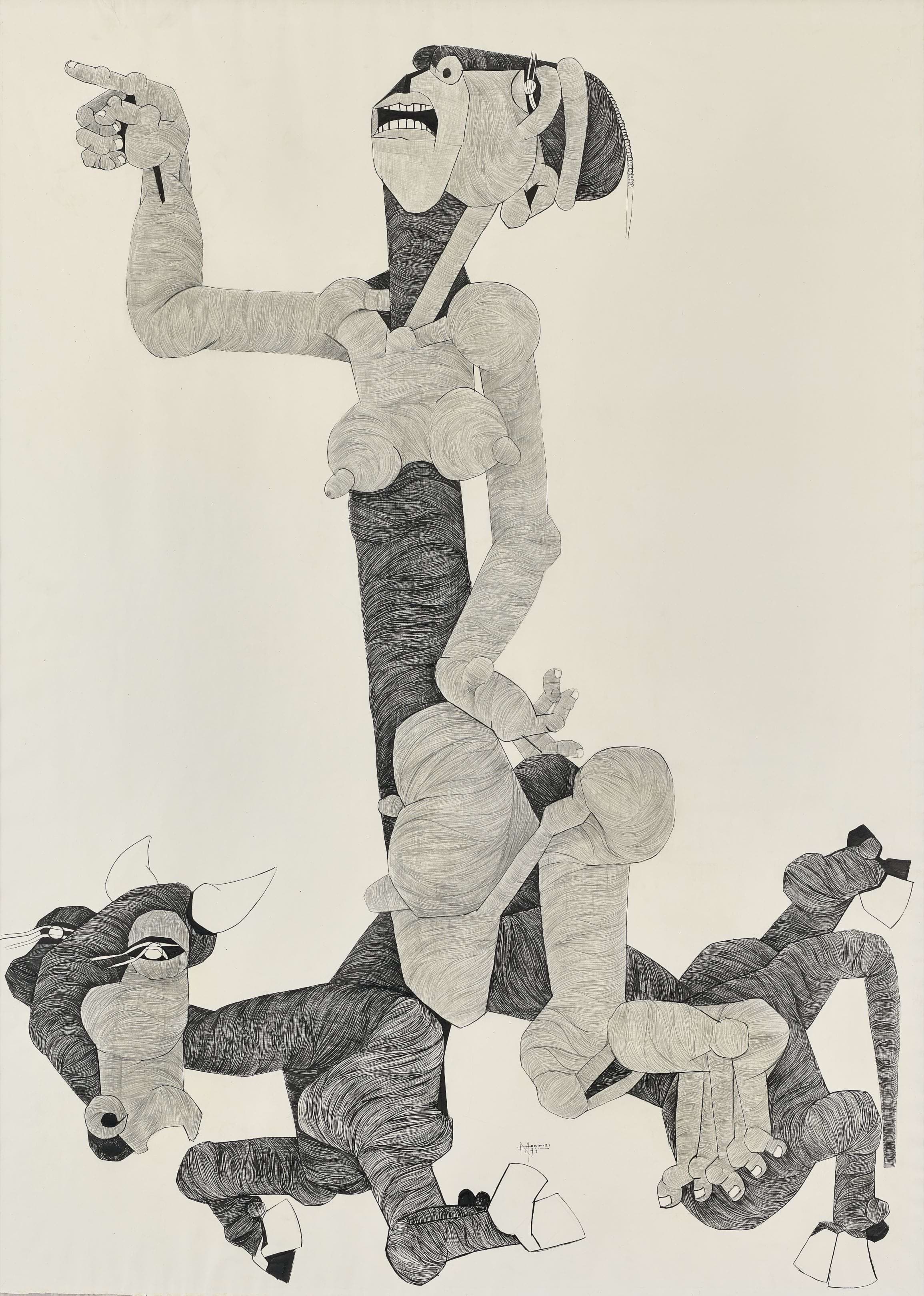
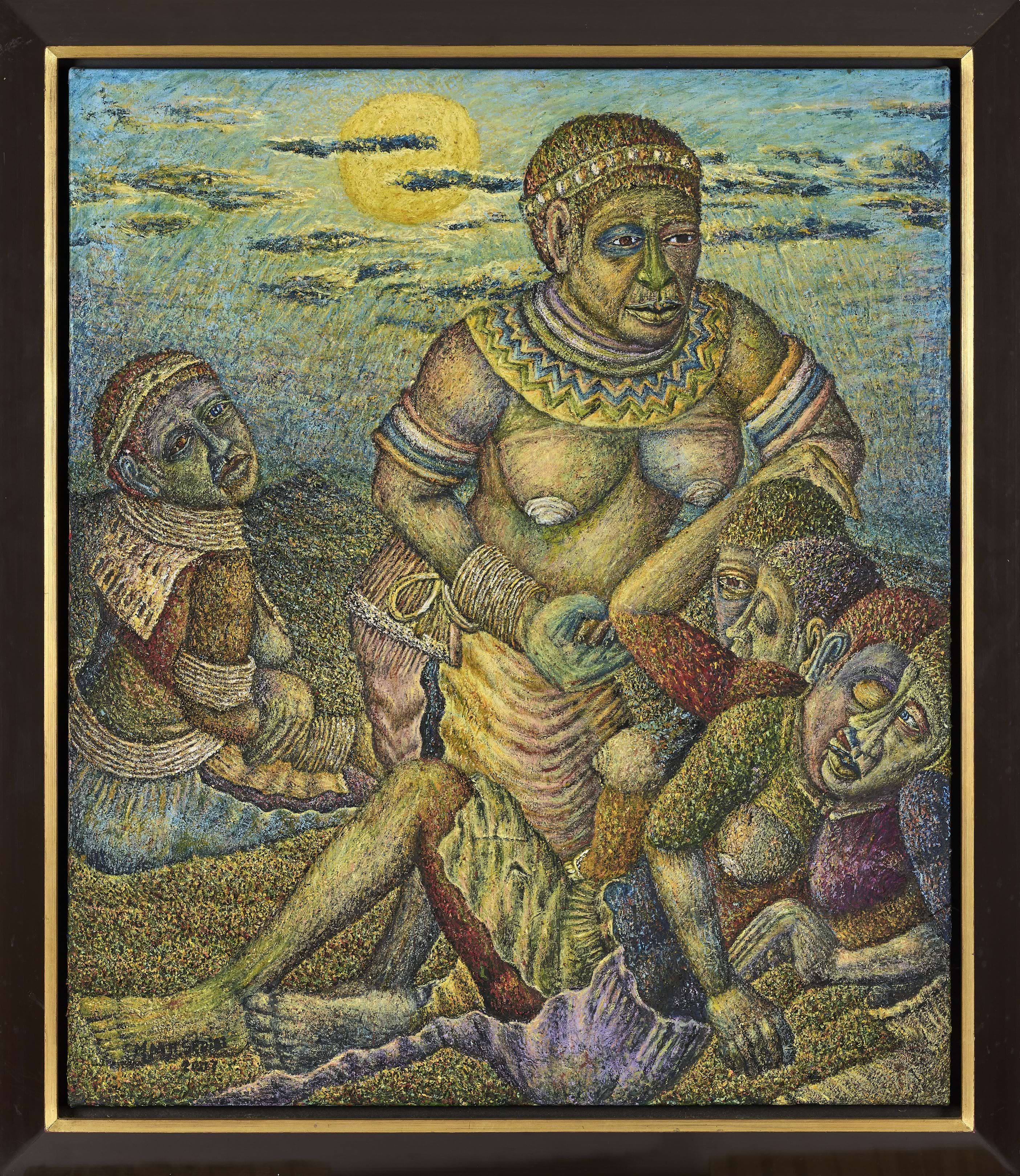
Nathaniel ‘Nat’ Ntwayakgosi Mokgosi (b. 1946, South Africa - d. 2016, South Africa) was a respected and influential artist and teacher who, throughout his career, dedicated himself and his practice to the upliftment of black artists. Born in Newclare, a township near Johannesburg during the height of the Apartheid era, Mokgosi’s work strongly depicts the social inequities and political turmoil of the time.
In 1965 Mokgosi enrolled at the popular Jubilee Art Centre for a year of formal training, studying under artist and mentor, Ezrom Legae (1939-1999). Mokgosi subsequently spent time teaching at the Open School in Johannesburg before launching his career as a full-time artist in 1970. In the succeeding four decades of his career, Mokgosi’s work was collected by numerous public and private individuals and was shown in important exhibitions around South Africa - notably, in 1975 being selected by American art critic Clement Greenberg for the exhibition Art in South Africa Today; a series of seven national art exhibitions open to South African artists of all races.
The depiction of man and beast as seen in Mythological Rider is a subject Mokgosi shared with many of his contemporaries, including artists such as Ezrom Legae, Sydney Kumalo (1935-1988) and Dumile Feni (1942-1991). This notable work reflects an era when many of the drawings Mokgosi produced were steeped in African spiritual mysticism. Created in 1974 when Mokgosi was producing some of his most significant works, Mythological Rider is impressive in scale, technique and visual concept. Exploring the motif of combining man and beast into a singular form, a feature common in Mokgosi’s work, Mythological Rider depicts a large human figure astride a stalking beast - likely a bull. The power relations are apparent as the figure is disproportionately larger than the comparatively small bull - a representation of power and submission and a perceptible commentary on the social and economic injustices of the 1970s.
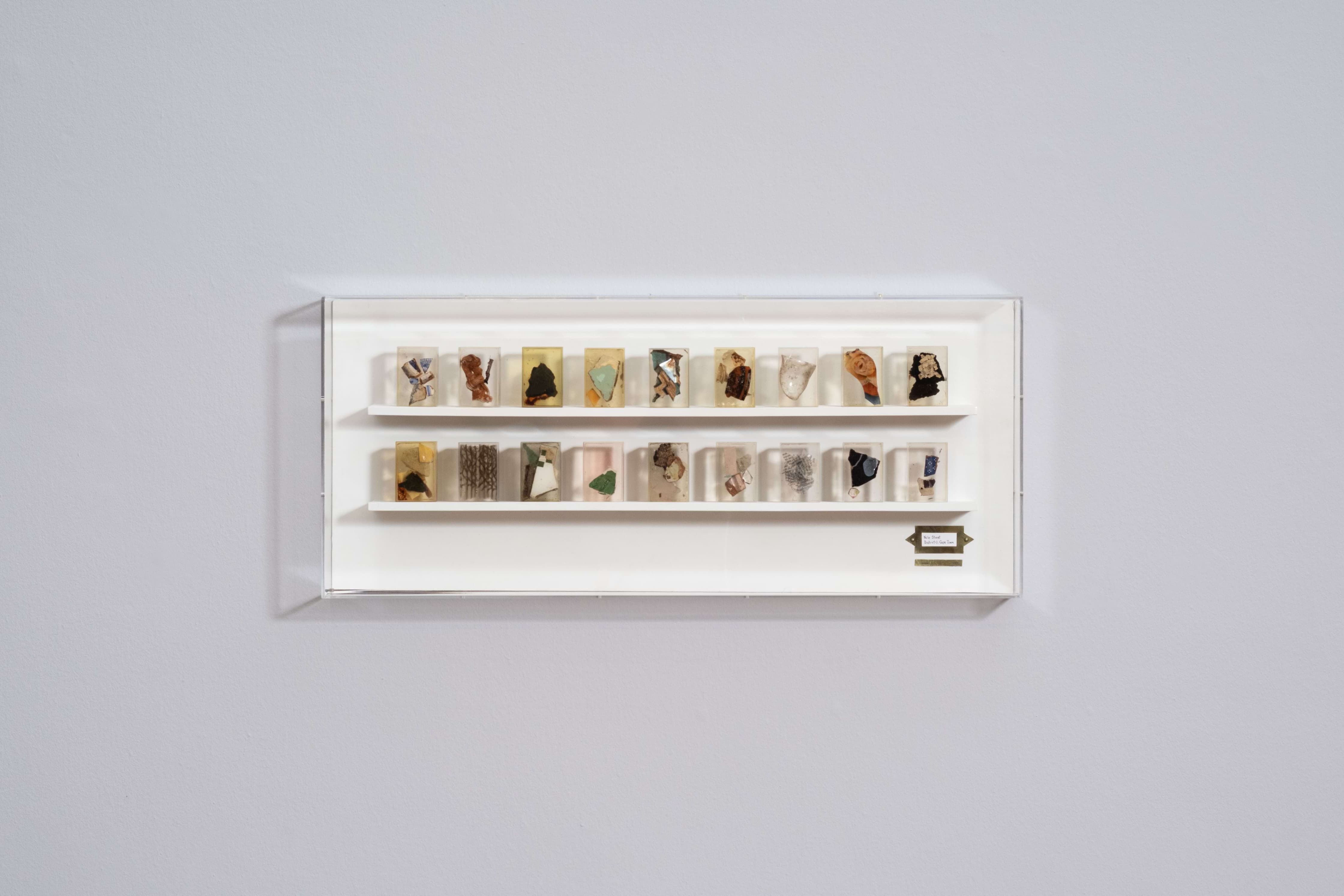
District Six, in Cape Town, was once one of the liveliest parts of the city, a close knit mixed race community with schools, social clubs, a fish market, sporting teams, beauty pageants and a tradition of jazz.
In the mid 1960s, the apartheid government announced that under the Group Areas Act, District Six would be demolished and in future would be for Whites only.
Years passed. People thought it would never happen, but slowly street by street, District Six was demolished and 60 000 people were moved out of their homes to the bleak areas on the outskirts of the city.
In 1981, as an artist and as a member of the Friends of District Six, Sue Williamson spent weeks gathering materials from the demolition sites and recording voices from District Six residents, those who remained, and also those who had left. It was part of an artistic strategy to raise consciousness and try to save the remaining houses from being demolished.
The rubble was placed in the middle of the Gowlett Gallery in Cape Town, surrounded by six chairs draped in white. The tape played, and photos on the wall documented the artist's process. The exhibition received major press publicity, and visitors included the security police.
The exhibition was titled The Last Supper. Twelve days after the opening the exhibition ended and the doors, windows, baths, bricks, books, and chunks of plaster were returned to the demolition sites. Within a year, District Six existed no more.
By 1993, grass had grown over the demolition sites, but under the grass, fragments of houses and belongings remained, the evidence of a community which had now left.
On a new search, the artist gathered more materials and broken domestic objects and encased these fragments into small resin blocks. The fragments were left as they had been picked up, so the soil that adhered to them remained, and sometimes building materials leaked residue into the resin. The blocks were displayed in 'Museum Cases,' each named after a street in District Six.
In 2023, the last set of the blocks received a new layer of polyurethane resin, preserving them from chipping, and capturing for ever the fragments of china, mirrors, shower curtains, kitchen linoleum which were once part of the daily life of District Six.
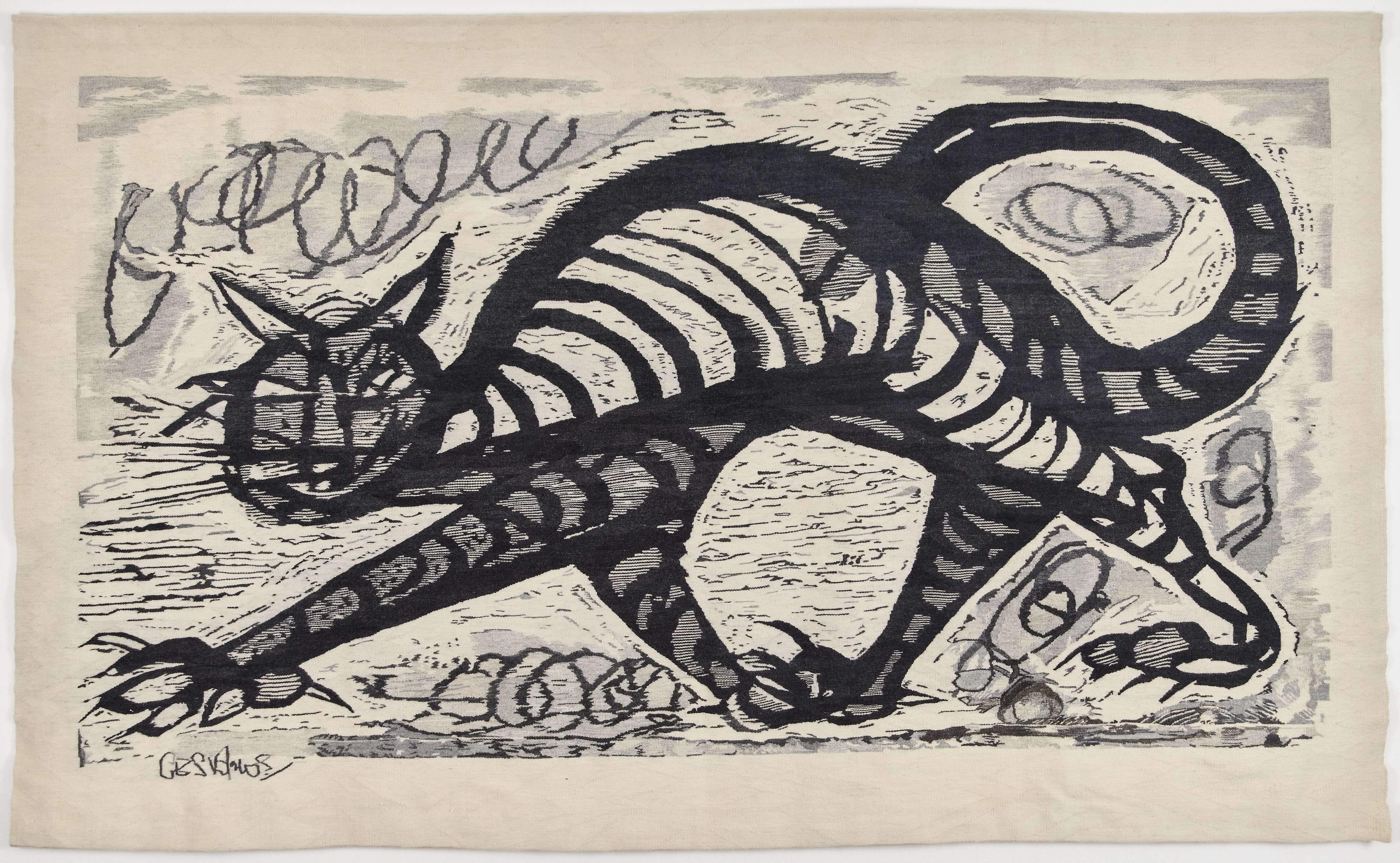
signed label by Pippa Skotnes for estate; based on a woodcut print design 1960 by Cecil Skotnes; this weaving done in 2020
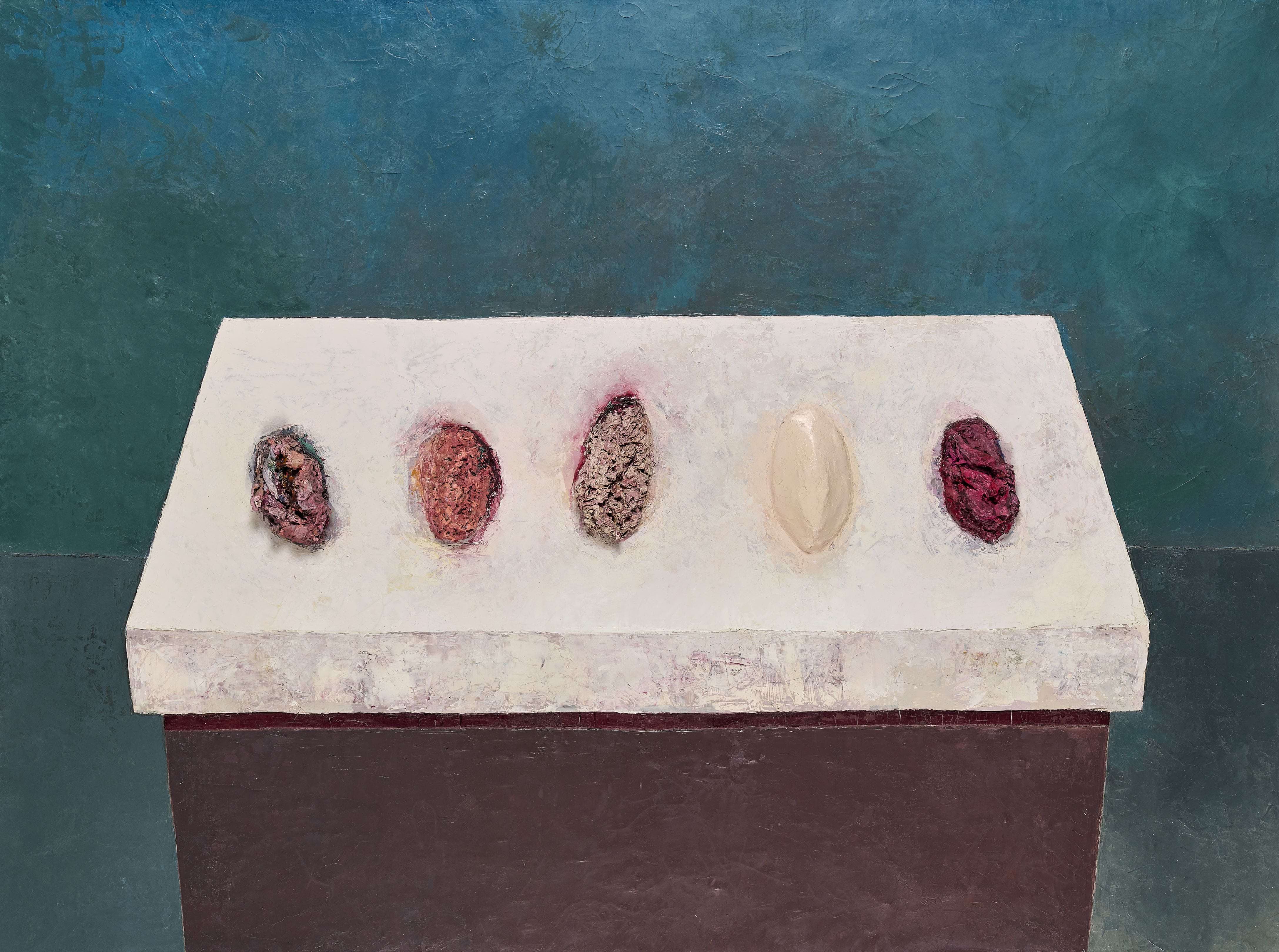
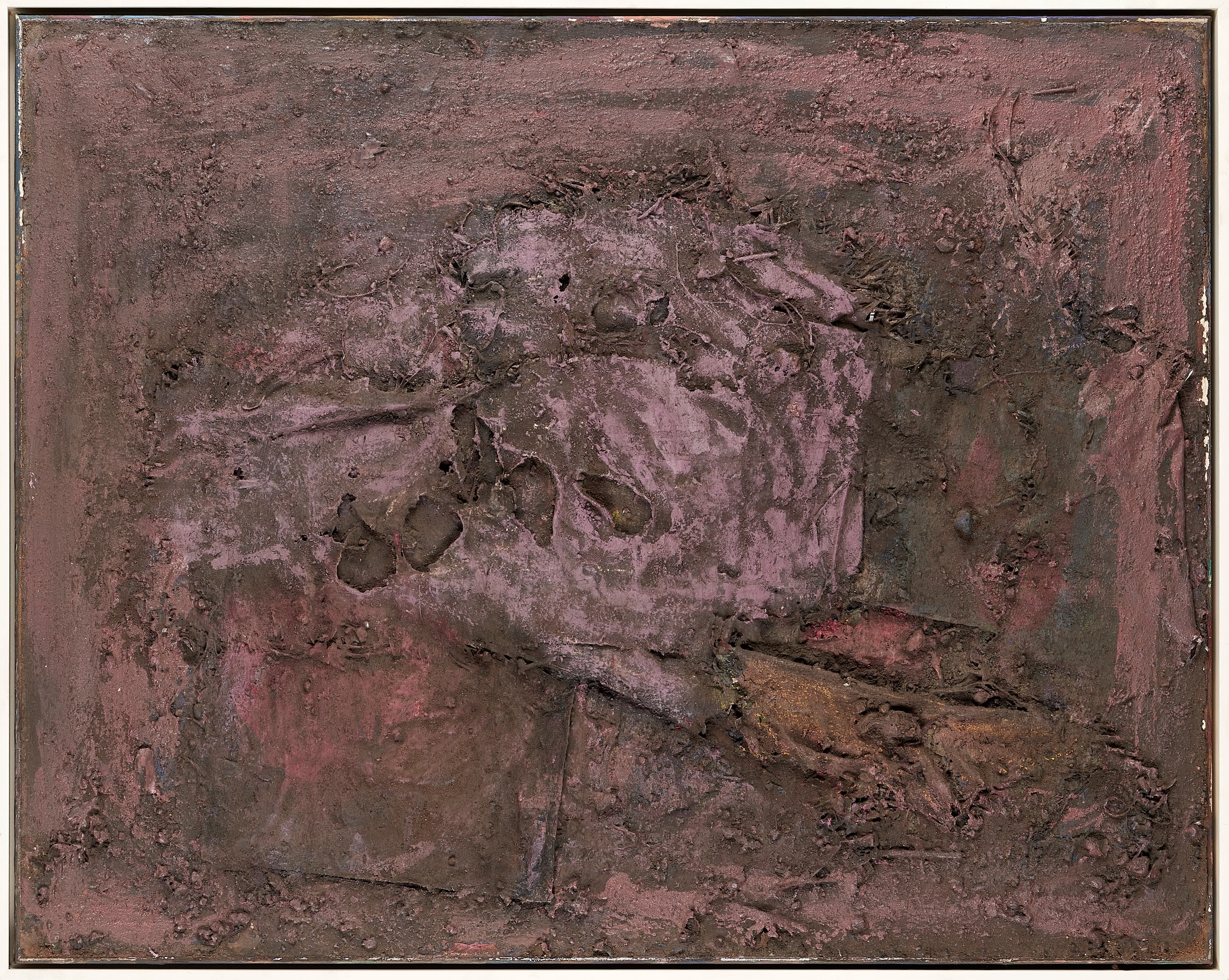
Paint in Siopis’ hands is a medium of sensuous and conceptual alterity, of strangeness, of otherness. The touch-oriented, sensuous intimacy of her early work, the logic of assembling readymade materials in complex spatial constellations in the history paintings and assemblages, which follow through in her later installations, can be traced to her maverick use of paint as object, sign, and surface from her earliest creative years. Siopis’ creative affair with materiality and surface is as much an intellectual as an intuitive passion. Tracking that passion through her work offers us profound insights into her distinctive creative responsiveness, riskiness and resilience
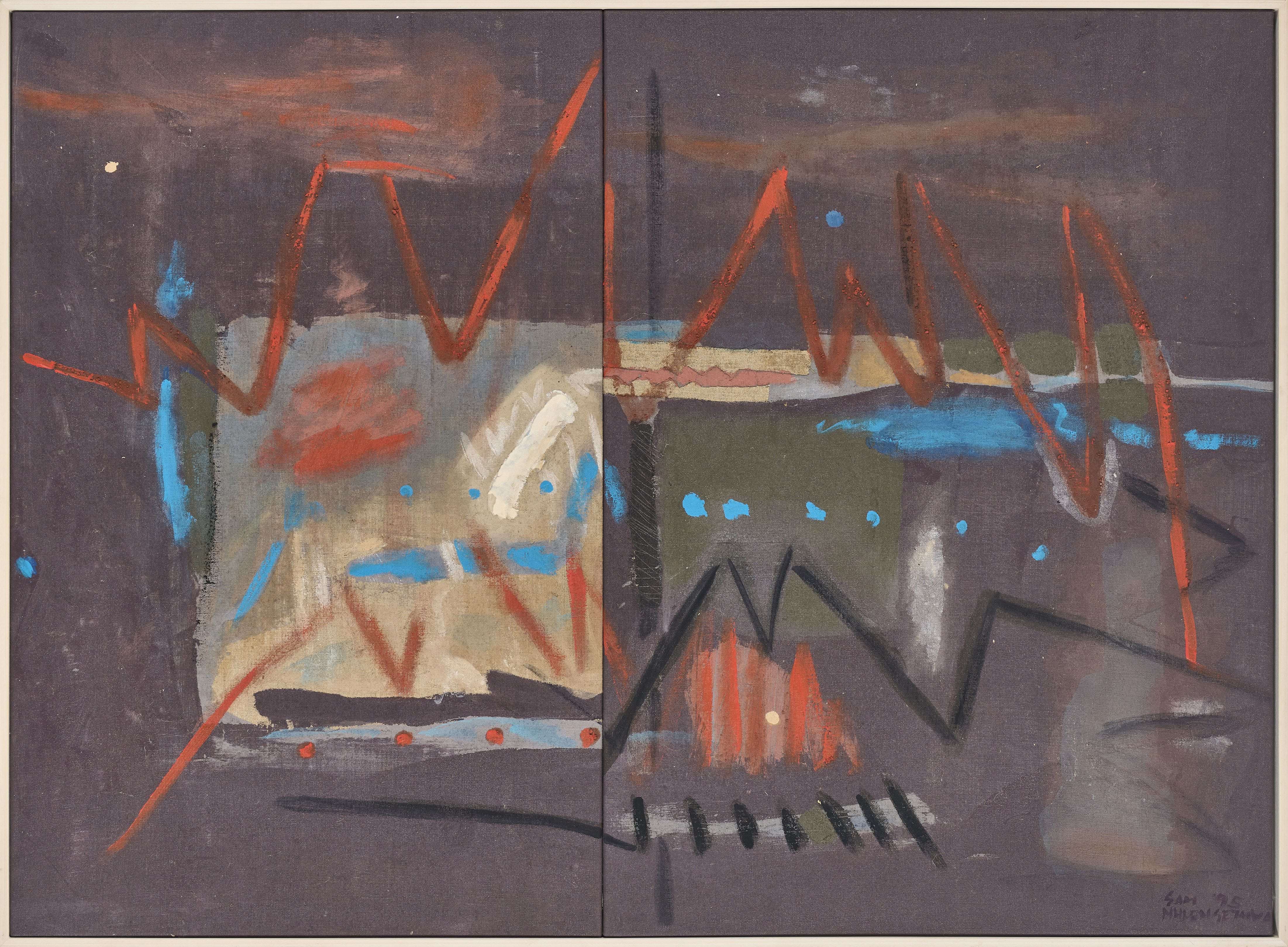
This painting forms part of a series of abstract works created by Sam Nhlengethwa during the Africa 95 workshop held in Dakar, Senegal. The workshop, sponsored by the British Council, was attended by artists from South Africa, including David Koloane, the rest of the continent and Britain. Nhlengethwa has been working in abstract forms since 1985. This particular work was inspired by Nhlengethwa’s interaction with the local colour palate in Senegal, which he calls “natural, earthy colours”. This work is his interpretation of that impression.
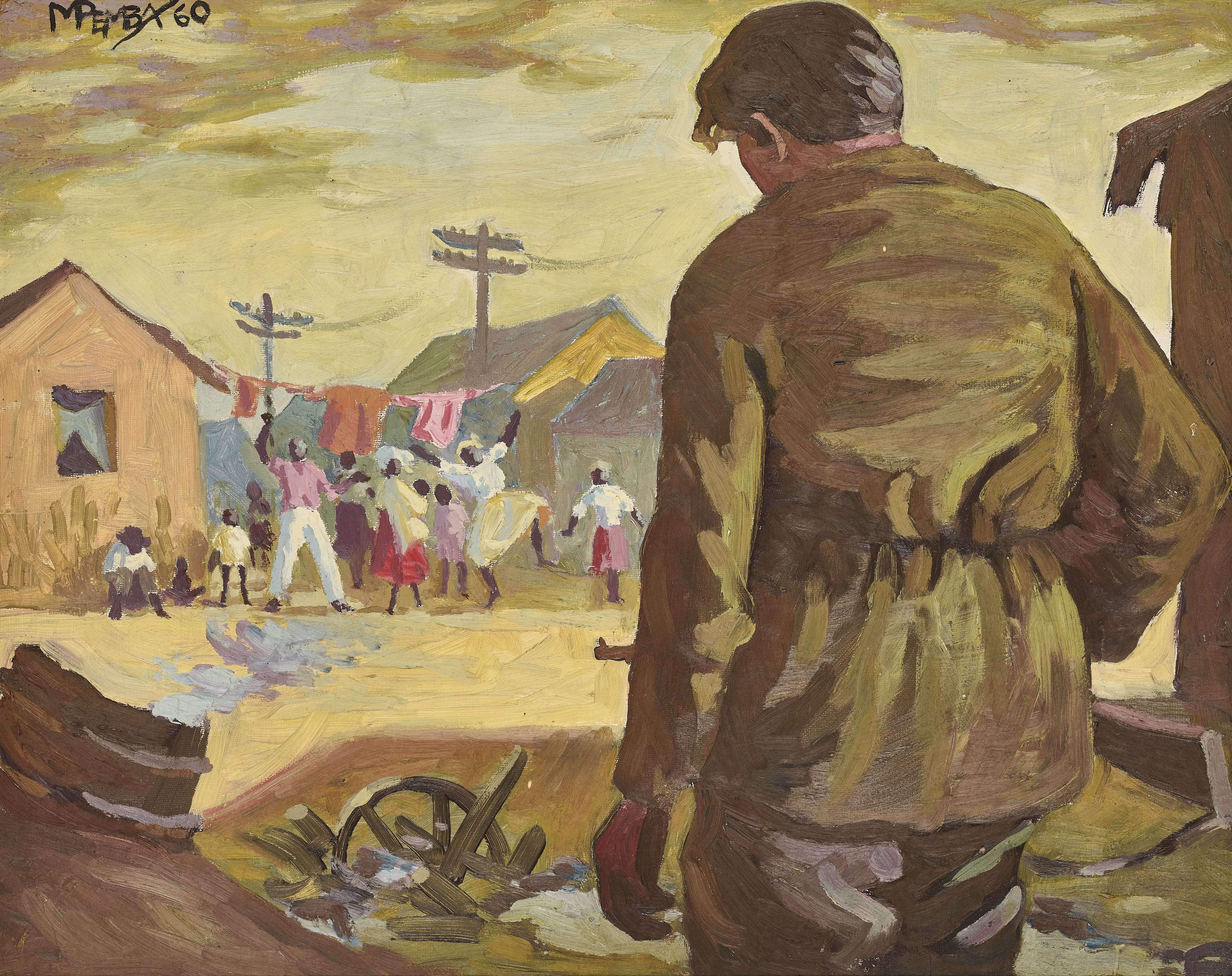
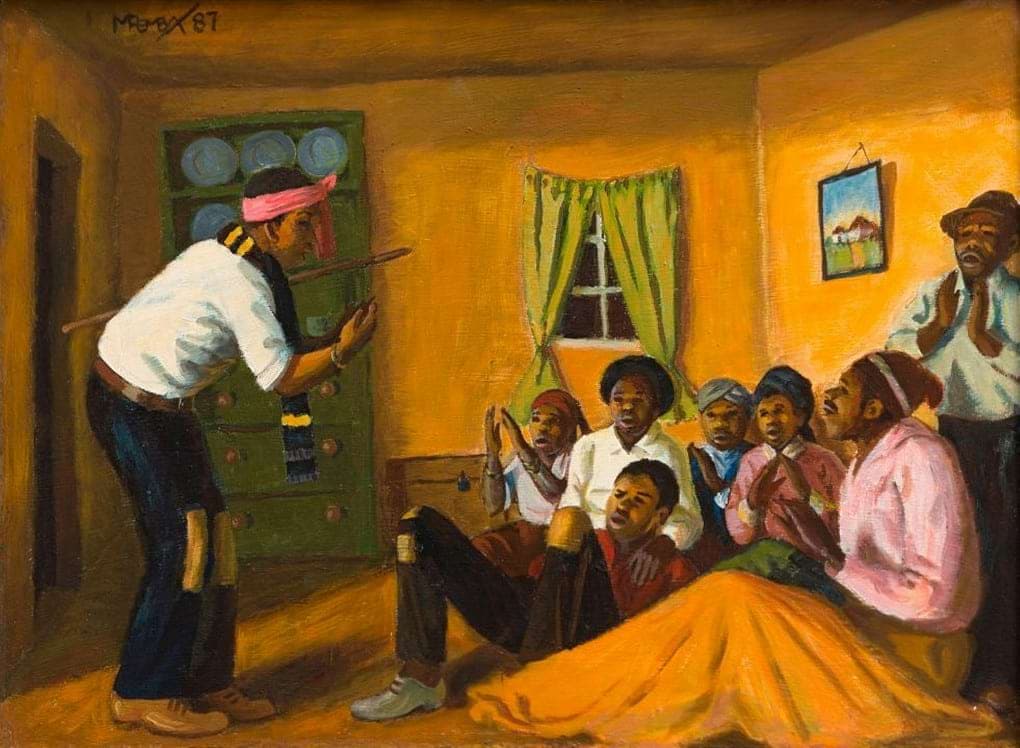
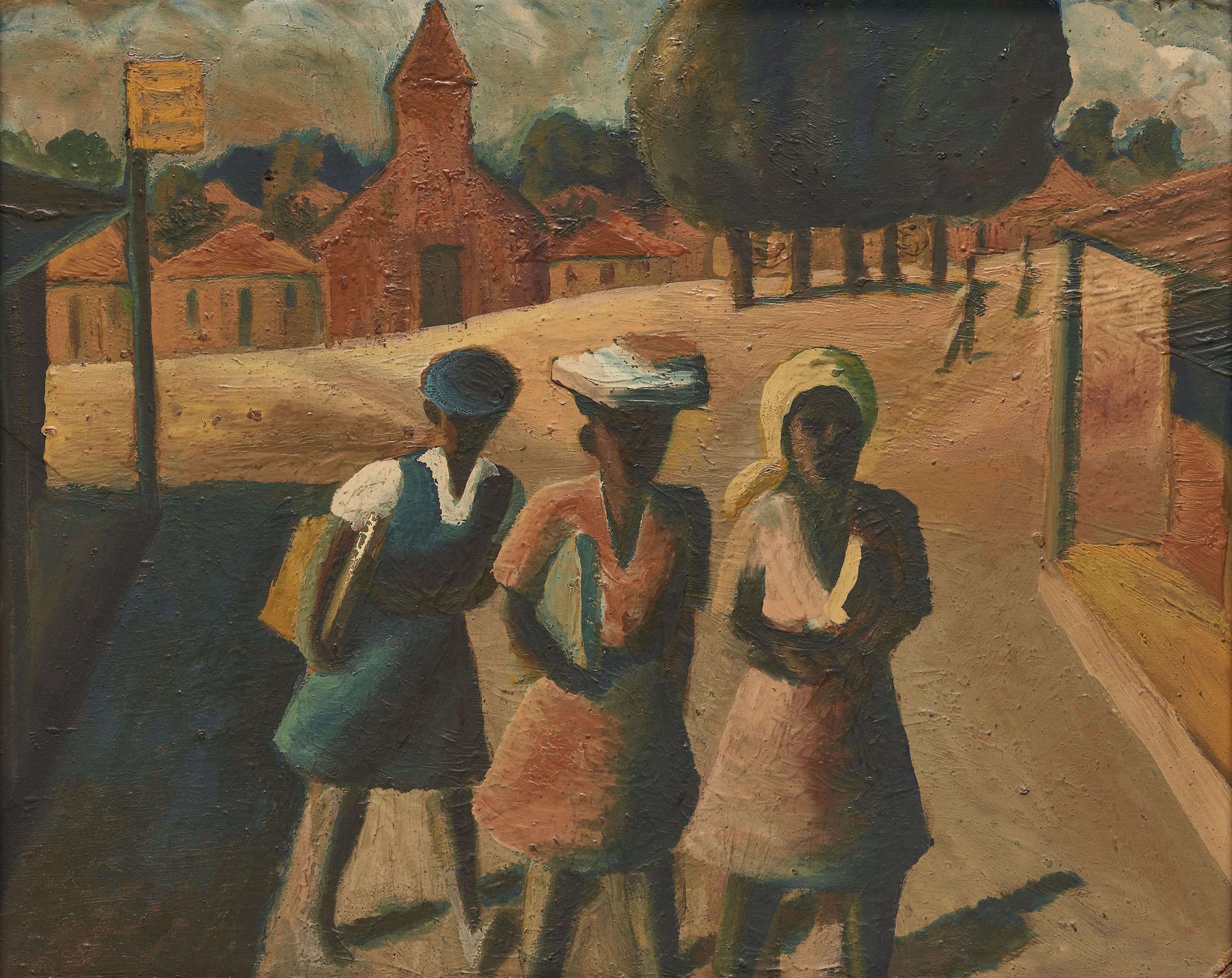
George Pemba painted a range of subjects: portraits of individuals from a variety of backgrounds, images drawn from Xhosa and Sotho traditions, and landscapes. He is, however, best known for his township scenes. His subject is the poignant social realism of township life - through what could, superficially, be perceived as a simplistic reflection of life in the New Brighton Township and Eastern Cape surrounds. He painted the harsh story of life in a South African township at the height of Apartheid's oppression.
As a social historian Pemba interpreted the customs and living conditions of township dwellers of the Eastern Cape during apartheid, revealing processes of modernization in which a resilient black culture survives extreme oppression. The paintings, however, were not couched in the socialist realism of revolutionary 20th century propaganda art, but rather in an impressionistic style in keeping with the trends set by Eastern Cape artists such as Dorothy Kay, with whom Pemba painted in the 1950's.
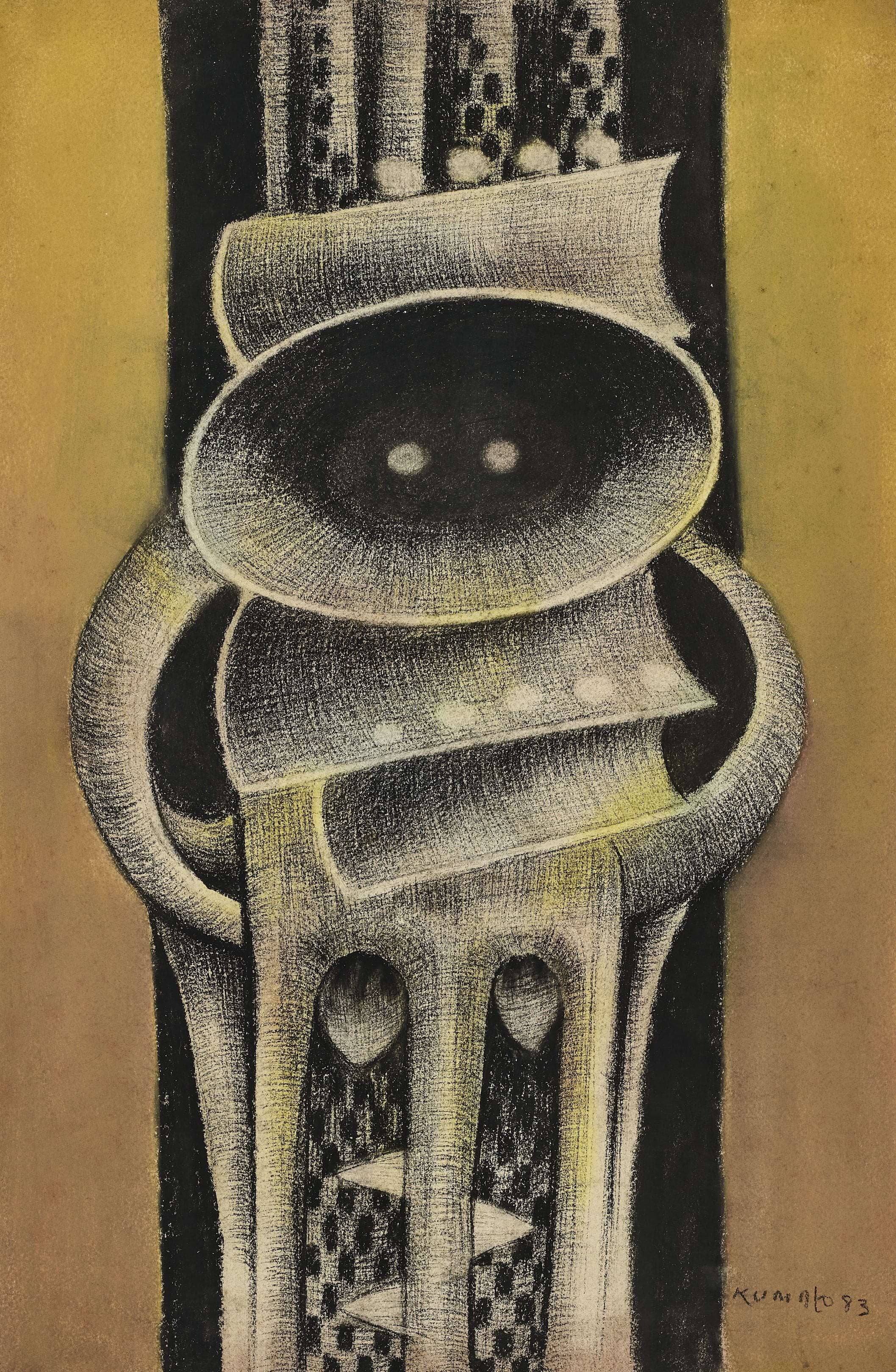
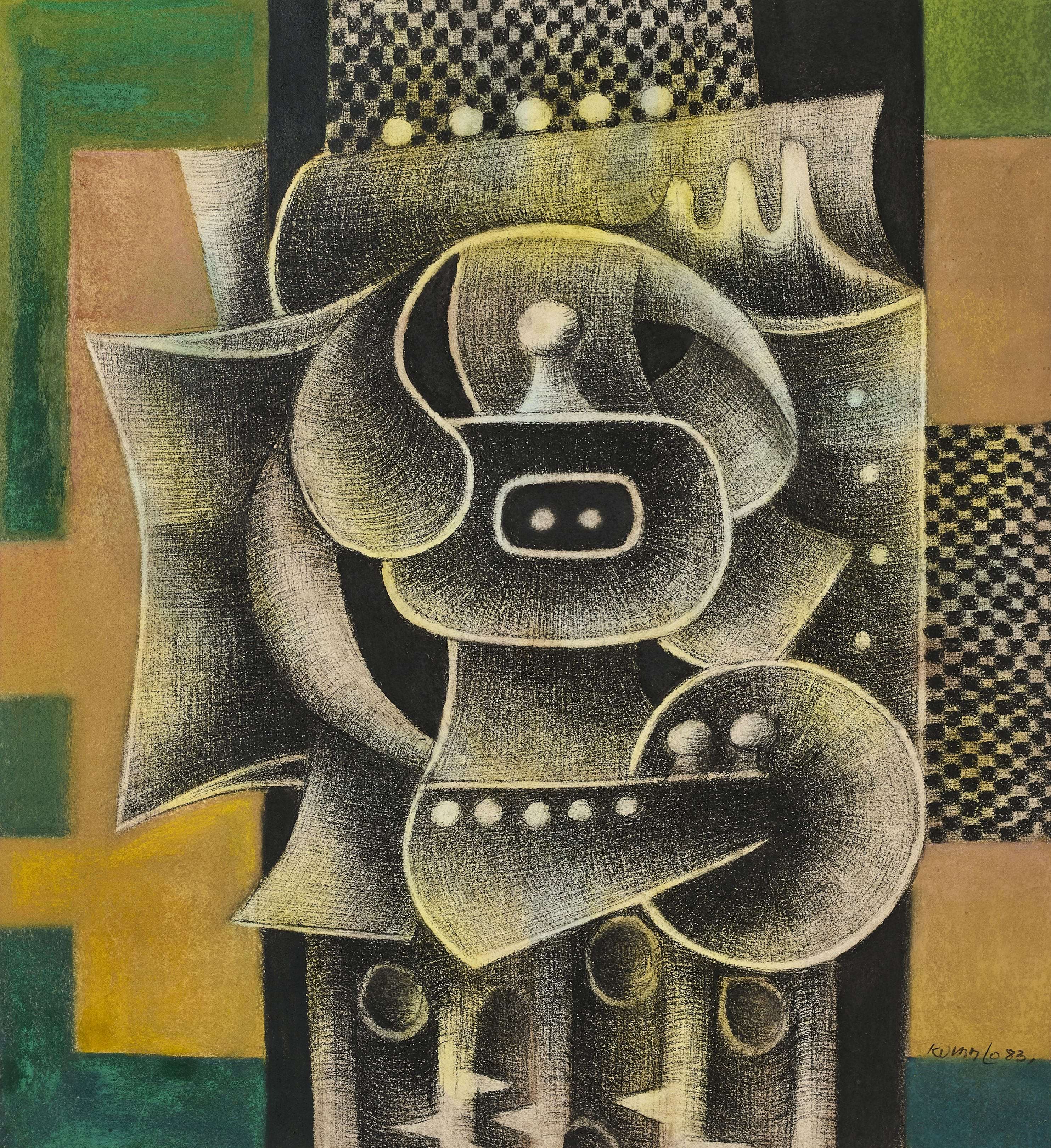
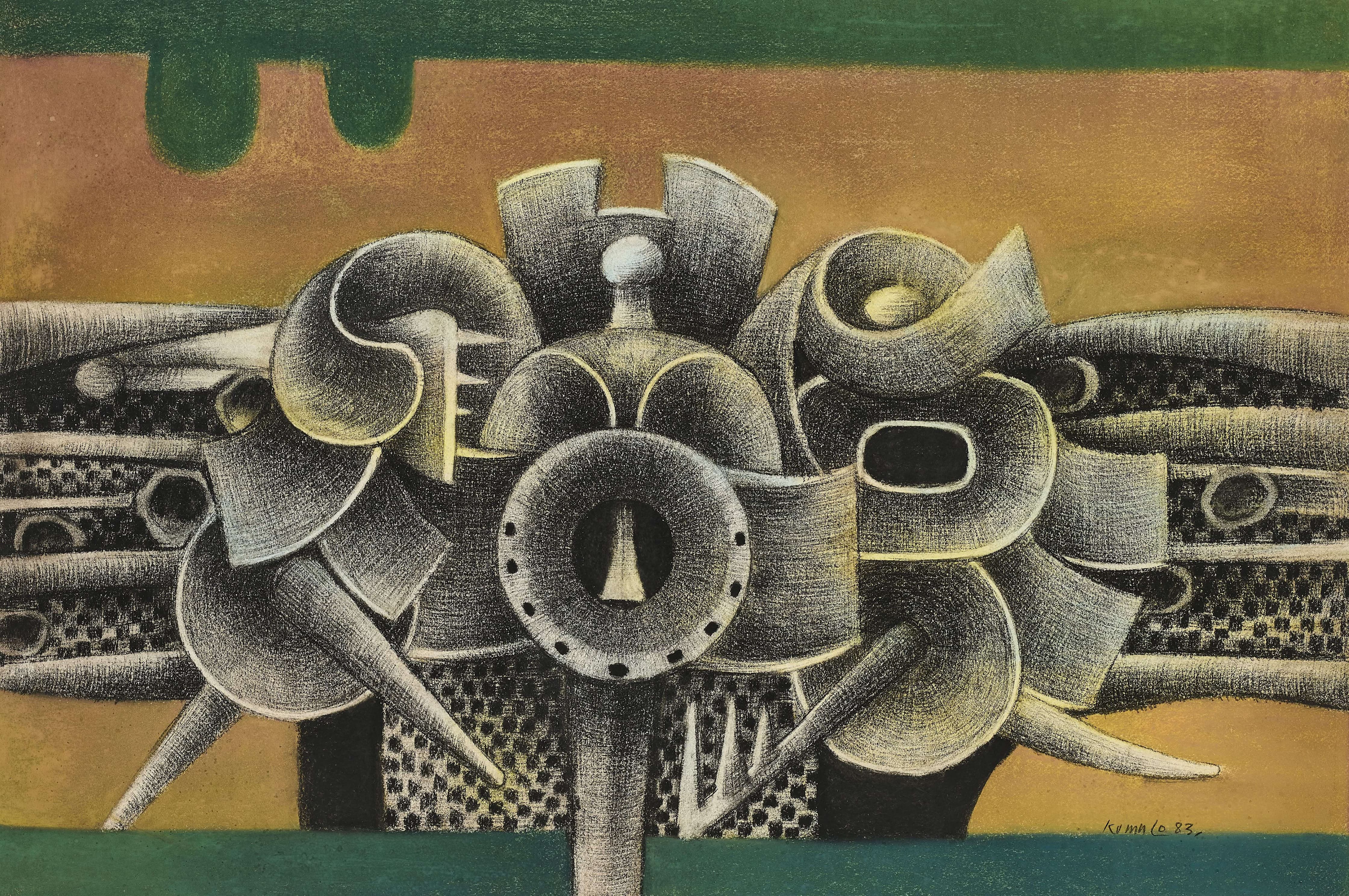
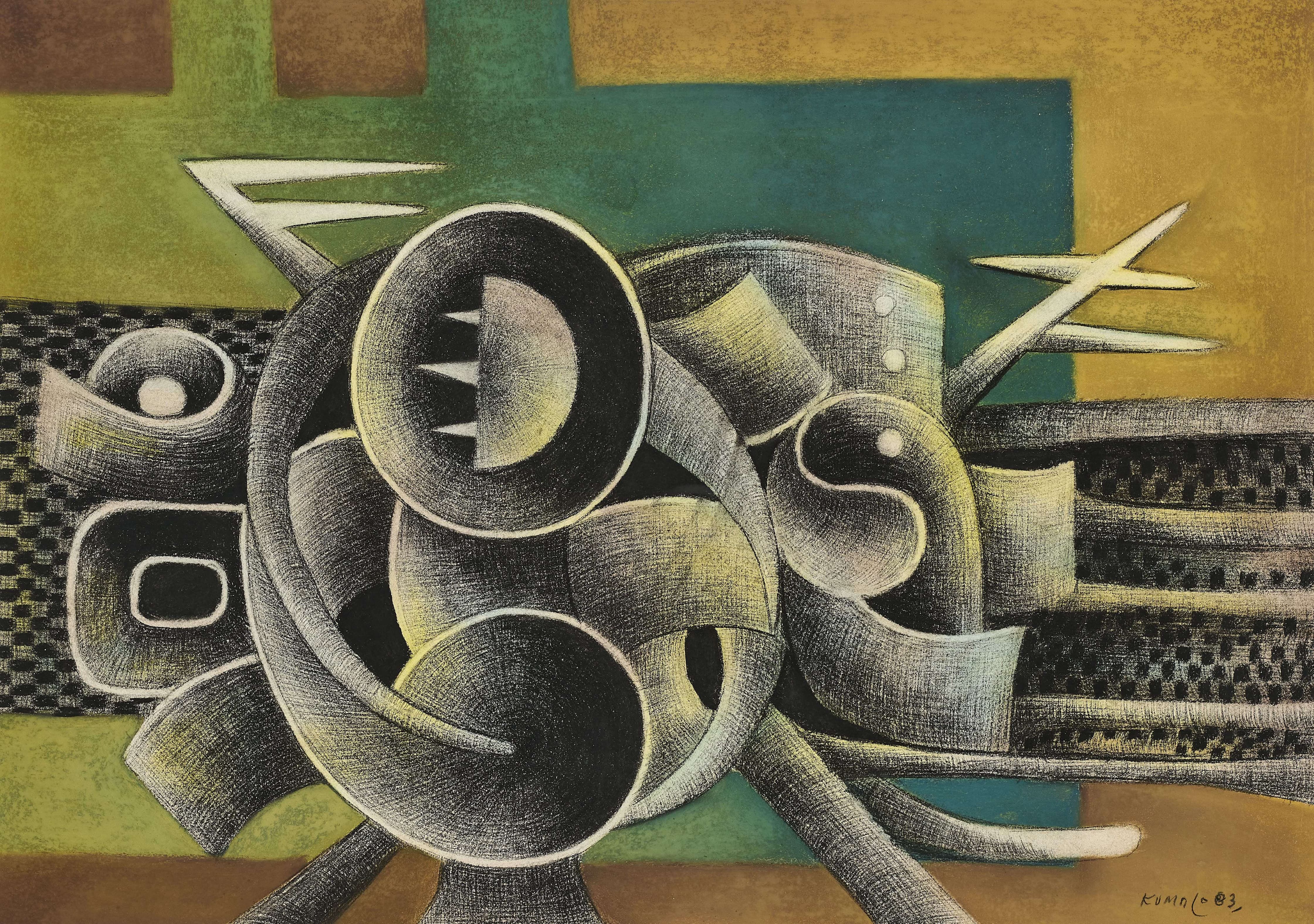
Sydney Kumalo (b. 1935, Johannesburg, South Africa - d. 1988, Johannesburg, South Africa) is one of South Africa’s renowned and respected artists. Kumalo studied at the Polly Street Art Centre where he later became a teacher. In the 1960s Kumalo was represented by German/South African gallerist Egon Guenther as part of the Amadlozi Group, along with Cecil Skotnes, Edoardo Villa and Ezrom Legae
Kumalo’s travels in the UK and USA fostered his interest in modernist sculptors. He acknowledged the influence but also invoked the style of South African and West African carved forms. His works revealed an increasing interest in abstraction in drawn and sculpted figurative works, with both animal and human subjects.
Kumalo exhibited at the Biennales of Venice (1965) and Sao Paulo (1968) and was a guest of the USSSALEP leadership exchange in New York in 1979. He visited and exhibited in Germany, at the Art Basel Fair and in a touring show in the USA with Goodman Gallery through the 1980’s. He died after a sudden brief illness in 1988, in Johannesburg.
The series Drawings for Wall Relief Sculpture is typical of Kumalo’s study drawings, templates for what he would turn into three dimensions by carving terracotta clay, terrazzo, or plaster, before the making of a mould and first bronze casting. Kumalo drew most days in his studio, often exploring for himself the possibilities of mural sculpture, or untried figures in the round, and exploring colour.
Once a sculpture was completed, (cast or carved) he often made a second study drawing of the work to examine how his concept had been achieved. Such drawings served as design proposals for unique mural sculptures in stone, clay or occasionally painted plaster, as well as bronze editions in three dimensions.
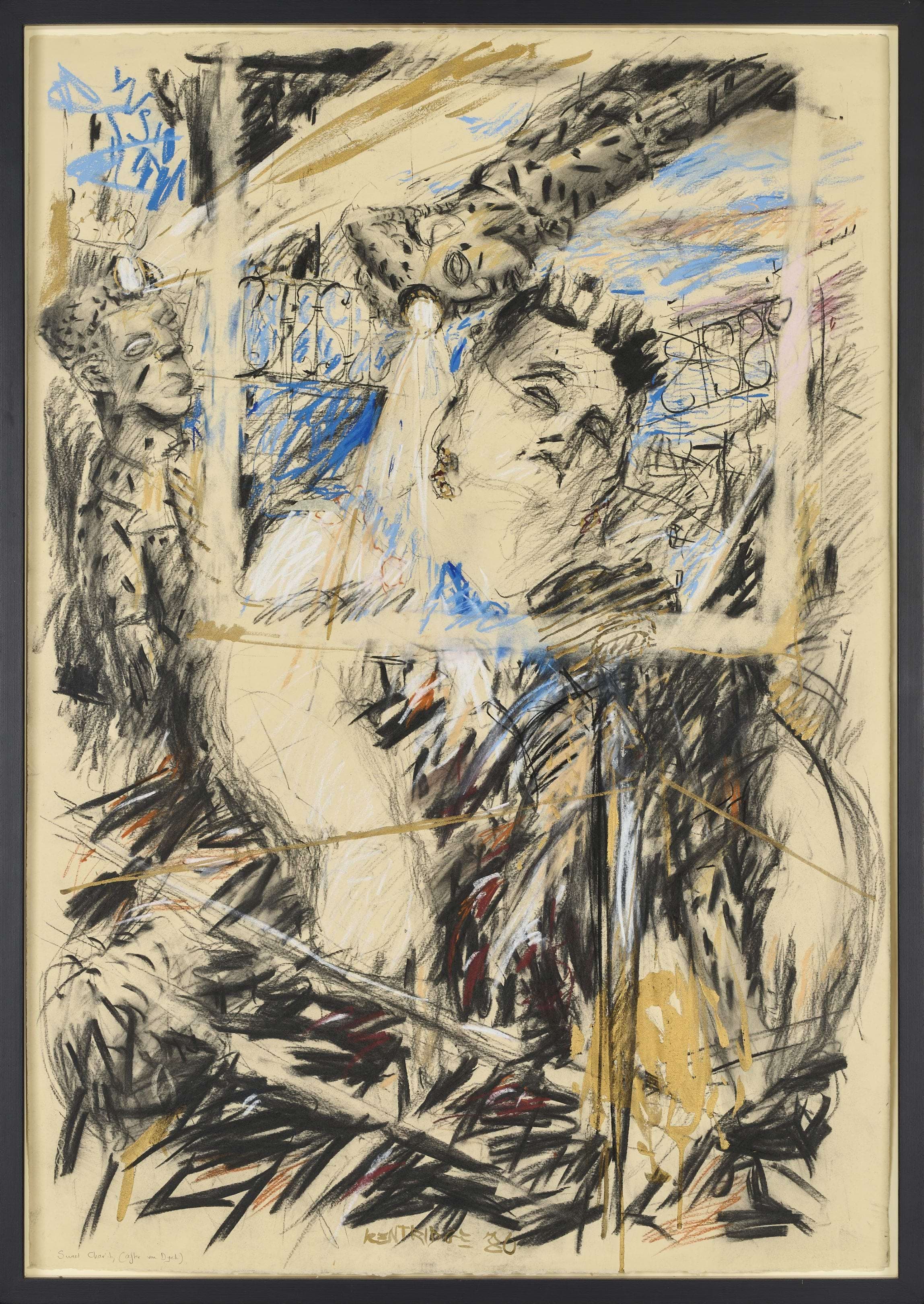
Sweet Charity was made 4 years after Kentridge’s sojourn in Paris studying mime. It was also included in a Kentridge survey exhibition which travelled in Japan, 2009 – 2010. 1986 was a year of dramatic upheaval in South Africa. This drawing has a theatrical style, combining a central female figure and what appear to be carved African figures. The woman in the centre of the work is seemingly asleep, perhaps not conscious. She is spot lit from above and blanketed by objects. She seems unaware of where she is and what is around her.
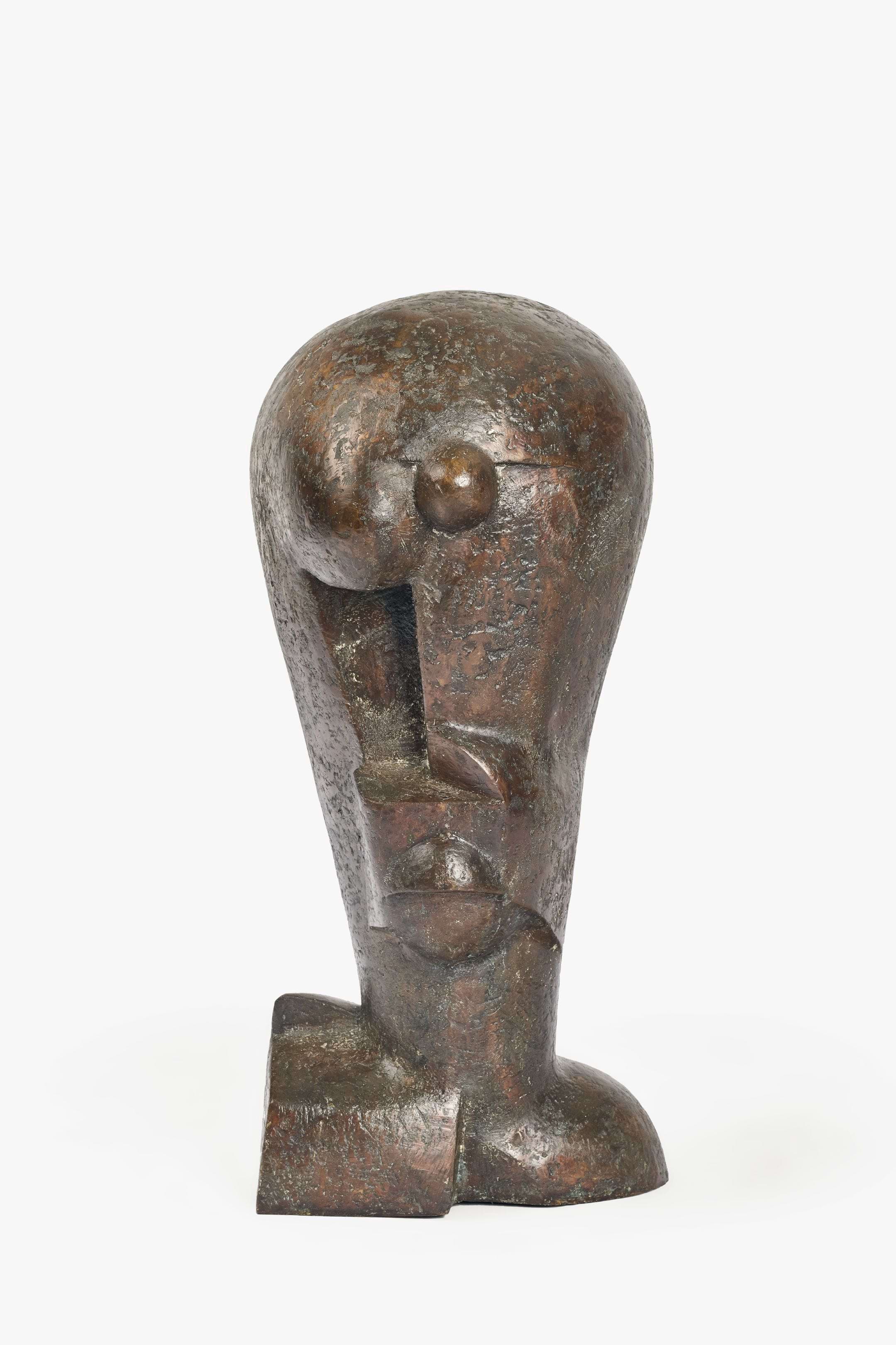
Edoardo Villa (b. Bergamo, 1915 - d. Johannesburg, 2020) produced one of the major bodies of sculpture in twentieth-century South Africa. Numbering over 1000 works, Villa’s muscular sculptures, which ranged from solid volumes in bronze to curved surfaces and elongated cylinders in steel, played a decisive role in modernising the language of South African sculpture. Throughout his career Villa produced a rigorous body of work noted for its diverse use of materials, forms and colours. Villa’s importance lies in his volumetric experiments and abstracted interpretations of the human form in bronze and constructed steel.
His work straddles a key moment in South African art history, coming after the accomplished if conservative figurative work of Anton van Wouw and directly influencing the syncretic modernism of Sydney Kumalo and Ezrom Legae, both mentored by Villa. His involvement with dealer Egon Guenther’s Amadlozi Group of artists – he was a founding member with Kumalo, Giuseppe Cattaneo, Cecily Sash and Cecil Skotnes – positioned him as both a creative innovator and political progressive. Villa’s output as a sculptor is also as singular and enigmatic as that of Jackson Hlungwani.
Trained at the Scuola D’Arte Andrea Fontoni, a conservative Bergamo art school named after an Italian sculptor and woodcarver of the late-Baroque period, Villa’s conscription into the Italian military and later capture in Egypt radically changed his life path. Sent to South Africa, where he was imprisoned in Zonderwater, an internment camp east of Pretoria, Villa decided to stay in the country and work as an artist after his release in 1947. That same year he held his first exhibition in the Johannesburg Library.
This particular form was realised in bronze as a unique work, commissioned by a European financier who had a home in Johannesburg for much of the 1970’s and 80’s. The bronze and a sepia drawing after the female figure was cast, returned to Europe with the collector in 1985.
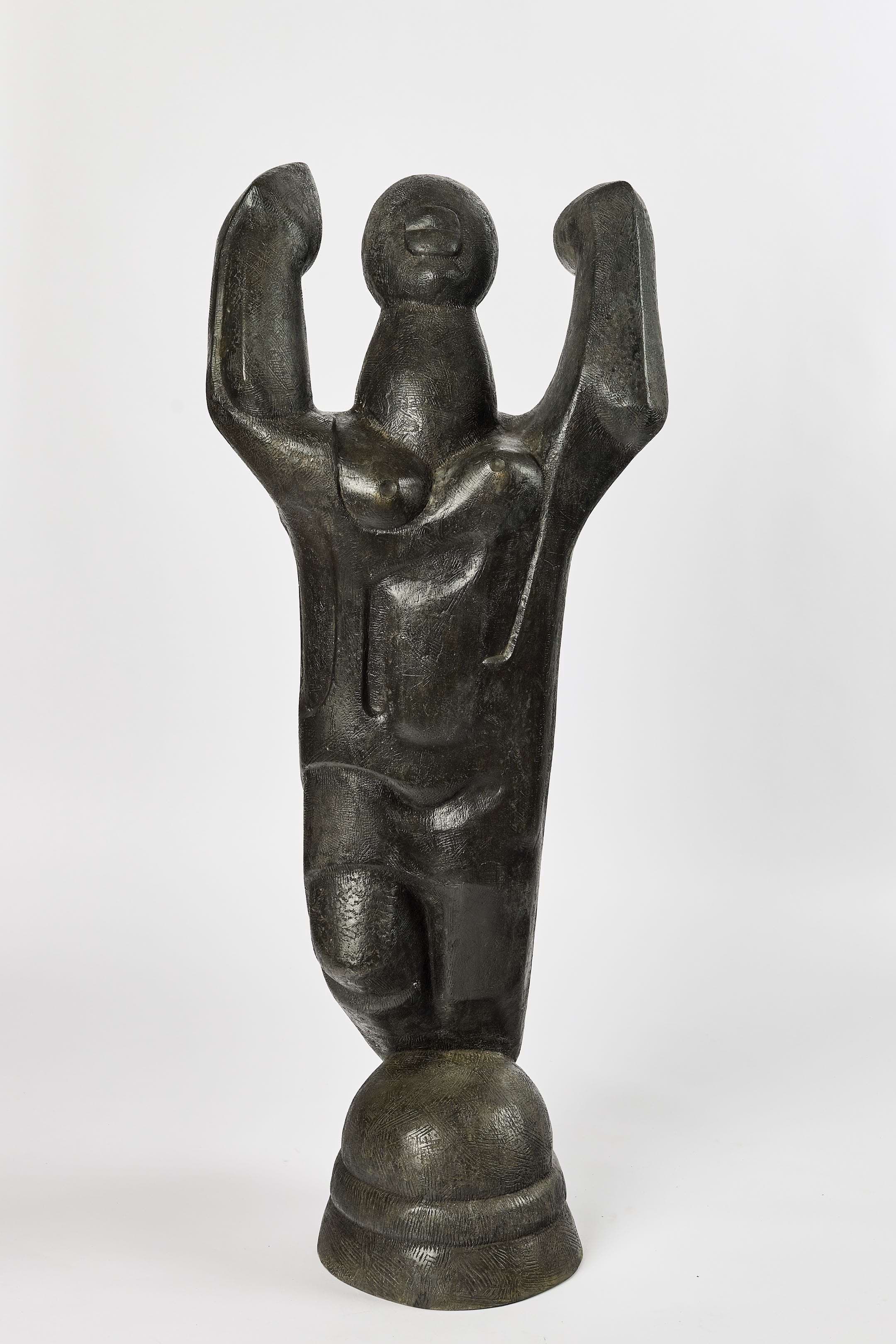
The bronze Anguished Angel is a classic example of the great sculptor’s work. Its stance and standing support both reference the bible story of angels on the head of a pin. Its wings are diminished and folded while its arms are thrown up, but this is an anguished protest, not defeat and surrender and is one of a group of sculptures which echo this call to God to free his people and liberate South Africa.
The bronze was cast in the Vignali Foundry in Pretoria North in 1973, exhibited at Goodman Gallery that year and sold from the exhibition to a private collector, it’s only prior owner. Anguished Angel has not been publicly exhibited since 1973.
cast 29 July 1973; one owner only, exhibited on Kumalo solo show at Goodman Gallery Hyde Square, in 1973, & sold September that year. Edition incomplete
Signed, dated 1994-95, and inscribed with the title, medium, and “Begun Tues July 5 ‘94” verso
NOT FOR SALE
Verso bears Gainsborough Gallery label
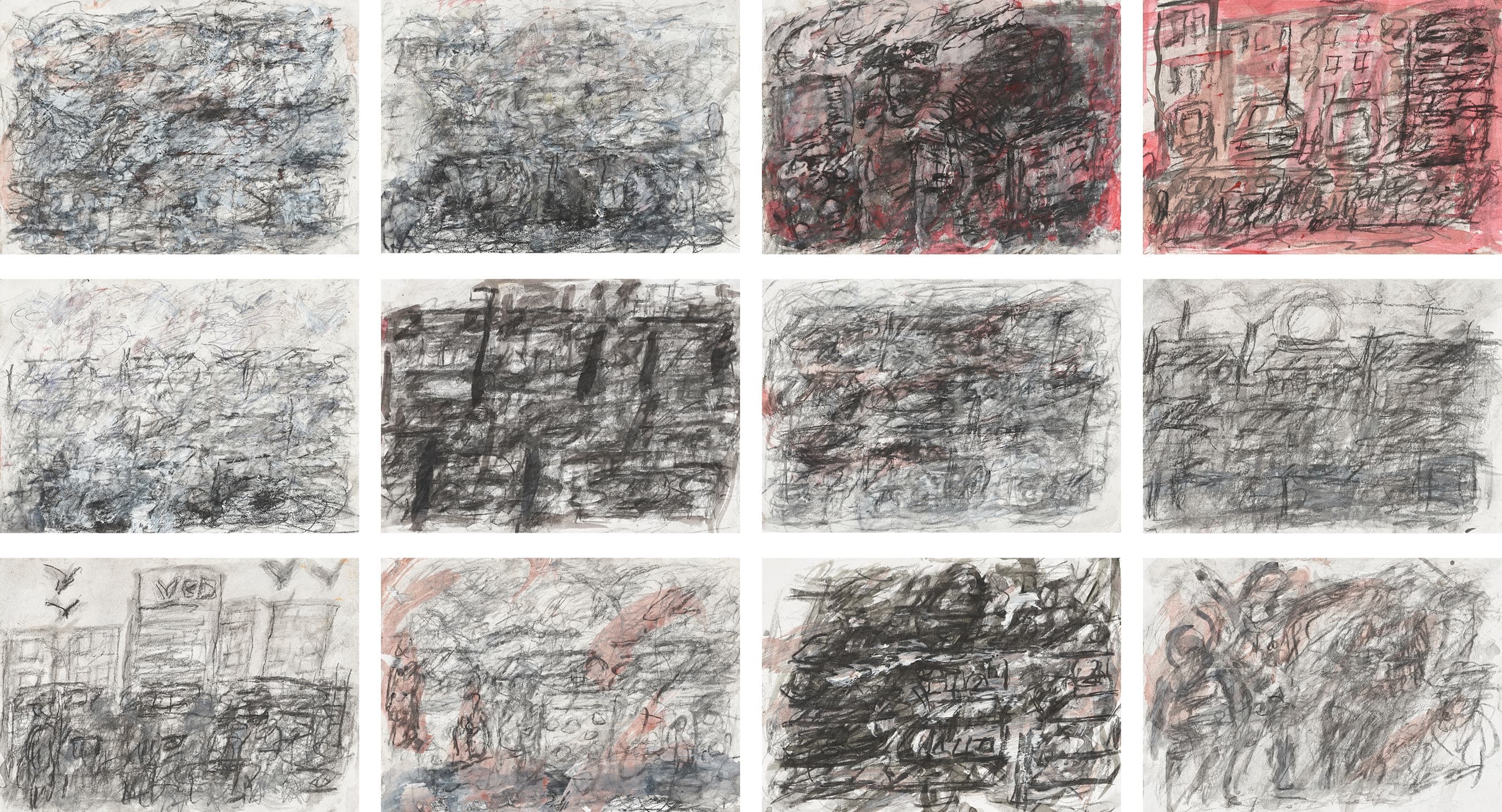
Koloane’s cityscape drawings depict the spatial dynamics, disorder and layered history of Johannesburg. The work also reflects the psychological evocations present in city living. In
‘Drawing Table 2 (Cityscapes Notebooks)’ we see his continued exploration of the bustle and tensions of inner city life. These works offer gestural pen and pencil markings that reflect crowded, hazy streets as well as towering buildings choked by smog.