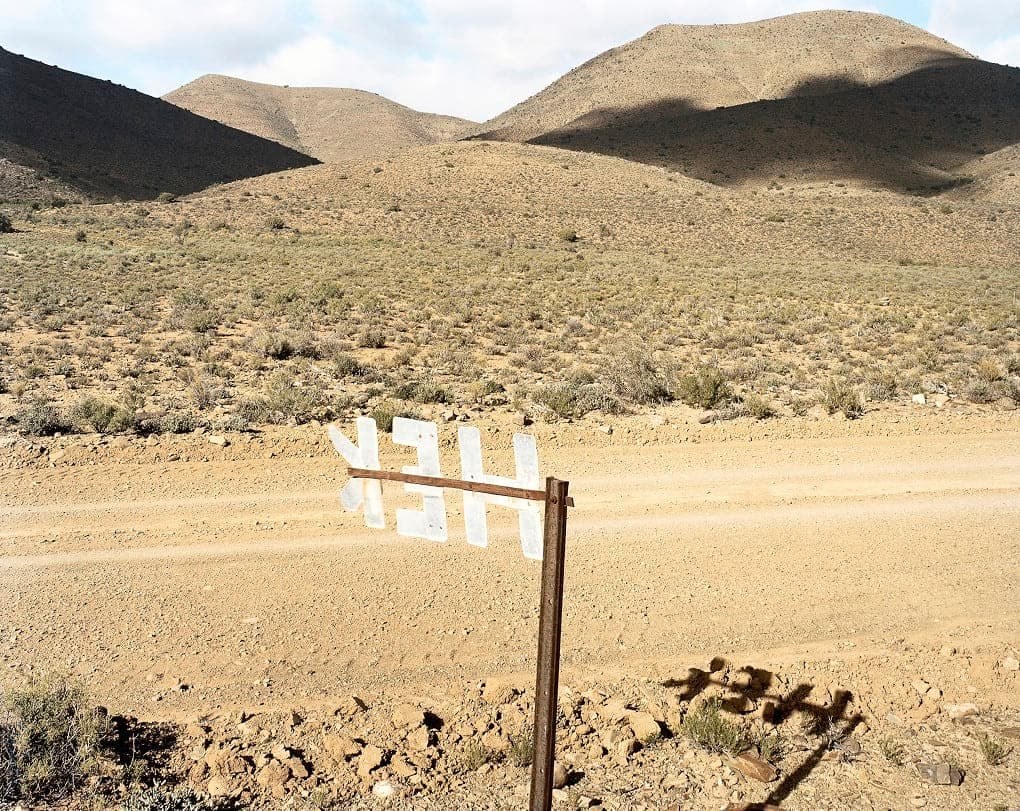
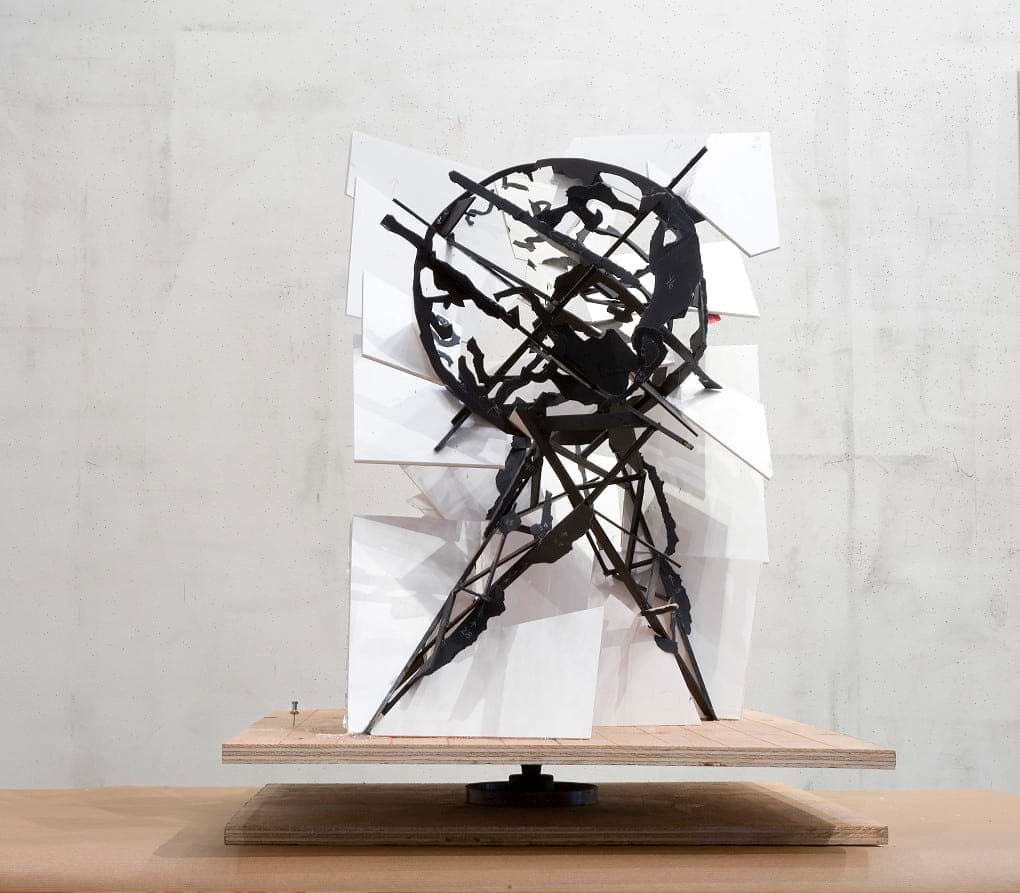
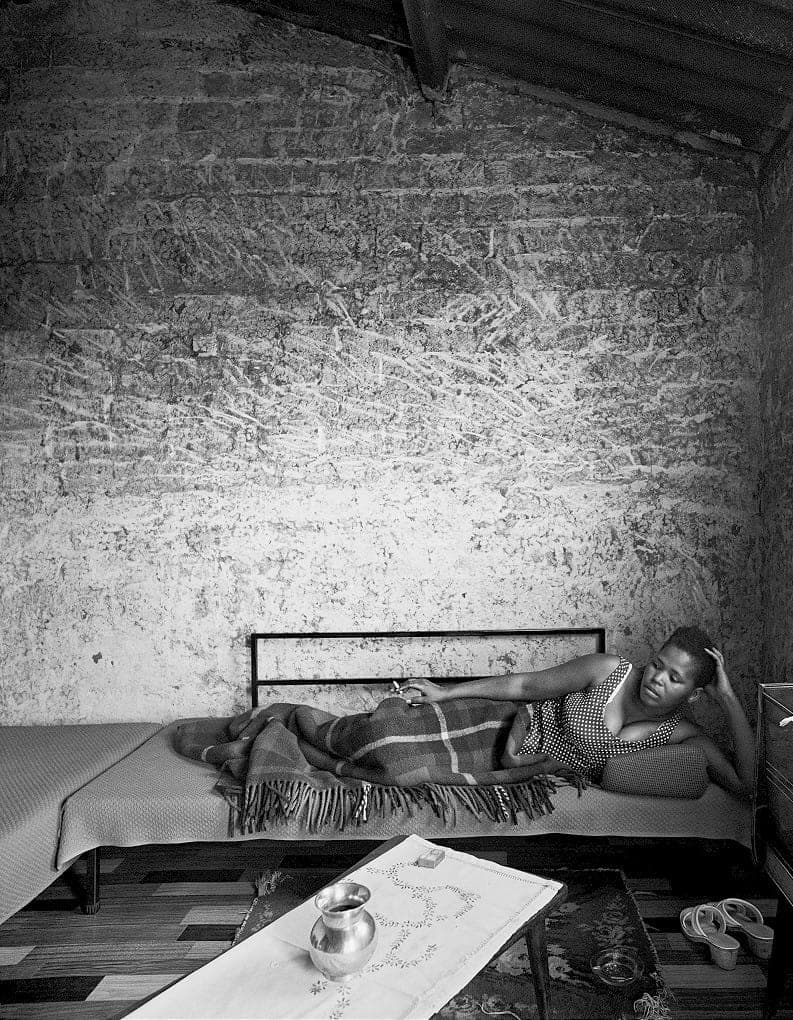
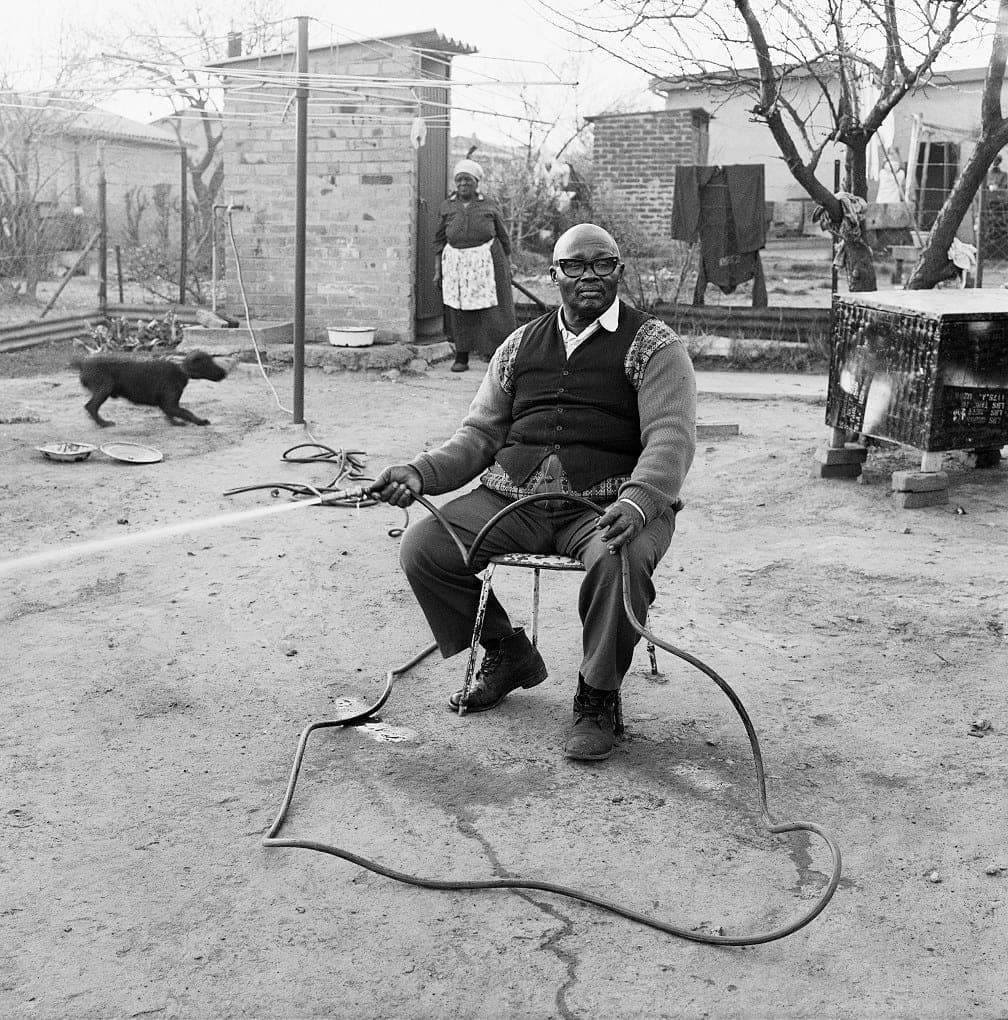
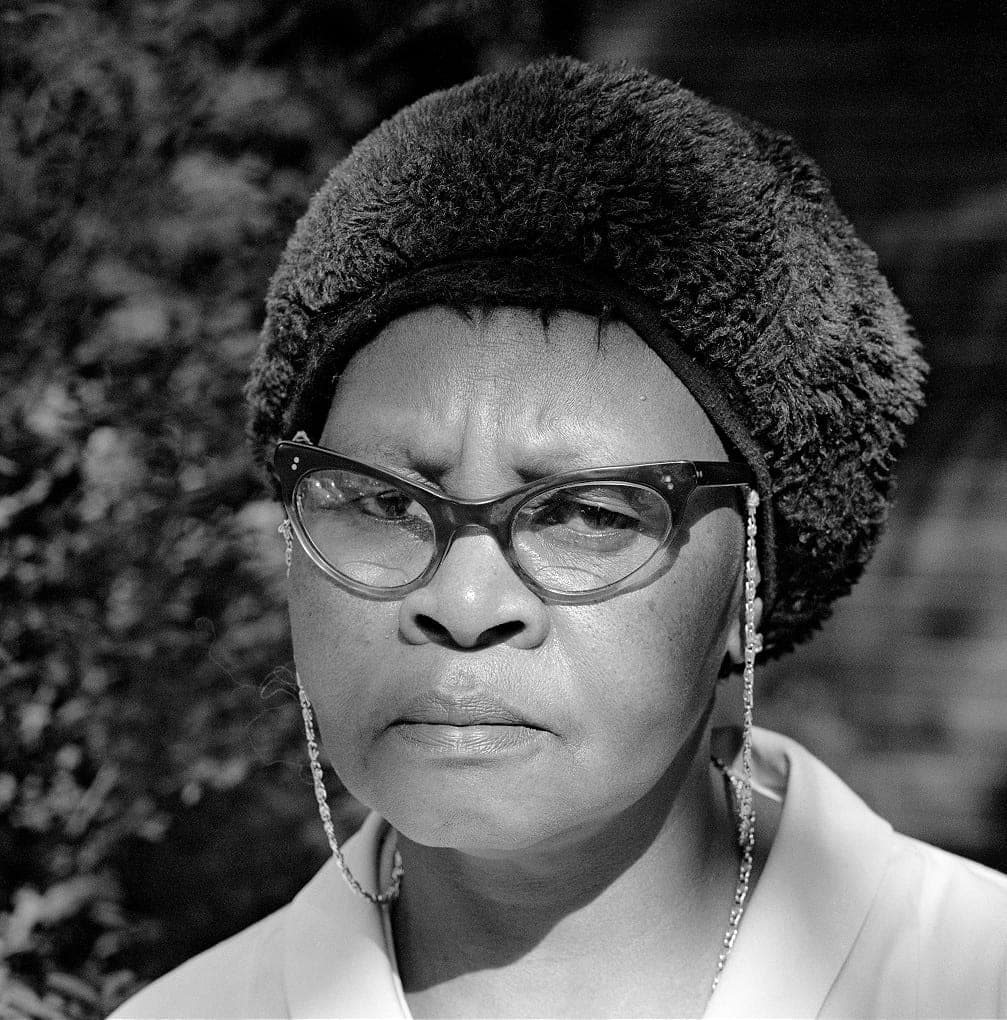
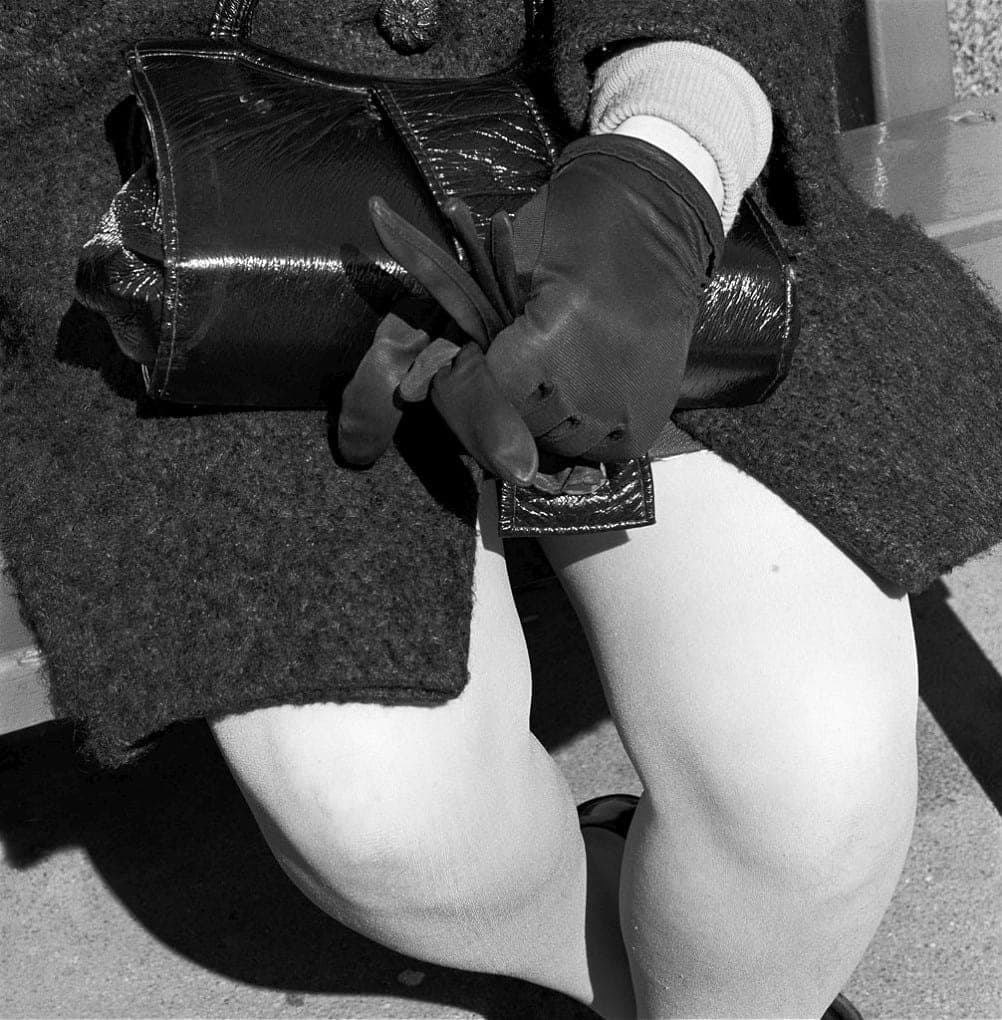
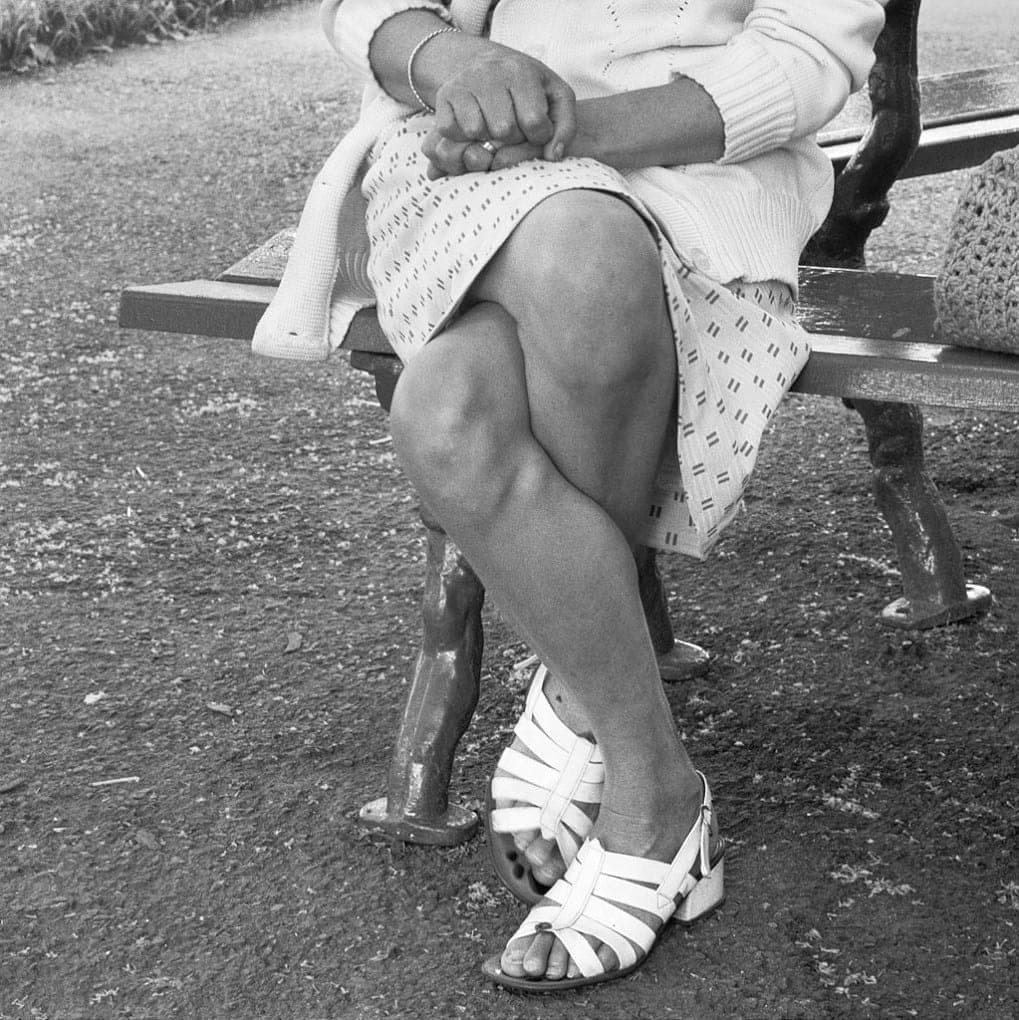
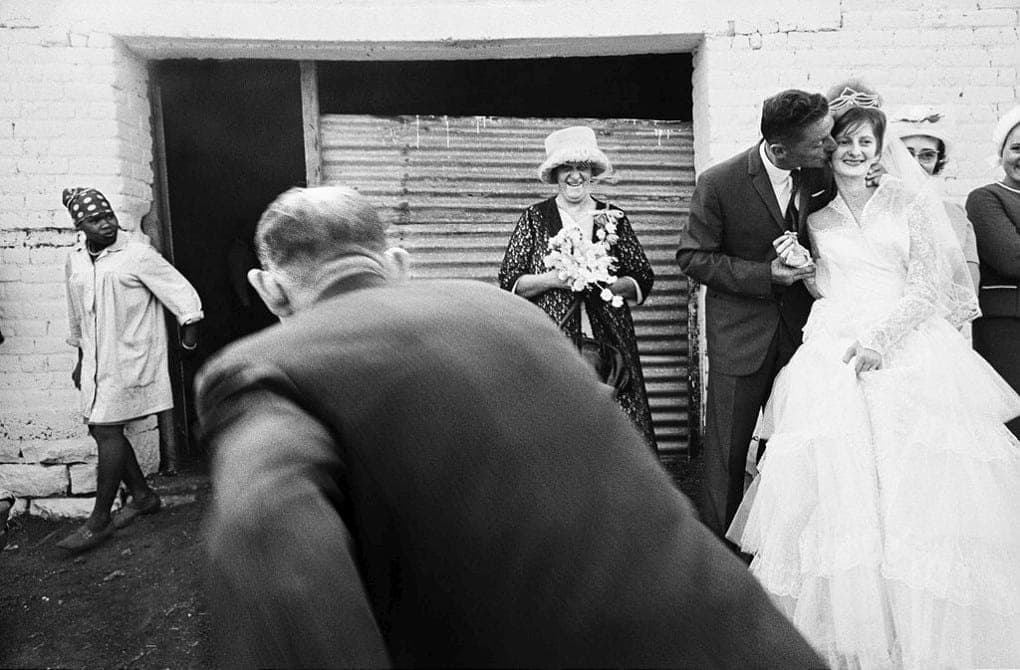
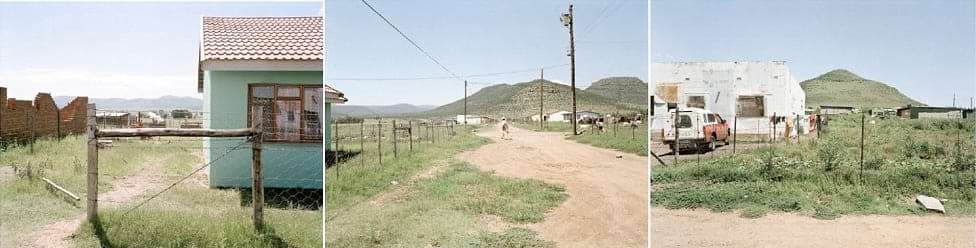
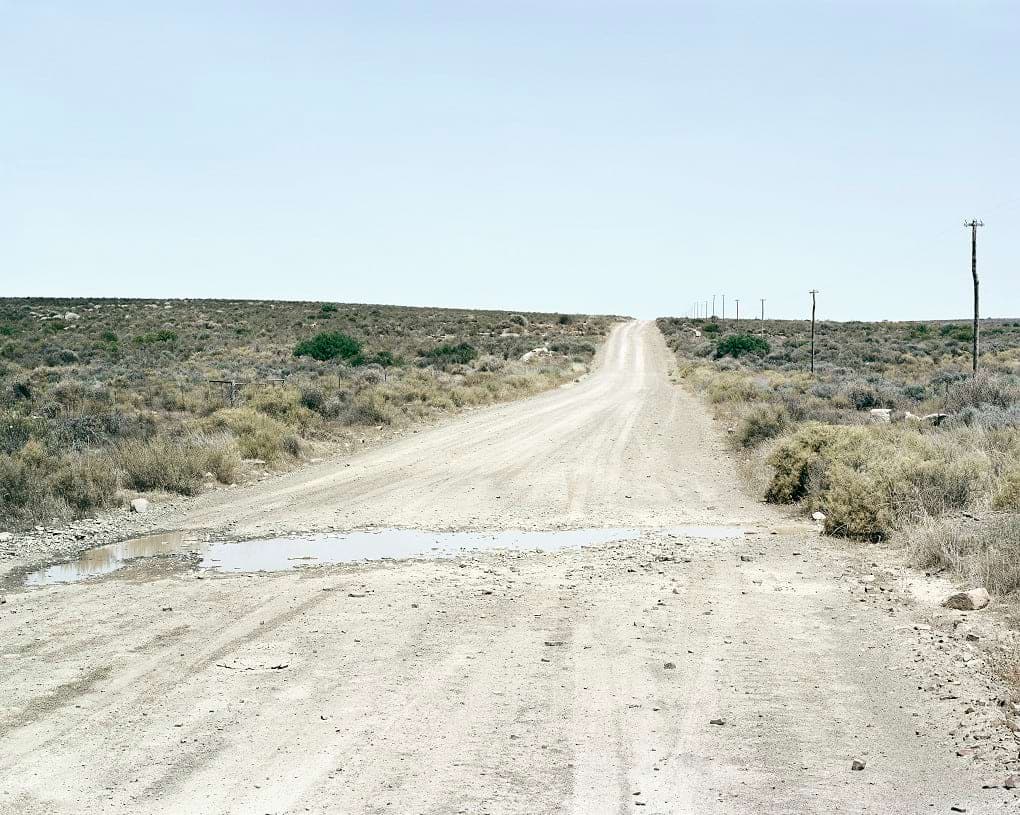
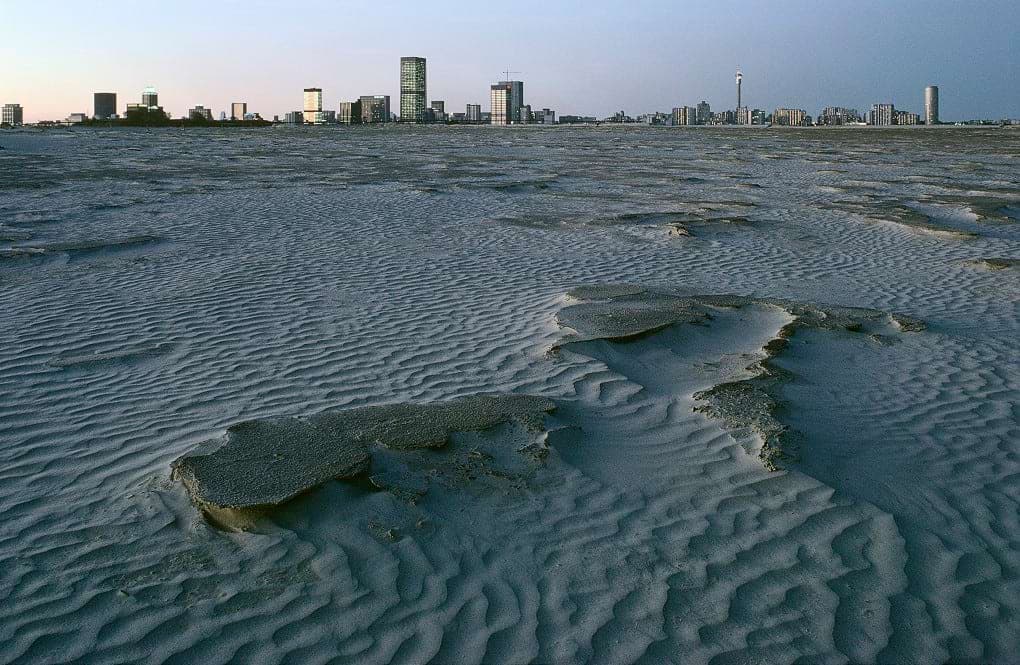
David Goldblatt’s ‘Intersections’ is a major body of colour work produced between 2001 and 2011, marking a notable departure from the black-and-white photography that defined his earlier career. Motivated by the shifting political landscape of post-apartheid South Africa and new possibilities in digital printing, Goldblatt turned to colour to more fully capture the layered and often contradictory realities of the period. The series spans vast landscapes, urban and rural settings, monuments and subtle traces of human presence – subjects united by Goldblatt’s enduring concern with how political and moral values are inscribed in the physical world.
Five themes underpin the ‘Intersections’ series: the elusive presence of “fuck all” landscapes, the visual and symbolic function of fences and boundaries, the persistent histories of possession and dispossession, the quiet aftermath of mortality and memory in the era of HIV/AIDS, and an expanded awareness of photographic perspective. Travelling the country in a campervan, Goldblatt photographed open and often featureless terrain, scenes where human presence was marked not by people but by poles, fences or signage. In so doing, he captured the enduring effects of colonial and apartheid spatial planning, especially regarding land use and ownership. Increasingly, he acknowledged his own position in the act of seeing, presenting multiple viewpoints and inviting reflection on the role of the photographer. Together, these works form a nuanced and expansive visual inquiry into South Africa’s evolving landscapes of power, memory and meaning.
Goldblatt spent years taking photographs of Johannesburg – of the white areas of the city centre, the comfortable suburbs and the townships on the outskirts of the city.
Goldblatt was engaged in the conditions of society and the values by which people lived, rather than the climactic outcomes of those conditions. He intended to discover and probe these values through the medium of photography.
“Johannesburg is not an easy city to love. From its beginnings as a mining camp in 1886, whites did not want brown and black people living among or near them and over the years pushed them further and further from the city and its white suburbs. Like the city itself my thoughts and feelings about Joburg are fragmented. I can’t easily bring a vision or a coherent bundle of ideas to mind and say, ‘That’s Joburg for me.’ Over the years I have photographed a wide range of subjects, each was almost self-contained, a fragment of a whole that I’ve never quite grasped.”
— David Goldblatt, 2017
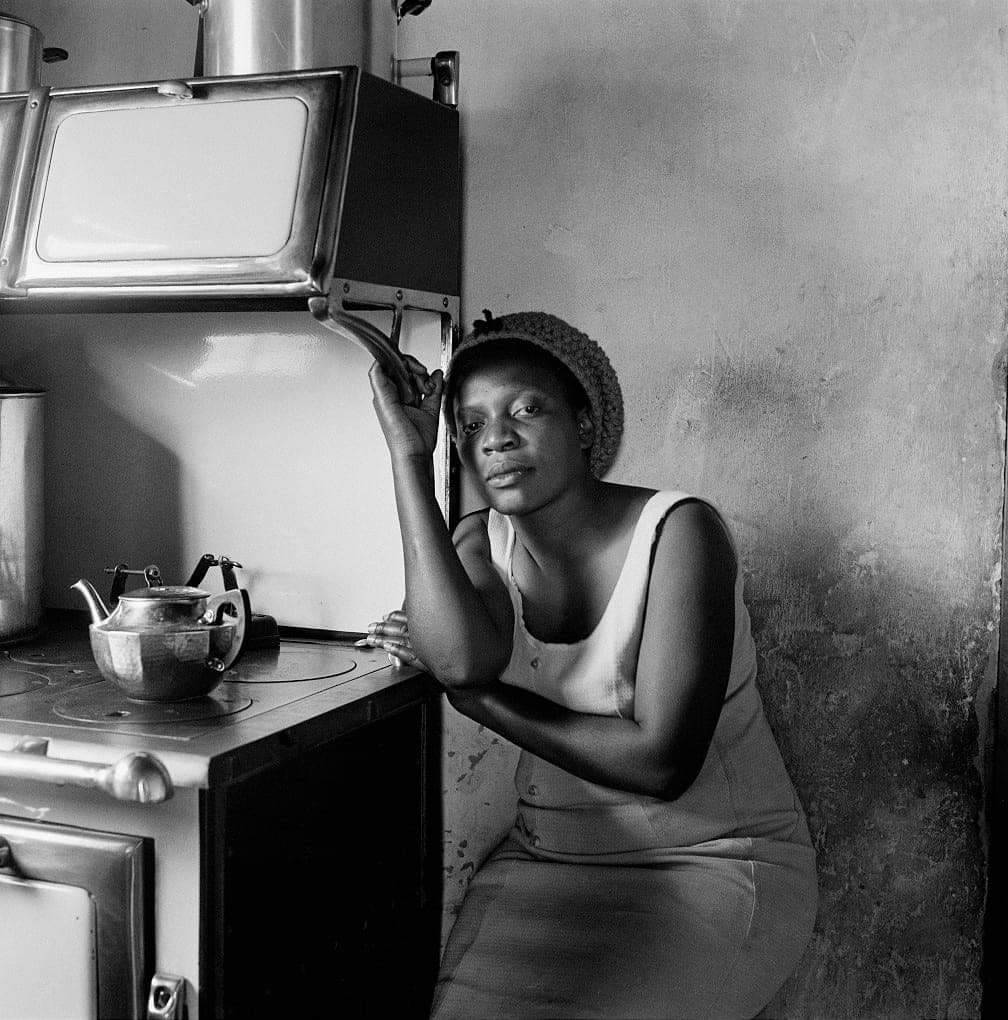
Goldblatt spent years taking photographs of Johannesburg – of the white areas of the city centre, the comfortable suburbs and the townships on the outskirts of the city. "With a camera, I was for the first time able to expand my experience of other people’s lives. Making portraits of people in Soweto in 1972 was a significant moment for me fundamentally," said Goldblatt of his 1972 photographic essay.
Goldblatt was engaged in the conditions of society and the values by which people lived, rather than the climactic outcomes of those conditions. He intended to discover and probe these values through the medium of photography.
Video
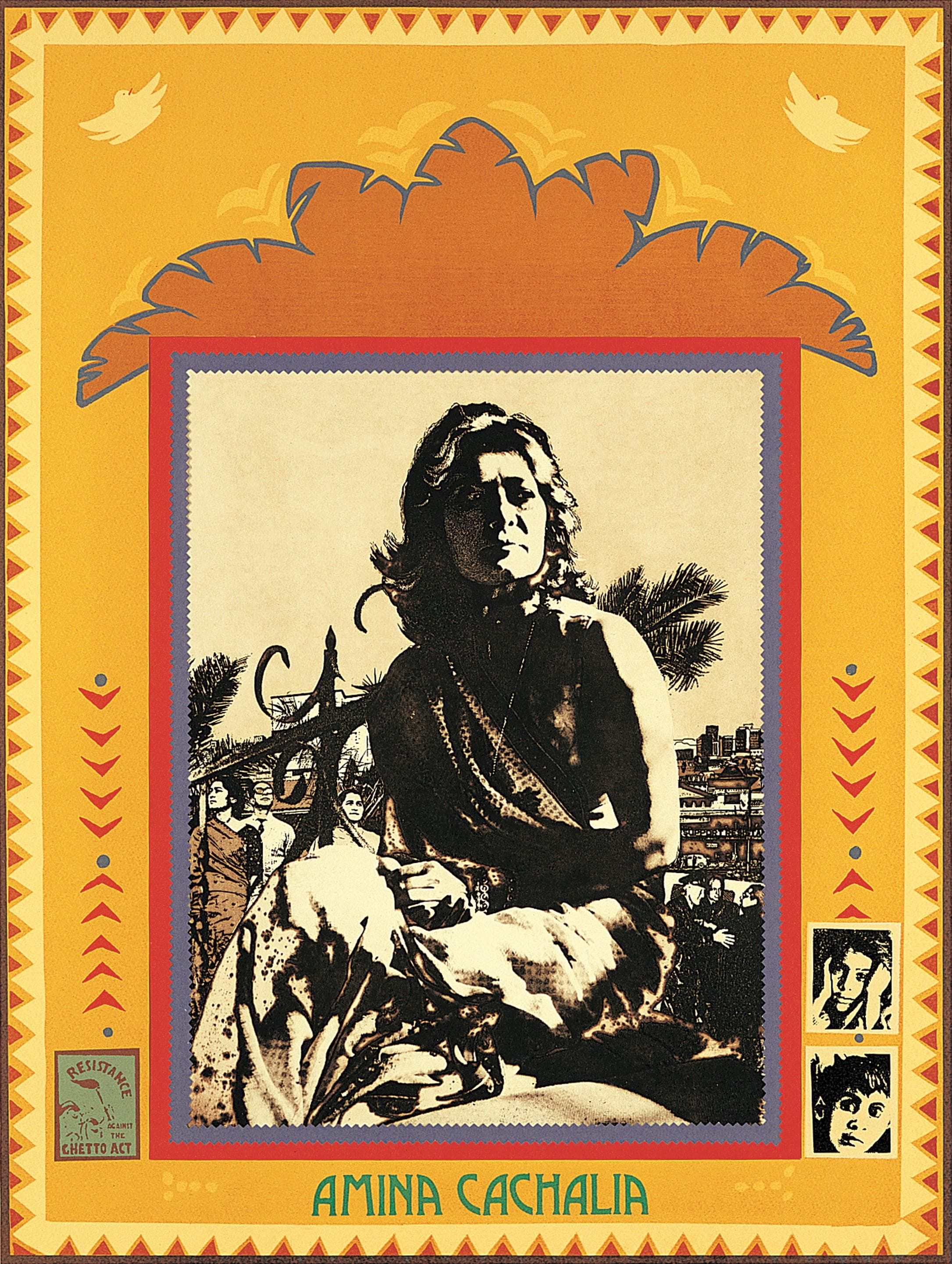
In 1982, Sue Williamson spent much of her time in Crossroads, an informal Cape Town community marked for destruction by the apartheid state. She was working with residents on strategies to oppose the demolitions. It was there that she first encountered the image of Elizabeth Paul – a Xhosa faith healer whose faded photo adorned the walls in many homes. This repetition marked Elizabeth as an important figure in the community, a person to be honoured and remembered.
Williamson began a series of photo-etched portraits with screen-printed frames, with the first in the series, a portrait of Elizabeth Paul. Each was a tribute to a woman who inspired others through her leadership, often in the struggle for liberation: Helen Joseph, Winnie Mandela, Annie Silinga, Mamphela Ramphele. Their names are familiar today, but in the 1980s they were largely invisible. Williamson’s work sought to give them visibility, and to honour them.
Her influences were many. Renaissance portraiture offered structure; the inventive frames of Crossroads homes provided texture. But more than technique, it was the desire to make these women known that shaped the work. In mass- producing and distributing postcard versions of the portraits, Williamson made the series portable, ensuring that these stories could travel, unbound by gallery walls.
Amina Cachalia grew up in a politically aware family and was one of the leaders of the Federation of South African Women, a broad-based organisation which opposed apartheid. She was banned in 1963. Her husband, Yusuf, was under house arrest and her sister, Zainab, who lived next door, was also banned. After the first democratic election, in 1994, Amina accompanied Nelson Mandela on a visit to the widow of Hendrik Verwoerd, the architect of apartheid, in a classic action of reconciliation.
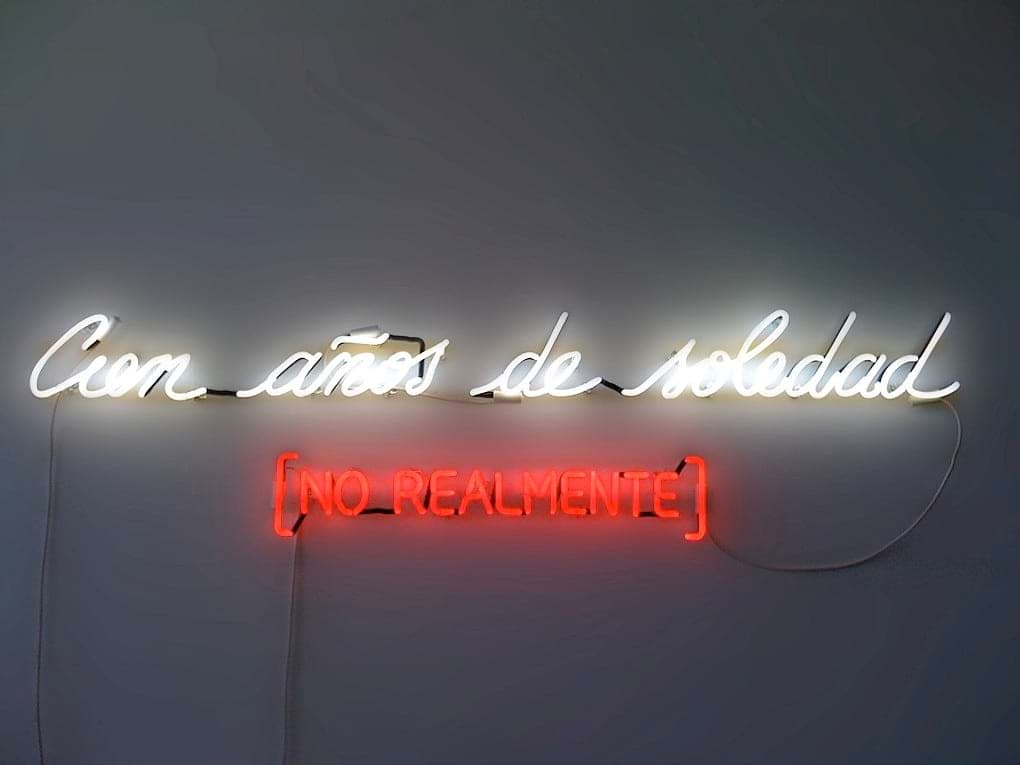
Neon - Edition of 3 + 3 AP's
The work takes its name from the best known novel by the Colombian writer Gabriel García Márquez. The story explores the inevitable repetition of history, something Jaar says he has witnessed too frequently around the world. The Nixon administration’s financing of the Chilean coup is one example of how the United States dominates world politics and continuously interferes in Latin American affairs. The work's main title is ironically completed by No realmente (“Not really”).
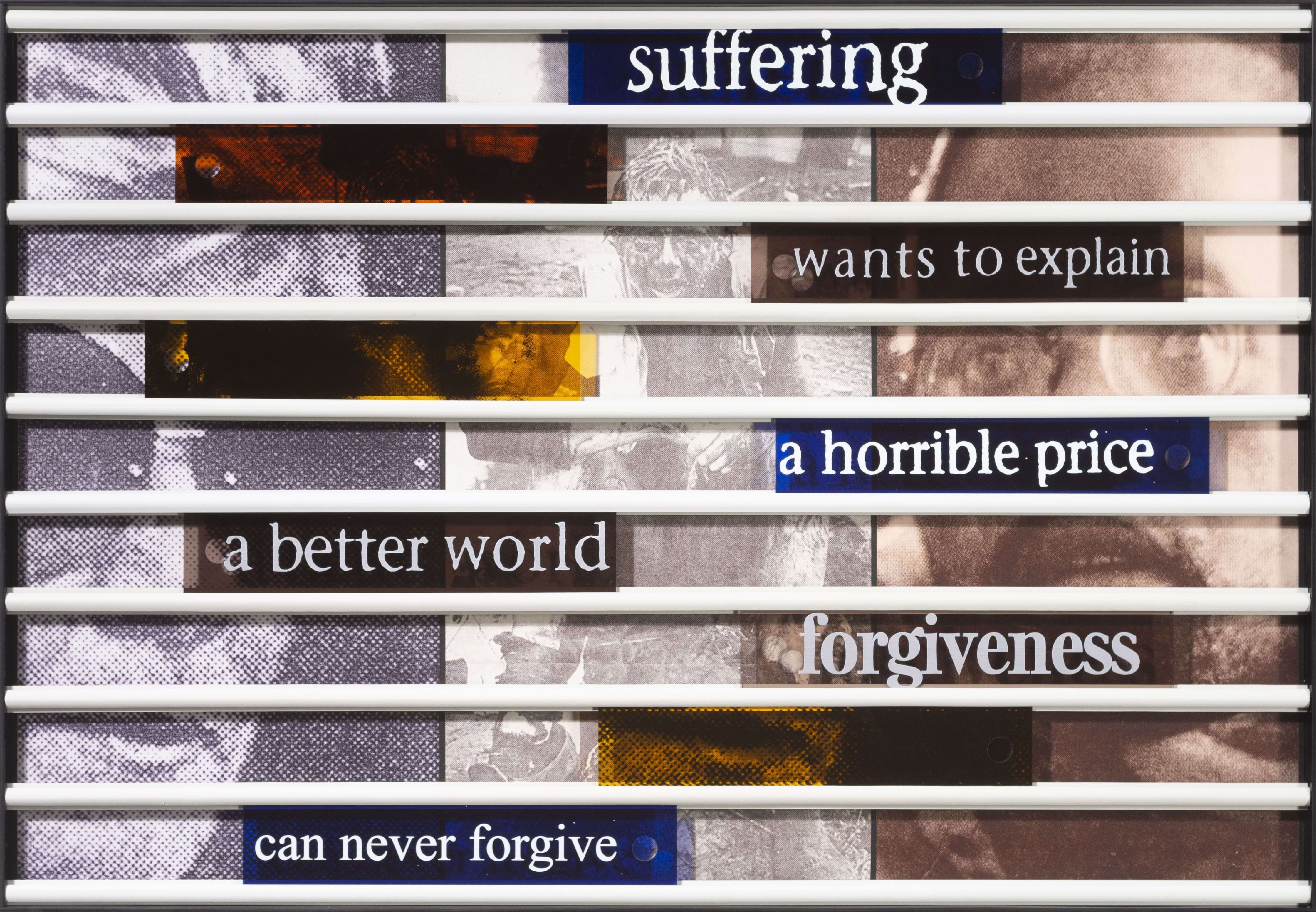
The ‘Truth Games’ series reflects on the role of South Africa’s Truth and Reconciliation Commission (TRC) in the country’s process of healing after apartheid. The Commission was set up in 1995 by President Mandela, who named Archbishop Demond Tutu as its chairman, and invited witnesses who were identified as victims of gross human rights violations to give statements. Hearings were held across the country. Perpetrators of violence could also give testimony and request amnesty from both civil and criminal prosecution, on the condition that they told the whole truth and had acted from political belief, whether on the right or the left.
Sue Williamson kept daily newspapers through the entire process of the hearings, cutting out images and texts relating to the hearings. Each piece in the ‘Truth Games’ series presents a triptych of images drawn from this file: on the left, the accuser, in the centre, an image of the event, on the right, the defender. On the sliding perspex slats which run horizontally across the work, are scraps of texts from the evidence of the accusers and the defenders, giving an epigrammatic summary of the proceedings. However, at no point are all three visible at once. Text drawn from TRC transcripts is printed on sliding slats that obscure parts of the images. Viewers are encouraged to move these slats, revealing or concealing portions of the work as they attempt to piece together a fuller picture, echoing the nation’s collective attempt to uncover the truth.
ANC leader Chris Hani was assassinated in his driveway in 1993. At the hearing, his widow, Limpho, says he was ‘gunned down’, that his killers had ‘shown no remorse’ and concludes the hearings ‘will not bring my husband back’. Right wing activist Gaye Derby Lewis admits that she ‘gave Hani’s address to his killer’, that Hani was ‘third on hitlist’ and that her group’s motive was a ‘plan to create chaos’. By mediating the flood of images and narratives that circulate in public discourse and mass media, Williamson aimed to offer a more focused, reflective space - a space in which to engage with difficult truths, and consider the layers of meaning that often remain hidden.
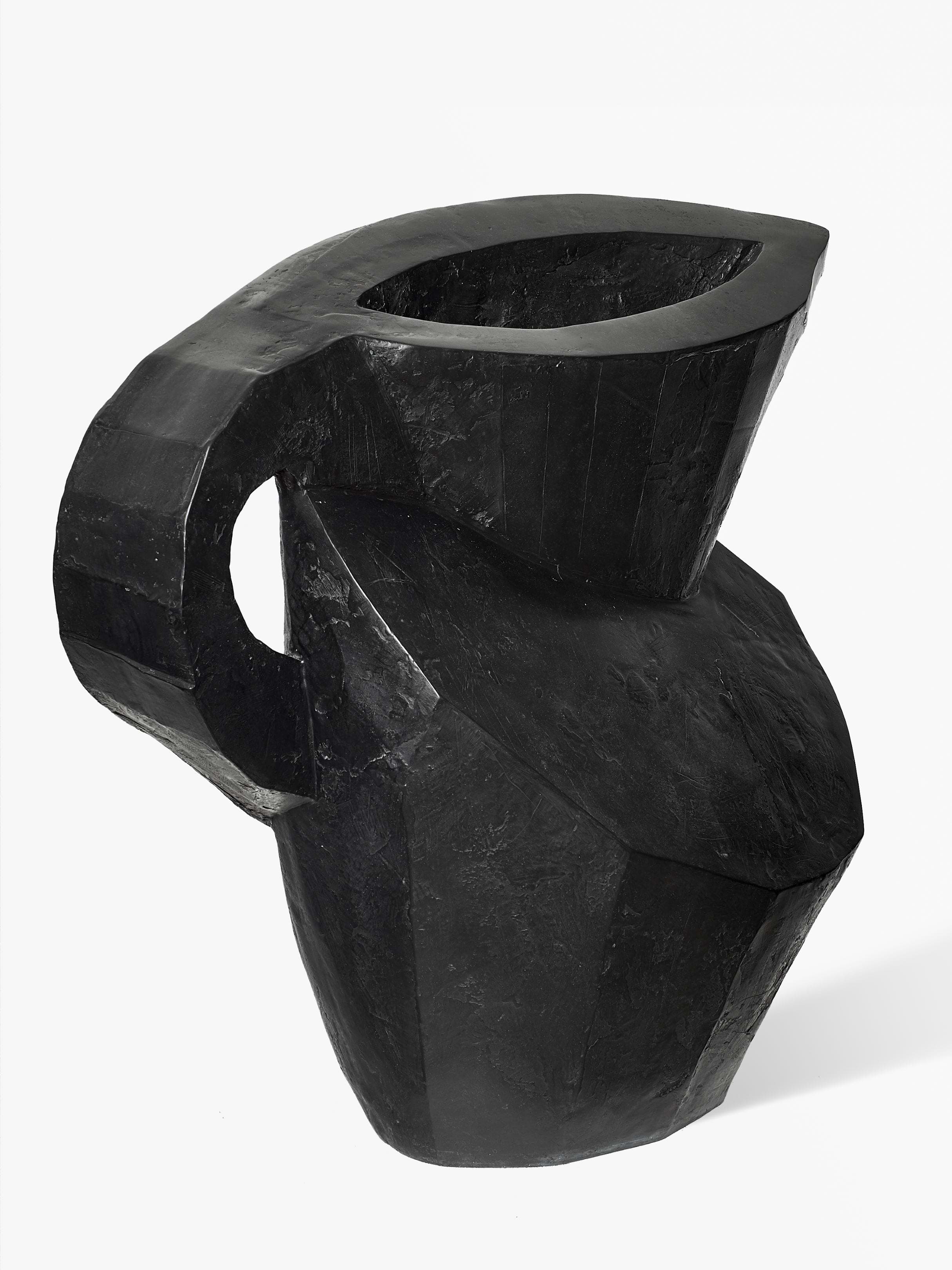
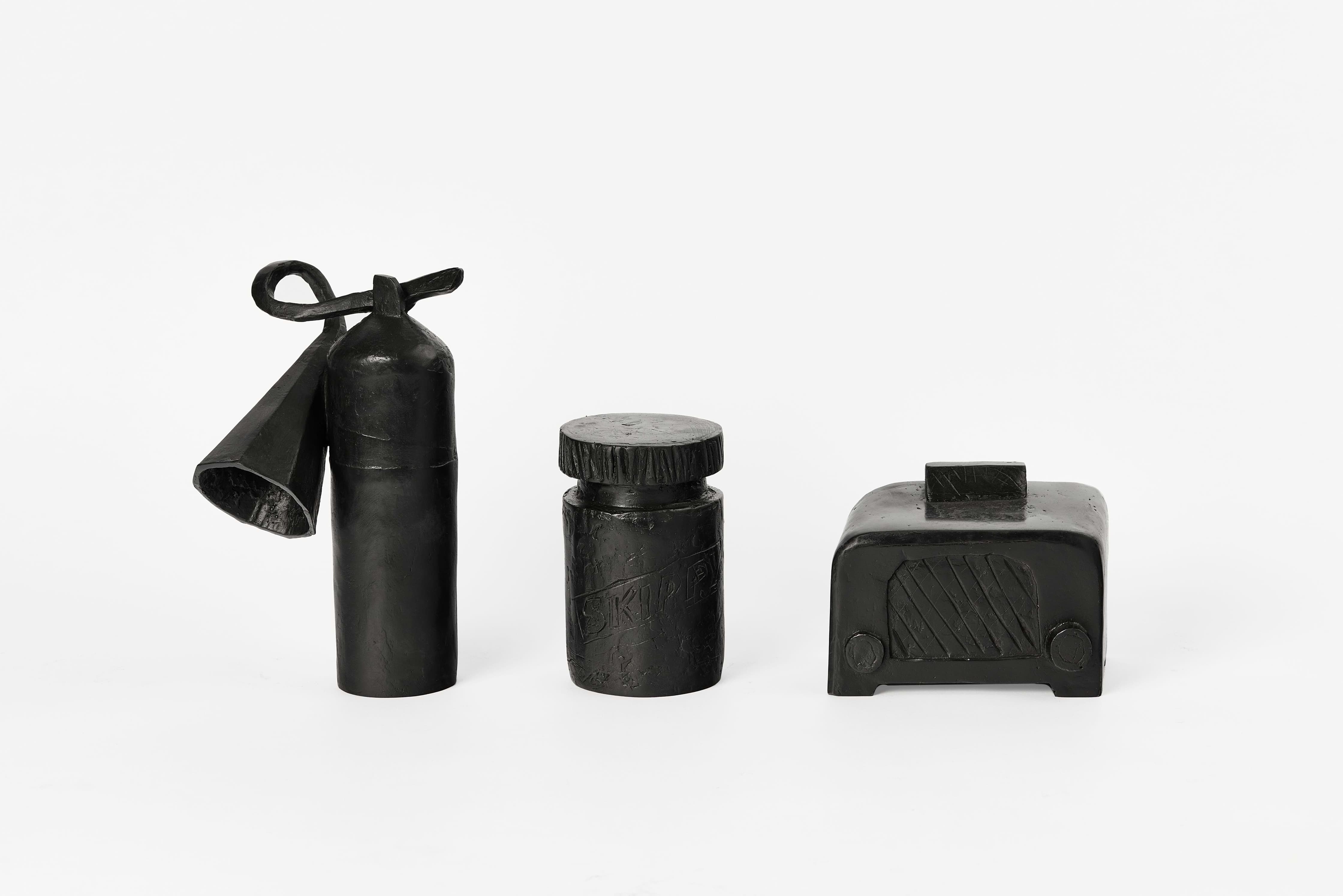
William Kentridge’s large and medium scale bronzes, from the Lexicon project, are an accumulation of elemental symbols within the artist’s larger practice. This sculptural vocabulary is comprised of icons, ubiquitous in Kentridge’s creations, which are dispersed throughout all of the media in which he works. As a series of bronze sculptures, each work functions as part of the artist’s visual dictionary and broader language.
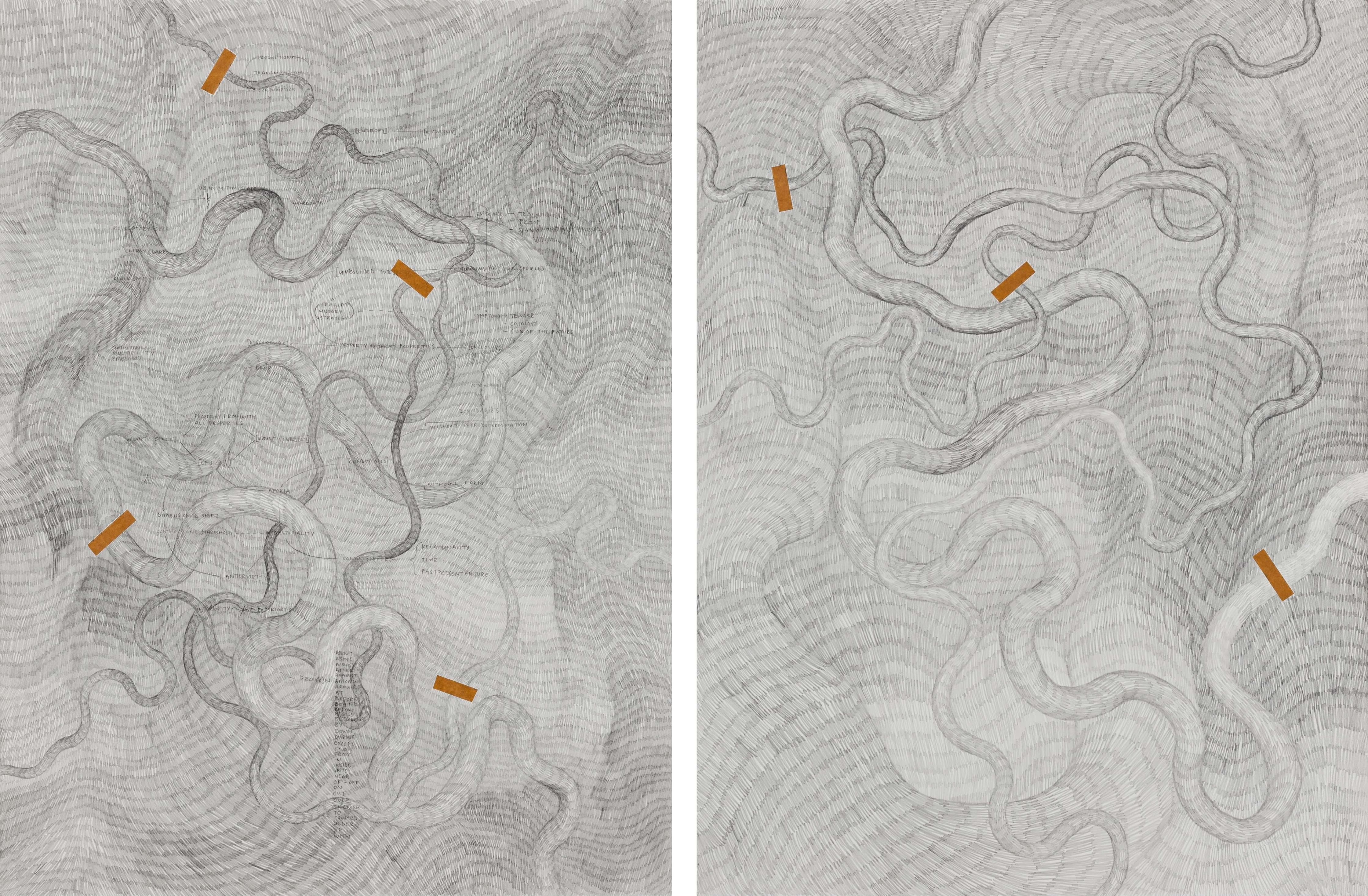
“prou(k)n is a false acronym for: Project For the Affirmation of the (K)new - a series of drawings echoing El LIssitzky’s Proun series of paintings.
The prou(k)n series is an effort to find a sketched language that registers the tension between the new, as a move toward the unknown, and the knew, as a move toward recovery of what was lost. In our ongoing project of post-colonial transformation and anti-colonial liberation we are looking for both the return of what we know was taken (dignity, memory, possibility) and simultaneously to transcend the boundaries of all that we know and all that is knowable. This is the double agency of decoloniality.
The prou(k)n series builds a soft language of ganglia and quantum entanglements for thinking with our collective nervous body. These drawings form a gestural vocabulary for an other-worldly protest drawn over analytic diagrams of the post-colonial condition. prou(k)n drawings are knotted signals in the noise of a collective dream (sometimes nightmare) of another world.” - Nolan Oswald Dennis
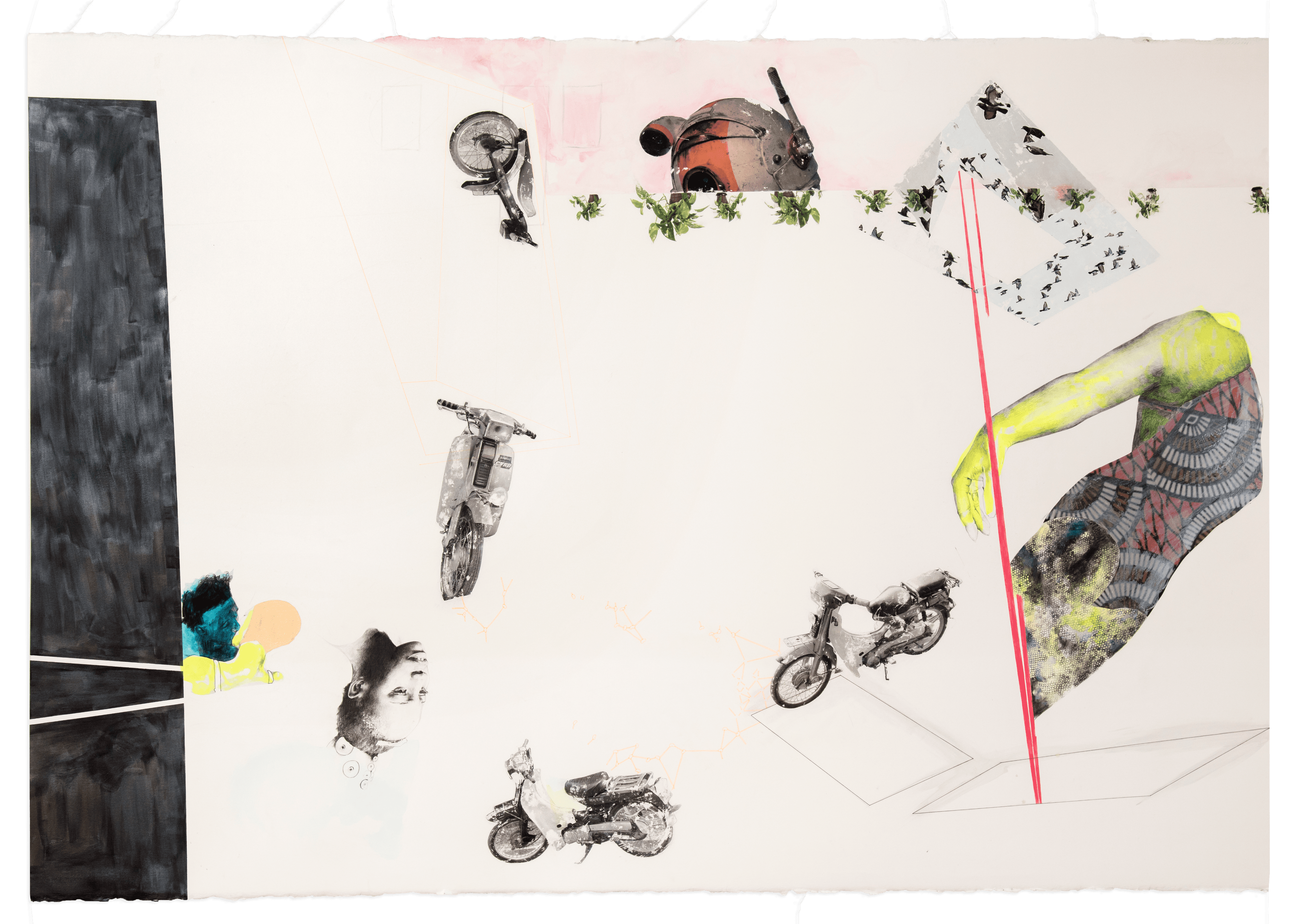
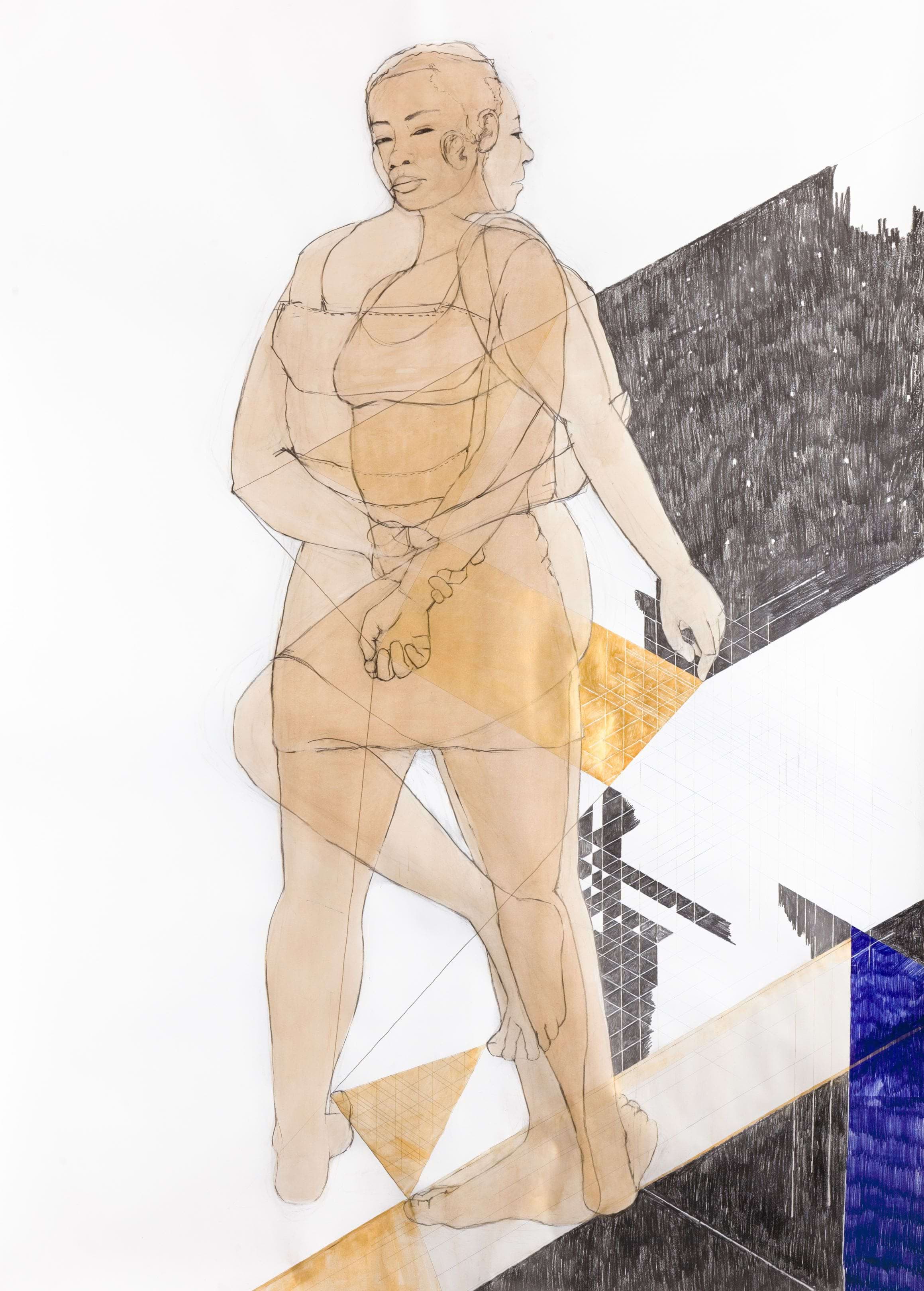
you looked for a beginning but there was none, is a mixed-media drawing coalescing imaginary places, constructed spaces and a unique cast of characters that float, dance, stretch and interact with each other. Through this work, amanze establishes a contemplative dialogue in a quest to materialize her explorations of displacement, dislocation and belonging. By cutting, dicing, sampling, rearranging and mashing together, amanze composes images that articulate free play as an act of revolution. In this work, lines cut through space and multiple sheets of paper are transferred and layered to form complex spatial configurations.
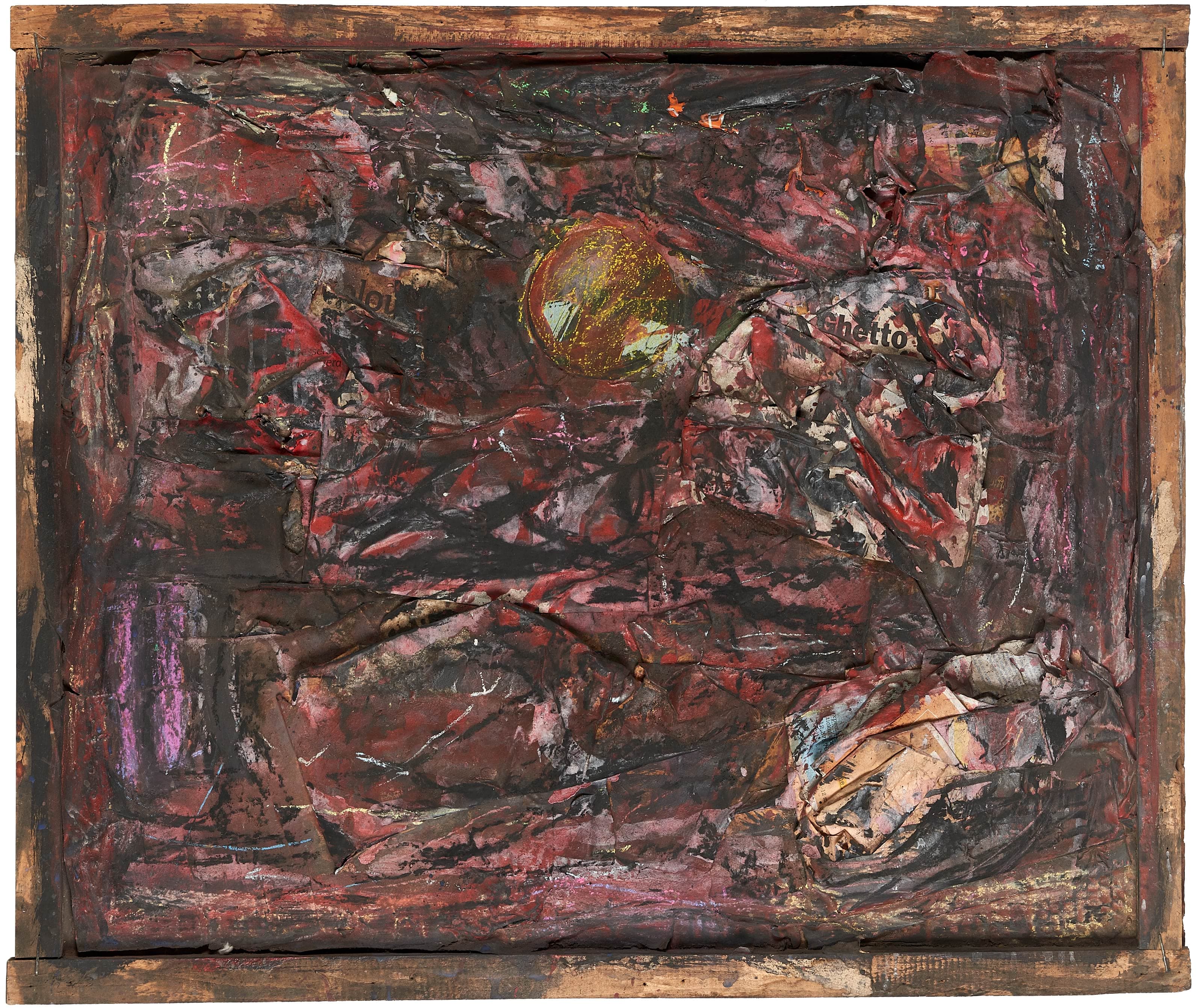
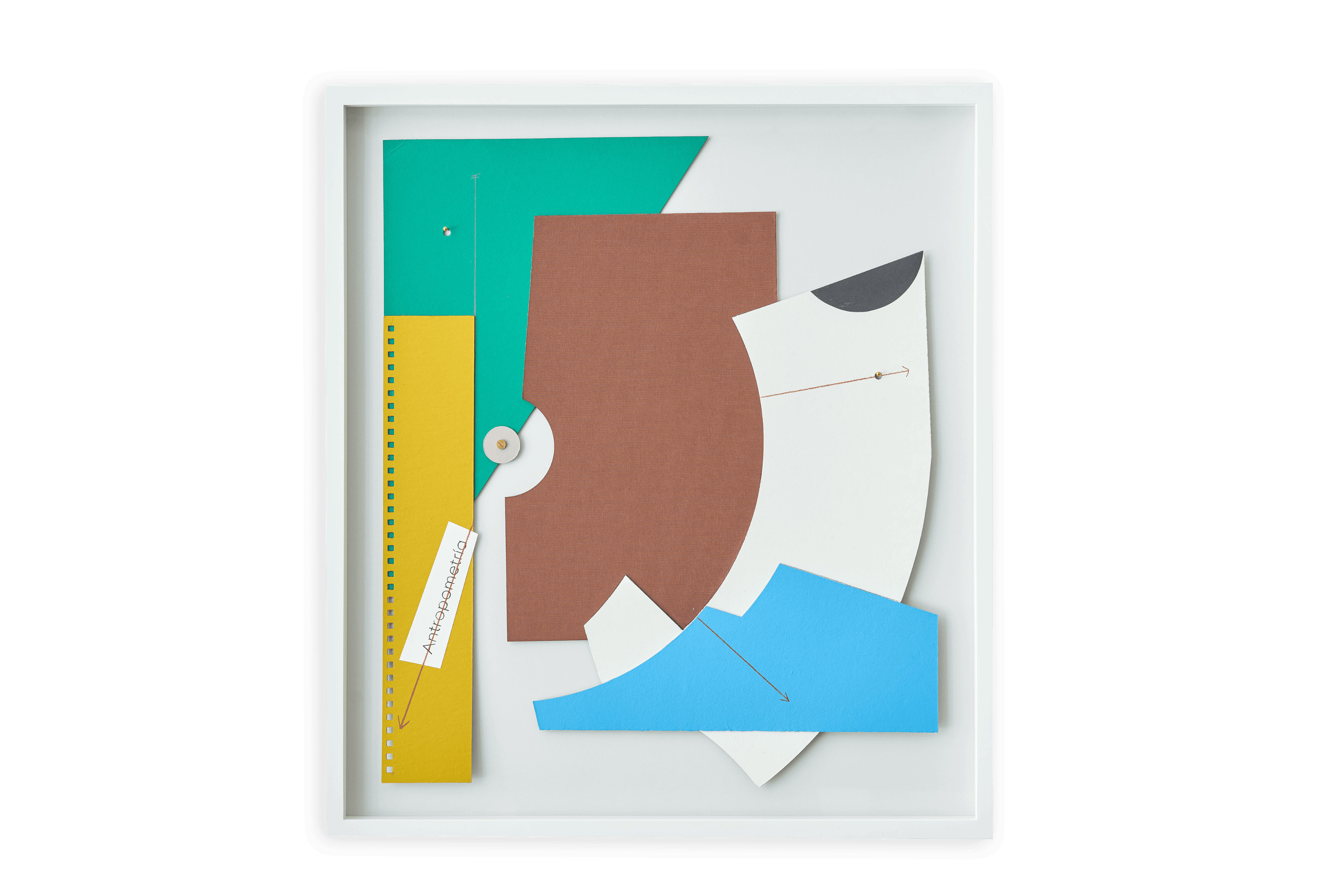
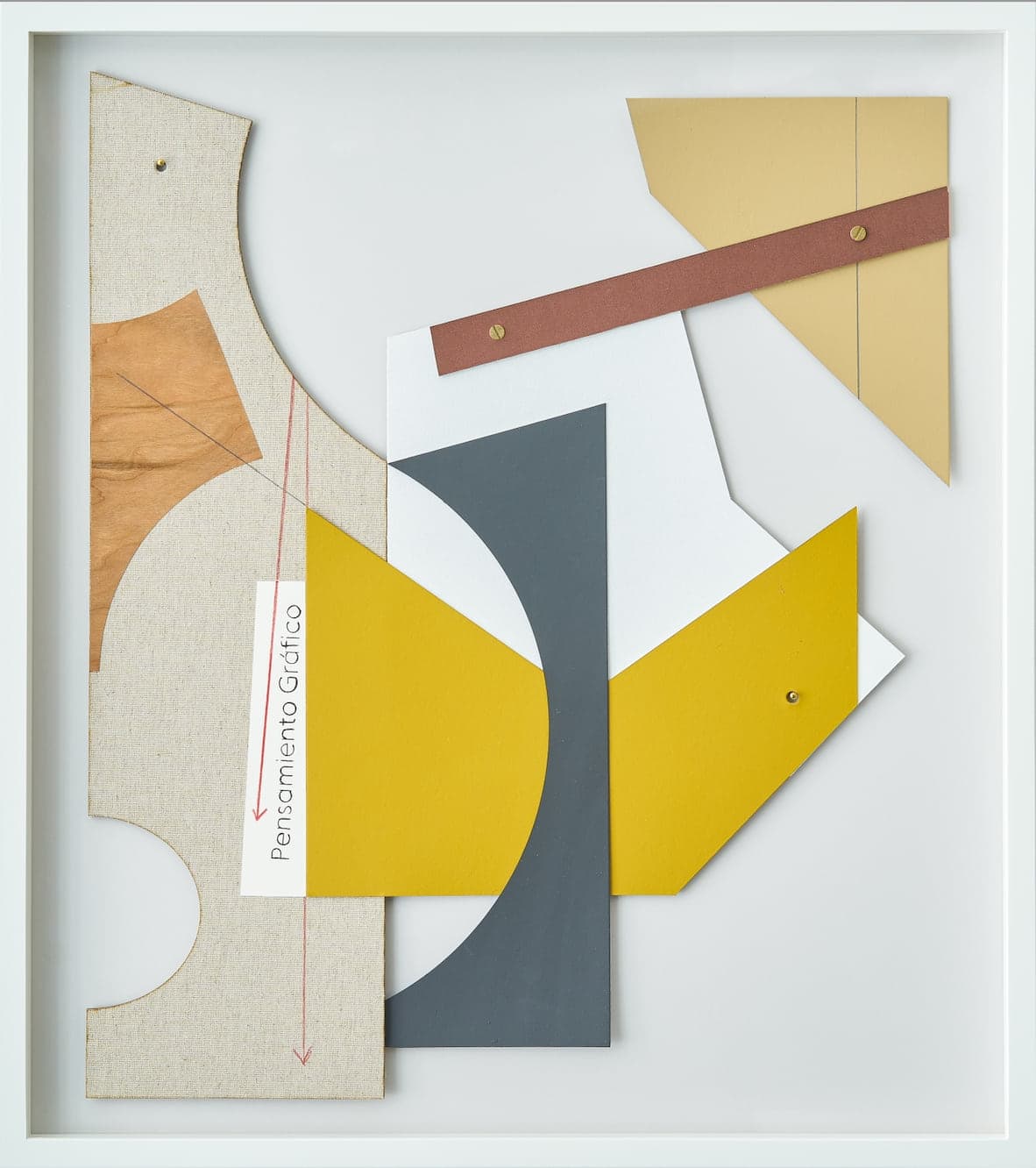
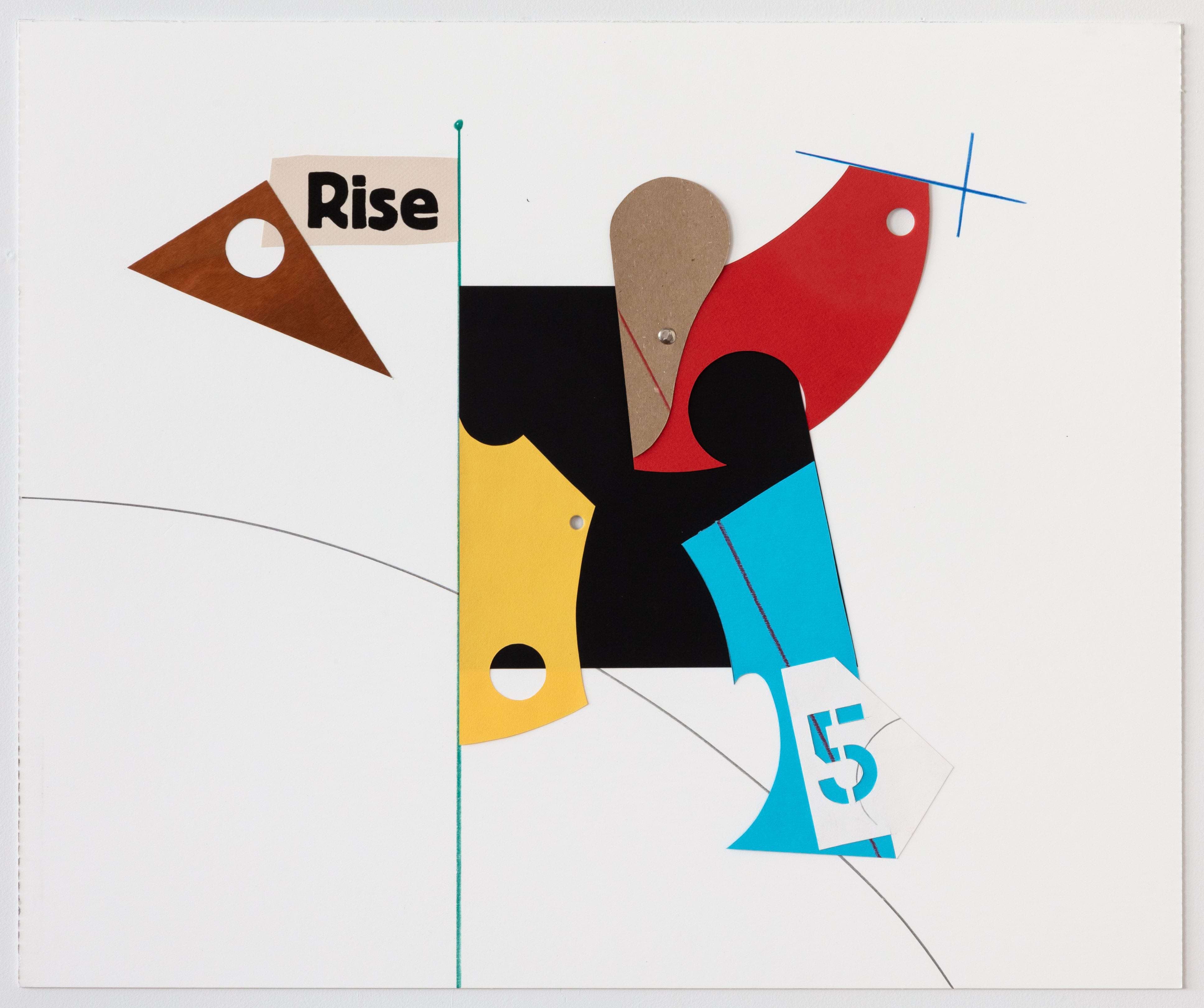
The collage works form part of the ongoing series, 'The waste of my time', in which Mateo López repurposes unused materials in his studio. The latest works in this series were made in the artist’s New York studio just before lockdown, using cardboard, acrylic paint and grommet. López draws inspiration from an anecdote on Josef Albers at Bauhaus Preliminary Class in 1923, which encapsulates his playful and paired down approach.
As told by López, “Albers entered the classroom with a bundle of newspaper under his arm. ‘Ladies and gentleman’, he said, ‘we are poor and not rich. We cannot afford to waste materials or time. Every piece of work has a starting material, and therefore we must examine the nature of this material. I would like you to take these newspapers in hand and make something more out of them than what they are at present. If you can do so without any accessories, such as cutters, scissors or glue, all the better.”
The collage works form part of the ongoing series, 'The waste of my time', in which Mateo López repurposes unused materials in his studio. The latest works in this series were made in the artist’s New York studio just before lockdown, using cardboard, acrylic paint and grommet. López draws inspiration from an anecdote on Josef Albers at Bauhaus Preliminary Class in 1923, which encapsulates his playful and paired down approach.
As told by López, “Albers entered the classroom with a bundle of newspaper under his arm. ‘Ladies and gentleman’, he said, ‘we are poor and not rich. We cannot afford to waste materials or time. Every piece of work has a starting material, and therefore we must examine the nature of this material. I would like you to take these newspapers in hand and make something more out of them than what they are at present. If you can do so without any accessories, such as cutters, scissors or glue, all the better.”
Video
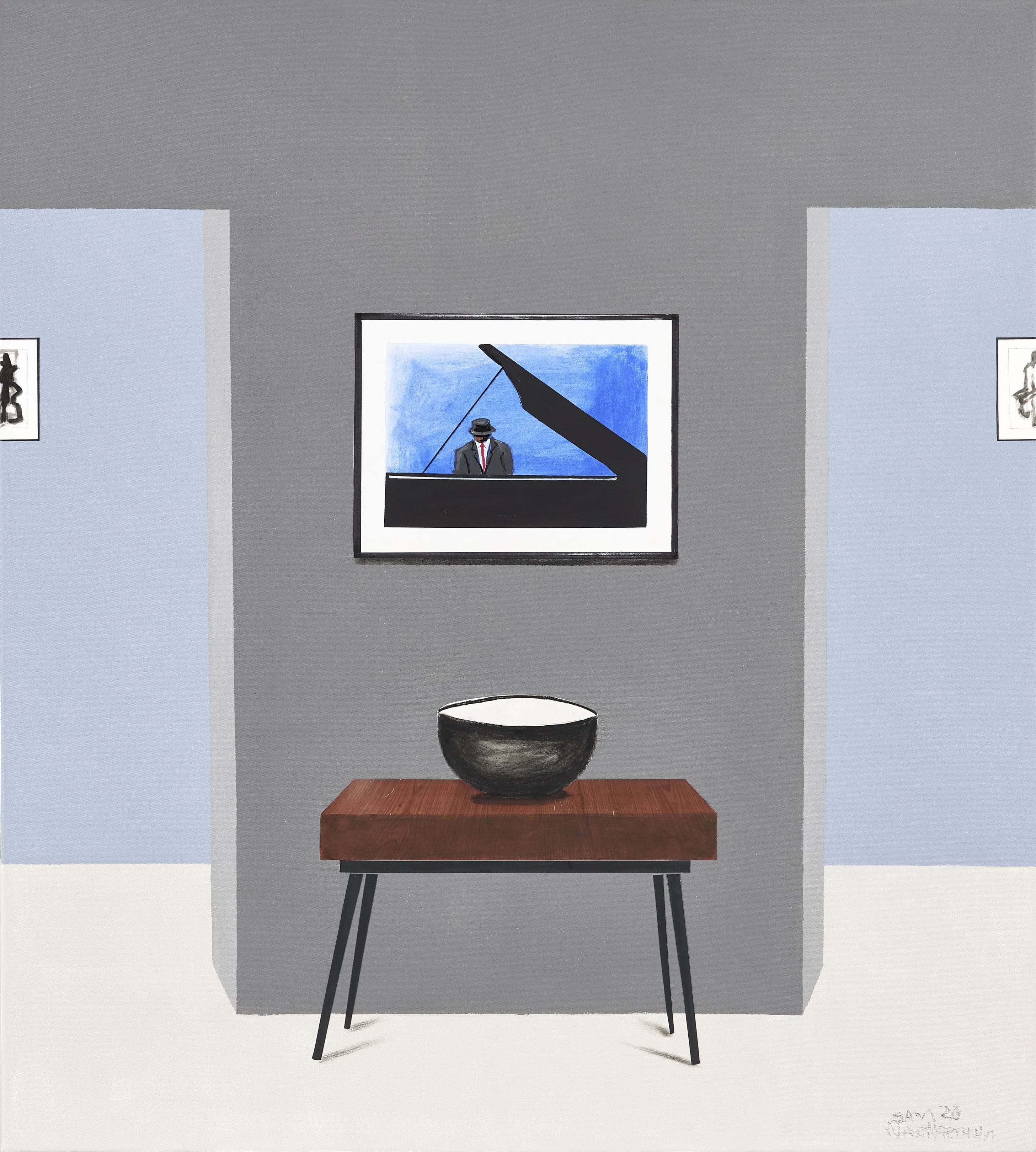
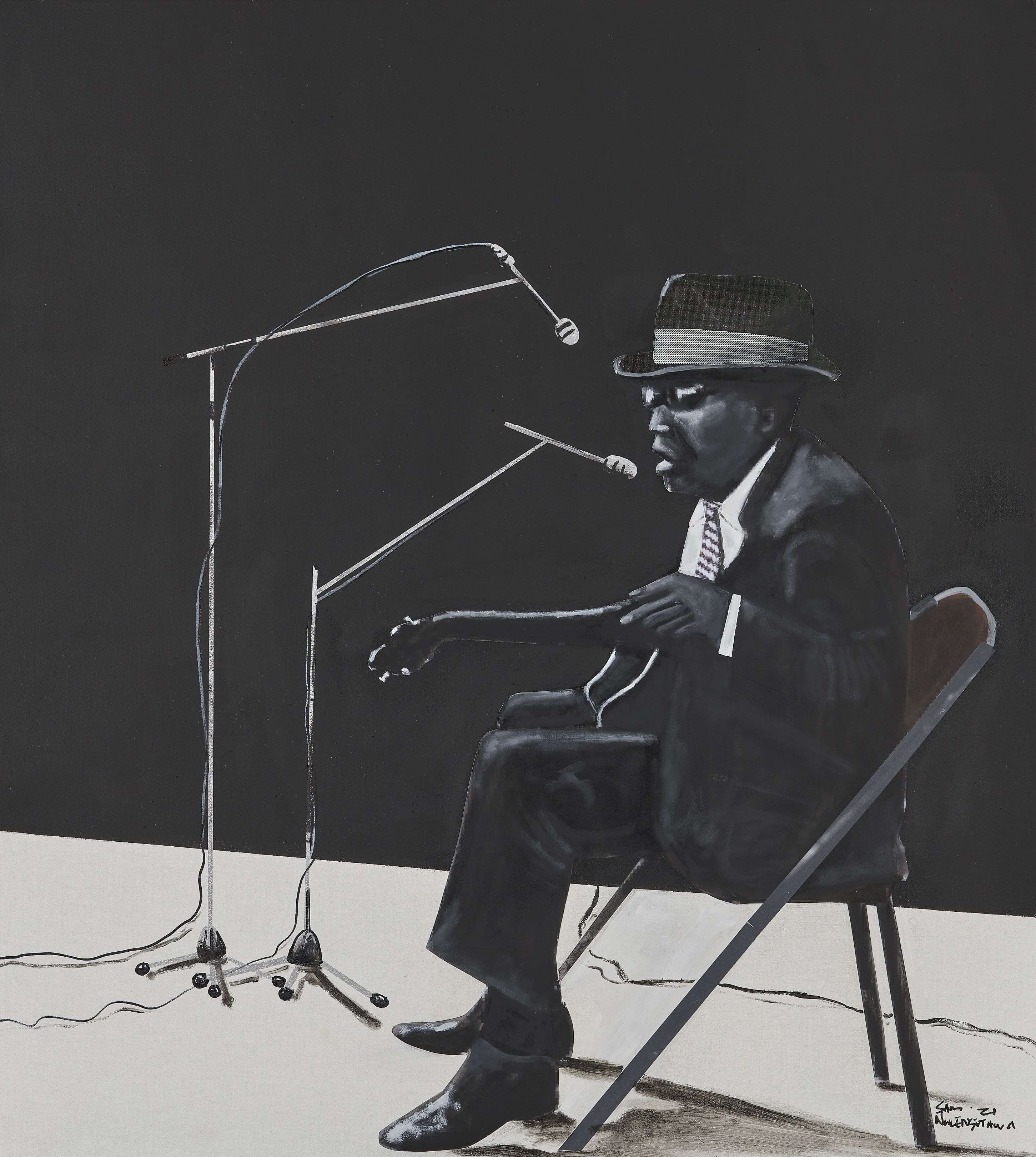
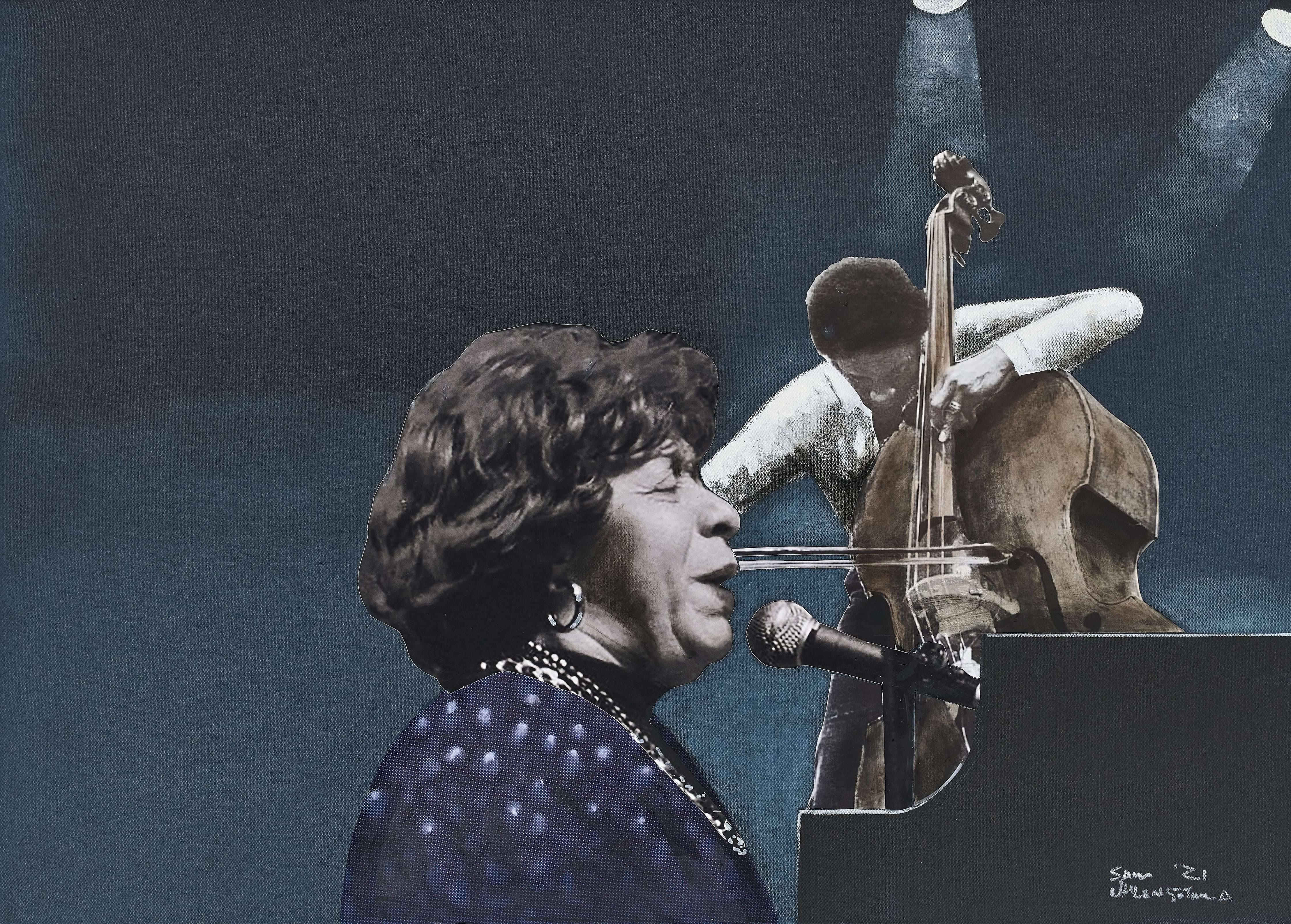
Over the course of his career, Sam Nhlengethwa’s ongoing Interiors series has become an important space for the artist to pay various tributes, bringing cultural icons into conversation with his practice and each other. The painting-collage works comprise an eclectic constellation of references and are presented together as their own contained interior space.
The suite of painting-collages that make up this series was made under the unique circumstances of a nationwide lockdown, confining the artist to his home studio but with his family surrounding him. Work such as Dark Grey Wall II carries direct references to Nhlengethwa’s personal domestic space in this unique time.
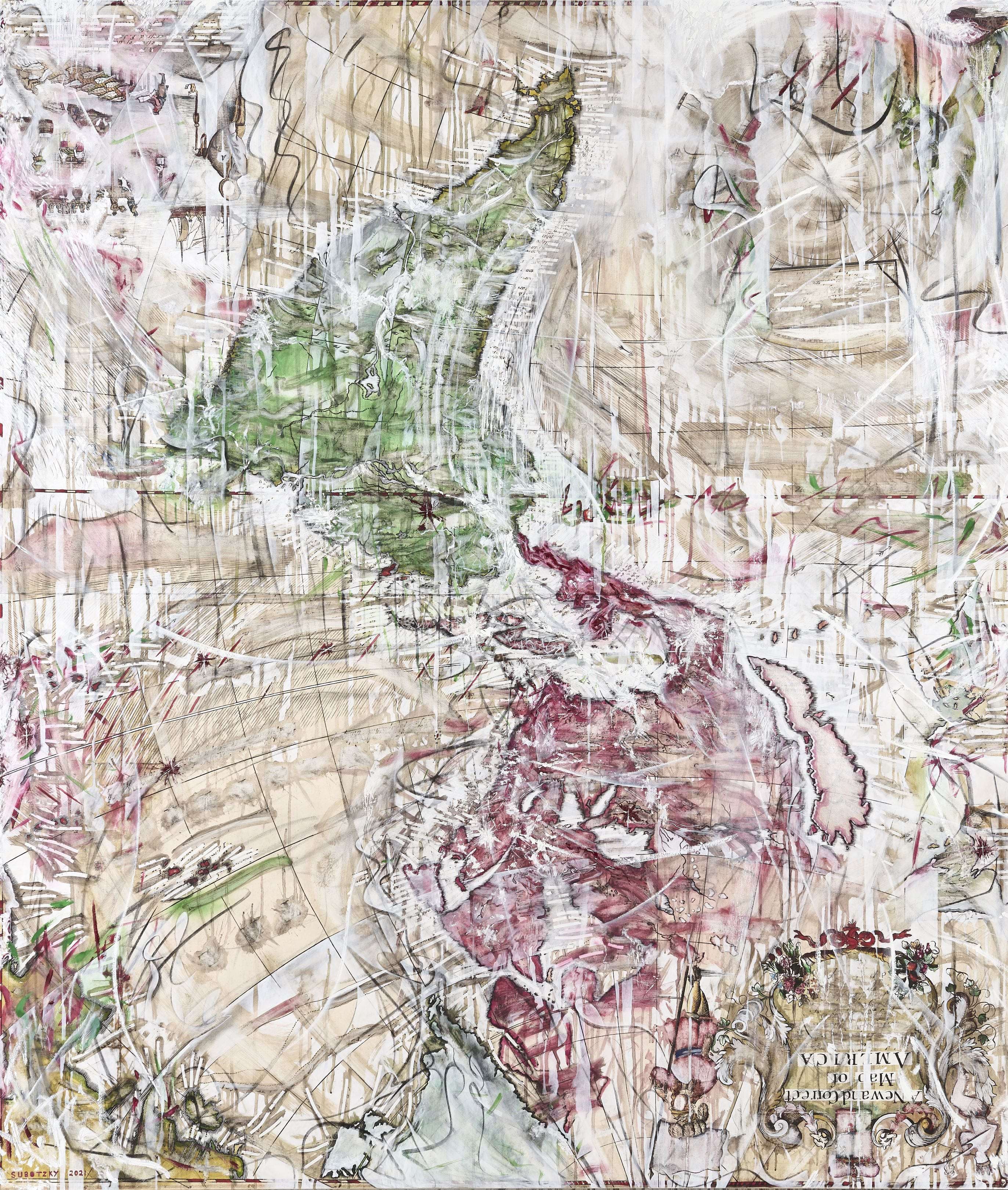
Take California (or A New and Correct Map of America) is based on a 1752 map of the Americas from the Stanford Library collection in which California is drawn as an island. This error was repeated for over a hundred years as mapmakers copied one another — the thirst for tokens of “discovery” in bourgeois 18th-century Europe quickly outgrowing the resources to accurately render the conquered lands.
As with previous map works, Subotzky starts by turning the source “upside-down” and erasing the colonial names, a futile attempt to defamiliarize synthetic hierarchies of cartographic relations. He then alternates between scrubbing away ink and adding paint, the disorder of his hand fighting against the control exerted by the map’s epistemological assertion that it represents the world in two dimensions. Subotzky paints his way into the dimensional gap between the flattened landscape and the historical narratives that are there undrawn, picturing the flows of tides, weather, resources and humans. He notes;
“As I paint I wonder what a real “new and correct” map might look like, one that unhides the memories that bleed through the porous cartographic outlines. One day my brush dropped, mid-Atlantic, as I realized with shock that I was painting the Middle Passage. In focusing on the self-repeating erroneous ‘island’ of California as an emblem of colonial failure, I had quite literally brushed over the oceans of unimaginable violence and trauma that stood between my home in Johannesburg and that made-up, misrepresented place. It reminded me of the disembodied bubble of the many flights that I have taken across the Atlantic, the blinking cartoon plane on the screen bridging the ocean in my sleep as if it really was just a blue strip on the map.”
Over the course of his career, Nhlengethwa – dubbed by critics “one of the country’s most celebrated living artists” – has developed a distinctive collage and painting practice while exploring themes common to everyday life in South Africa, the street life, domestic interiors to the influence of mining. Intrinsic to this practice is Nhlengethwa’s love of jazz.
From the age of 15, Nhlengethwa was exposed to the genre through his two older brothers who listened to everything from the classic standards of artists such as Miles Davis and Dave Brubeck to the more experimental sounds of Sun Ra, Eric Dolphy and Charles Mingus, to name a few.
“My life belongs to the jazz world because I don’t spend a day in my studio without listening to jazz in the background,” says Nhlengethwa. With a collection of over 4000 vinyls, Nhlengethwa views his records as “art material”, likening the experience of listening while working to a dialogue. “I don’t think I could be who I am, what I’m doing in the art world, if there was no jazz. It is my daily inspiration.”
Prominent jazz musicians have regularly featured in Nhlengethwa’s work over the years.
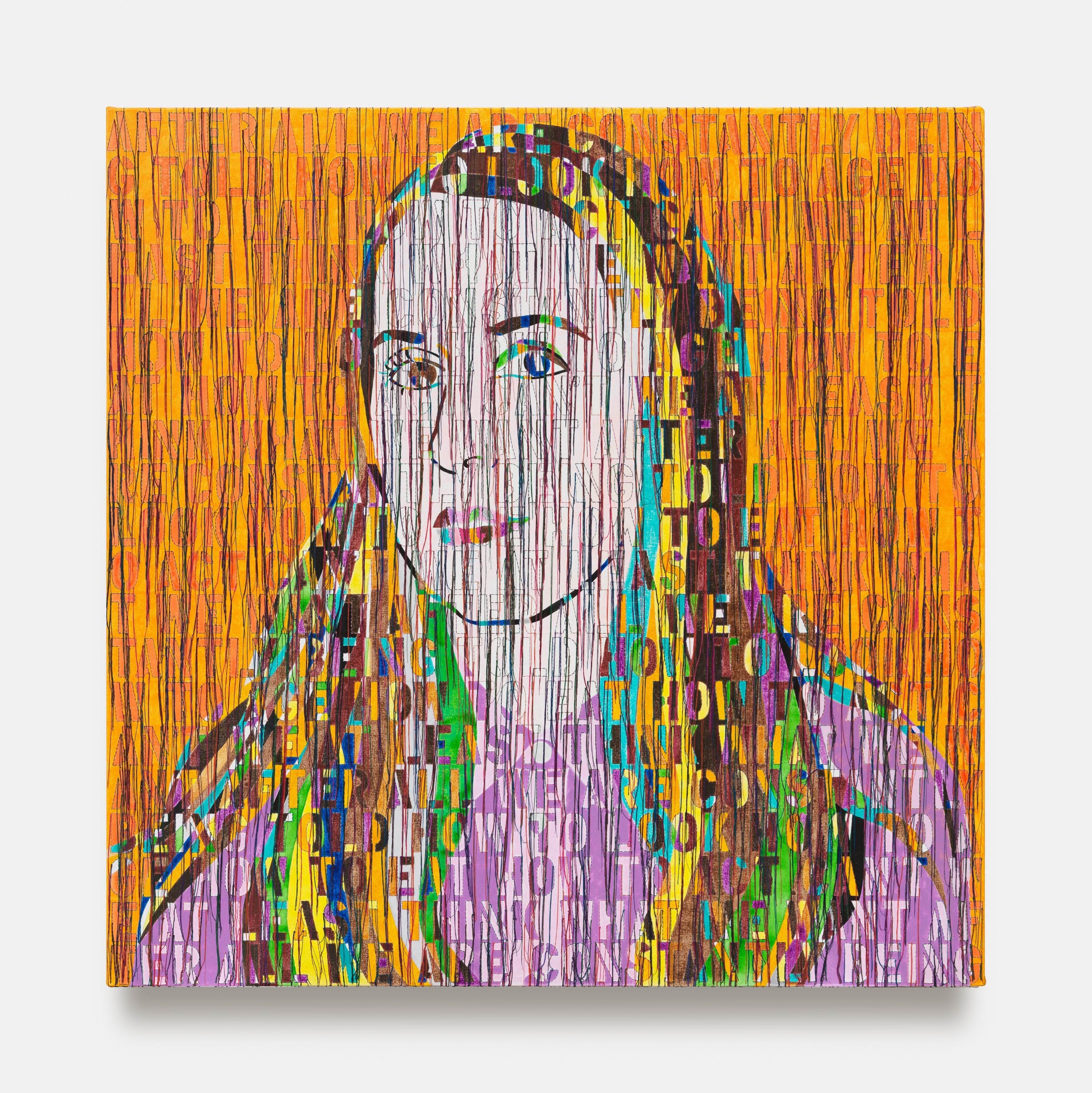
Portraits of the Women that I Know is an ongoing series of portraits that Ghada Amer started in 2013 and that includes a self-portrait. Each one consists of two superimposed elements: the painted portrait and a statement repeated on the canvas from top to bottom, embroidered with thread. On the Portrait of Ellen for instance, we read: “After all we are constantly being told how to look how to age how to eat how to act can’t we at least think what we want.” Words and painting vie for the audience’s attention. Anne Creissels problematizes the relationship between the two mediums in Amer’s work, reflecting on the difficulty of reading and looking at the same time. In the case of the portraits, do viewers search for resemblance with the person whose portrait it is or do they instead become readers as they attempt to decipher the statements?
Credit: https://ghadaamer.com
Over the course of his career, Nhlengethwa – dubbed by critics “one of the country’s most celebrated living artists” – has developed a distinctive collage and painting practice while exploring themes common to everyday life in South Africa, the street life, domestic interiors to the influence of mining. Intrinsic to this practice is Nhlengethwa’s love of jazz.
From the age of 15, Nhlengethwa was exposed to the genre through his two older brothers who listened to everything from the classic standards of artists such as Miles Davis and Dave Brubeck to the more experimental sounds of Sun Ra, Eric Dolphy and Charles Mingus, to name a few.
“My life belongs to the jazz world because I don’t spend a day in my studio without listening to jazz in the background,” says Nhlengethwa. With a collection of over 4000 vinyls, Nhlengethwa views his records as “art material”, likening the experience of listening while working to a dialogue. “I don’t think I could be who I am, what I’m doing in the art world, if there was no jazz. It is my daily inspiration.”
Prominent jazz musicians have regularly featured in Nhlengethwa’s work over the years.
Video
Photography credit: Aatjan Renders
Video
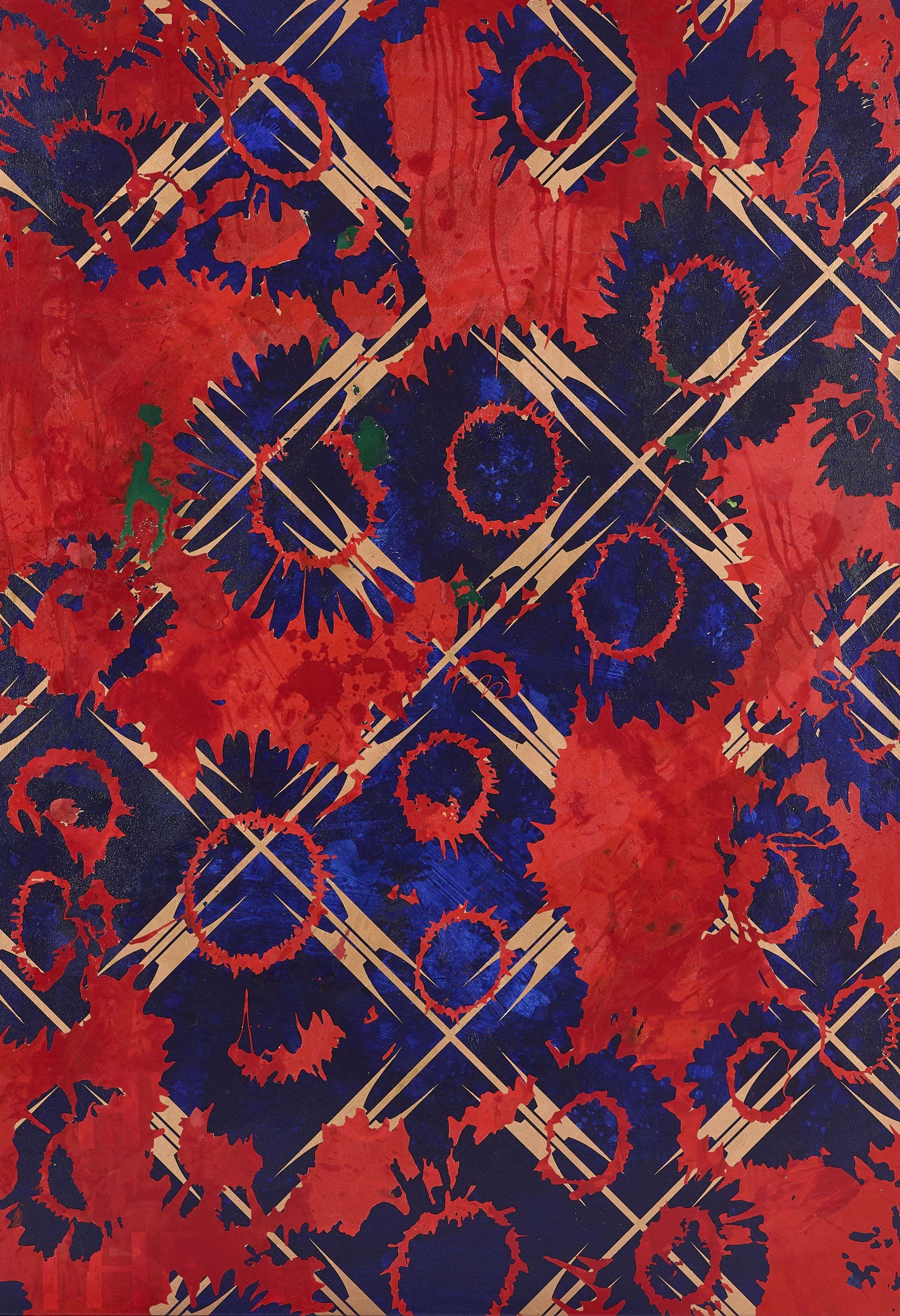
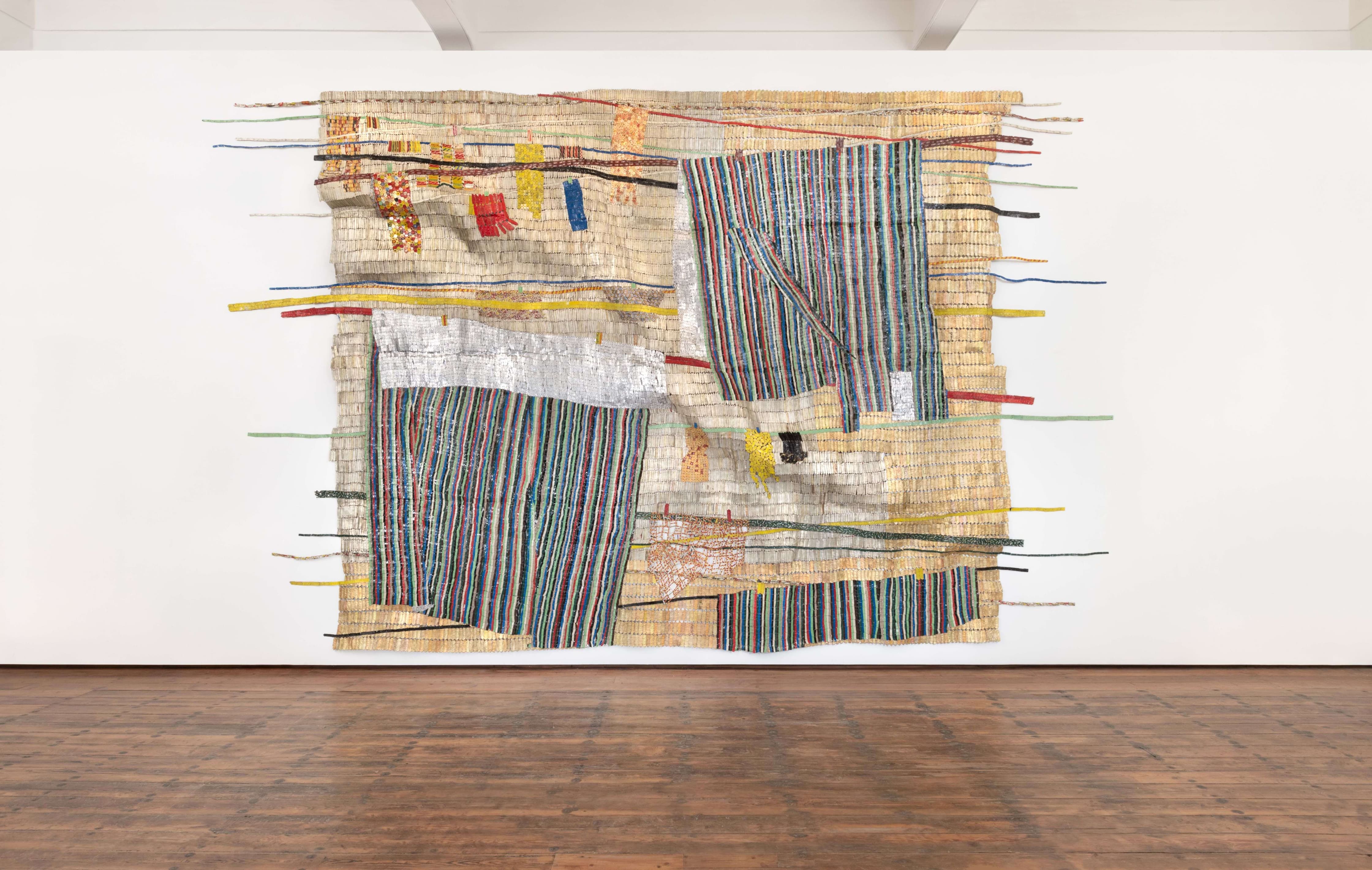
In ‘Drying Line’, El Anatsui departs from the dense, tightly woven surfaces of his signature metal tapestries to embrace a looser, more open composition. Strands extend outward from the body of the work, evoking the casual geometry of laundry hung to dry – an everyday scene reimagined through sculptural abstraction. These free-flowing lines offer a sense of ease and release, contrasting with the more structured, grid-like compositions found in many of his earlier pieces. The interplay of form here mirrors a shift in tempo: a softening of rhythm, and an openness to air, space, and movement.
Colour plays a central role in balancing the work’s emotional register. A dialogue unfolds between warm and cooler tones – vibrant reds and golds give way to silvers and blues – creating a dynamic surface that oscillates between intensity and stillness. With ‘Drying Line’, Anatsui reflects on the contrasts he observes from his studio in Tema, Ghana: the vibrant energy of daytime activity giving way to the stillness of night. This tension – between vigour and quietude, presence and absence – is embedded in the work’s shifting textures and sprawling lines. As with his broader practice, ‘Drying Line’ resists closure, instead offering a form in flux that is alive to its surroundings, and charged with the rhythms of daily life.
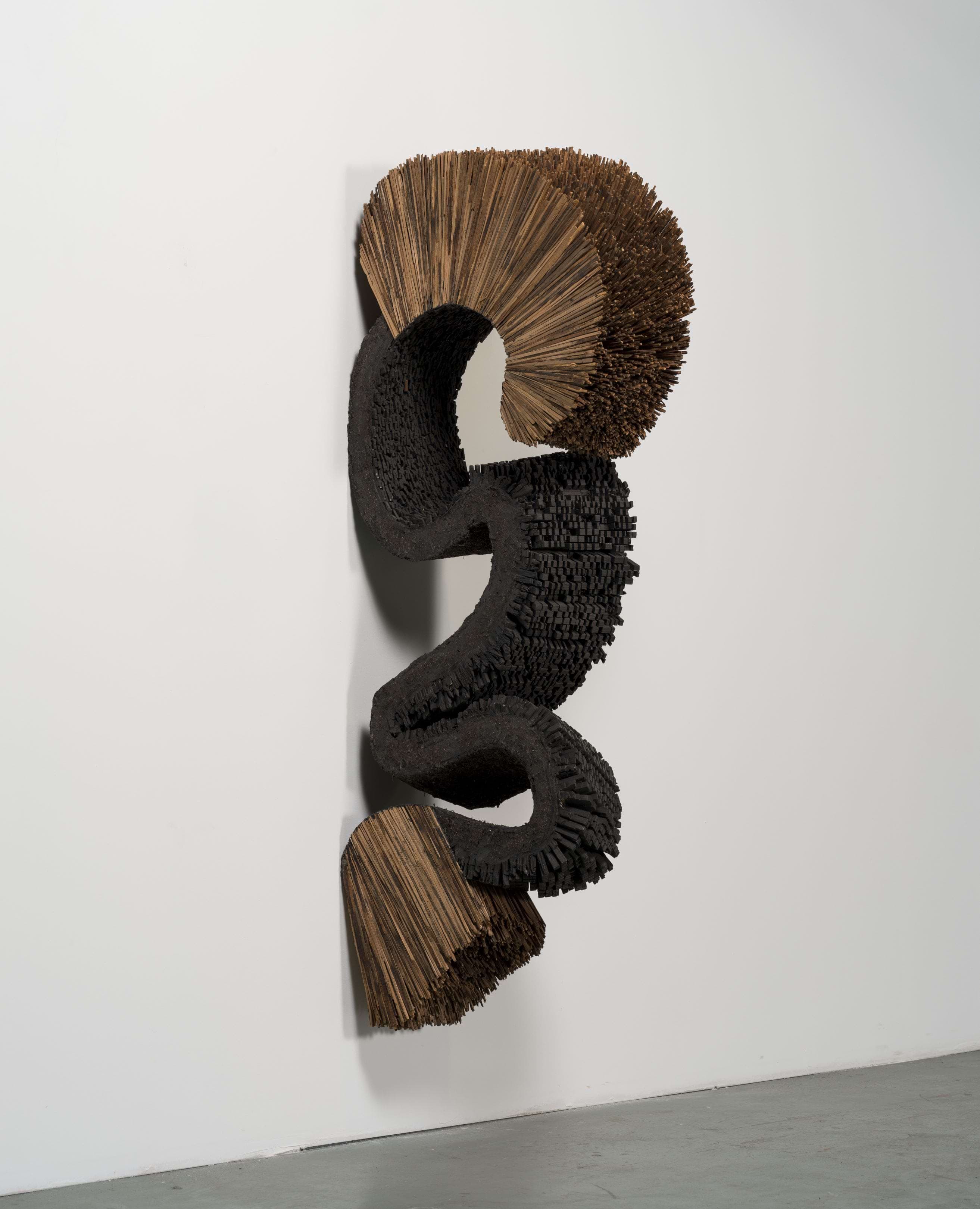
Leonardo Drew (b. 1961, USA) is known for his significant installations and sculptures which explore the tension between order and chaos. His work has been seen in major museums worldwide and is currently the subject of a major new commission at Yorkshire Sculpture Park, UK on view through 2023.
Number 344 and Number 366 demonstrate Drew’s approach to manipulating organic material to create richly detailed works which resemble densely populated cities, urban wastelands or organic forms and evoke the mutability of the natural world. Both works were shown in the artist’s first solo exhibition on the continent at Goodman Gallery Johannesburg earlier this year.
Kapwani Kiwanga is a Franco-Canadian artist based in Paris. Kiwanga’s work traces the pervasive impact of power asymmetries. Her work is research-driven, instigated by marginalised or forgotten histories, and articulated across a range of materials and mediums including sculpture, installation, photography, video, and performance.
Kunstmuseum Wolfsburg recently launched Kapwani Kiwanga’s first comprehensive mid-career retrospective, The Length of the Horizon until 7 January 2024. This show includes her memorable 2022 Venice Biennale installation ‘Terrarium’. The artist has been selected to represent Canada at their national pavilion at the 2024 Venice Biennale.
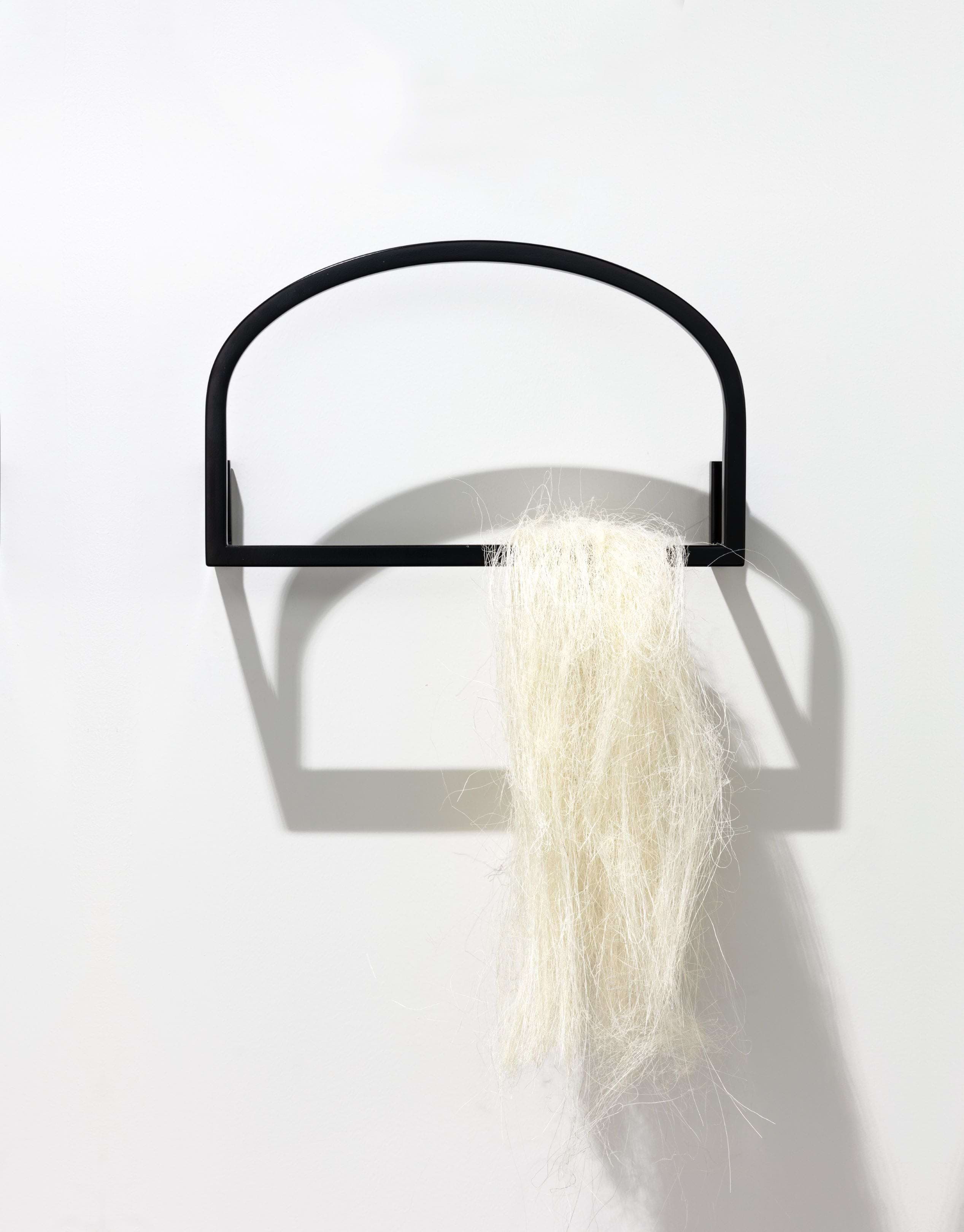
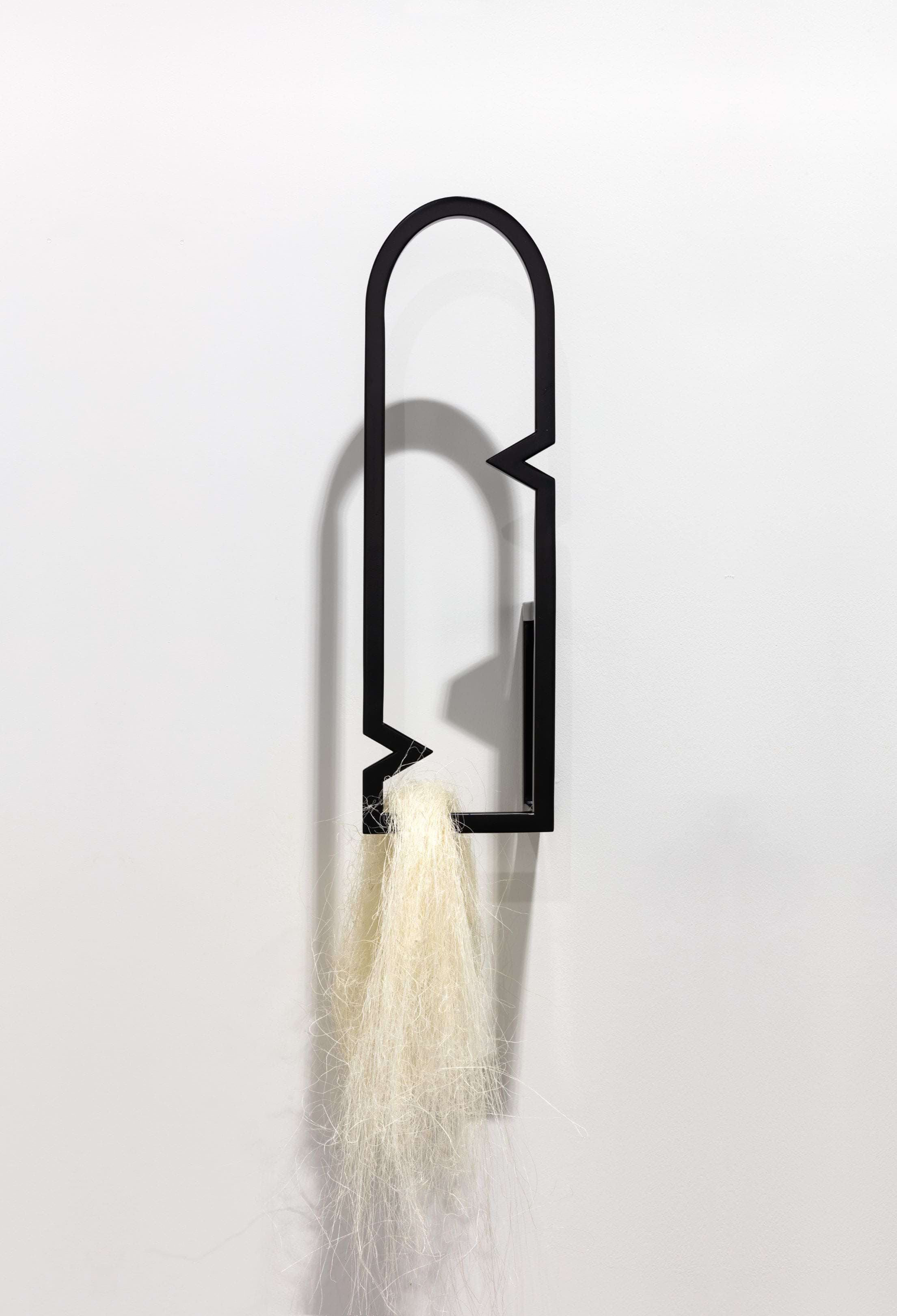
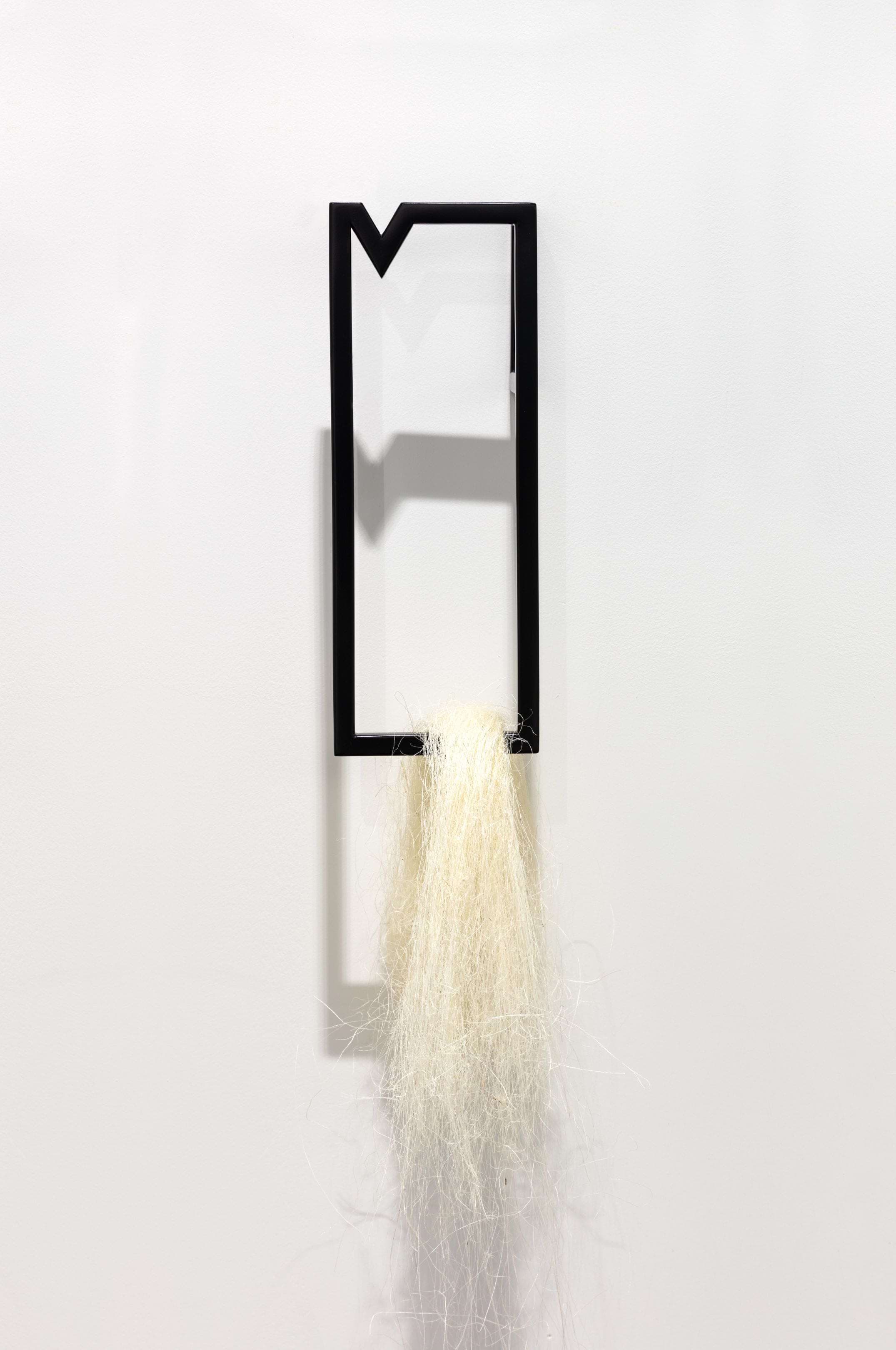
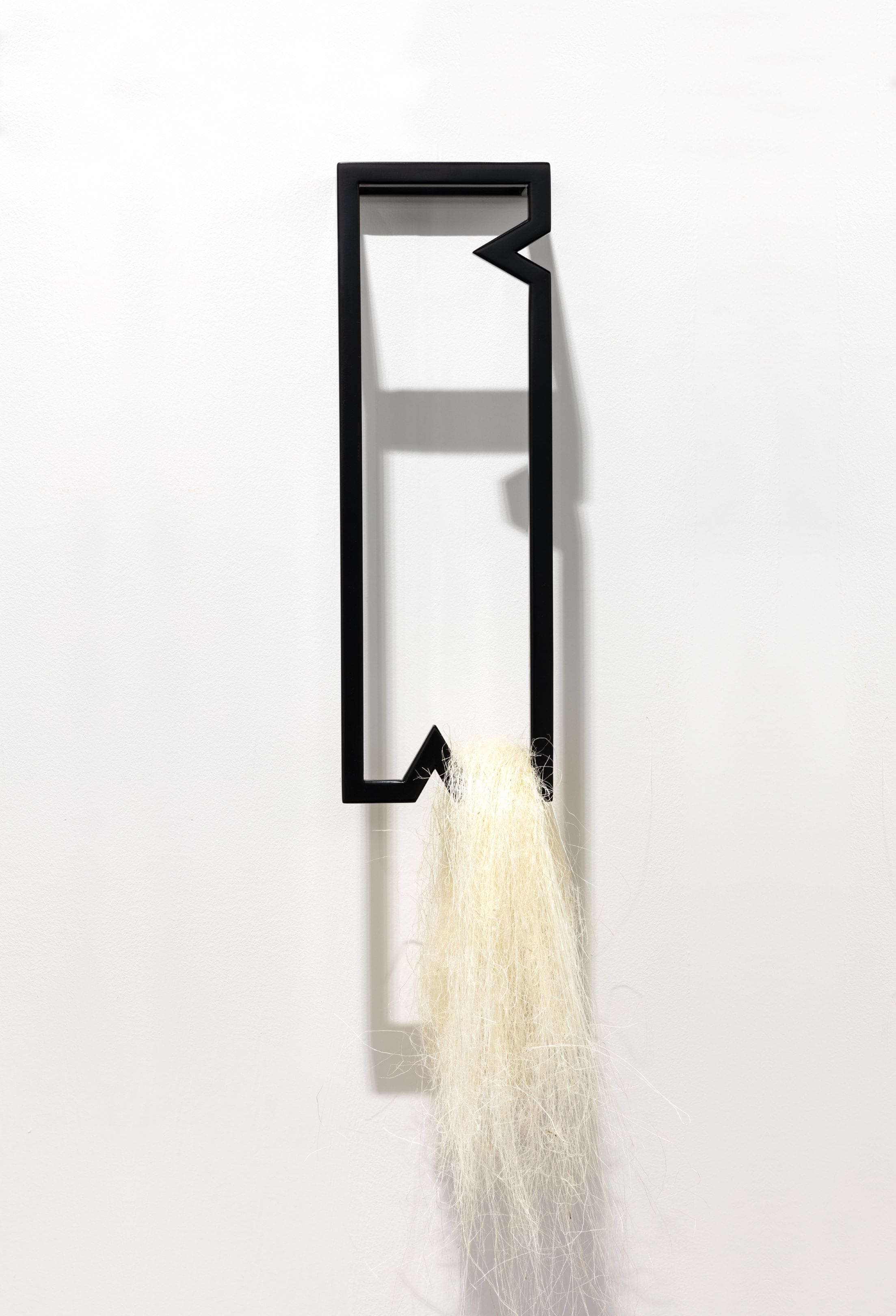
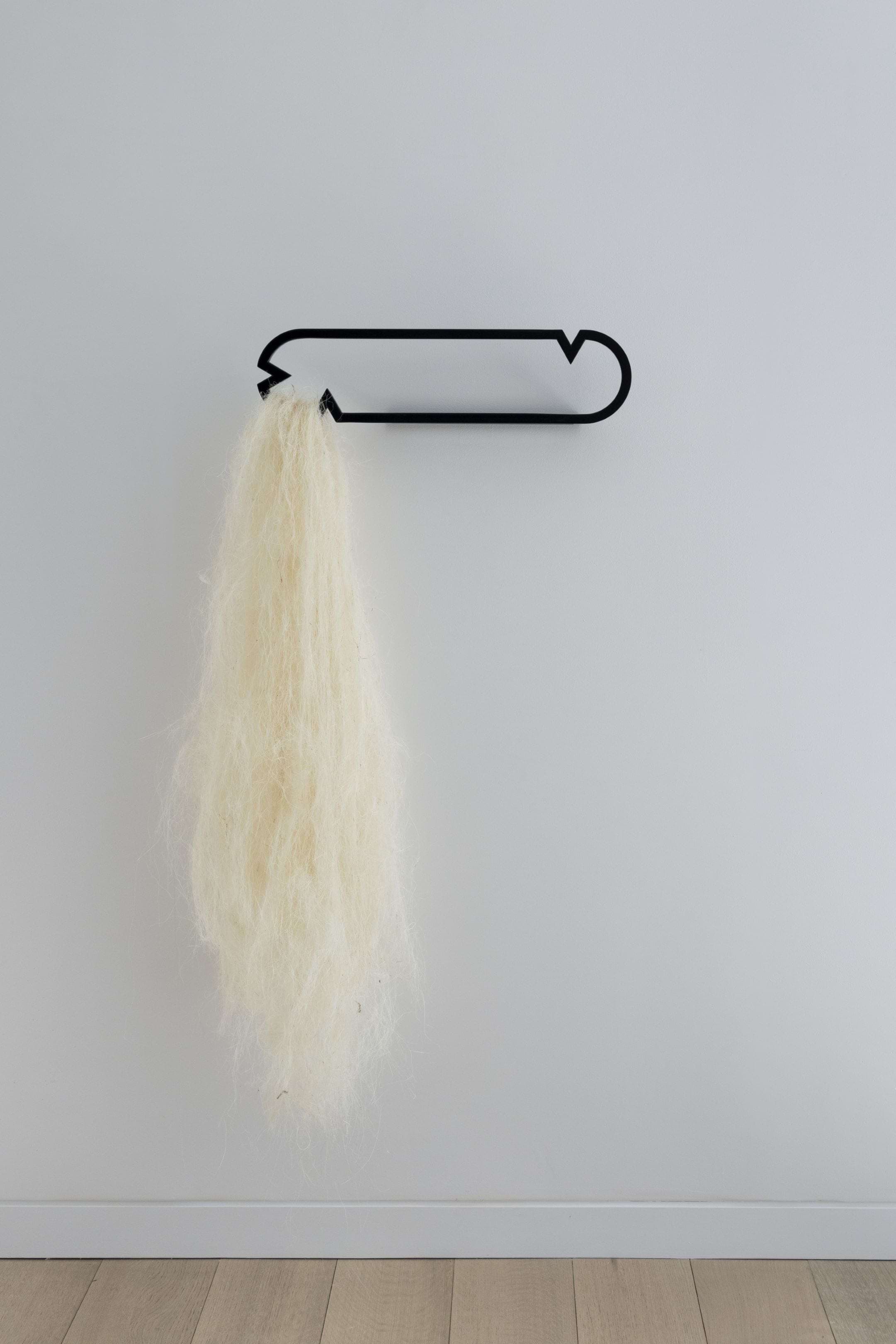
Kiwanga’s interest in the historical and symbolic affect of materials is demonstrated through the artist’s Sisal series - an arrangement of steelworks covered in sisal fibre. The golden spun fibre, harvested from the botanical plant agave sisalana, is typically used for rope and twine. Kiwanga first encountered sisal whilst travelling through rural Tanzania where this flowering plant is a primary export commodity. Fascinated by the fibre’s colour (yellow and gold) as well as the rhythmic rows of the crop, Kiwanga came to learn more about the plant in relation to Tanzania’s political, economic and social history.
2021
Variable dimensions
10 000 Euro
Kapwani Kiwanga is a Franco-Canadian artist based in Paris. Kiwanga’s work traces the pervasive impact of power asymmetries. Her work is research-driven, instigated by marginalised or forgotten histories, and articulated across a range of materials and mediums including sculpture, installation, photography, video, and performance.
Kunstmuseum Wolfsburg recently launched Kapwani Kiwanga’s first comprehensive mid-career retrospective, The Length of the Horizon until 7 January 2024. This show includes her memorable 2022 Venice Biennale installation ‘Terrarium’. The artist has been selected to represent Canada at their national pavilion at the 2024 Venice Biennale.
Kiwanga’s interest in the historical and symbolic affect of materials is demonstrated through the artist’s Sisal series - an arrangement of steelworks covered in sisal fibre. The golden spun fibre, harvested from the botanical plant agave sisalana, is typically used for rope and twine. Kiwanga first encountered sisal whilst travelling through rural Tanzania where this flowering plant is a primary export commodity. Fascinated by the fibre’s colour (yellow and gold) as well as the rhythmic rows of the crop, Kiwanga came to learn more about the plant in relation to Tanzania’s political, economic and social history.
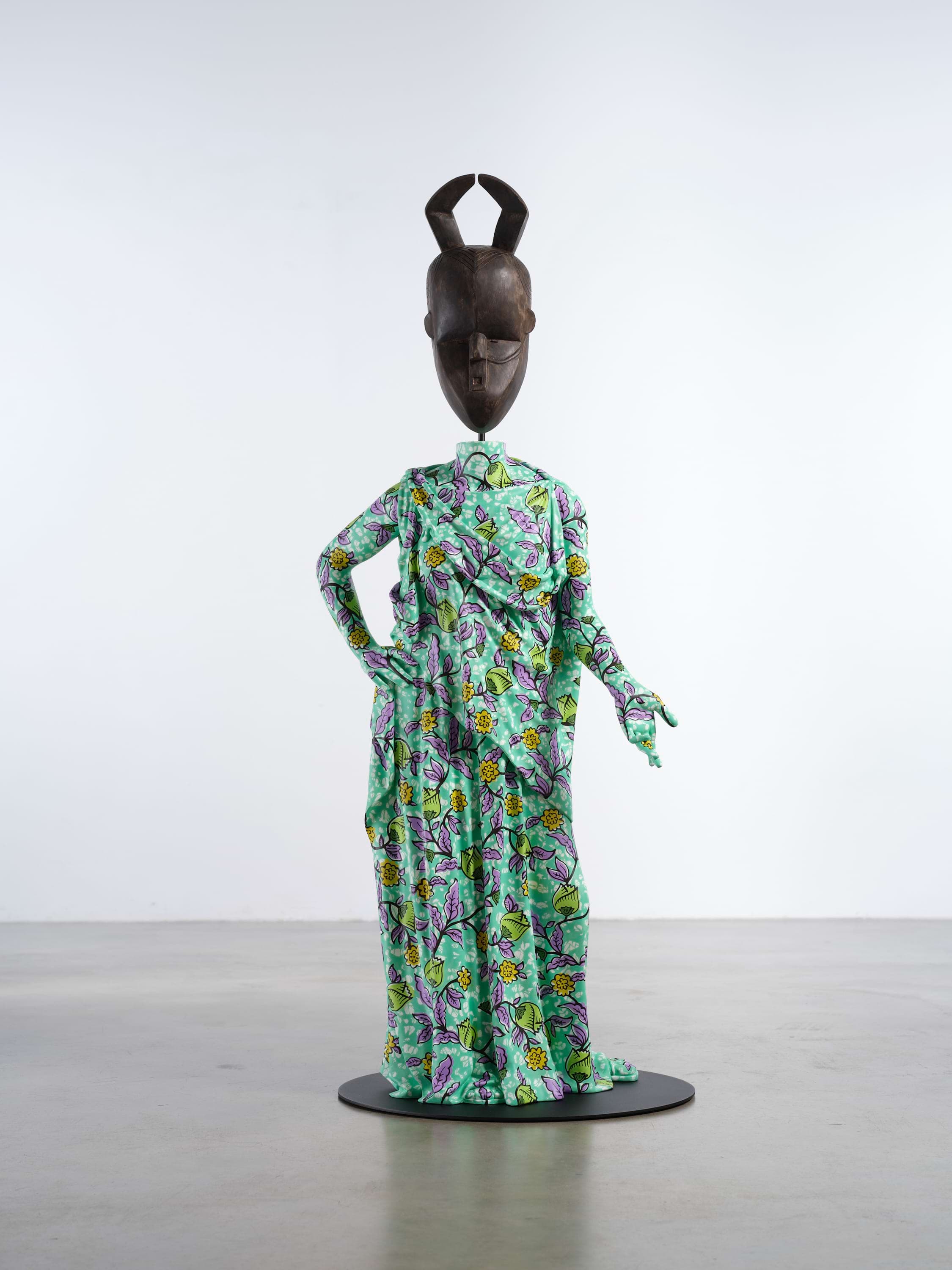
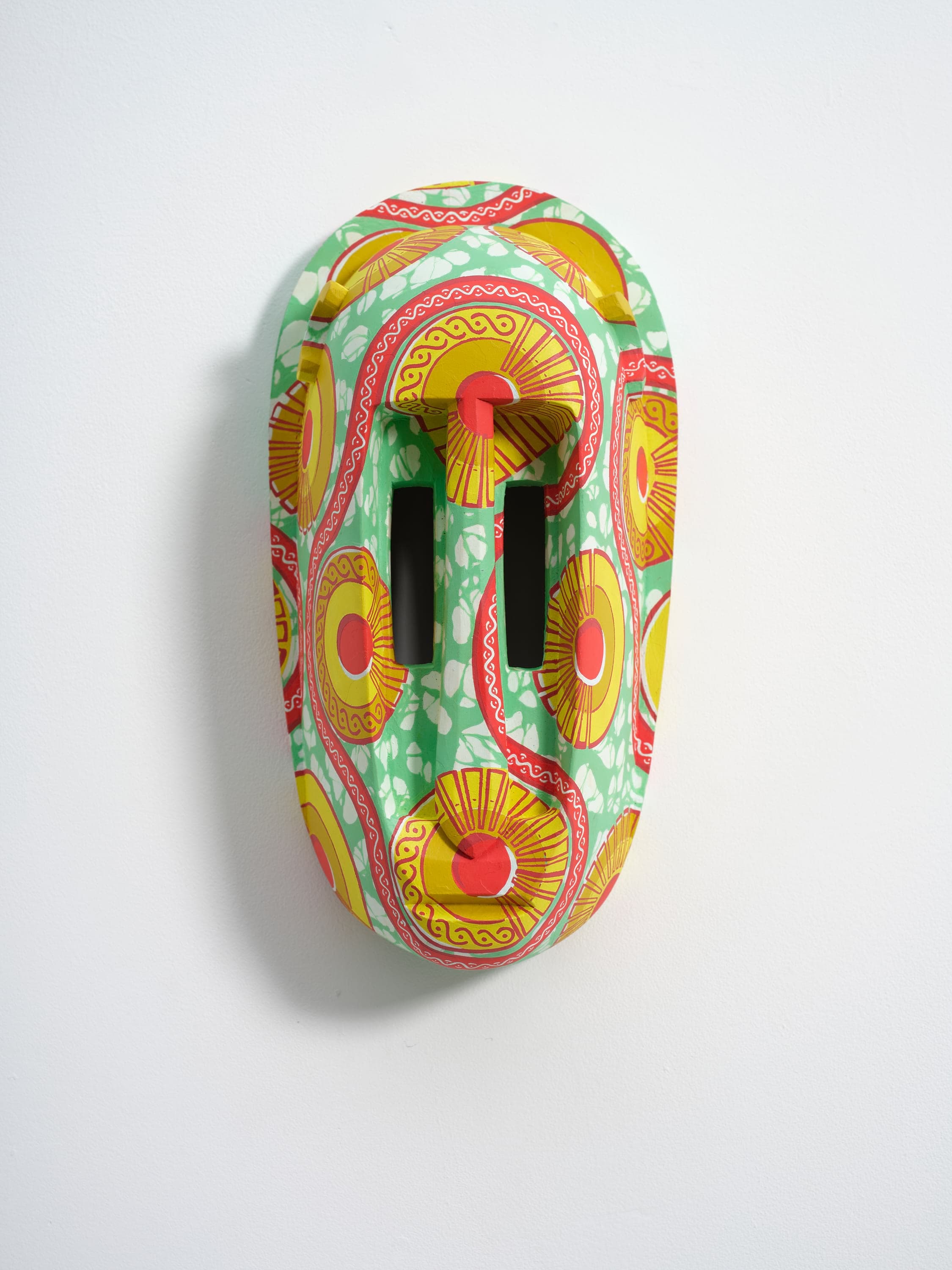
The Hybrid Mask series by Yinka Shonibare is intricate, hand-painted masks that consider how African aesthetics have shaped western modernist expression. Using the collections of African artefacts of Georges Braque, André Derain and Amedeo Modigliani as a starting point they are a response to the widely acknowledged influence that African imagery had on major twentieth-century artists and on entire western art movements, such as Cubism, Dada and Surrealism. The work exposes the conflicted relationships between ‘western’ and ‘tribal’, appropriation and admiration.
“I want to challenge notions of cultural authenticity, by creating a composite ideology, ‘a third myth’, exploring appropriation, cultural identity, and the ability to transform beyond what is expected and therefore compels us to contemplate our world differently” - Yinka Shonibare CBE RA.
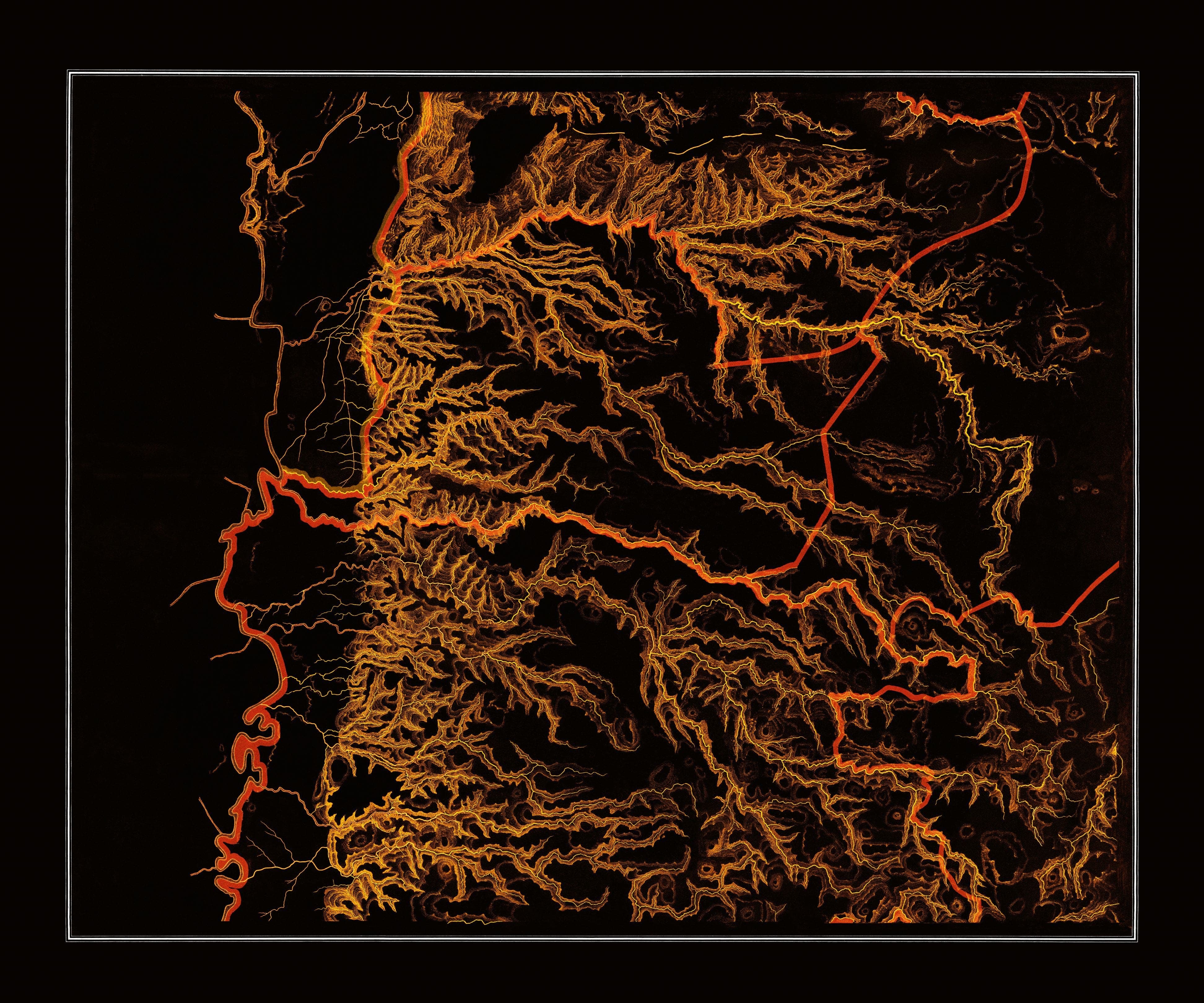
With his series Amid Imperial Grids, Dor Guez critically examines early cartographic representations of Palestine. Drawing from the first modern maps of the region dating back to 1885, Guez engages with the imposition of colonial order through geography, specifically referencing the British Palestine Grid and the French Levant Grid. By stripping the maps of all human markers such as names of towns, roads, borders, and topographical labels, Guez reveals the abstraction and control embedded in imperial mapping practices. The resulting images present a ghostly, decontextualized terrain that prompts viewers to question how land, identity, and history are shaped and erased through systems of classification and visual power.
Kiwanga’s interest in the historical and symbolic affect of materials is demonstrated through an arrangement of steelworks covered in sisal fiber. The golden spun fibre, harvested from the botanical plant agave sisalana, is typically used for rope and twine. Kiwanga first encountered sisal whilst traveling through rural Tanzania where this flowering plant is a primary export commodity. Fascinated by the fiber’s colour (yellow and gold) as well as the rhythmic rows of the crop, Kiwanga came to learn more about the plant in relation to Tanzania’s political, economic and social history.
“The agave cactus was first brought illegally to Tanzania by German plantation owners who began to develop the crop on a large scale,” Kiwanga explains “At the time of Tanzanian independence, plantations that had once been privately owned were nationalised, in an attempt to assure Tanzania would be economically self-sufficient. Sisal was meant to play an economic role in the country becoming an independent socialist state. Ujamaa socialism failed, for many different reasons, but when the price of sisal plummeted on the world market it contributed to this as it adversely affected prospects of financial resilience.”
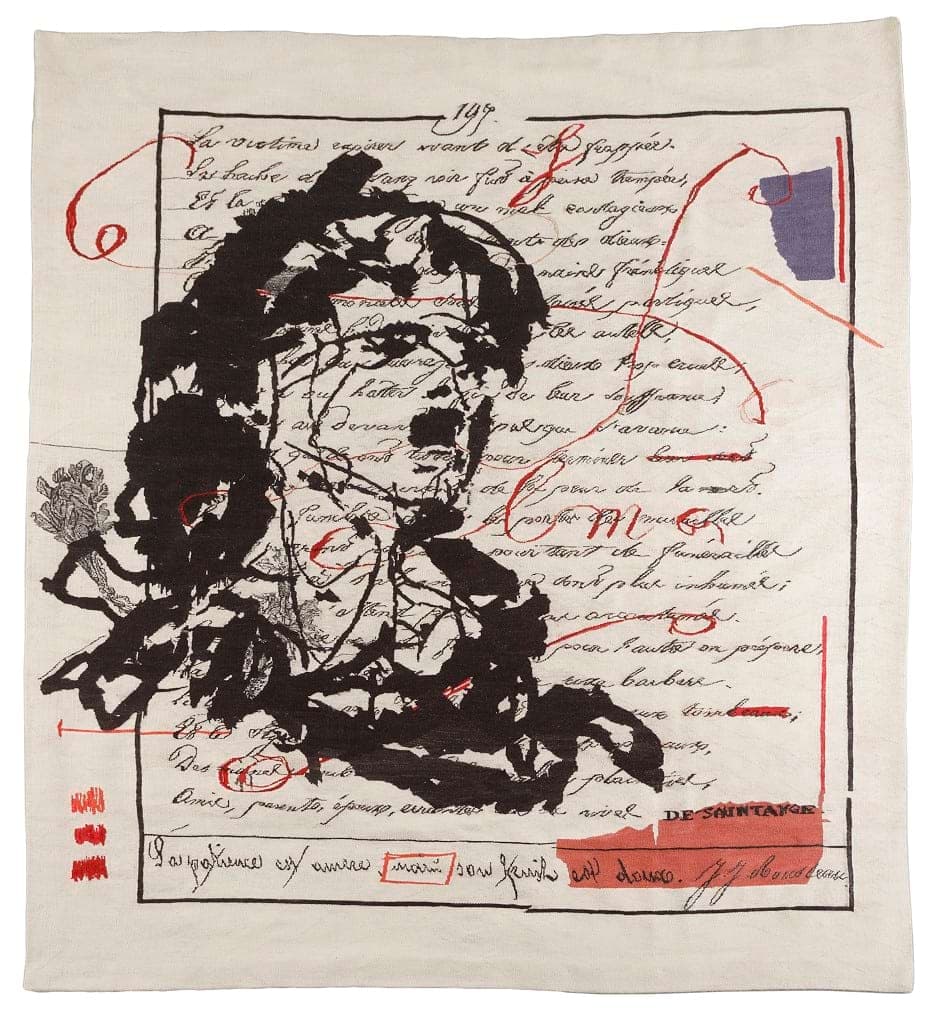
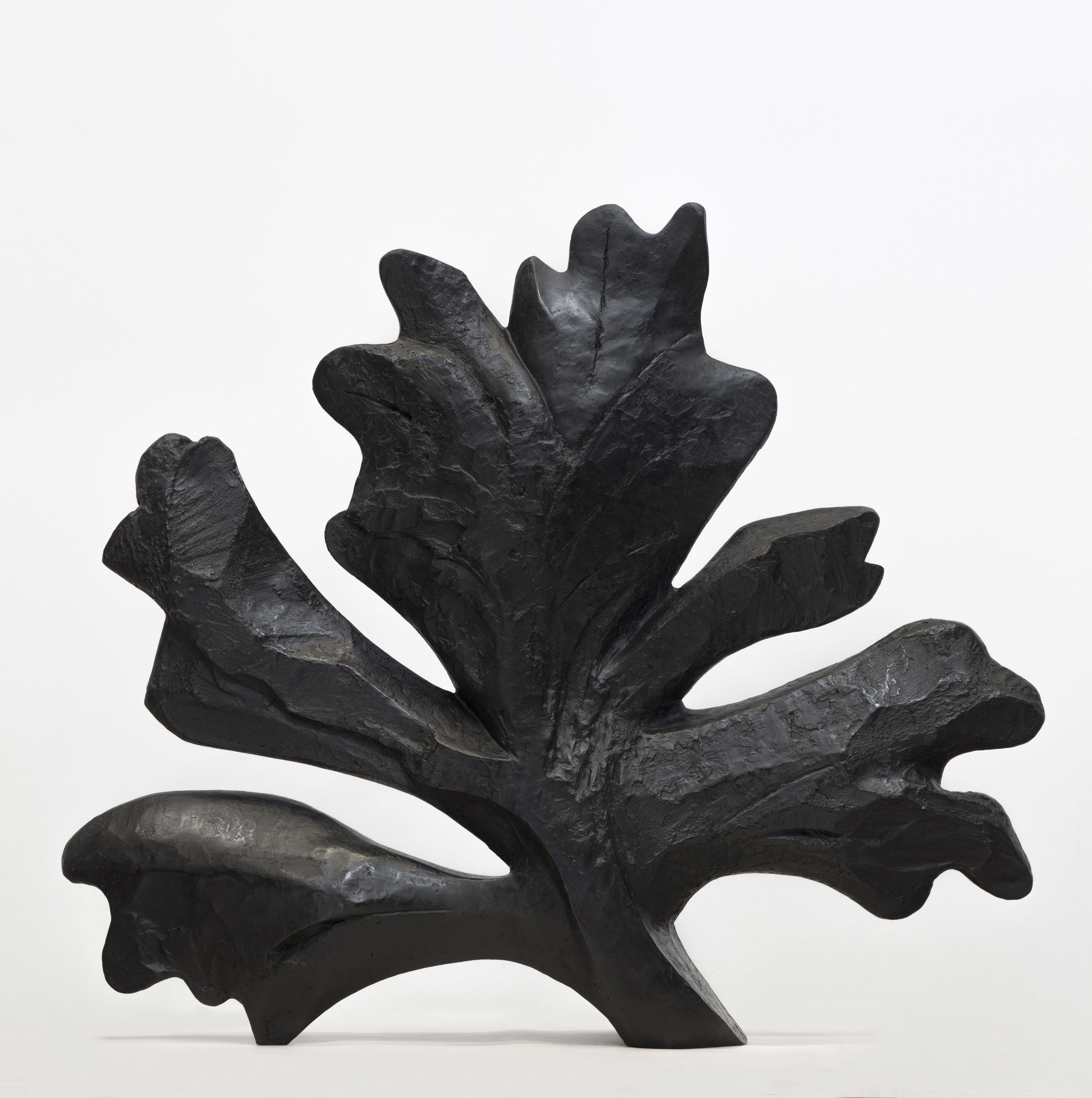
Oak Leaf forms part of an accumulation of elemental symbols within Kentridge’s broader practice. This series of bronze sculptures functions as a form of visual dictionary. The sculptures are symbols and ‘glyphs’, a repertoire of everyday objects or suggested words and icons, many of which have been used repeatedly across previous projects. The glyphs can be arranged to construct sculptural sentences and rearranged to deny meaning.
“The glyphs started as a collection of ink drawings and paper cut-outs, each on a single page from a dictionary. Previously I had taken a drawing or silhouette and given it just enough body to stand on its own feet - paper, added to cardboard and put on a stand. With the glyphs, I wanted a silhouette with the weight that the shape suggested. A shape not just balancing in space, but filling space. Something to hold in your hand, with both shape and heft.” - William Kentridge
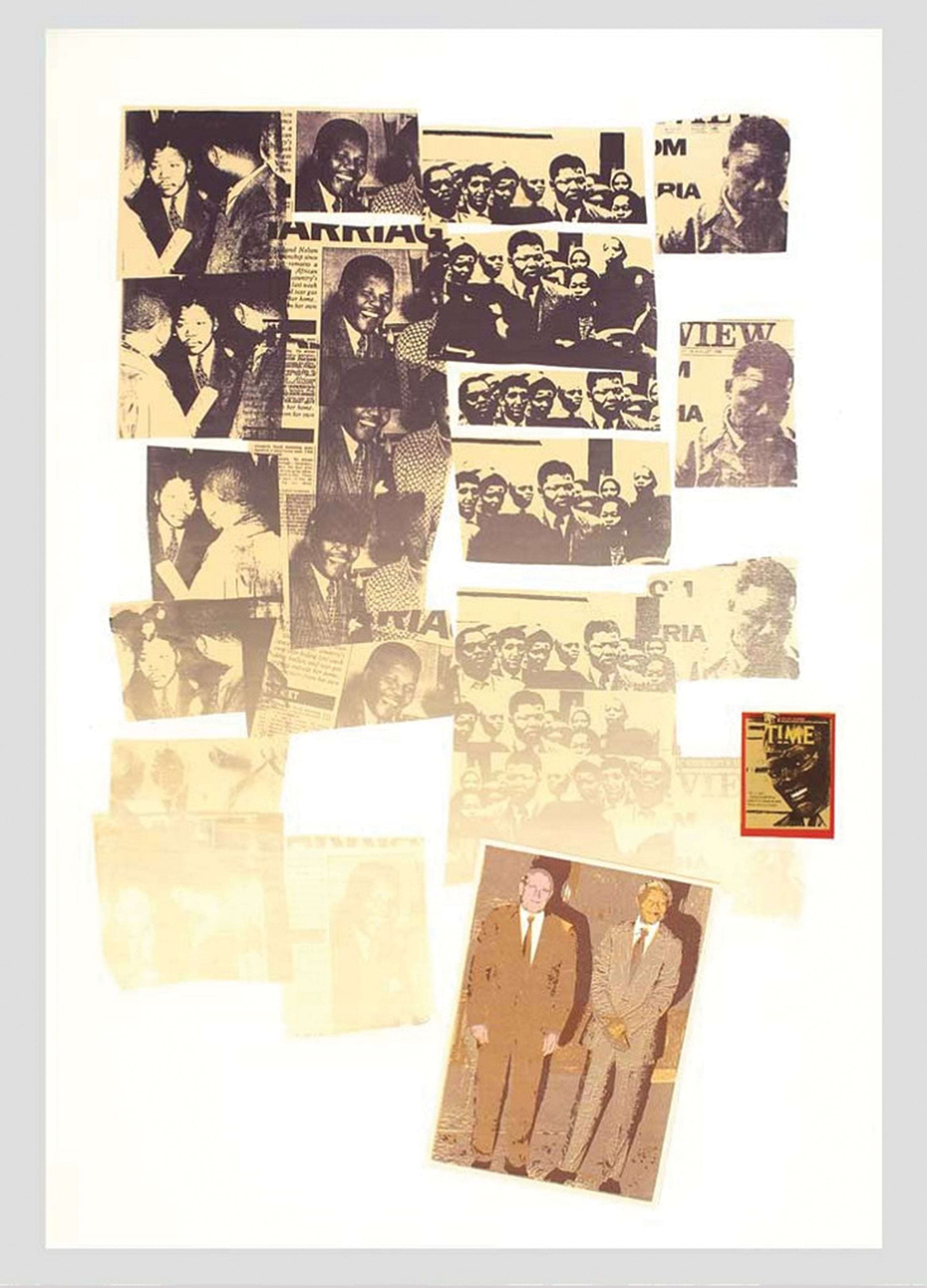
The intense anticipation surrounding Nelson Mandela’s release after 27 years of imprisonment centred not only on his freedom but also on the mystery of his image. During his time on Robben Island, all photographs of him were banned.
This work draws on early protest images, reproduced countless times over the years, and distills them into a faded, almost forgotten form. These images, once sharp in their defiance, now blur into the realm of memory.
The world expected the first photo of Mandela stepping into freedom to be one of jubilation and power, surrounded by his supporters. Instead, the first photo released to the world’s press came from the office of State President F. W. de Klerk. In a stunning public relations coup, De Klerk had himself photographed next to Mandela, who, dressed in a business suit, glances uneasily away from the camera.
In 1993, the two were jointly awarded the Nobel Peace Prize.