
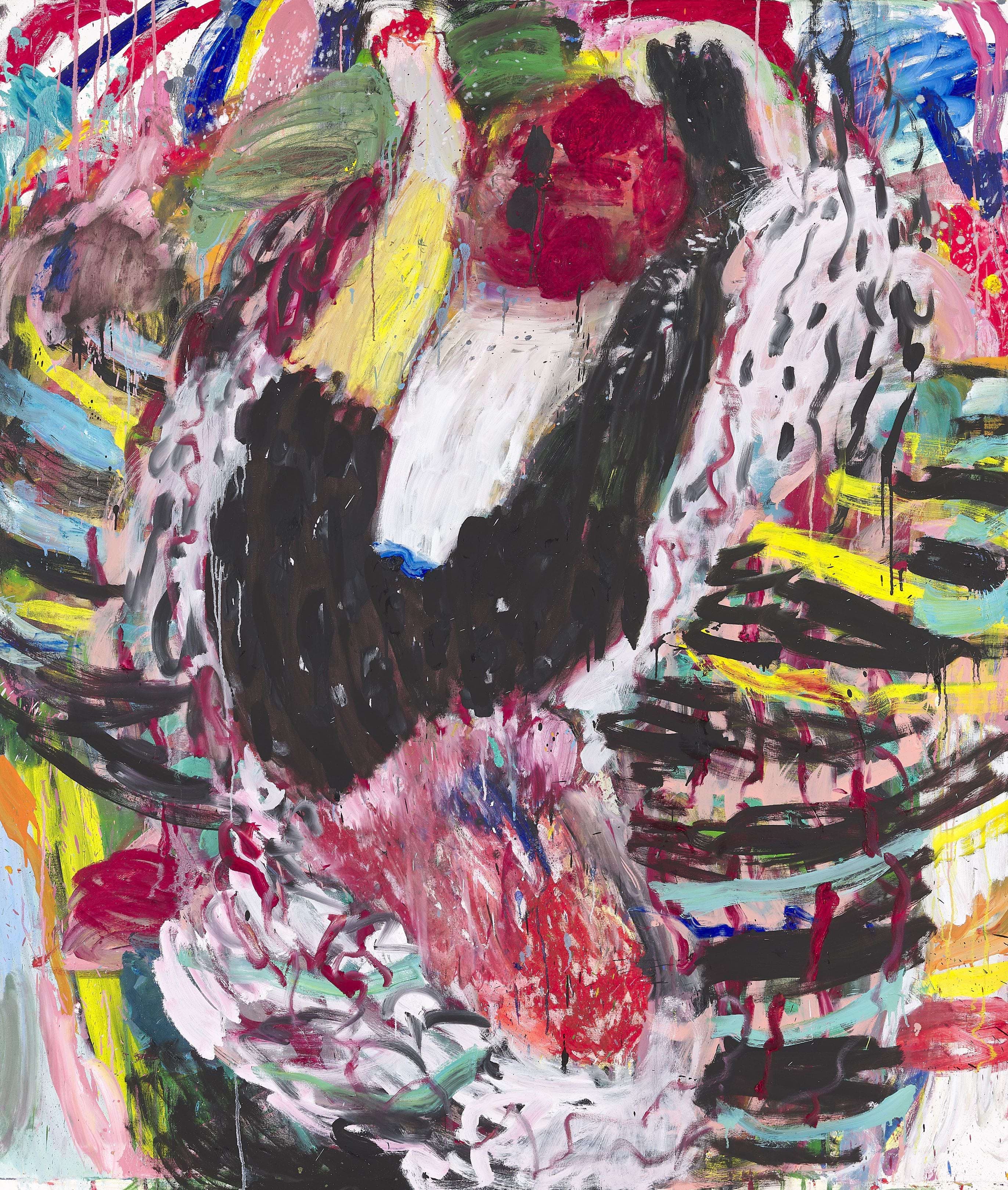
“What if history has not been told properly? What if only some of its characters have been revealed as part of the narrative? And what if our history is haunted by cyclical vi- olence precisely because it has not been buried properly?” Grada Kilomba asks.
In her series of photographic works 'Heroines, Birds and Monsters' (2020), Kilomba carefully captures the complexities of the characters in her video trilogy 'A World of Illusions' (2019); a series of filmic installations in which the artist brings the African oral tradition of storytelling into a contemporary context to illuminate memories and realities of the postcolonial world.
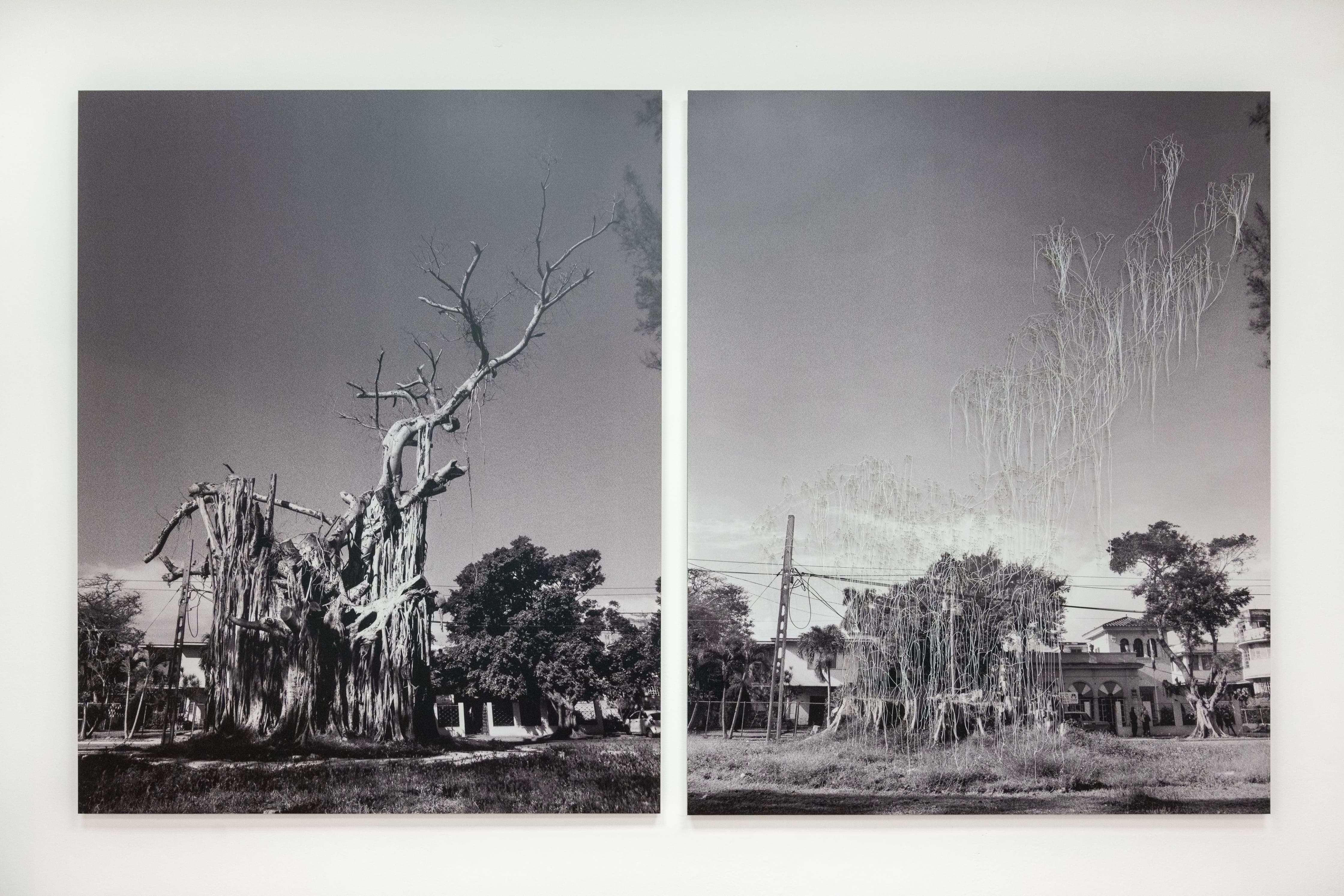
Through a multidisciplinary approach, Carlos Garaicoa addresses issues of culture and politics with a reflexive lens into architecture, urbanism and history. In his essay, ‘Between Apparatus and Subjectivity: Carlos Garaicoa’s Post-Utopian Architecture’, Okwui Enwezor described his practice,“Garaicoa is perhaps one of the most significant artists of his generation to develop a sustained aesthetic and analytical framework that would fuse the heritage of modern Cuban art and its complex political structure.” Garaicoa combines photographs, drawings and mixed media as forms of intervention to examine architecture and urbanism as mirrors of political reality and social development.
Through black and white photographs, he merges imagery of dilapidated buildings and structures with imaginary buildings whose construction was never completed. The work is a form of criticism against the government, which has not prevented the decay of Havana, since the Cuban revolution. For various years, Garaicoa has been working on a series of black and white mural photographs of different buildings in Havana integrated with thread drawings. In his work, what may seem at first glance as diametrical opposition produces generative intrapsychic tensions that can be explored and reconfigured —cityscape against nature, history against futurity, reconstruction and ruination— sitting squarely at the centre of these tensions.
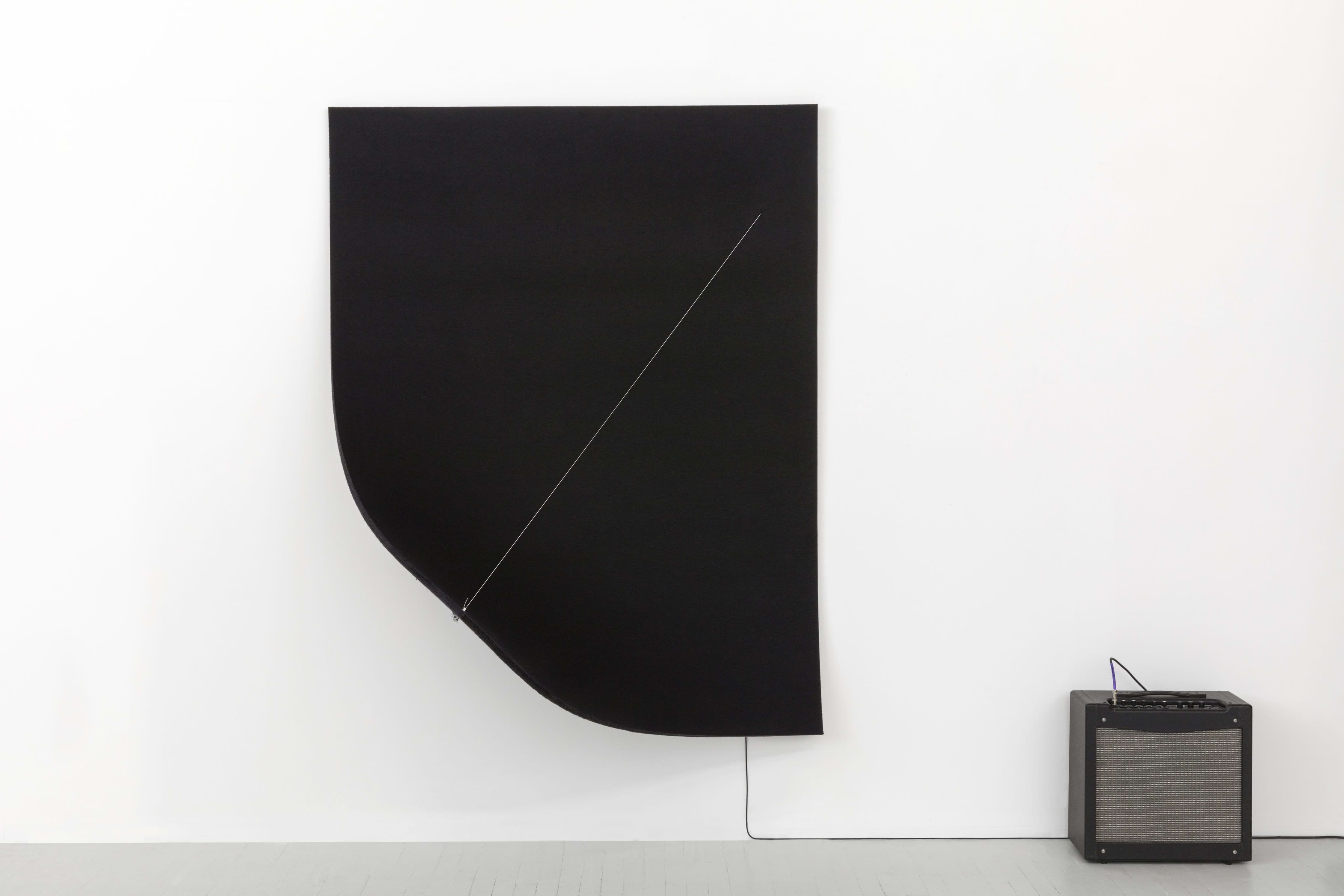
In this ongoing series of work, Naama Tsabar transforms raw industrial felt into modifiable stringed instruments. Through the addition of carbon fibre and guitar tuning pegs, the felt pieces take on new features that contradict their natural character. The work recalls the post-Minimalist art of the 1970s, extending its application by merging minimal aesthetics with performativity. Viewers are invited to directly engage with the works by plucking the strings and creating a new acoustic landscape. The works output sound through human encounter —tightening or loosening the strings changes the degree of the bowing of the sculptures as well as the sound they emit. The transformative nature of the work is such that the appearance of the sculptures, their erectness or flatness, directly corresponds to the pitch they produce. Reflecting on the use of felt as a material in her earlier works, Tsabar notes; “I was thinking about Robert Morris’s post-Minimalist gravity felt sculptures, and the deadening of sound in relation to Joseph Beuys’s felt suit for a piano. My first two pieces were on the floor, and in late 2015 I moved up to the wall.”
[Bomb Magazine, Sculpture and Sound: Naama Tsabar Interviewed by Naomi Lev, 2018].
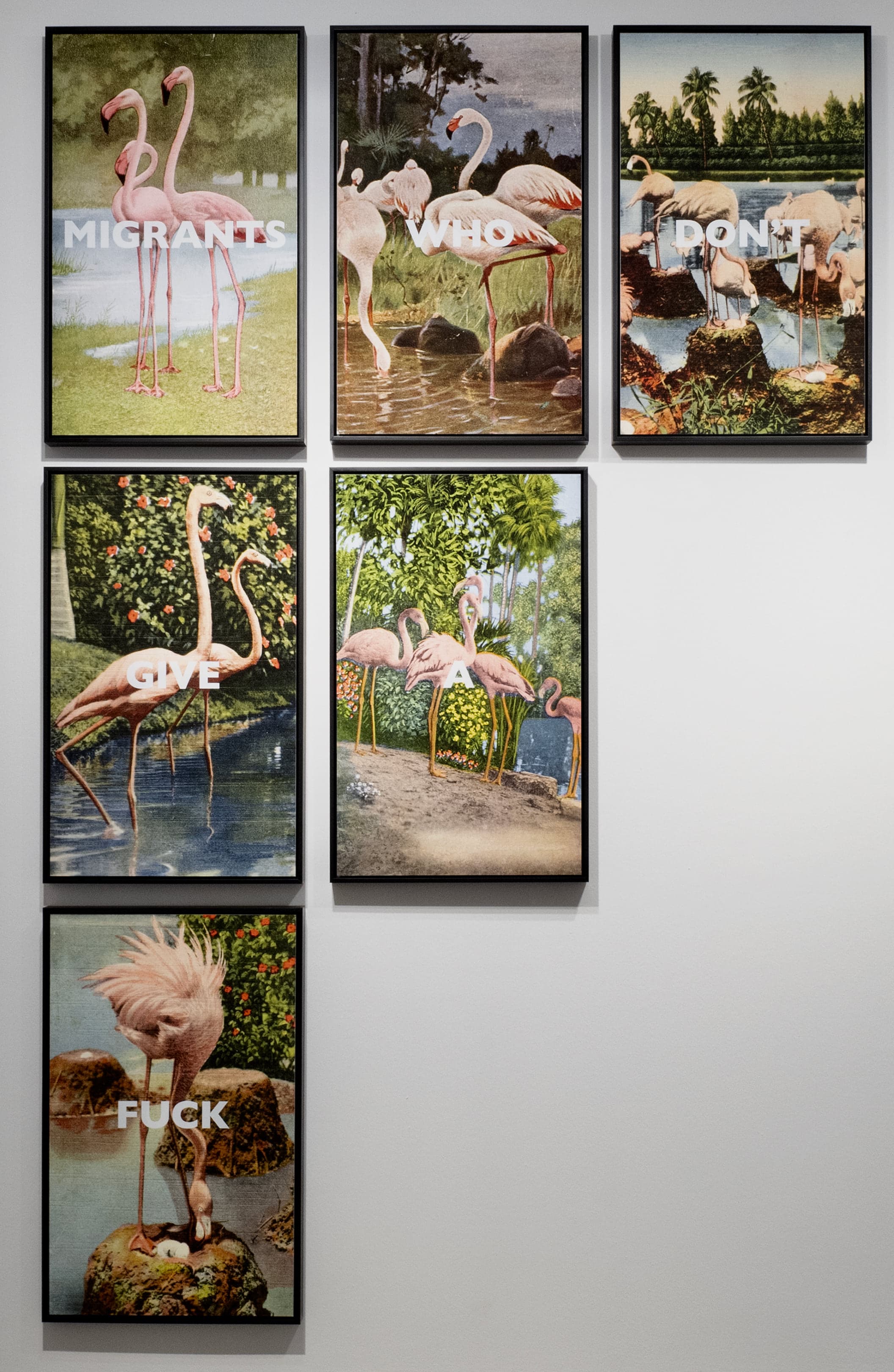
The theme of migration and mobility is evoked by the image of flamingos, birds with a nomadic lifestyle which for the artist symbolize migration as a human, free and universal phenomenon. 'Migrants Who Don't Give a Fuck' is made up of vintage postcards of pink flamingos in various natural settings. Each postcard corresponds to a word that makes up the sentence of the title, ironically testifying to independence from rules and regulations that can limit their freedom of movement. The work is a poetic image of the animal kingdom, presented as a territory of absolute autonomy from the human one.
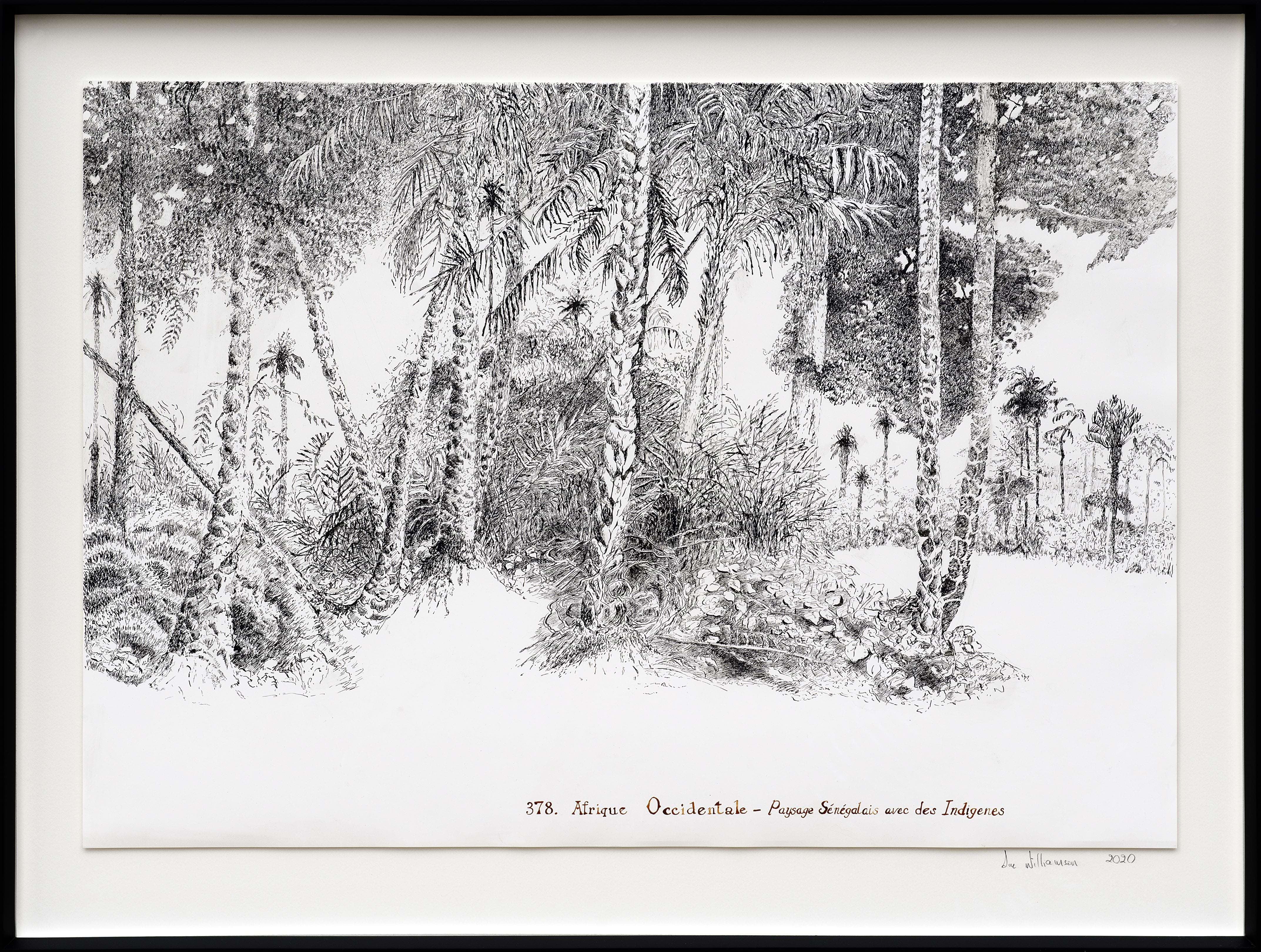
The ongoing series ‘Postcards from Africa’ engages with vintage postcards from the early 20th century, originally produced by European colonists and photographers. Part of a global craze for this new form of communication, these postcards were intended to demonstrate colonisation’s civilising effect on the dark continent, or to depict Africa as an exotic landscape for European audiences. Sourcing these images from archives, Williamson reimagines them through intricate ink drawings, layering cross-hatching and a faded palette. The drawings retain traces of habitation or recent activity — ripples in the water suggest children at play, a canoe floats on a lagoon at dusk, on a deck, fish are being chopped up, a load of wood floats in mid air, —but the people once pictured as part of the landscape are absent.
In a text by Nkopoleng Moloi for Williamson’s exhibition, ‘Distant Visions’ in 2021, “Postcards hold traces of historical memory, and through her evocative ink drawings with their deliberate erasures, Williamson seeks to confront the painful and unresolved legacies of colonialism — an important juncture in world history that has never been fully reckoned with, and whose catastrophic effects continue to be felt by millions of dispossessed peoples across the globe. In this instance, the absence makes the violence visible”.
For quite a few years I have been thinking about my role as an artist, the use and purpose of an artwork, as well as its activation and functionality.
Over time, I began using less rationality and more affection, emotion and hospitality as part of my approach to making art. That’s why I usually include a gesture of hospitality in my exhibitions, such as a piece of furniture to sit or lay down on. The idea being to spend time and remind yourself that you are not there just to watch, you are an active part of it.
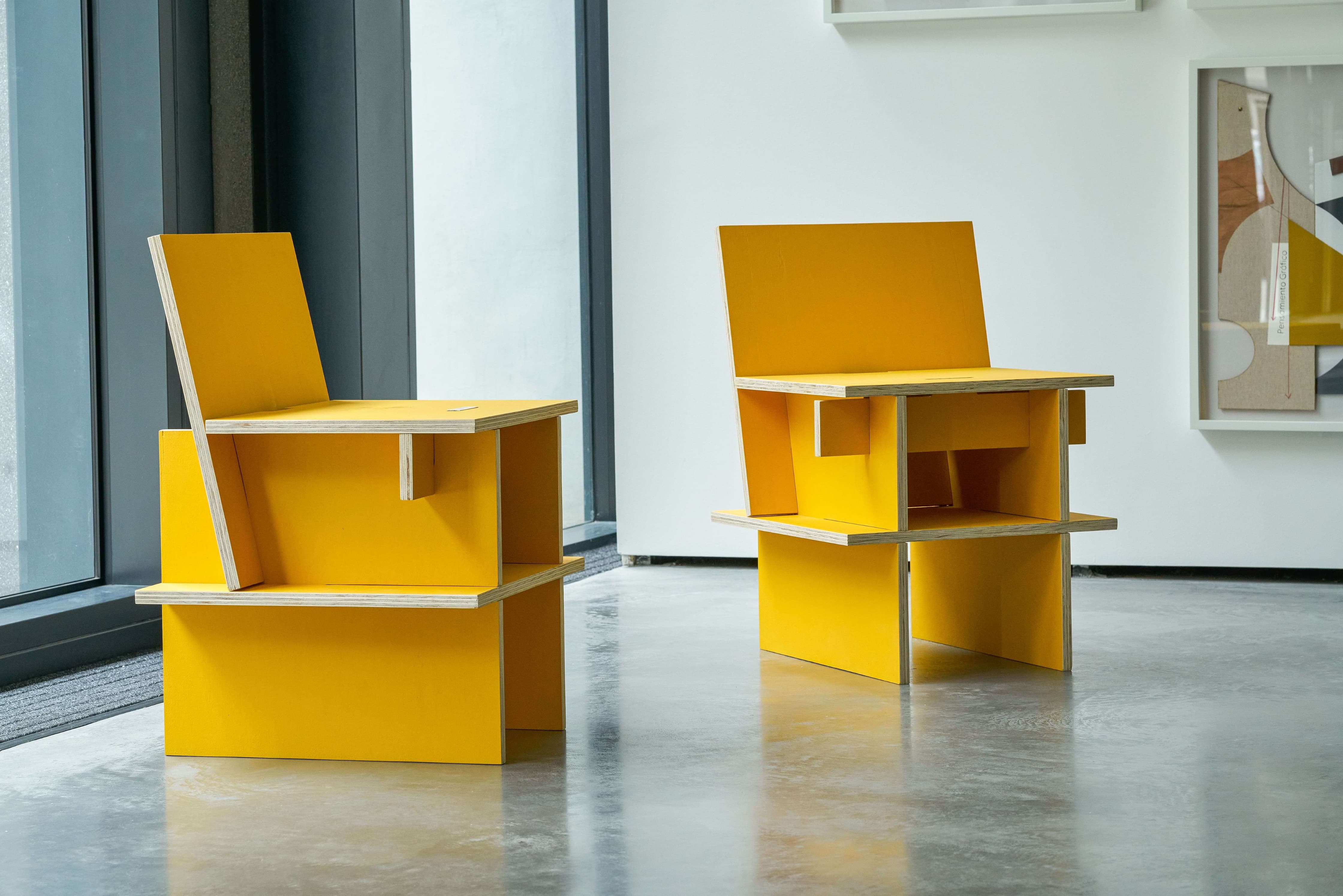
These two chairs, titled Sillas Núcleo will be replacing the chairs the gallery usually has in the space to host visitors. They are very simple chairs comprising six interlocked pieces. If you were to explode out all the individual pieces into their individual parts floating in the space, the chromatic Turmeric yellow might remind you of Hélio Oiticica’s Grande Nucleo. This work is a homage, and a reference to Oiticica and that generation of artists experimenting with the idea of a radical approach to art.
- Mateo López, 2020.
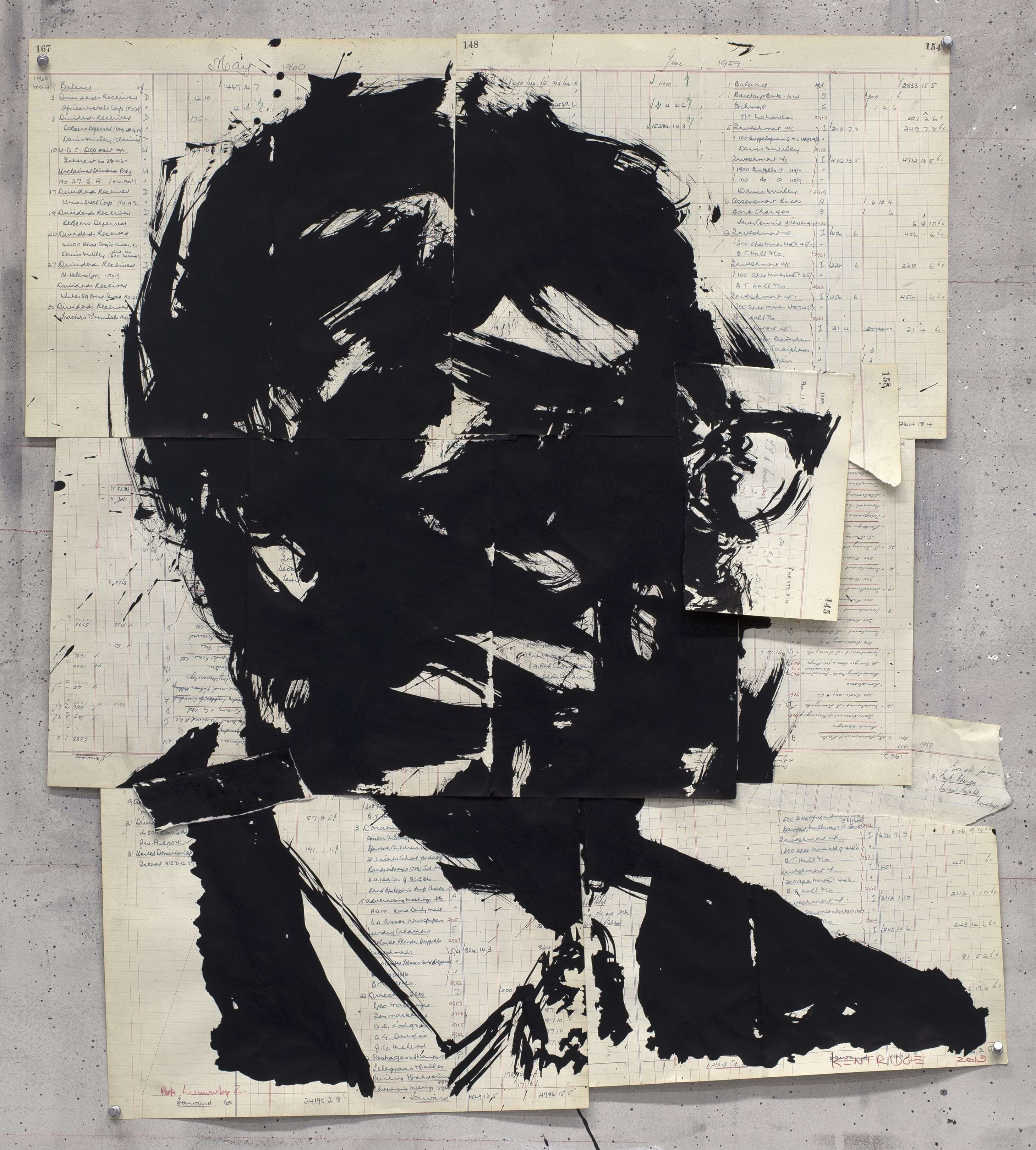
Untitled (Patrice Lumumba II), 2016 was drawn for William Kentridge’s three-channel film installation, Notes Towards a Model Opera.
The project began with an invitation to show Kentridge’s work in a museum in Beijing.
Kentridge writes,
“What is it in my work that would interest people there? I wanted both to find a link to it and to make a work that would refer to this question. Drawing, film, performance, posters, sculptures - all was possible, everything was open. The project begins, as many do, with distracted reading and looking. I read the books of Lu Xun, a modernist whose sensibility placed him with Japanese writer Aktagawa and European writers in the tradition of the absurd modern like Gogol and Kafka. Books of revolutionary posters. Here the language pulled me in, the exhortations, the instructions, the clamor of incredible and unstoppable enthusiasm.”
Rooted in the extensive research into the intellectual, political, and social history of modern China, from Lu Xun to revolutionary theater, Notes Towards a Model Opera explores dynamics of cultural diffusion and metamorphosis through the formal prism of the eight model operas of the Cultural Revolution.