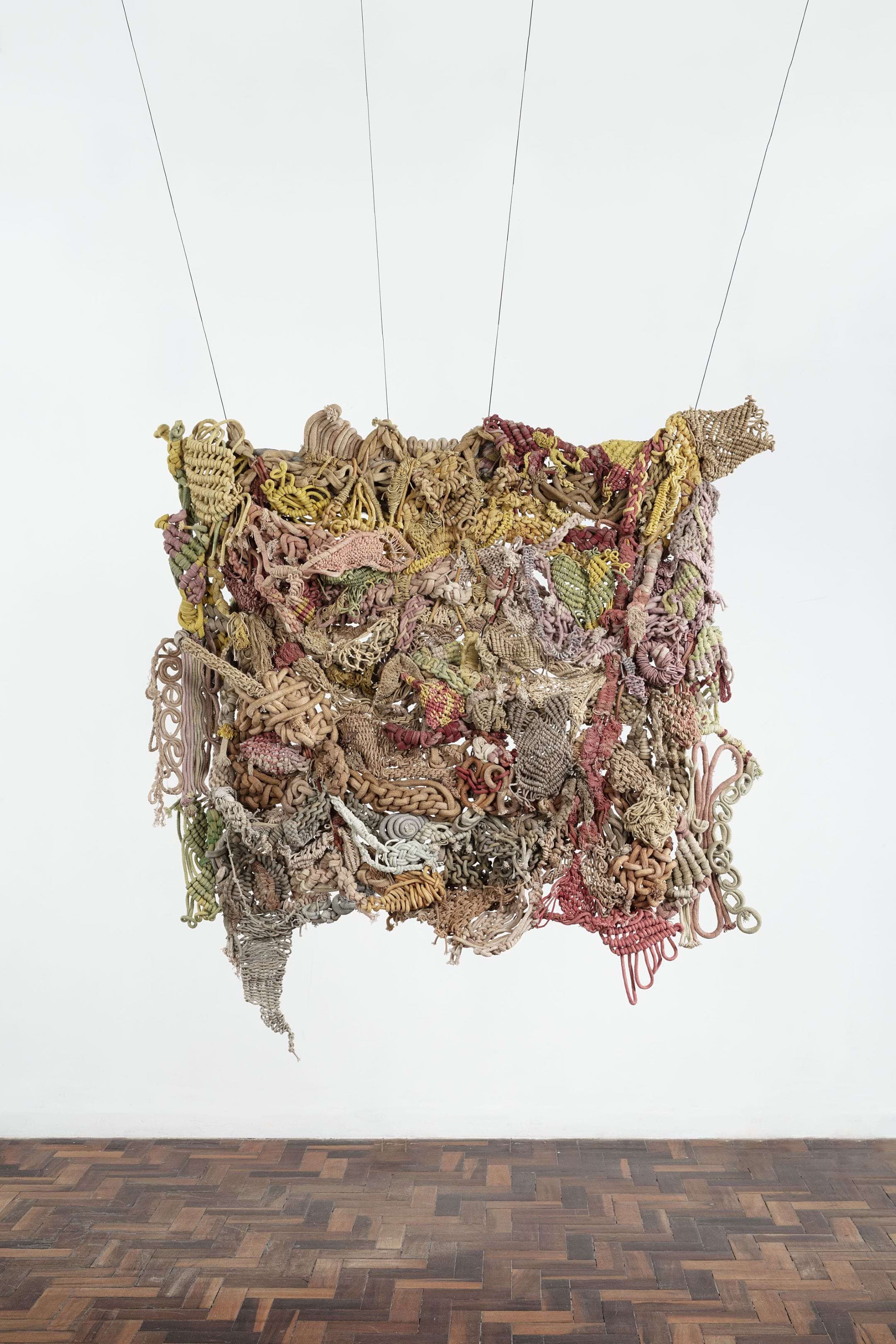
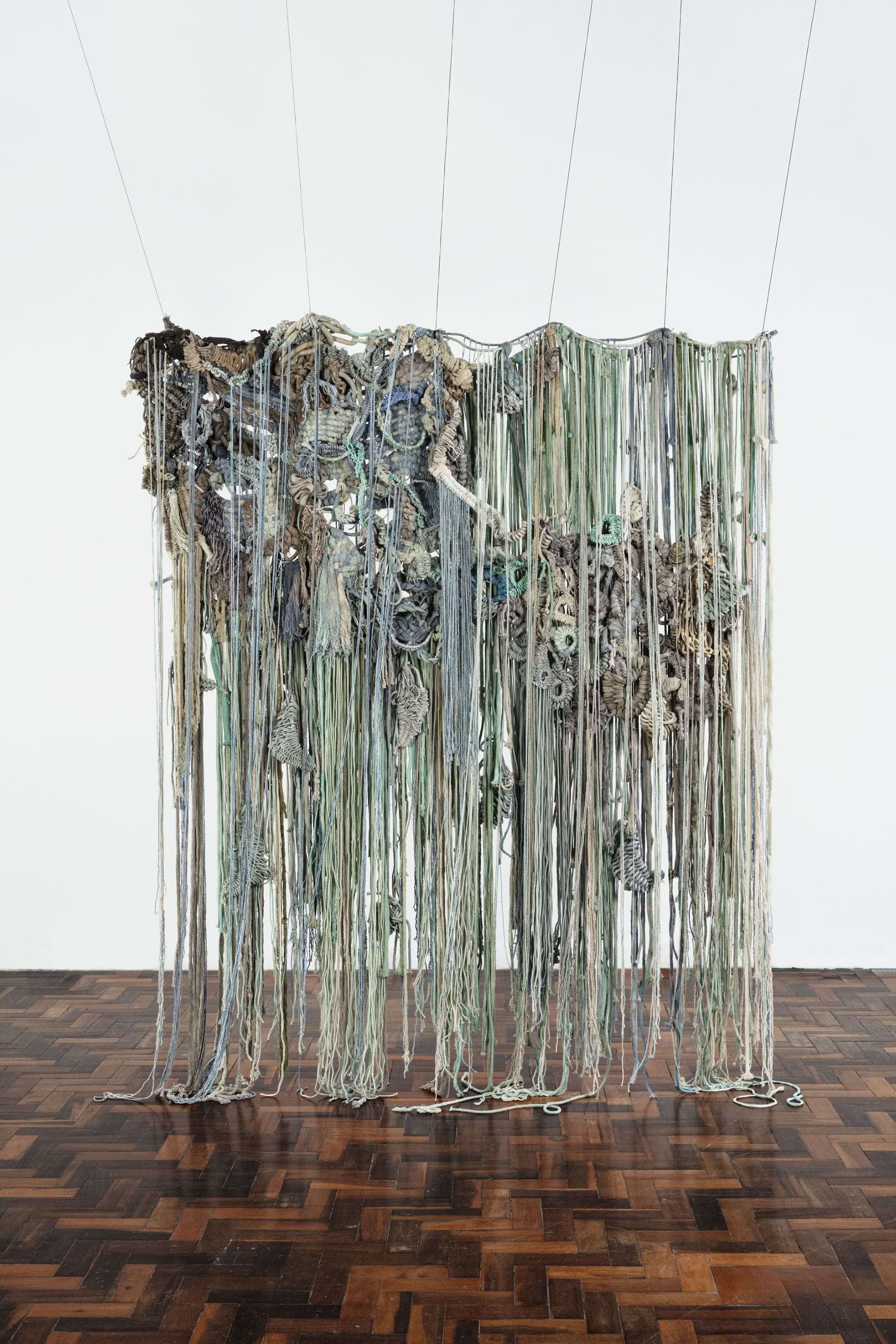
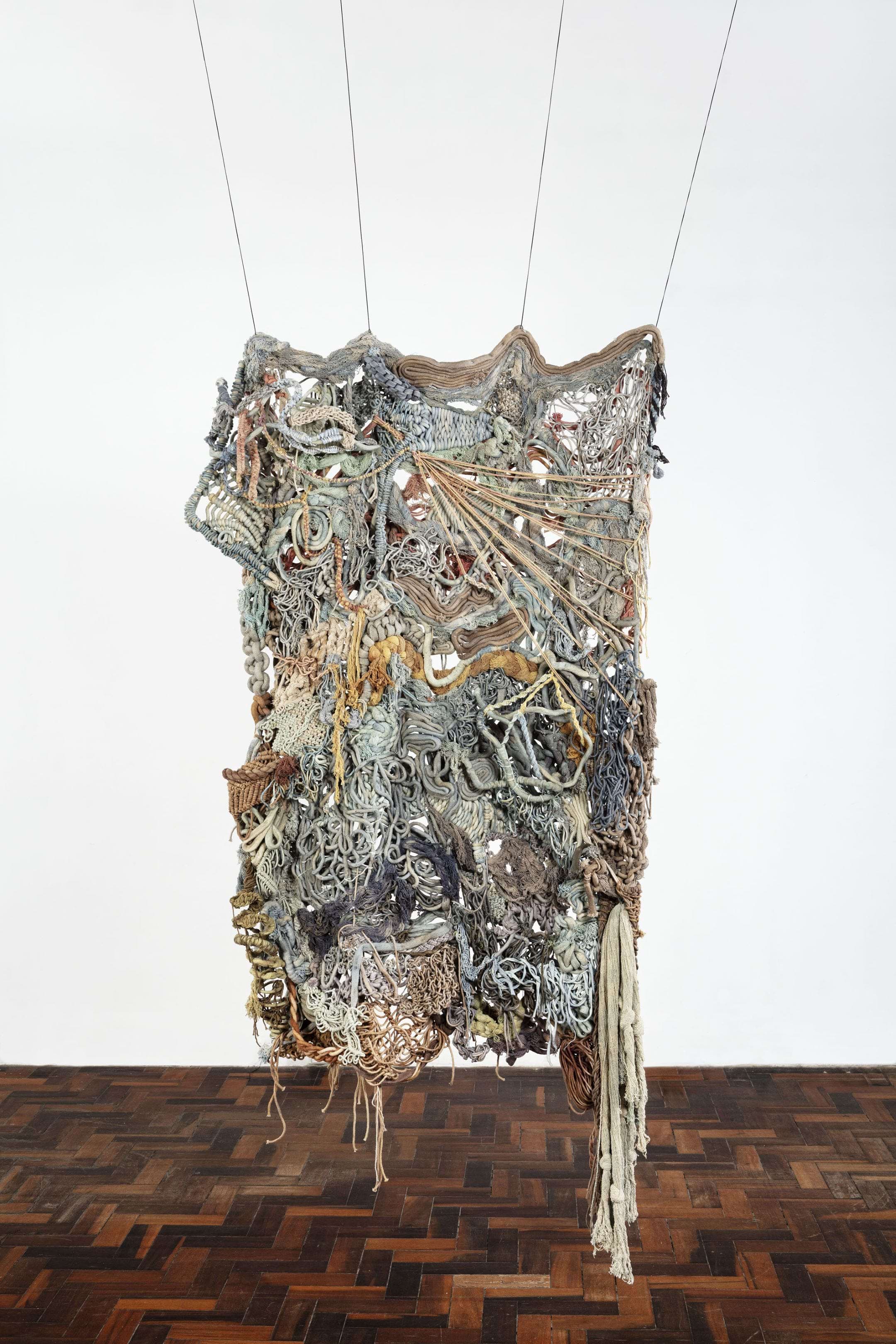
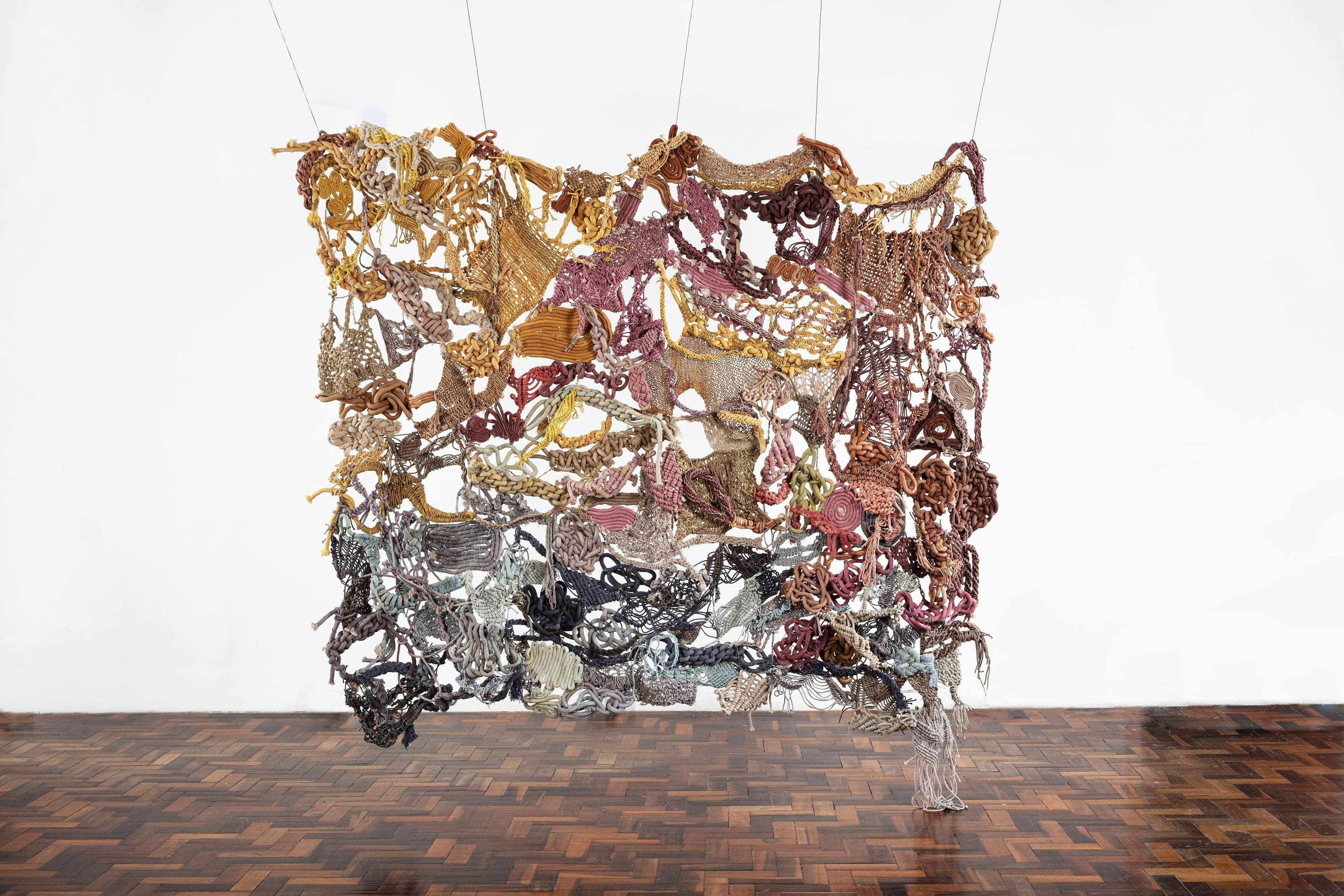
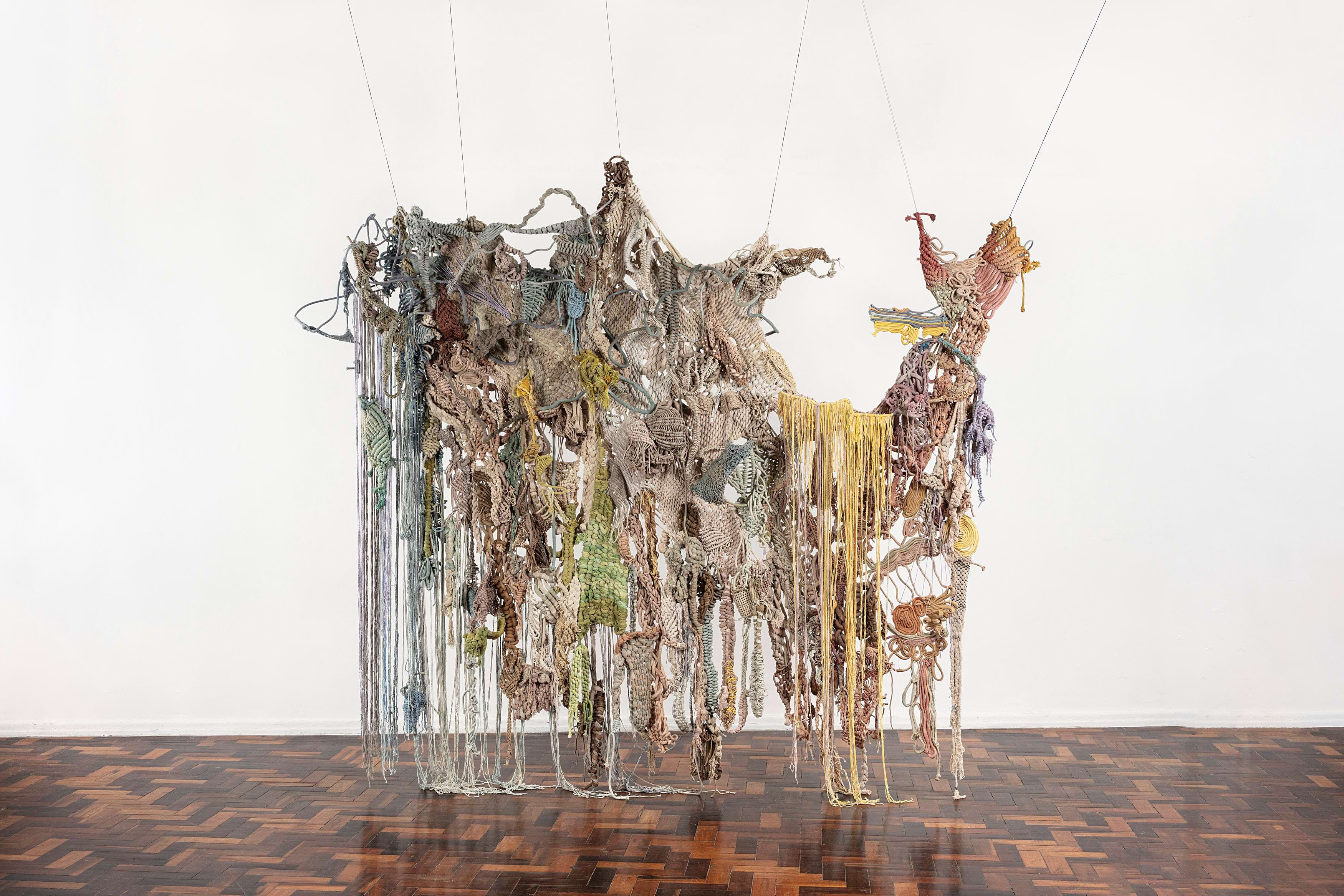
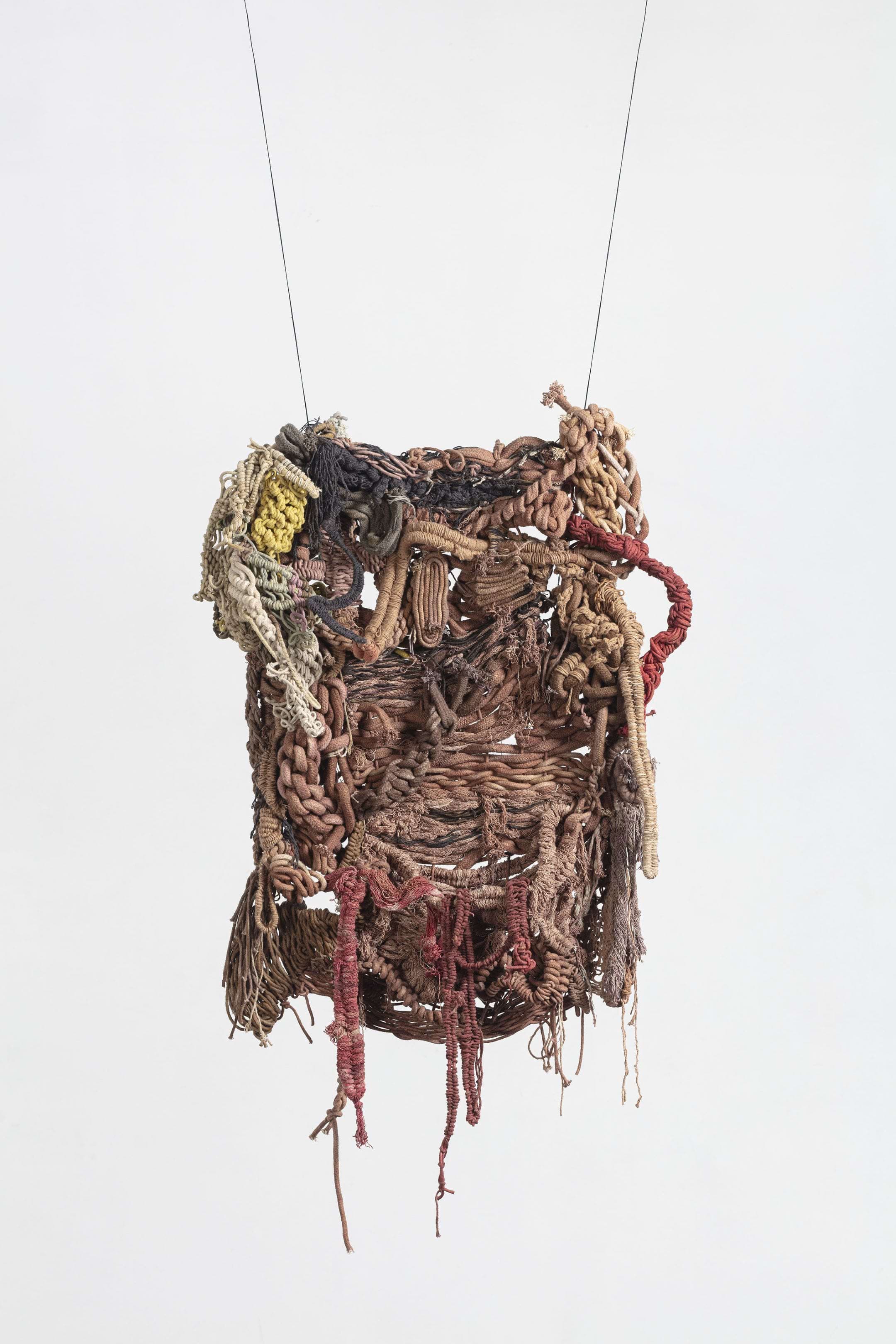
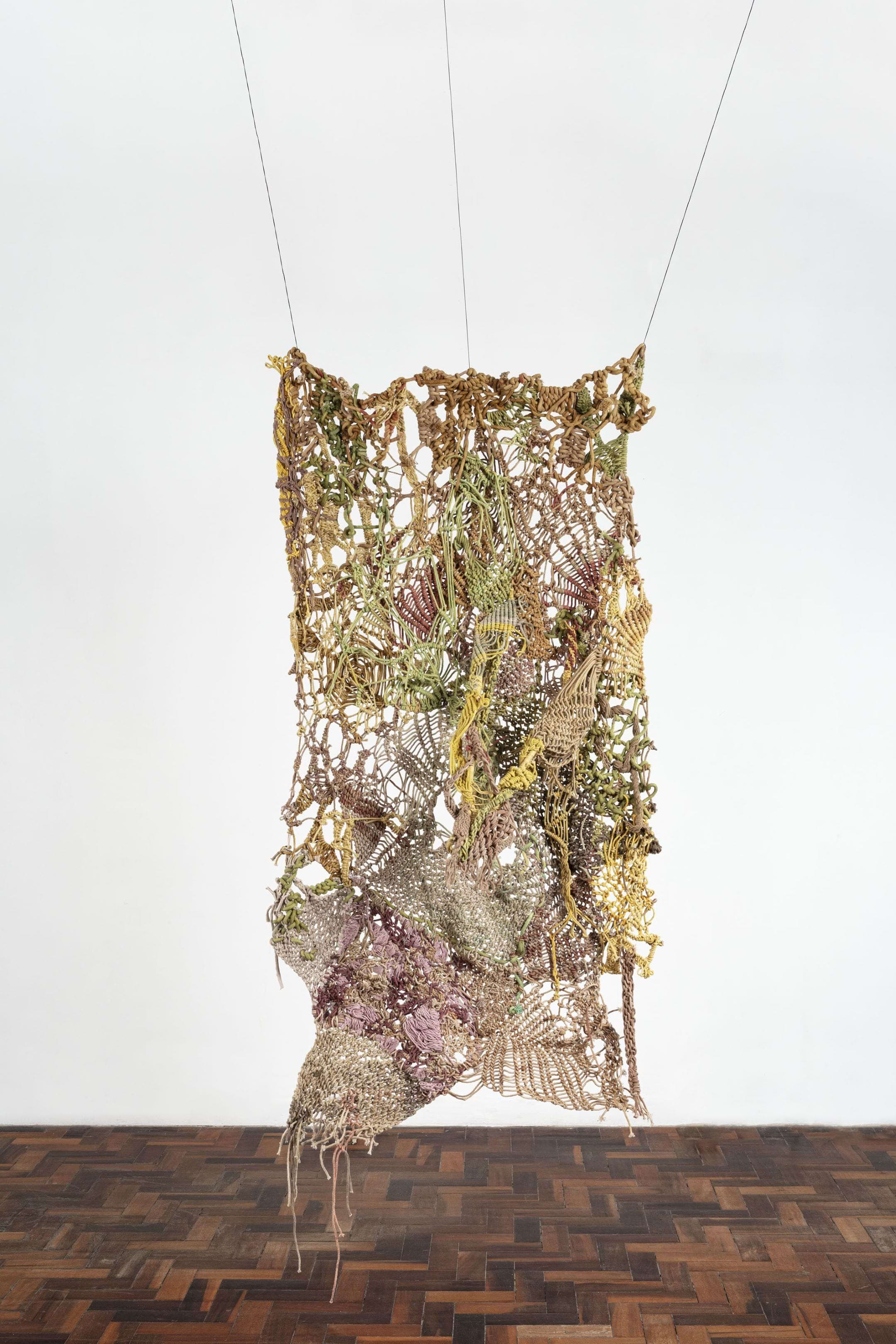
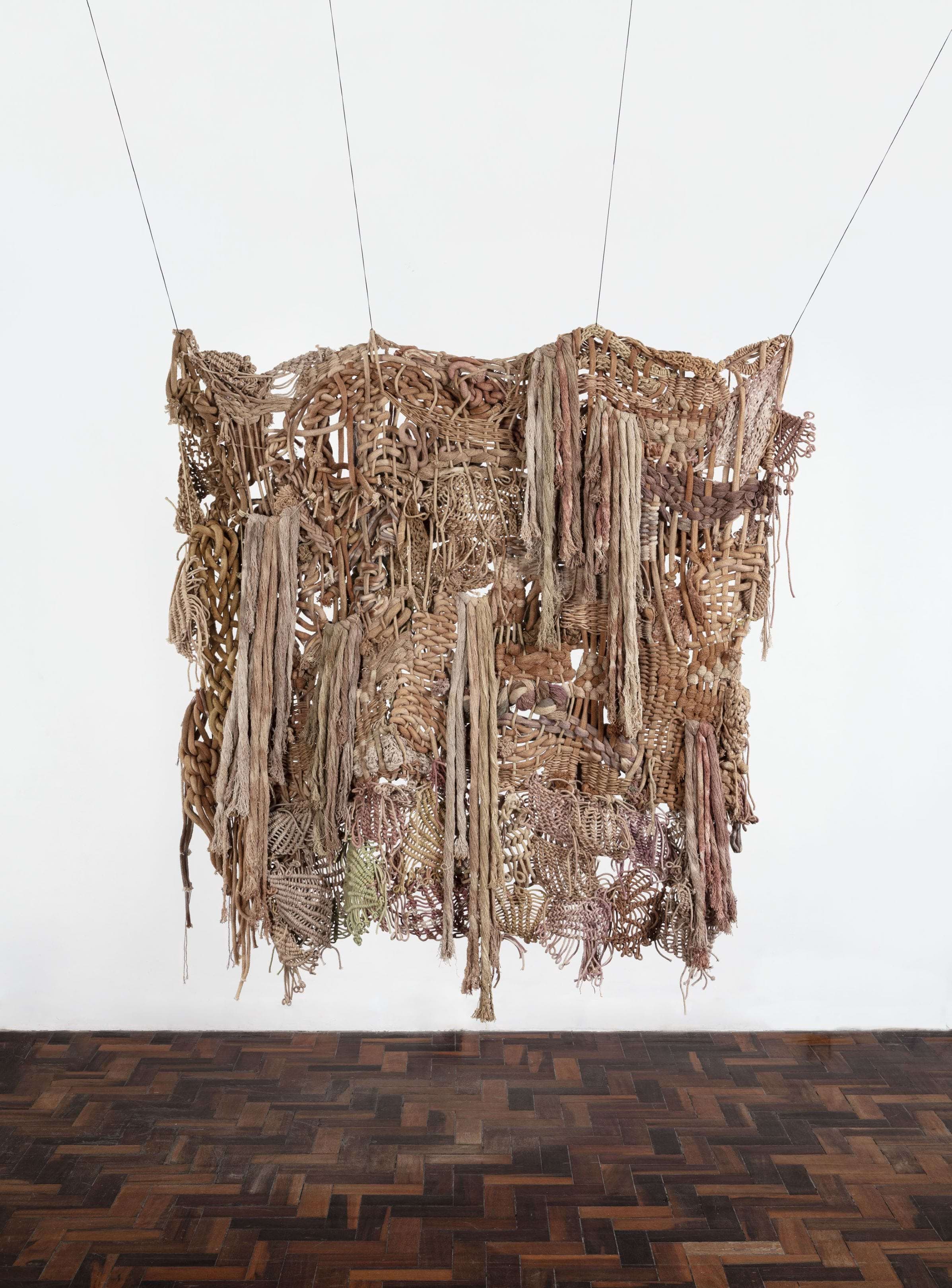
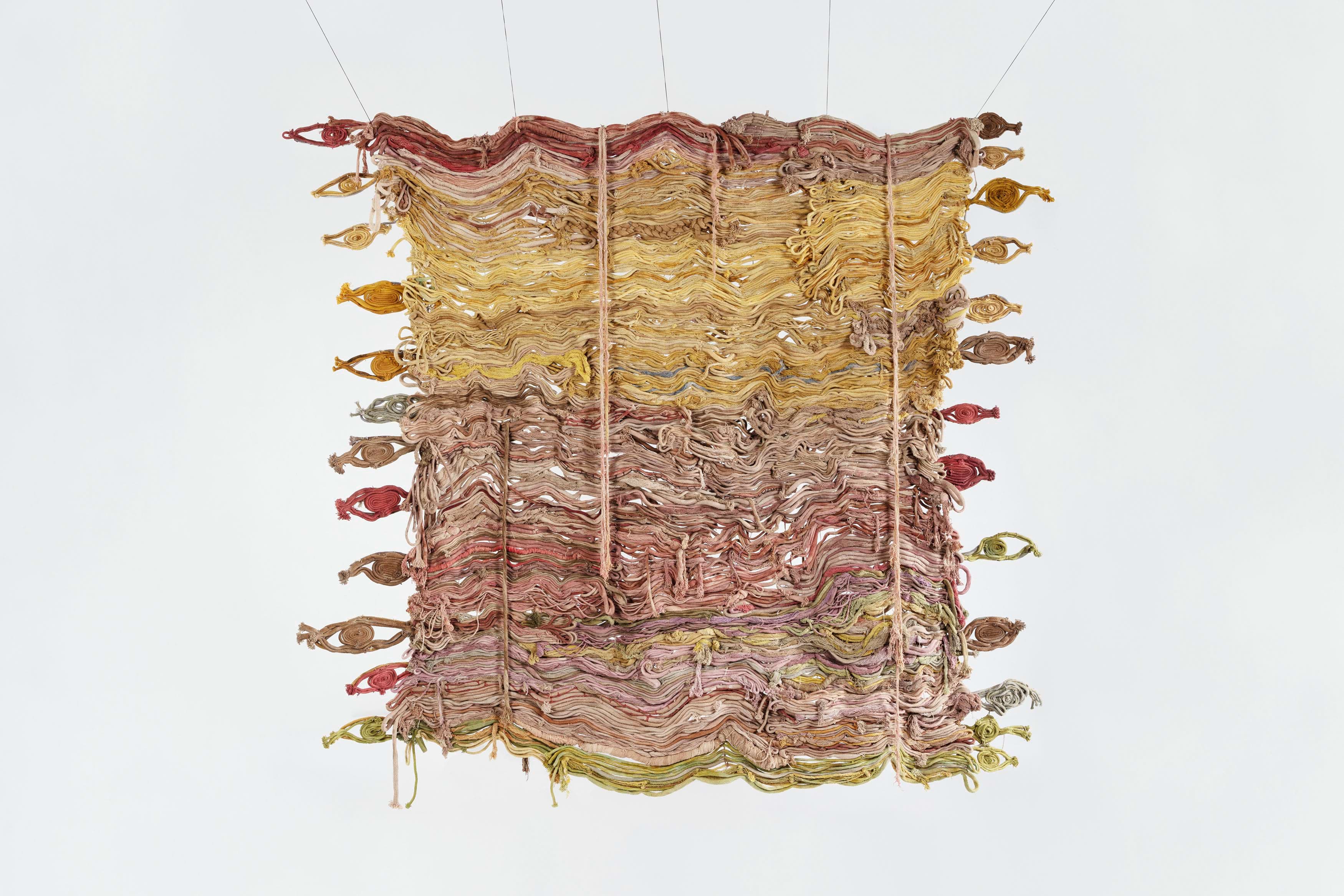
Laura Lima’s practice is grounded in Brazilian cosmologies, natural processes, and the transformative potential of materials. Over the past two decades, she has developed a body of work that moves fluidly between installation, film, textiles, and performative gestures, combining philosophical inquiry with tactile experimentation. Her works often evolve over time, allowing for discolouration, decay, and disintegration to play an active role in shaping meaning and form.
Porosity and tension are central to Lima’s sculptural environments. Woven structures with deliberate gaps invite viewers to move through and around the work, encouraging shifts in perspective and engaging the body in the act of looking. In this way, Lima disrupts passive viewing and fosters a more embodied and perceptual encounter with the artwork.
Tutu draws on the folkloric figure of Tutu Marambá, a fearsome creature used to frighten children, whose story blends European origins with African linguistic influence. The name Tutu is derived from quitutu, an Angolan word meaning "ogre." Described in some versions as quarrelsome and covered in fur, and in others as a being with no fixed form, the creature embodies uncertainty and transformation. Lima translates this myth into a sculptural form composed of raw cotton threads dyed with natural pigments such as indigo, red cabbage, black beans, turmeric, and hibiscus, combined with steel wire. The resulting work suggests a shifting presence, where material and myth are held in a state of quiet tension, open to movement, change, and interpretation.
Charía is part of the Tupi-Guarani mythology. It is believed that eclipses are caused by a bluish jaguar eating the sun and moon. When the world ends, she will descend into the world and devour people. Until then, she rests beneath the hammock of Nhanderuvuçu, the supreme god.
Raw cotton threads dyed by natural pigments (indigo, red cabbage, black beans, porangaba) and steel wire
Omar is, in Guyanese folklore, an aquatic spirit with the body of a crab and a giant fish. The Omars like to eat rotten wood, sinking boats when they mistake them for floating logs. Legend has it that a “Peaiman” (shaman or sorcerer) carefully rolled up two pieces of wood used to light fires so that they would not get damp. Then he let himself be swallowed by an Omar. Peaiman found a lot of wood inside the monster's belly, and set it on fire. Omar felt a lot of pain, rose to the surface, belched the shaman and died.
Raw cotton threads dyed by natural pigments (black acacia, indigo, beetroot, coffee, chamomile, carqueja, onion, marsh cane, avocado seed, mackerel, mate tea, black tea, clove vine, crajiru, turmeric, fennel, maitén, avocado leaves, cashew leaves, chestnut leaves, tobacco, hibiscus, iron mordant, sweet paprika, brazilwood, red cabbage, salt, seven sangria, senna, annatto, vinegar, red wine) and wire.
Laura Lima’s work often unfolds at the intersection of mythology, material transformation, and philosophical inquiry. Her sculptural environments invite the passage of time – welcoming natural processes such as discolouration, decay, and erosion as integral to the evolution of each piece. Working across installation, film, textiles, and performance, Lima constructs porous, tactile forms that resist fixity. Gaps and tensions within her woven structures activate space, drawing viewers into a shifting encounter where movement and perception become part of the work’s unfolding.
‘Matinta Pereira’ takes its name from a figure in Brazilian folklore – an ancient witch who transforms into a bird at night, perching on rooftops to frighten inhabitants into offering food. Rooted in stories most commonly told in Brazil’s North, yet varying across regions, Matinta is both feared and pitied, embodying transformation, cunning, and a hunger that cannot be easily satisfied. In Lima’s interpretation, the spirit is rendered through an intricate web of raw cotton threads, dyed with natural pigments interlaced with steel wire. The resulting form appears suspended, spectral, and alive with tension. As with the folklore it draws from, the work occupies a liminal space between human and animal, presence and absence, myth and material memory.
Irapuru is a magical red bird, a symbol of happiness in Brazilian folklore. According to the legend, a young indigenous man was cursed by a tribe chief for being in love with his daughter. The indigenous man became Irapuru and began to sing a beautiful song. The chief heard it and went into the forest to capture the bird, but he got lost and never returned. Irapuru still sings today, hoping that his lover will hear and recognize him. Whoever finds this bird gets a wish.
Raw cotton threads dyed by natural pigments (indigo, wine, red cabbage, porangaba, black tea, spinach, parsley, red beans, annatto, crajiru, redwood) and steel wire
Video
‘Caboclinho do Mato’ draws on a figure from Brazilian folklore – a small forest-dwelling man said to be one of the guiding spirits for shamanic apprentices. According to legend, Caboclinho was once an ordinary man who consumed such an overwhelming dose of ayahuasca that he crossed fully into the spiritual realm, body and soul, without dying. In Lima’s interpretation, this mythic transformation is rendered through an intricate structure of raw cotton threads, dyed using a vast range of natural pigments: black acacia, beetroot, indigo, turmeric, chamomile, avocado seed, tobacco, red wine, and many others.
The resulting form hums with layered meaning. Organic, vibrant, and richly textured, it evokes the forest’s dense, alchemical vitality – a space of both concealment and revelation. Steel wire lends subtle structure to the woven threads, suggesting a body suspended between worlds. As with much of Lima’s work, ‘Caboclinho do Mato’ resists clear categorisation, instead offering a sensorial encounter shaped by myth, material, and the transformative potential of ritual. It invites viewers to linger in ambiguity between human and spirit, forest and body, substance and vision.
Video
Laura Lima’s practice draws deeply from Brazilian mythology, natural processes, and the mutable qualities of materials. Over the past two decades, she has worked across installation, film, textiles, and performance-related forms, weaving together philosophical inquiry with tactile experimentation. Her work often engages the passage of time and organic transformation inviting elements such as decay, discolouration, and disintegration to become active agents in shaping the work’s meaning and form.
Porosity and tension are central to Lima’s installations, where gaps in woven structures invite movement and contemplation. Viewers are encouraged to shift position, navigate space, and animate the performative charge that pulses through her environments. In this way, Lima dismantles passive viewing, replacing it with a heightened physical and perceptual awareness.
‘Ipupiara’ draws on the figure of a mythical sea creature from Brazilian folklore – a cannibalistic merman said to be half man, half sea lion, covered in fur and possessing a cat-like moustache. To kill, it suffocates its victims in an embrace. The female Ipupiara, by contrast, is described as beautiful, with long hair. Lima references this duality through a sculptural construction composed of raw cotton threads dyed with natural pigments – wine, hibiscus, turmeric, spinach, almond leaves, and more – interlaced with steel wire and wood. The resulting form is both alluring and unsettling, suggesting a body in tension, suspended between myth and matter, seduction and threat.
‘Chupa Cabra’ draws on the mythical creature from folklore across the Americas, known for its reported attacks on livestock, particularly goats. The name, meaning “goat sucker,” refers to its supposed vampiric behaviour, feeding on the blood of animals under the cover of night. Often described in conflicting accounts, the Chupa Cabra occupies a space between fear and fascination, its form shifting across stories and geographies.
In Laura Lima’s interpretation, the creature is evoked through a richly layered construction of raw cotton threads dyed with a wide array of natural pigments including black acacia, beetroot, coffee, tobacco, red wine, and indigo, combined with steel wire. The resulting work carries a sense of suspended tension and restless energy, suggesting a presence that is both material and elusive. As with much of Lima’s practice, Chupa Cabra resists easy definition, inviting viewers into a space shaped by uncertainty, transformation, and the quiet persistence of myth.
Video
‘Anhanguá’ takes its name from a protective spirit in Tupi mythology – an elusive guardian of animals, especially females and their young. Traditionally appearing as a white deer with glowing red eyes, Anhanguá is known to shift form, embodying the fluidity and unpredictability of the natural world. In Lima’s interpretation, this mythic presence is translated into a sculptural form composed of raw cotton threads dyed with natural pigments – such as coffee, black tea, turmeric, hibiscus, cashew leaves, annatto, and more – interwoven with steel wire.
As with much of Lima’s practice, the work blurs boundaries between material and myth, structure and spirit. The delicately dyed threads create a tactile, porous body that resists fixed form, encouraging the viewer to move around it, to look closely, and to sense its quiet, watchful energy. At once fragile and resilient, Anhanguá honours the protective instincts embedded in myth, while drawing attention to cycles of care, transformation, and the intimate life of materials.