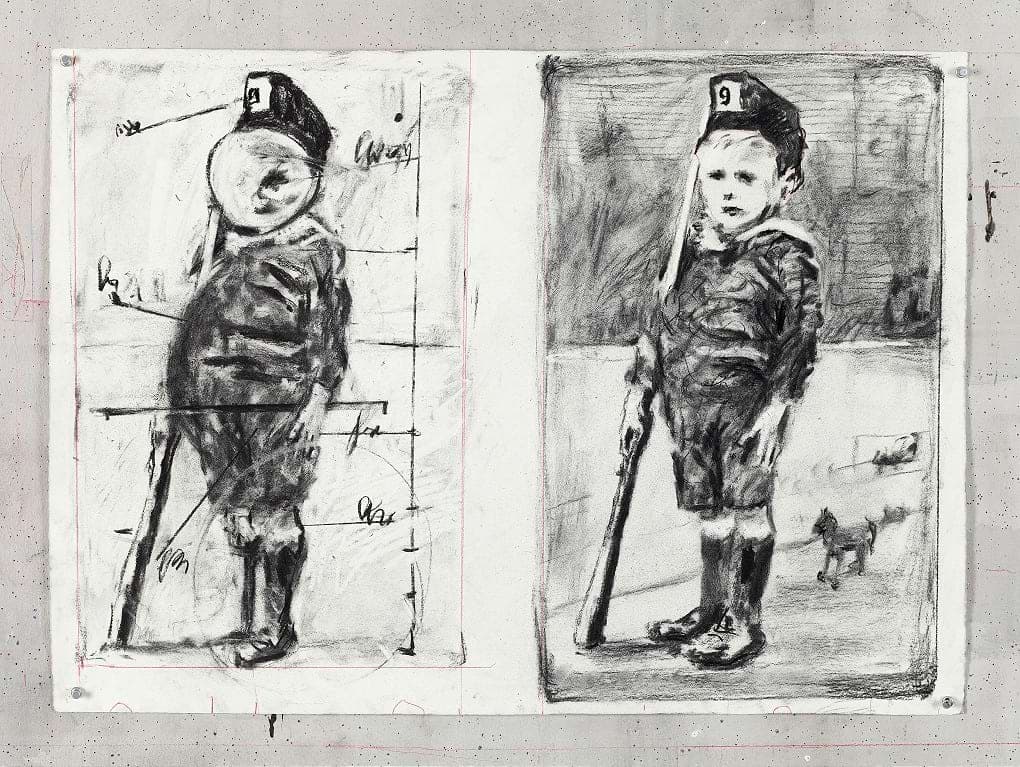
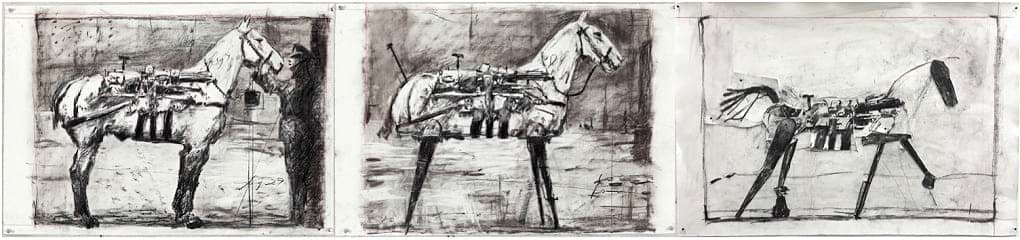

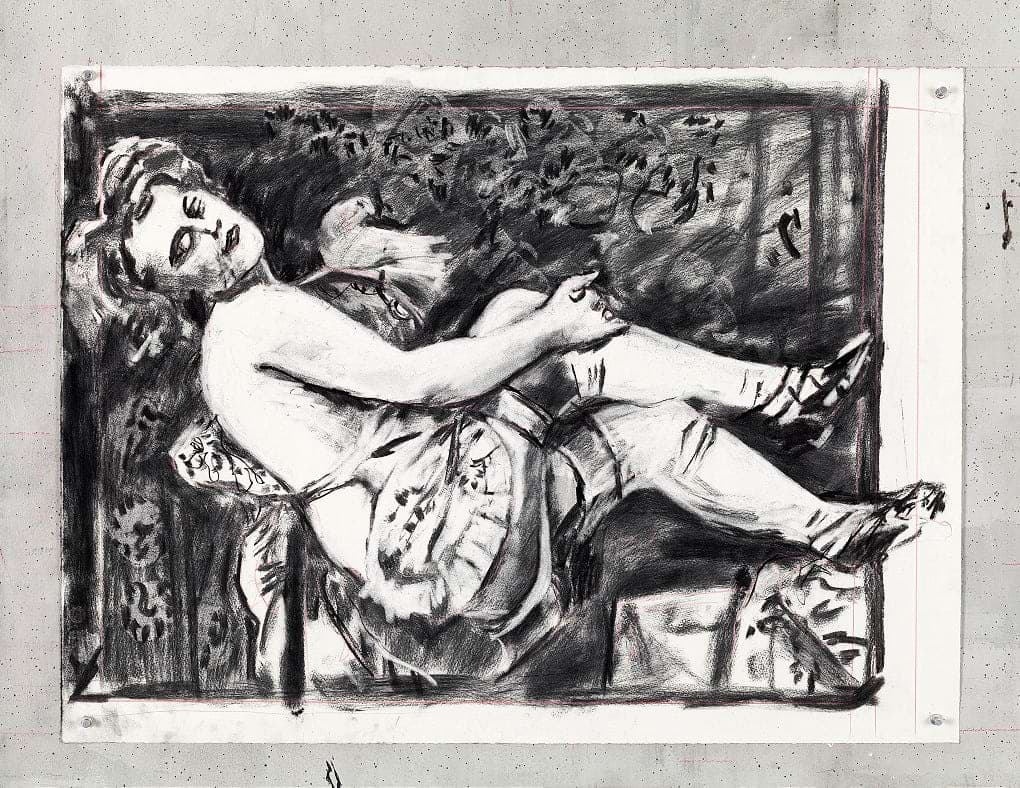
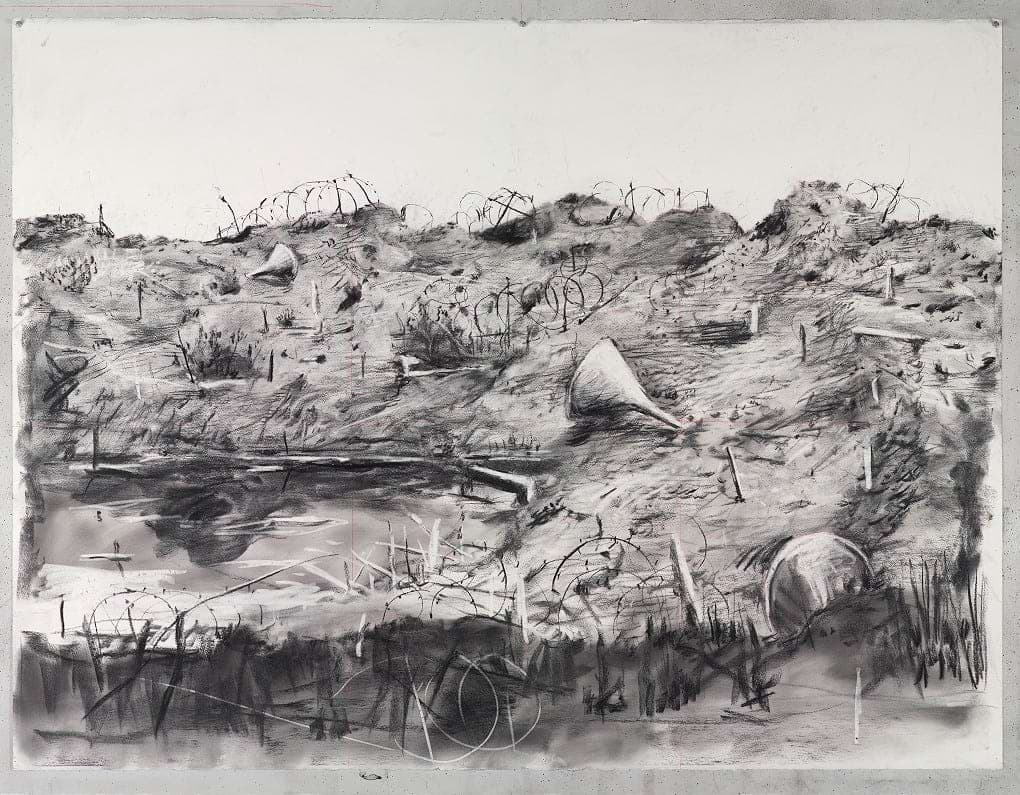
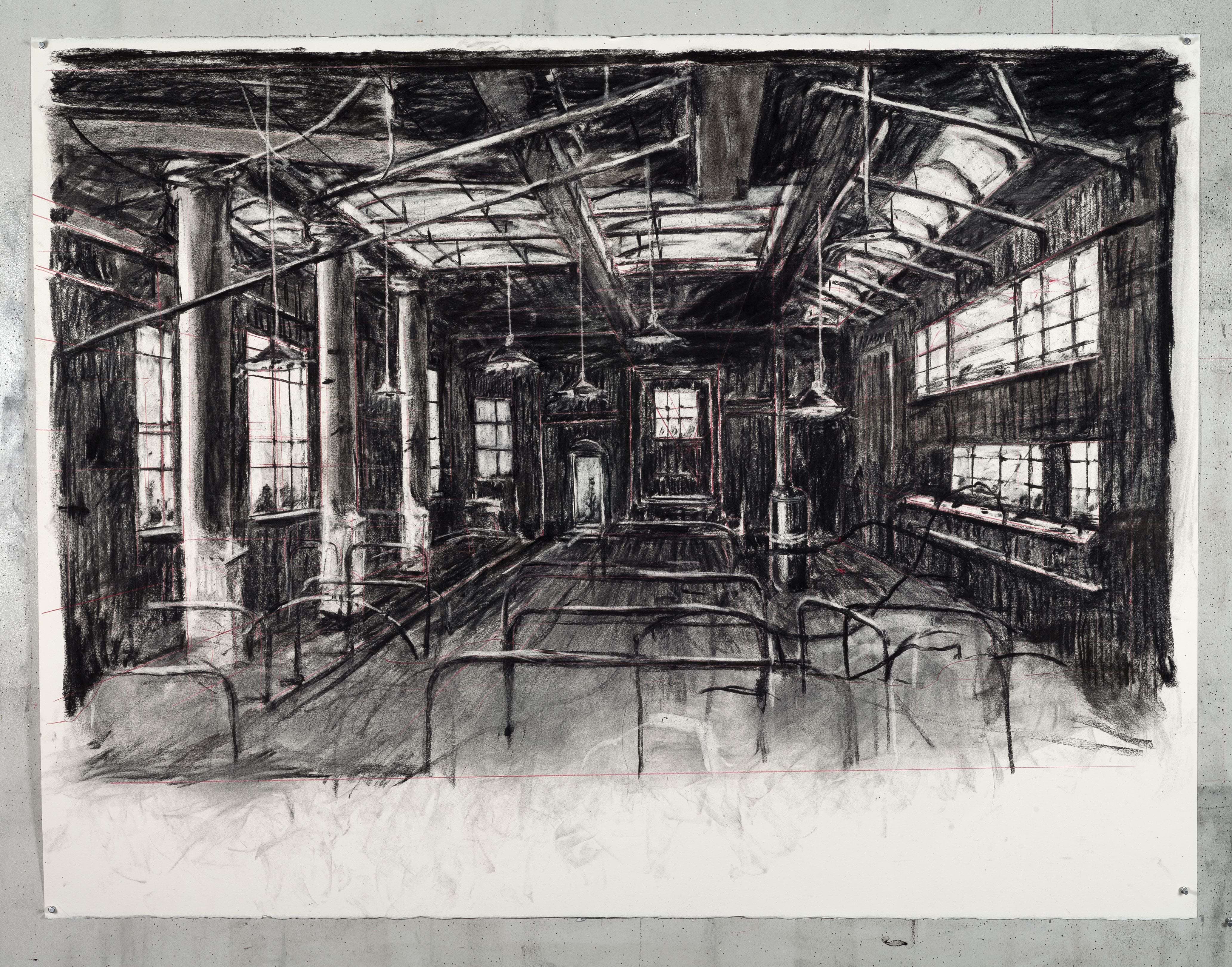

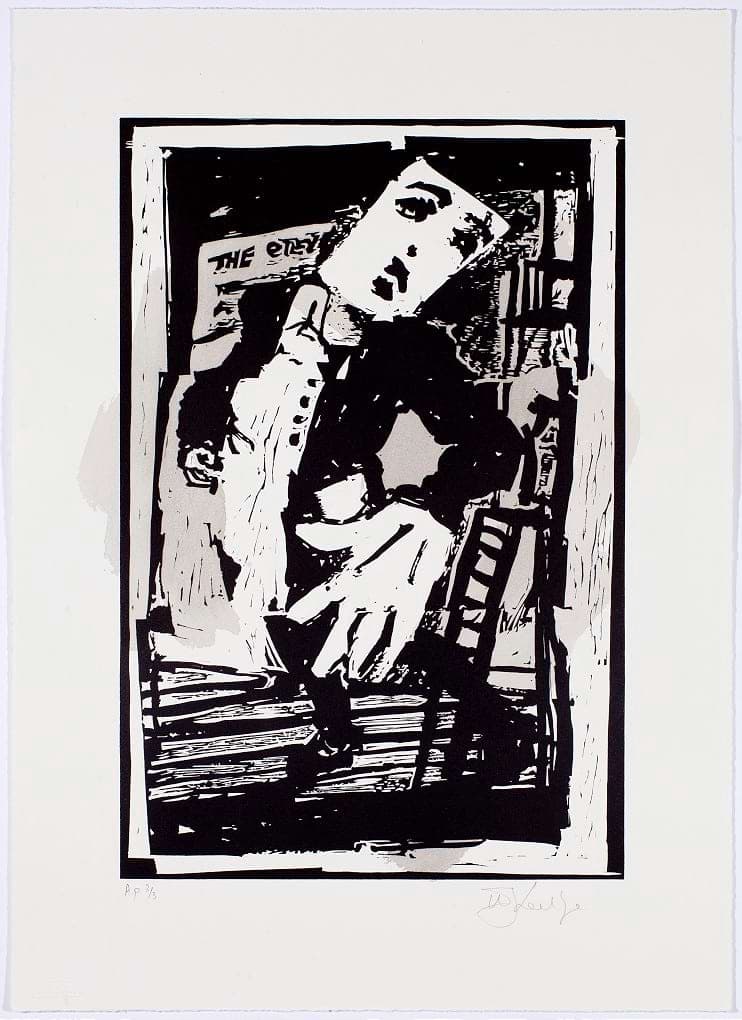
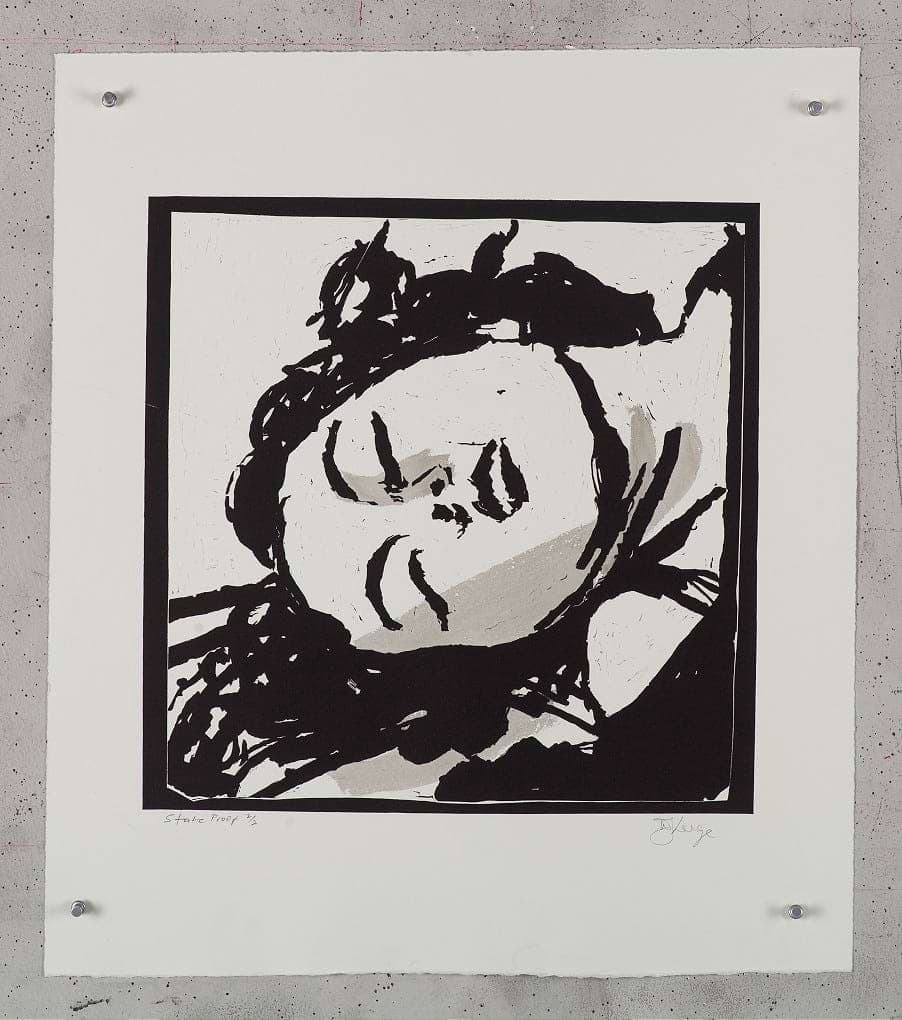
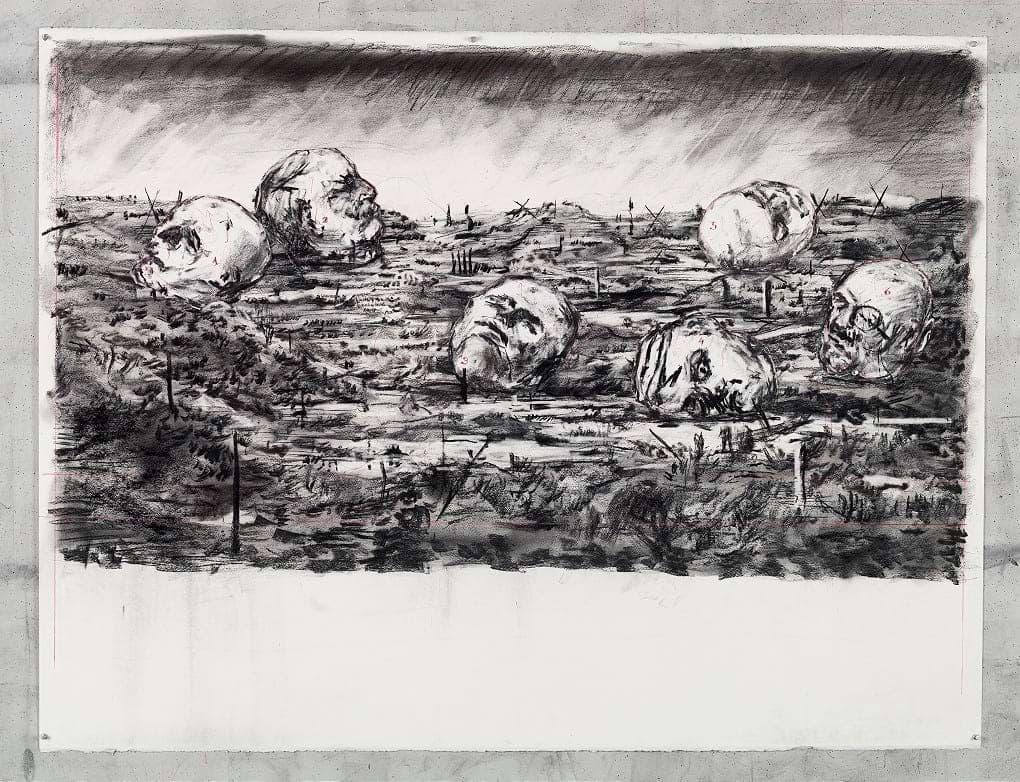
Kentridge was invited by the Salzburger Festspiele to be the creative director of a new production of Alban Berg’s opera, Wozzeck which premiered in Salzburg in the summer of 2017. He produced a number of charcoal drawings that were used as projected backdrops in the critically acclaimed production.
Kentridge chose to set the opera, based on the 1837 Buchner play of the same title, at the time of "The Great War" in Europe, as he found the play “a premonition of the war to come”. The aesthetic of this production is characterised by bleak landscapes, denuded of their trees and scarred by shell craters. Kentridge was inspired by documentary photographs, which depict the ravaged battlefields of Flanders. He explains that the opera had “to meet a material for it to take fire - with Wozzeck, it’s the roughness of charcoal drawing. So all of the projections are made out of charcoal drawings and there’s something in the graininess of the drawing itself that echoes both with the music, obviously, but also with the world that it’s depicting – of things transforming, of sounds under the earth.” Since the Salzburg premiere, the opera has been performed at the Sydney Opera House in 2019 and will next be seen at the Metropolitan Opera, New York and Toronto, thereafter.
Kentridge was invited by the Salzburger Festspiele to be the creative director of a new production of Alban Berg’s opera, Wozzeck which premiered in Salzburg in the summer of 2017. He produced a number of charcoal drawings that were used as projected backdrops in the critically acclaimed production.
Kentridge chose to set the opera, based on the 1837 Buchner play of the same title, at the time of "The Great War" in Europe, as he found the play “a premonition of the war to come”. The aesthetic of this production is characterised by bleak landscapes, denuded of their trees and scarred by shell craters. Kentridge was inspired by documentary photographs, which depict the ravaged battlefields of Flanders. He explains that the opera had “to meet a material for it to take fire - with Wozzeck, it’s the roughness of charcoal drawing. So all of the projections are made out of charcoal drawings and there’s something in the graininess of the drawing itself that echoes both with the music, obviously, but also with the world that it’s depicting – of things transforming, of sounds under the earth.” Since the Salzburg premiere, the opera has been performed at the Sydney Opera House in 2019 and will next be seen at the Metropolitan Opera, New York and Toronto, thereafter.
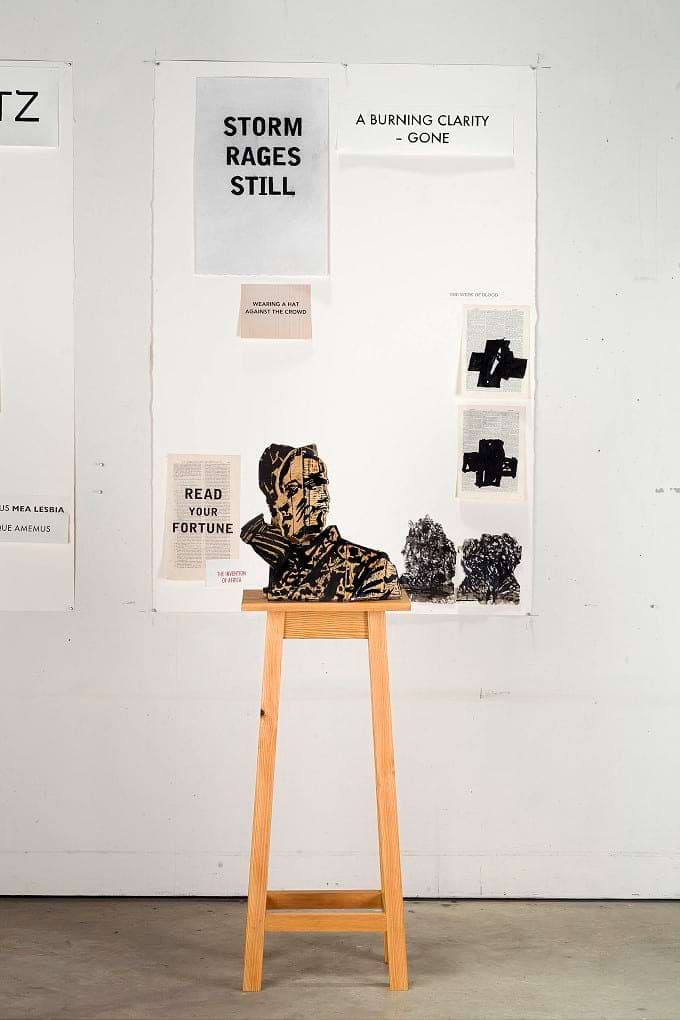
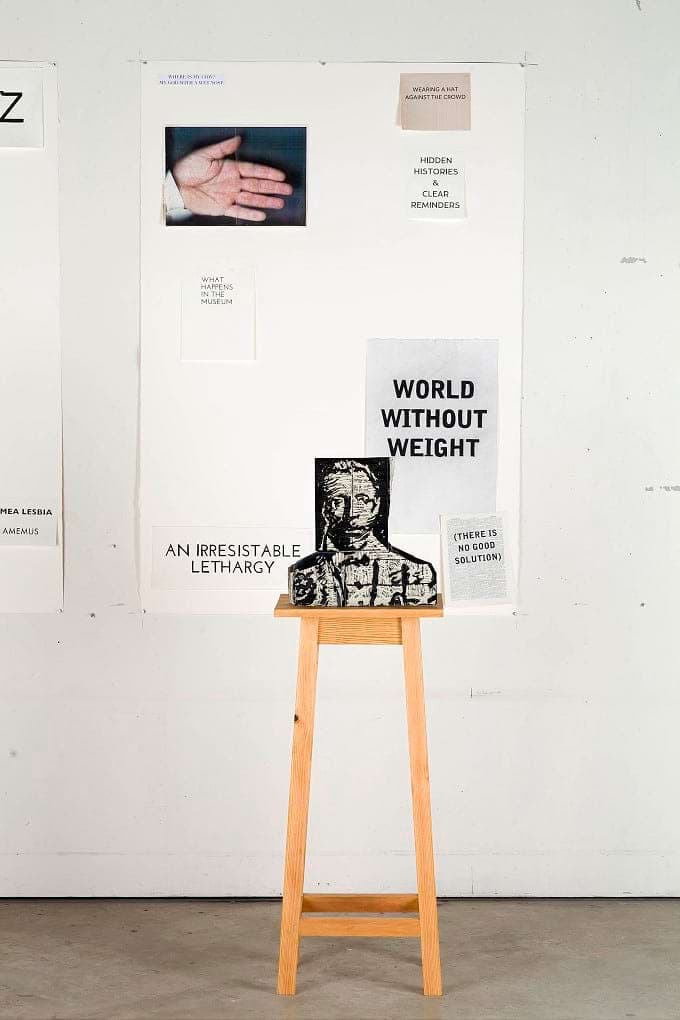
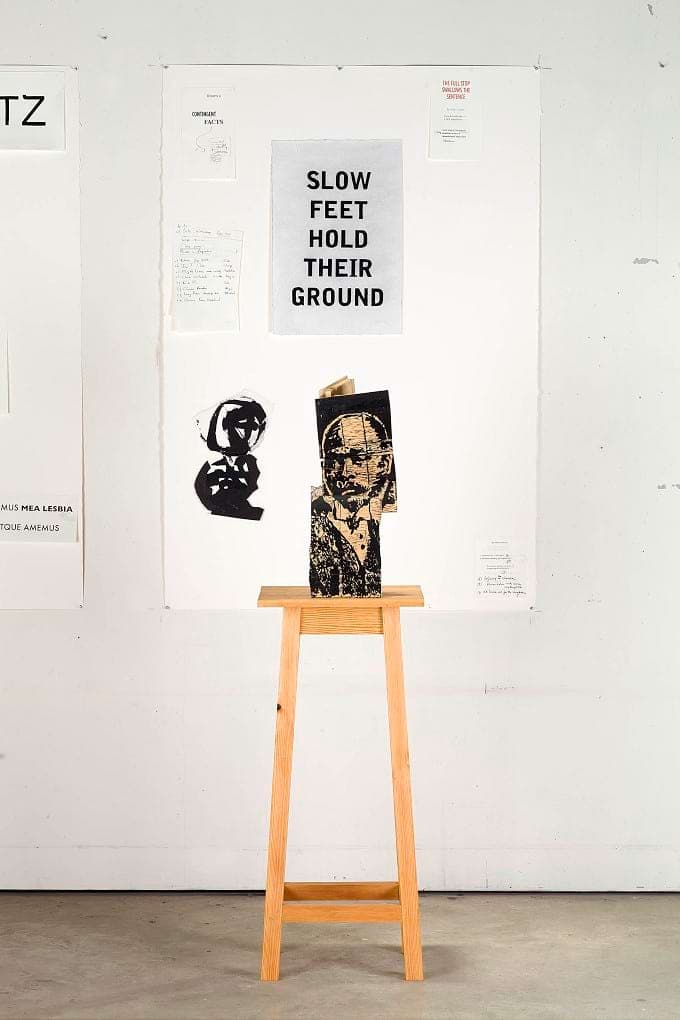
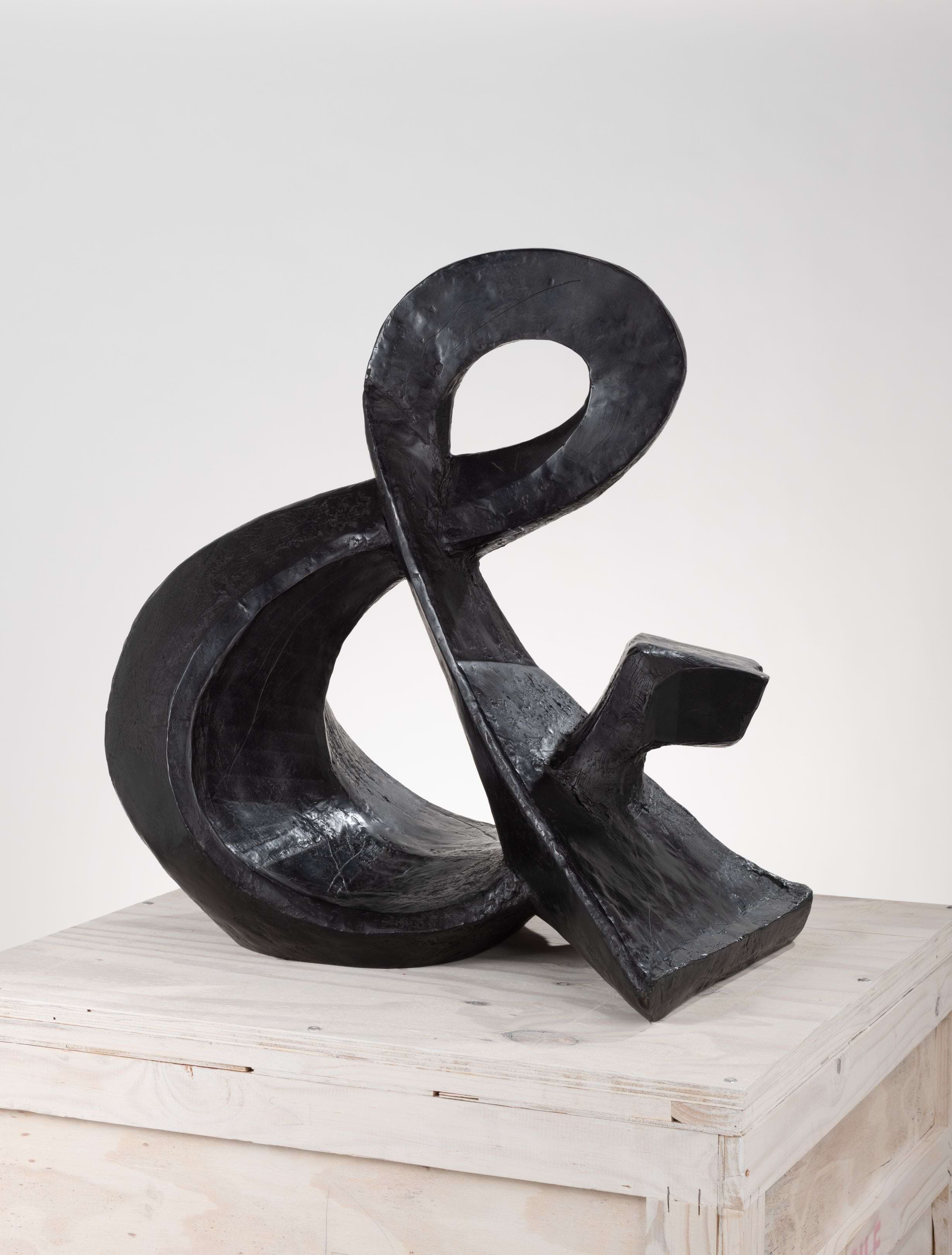
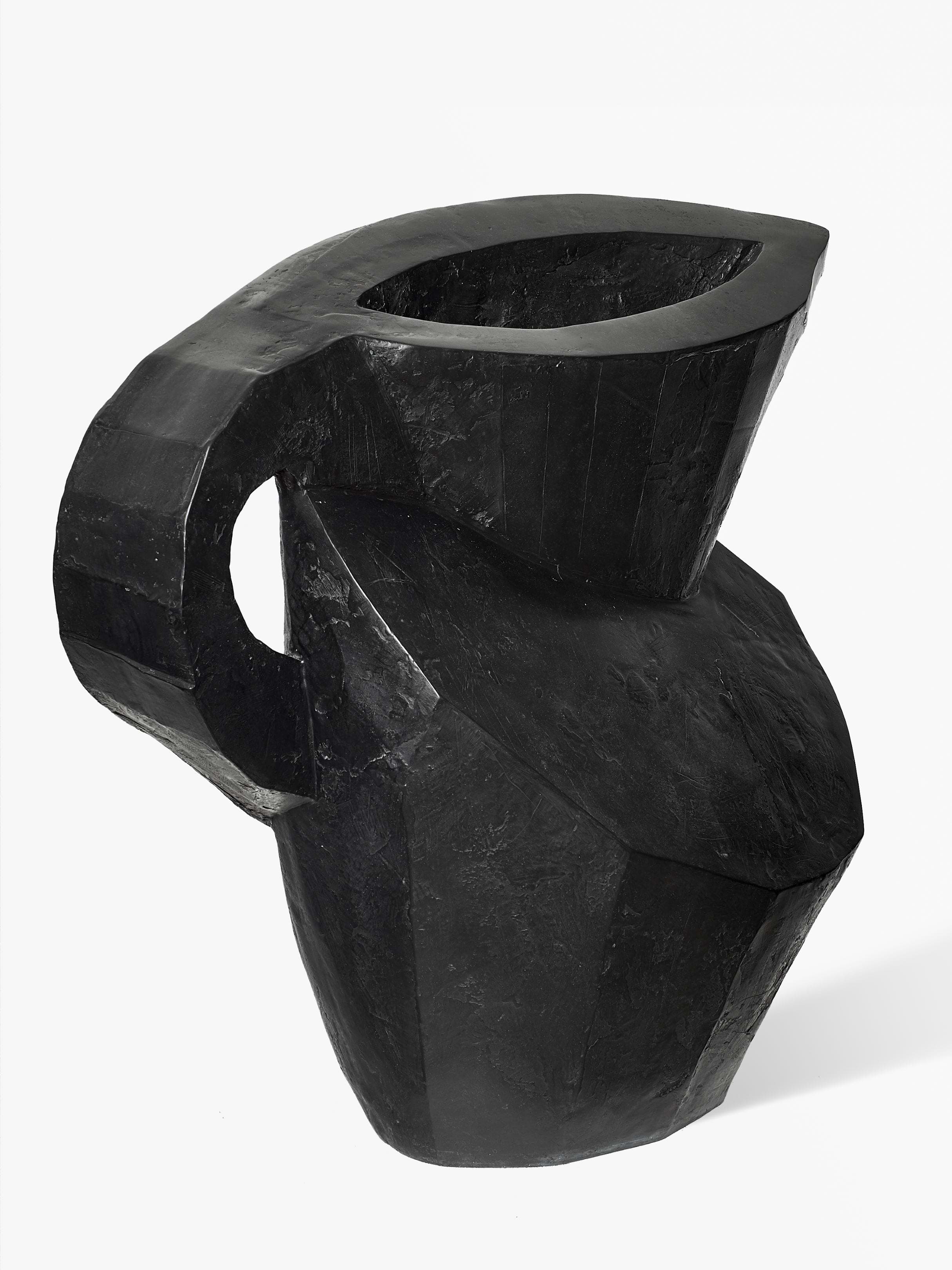
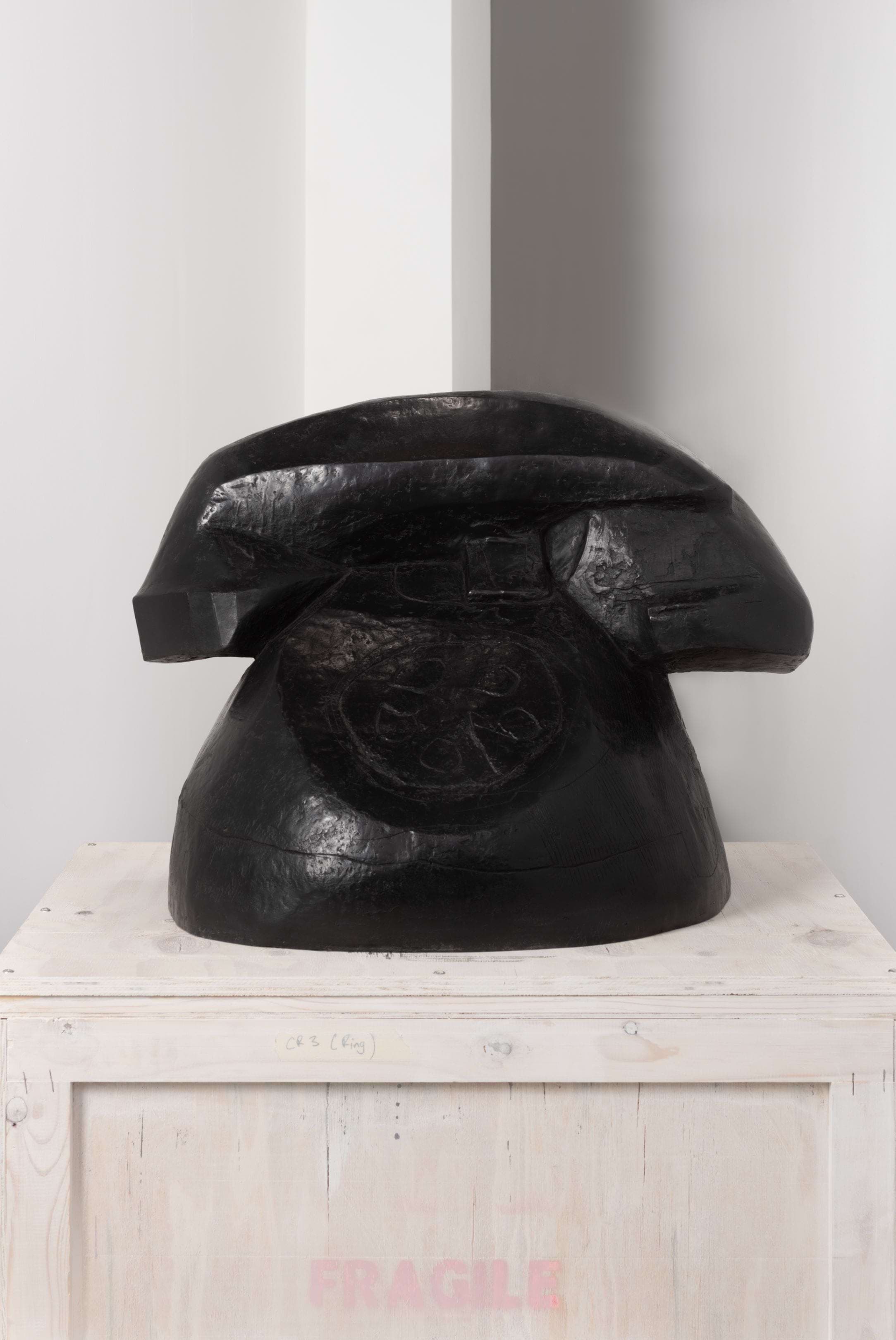
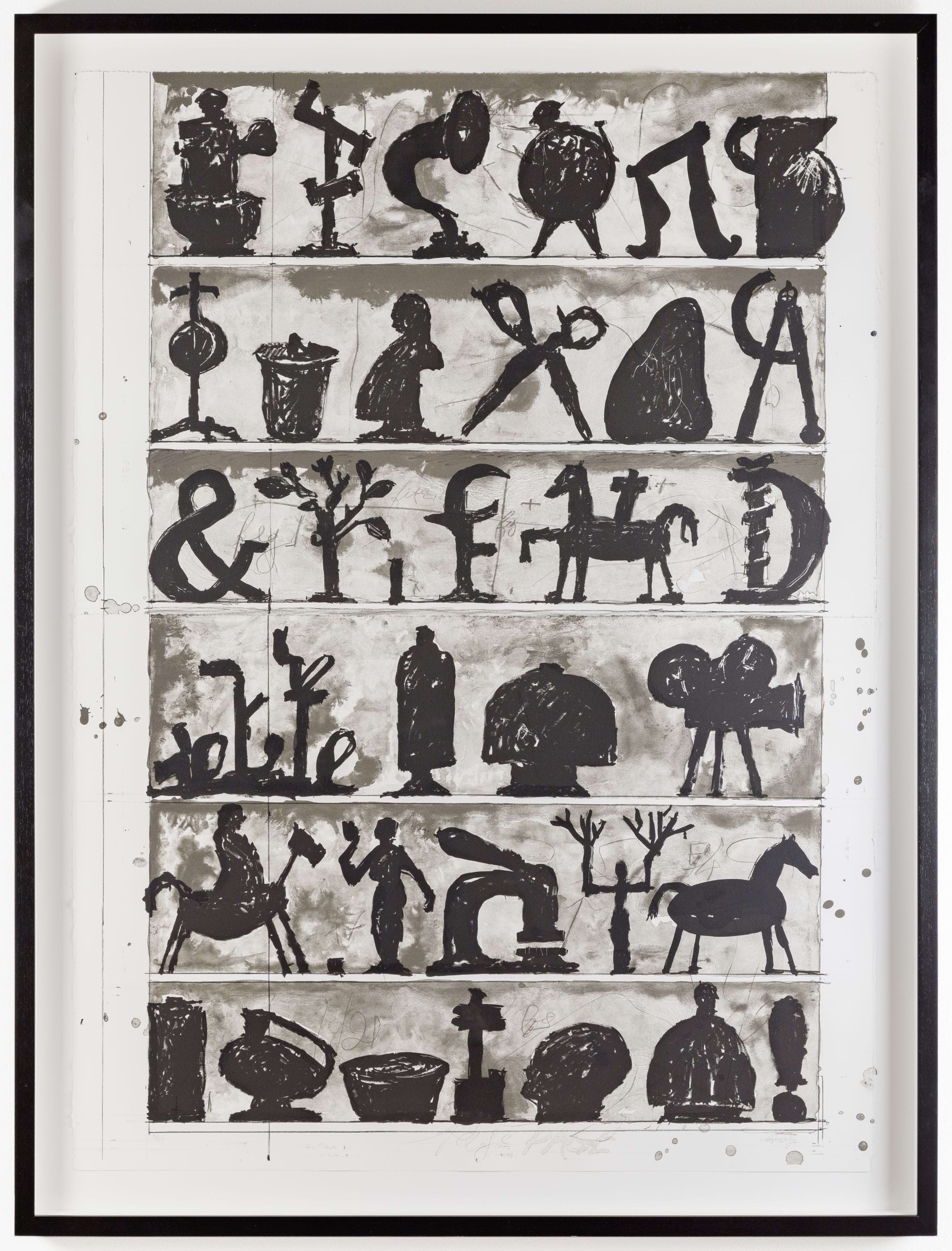
William Kentridge’s Lexicon (2017) is an accumulation of elemental symbols within the artist’s larger practice. The series of bronze sculptures, functions as a form of visual dictionary. These sculptures are symbols, glyphs, suggested words or icons, many of which have been used repeatedly across projects and bodies of work. The glyphs can be arranged in order to construct sculptural sentences and rearranged to deny meaning. In late 2017 and early 2018, Kentridge chose a group of ten glyphs from the small-scale Lexicon set and made medium scale versions, each of close to a metre in height.
William Kentridge’s large and medium scale bronzes, from the Lexicon project, are an accumulation of elemental symbols within the artist’s larger practice. This sculptural vocabulary is comprised of icons, ubiquitous in Kentridge’s creations, which are dispersed throughout all of the media in which he works. As a series of bronze sculptures, each work functions as part of the artist’s visual dictionary and broader language.
William Kentridge’s Lexicon (2017) is an accumulation of elemental symbols within the artist’s larger practice. The series of bronze sculptures, functions as a form of visual dictionary. These sculptures are symbols, glyphs, suggested words or icons, many of which have been used repeatedly across projects and bodies of work. The glyphs can be arranged in order to construct sculptural sentences and rearranged to deny meaning. In late 2017 and early 2018, Kentridge chose a group of ten glyphs from the small-scale Lexicon set and made medium scale versions, each of close to a metre in height.
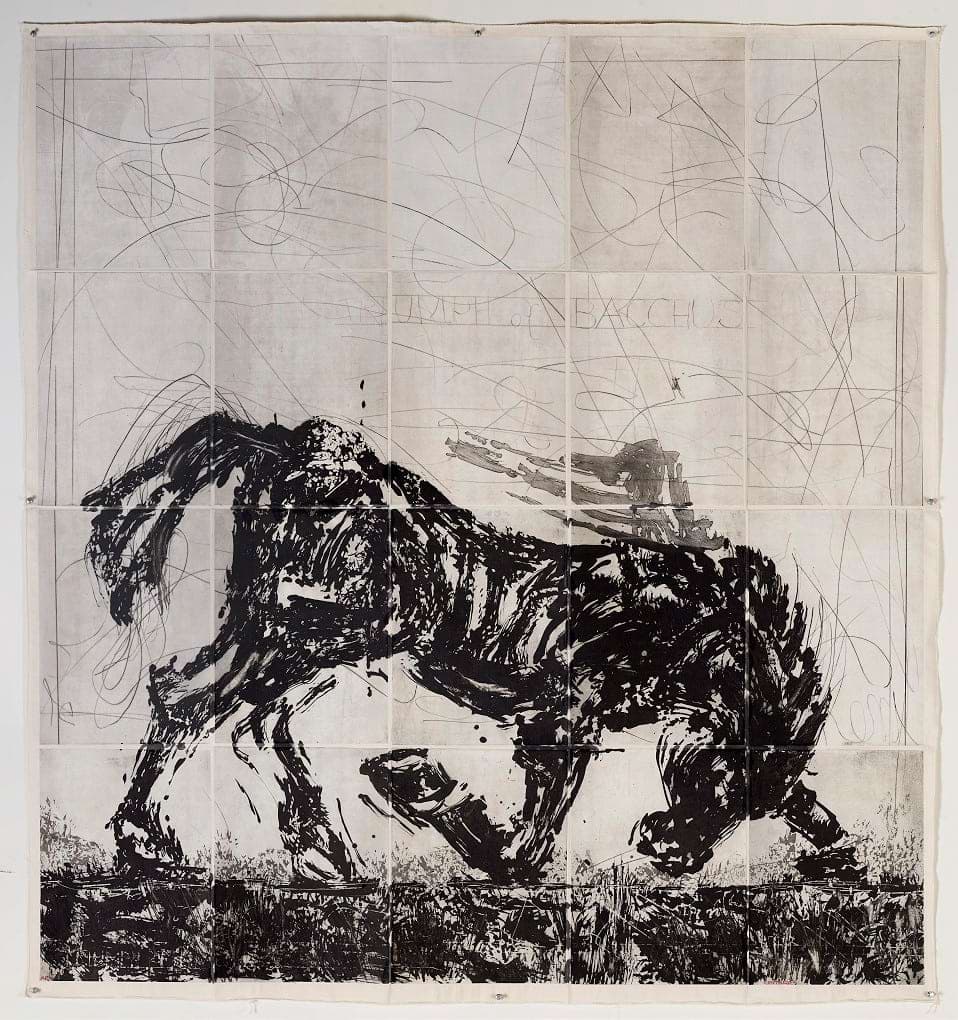
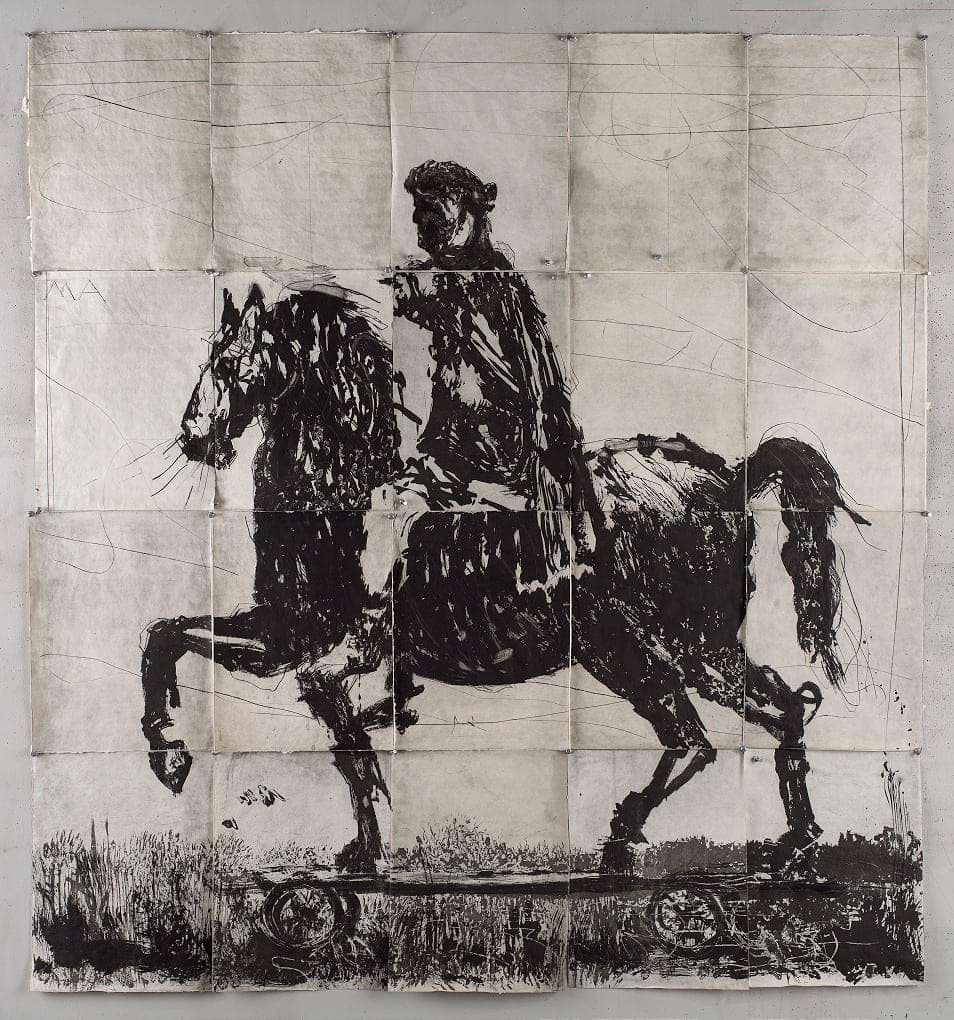
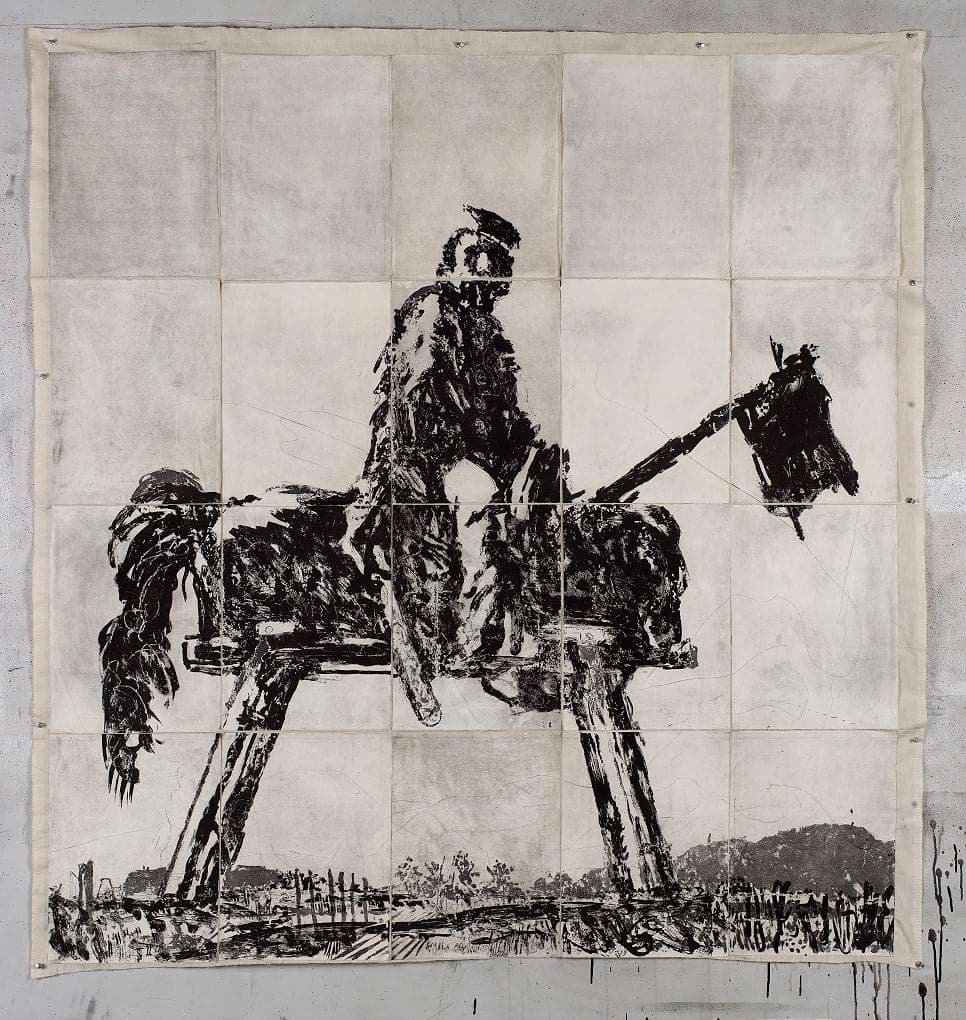
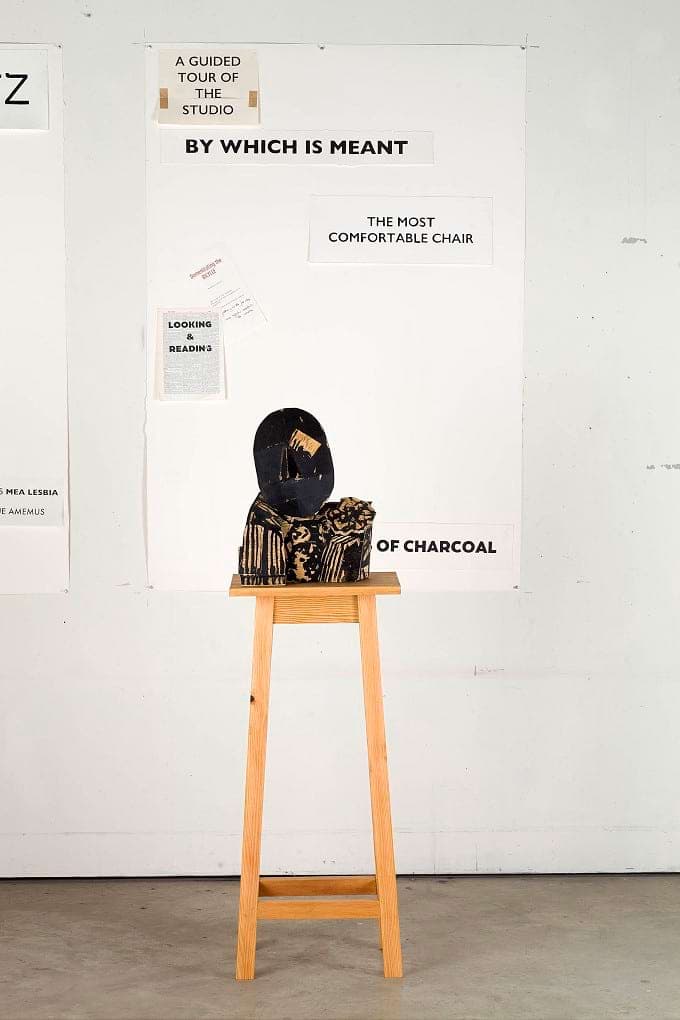
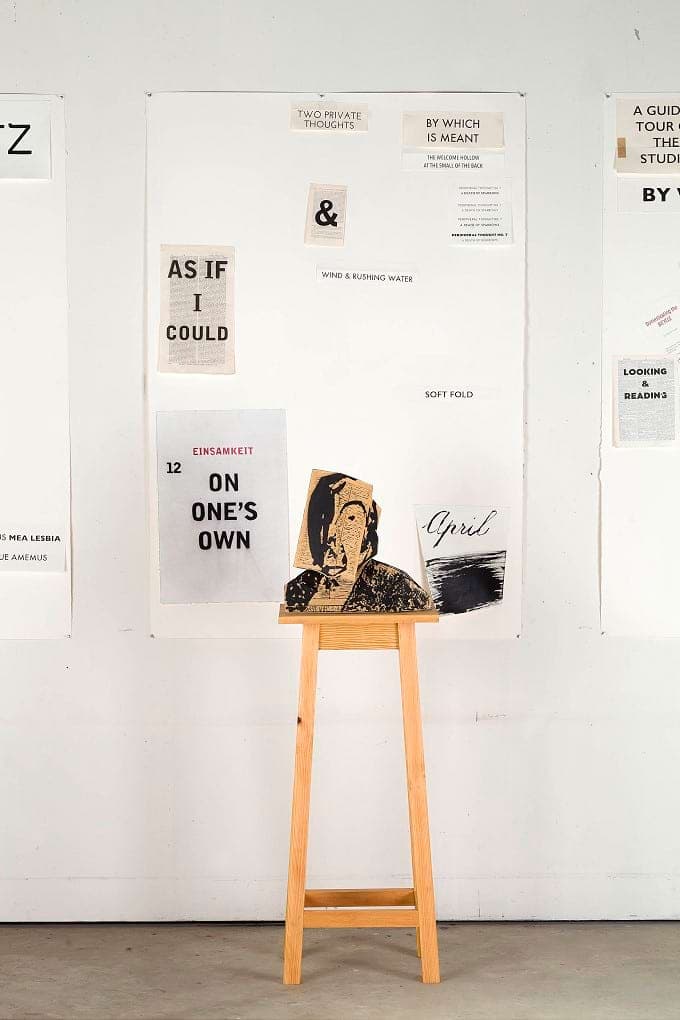
Reflecting on the practice of drawing in his seminal book, Six Drawing Lessons, Kentridge notes; “Drawing has the potential to educate us about the most complex issues of our time” he offers further; “Charcoal and paper are not perfect substances. Charcoal can be erased easily, but not perfectly. The paper is tough and can be erased, redrawn, erased, and still hold its structure — but not without showing its damage. The erasure is never perfect.”
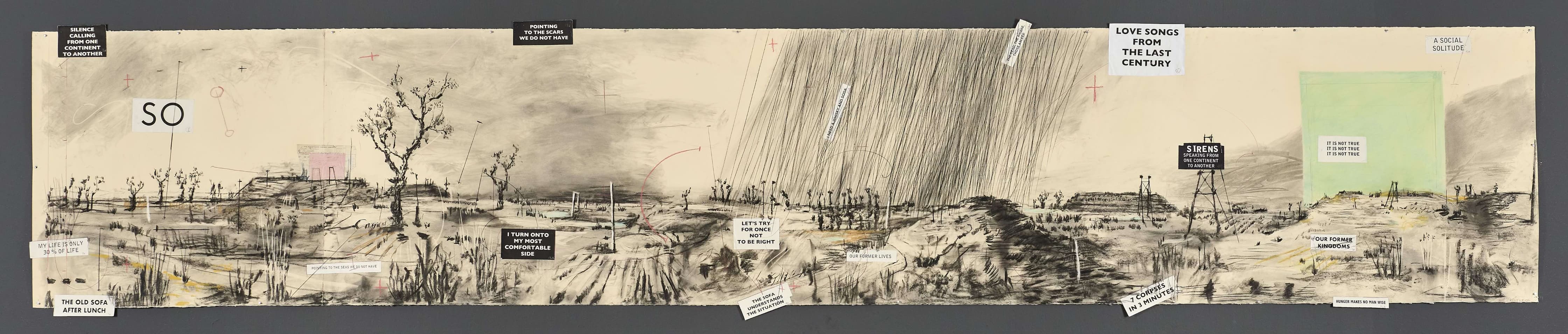
Drawing for Love Songs from the Last Century is a charcoal drawing of the Johannesburg landscape. The drawing was created alongside the 360-degree film Love Songs for the Last Century, which was made as one element of the Invisible exhibition shown at the Centre for the Less Good Idea in Johannesburg, in October 2017. The Invisible Exhibition was an exhibition in which 27 Johannesburg artists were invited to make works that could be experienced through augmented and virtual reality (VR) technologies.
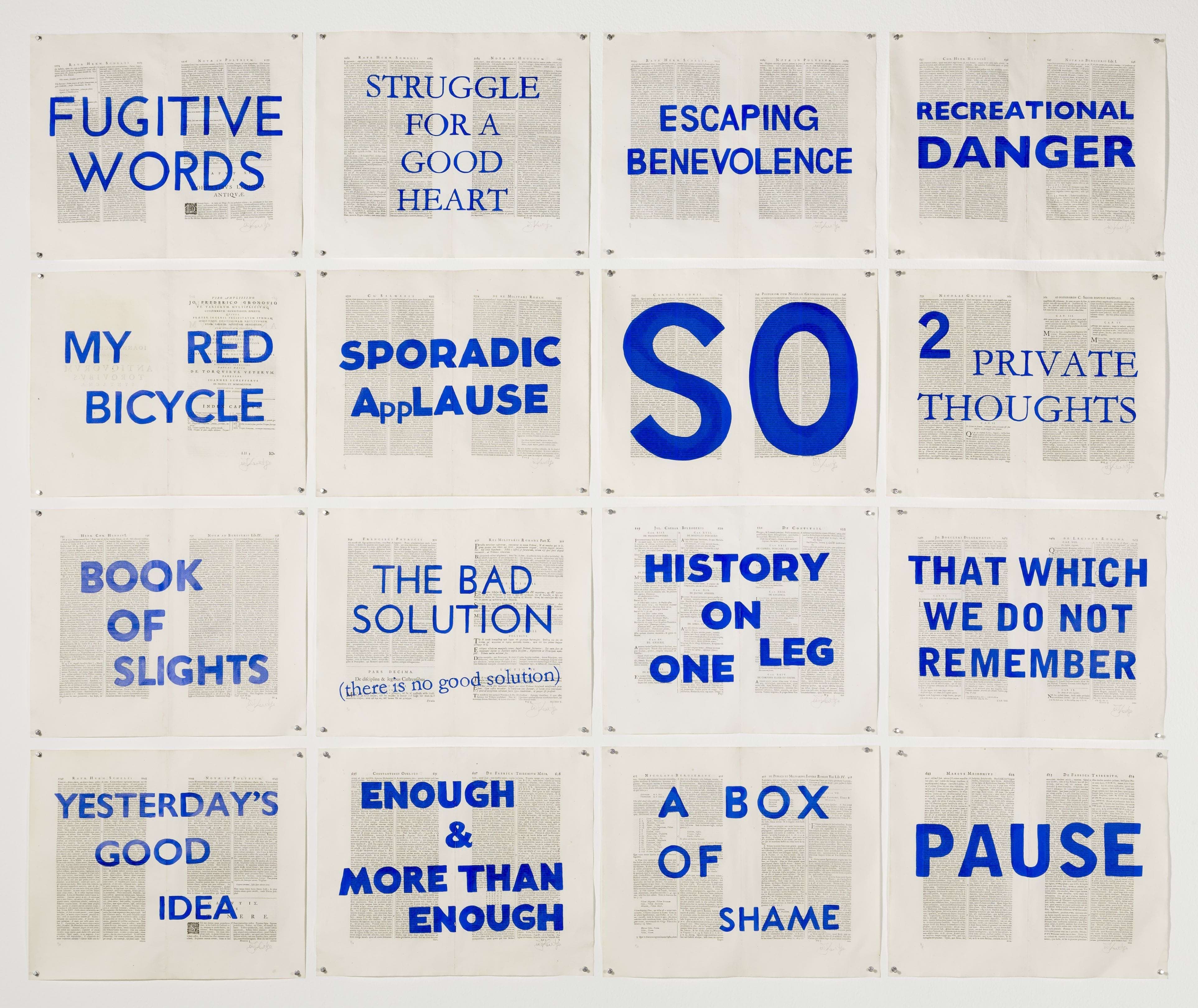
The film is in fact an entirely analogue film but is viewed using a virtual reality headset. In making the film, a five-meter charcoal and pastel drawing of a landscape was curved into a cylinder with a 360-degree camera placed at the bottom of the cylinder. A variation of phrases was mounted on cardboard and once the camera was turned on, the texts were placed and moved while Kentridge ran around the cylinder dropping different words and elements into it. Long time musical collaborator Joanna Dudley participated in the experiment, singing and whistling. Black tissue paper confetti was added and the studio fan was pressed into service. Only after this filming process was a computer brought in, first to stitch the images of the camera together, to edit and finally to translate the imagery into VR.
The film is about regret —about phrases that hover at the edge of making sense. What makes it an utterly different experience from watching a single screen film is the viewer's participation, not in making the film, but in reading it — the need to swivel in the chair from one side to the other, to activate the conversation. The film also functions as a test of what a performance of actors might be, if they were placed around the viewer, such that the viewer has to shift their view to follow the action that happens around them.