Alt
Alt
Alt
Alt
Alt
Alt
Alt
Alt
Alt
Alt
Alt
Alt
Alt
Alt
Alt
Alt
Alt
Alt
Alt
Alt
Alt
Alt
Alt
Alt
Alt
Alt
Alt
Alt
Alt
Alt
Alt
Alt
Alt
Alt
Alt
Alt
Alt
Alt
Alt
Alt
Alt
Alt
Alt
Alt
Alt
Alt
Alt
Alt
Alt
Alt
Alt
Alt
Alt
Alt
Alt
Alt
Alt
Alt
Alt
Alt
Alt
Alt
Alt
Alt
Alt
Alt
Alt
Alt
Alt
Alt
Alt
Alt
Alt
Alt
Alt
Alt
Alt
Alt
Alt
Alt
Alt
Alt
Alt
Alt
Alt
Alt
Alt
Alt
Alt
Alt
Alt
Alt
Alt
Alt
Alt
Alt
Alt
Alt
Alt
Alt
Alt
Alt
Alt
Alt
Alt
Alt
Alt
Alt
Alt
Alt
Alt
Alt
Alt
Alt
Alt
Alt
Alt
Alt
Alt
Alt
Alt
Alt
Alt
Alt
Alt
Alt
Alt
Alt
Alt
Alt
Alt
Alt
Alt
Alt
Alt
Alt
Alt
Alt
Alt
Alt
Alt
Alt
Alt
Alt
Alt
David Goldblatt
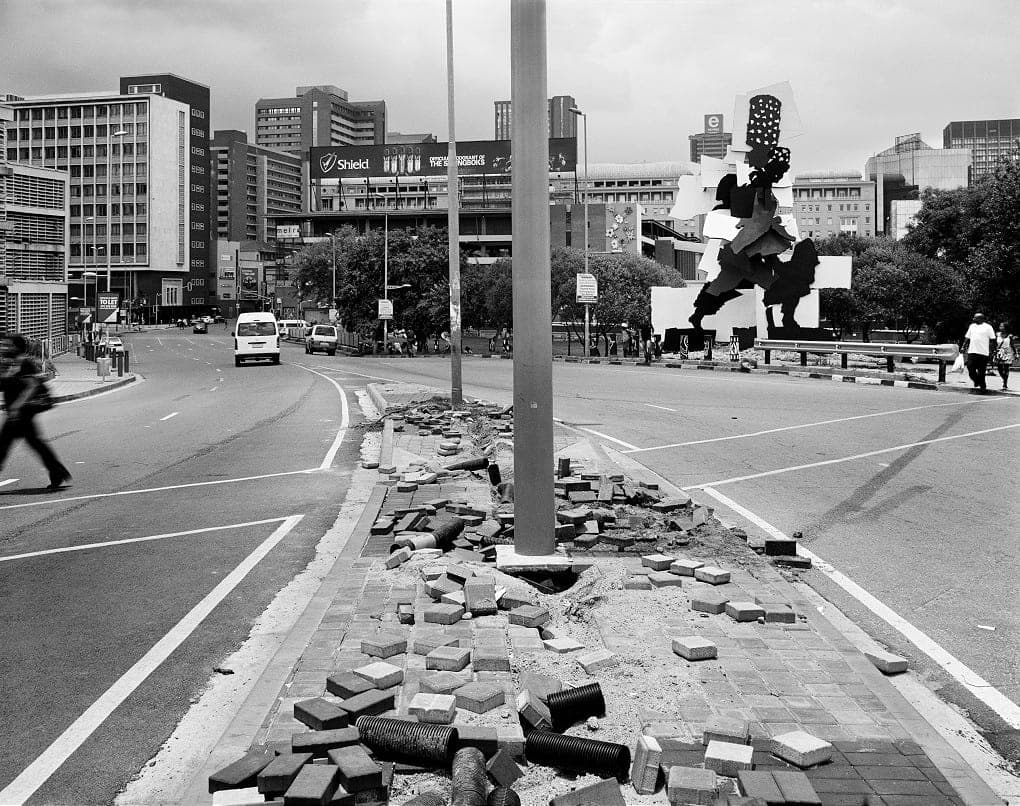
The City, The Firewalker and the aftermath of copper cable theft, Queen Elizabeth bridge, Johannesburg, 29 December 2011. The 11 metre sculpture by William Kentridge and Gerhard Marx depicts one of the women often seen on Joburg streets carrying a brazier with live coals on her head. She will set it up on a sidewalk where she will roast yellow mielies or sheep's heads for sale to passersby. The paving stones are scattered because someone tied a rope to the electric cable under the lamp post to a truck and ripped the cable out to steal the copper wire (4_A0821, 2011
Silver gelatin print on fibre-based paper, dibonded
89 x 107 cm
35 x 42.1 in
Edition of 10

David Goldblatt
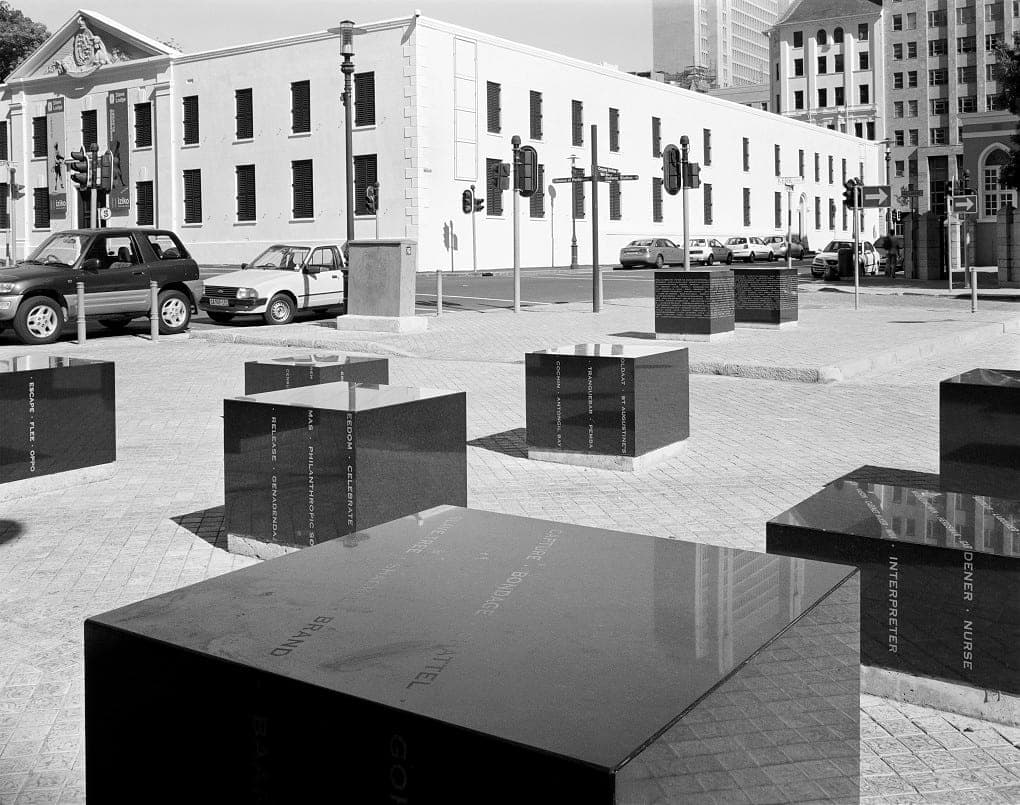
Memorial to the Enslaved by Wilma Cruise and Gavin Young. The white building was the Dutch East India Company's slave lodge in the centre of Cape Town. Some 9000 slaves, convicts and mentally disturbed people are thought to have been confined within it between 1679 and 1811. It is now a museum. 11 March 2012 , 2012
Silver gelatin print on fibre-based paper, dibonded
approx. 98 x 120 cm
38.6 x 47.2 in
Edition of 10
David Goldblatt
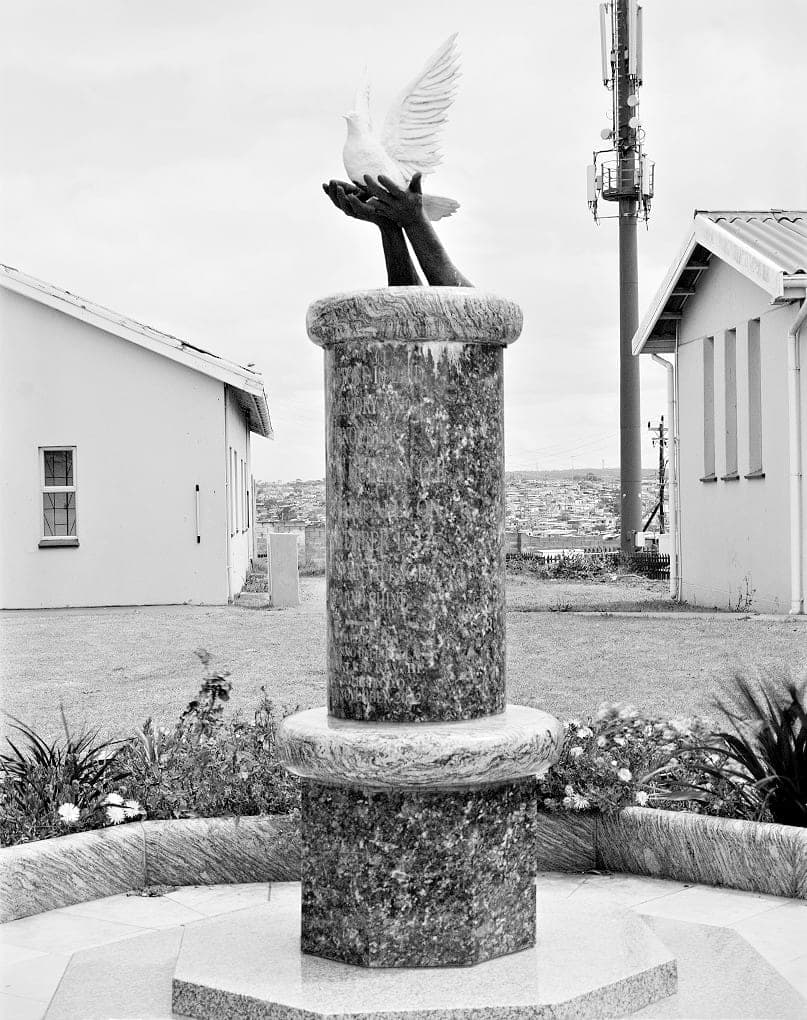
Memorial to Sister Dr. Mary Aidan Quinlan who was murdered on November 9 1952 by a mob near Duncan Village. It was the time of the ANC’s Defiance of Unjust Laws campaign. Several thousand people had gathered on Bantu Square, near Duncan Village, for what was supposedly a religious meeting for which the magistrate had given permission. Hidden in a house nearby, waiting to address the crowd were ANC leaders. At the last minute, the police, suspecting the true purpose, ordered the crowd to disperse, but opened fire before they could do so. Nine were killed and many wounded. The crowd became a vengeance-seeking mob into which, taking a familiar shortcut to her church, drove Sister Quinlan. Her car was overturned and set alight. She was killed and perhaps partly cannabilised. Running battles between police, troops and township people continued into the night. It was said that more than two hundred people were killed. She had devotedly served the Duncan Village community as a medical doctor. Koko Qebeyi, not born at that time, became an anti-apartheid activist and city councillor and arranged for the erection of this monument to a woman who had devotedly served the community of Duncan Village. Catholic Church, Duncan Village, East London. 13 October 2013 , 2013
Silver gelatin print on fibre-based paper, dibonded
approx. 120 x 98 cm
47.2 x 38.6 in
Unique

It was the time of the ANC’s Defiance of Unjust Laws campaign. Several thousand people had gathered on Bantu Square, near Duncan Village, for what was supposedly a religious meeting for which the magistrate had given permission. Hidden in a house nearby, waiting to address the crowd were ANC leaders. At the last minute, the police, suspecting the true purpose, ordered the crowd to disperse, but opened fire before they could do so. At least nine were killed and many wounded. The crowd became a vengeance-seeking mob into which, taking a familiar shortcut to her church, drove Sister Quinlan. Her car was overturned and set alight. She was killed and perhaps partly cannabilised. Running battles between police, troops and township people continued into the night. It was said that more than two hundred people were killed.

Koko Qebeyi, not born at that time, became an anti-apartheid activist and city councillor and arranged for the erection of this monument to a woman who had devotedly served the community of Duncan Village.

David Goldblatt
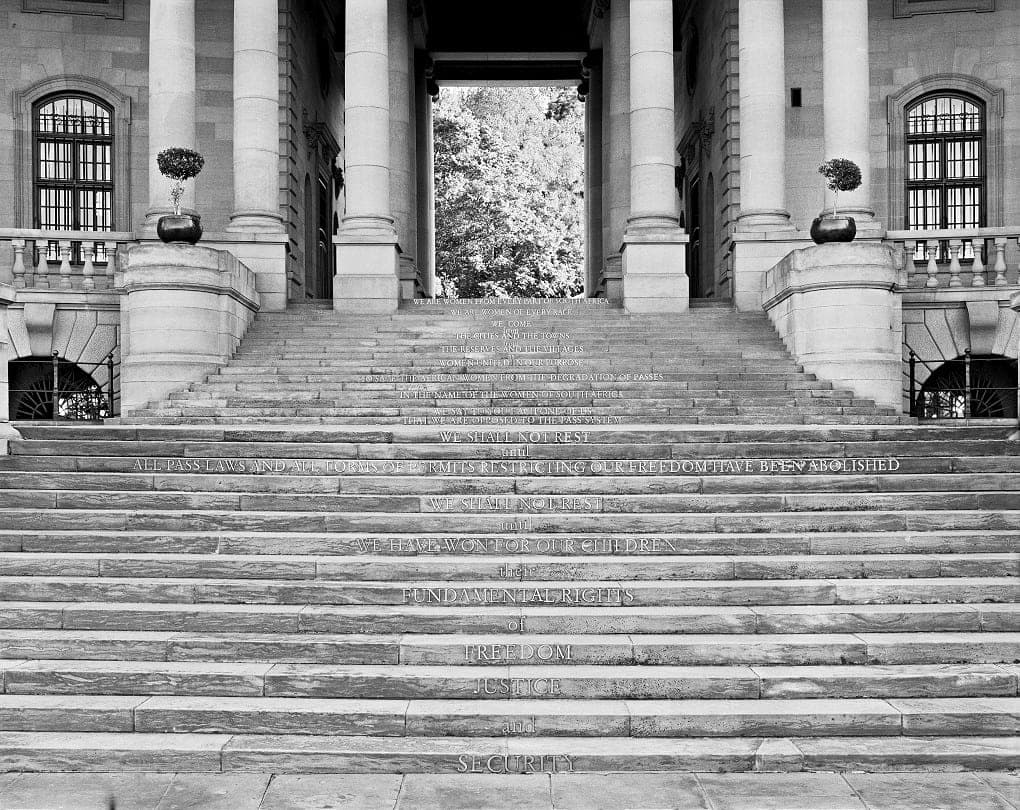
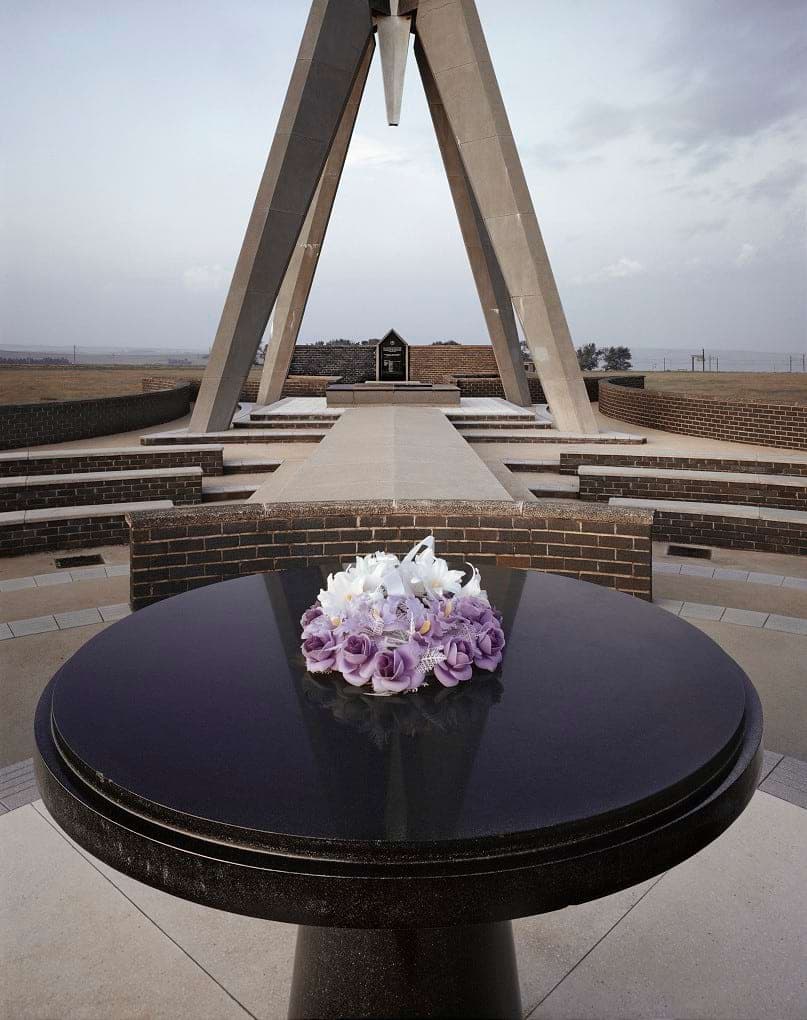
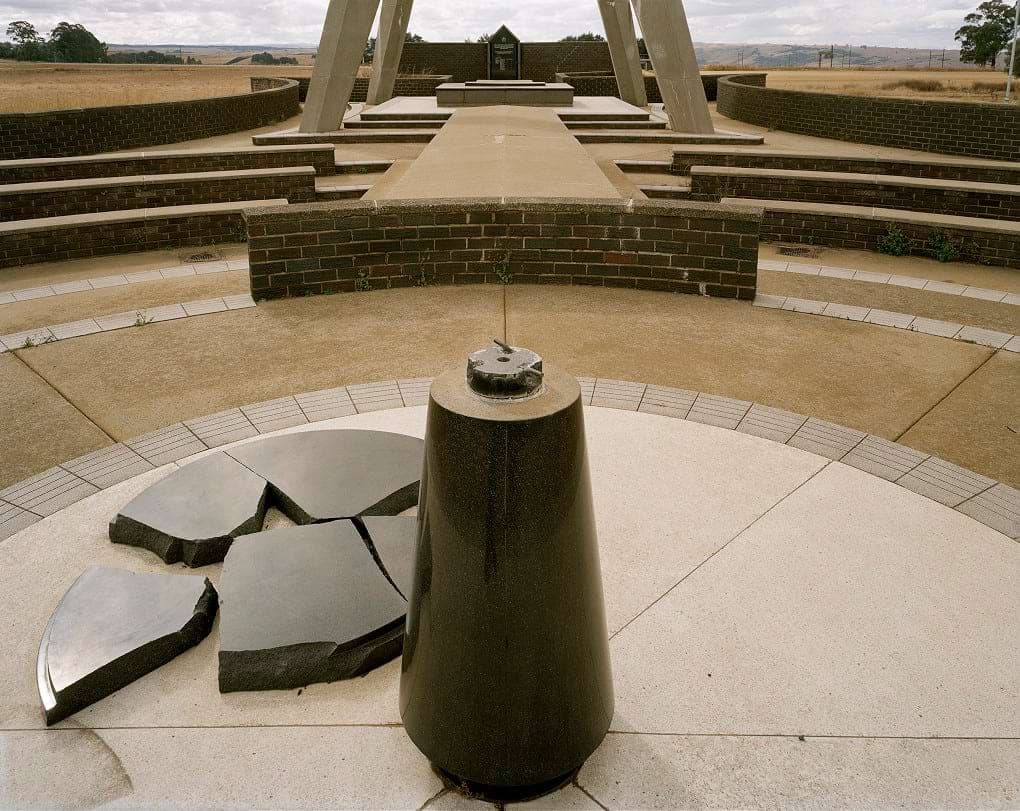
The Women's Monument at the Union Buildings, Pretoria. It commemorates the march by some 20,000 women on 9 August 1956, through Pretoria to the Union Buildings, where they attempted to present a letter to prime minister JG Strijdom, protesting the 'pass laws' and in particular, the law requiring African women to carry 'passes'. Neither Strijdom nor anyone else in government accepted the letter. In 2006 this memorial to the march was unveiled. It is in the amphitheatre where the women gathered. The artists were Wilma Cruise and Marcus Holmes. It is not accessible to the public. 1 November 2013 , 2013
Silver gelatin print on fibre-based paper, dibonded
approx. 98 x 120 cm
38.6 x 47.2 in
Edition of 10

On 9 August 1956 some 20,000 women marched through Pretoria to present a letter to the prime minister, JG Strijdom, objecting to the law under which they were now compelled to carry “passes.” Neither he nor any of the people working under him accepted the document. On 9 August 2006, the 20th anniversary of the March, this memorial to it was unveiled here, in the amphitheatre where the women had gathered. The words are taken from the protest letter 'The Demand of the Women of South Africa for the Withdrawal of Passes for Women and the Repeal of the Pass Laws' which was to have been handed to Strijdom. The monument is not accessible to the public.

David Goldblatt
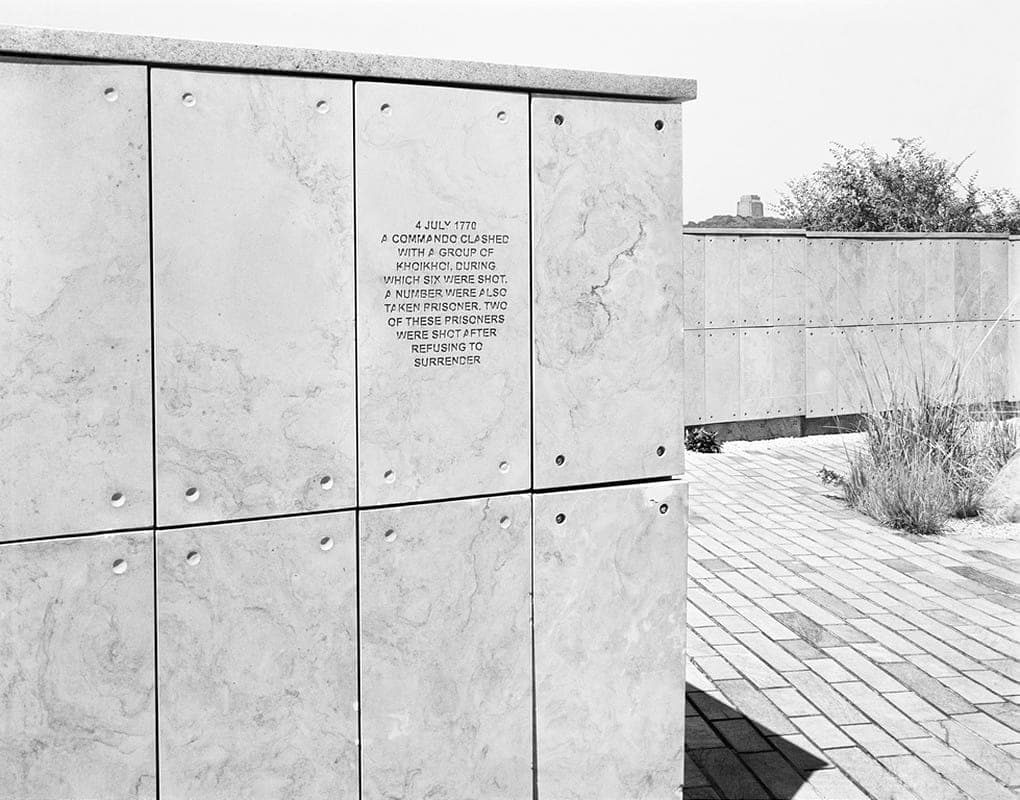
Freedom Park and the Voortrekker Monument, Pretoria. 26 May 2014 , 2014
Silver gelatin print on fibre-based paper, dibonded
approx. 98 x 120 cm
38.6 x 47.2 in
Edition of 10

This is one of some 75000 names and historic incidents relating to conflicts in South Africa's history, inscribed in the Wall of Names at Freedom Park.

David Goldblatt
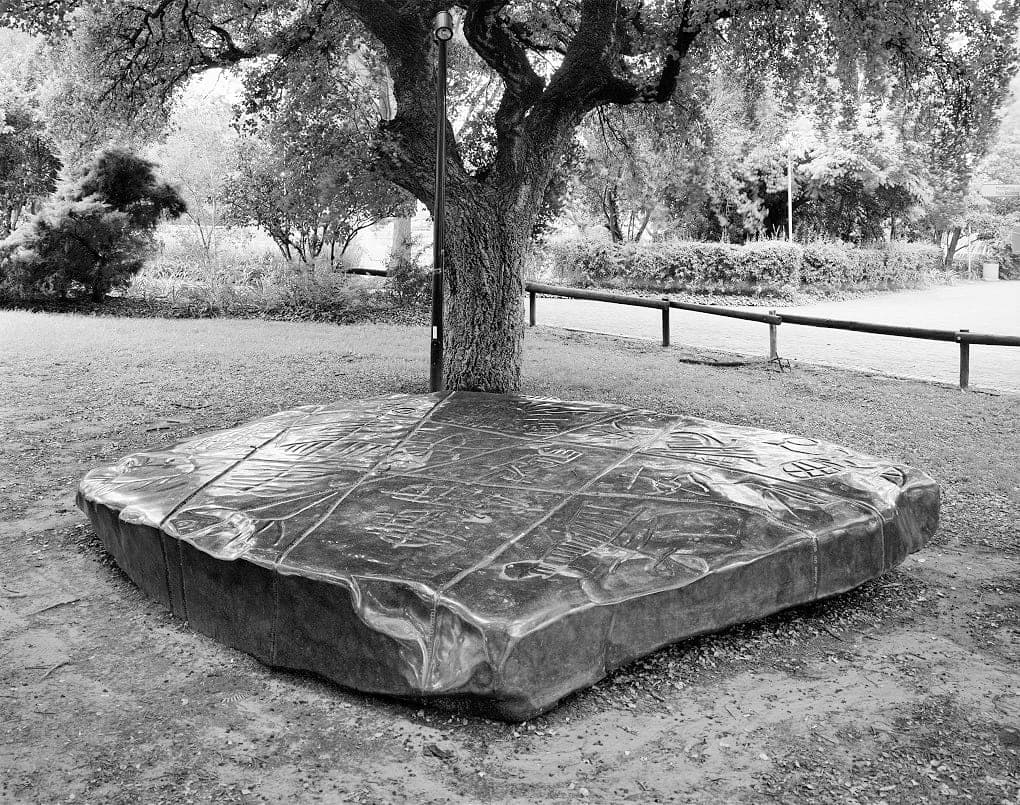
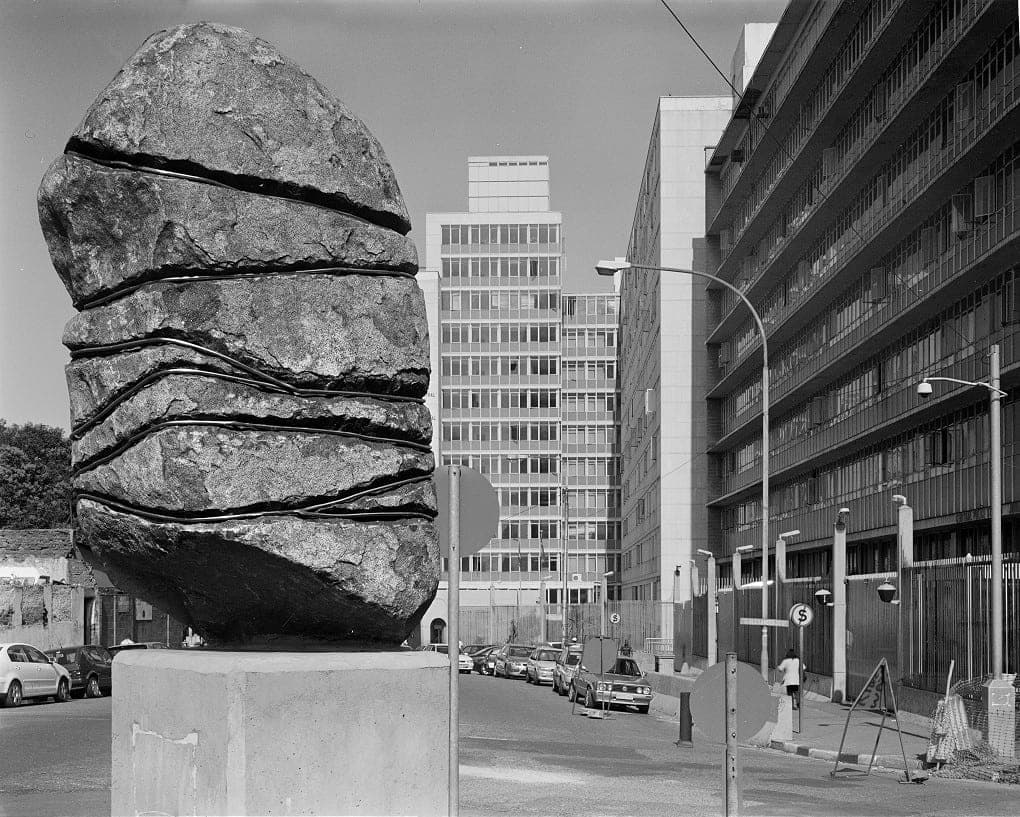
The Thinking Stone, 32 tons of granite sculpted by Willem Boshoff. One of a number of artworks commissioned by the university after some Afrikaner male students were alleged to have urinated into the food of some black workers. This 'sculpture-on-the-campus' project was undertaken in the hope that it would "promote greater respect for cultural differences and would instill a sense of belonging in staff and students". University of the Free State, Bloemfontein. 14 March 2013 , 2013
Silver gelatin print on fibre-based paper, dibonded
98 x 124 cm
38.6 x 48.8 in
Edition of 10

This is one of a number of works commissioned by the university after some Afrikaner men students were alleged to have urinated into the food of some Black workers. It is hoped that this “Sculpture-on-Campus” project would “promote greater understanding, respect and appreciation of cultural differences” among staff and students, and that it would instil a sense of belonging within them.

David Goldblatt
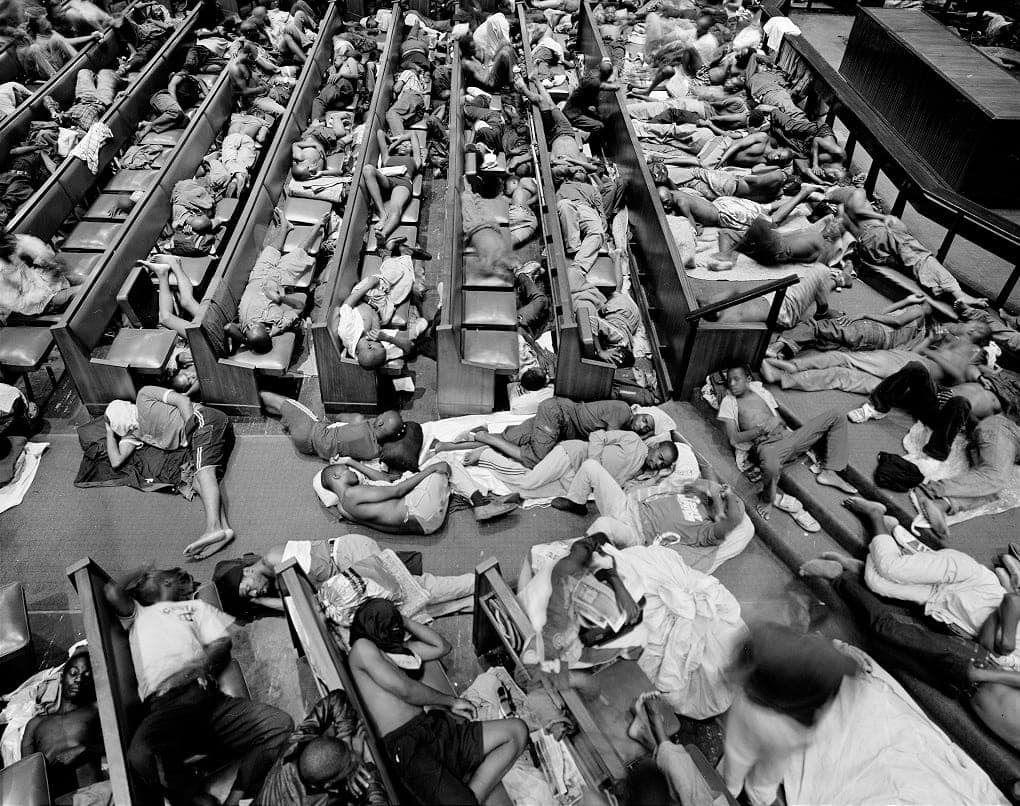
Refugees from Zimbabwe and refugees from violent acts of xenophobia on the Witwatersrand, sheltering in the Central Methodist Church, Kerk Street, Johannesburg. 22 March 2009. (4_A00482/4_A0469/ 4_A0482), 2009
Silver gelatin print on fibre-based paper dibonded
99 x 123 cm
39 x 48.4 in
Edition of 10
David Goldblatt
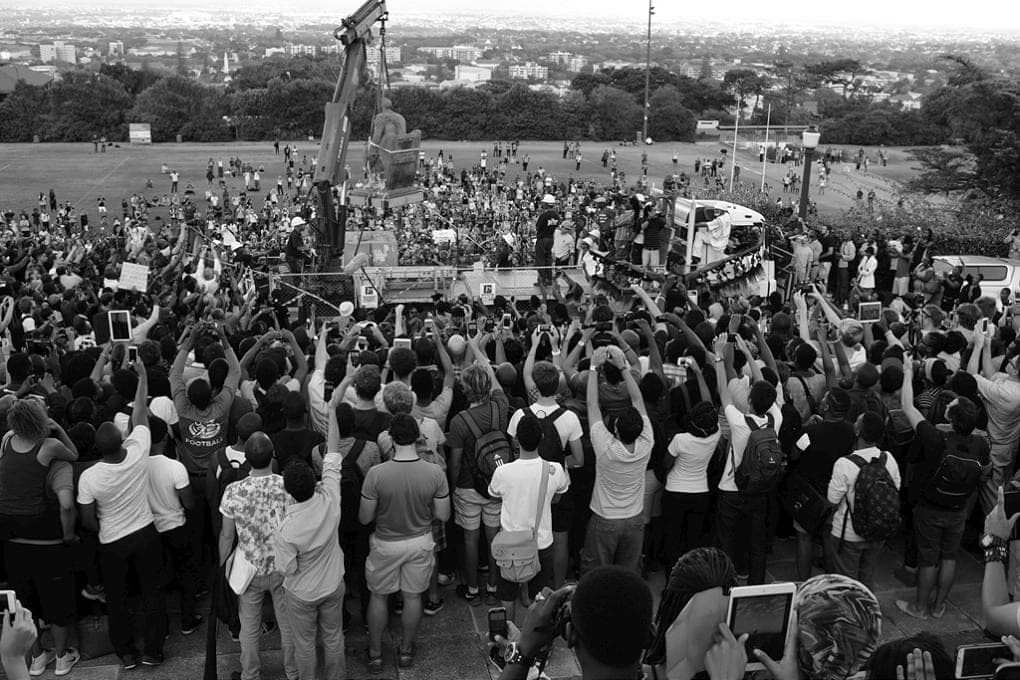
The dethroning of Cecil John Rhodes, after the throwing of human faeces on the statues and the agreement of the University to the demands of students for its removal. The University of Cape Town, 9 April 2015 , 2015
Silver gelatin print on fibre-based paper
A0+
Edition of 10
David Goldblatt
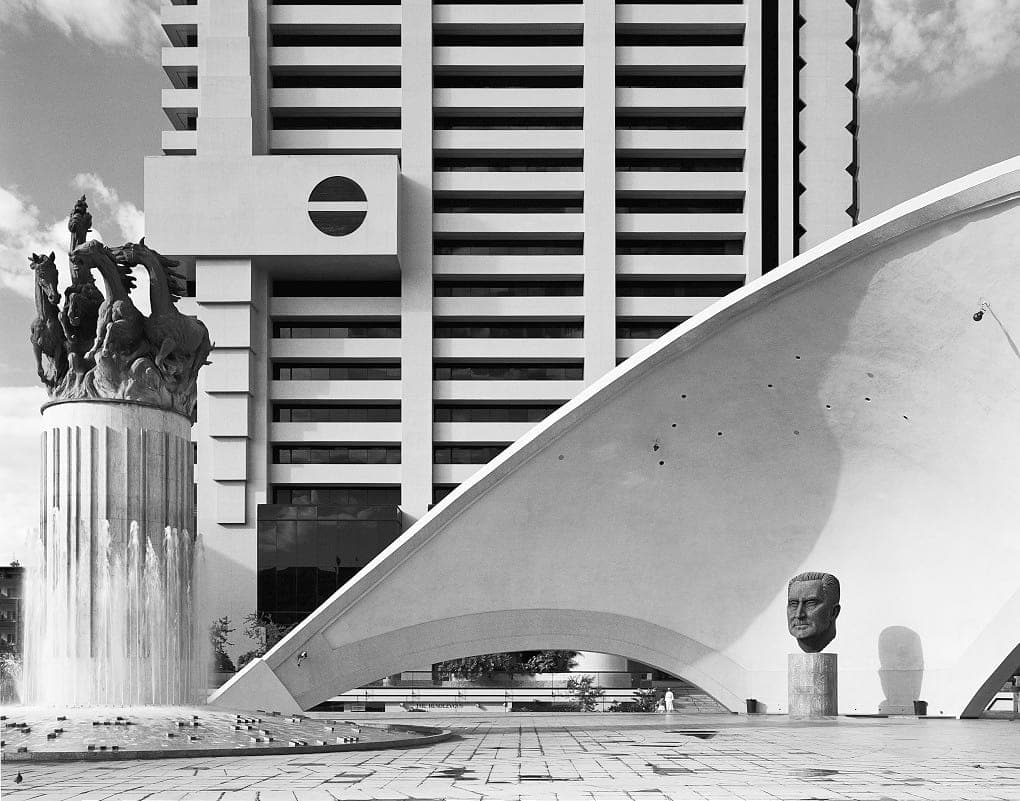
The monument at left celebrates the fifth anniversary of the Republic of South Africa. The one at right is to J G Strijdom, militant protagonist of White supremacy and of an Afrikaner republic, who died in 1958. At rear is the headquarters building of Volkskas (‘The People’s Bank’) founded in 1934 to mobilise Afrikaner capital and to break the monopoly of the ‘English’ banks. Pretoria, 25 April 1982. , 1982
Silver gelatin print on fibre-based paper
46.8 x 58.9 cm
18.4 x 23.2 in
4/4

At about 3 a.m. on 31 May 2001, forty years to the day after the Republic of South Africa was declared, the sculpture of Strijdom’s head fell through its supporting floor into the parking garage below and was smashed. There was no sabotage. Two homeless people sleeping nearby were slightly injured.

David Goldblatt
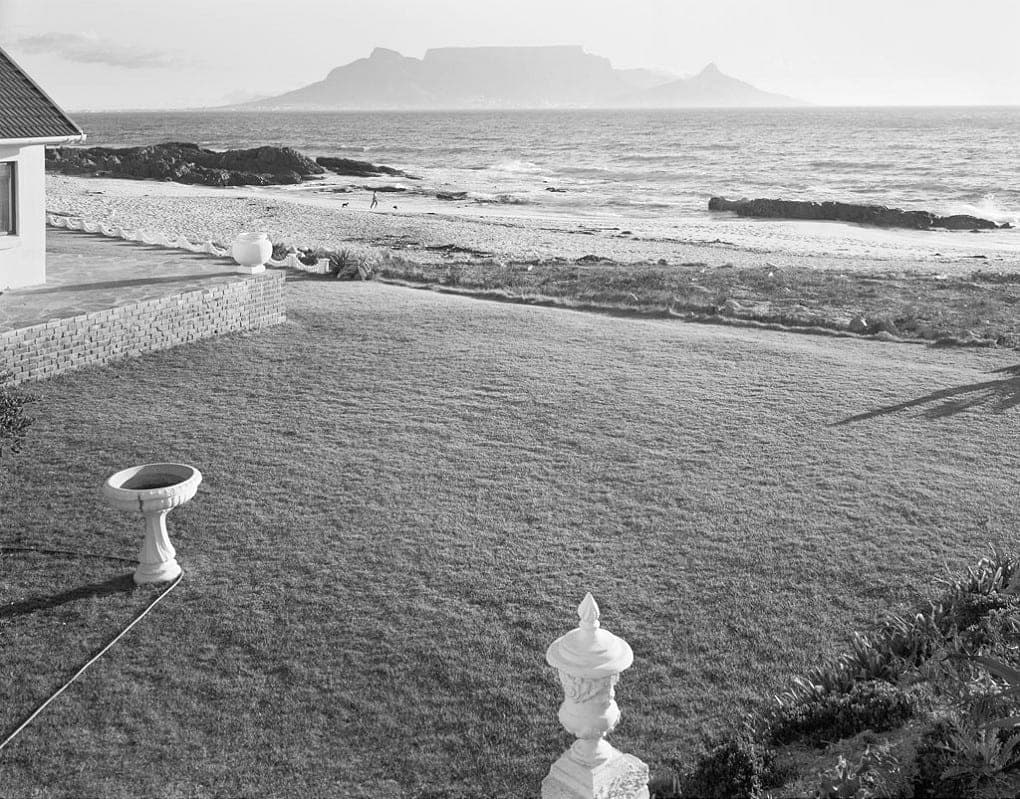
Thirteen kilometres of this coastline were a White Group Area, Bloubergstrand, Cape Town. 9 January 1986 , 1986
Silver gelatin print on fibre-based paper, dibonded
92.8 x 117.7 cm
36.5 x 46.3 in
4/4

‘...the entire coastal belt from Bloubergstrand to Melkbosstrand (a distance of about 13 kilometres) has been proclaimed a white group area’ from The Standard Encylopaedia of Southern Africa (1971

David Goldblatt
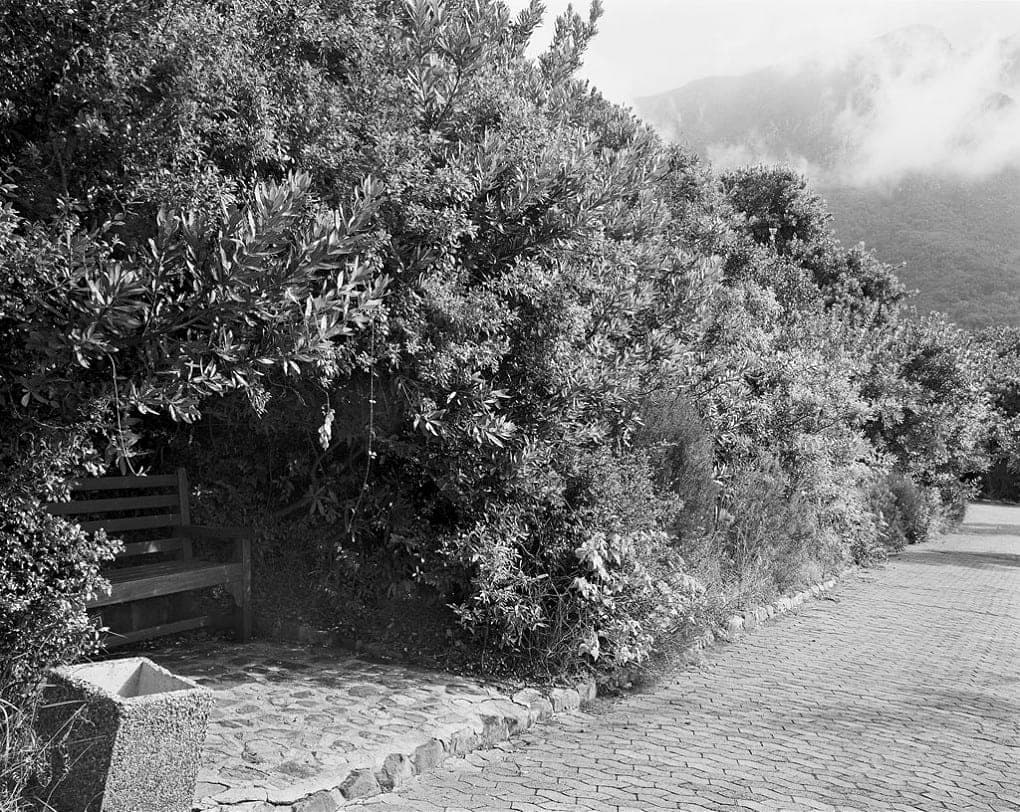
Remnant of a wild almond hedge planted in 1660 to prevent livestock from being taken out of the European settlement in South Africa by the indigenous Khoi. Kirstenbosch, Cape Town. 16 May 1993 , 1993
Silver gelatin print on fibre-based paper, dibonded
A0, approx 85 x 117 cm
33.5 x 46.1 in
Edition of 10
David Goldblatt
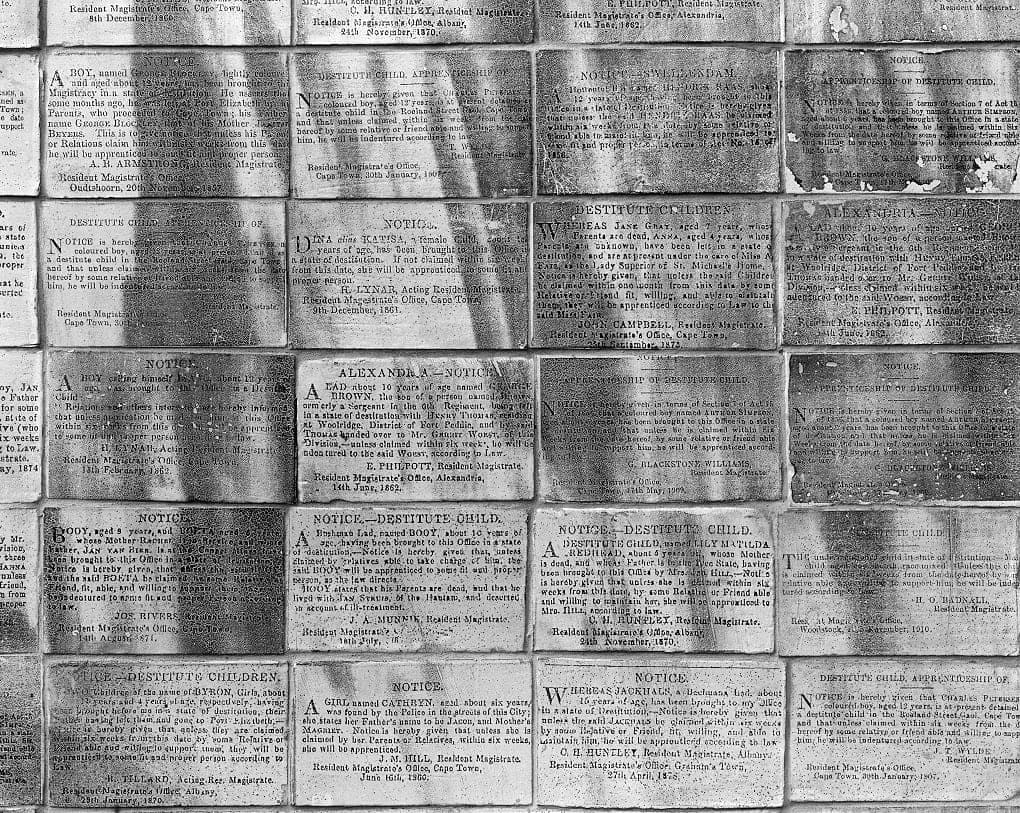
Copies of advertisements regarding destitute children that appeared in the Cape Government Gazette, form part of a memorial to children entitled We are still here. Between 1841 and 1921 some 7000 children were advertised as destitute in the Gazette. If not claimed by someone able to support them they were indentured, presumably as labourers. Memorial by Lovell Friedman and Leora Lewis, Longmarket pedestrian mall, Cape Town. 11 March 2012 , 2012
Silver gelatin print on fibre-based paper, dibonded
approx. 98 x 120 cm
38.6 x 47.2 in
Edition of 10
David Goldblatt
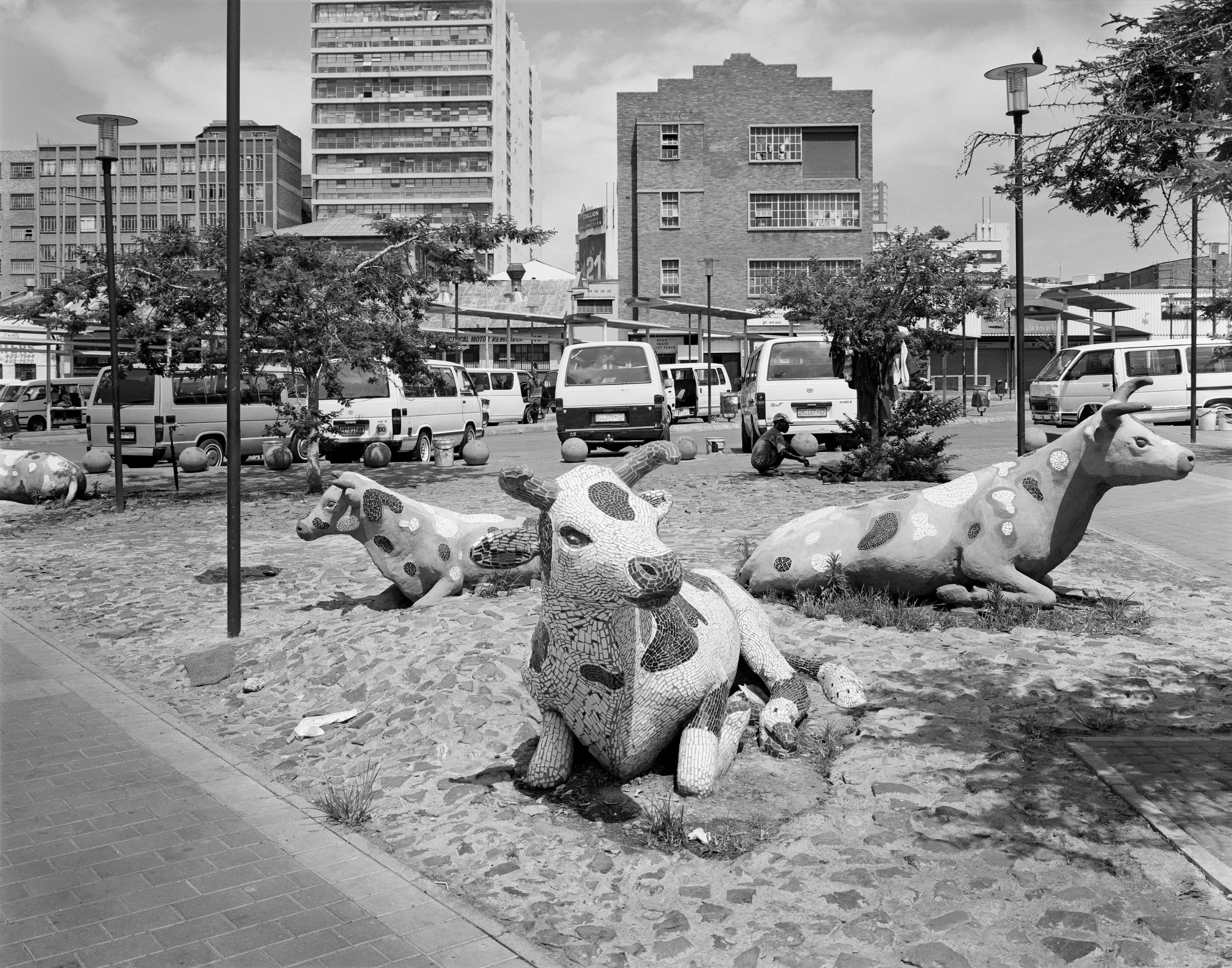
Cows at a taxi rank on Error Street, New Doornfontein, Johannesburg. 8 December 2012 , 2012
Carbon ink on Hahnemeule 315gsm
A0
31.5 x 45.2 in
Unique

In a city not known for the respect shown to its structures, these sculptures by Andile Maswangelwa, installed in 2008, were pristine in 2014.

David Goldblatt
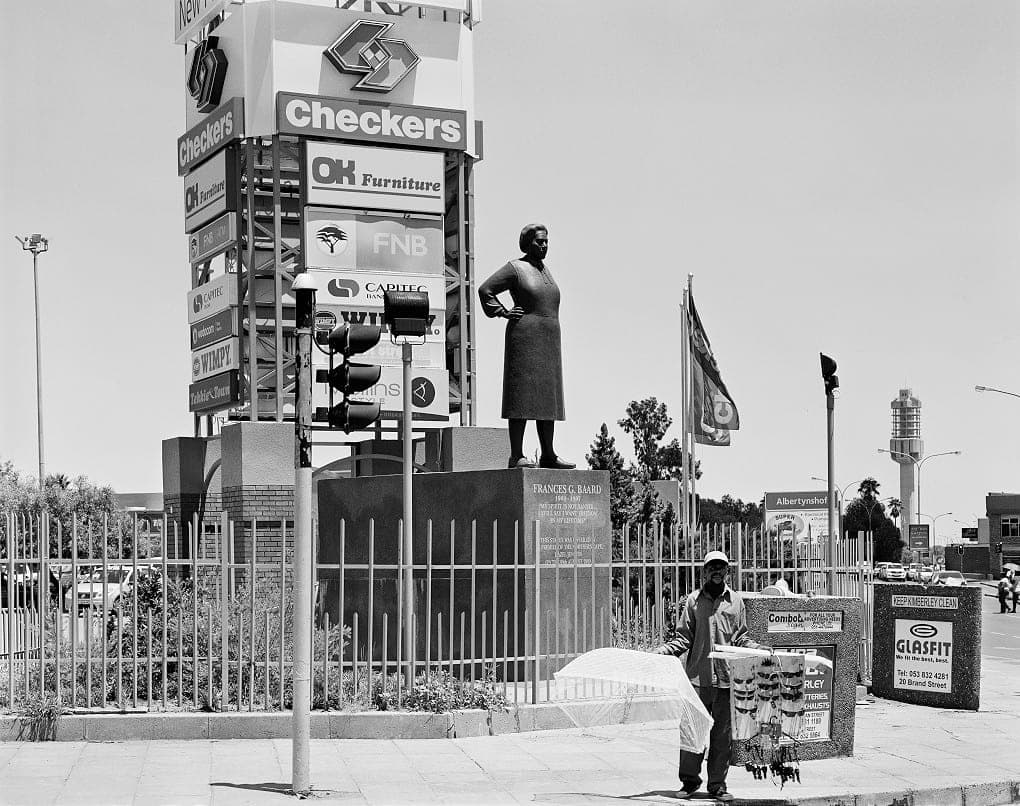
Frances Baard, militant trade unionist and leader of the ANC Women’s League, sculpted by Anton Momberg. Kimberley, 5 February 2013 , 2013
Silver gelatin print on fibre-based paper, dibonded
approx. 98 x 120 cm
38.6 x 47.2 in
Edition of 10
David Goldblatt
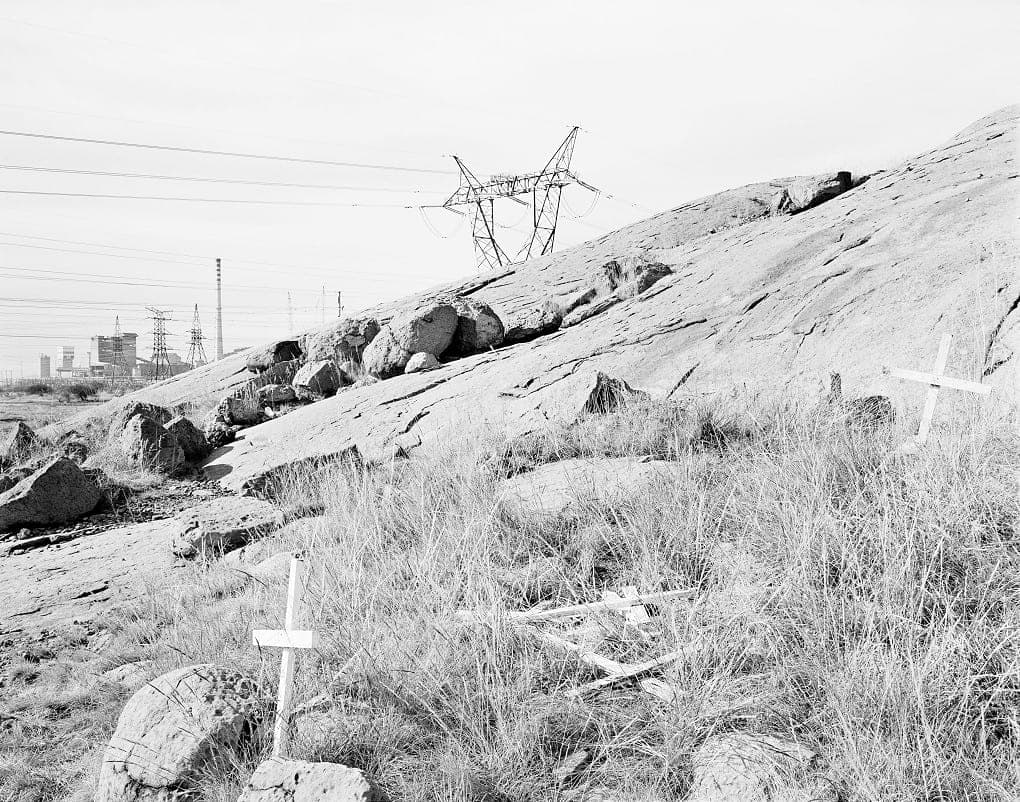
On August 16 2012 South African Police shot striking mineworkers of the Lonrho platinum mines, killing 34 and wounding 78 in seemingly wild shooting without good cause. The men were shot, some with their hands up in surrender, within a radius of about 300 metres of this koppie on which they met. Beyond is the Lonhro smelter, which stood idle during the strike. Marikana, North-West Province. 11 May 2014 , 2014
Silver gelatin print on fibre-based paper, dibonded
97 x 119.5 cm
38.2 x 47 in
Edition of 10
David Goldblatt
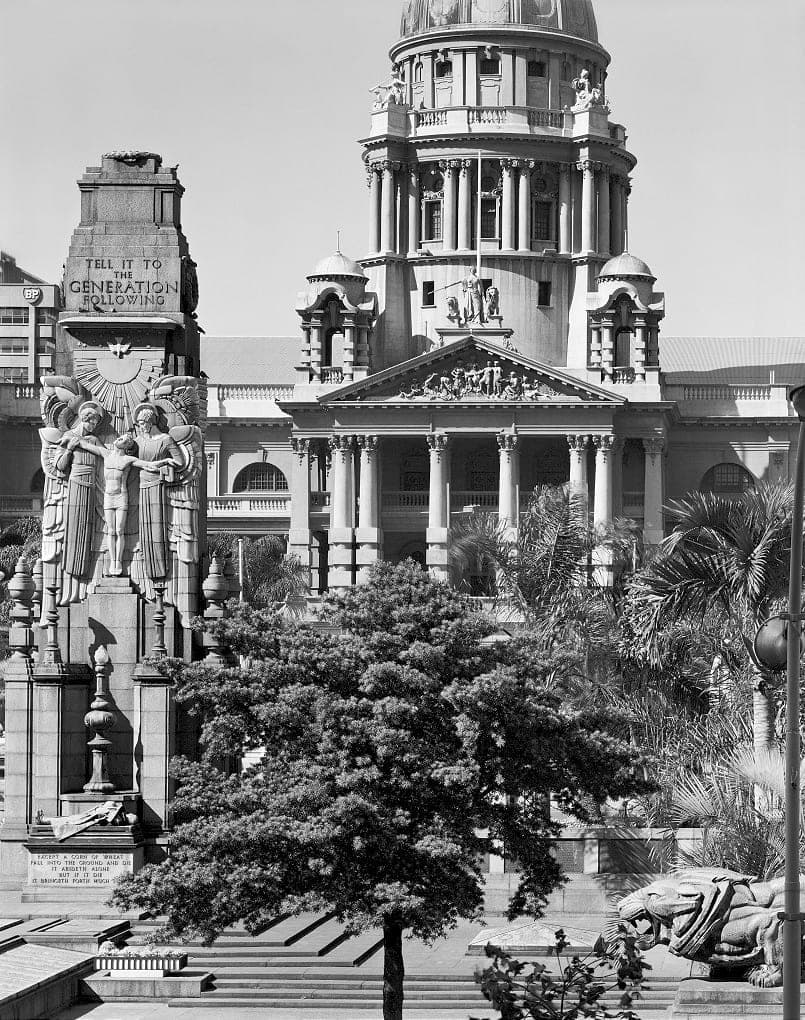
The City Hall, opened on 12 April 1910, and the Cenotaph, unveiled on 7 March 1926, Durban, Natal. 1980 , 1980
Silver gelatin print on fibre-based paper, dibonded
A0
Edition of 10
David Goldblatt
Sculpted by Kagiso Pat Mautloa, a memorial to those who died while in the detention of the Security Police in this building, John Vorster Square, now Johannesburg Central Police Station. 27 February 2012 , 2012
Silver gelatin print on fibre-based paper, dibonded
A0
Edition of 10
David Goldblatt
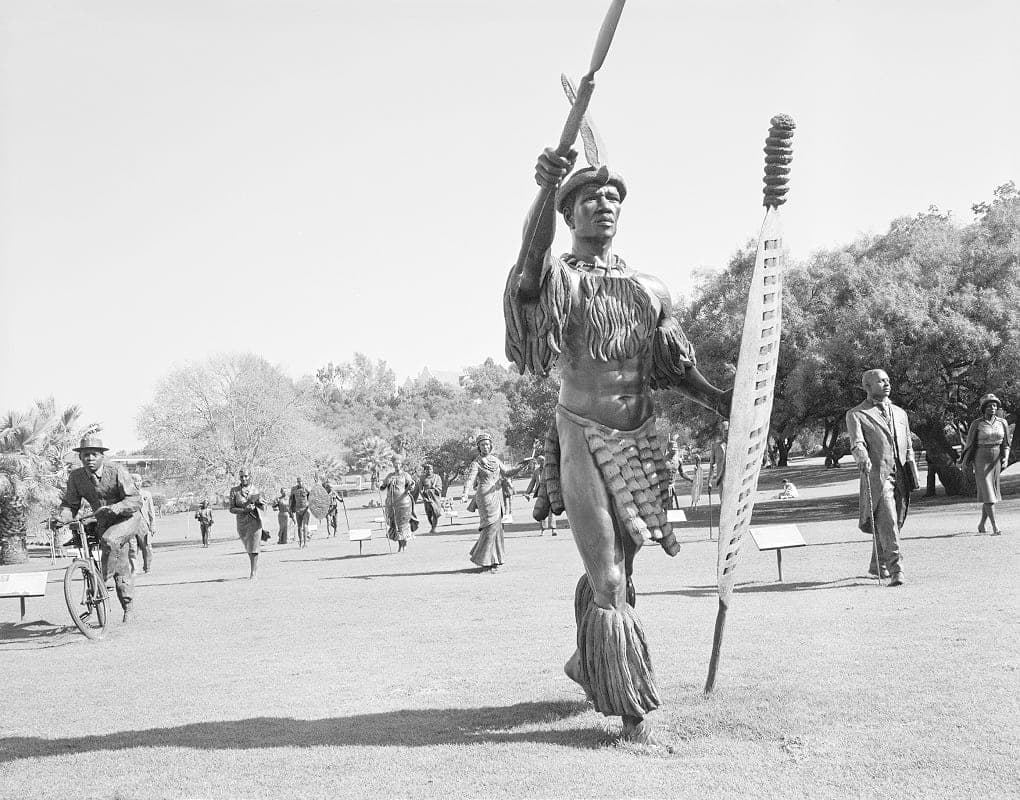
Life-size, life-like bronzes looking and "moving" forward in a Long March to Freedom, on the lawns of the Olievenhuis Art Museum, Bloemfontein. 18 May 2014 , 2014
Silver gelatin print on fibre-based paper, dibonded
A0
Edition of 10
David Goldblatt
Monument to the Cradock Four, who, while travelling from Port Elizabeth to Cradock, were abducted here by Security Policemen, then assaulted, assassinated and their bodies burnt on 27 June 1985. Vulindela Housing Estate, Coega, Port Elizabeth. 21 December 2014 , 2014
Silver gelatin print on fibre-based paper, dibonded
A0
Edition of 10
David Goldblatt
Built in 2013: The Zulu side of a Bridge of Reconciliation between the Voortrekkers and the Zulus at the Nkome or Blood River. This is the Zulu side of the bridge. The Voortrekker side is usually locked for lack of funds to fence it against unpaid entrance to the site. Blood River,KwaZulu Natal, 24 January 2015 , 2015
Silver gelatin print on fibre-based paper, dibonded
A0
Edition of 10
David Goldblatt
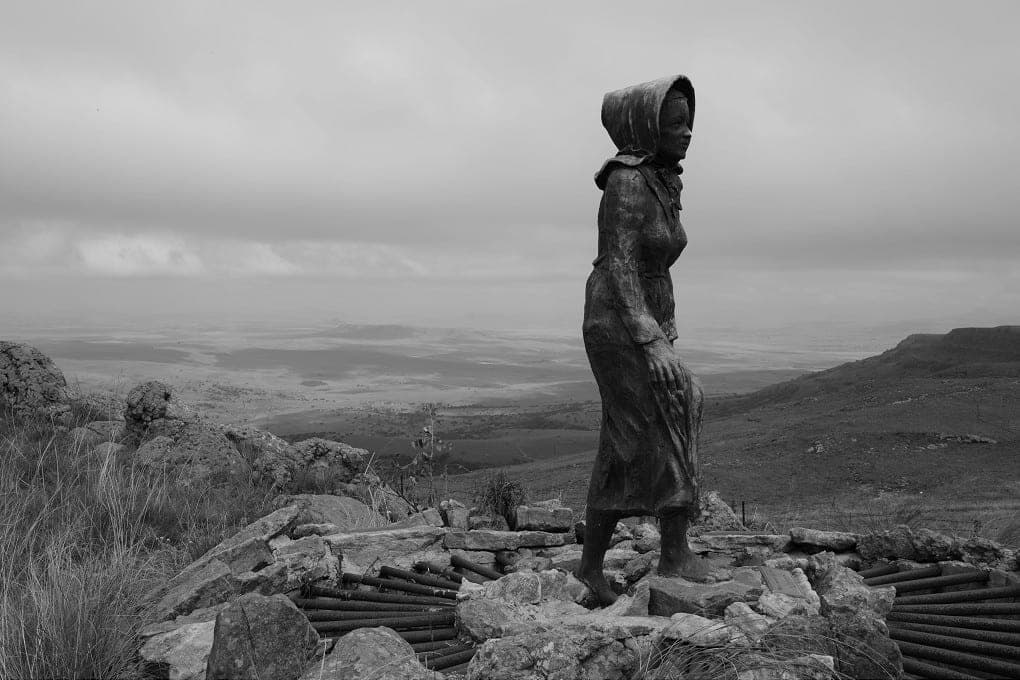
Sculpture of Susanna Smit, leader of a group of 400 Voortrekker women who in 1843 protested the annexation of Natalia by Britain. Vergezient, KwaZulu Natal. 28 March 2015 , 2015
Silver gelatin print on fibre-based paper, dibonded
79.1 x 118 cm
31.1 x 46.5 in
Edition of 10
David Goldblatt
Cafe-de-Move-On, Croesus, Johannesburg. 1964 , 1964
Silver gelatin print on fibre-based paper, dibonded
A0
5/10
David Goldblatt
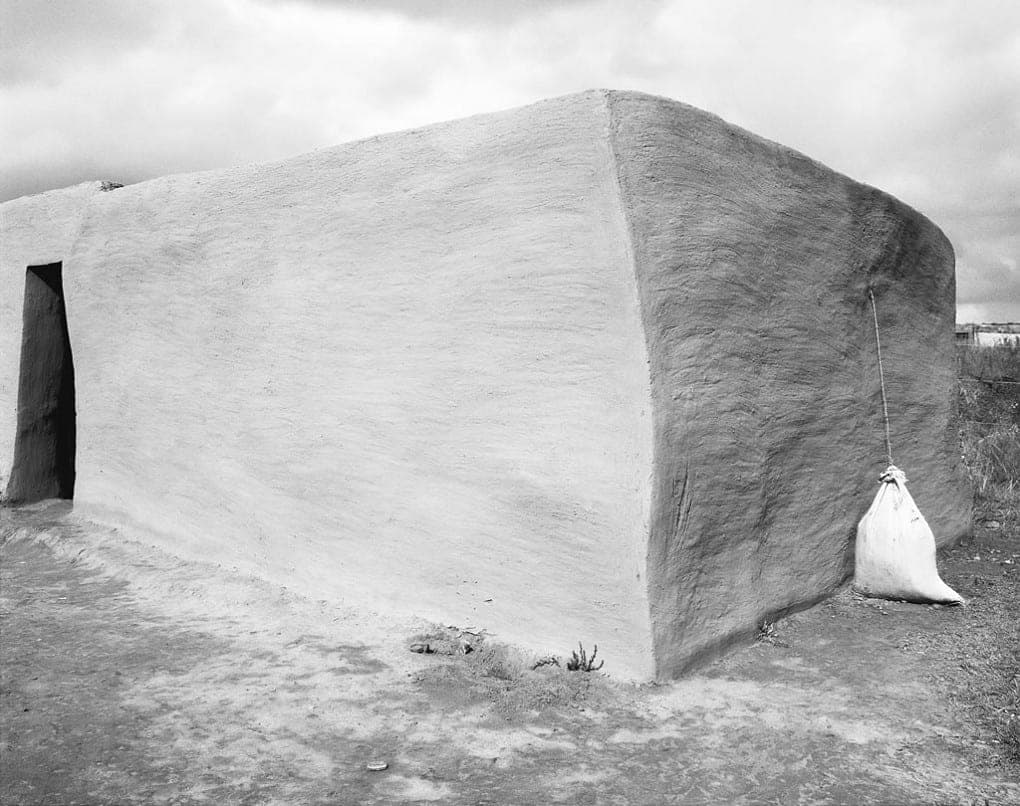
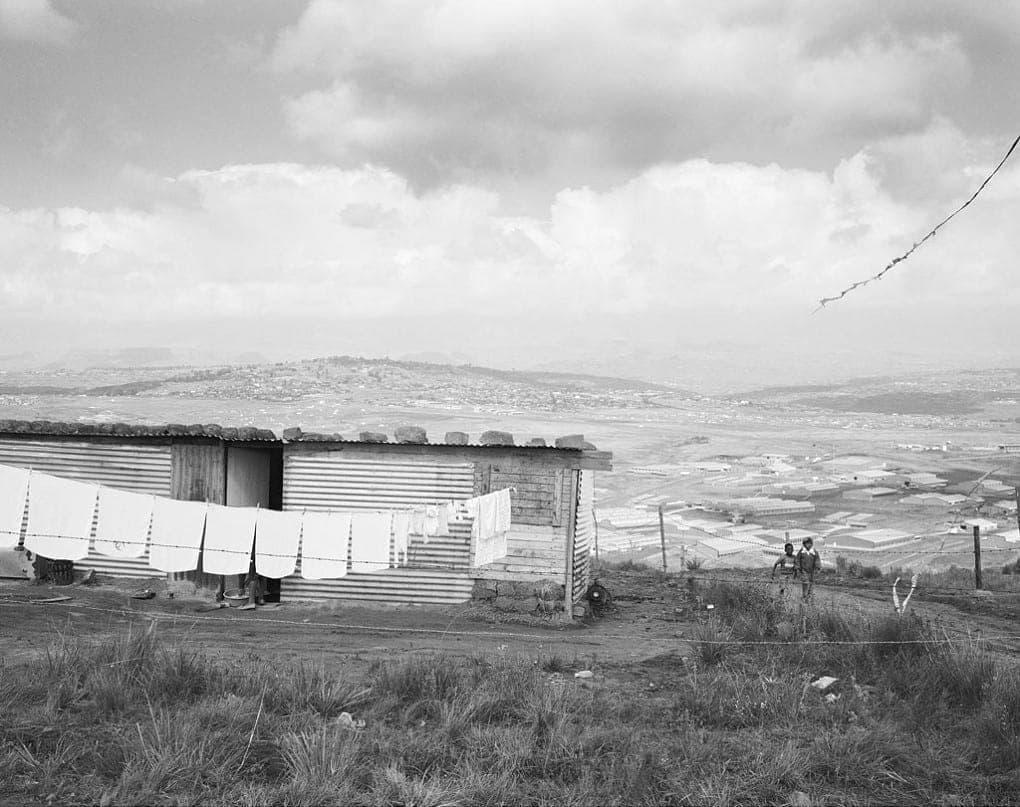
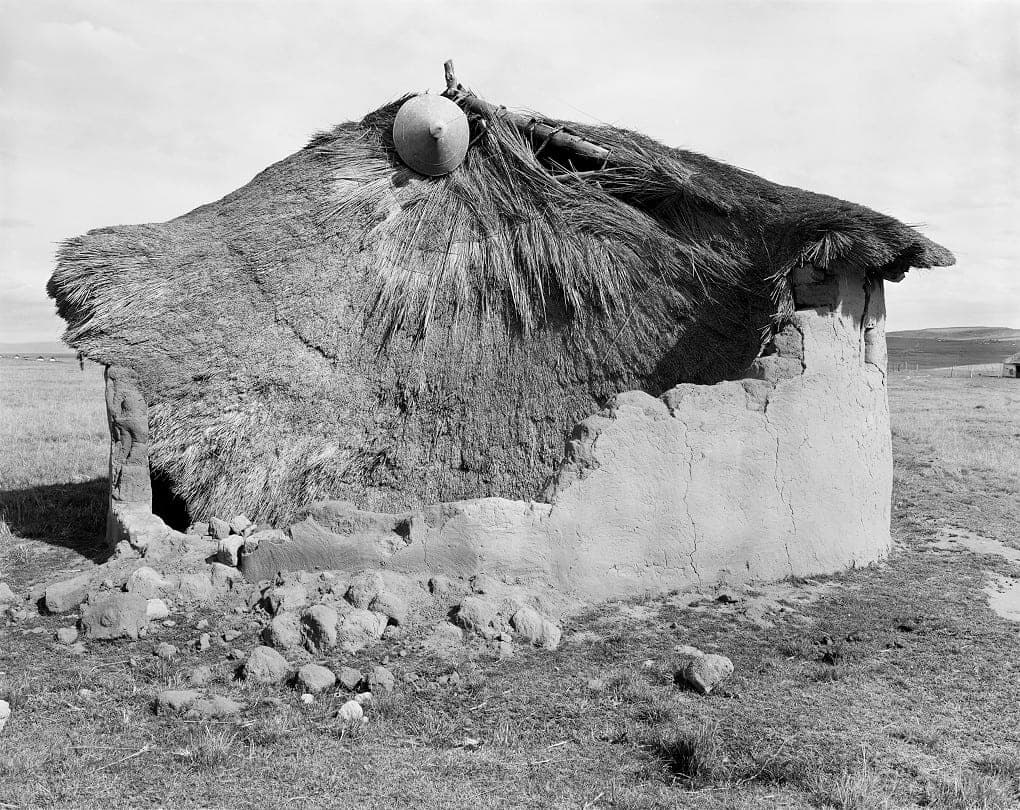
House near Phuthaditjhaba. QwaQwa. 1 May 1989 , 1989
Silver gelatin print on fibre-based paper
A0
Edition of 8

House near Phuthaditjhaba. QwaQwa. 1 May 1989 forms part of Goldblatt’s Structures series. Based on the idea that structures reflect the values of the people who build them, this series is a photographic exploration of the ways in which colonial and Apartheid values were expressed in the construction and deconstruction of structural landscapes. The images in this series - taken between 1964 and 1994 - consider the impact of built environments on landscapes and people.

David Goldblatt
A domestic worker's afternoon off, Sunninghill, Sandton, Johannesburg. 23 July 1999 , 1999
Silver gelatin print on fibre-based paper, dibonded
A0 98 x 120cm
38.6 x 47.2 in
Edition of 10
David Goldblatt
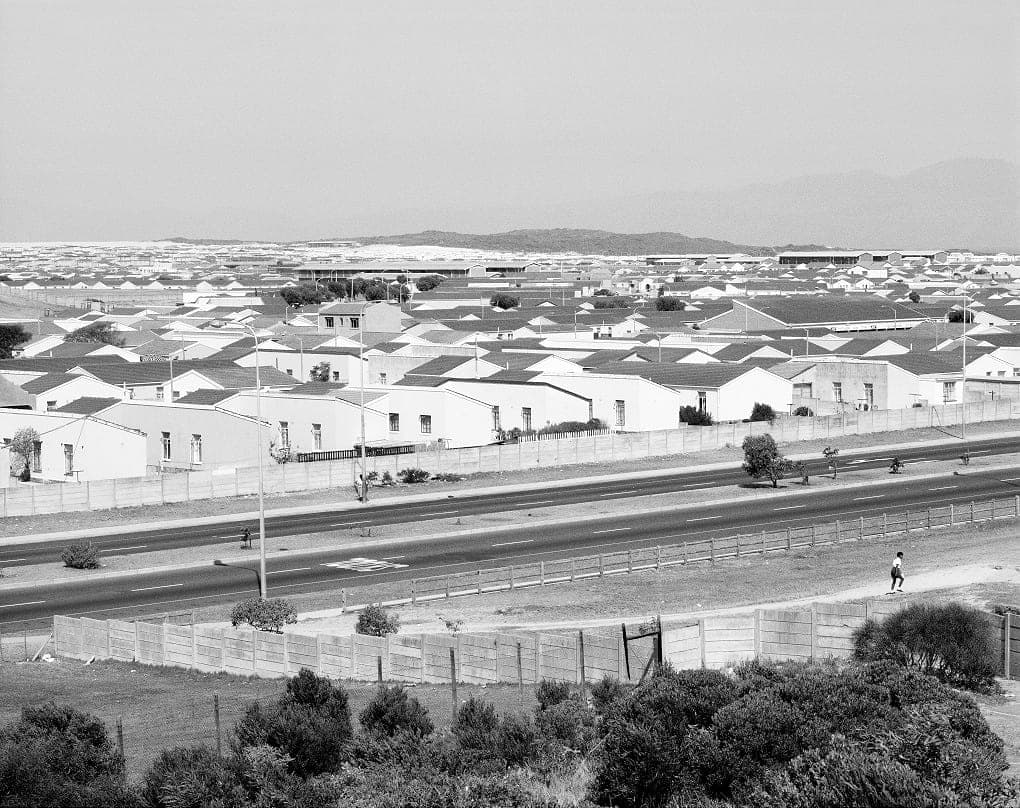
Portlands, Mitchells Plain, Cape Town. 08 February 1989 , 1989
Silver gelatin print on fibre-based paper, dibonded
A0
Edition of 10
David Goldblatt
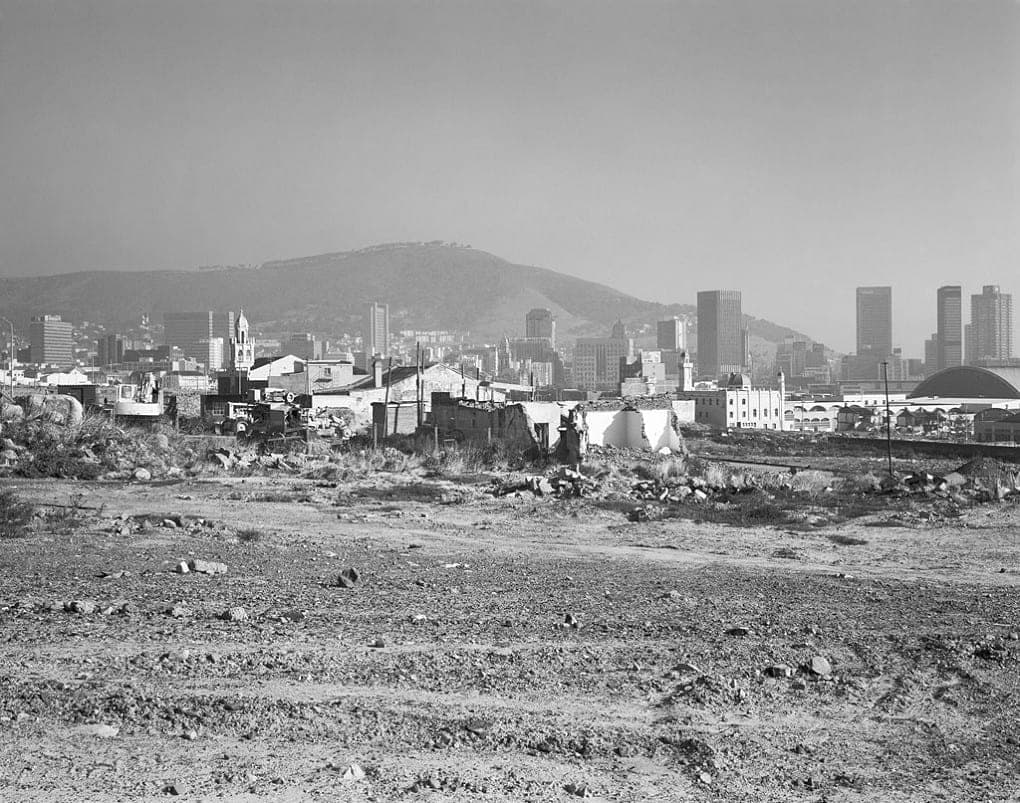
The destruction of District Six under the Group Areas Act, Cape Town , 1982
Silver gelatin print on fibre-based paper, dibonded
A0
Edition of 10

A multi-racial area which effectively became the home of Cape Town’s Coloured people, District Six was declared a group area for Whites by the government in 1966. Despite strong objections by many and disparate people and organisations, the proclamation was enforced. Fifty thousand ‘disqualfied’ people, most of them Coloureds, some of whose families had lived in the District for as long as seven generations, were removed to mass housing beyond the city. Such was the odium attached to this act of government that private developers eschewed the prime city property thus released.

David Goldblatt
Kite flying, near Phuthaditjhaba, in the apartheid bantustan of Qwa Qwa. 1 May 1989 , 1989
Silver gelatin print on fibre-based paper, dibonded
A0: 98 x 120cm
38.6 x 47.2 in
Edition of 10

David Goldblatt was born in Randfontein, a small mining town outside of Johannesburg, South Africa. Through his lens, chronicled the people, structures and landscapes of his country from 1948, through the rise of Afrikaner Nationalism, the apartheid regime and into the democratic era - until his death in June, 2018. In particular, Goldblatt documented the people, landscapes and industry of the Witwatersrand, the resource-rich area in which he grew up and lived, where the local economy was based chiefly on mining. In general, Goldblatt's subject matter spanned the whole of the country geographically and politically from sweeping landscapes of the Karoo desert to the arduous commutes of migrant black workers, forced to live in racially segregated areas. His broadest series, which spans six decades of photography, examines how South Africans have expressed their values through the structures, physical and ideological, that they have built.

David Goldblatt
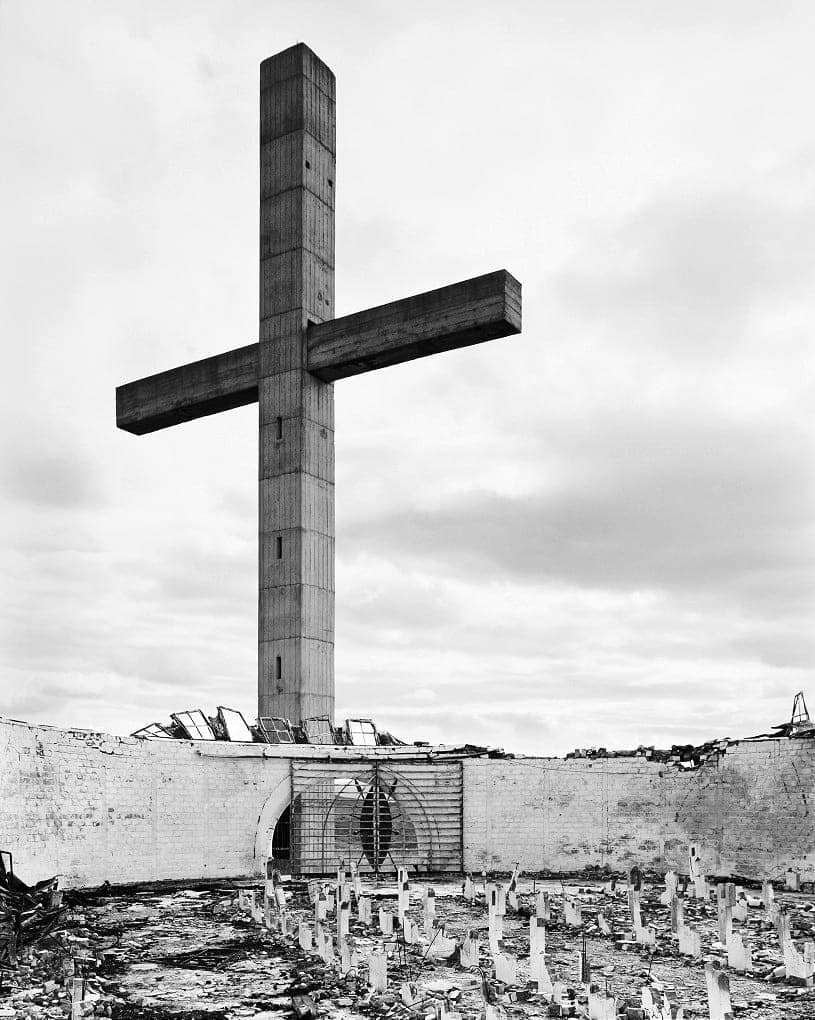
Assegais, shield, and 23-metre-high cross of the Nederduitse Gereformeerde Kerk in Afrika, (Dutch Reformed Mission Church to Africans), which stands above Dingane's destroyed capital, uMgungundlovu. The church was burnt down in 1985; Dinganestad, Natal. 1989 , 1989
Silver gelatin print on fibre-based paper, dibonded
A0: 98 x 120cm
38.6 x 47.2 in
Edition of 10

David Goldblatt (1930 -2018, South Africa), through his lens, chronicled the people, structures and landscapes of his country from 1948, through the rise of Afrikaner Nationalism, the apartheid regime and into the democratic era until his death in June, 2018. In particular, Goldblatt documented the people, landscapes and industry of the Witwatersrand, the resource-rich area in which he grew up and lived, where the local economy was based chiefly on mining. Art Institute Chicago will present an exhibition spanning Goldblatt’s seven-decade career titled No Ulterior Motive in December 2023.

Goldblatt's subject matter spanned the whole of the country geographically and politically from sweeping landscapes of the Karoo desert to the arduous commutes of migrant black workers, forced to live in racially segregated areas. His broadest series, which spans six decades of photography, examines how South Africans have expressed their values through the structures, physical and ideological, that they have built.

David Goldblatt
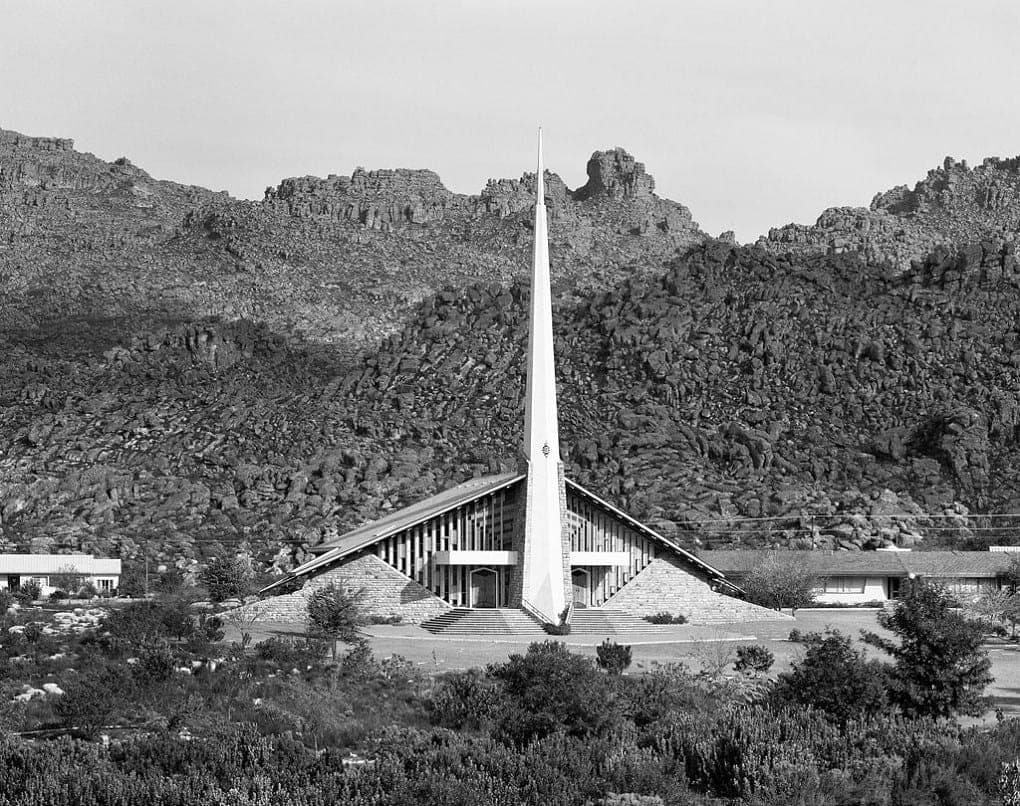
Dutch Reformed Church inaugurated on 31 July 1966, Op-die-Berg, Koue Bokkeveld. 23 May 1987 , 1987
Silver gelatin print on fibre-based paper
A0
Edition of 8

David Goldblatt’s ‘Structures of Dominion and Democracy’ is a long-term photographic project that examines how South Africa’s built environment reflects the ideologies of its successive political regimes. Initiated in the 1980s and developed over several decades, the series documents a wide range of structures – courthouses, mining compounds, schools, homes, churches, and public spaces – each chosen for its connection to systems of power, control, and belief. Goldblatt was interested in how architecture could serve as a material record of social values. By photographing these structures with clarity and restraint, he invited viewers to consider the moral and historical forces embedded within them.

The series is divided into two parts: structures of "dominion," associated with the apartheid regime and its mechanisms of racial control, and those of "democracy," built after 1994, in the wake of South Africa’s transition to constitutional rule. Goldblatt did not present this shift as a clean rupture, but as a complex, ongoing negotiation between past and present. Many of the post-apartheid structures appear provisional, hopeful yet unresolved, while others suggest the persistence of older patterns of inequality. Together, the photographs offer a sober reflection on the relationship between architecture and ideology, and on how the aspirations and contradictions of a society are made visible in its physical forms.

David Goldblatt
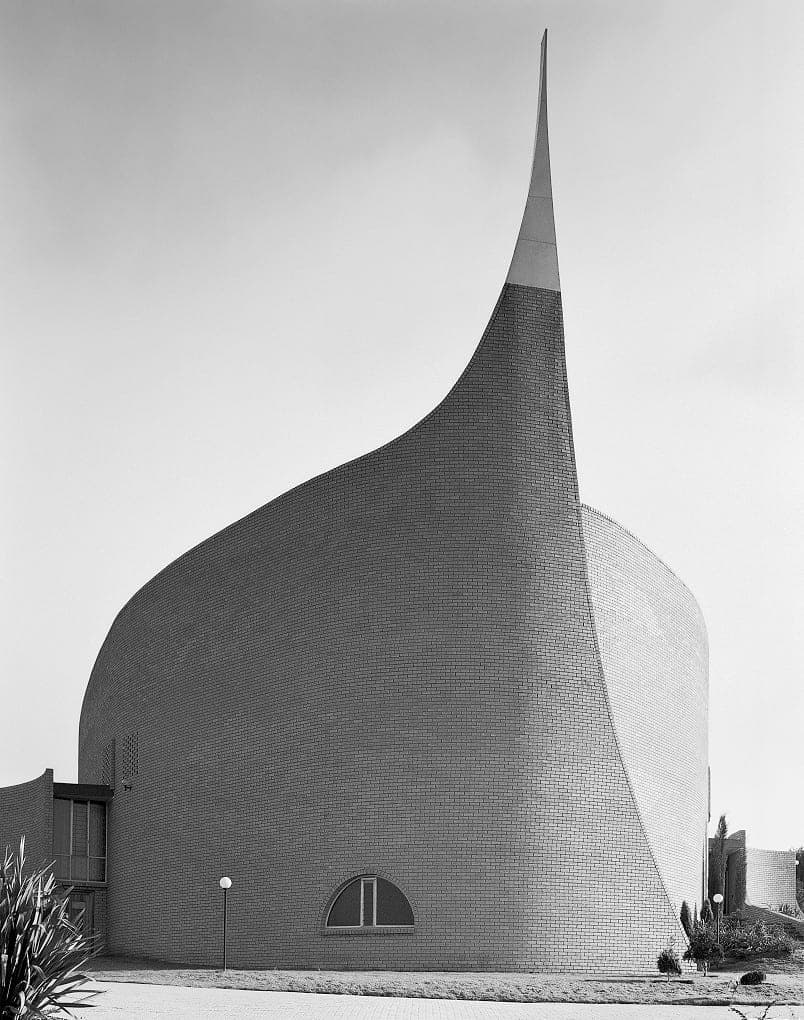
Nederduitse Gereformeerde Kerk (Dutch Reformed Church), completed in 1984, Quellerina, Johannesburg, Transvaal 4_4627, 1986
Silver gelatin print on fibre-based paper, dibonded
Image: 84 x 119 cm
Image: 84 x 119 cm
Edition of 10
David Goldblatt
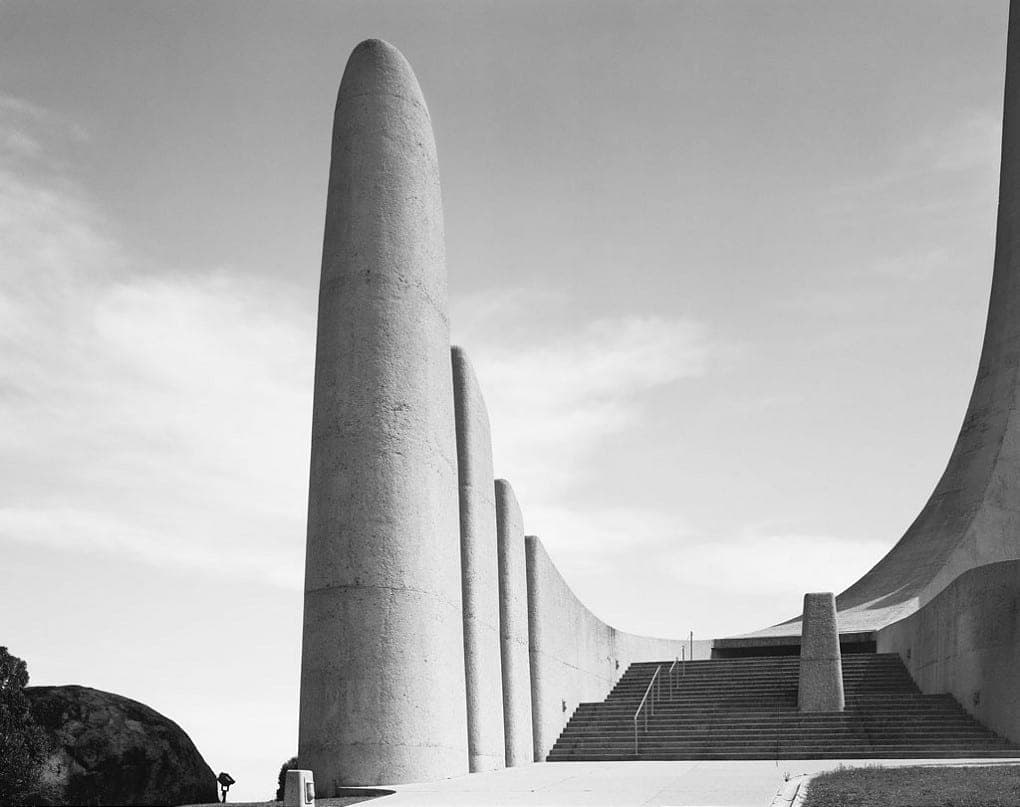
Monument to the Afrikaans language, inaugurated on 10 October 1975, Paarl. 5 April 1992 , 1992
Silver gelatin print on fibre-based paper, dibonded
A0: 98 x 120cm
38.6 x 47.2 in
Edition of 8
David Goldblatt
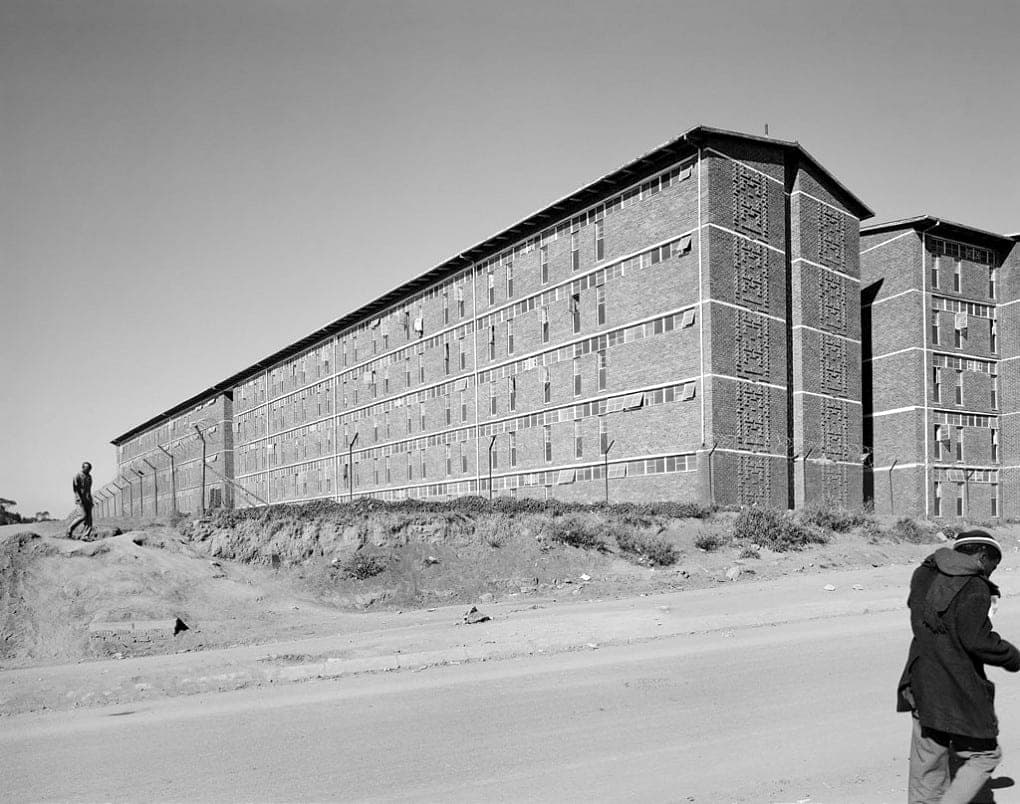
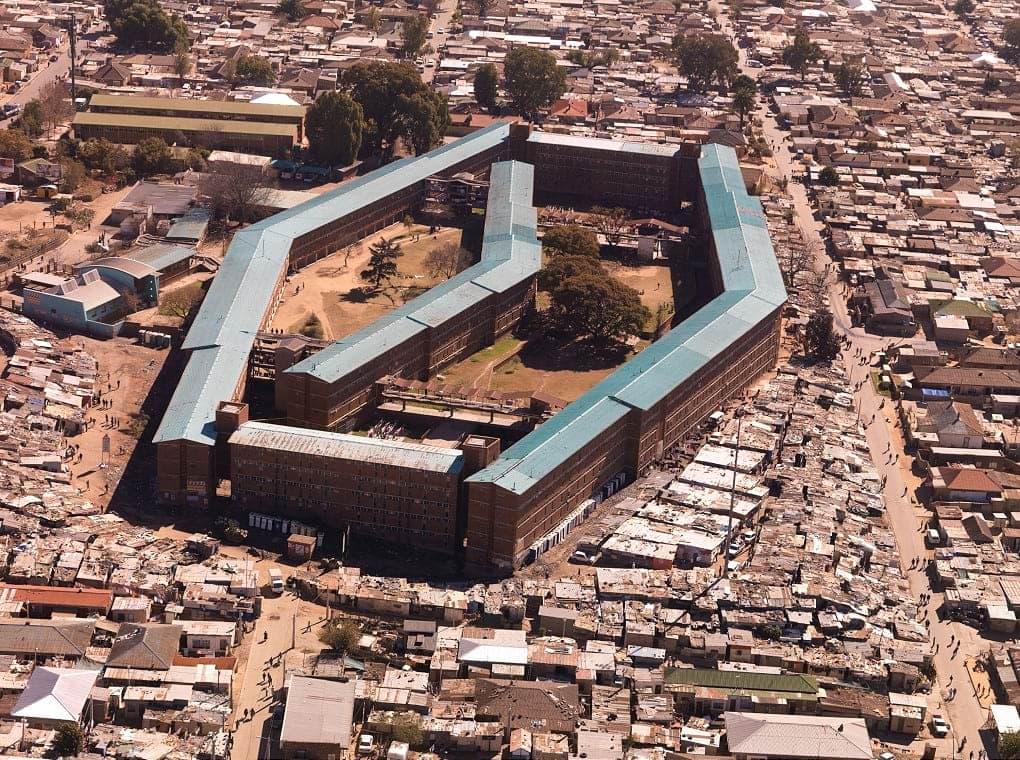
South-east wing of a hostel for Black male workers erected during apartheid as part of a scheme to make Joburg city and suburbs white. Alexandra Township. 1 June 1988 , 1988
Silver gelatin print on fibre-based paper
A0
Edition of 10
David Goldblatt
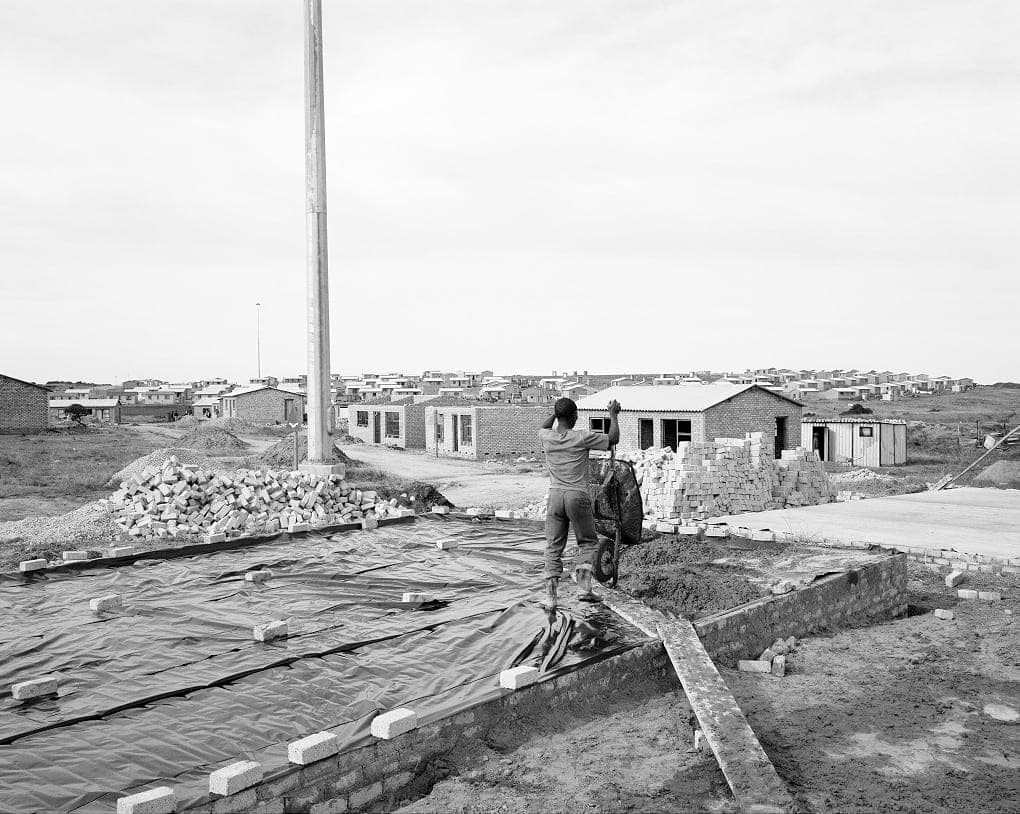
Man building his house, Marselle Township, Kenton-on-sea. 08 July 1990 , 1990
Silver gelatin print on fibre-based paper, dibonded
20.1 x 25.3 cm
7.9 x 10 in
Edition of 10
David Goldblatt
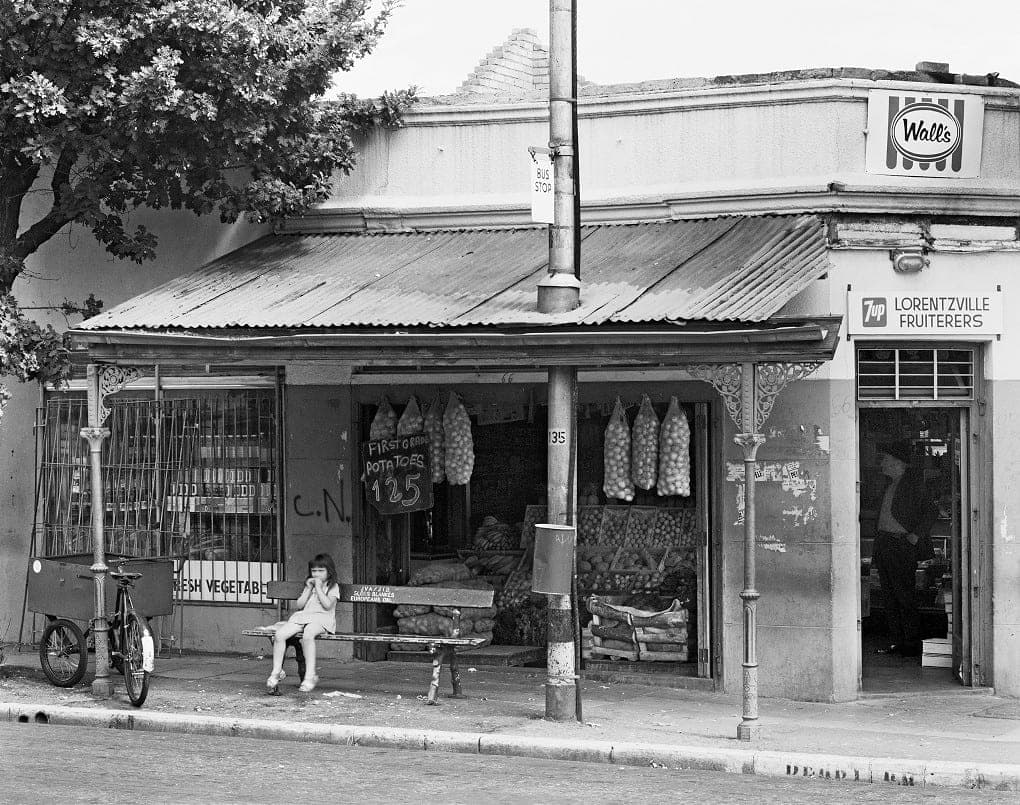
Bus stop, Derby Road, Lorentzville, Johannesburg. December 1973 , 1973
Silver gelatin print on fibre-based paper
A0
Edition of 10
David Goldblatt
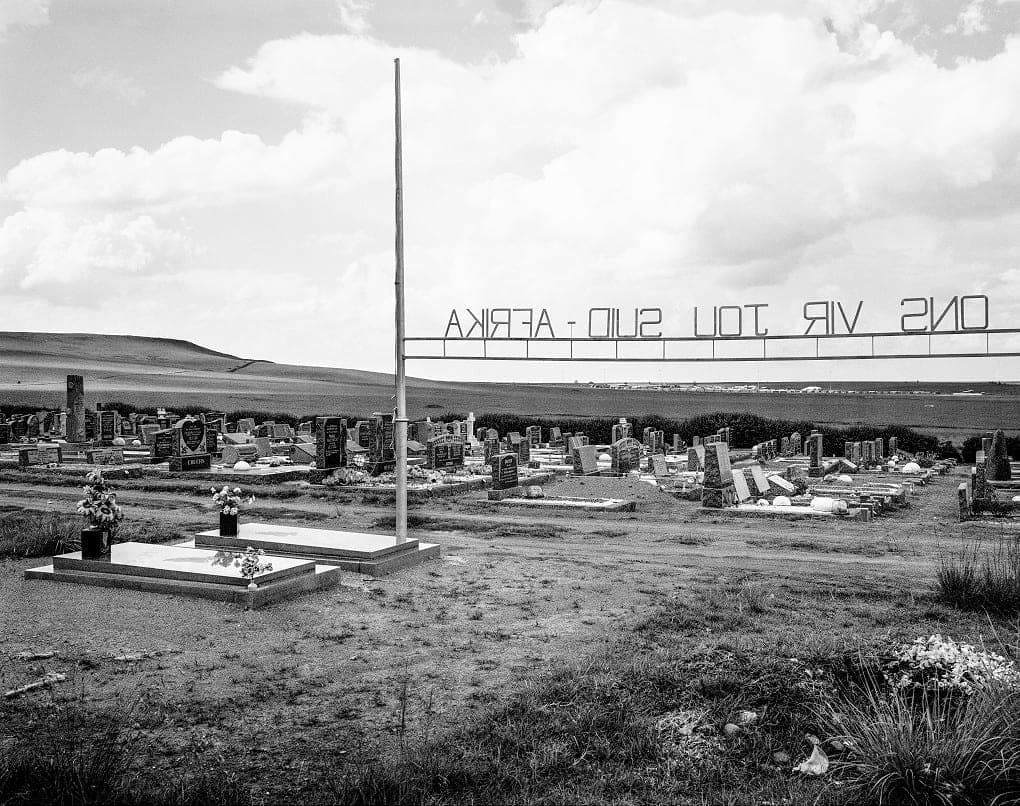
"Ons vir jou Suid-Afrika" (we are for you you South Africa)" The Heroes' Acre: Military graves at the cemetery with Zamoukuhle township Amersfoort. 20 December 1986 , 1986
Silver gelatin print on fibre-based paper, dibonded
27 x 34.5 cm
10.6 x 13.6 in
Edition of 10
David Goldblatt
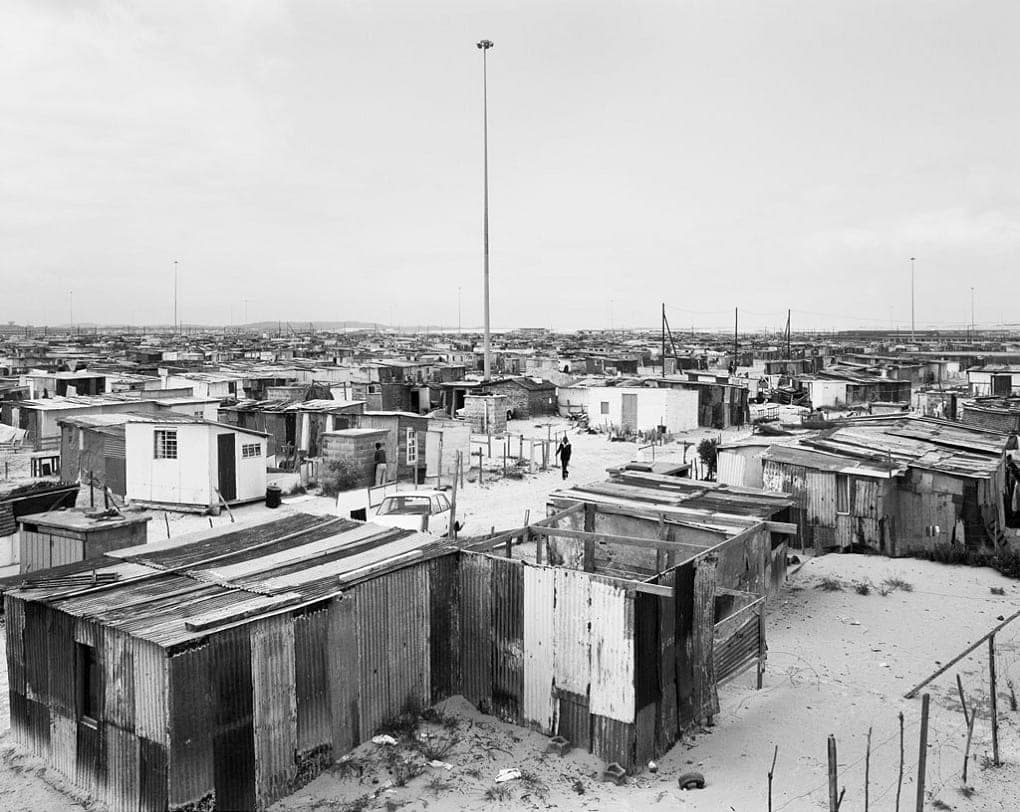
Flushing Meadows and lighting masts, Site B, Khayelitsha, Cape Town, 11 October 1987 Structures , 1987
Silver gelatin print on fibre-based paper, dibonded
Image: 84 x 119 cm
Image: 84 x 119 cm
Edition of 10
David Goldblatt
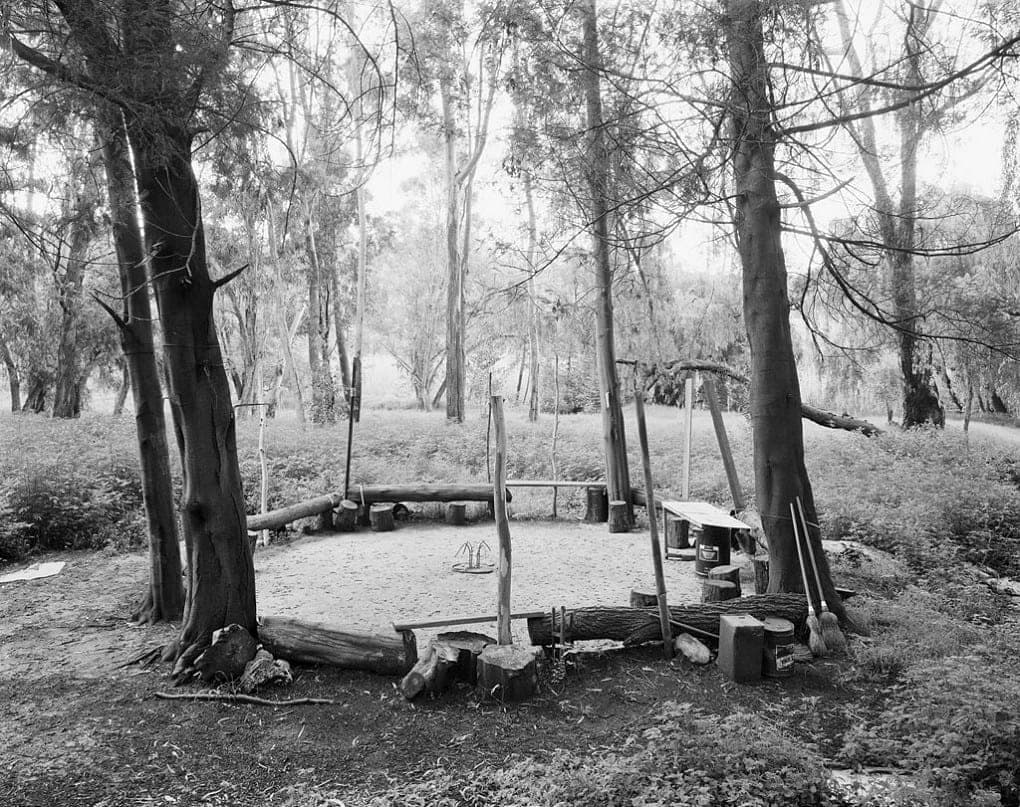
The meeting place of the Jerusalema Apostolic Church in Zion, Melrose Bird Sanctuary, Johannesburg, 31 December 1987 , 1987
Silver gelatin print on fibre-based paper, dibonded
A0
Edition of 10
David Goldblatt
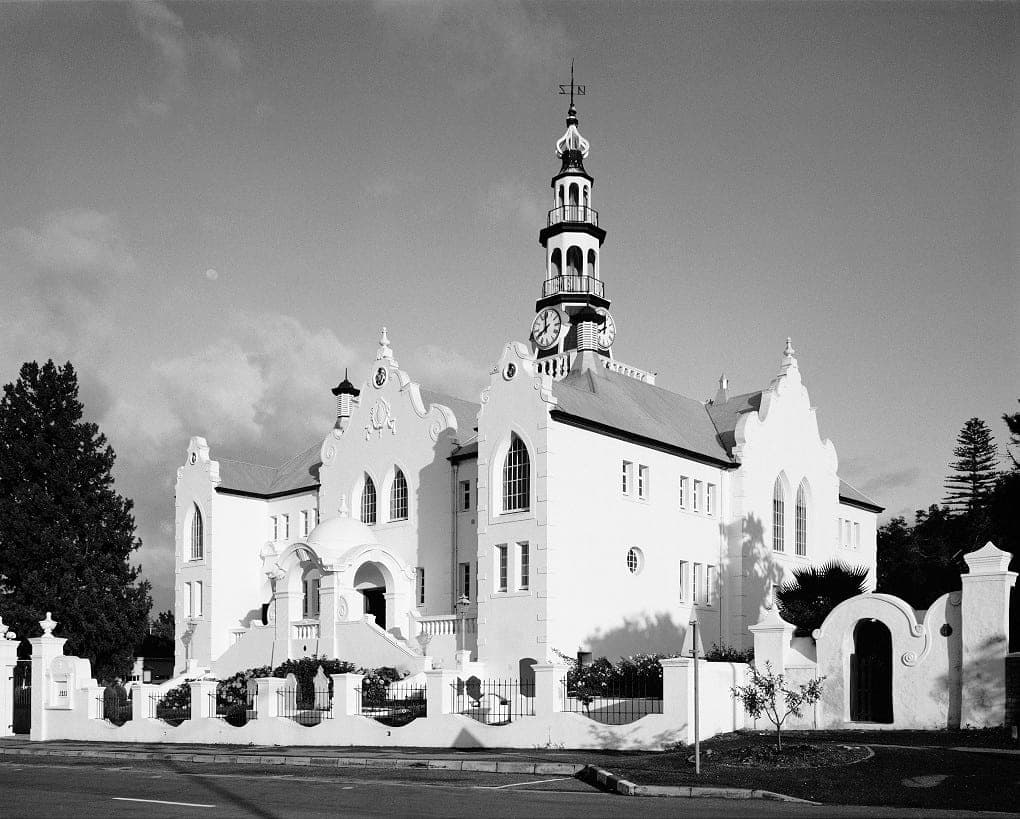
Dutch Reformed Church, built in 1911 Swellendam, Cape. 9 April 1993 , 1993
Silver gelatin print on fibre-based paper, dibonded
A0
Edition of 10
David Goldblatt
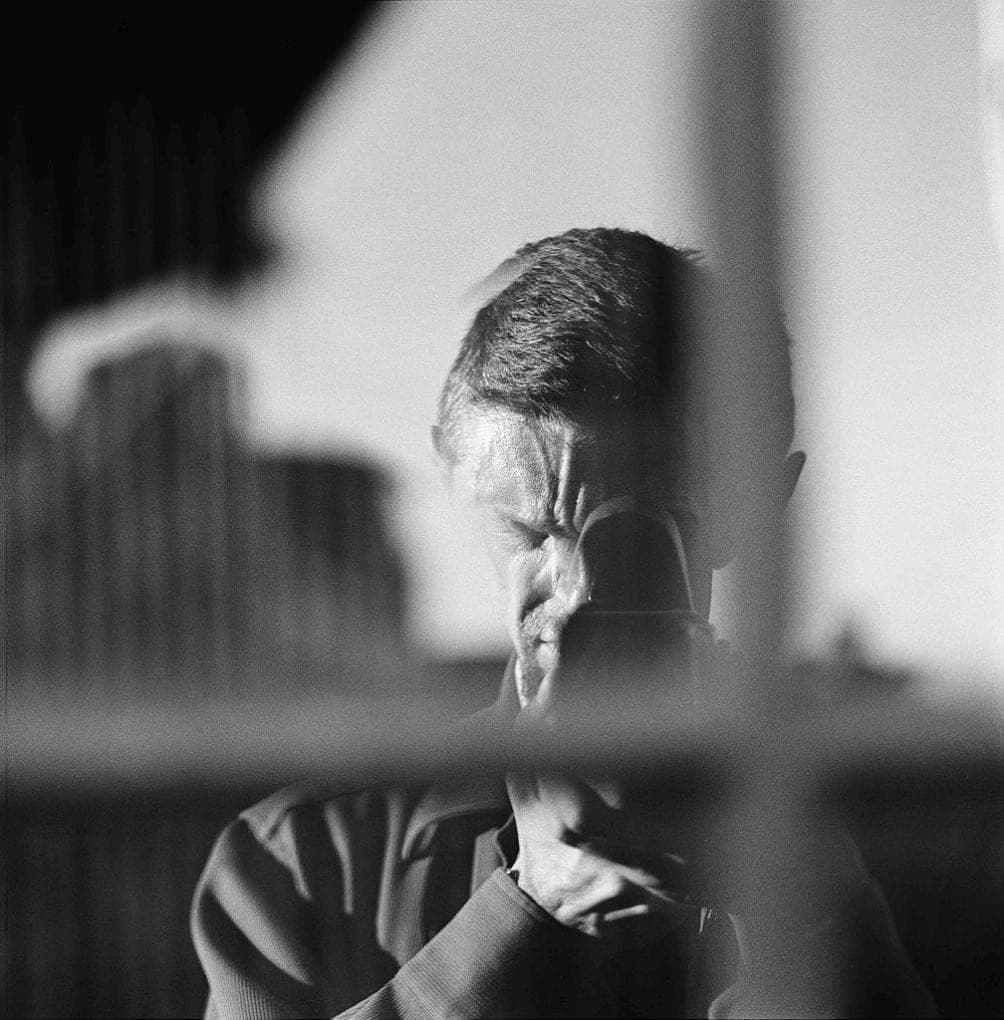
Self-portrait at Consolidated Main Reef Mines, Roodepoort. , May 1967
Silver gelatin print on fibre-based paper
43.5 x 44 cm
17.1 x 17.3 in
Edition of 10
David Goldblatt
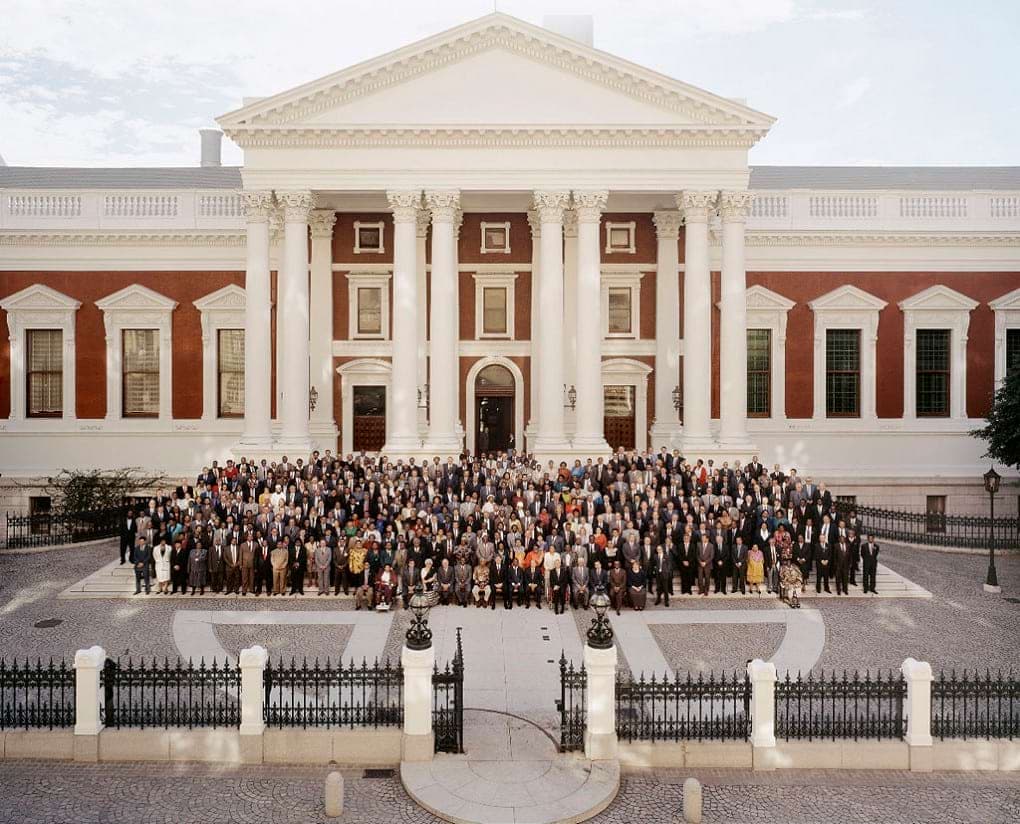
Members of the Constitutional Assembly on the steps of the Senate House in the parliamentary precinct, shortly after they had unanimously adopted the Constitution of South Africa, Cape Town. 11 October 1996 , 1996
Digital print in pigment inks on cotton rag paper
A0
Edition of 10
David Goldblatt
Freedom Square: here, in the time of apartheid, on 26 June 1955, under harassment by the police, some 3000 people of all races, from all over South Africa, gathered in a Congress of the People and adopted the Freedom Charter, a template for the governance of a non-racial, democratic South Africa. The Charter became the basis of South Africa’s democratic constitution. Kliptown, Soweto, Johannesburg. 10 December 2003 , 2003
Digital print in pigment inks on cotton rag paper
A0
Edition of 10
David Goldblatt
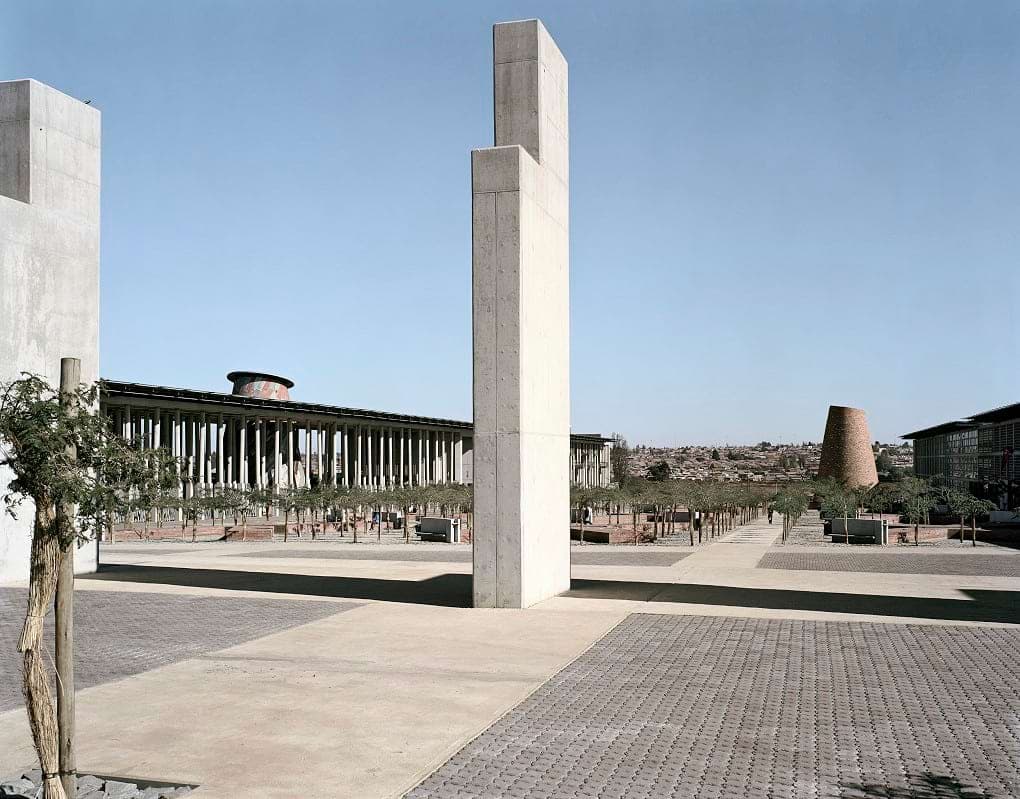
This monument, covering what was Freedom Square, commemorates the Congress of the People in 1955. Costing R160 million it has a hotel, conference centre, auditorium , galleries, shops, museum, plaza for informal traders, conical tower in which the Freedom Charter is displayed. The community of Kliptown in whose midst it was built, were not consulted. Most of the facilities are hardly used. Fearing that tourists might confuse Freedom Park, Pretoria with Freedom Square, Kiptown, the branding experts named it instead, the Walter Sisulu Square of Dedication. Sisulu had very little to do with this place. Kliptown, Soweto, 22 June 2006 , 2006
Digital print in pigment inks on cotton rag paper
A0
Edition of 10

Costing some R160 million, it has a hotel, conference centre, auditorium, galleries, shops, a museum, a plaza with platforms for the display of their wares by informal traders, a conical tower in which the Freedom Charter is displayed. Most of these facilities are largely unused. Neither the people of Kliptown in whose midst it was planted without their consultation, nor the people of greater Soweto, which it adjoins, have taken to it. Most of the informal traders prefer the ground and the sidewalks to the facilities designed for them.

Fearing that tourists might be confused between Freedom Park in Pretoria and this place which was known as Freedom Square, the branding experts have called it instead The Walter Sisulu Square of Dedication. It is a place with which that hero of the Struggle had very little to do. 22 June 2006

David Goldblatt
Sarie Fink doing her hair; she lived with her aunt, who farmed here at Klein Rivier, Buffelsdrift, between Oudtshoorn and Uniondale, Western Cape. 23 November 2004 , 2004
Digital print in pigment inks on cotton rag paper
A0
Edition of 10

“In the 1990s my anger dissipated. Apartheid was no more. There were things to probe and criticise, but the emphasis was different. Lyricism seemed not only permissible but possible. In the late ‘90s I became aware of colour as a particular quality of this place and its light that I wanted to explore. It seemed ‘thin’, yet intense. To achieve prints that would hold these qualities I would need to print in colour in a way that was similar to that which I had developed for my black and white work … Over the generations, the land has shaped us - I say us in the broadest sense, us South Africans. And we have shaped the land. It is almost impossible now to find a pristine landscape. The grass has been grazed to the point of being threadbare, crops come and go, roads traverse, fences divide, and mines penetrate and throw up scabs of their detritus. These and our structures are the marks of our presence. I am drawn by the intimacies of our association with this land.” David Goldblatt

David Goldblatt
From Devil’s Bellows Nek on Old Katberg Pass, Transkei, Eastern Cape, 7 May 2007 , 2007
Digital print in pigment inks on cotton rag paper, dibonded
A0
Edition of 10
David Goldblatt
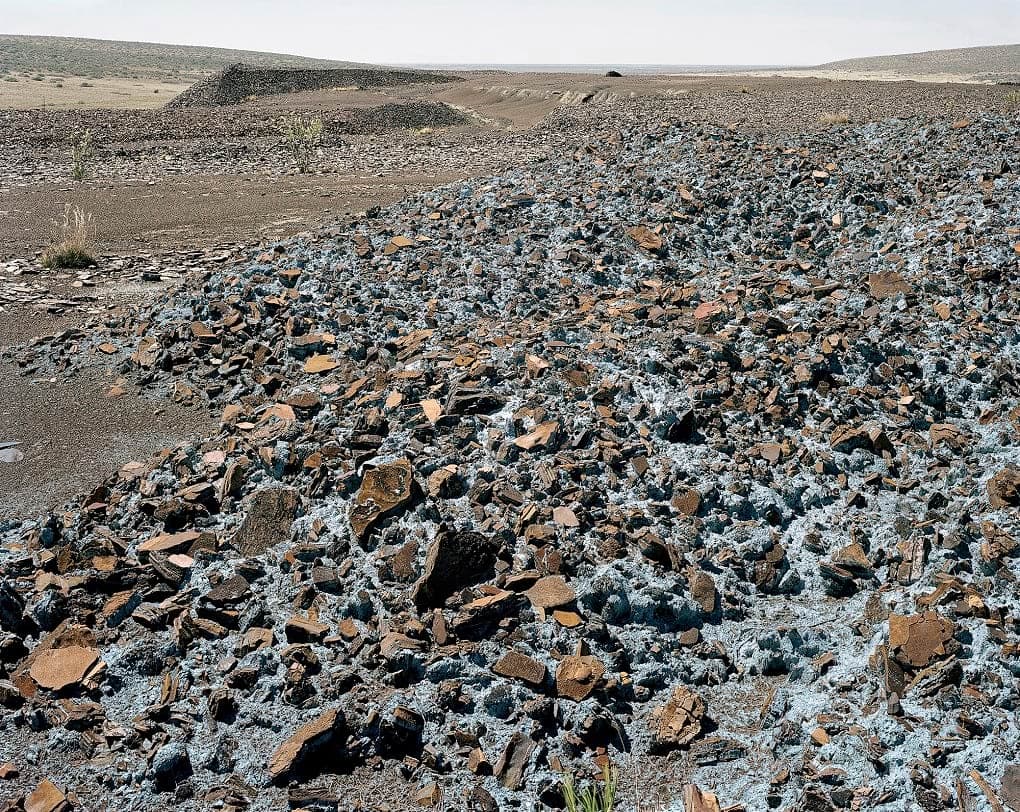
Blue asbestos waste on the Owendale Asbestos Mine tailings dump, Near Postmasburg, Northern Cape. 21 December 2002 , 2002
Digital print in pigment inks on cotton rag paper
A0
AP
David Goldblatt
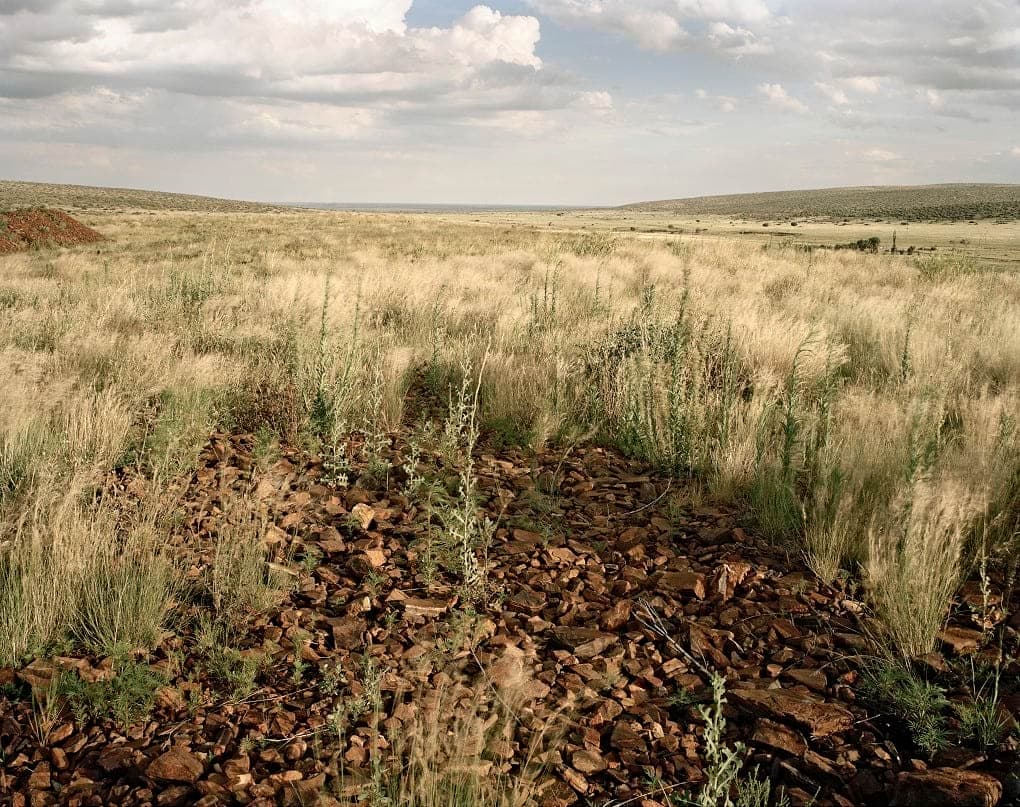
Tailings dump after reclamation, Owendale Asbestos Mine, Northern Cape. 24 December 2007 , 2007
Digital print in pigment inks on cotton rag paper
A0
Edition of 10

David Goldblatt was born in Randfontein, a small mining town outside of Johannesburg, South Africa. Through his lens, chronicled the people, structures and landscapes of his country from 1948, through the rise of Afrikaner Nationalism, the apartheid regime and into the democratic era - until his death in June, 2018. In particular, Goldblatt documented the people, landscapes and industry of the Witwatersrand, the resource-rich area in which he grew up and lived, where the local economy was based chiefly on mining. In general, Goldblatt's subject matter spanned the whole of the country geographically and politically from sweeping landscapes of the Karoo desert to the arduous commutes of migrant black workers, forced to live in racially segregated areas. His broadest series, which spans six decades of photography, examines how South Africans have expressed their values through the structures, physical and ideological, that they have built.

David Goldblatt
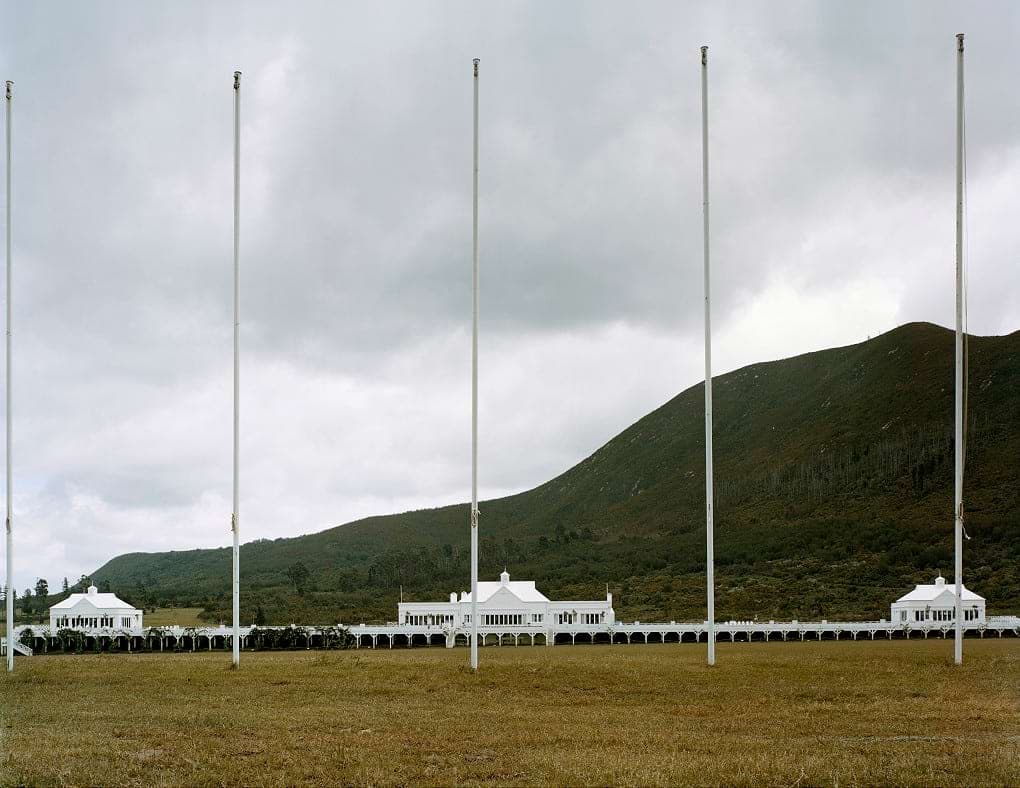
Polo pavilion, Kurland Estate, Plettenburg Bay, Western Cape. 9 October 2004 , 2004
Digital print in pigment inks on cotton rag paper
A0 or A0+
Edition of 10
David Goldblatt
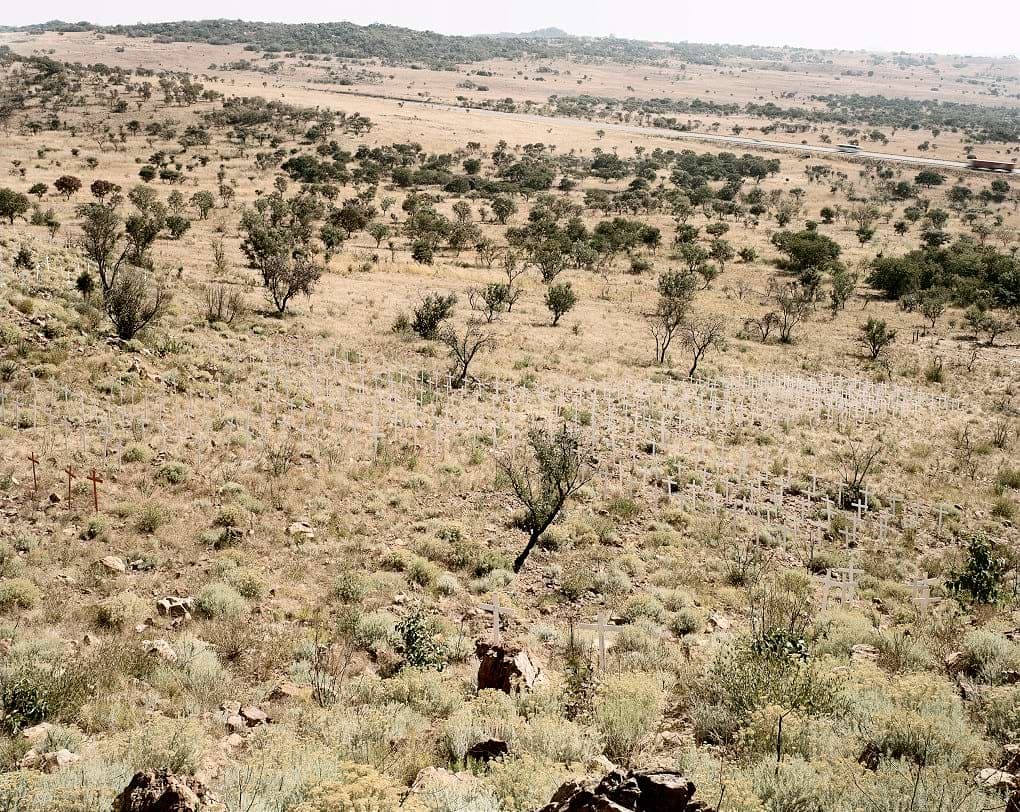
In commemoration of and protest against farm murders, Rietvlei, on the N1 near Polokwane. 19 June 2004 , 2004
Digital print in pigment inks on cotton rag paper
A0
Edition of 10
David Goldblatt
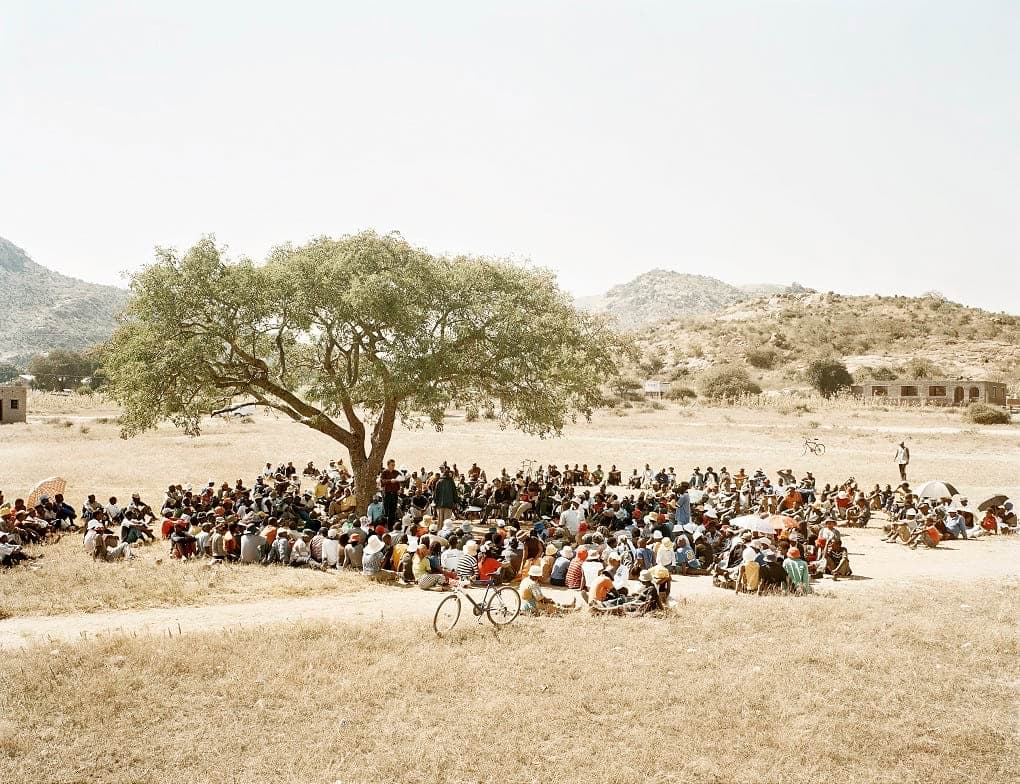
A consultation under a maroela tree between the Mohlohlo farming community and their lawyers, Richard Spoor and Steven Goldblatt, to discuss attempts by the Anglo American Corporation to force the community off their land to make room for a platinum mine. Mokopane, Limpopo Province. May-June 2006 , 2006
Digital print in pigment inks on cotton rag paper
A0
Edition of 10
David Goldblatt
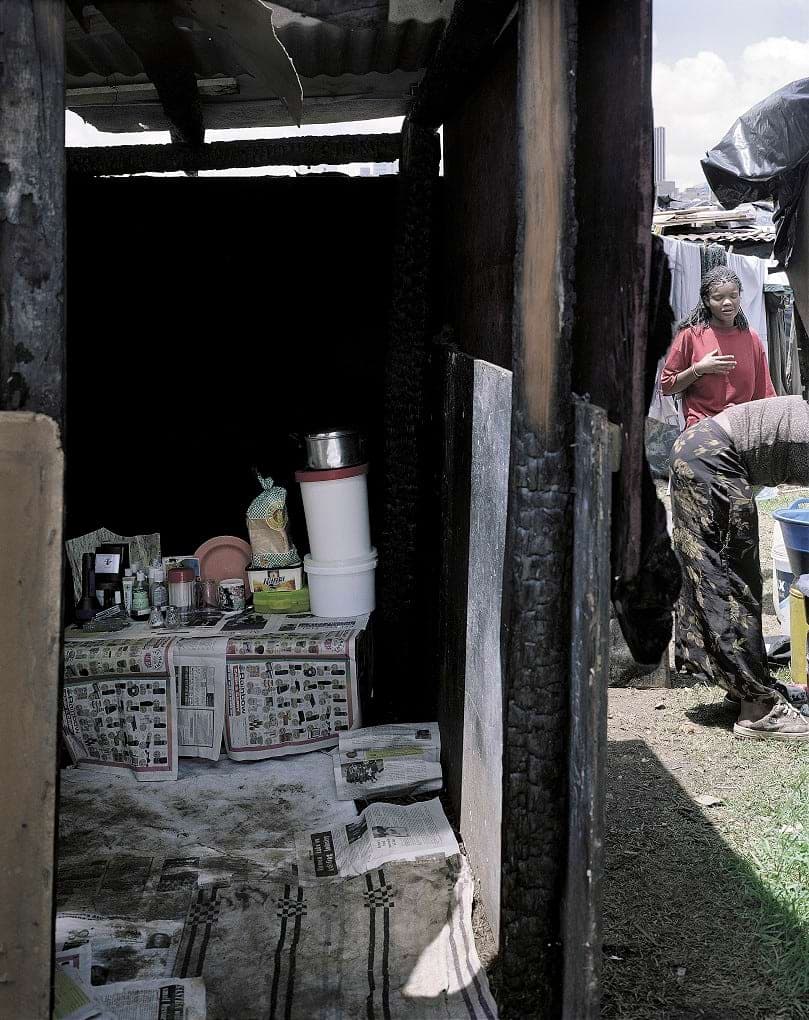
Women singing, Newtown Squatter Camp, Johannesburg. 1 November 2001 , 2001
Digital print in pigment inks on cotton rag paper
100.8 x 80.2 cm
39.7 x 31.6 in
Edition of 6
David Goldblatt
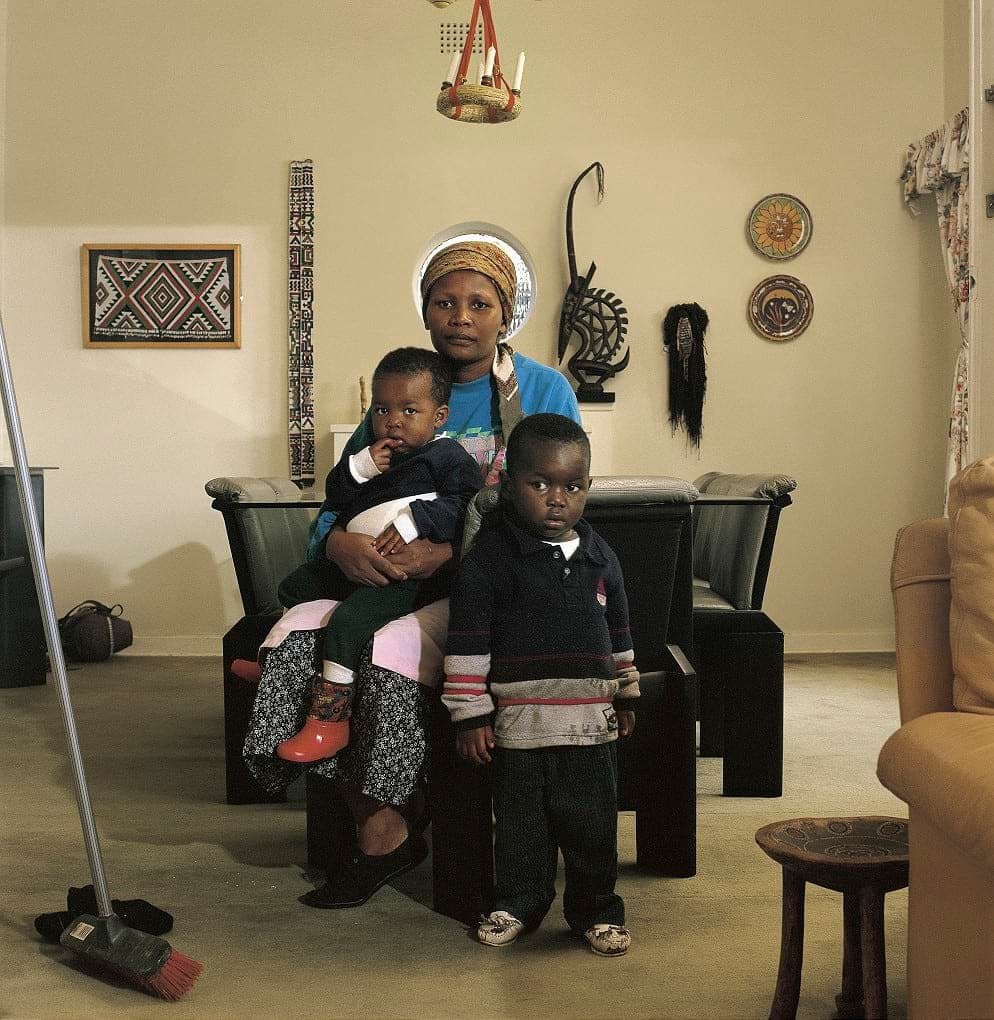
Victoria Cebekhulu, housekeeper, in her employer’s dining room with her son Sifiso and daughter Onica, Johannesburg, June 1999. Victoria died of AIDS on 13 December 1999, Sifiso died of AIDS on 12 January 2000, Onica died of AIDS in May 2000 , 1999
Digital print in pigment inks on cotton rag paper
64 x 64 cm
25.2 x 25.2 in
Edition of 6
David Goldblatt
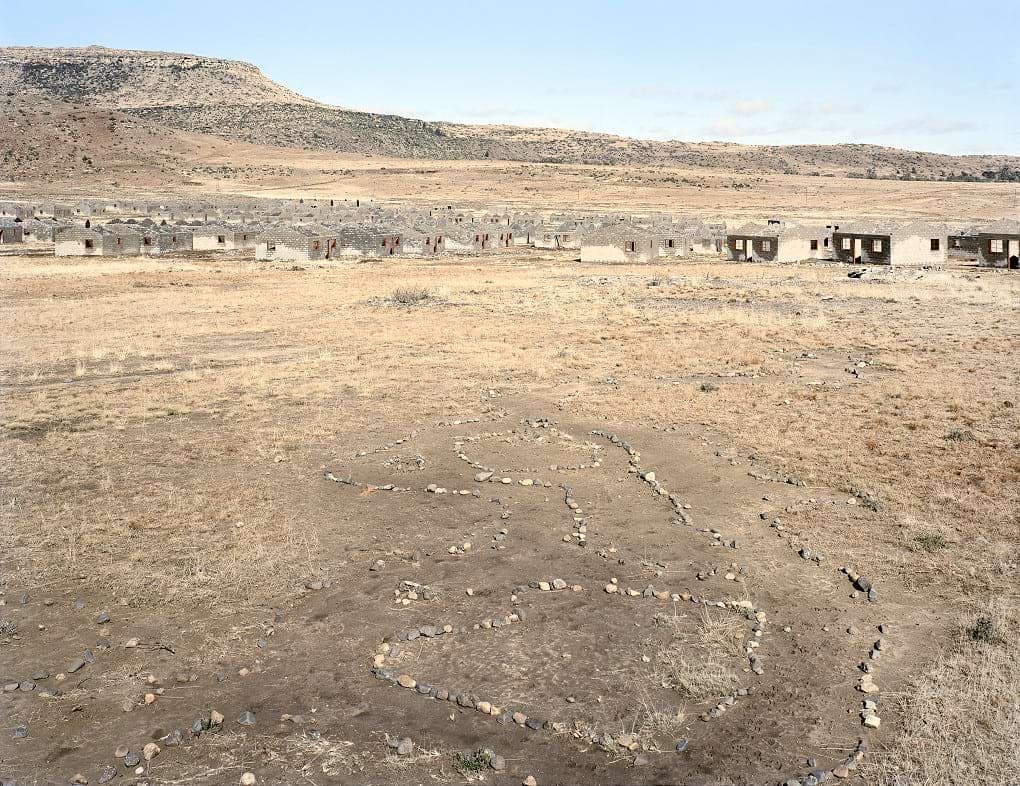
Remains of households in a children's game called onopopi, and the shells of incomplete houses in a housing scheme that stalled, Kwezinaledi, Lady Grey, Eastern Cape. 5 August 2006 , 2006
Digital print in pigment inks on cotton rag paper
81 x 102.5 cm
31.9 x 40.4 in
Edition of 10
David Goldblatt
The Women's Hostel, Alexandra Township, 26 June 2009. , 2009
Digital print in pigment inks on cotton rag paper
A0 or A0+
Edition of 10
David Goldblatt
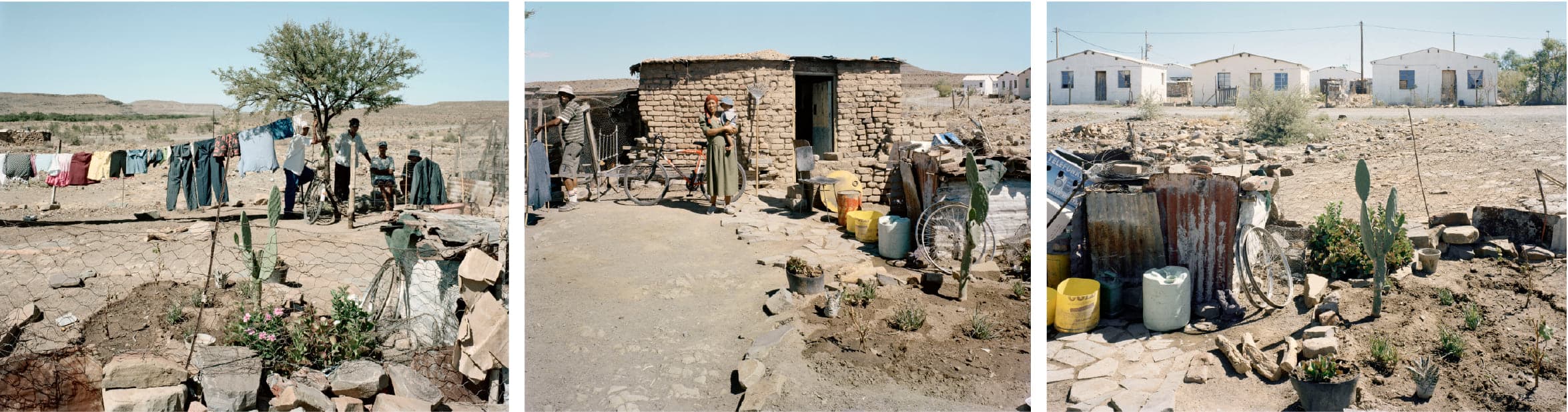
Willem Voster with friends, family, home and garden, Merweville, Western Cape, 2 March 2009 (4_A0463) (4_A0467) , 2009
Digital print in pigment inks on cotton rag paper
Triptych A0 each
Edition of 5

“In the 1990s my anger dissipated. Apartheid was no more. There were things to probe and criticise, but the emphasis was different. Lyricism seemed not only permissible but possible. In the late ‘90s I became aware of colour as a particular quality of this place and its light that I wanted to explore. It seemed ‘thin’, yet intense. To achieve prints that would hold these qualities I would need to print in colour in a way that was similar to that which I had developed for my black and white work … Over the generations, the land has shaped us - I say us in the broadest sense, us South Africans. And we have shaped the land. It is almost impossible now to find a pristine landscape. The grass has been grazed to the point of being threadbare, crops come and go, roads traverse, fences divide, and mines penetrate and throw up scabs of their detritus. These and our structures are the marks of our presence. I am drawn by the intimacies of our association with this land.” David Goldblatt

David Goldblatt
Berg-en-Dal Monument. Commemorated are 60 men of the South African Republic Police who died here in a bitter battle against overwhelming British forces in the South African War 1899-1902. The sarcophagus holds their bones. Dalmanutha, Mpumalanga. December 1983 , 1983
Digital print in pigment inks on cotton rag paper
85 x 66 cm
33.5 x 26 in
Edition of 10
David Goldblatt
Berg-en-Dal Monument.and Sarcophagus, Dalmanutha, Mpumalanga. 24 June 2005 , 2005
Digital print in pigment inks on cotton rag paper
85.5 x 105.5 cm
33.7 x 41.5 in
Edition of 10
David Goldblatt
Diepsloot, 15 August 2009 , undefined
Demonstration print
A0
Edition of
David Goldblatt
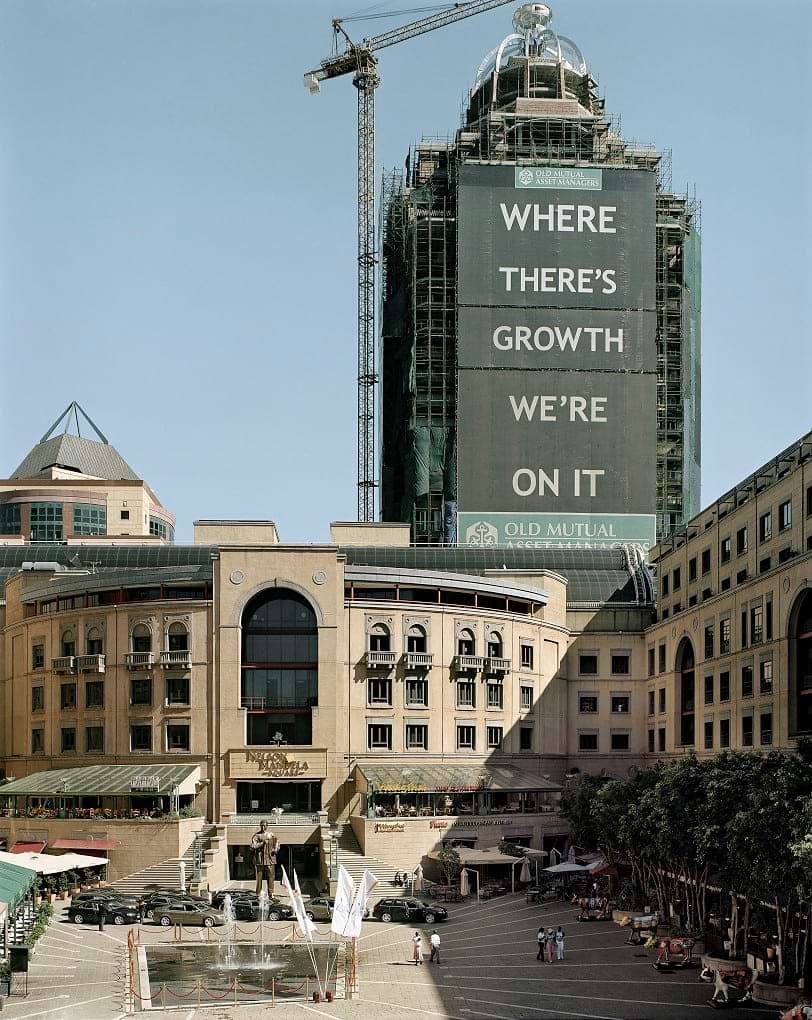
Mother and child, Nelson Mandela Square, Sandton. 8 March 2005 , 2005
Digital print in pigment inks on cotton rag paper
A0
Edition of 10
David Goldblatt
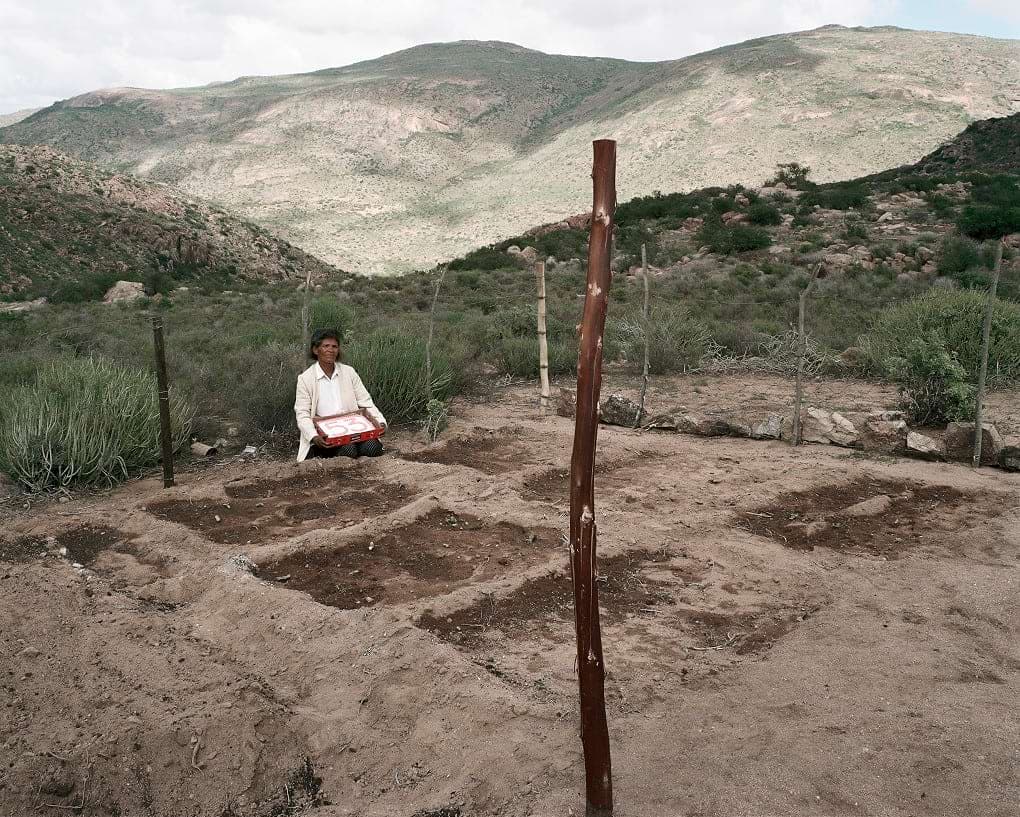
Anna Boois, goat Farmer, with her birthday cake and vegetable garden, Kamiesberge, near Garies, Namaqualand, Northern Cape , 20 September 2003
Digital print in pigment inks on cotton rag paper
A0
Unique
David Goldblatt
Going to work, Mathysloop, KwaNdebele, 1984 , 1984
Silver gelatin print on fibre-based paper
26 x 39.6 cm
10.2 x 15.6 in
Edition of 10
David Goldblatt
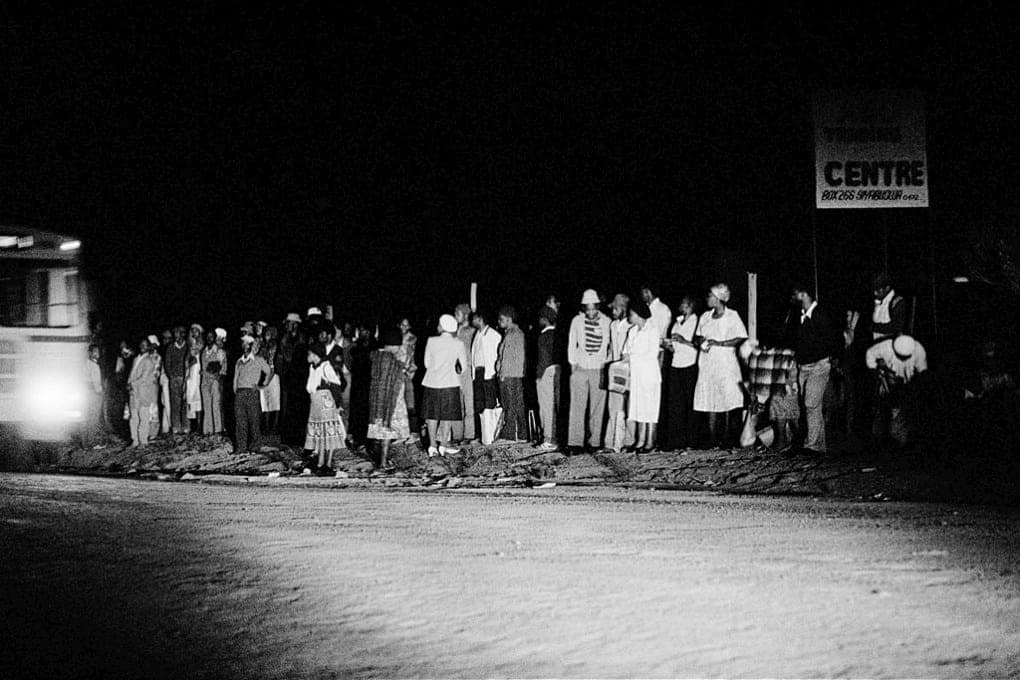
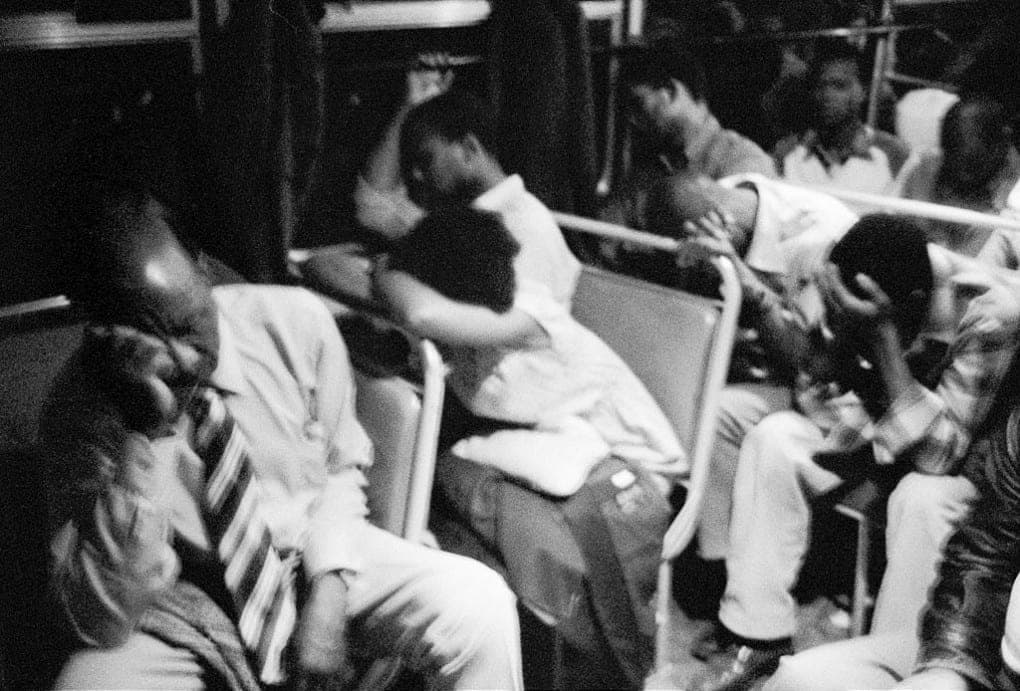
Going to work: 2:45 am, the first bus of the day. There being almost no employment opportunities in KwaNdebele, these people travel up to eight hours per day to get to and from work around Pretoria, Mathysloop, KwaNdebele , 1984
Silver gelatin print on fibre-based paper
approx. 30 x 40cm
11.8 x 15.7 in
Edition of 10
David Goldblatt
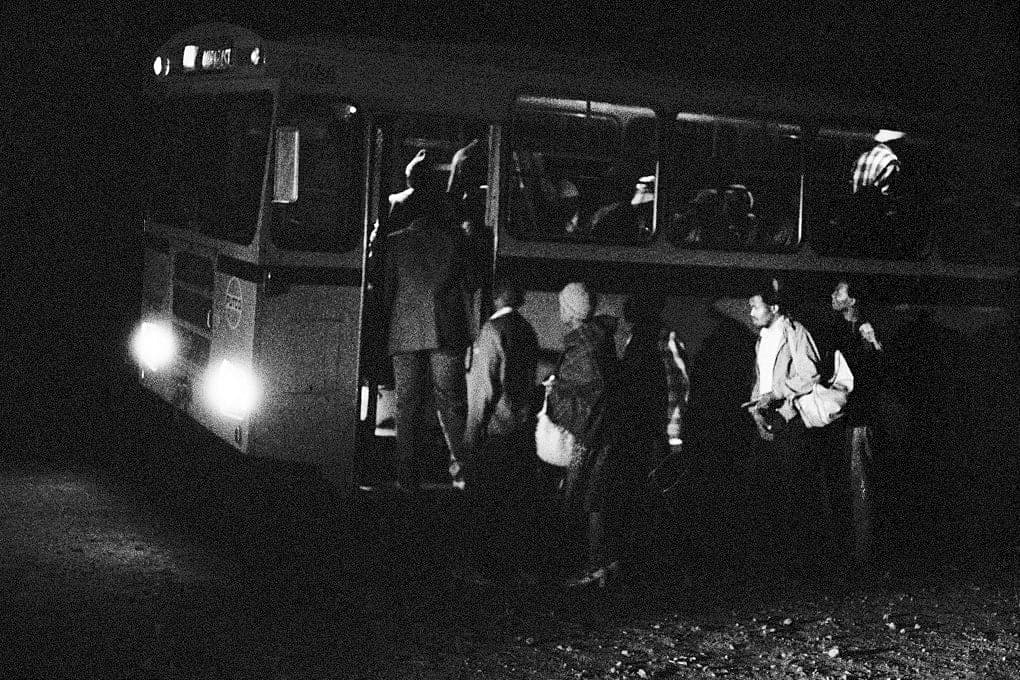
Boarding the first bus at Mathysloop. It should reach the terminal at Marabastad in Pretoria two and a half hours later at 5:15 am , 1983
Silver gelatin print on fibre-based paper
Image: 25.5 x 40 cm (10 x 15.7 in.)
Edition of 10
David Goldblatt
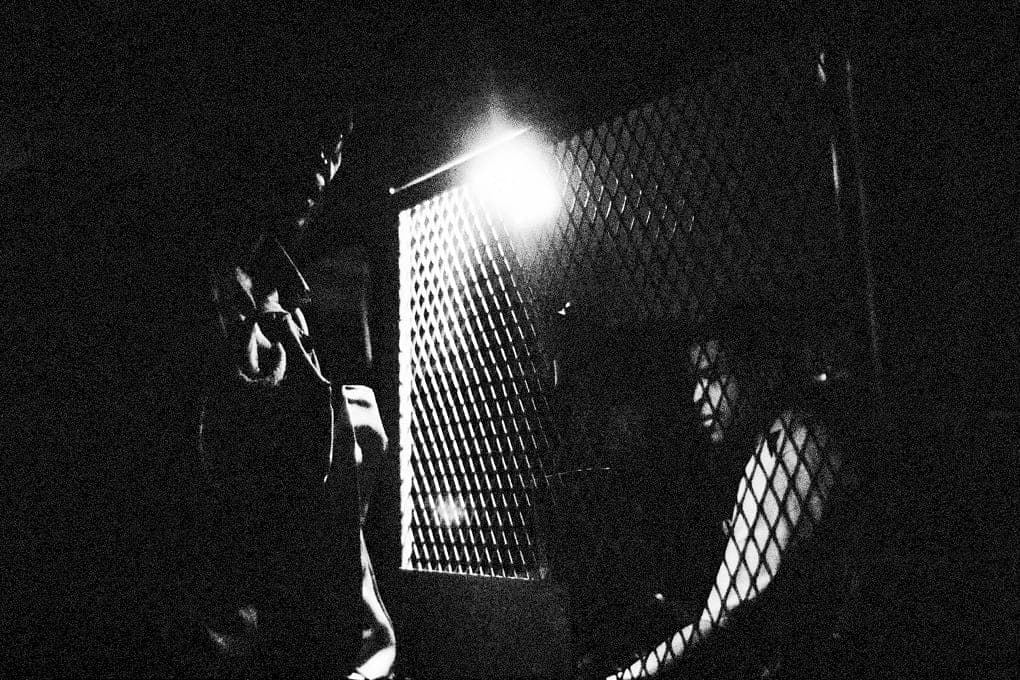
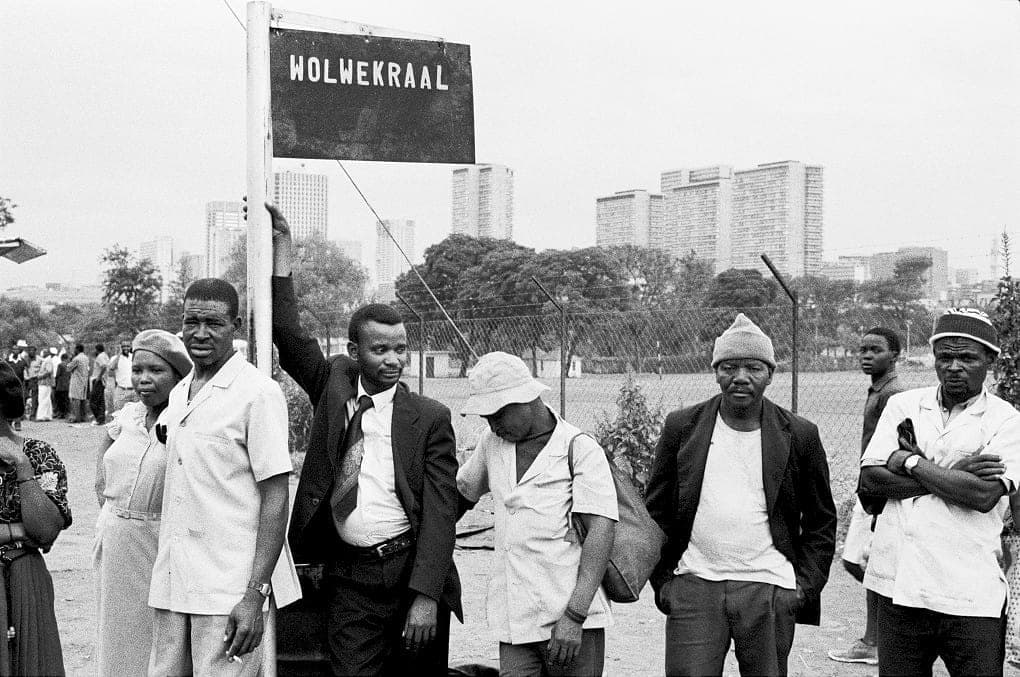
On the Wolwekraal- Marabastad route the first passenger of the morning has his ticket clipped by the driver at about 2:50 am , 1983
Silver gelatin print on fibre-based paper
32.8 x 50 cm
12.9 x 19.7 in
Edition of 10
David Goldblatt
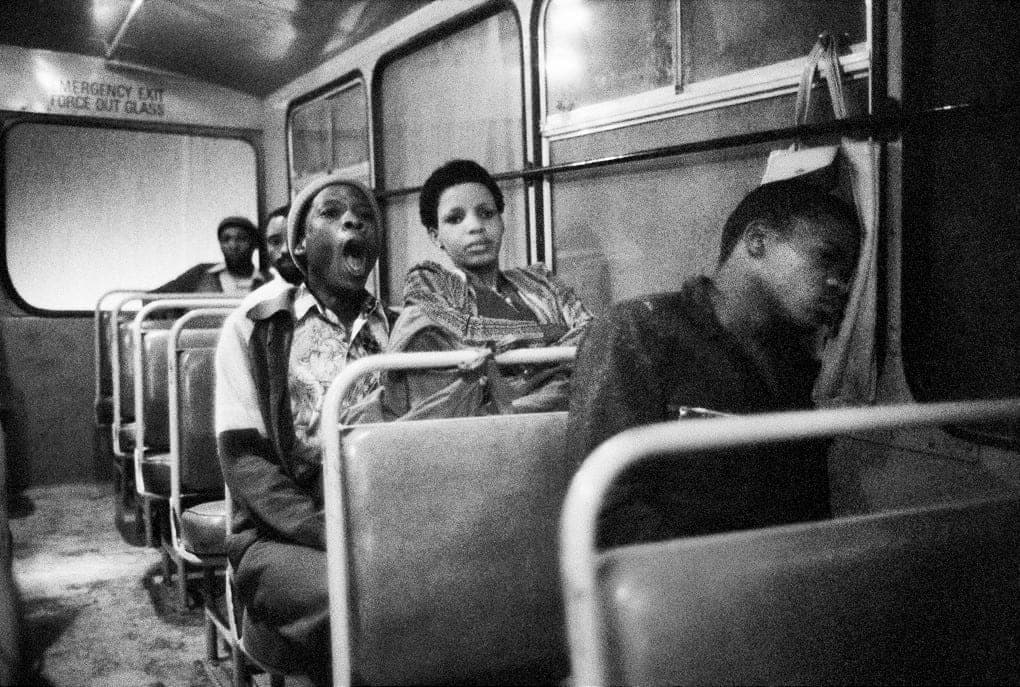
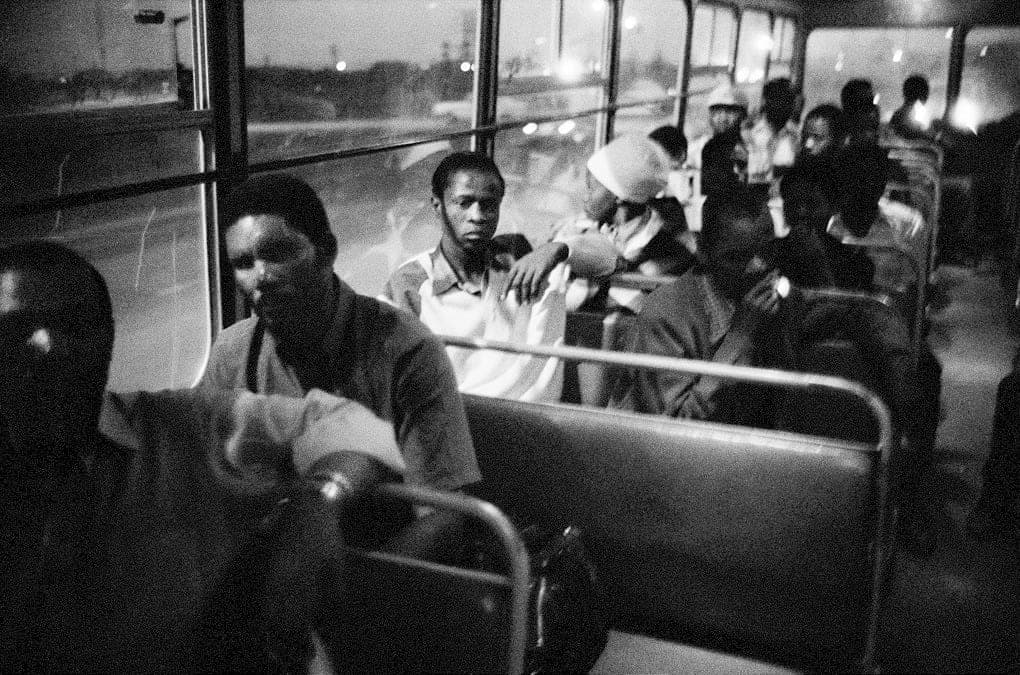
Going to work: 3:00 Am early passangers on the Wolwekraal-Marabastad bus , 1983
Silver gelatin print on fibre-based paper
26 x 39 cm
10.2 x 15.4 in
Edition of 10
David Goldblatt
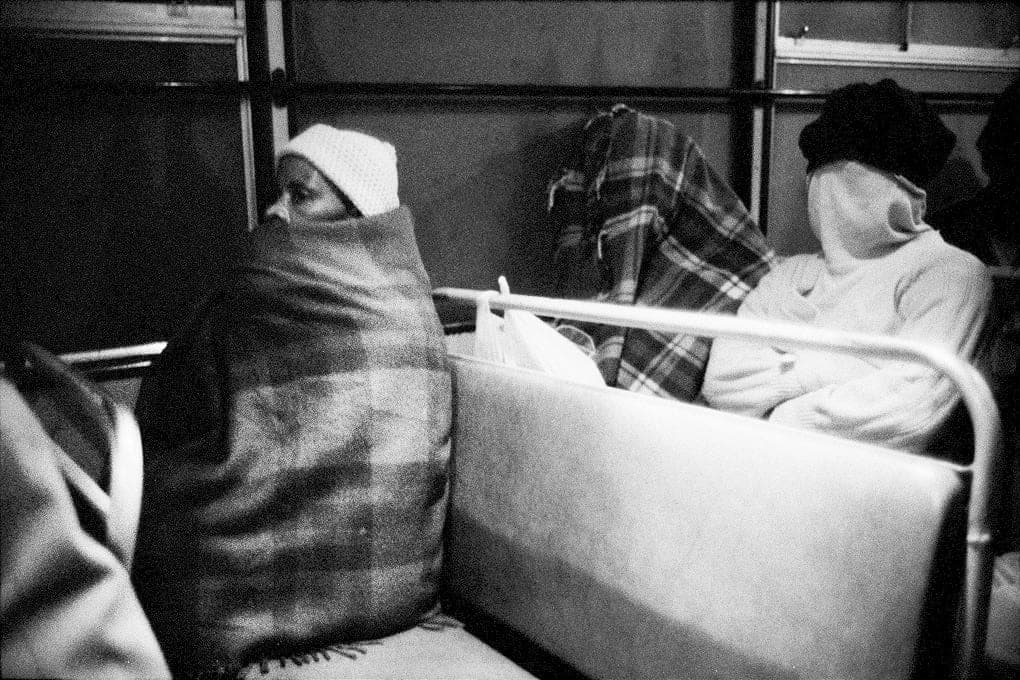
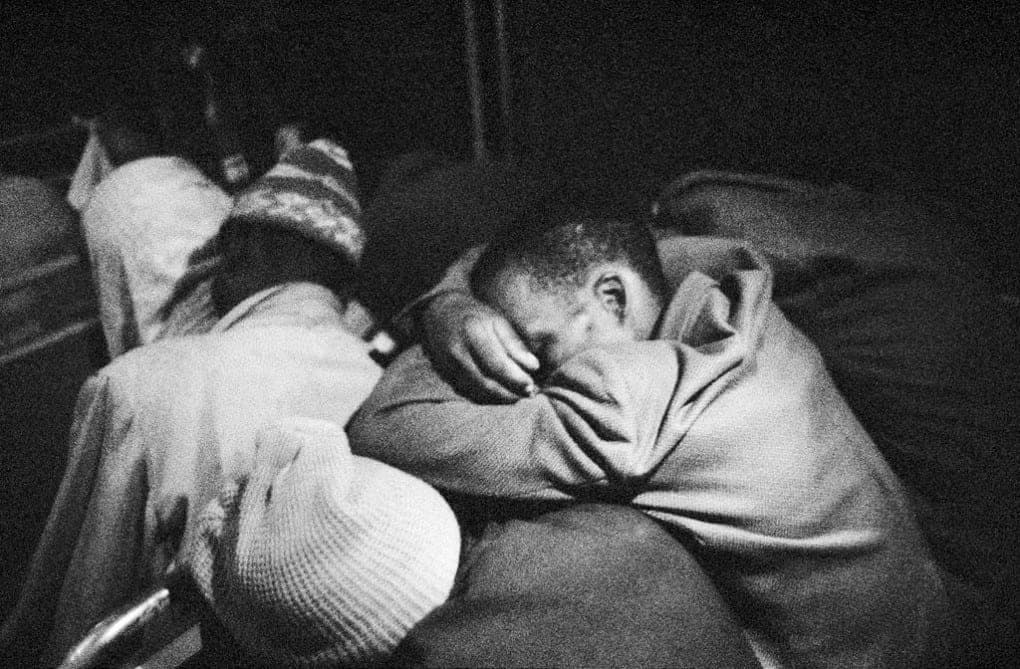
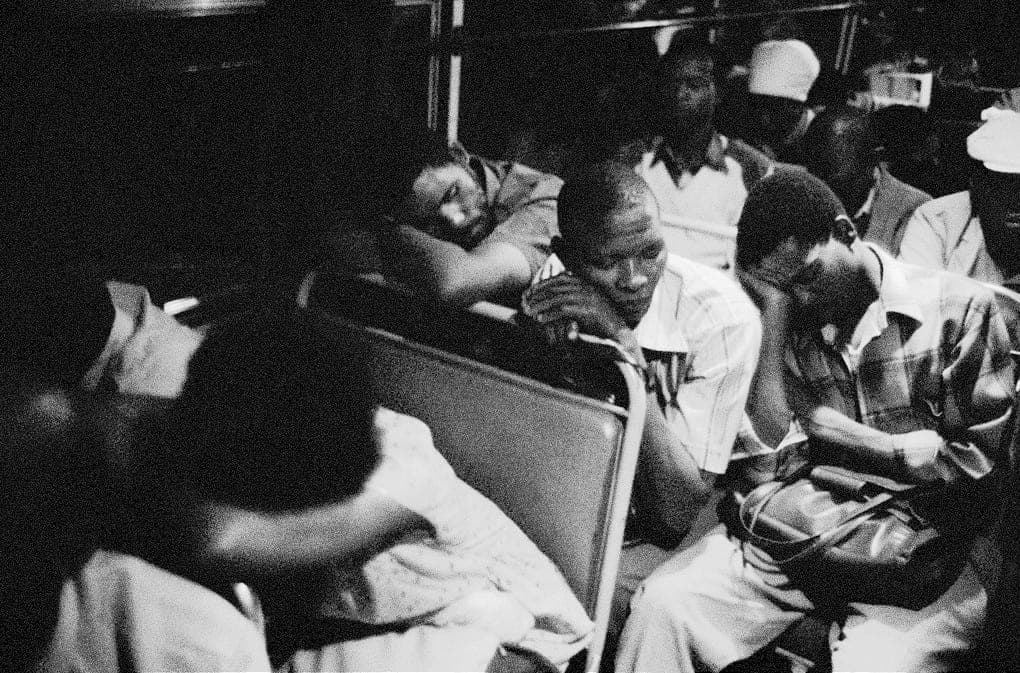
Wolwekraal-Marabastad route: In the hope of sleep, many, after sitting down, cover their faces with cloths or rugs or caps; some try to cushion their heads , 1983
Silver gelatin print on fibre-based paper
25.5 x 40 cm
10 x 15.7 in
Edition of 10
David Goldblatt
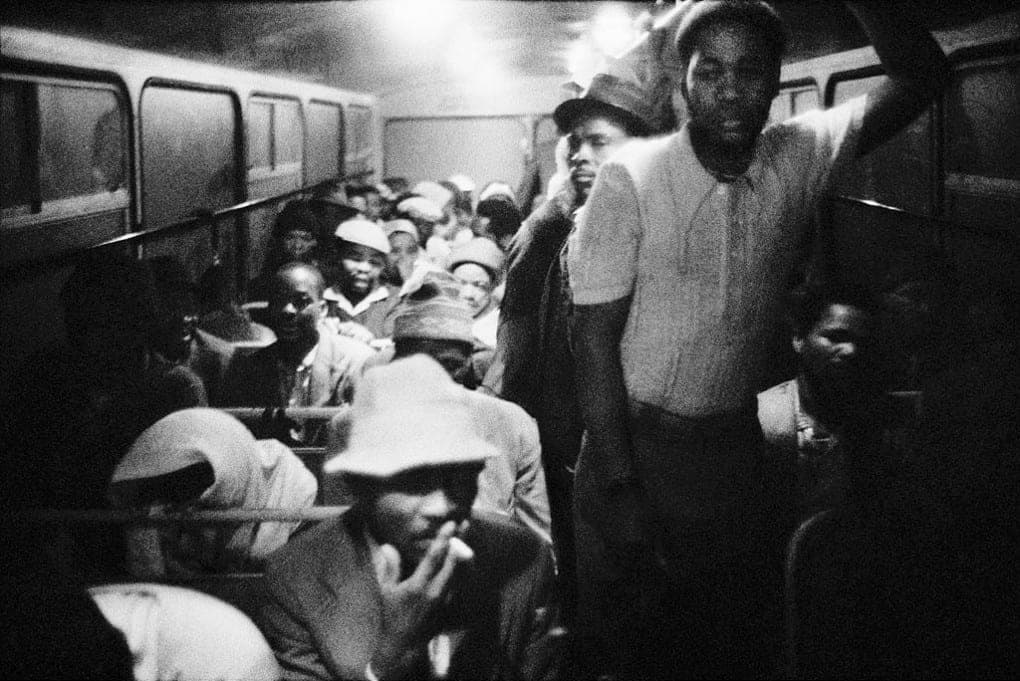
Going to work: standing room only now, on the Wolwekraal-Marabastad bus, which is licensed to carry 62 sitting and 29 standing passengers , 1983
Silver gelatin print on fibre-based paper
approx. 30 x 40cm
11.8 x 15.7 in
Edition of 10
David Goldblatt
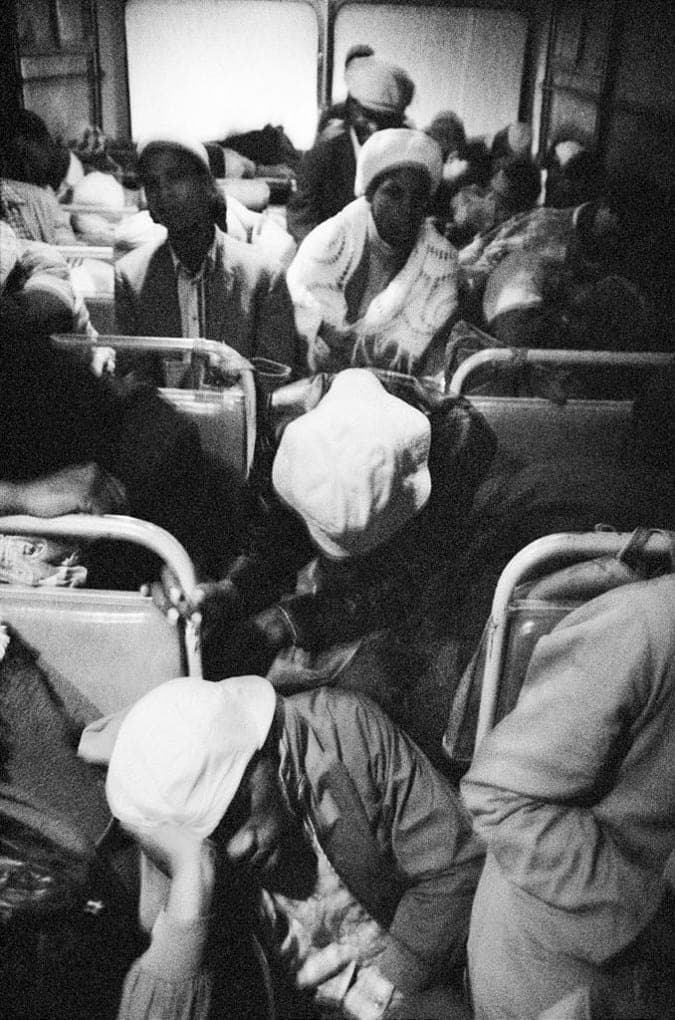
Going to work: 3:30am, Wolwekraal-Marabastad bus, standing passengers have slumped to the floor , 1983
Silver gelatin print on fibre-based paper
41 x 27.2 cm
16.1 x 10.7 in
Edition of 10
David Goldblatt
Going to work: Wolwekraal-Marabastad bus at 4 am: more than an hour and a half still to go. This bus took on its first passenger at about 2:50 am and will reach its destination in Pretoria at 5:35 am , 1983
Silver gelatin print on fibre-based paper
approx. 30 x 40cm
11.8 x 15.7 in
Edition of 10
David Goldblatt
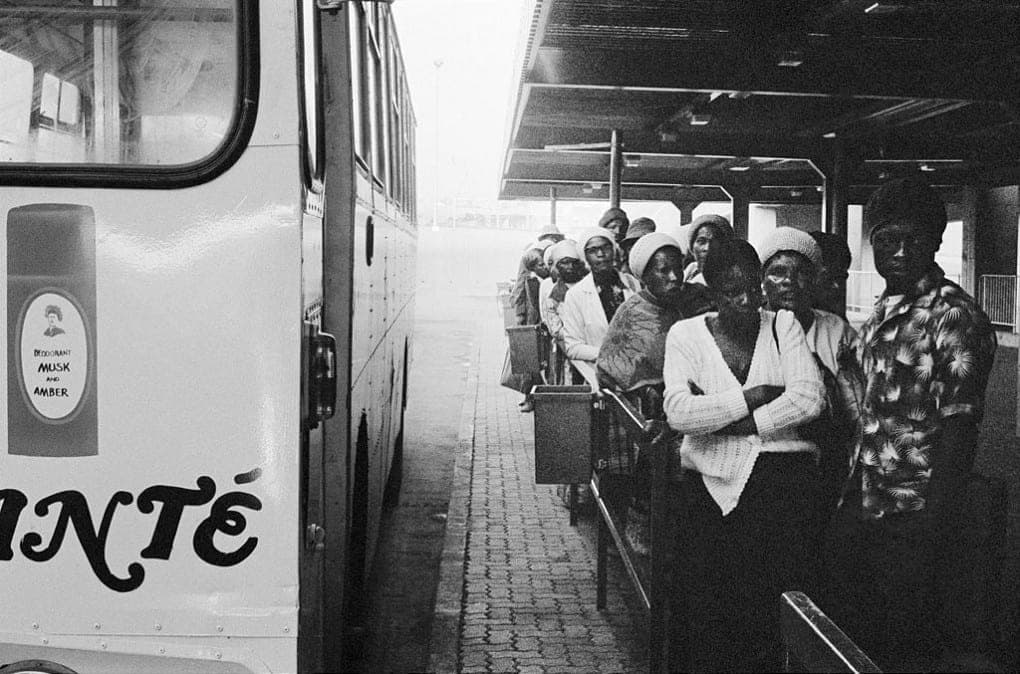
5:40 am: after arrival at the Marabastad terminal in Pretoria, many of the passengers from the Wolwekraal bus join others to line up for local buses that will take them to work in the suburbs and industrial areas of the city. Some will travel for another hour. , 1983
Silver gelatin print on fibre-based paper
approx. 30 x 40cm
11.8 x 15.7 in
Edition of 10
David Goldblatt
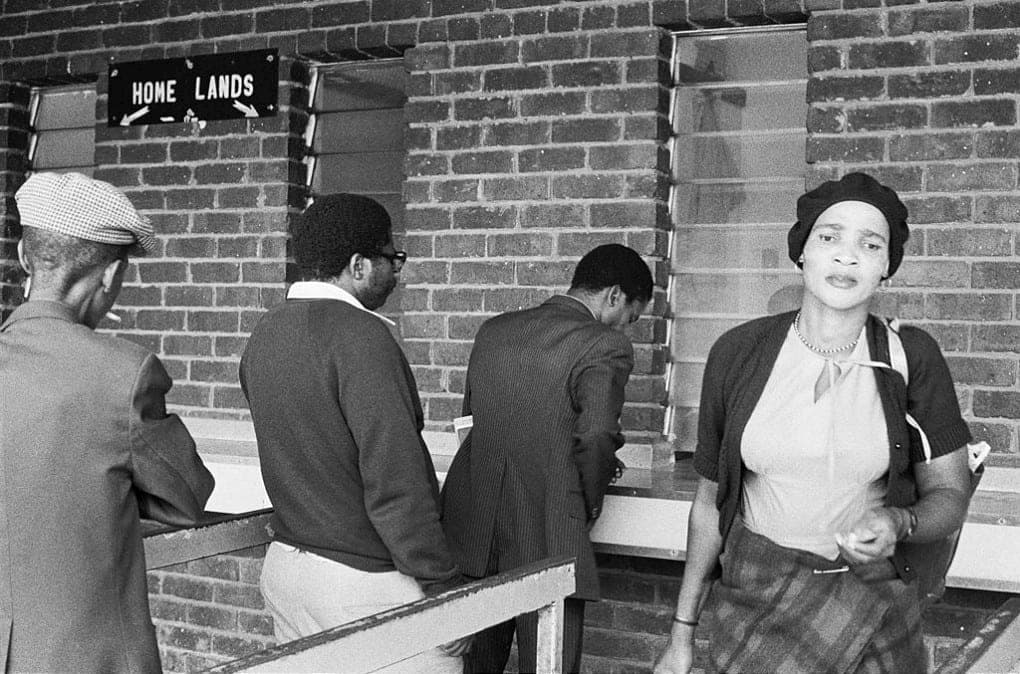
Travellers from KwaNdebele buying weekly season tickets at the PUTCO bus depot in Marabastad, Pretoria , 1983
Silver gelatin print on fibre-based paper
27.5 x 40.5 cm
10.8 x 15.9 in
Edition of 10
David Goldblatt
Going home: In the afternoon at Marabstad terminal in Pretoria, commuters start lining up for busses to take them back home to KwaNdebele , 1983
Silver gelatin print on fibre-based paper
approx. 30 x 40cm
11.8 x 15.7 in
Edition of 10
David Goldblatt
Pulling out of Pretoria the 7:00 pm bus from Marabastad to Waterval in KwaNdebele , 1983
Silver gelatin print on fibre-based paper
27.4 x 41.2 cm
10.8 x 16.2 in
Edition of 10
David Goldblatt
Marabastad-Waterval route: about 8:30 pm, an hour still to go. , 1984
Silver gelatin print on fibre-based paper
approx. 30 x 40cm
11.8 x 15.7 in
Edition of 10
David Goldblatt
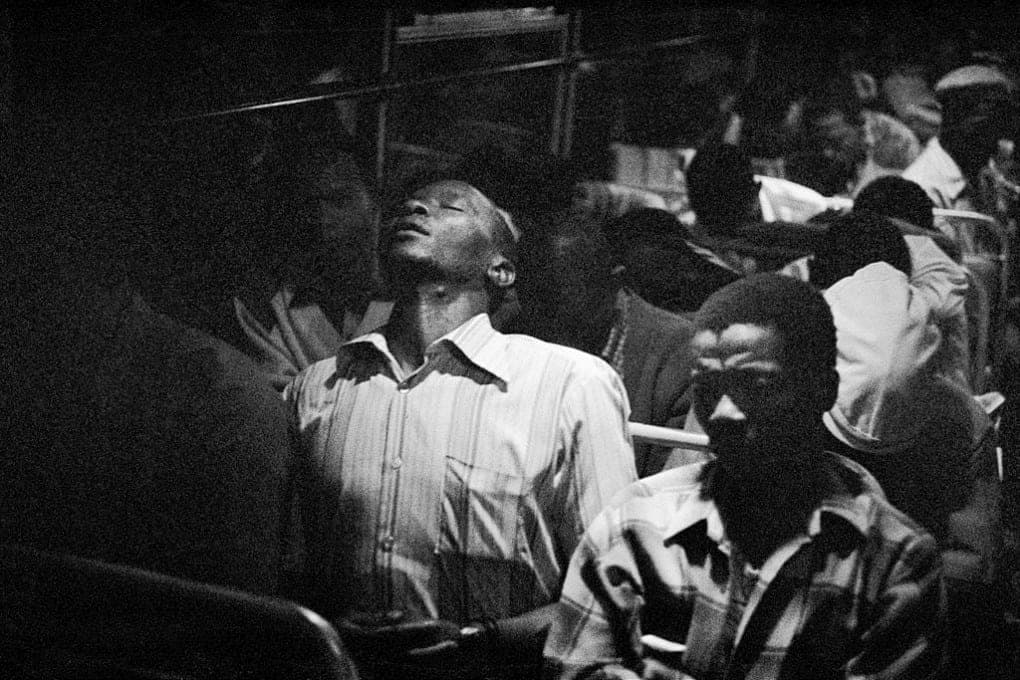
Going home: Marabastad-Waterval route: the most restful time on the bus is on the long run between Pretoria and the turnoff into the resettlement camps , 1984
Silver gelatin print on fibre-based paper
25.7 x 39.8 cm
10.1 x 15.7 in
Edition of 10
David Goldblatt
8:45 p.m. Going home: Marabastad-Waterval bus: 8:45 p.m., 45 minutes to the terminal. , 1984
Silver gelatin print on fibre-based paper
50.5 x 65 x 3 cm
19.9 x 25.6 x 1.2 in
Edition of 10
David Goldblatt
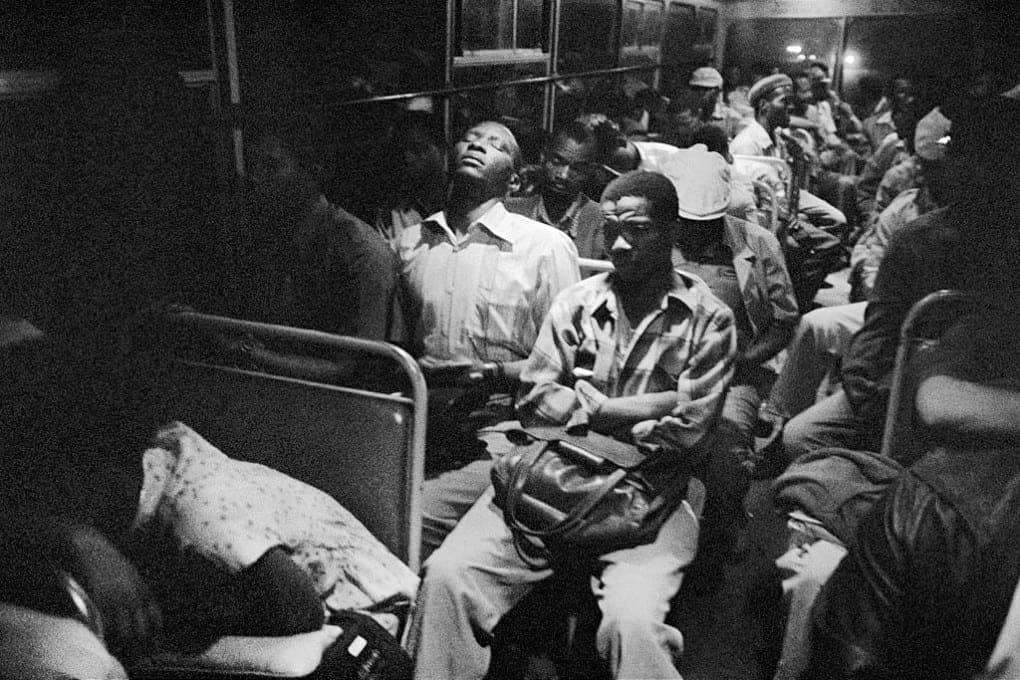
9.00 pm Going home: Marabastad-Waterval route: for most of the people in this bus, the cycle will start again tomorrow at between 2 and 3 am , 1984
Silver gelatin print on fibre-based paper
29 x 43.5 cm
11.4 x 17.1 in
Edition of 10

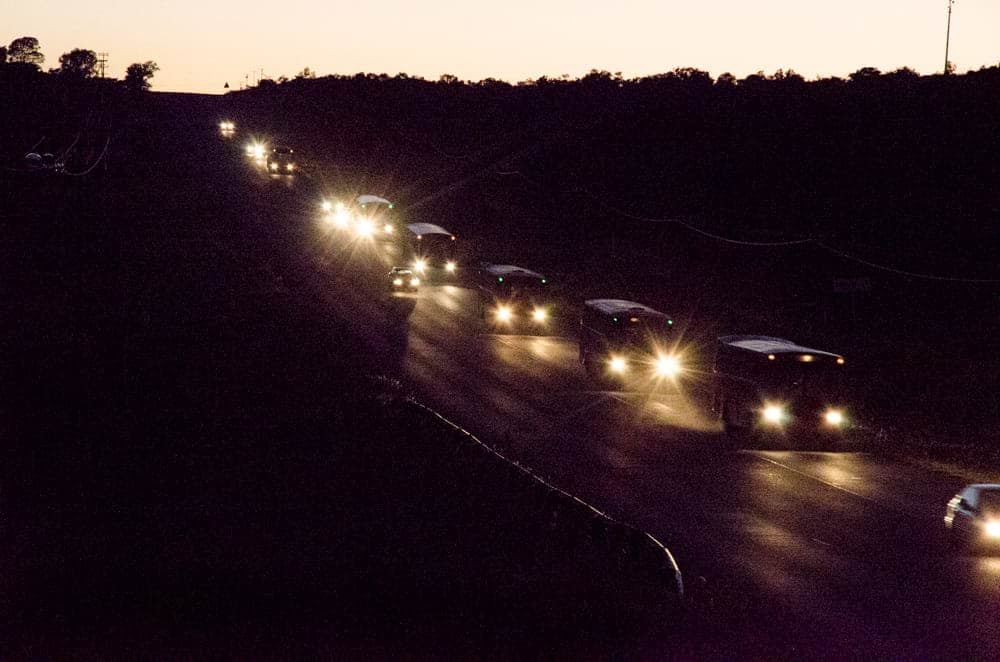
Goldblatt’s larger series ‘The Transported of KwaNdebele’ looks at the workers of an apartheid tribal homeland, KwaNdebele, which had no industry, very few opportunities for jobs, and was a long way from the nearest industrial- commercial activity of white-controlled Pretoria. Workers from KwaNdebele would catch buses in the very early morning, some as early as 2:45 am, in order to be at their workplaces in Pretoria by 7:00. At the end of the day they would repeat the journey in the other direction, to get home at between 8 and 10 pm. Goldblatt takes us on their bone-jarring journeys through the night, which is a metaphor for their arduous struggle toward freedom itself. In photographs devoid of sentimentality and artifice, the grim determination to survive and overcome emerges in almost heroic terms.

David Goldblatt
5:52 a.m. Going to work in 2012: Buses from former KwaNdebele homeland stream down the road to Pretoria. , 2012
Digital print in pigment inks on cotton rag paper
26 x 39.2 cm
10.2 x 15.4 in
Edition of 10
David Goldblatt
The hotel stoep, Cofimvaba, Transkei. 1975 , 1975
Carbon ink on Hahnemeule 315gsm
30 x 30 cm
11.8 x 11.8 in
Edition of 10
David Goldblatt
The home of a couple who went to Cape Town to look for work, Engcobo, Transkei. 9 October 1975 , 1975
Silver gelatin print on fibre-based paper
36.2 x 45.9 cm
14.3 x 18.1 in
Edition of 10
David Goldblatt
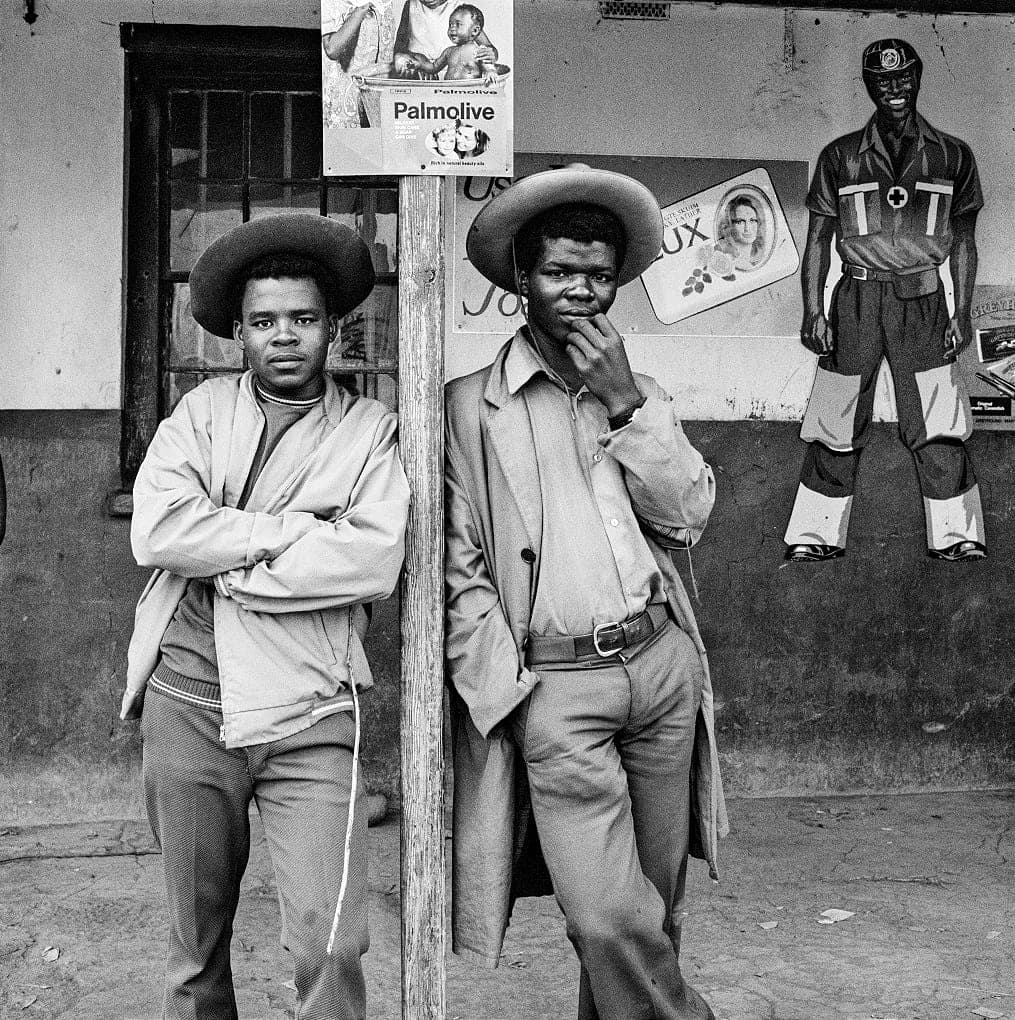
Young men and a labour recruitment poster for the mines, Transkei. 1975 , 1975
Carbon ink on Hahnemeule 315gsm
29.9 x 29.9 cm
11.8 x 11.8 in
Edition of 10
David Goldblatt
Young men at breakfast, Near Coffee Bay, Transkei. (3_G1070 new), 1975
Carbon ink on Hahnemeule 315gsm
29.9 x 45.2 cm
11.8 x 17.8 in
Edition of 10
David Goldblatt
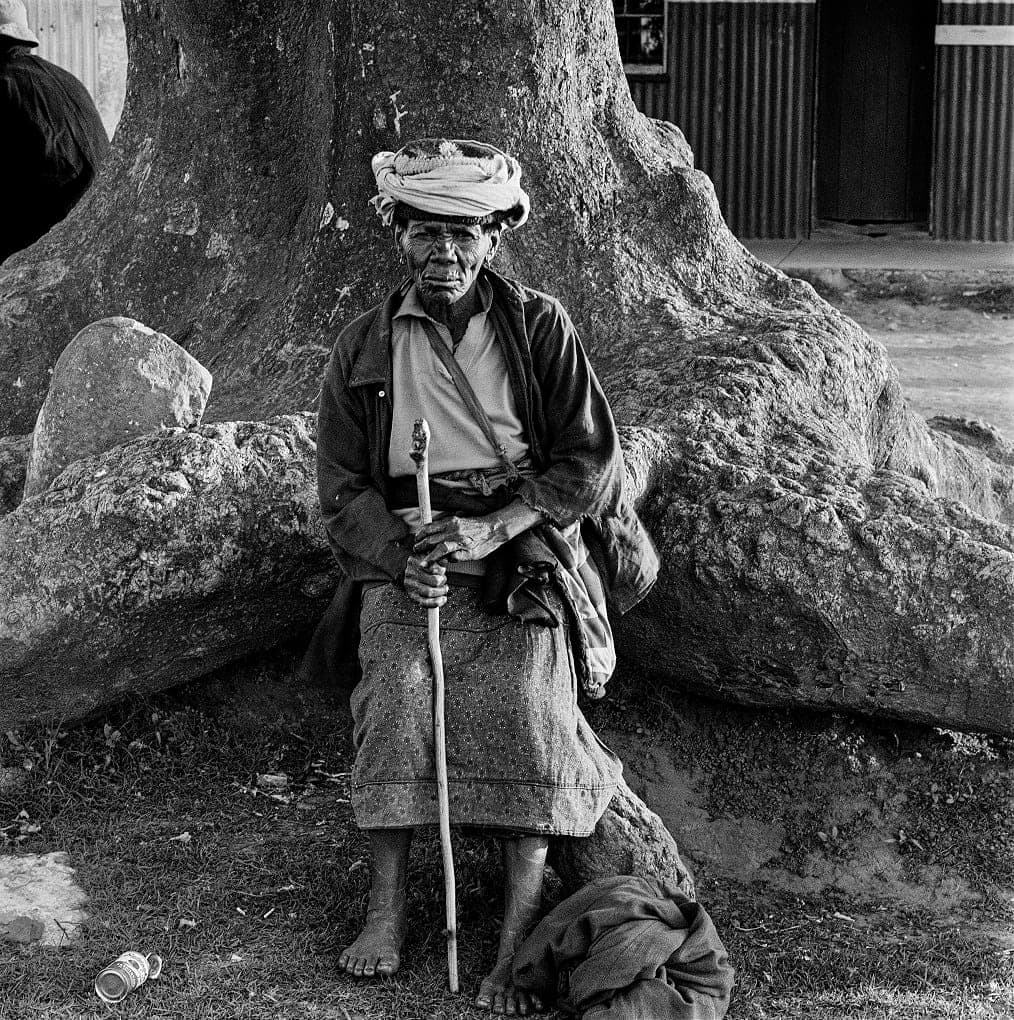
Old woman at a trading store. She said, "Ndimhle" – I am beautiful. Transkei. 1975 , 1975
Carbon ink on Hahnemuhle 315gsm
29.9 x 29.9 cm
11.8 x 11.8 in
Edition of 10
David Goldblatt
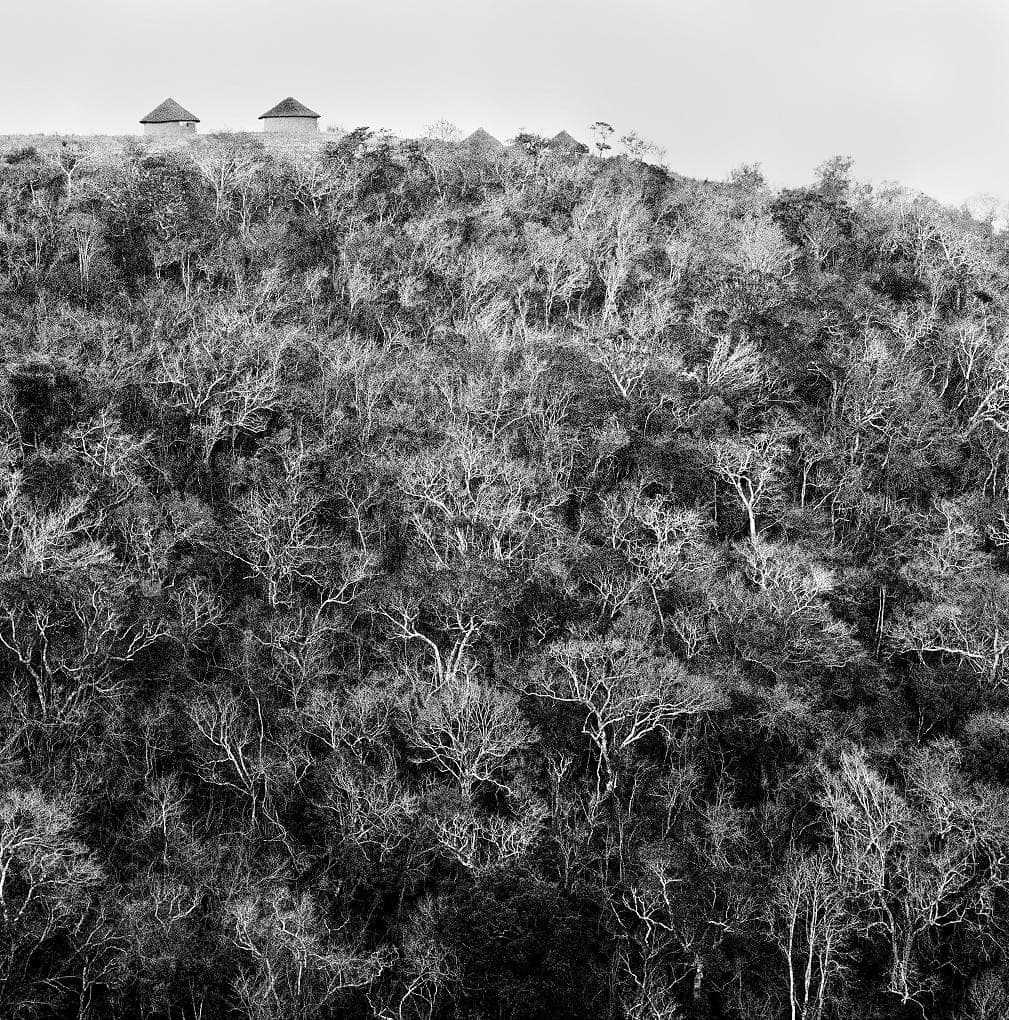
A Homestead and Forest, Near Coffee Bay, Transkei , 1975
Carbon ink on Hahnemeule 315gsm
29.9 x 29.9 cm
11.8 x 11.8 in
Edition of 10
David Goldblatt
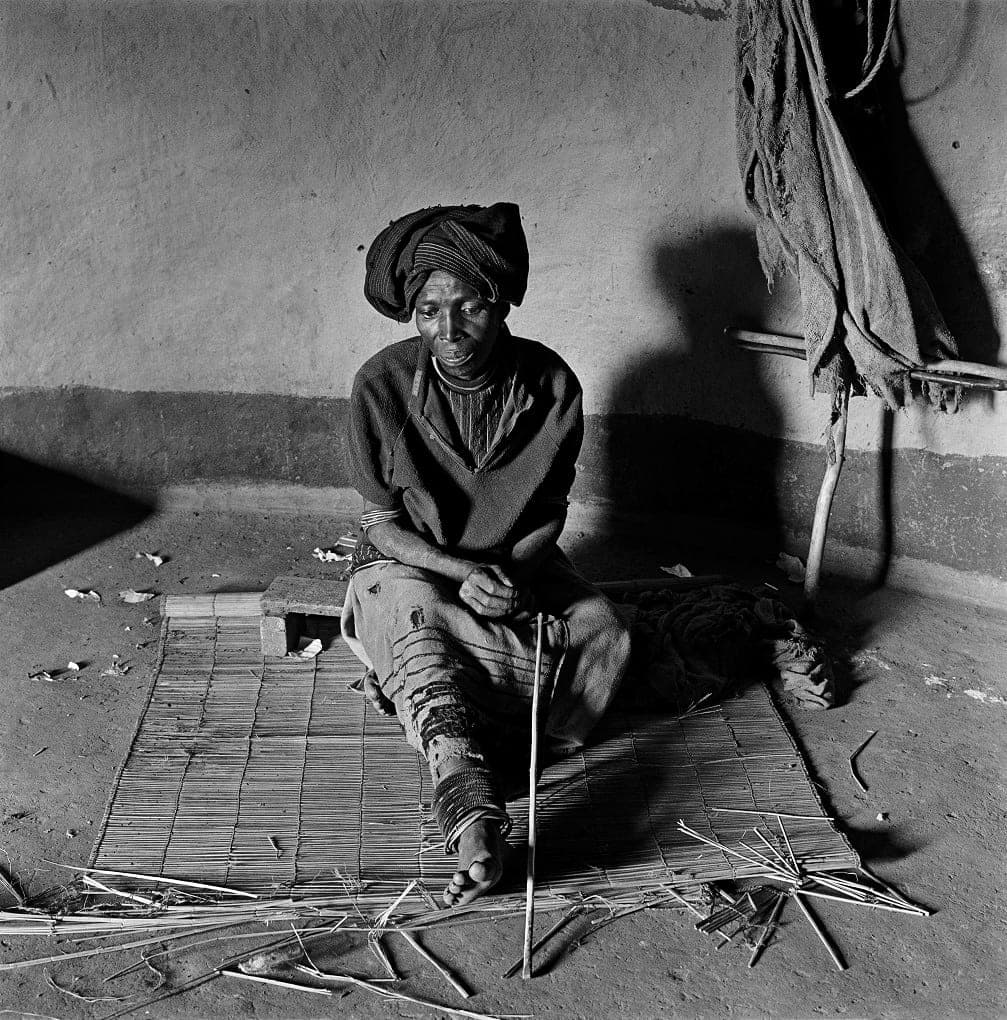
A peasant woman at home, Coffee Bay, Transkei , 1975
Carbon ink on Hahnemuhle 315gsm
29.9 x 29.9 cm
11.8 x 11.8 in
Edition of 10
David Goldblatt
A peasant woman's lamp, Coffee Bay, Transkei , 1975
Carbon ink on Hahnemuhle 315gsm
30 x 40 cm
11.8 x 15.7 in
Edition of 10
David Goldblatt
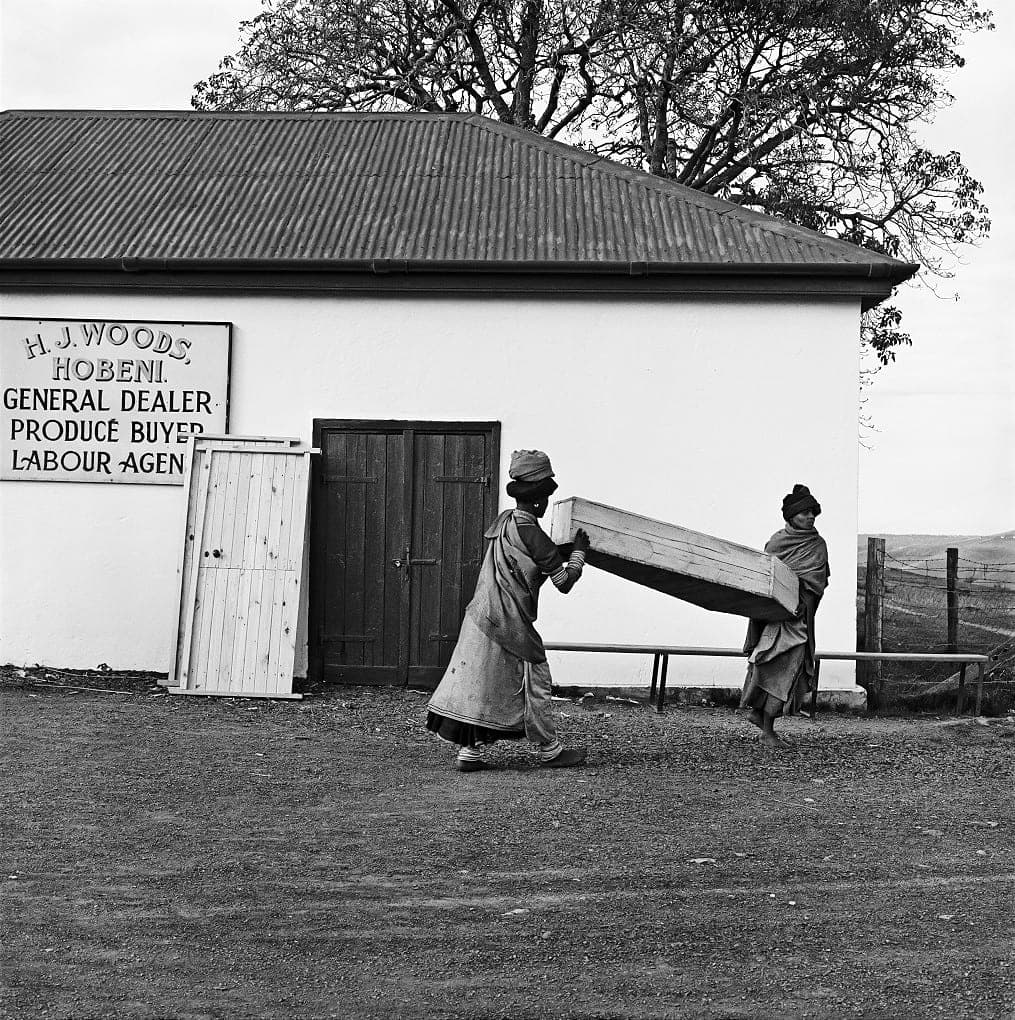
A coffin from the trading store, Hobeni, Transkei. 1975 , 1975
Carbon ink on Hahnemeule 315gsm
29.9 x 29.9 cm
11.8 x 11.8 in
Edition of 10
David Goldblatt
Going to the fields to hoe, Transkei. 1975 , 1975
Carbon ink on Hahnemeule 315gsm
30 x 30 cm
11.8 x 11.8 in
Edition of 10
David Goldblatt
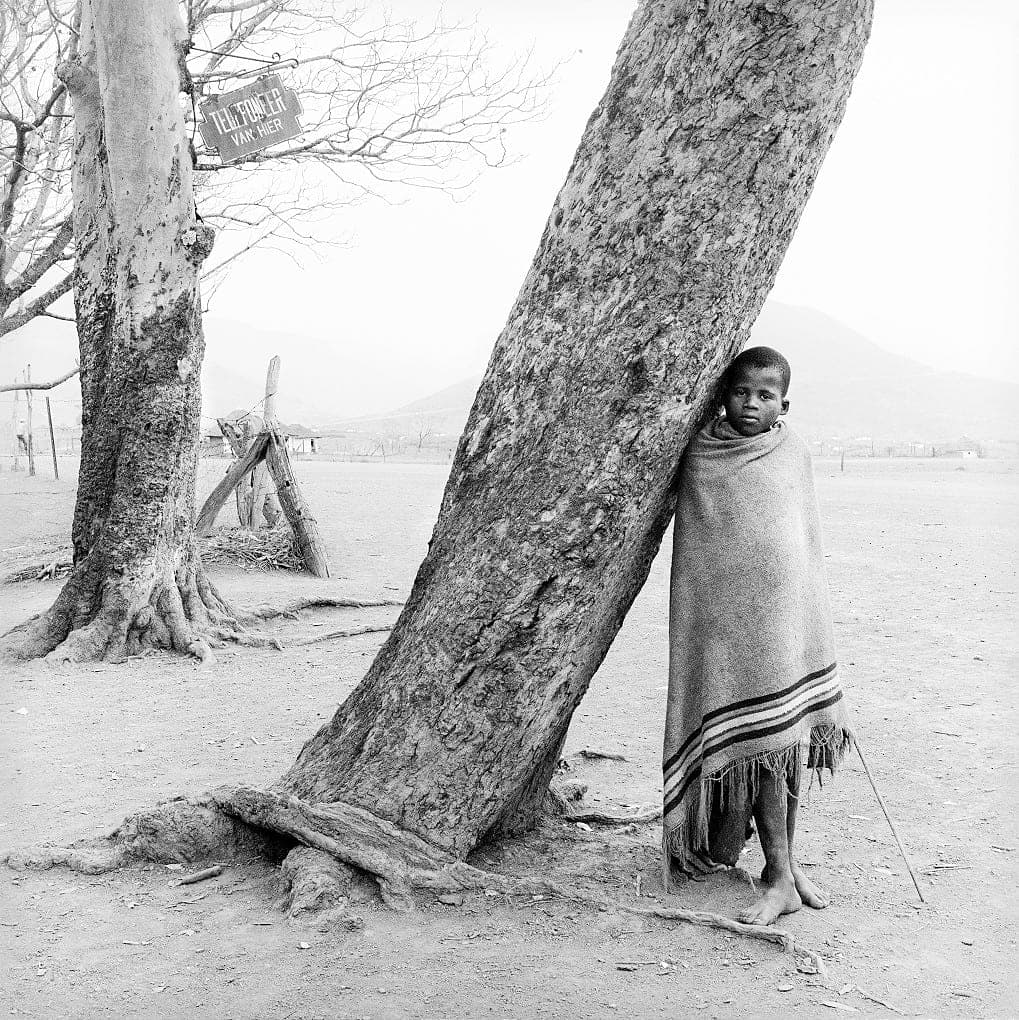
Herdboy, Transkei. 1975 , 1975
Carbon ink on Hahnemuhle 315gsm
29.9 x 29.9 cm
11.8 x 11.8 in
Edition of 10
David Goldblatt
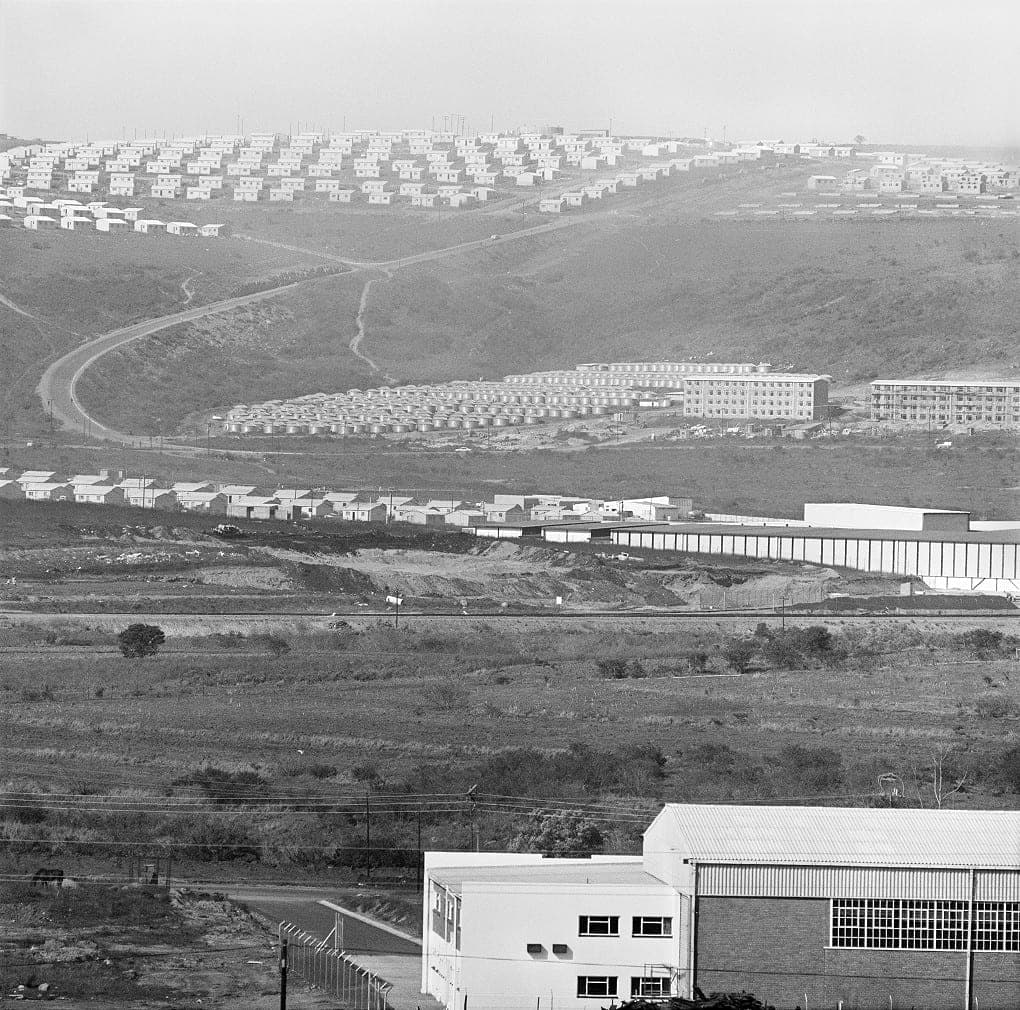
Factories and worker's housing. Substantial inducements were offered to industrialists to set up plants in the Bantustans. Butterworth was at that time one of the more successful of these areas. Butterworth, Transkei. , 1975
Carbon ink on Hahnemeule 315gsm
29.9 x 29.9 cm
11.8 x 11.8 in
Edition of 10
David Goldblatt
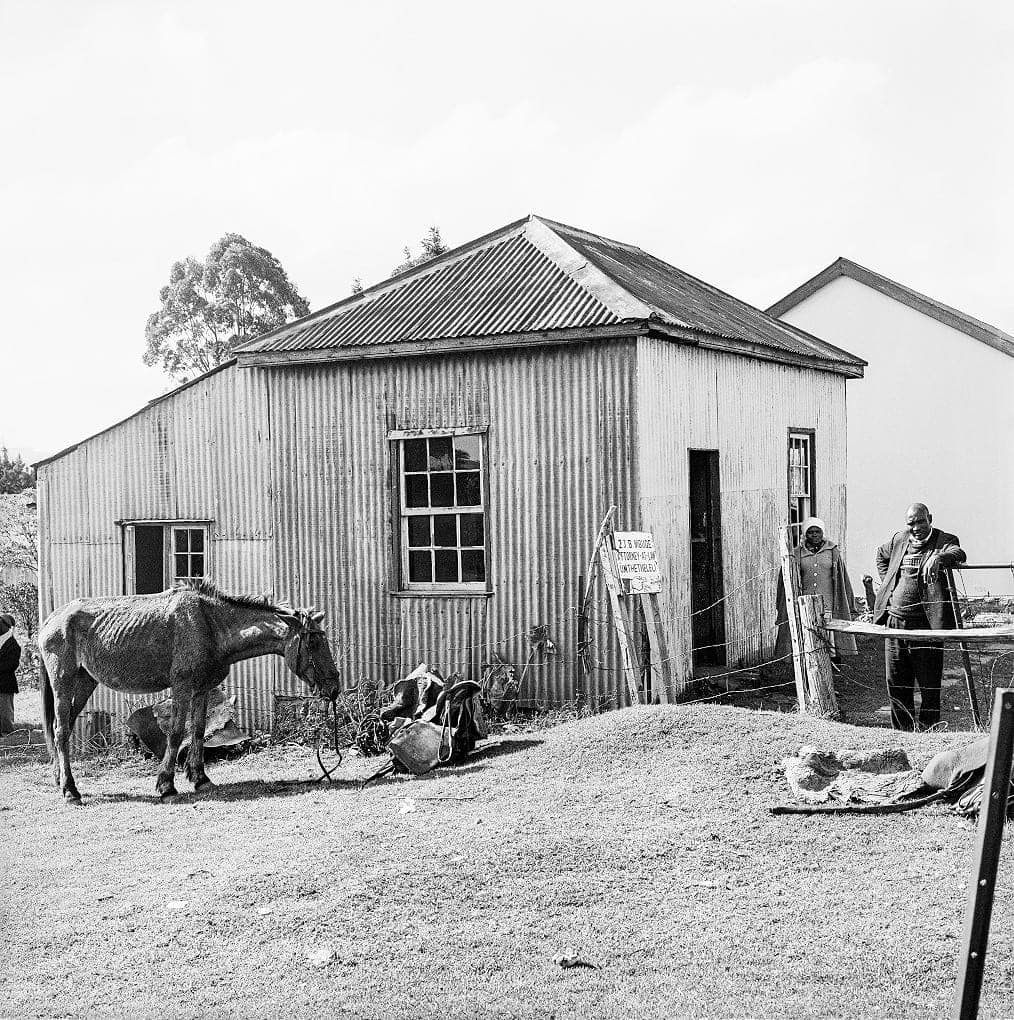
The office of attorney, Z J B Mbuqe, in Umthetheleli, Transkei. 1975 , 1975
Carbon ink on Hahnemeule 315gsm
30 x 30 cm
11.8 x 11.8 in
Edition of 10
David Goldblatt
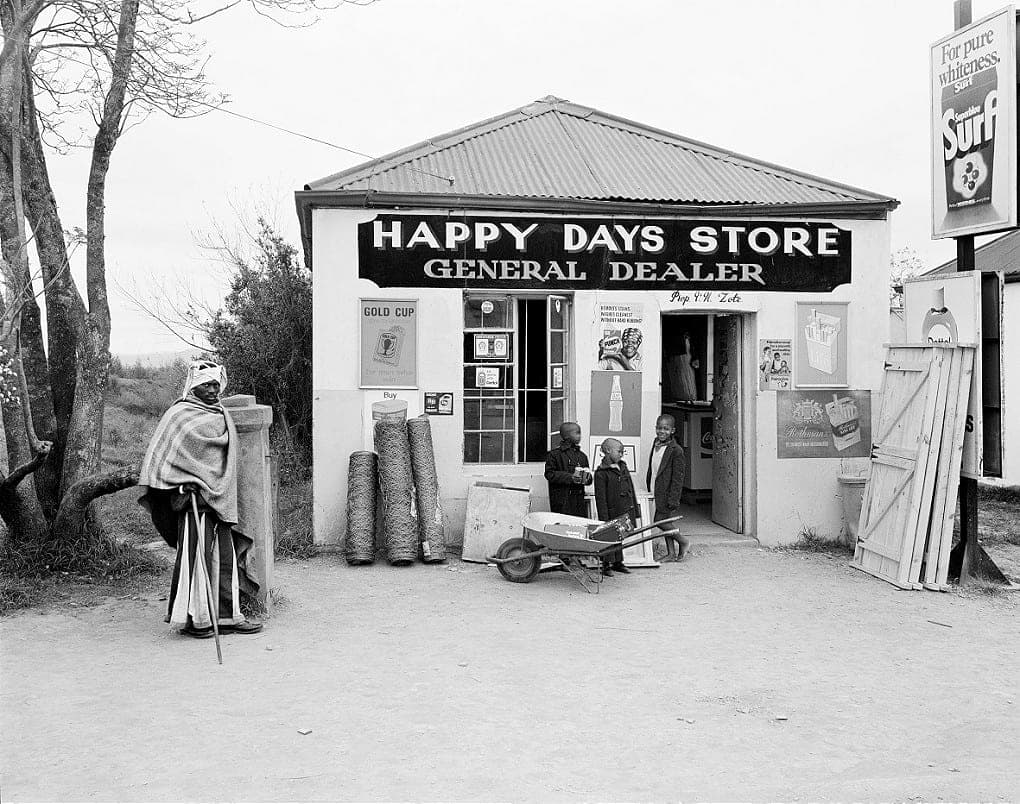
'Happy Days Store', Flagstaff, Transkei. 9 October 1975 , 1975
Carbon ink on Hahnemeule 315gsm
29.9 x 29.9 cm
11.8 x 11.8 in
Edition of 10
David Goldblatt
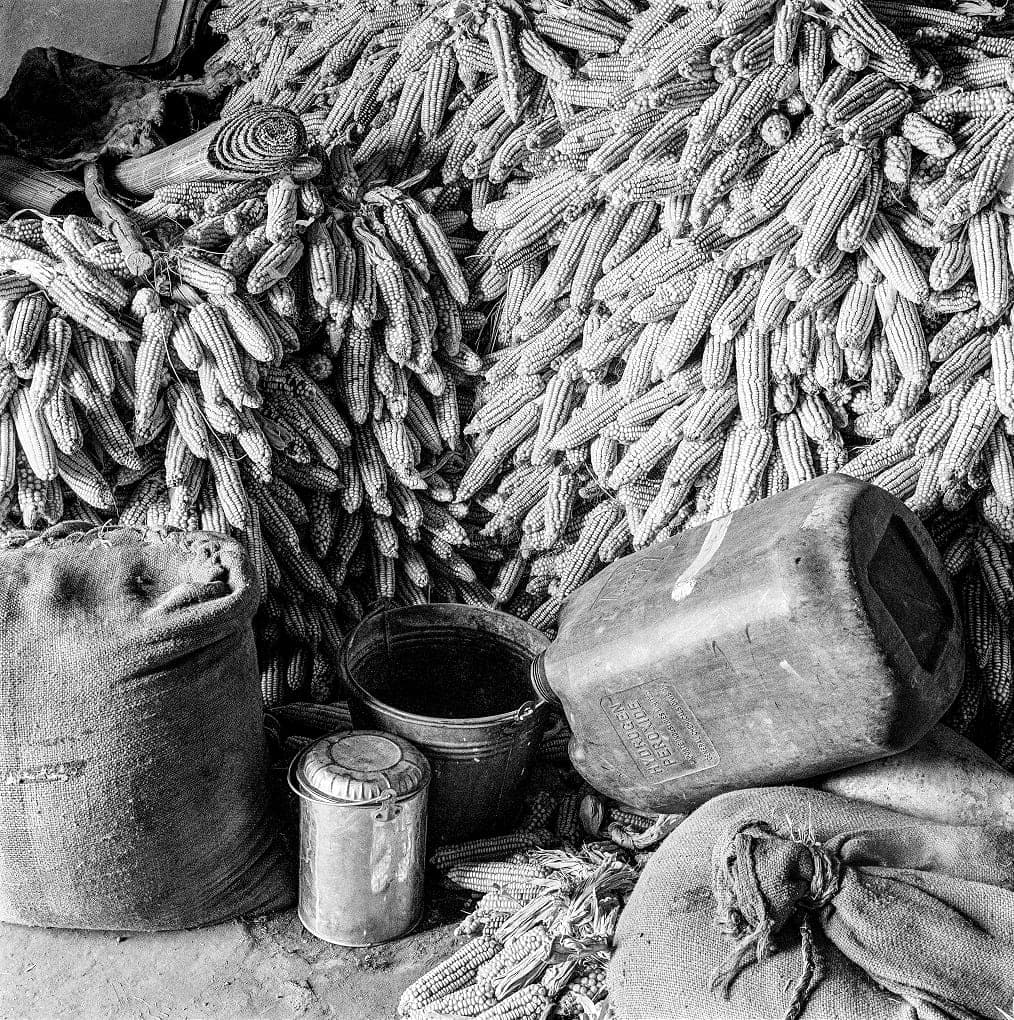
The crop, Transkei. 1975 , 1975
Carbon ink on Hahnemeule 315gsm
30 x 30 cm
11.8 x 11.8 in
Edition of 10
David Goldblatt
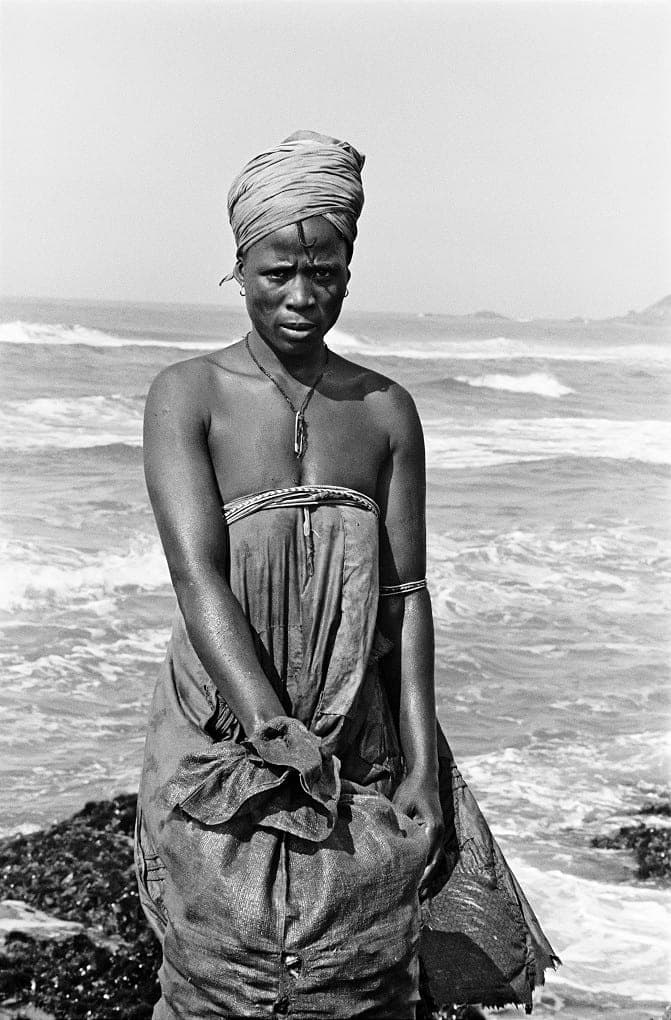
Woman collecting shellfish near Port St. John's, Transkei, 1975 , 1975
Silver gelatin print on fibre-based paper
approx. 30 x 40cm
11.8 x 15.7 in
Edition of 10
David Goldblatt
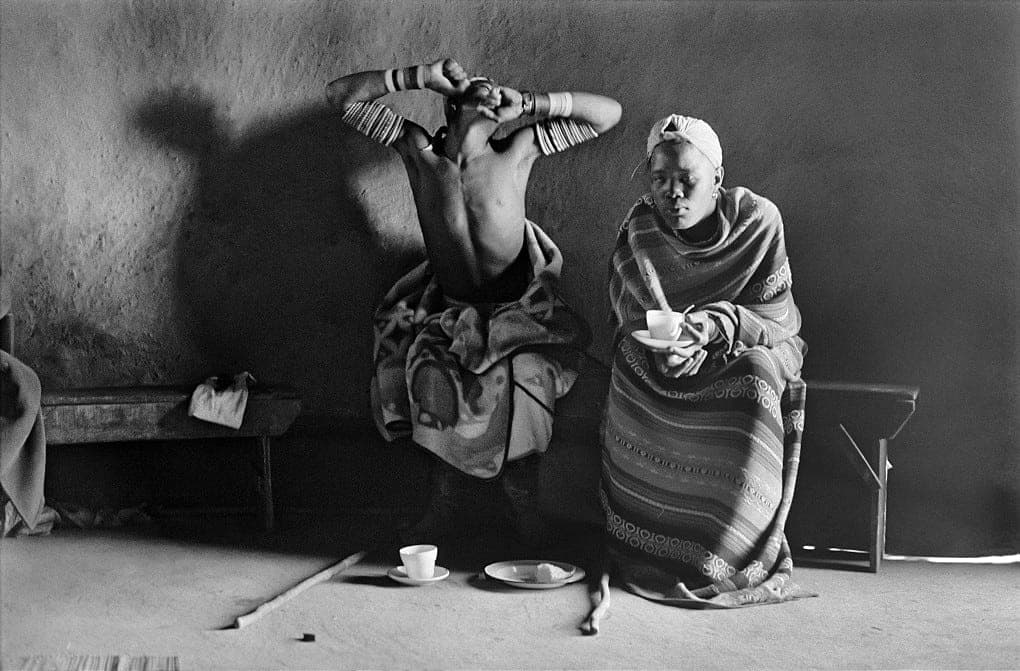
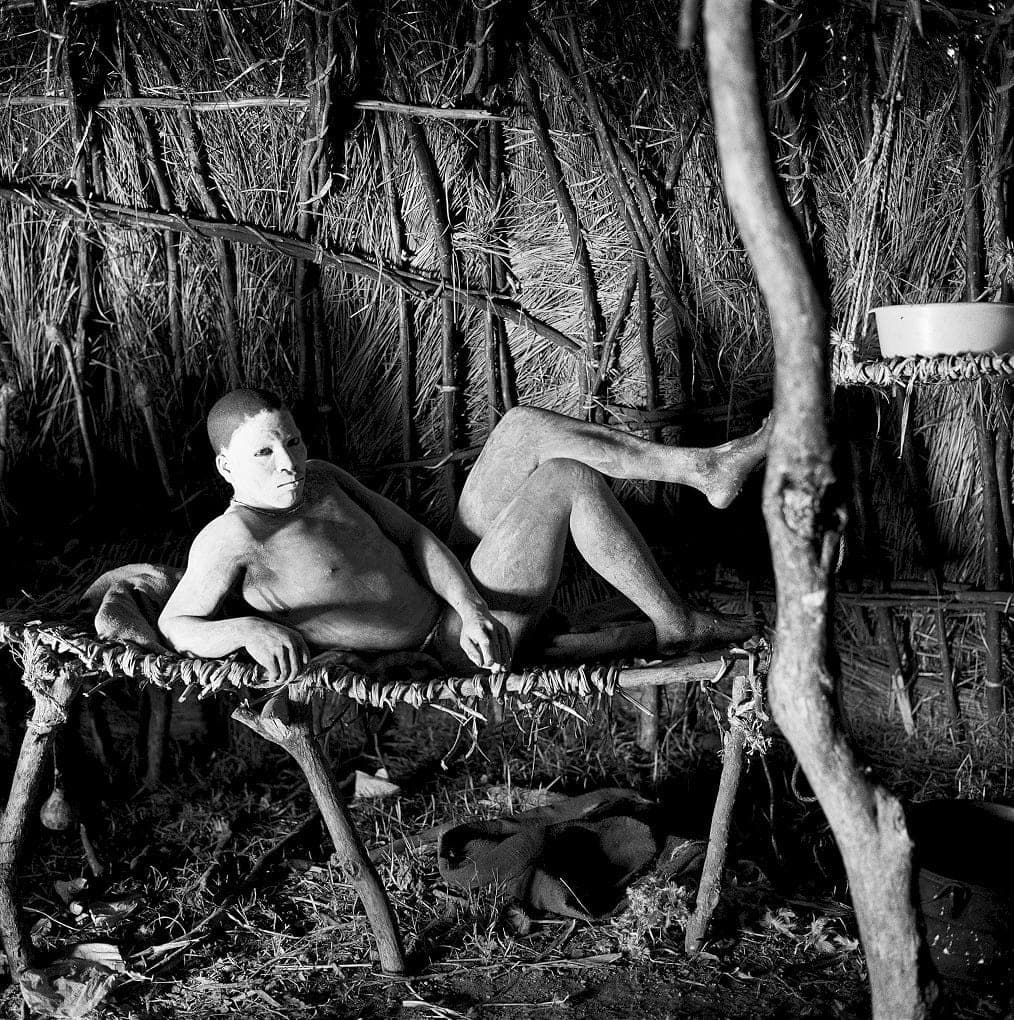
Circumcision initiate in the hut of the abakwetha, Transkei , 1975
Silver gelatin print on fibre-based paper
approx. 30 x 40cm
11.8 x 15.7 in
Edition of 10
David Goldblatt
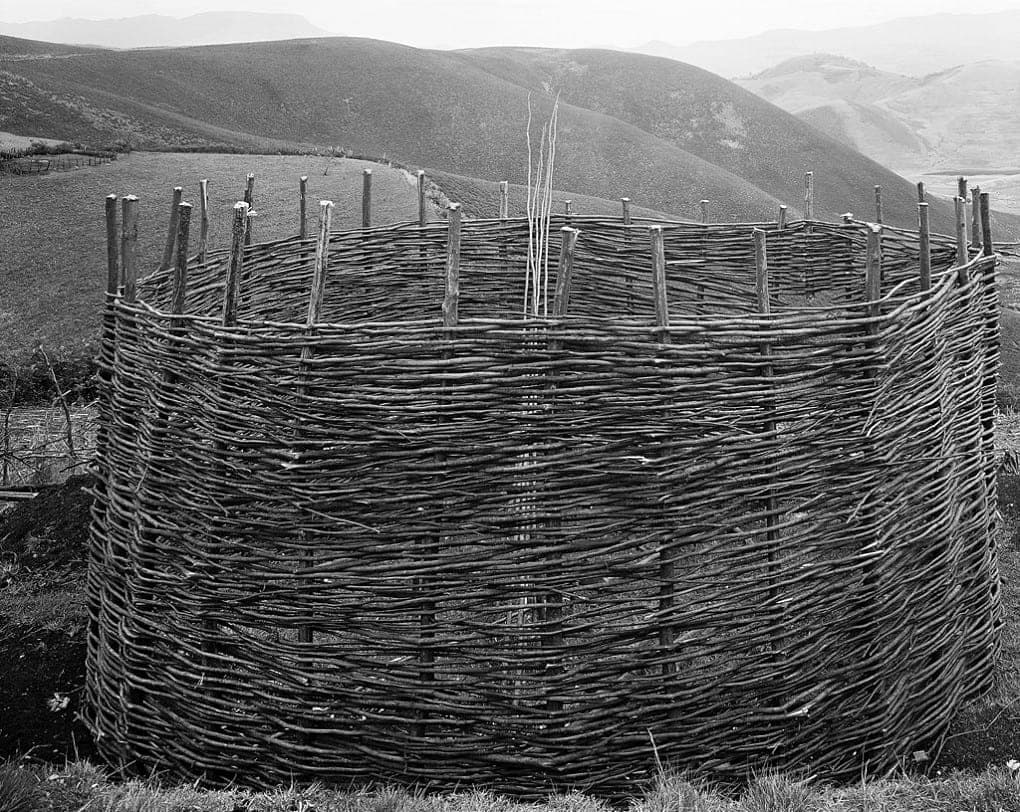
Framework for a new dwelling, near Flagstaff, Transkei. 9 October 1975 , 1975
Carbon ink on Hahnemeule 315gsm
29.9 x 37.5 cm
11.8 x 14.8 in
Edition of 10
David Goldblatt
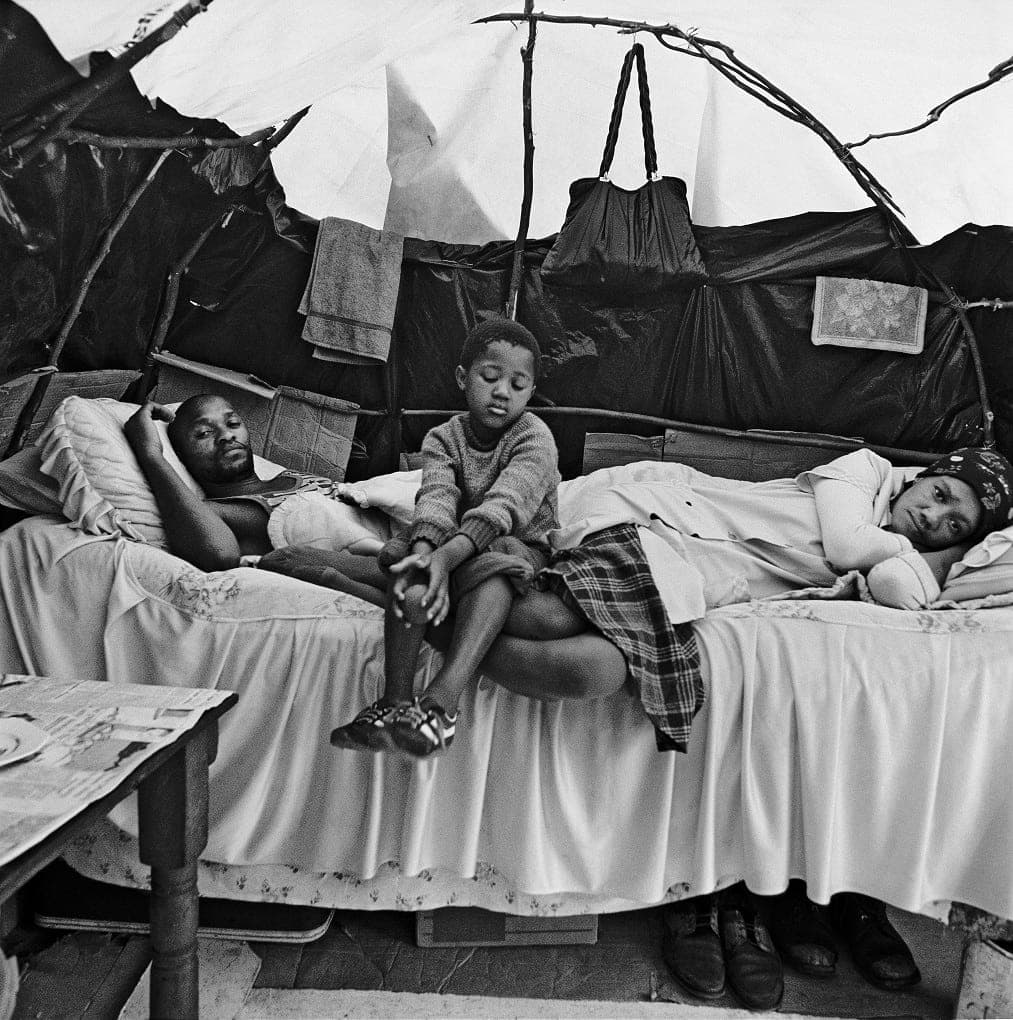
A Transkei family in their shelter, KTC squatter camp. The framework was made of strips of Port Jackson bush. For privacy black plastic sheets were used around the lower part of the shelter. For light, translucent plastic was used on the dome. Cape Town, September 1984 (2_31179), 1984
Silver gelatin print on fibre-based paper
approx. 30 x 40cm: 30 x 40 cm (11.8 x 15.7 in.)
Edition of 10
David Goldblatt
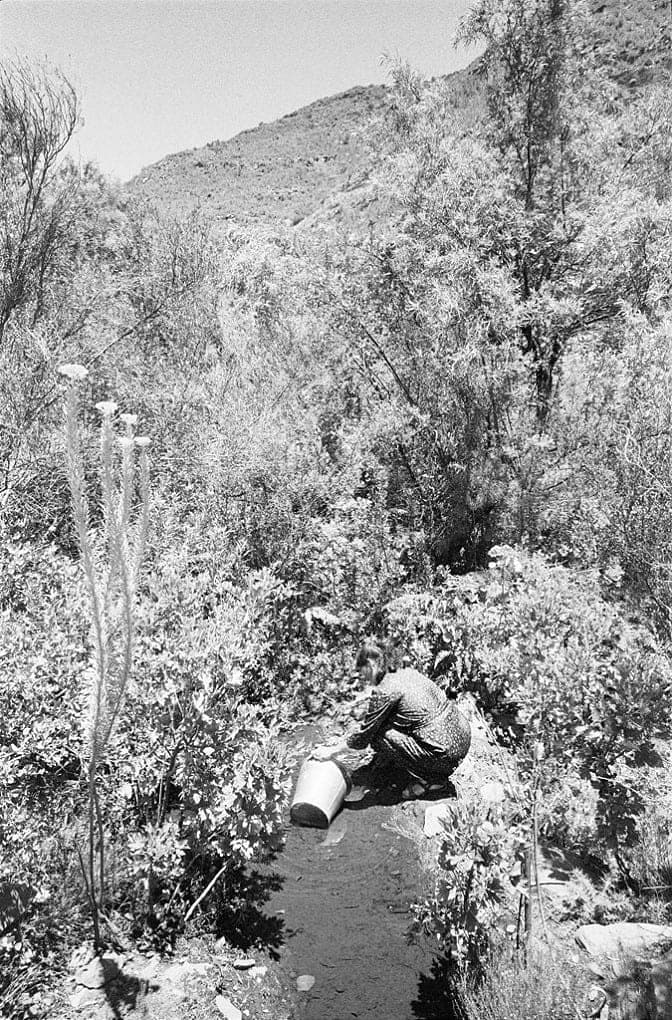
Hester Mostert fetching water from the river, Gamkaskloof, Cape Province (Western Cape) (3_C6464/5), 1966
Carbon ink on Hahnemeule 315gsm
45.2 x 29.9 cm
17.8 x 11.8 in
Edition of 10
David Goldblatt
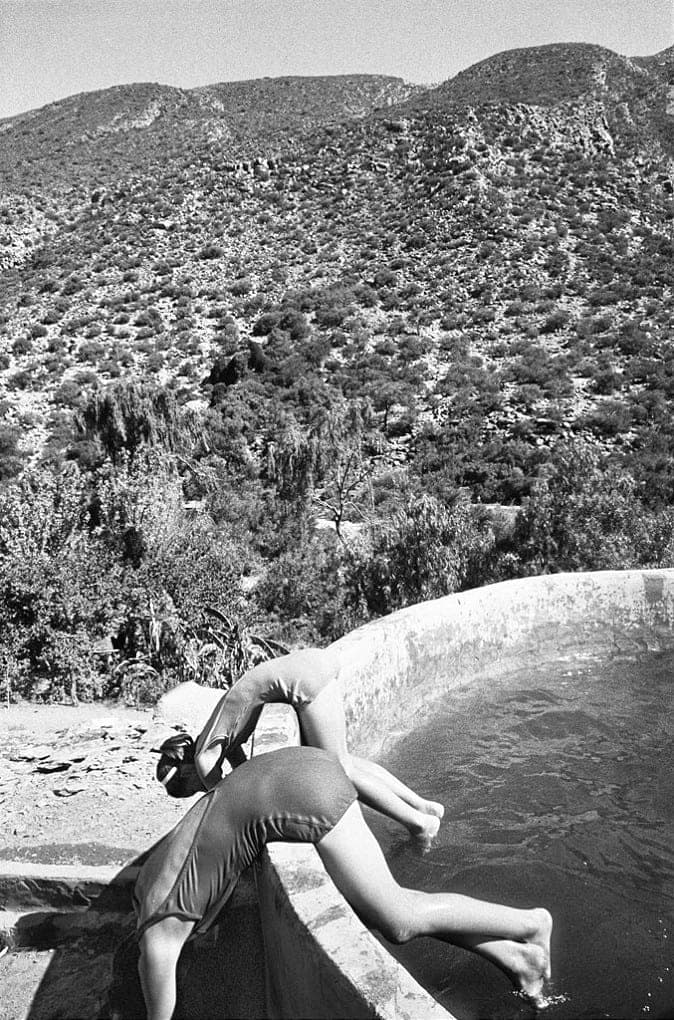
Ella and Betty Marais swimming in the dam that their father, Freek Marais, built, Gamkaskloof, Cape Province (Western Cape) , 1966
Silver gelatin print on fibre-based paper
approx. 30 x 40cm
11.8 x 15.7 in
Edition of 10

Caption: In this isolated community people would find their water during the long droughts by scooping in from holes dug in the riverbed. In 1966 Marais was the only man there to have put in a pump which sent water to a dam that he built near his house.

David Goldblatt
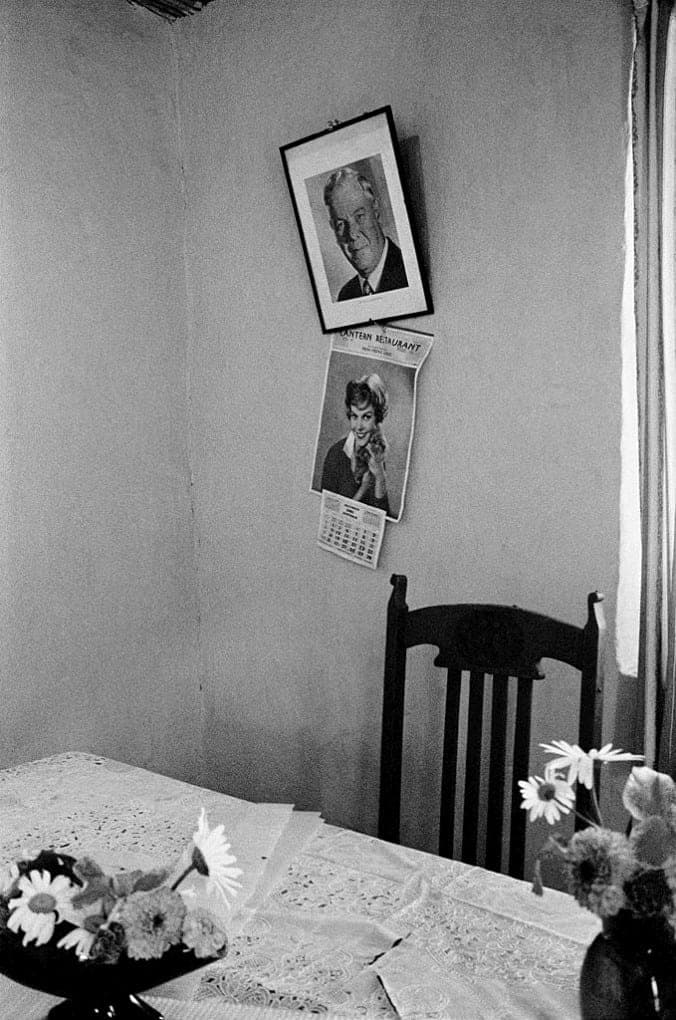
Dr. Verwoerd and the Lantern Restaurant in the voorkamer of Lewies and Katrina Nel, Gamkaskloof, Cape Province (Western Cape), December 1967 , 1967
Carbon ink on Hahnemeule 315gsm
45.2 x 30 cm
17.8 x 11.8 in
Edition of 10
David Goldblatt
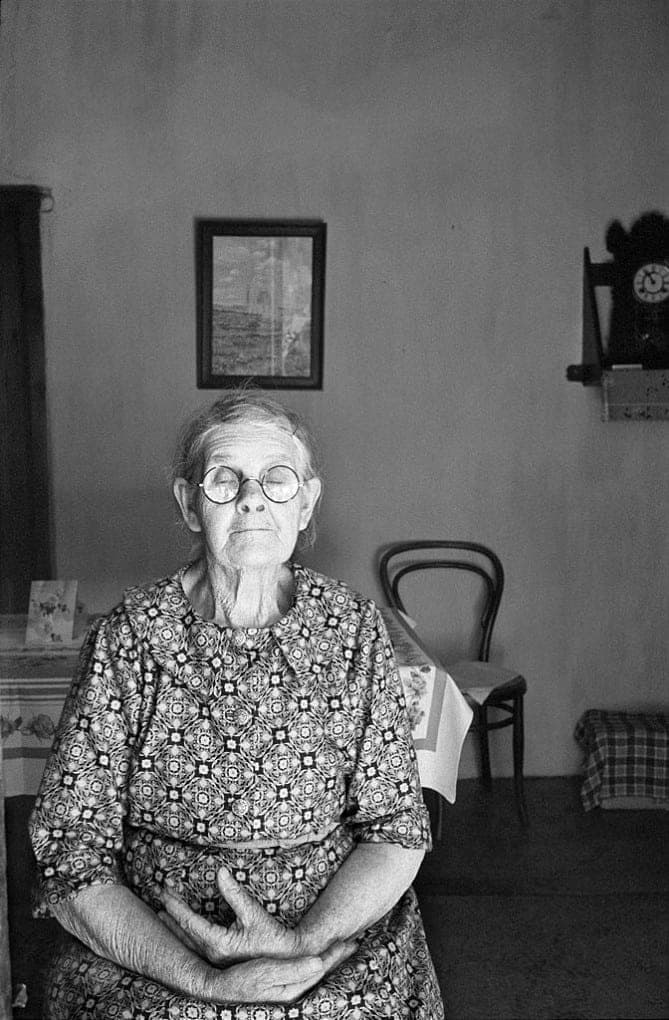
Ouma Hester Mostert, who came from Calitzdorp to Gamkaskloof as a seventeen-year-old bride, sitting at the door of her voorkamer. Gamkaskloof, Cape Province (Western Cape), 1968 (3_D9374), 1968
Silver gelatin print on fibre-based paper
Paper size: 50.5 x 34.8 cm
19.9 x 13.7 in
Edition of 10

Caption: I asked if she would allow me to make a photograph of her. Would i send her a copy? she replied. I said: Yes, in about three months' time. Don't worry, I'll be dead then, she said. The photograph was made on or about 1 January. She died on 7 April.

David Goldblatt
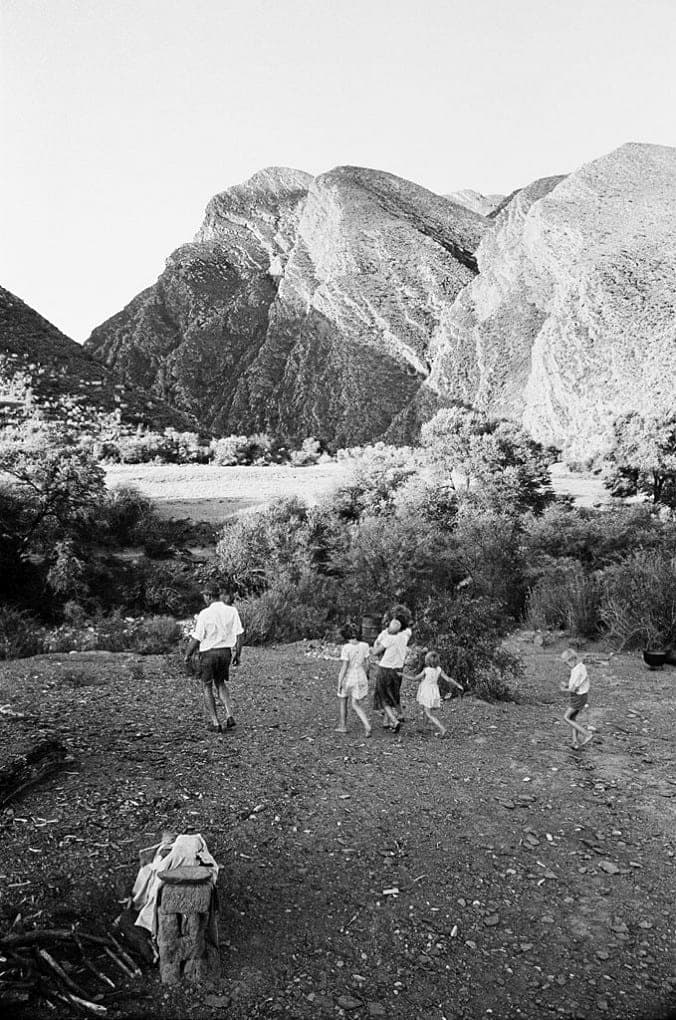
Koot and Hettie Cordier and their children going to visit their next-door neighbours, the Snymans, Gamkaskloof, (Die Hel) Cape Province (Western Cape) , Dec 1966
Carbon ink on Hahnemeule 315gsm
45.2 x 29.9 cm
17.8 x 11.8 in
Edition of 10
David Goldblatt
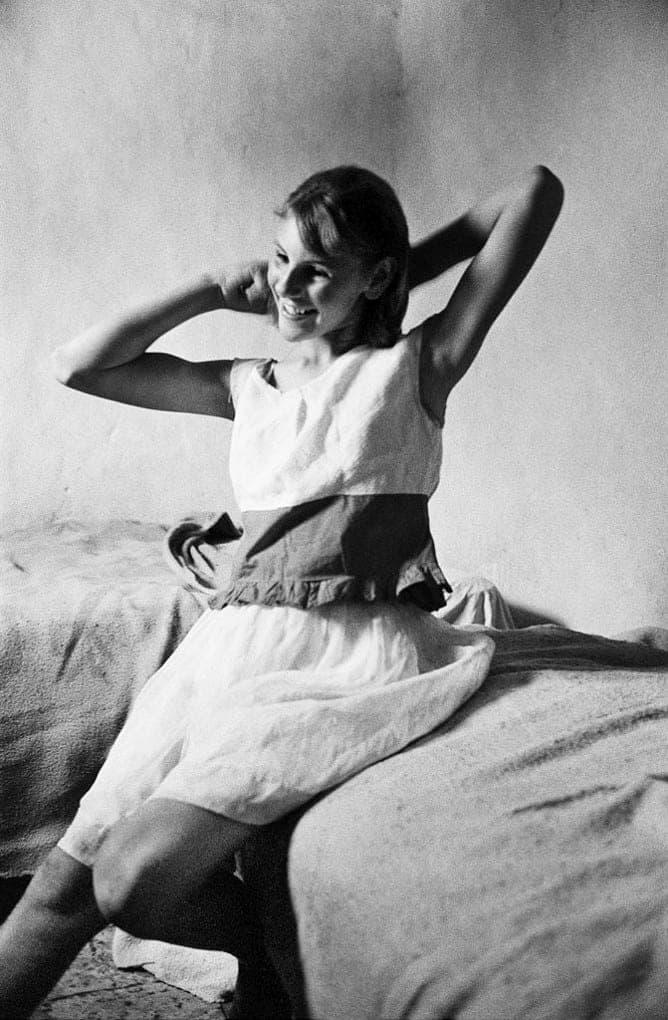
Ella, daughter of Freek and Martjie Marais, in the children's bedroom. Gamkaskloof, Cape Province (Western Cape), December 1967 , 1967
Silver gelatin print on fibre-based paper
45 x 30cm
17.7 x 11.8 in
Edition of 10
David Goldblatt
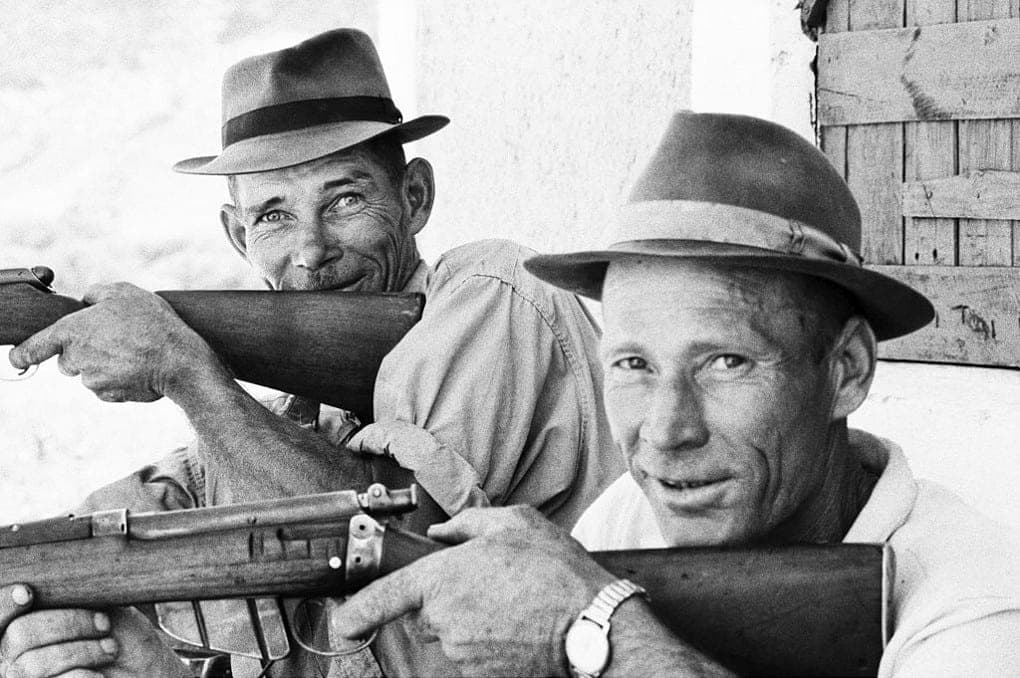
The brothers Stappies and Koot Cordier challenge me to a shooting competition. The target was a brown stone on a brown field about 50 metres away. As prize they put up a watermelon and I a couple of cans of beer. Gamkasfloof, Cape Province (Western Cape) , Dec 1967
Silver gelatin print on fibre-based paper
approx. 30 x 40cm
11.8 x 15.7 in
Edition of 10
David Goldblatt
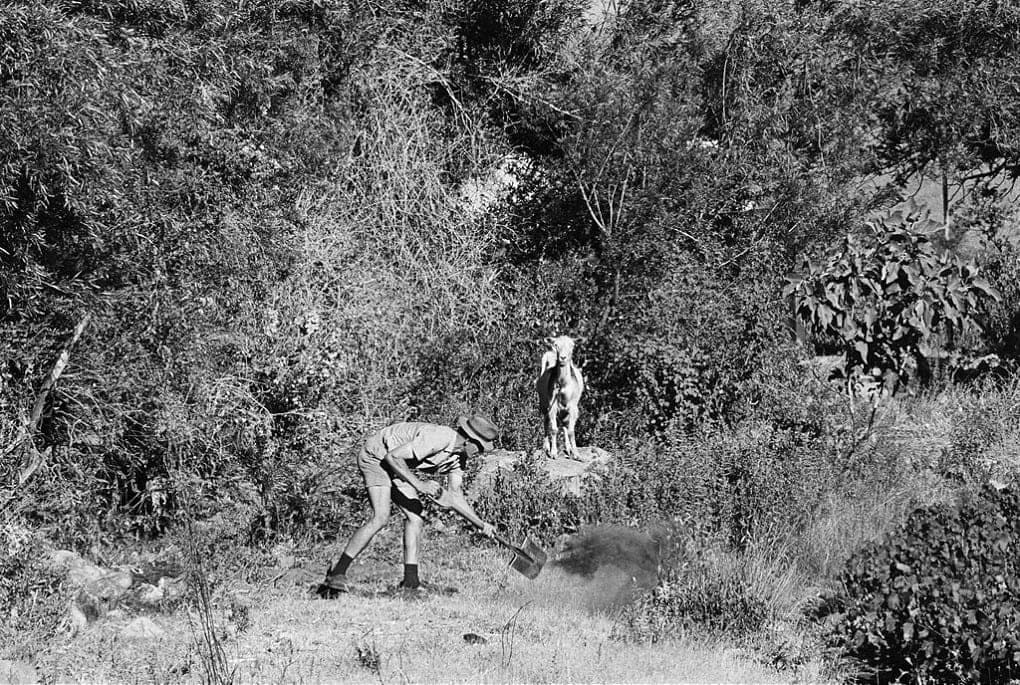
Piet Swanepoel clears ground for planting on his farm in Gamkaskloof. He left the valley in 1992, the last of the Kloof farmers to do so. Cape Province (Western Cape) , 1966
Silver gelatin print on fibre-based paper
31.5 x 46.5 cm
12.4 x 18.3 in
Edition of 10
David Goldblatt
Koot Cordier at his front door, Gamkaskloof, Cape Province (Western Cape), 1968 , 1968
Carbon ink on Hahnemeule 315gsm
Paper
18.9 x 13 in
Edition of 10
David Goldblatt
Bringing in the harvest, Koksoord Plots, Randfontein, Transvaal (Gauteng) /(3_6894), 1962
Carbon ink on Hahnemuhle 315gsm
41.2 x 29.9 cm
16.2 x 11.8 in
Edition of 10
David Goldblatt
The pensioner's daughter: she worked in a tobacco factory in Johannesburg and had bought her parents this furniture on hire-purchase. Randfontein. 1962 (3_5148), 1962
Silver gelatin print on fibre-based paper
46.5 x 30.2 cm
18.3 x 11.9 in
Edition of 10
David Goldblatt
Sitting at the kitchen door, he said, affectionately, to the child, "Ja, wat maak jy hier jou swart vuilgoed" (Yes, what are you doing here you black rubbish) Wheatlands, Randfontein. September 1962 , 1962
Carbon ink on Hahnemuhle 315gsm
29.9 x 45.2 cm
11.8 x 17.8 in
Edition of 10
David Goldblatt
Making a coffin for the body of a neighbour's servant whose family could not afford one, Bootha Plots, Randfontein , 1962
Silver gelatin print on fibre-based paper
30 x 40.5 cm
11.8 x 15.9 in
Edition of 10
David Goldblatt
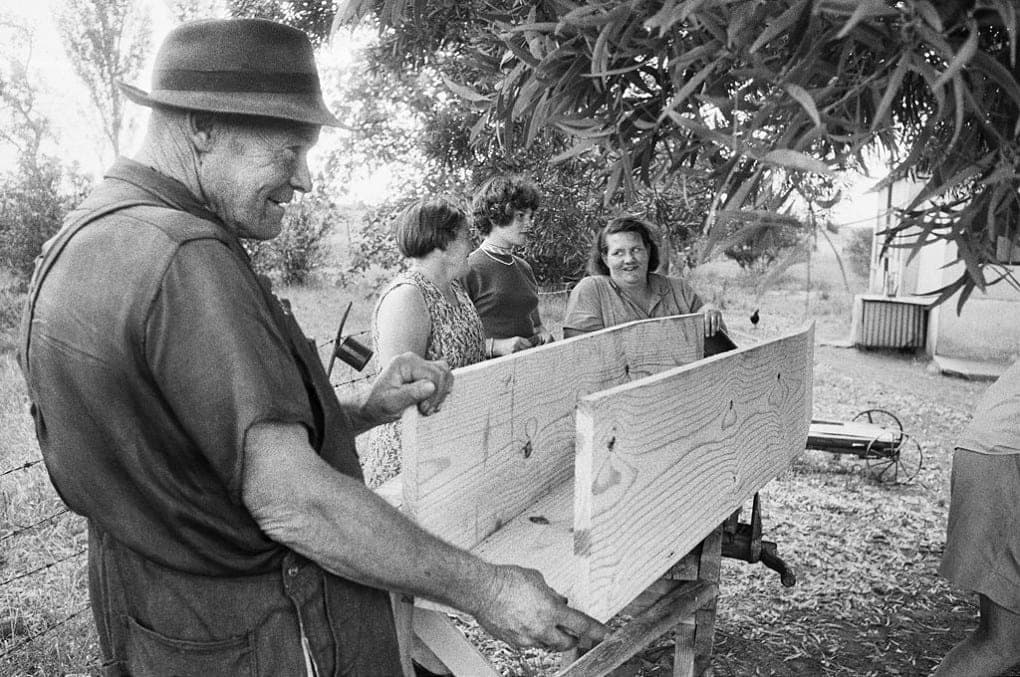
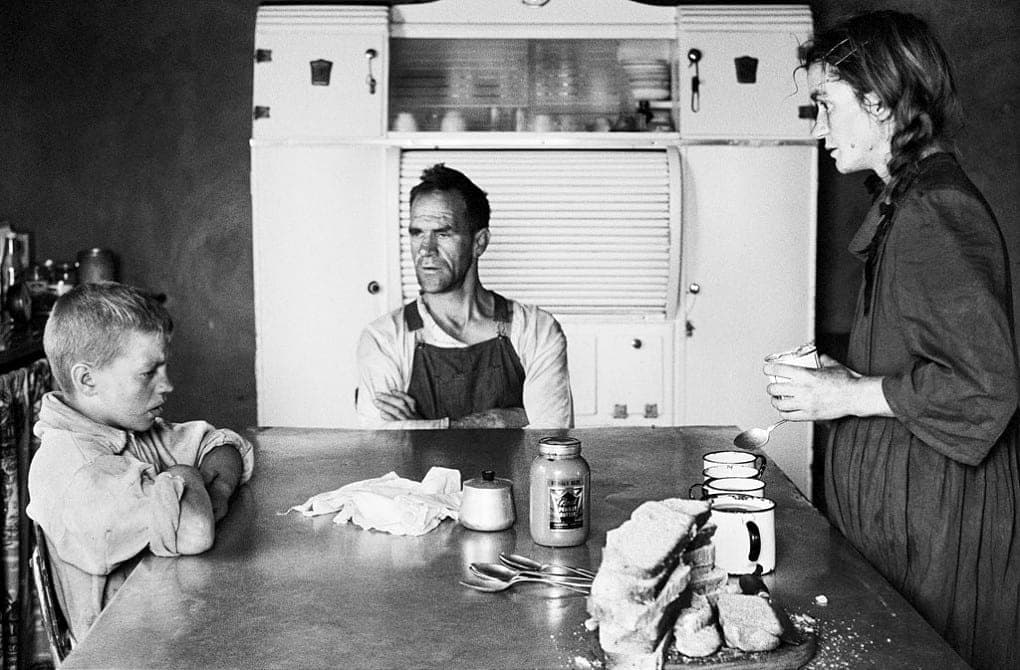
A plot-holder, his wife and their eldest son at lunch, Wheatlands, Randfontein , 1962
Silver gelatin print on fibre-based paper
27.5 x 40.5 cm
10.8 x 15.9 in
Edition of 10
David Goldblatt
Klonkie with kleinbaas, Bootha Plots, Randfontein. January 1962 (3_6556), Jan 1963
Silver gelatin print on fibre-based paper
approx. 30 x 40cm
11.8 x 15.7 in
Edition of 10
David Goldblatt
Kleinbaas with klonkie, Bootha Plots, Randfontein. January 1963 , Jan 1962
Silver gelatin print on fibre-based paper
approx. 30 x 40cm
11.8 x 15.7 in
Edition of 10
David Goldblatt
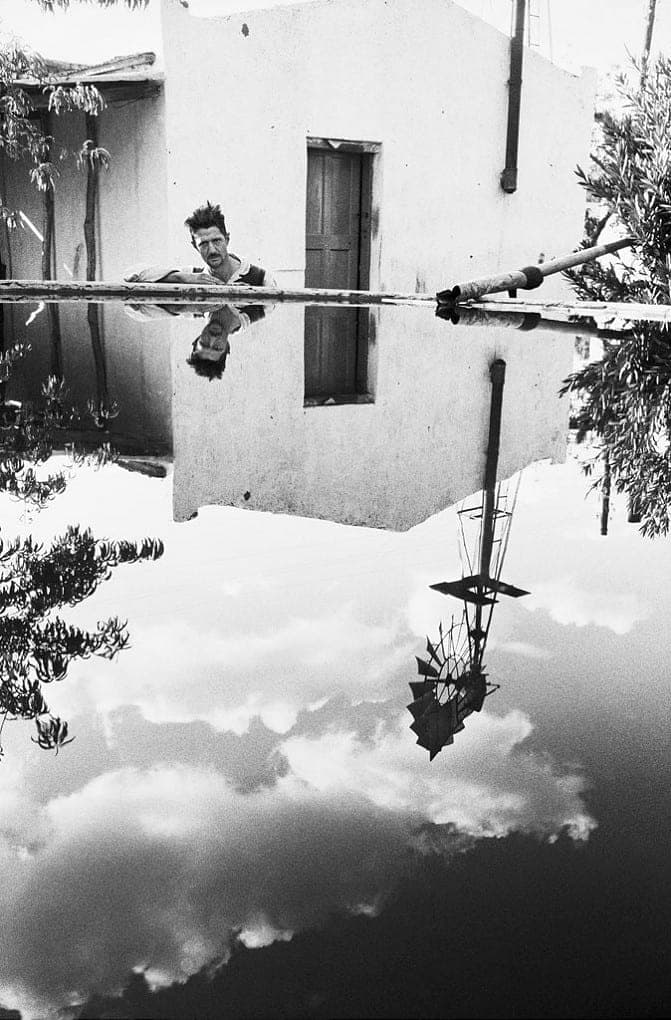
A railway shunter who dreamed of a garden without concrete or bricks, watered by this dam, Koksoord, Randfontein. 1962 , 1962
Carbon ink on Hahnemuhle 315gsm
45.2 x 29.9 cm
17.8 x 11.8 in
Edition of 10
David Goldblatt
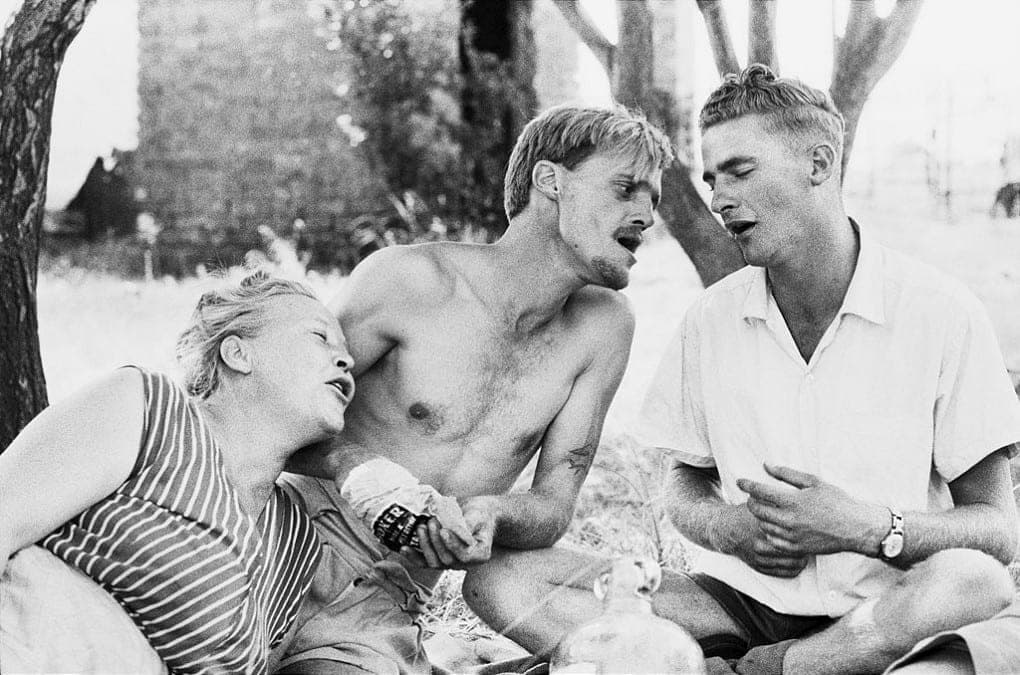
Songs on Christmas Day and a flagon of Tassies, Koksoord, Randfontein (3_6419), 1962
Silver gelatin print on fibre-based paper
24.6 x 37.1 cm
9.7 x 14.6 in
Edition of 10
David Goldblatt
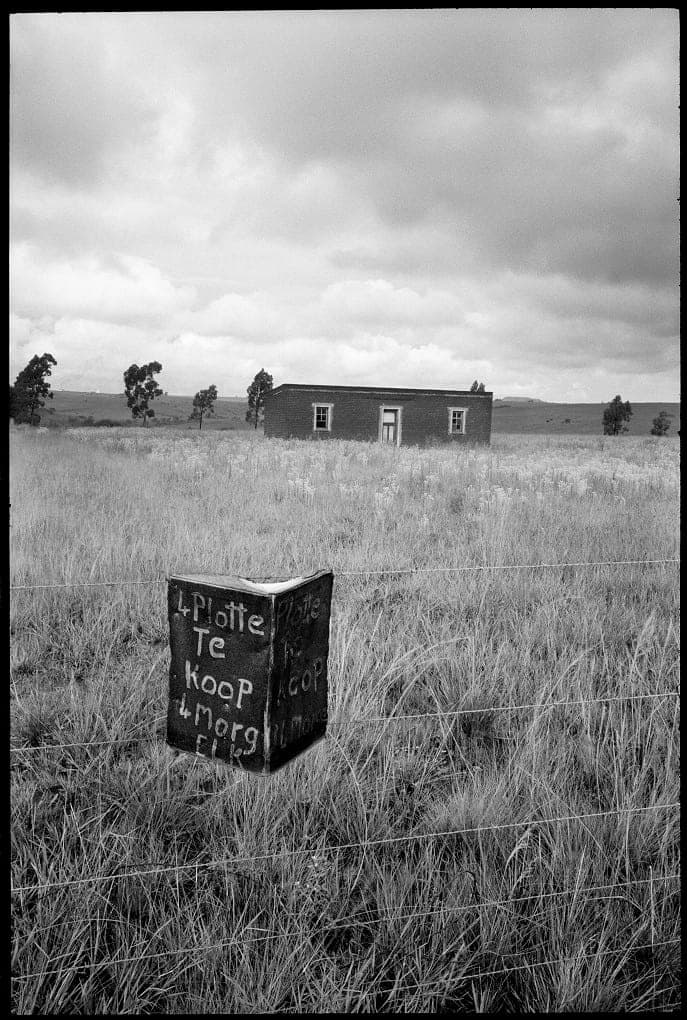
Plots for sale, Wheatlands, Randfontein. 1962 , 1962
Silver gelatin print on fibre-based paper
approx. 30 x 40cm
11.8 x 15.7 in
Edition of 10
David Goldblatt
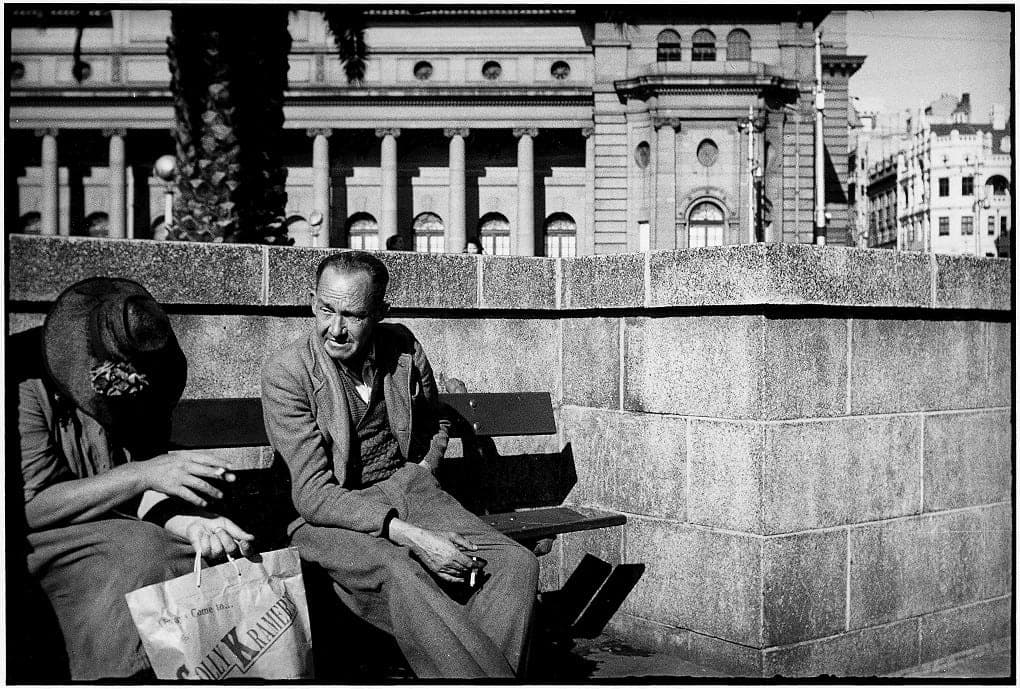
Couple in the Library Gardens, Johannesburg , 1948
Silver gelatin print on fibre-based paper, dibonded
30 x 45 cm
11.8 x 17.7 in
Edition of 10
David Goldblatt
Arriving family, King George Street, Johannesburg , c. 1955
Silver gelatin print on fibre-based paper
48.2 x 32.6 cm
19 x 12.8 in
Edition of 10
David Goldblatt
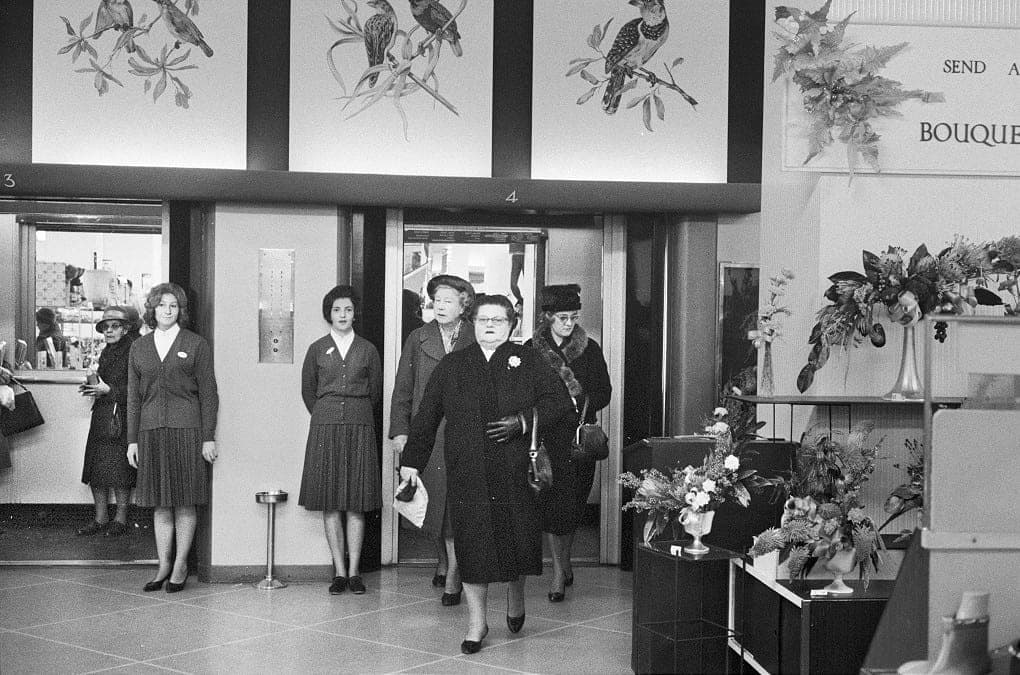
In a department store, probably John Orr's on Von Brandis Street, Johannesburg , June 1965
Silver gelatin print on fibre-based paper, dibonded
30 x 45cm
11.8 x 17.7 in
Edition of 10
David Goldblatt
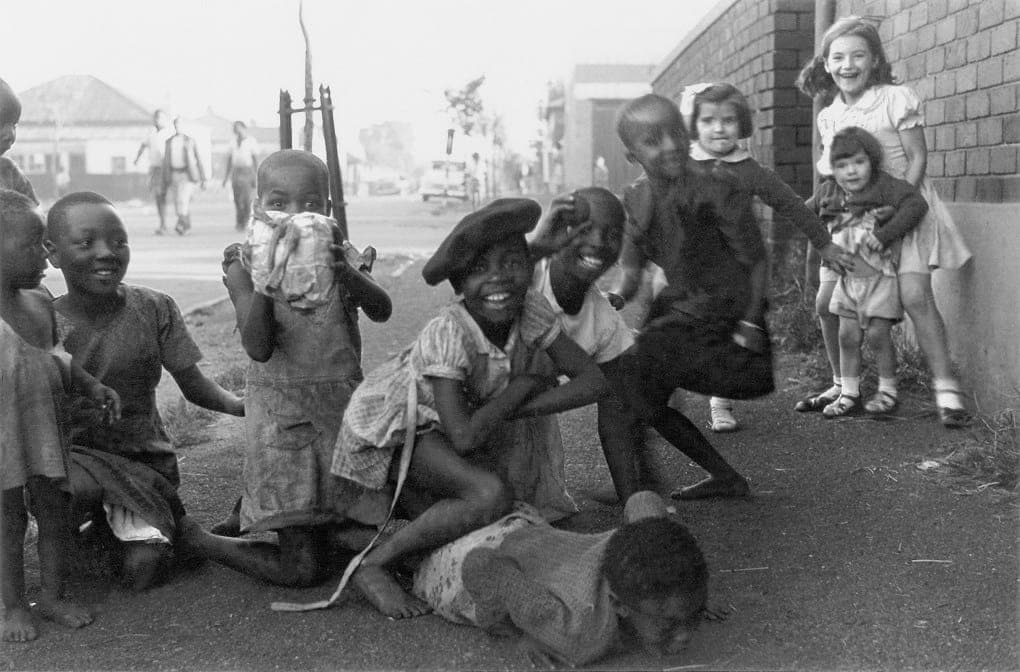
Children on the border between Fietas and Mayfair, Johannesburg , c. 1949
Silver gelatin print on fibre-based paper
30 x 45cm
11.8 x 17.7 in
Edition of 10
David Goldblatt
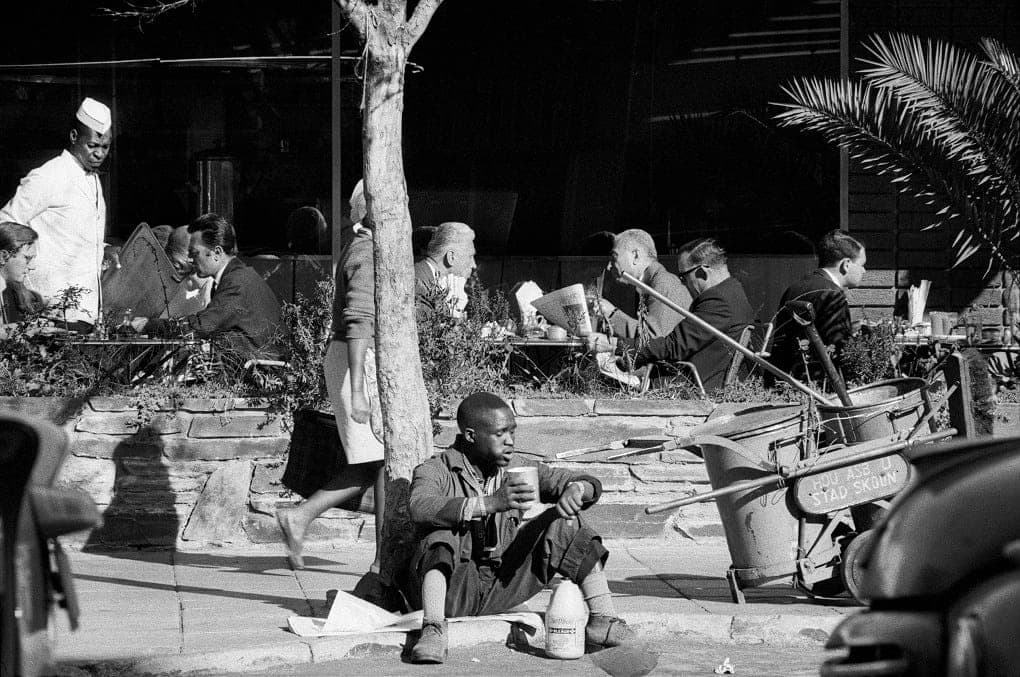
Lunch-hour, Pretoria Street, Hillbrow , 1966
Silver gelatin print on fibre-based paper, dibonded
30 x 45cm
11.8 x 17.7 in
Edition of 10
David Goldblatt
Hold-up in Hillbrow, Johannesburg , Nov 1963
Silver gelatin print on fibre-based paper/ dibond
30 x 45cm
11.8 x 17.7 in
Edition of 10
David Goldblatt
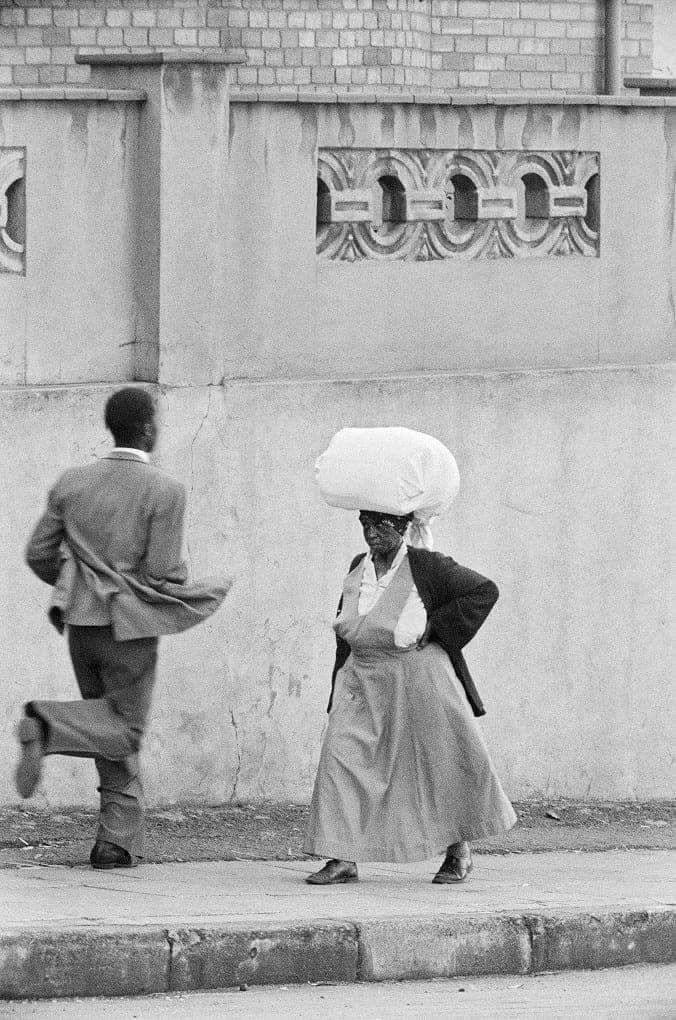
Anna Lebako, a washerwoman from Soweto carrying the week's laundry to a white suburban family, Harrow Road, January 1961 , 1961
Silver gelatin print on fibre-based paper
30 x 45cm
11.8 x 17.7 in
Edition of 10
David Goldblatt
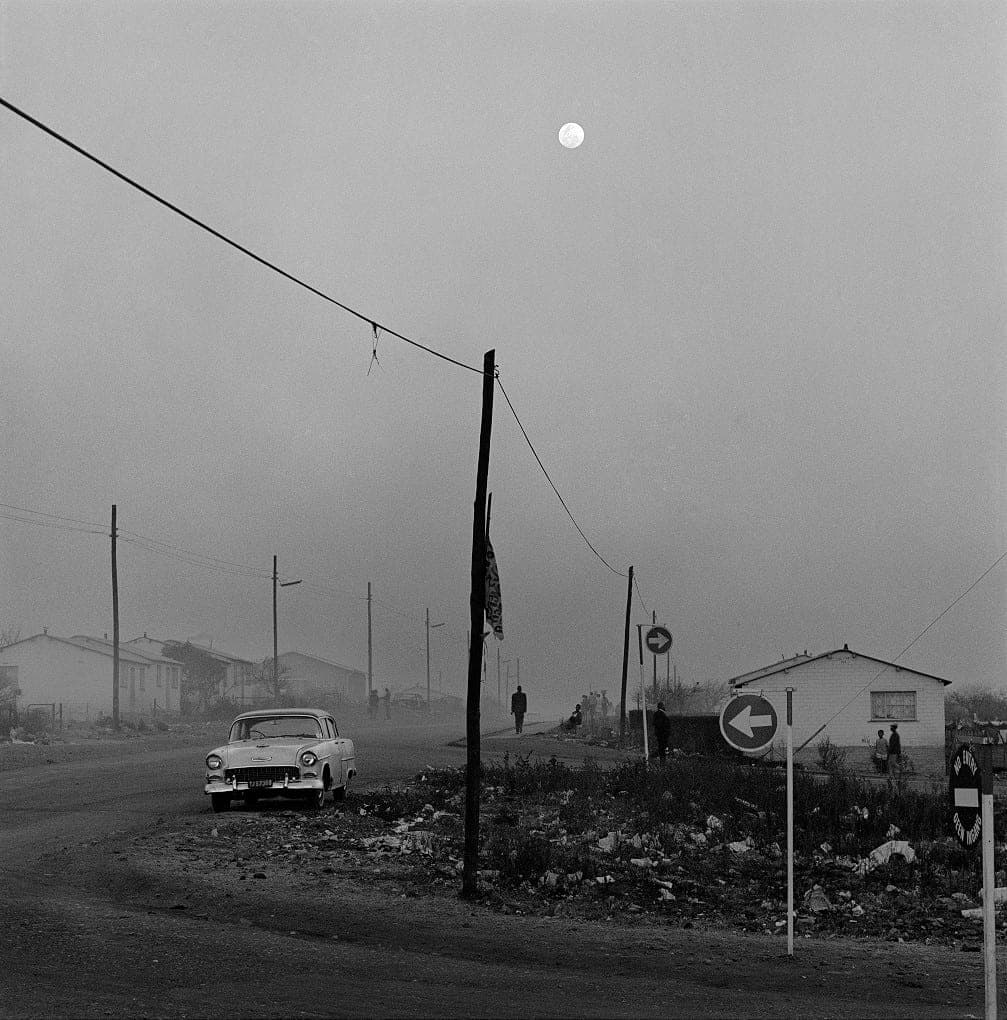
The moon over Diepkloof, Soweto , 1972
Silver gelatin print on fibre-based paper dibond
40 x 39.5 cm
15.7 x 15.6 in
Edition of 10
David Goldblatt
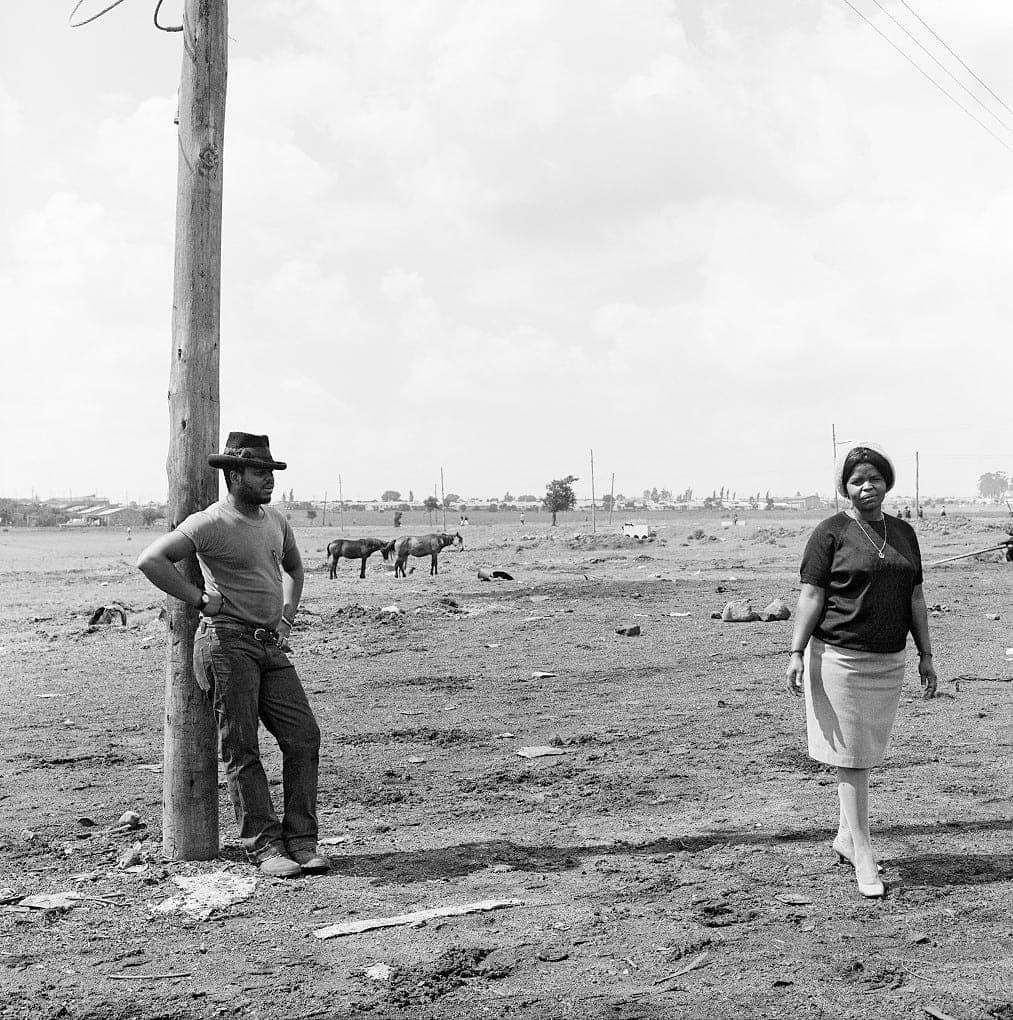
A man and a passing woman, Tladi, Soweto , Nov 1972
Silver gelatin print on fibre-based paper, dibonded
Image: 39.5 x 39.5 cm
Edition of 10
David Goldblatt
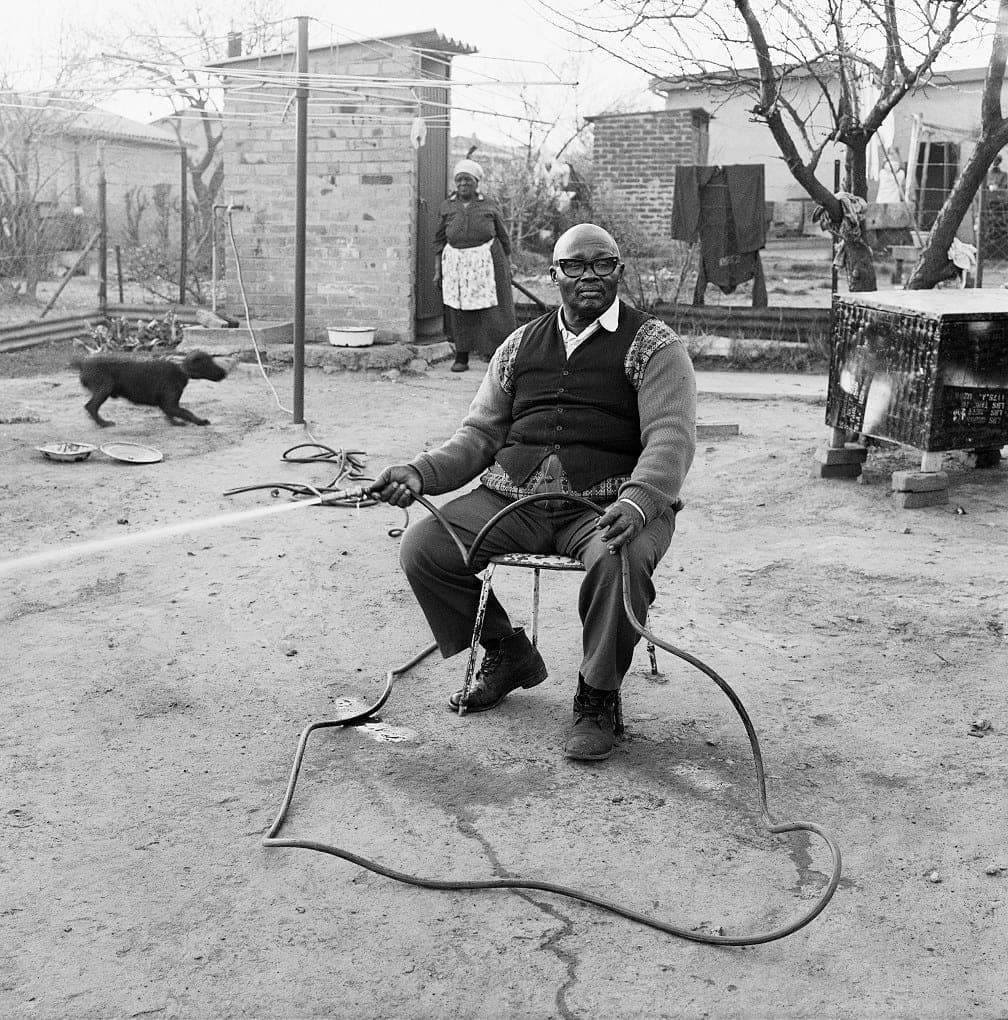
Ephraim Zulu watering his garden, 179 Central Western Jabavu, Soweto , 1972
Silver gelatin print on fibre-based paper
40 x 39.8 cm
15.7 x 15.7 in
Edition of 8
David Goldblatt
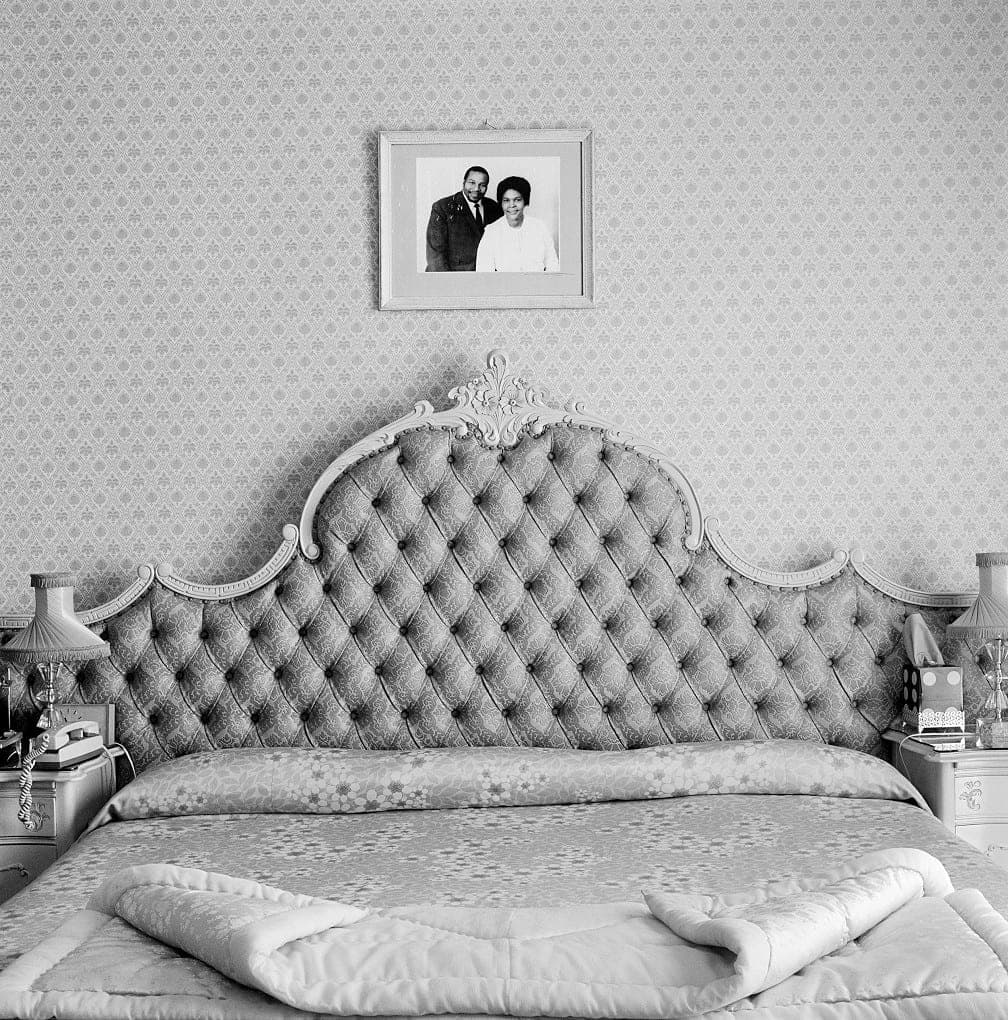
Richard and Marina Maponya, Dube, Soweto. 1972 , 1972
Silver gelatin print on fibre-based paper, dibonded
27.8 x 27.4 cm
10.9 x 10.8 in
Edition of 10
David Goldblatt
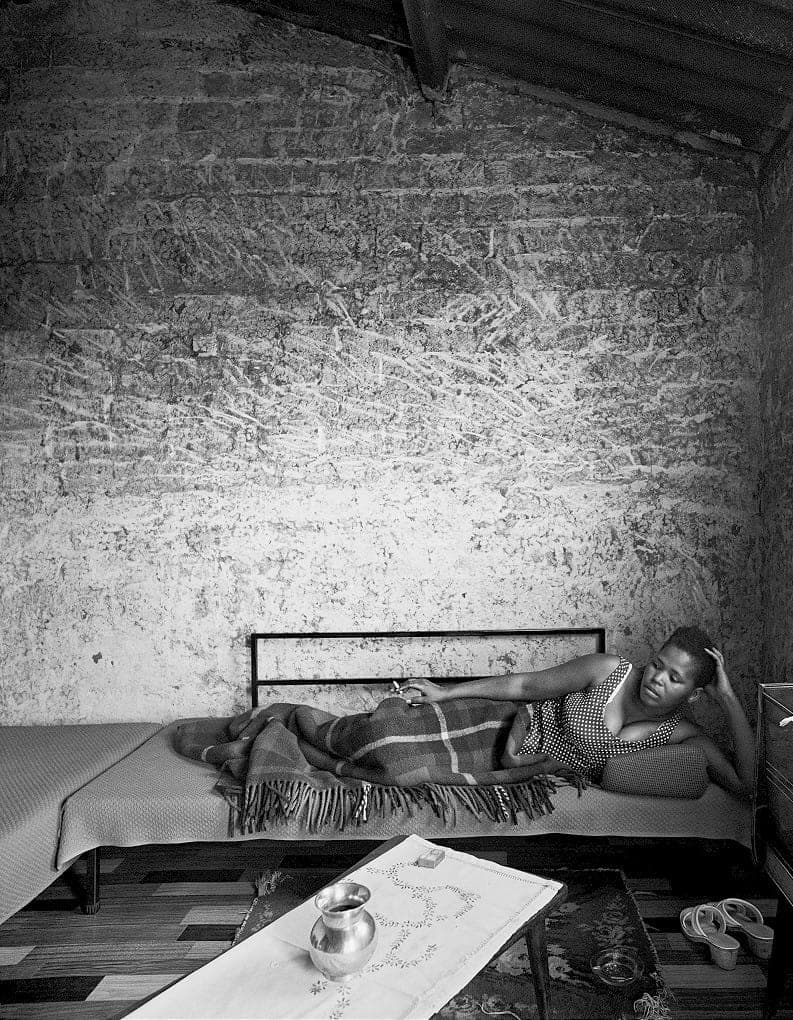
Margaret Mcingana, who later became famous as the singer Margaret Singana, at home, Sunday afternoon. Zola, Soweto , 1970
Silver gelatin print on fibre-based paper, dibonded
Image: 50 x 50 cm
Image: 50 x 50 cm
Edition of 8

Goldblatt spent years taking photographs of Johannesburg – of the white areas of the city centre, the comfortable suburbs and the townships on the outskirts of the city.

Goldblatt was engaged in the conditions of society and the values by which people lived, rather than the climactic outcomes of those conditions. He intended to discover and probe these values through the medium of photography.

“Johannesburg is not an easy city to love. From its beginnings as a mining camp in 1886, whites did not want brown and black people living among or near them and over the years pushed them further and further from the city and its white suburbs. Like the city itself my thoughts and feelings about Joburg are fragmented. I can’t easily bring a vision or a coherent bundle of ideas to mind and say, ‘That’s Joburg for me.’ Over the years I have photographed a wide range of subjects, each was almost self-contained, a fragment of a whole that I’ve never quite grasped.”

— David Goldblatt, 2017

David Goldblatt
Domestic worker on Abel Road, Hillbrow. March 1973 , 1973
Silver gelatin print on fibre-based paper
Image: 39.5 x 39 cm (15.6 x 15.4 in.)
Edition of 8
David Goldblatt
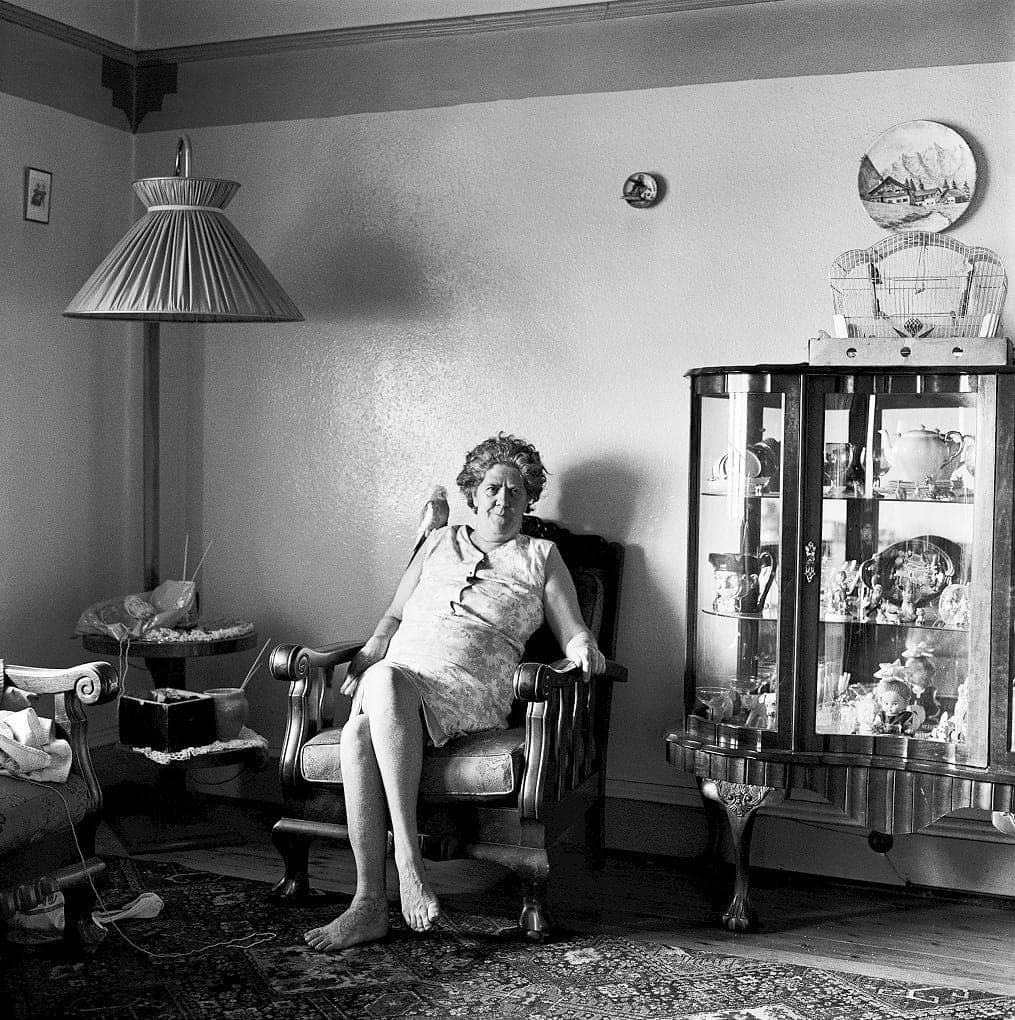
A Woman With Her Bird In Her Lounge, Bez Valley, Johannesurg , Nov 1973
Silver gelatin print on fibre-based paper, dibonded
50 x 50cm
19.7 x 19.7 in
Edition of 10
David Goldblatt
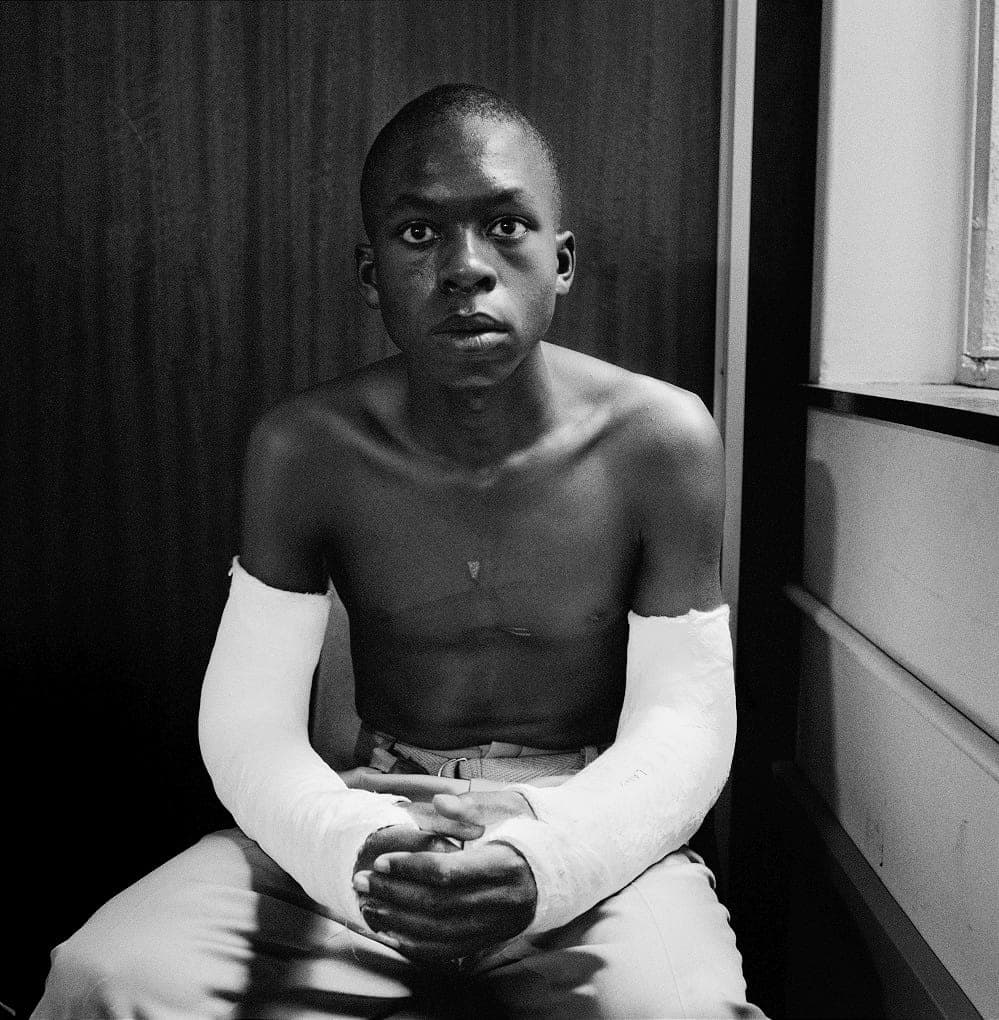
Fifteen-year old Lawrence Matjee after his assault and detention by the Security Police, Khotso House, de Villiers Street , 1985
Silver gelatin print on fibre-based paper
40 x 40cm
15.7 x 15.7 in
Edition of 8
David Goldblatt
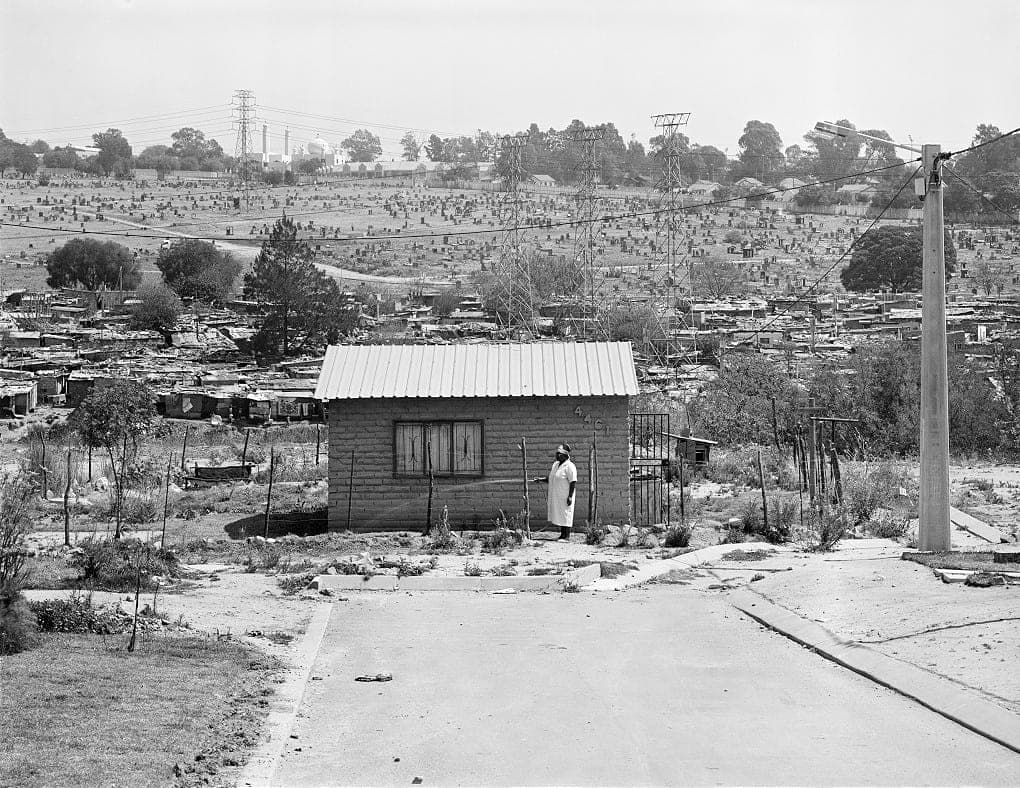
Miriam Mazibuko waters the garden of her RDP house for which she waited eight years. It consists of one room. Her four children live with her in-laws. Extension 8, Far East Alexandra Township, 12 September 2006 , September 2006
Silver gelatin print on fibre-based paper
42.2 x 54.2 cm
16.6 x 21.3 in
Edition of 10
David Goldblatt
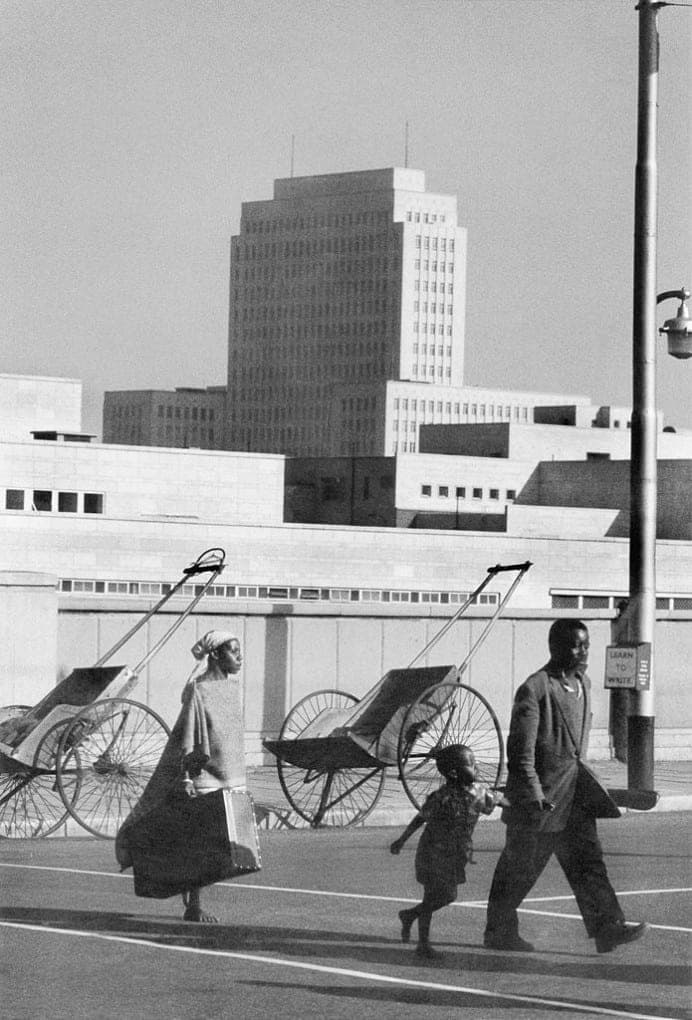
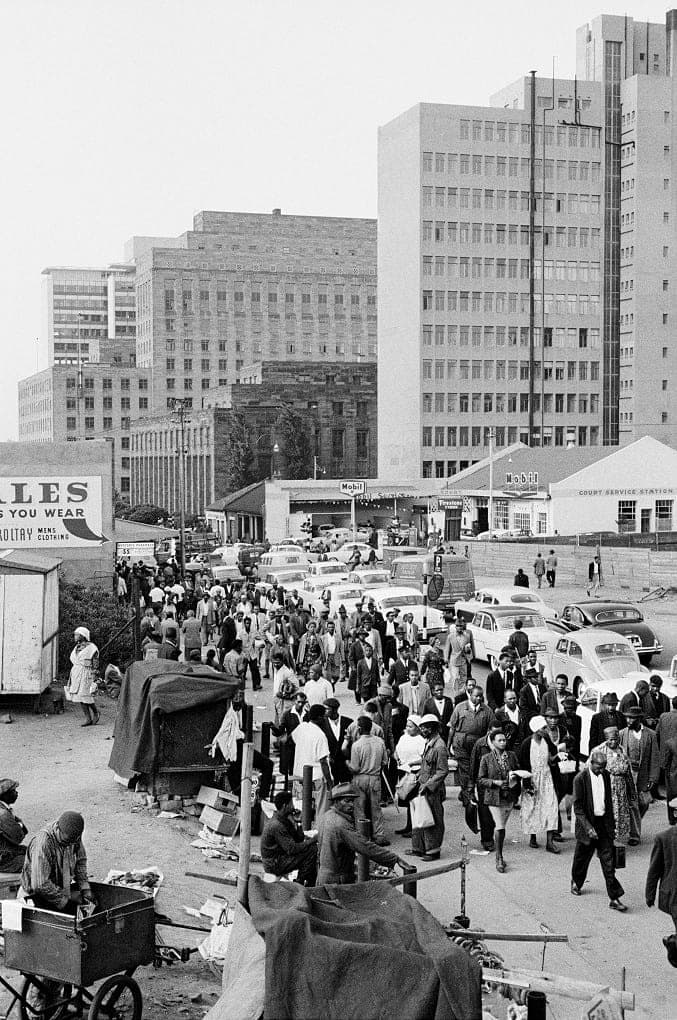
Evening exodus on West Street: Blacks going for trains in Soweto, Whites in their cars to the suburbs, Johannesburg .1964, 1964
Silver gelatin print on fibre-based paper, dibonded
37.5 x 25 cm
14.8 x 9.8 in
Edition of 8
David Goldblatt
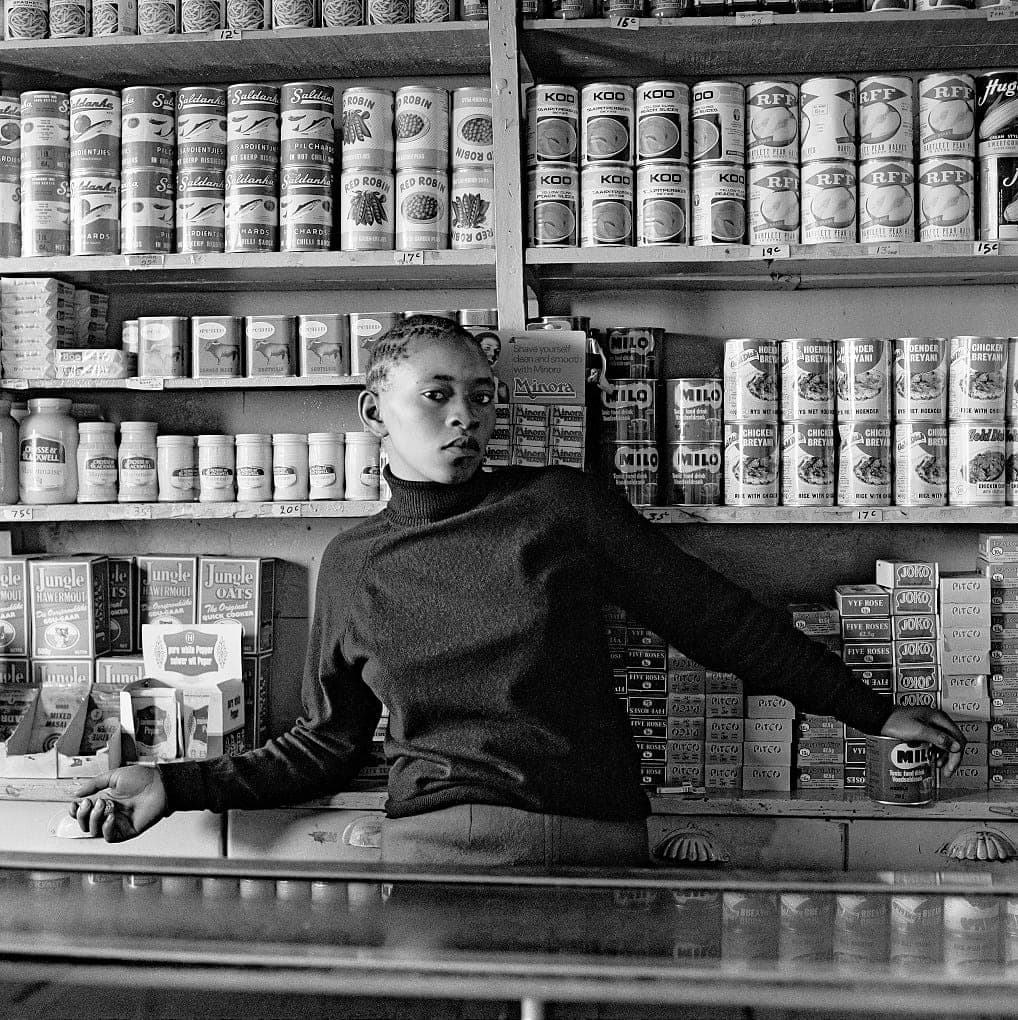
Shop assistant, Orlando West, 1972
Silver gelatin print on fibre-based paper
27.9 x 27.7 cm
11 x 10.9 in
Edition of 10

David Goldblatt’s ‘Johannesburg’ series includes a group of portraits taken in 1972 that offer a focused and intimate glimpse into the social fabric of the city at the height of apartheid. These photographs, made primarily in the central business district, depict people encountered in public spaces. While often taken with the subject’s awareness, the portraits are quiet and unposed, conveying a sense of mutual regard rather than intrusion. Goldblatt’s interest lay not in documenting spectacle, but in observing the dignity, posture, and presence of individuals moving through a city shaped by division and control.

The 1972 portraits reflect Goldblatt’s broader approach: careful composition, attentiveness to light and form, and a commitment to photographing without judgement. His lens lingers on small details allowing the viewer to consider how people inhabit public space, and how identity is both shaped by and resistant to its surroundings. Set against the rigid racial and spatial hierarchies of apartheid Johannesburg, these portraits are understated yet powerful documents of individuality. They stand as a testament to Goldblatt’s belief in photography as a way of seeing beyond surface divisions.

David Goldblatt
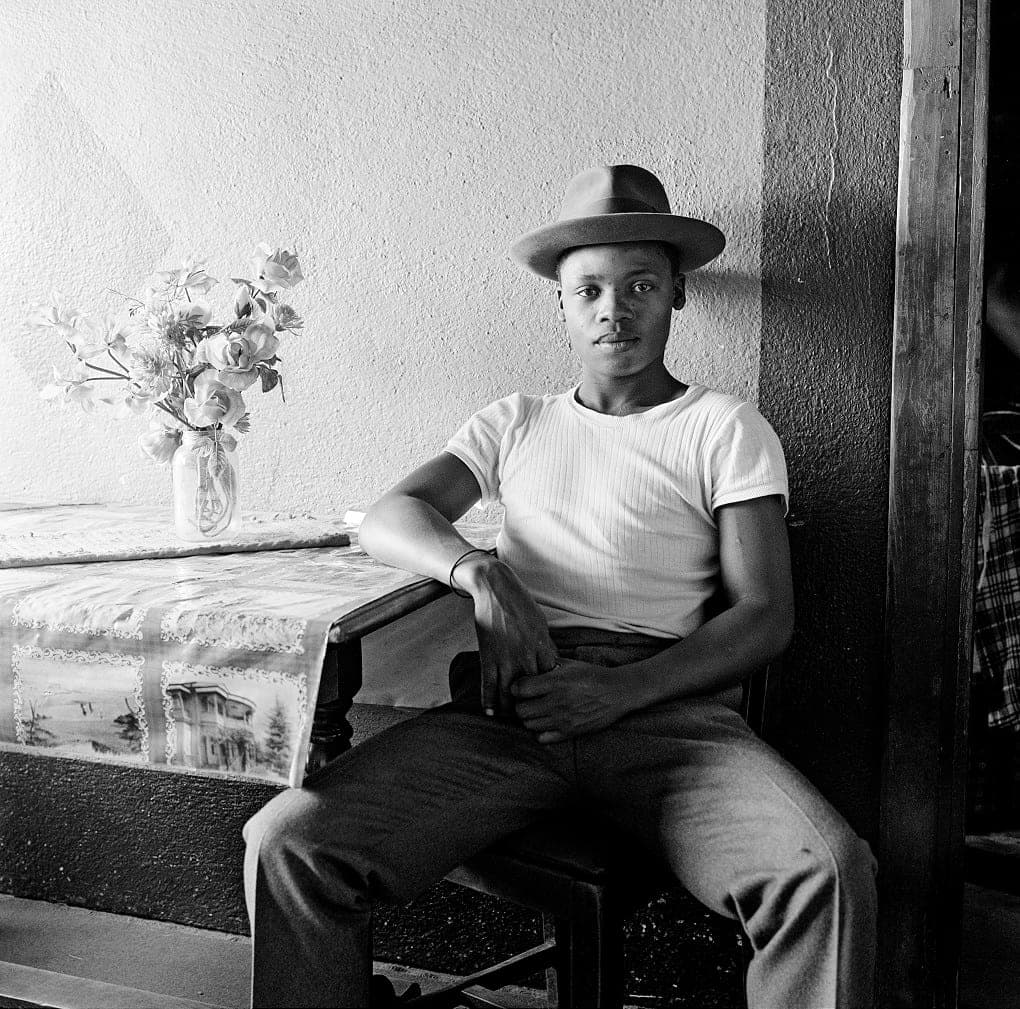
Young man at home, White City, Jabavu, Soweto. 1 October 1972 , 1972
Silver gelatin print on fibre-based paper
40 x 40 cm
15.7 x 15.7 in
Edition of 10
David Goldblatt
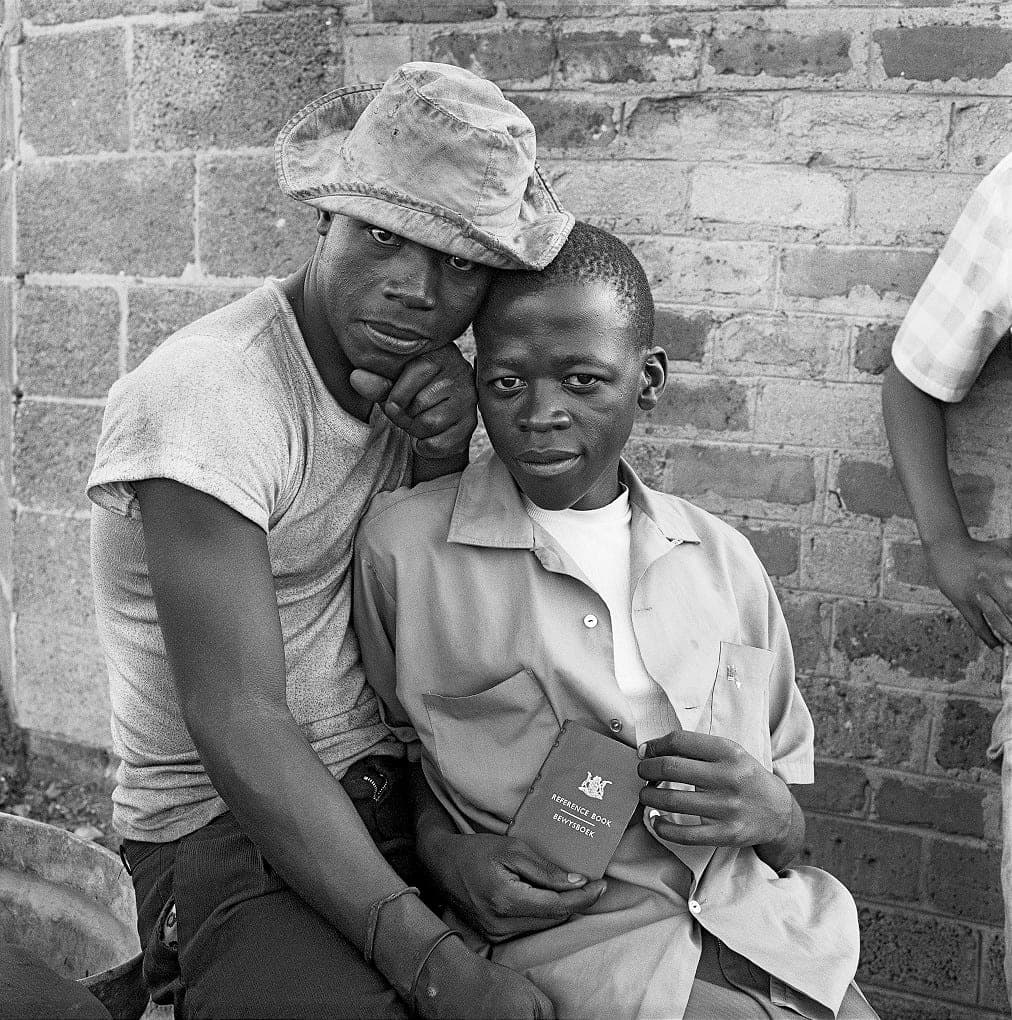
Young men with dompas (an identity document that every African had to carry), White City, Jabavu, Soweto , 1972
Silver gelatin print on fibre-based paper
40 x 40 cm
15.7 x 15.7 in
Edition of 10
David Goldblatt
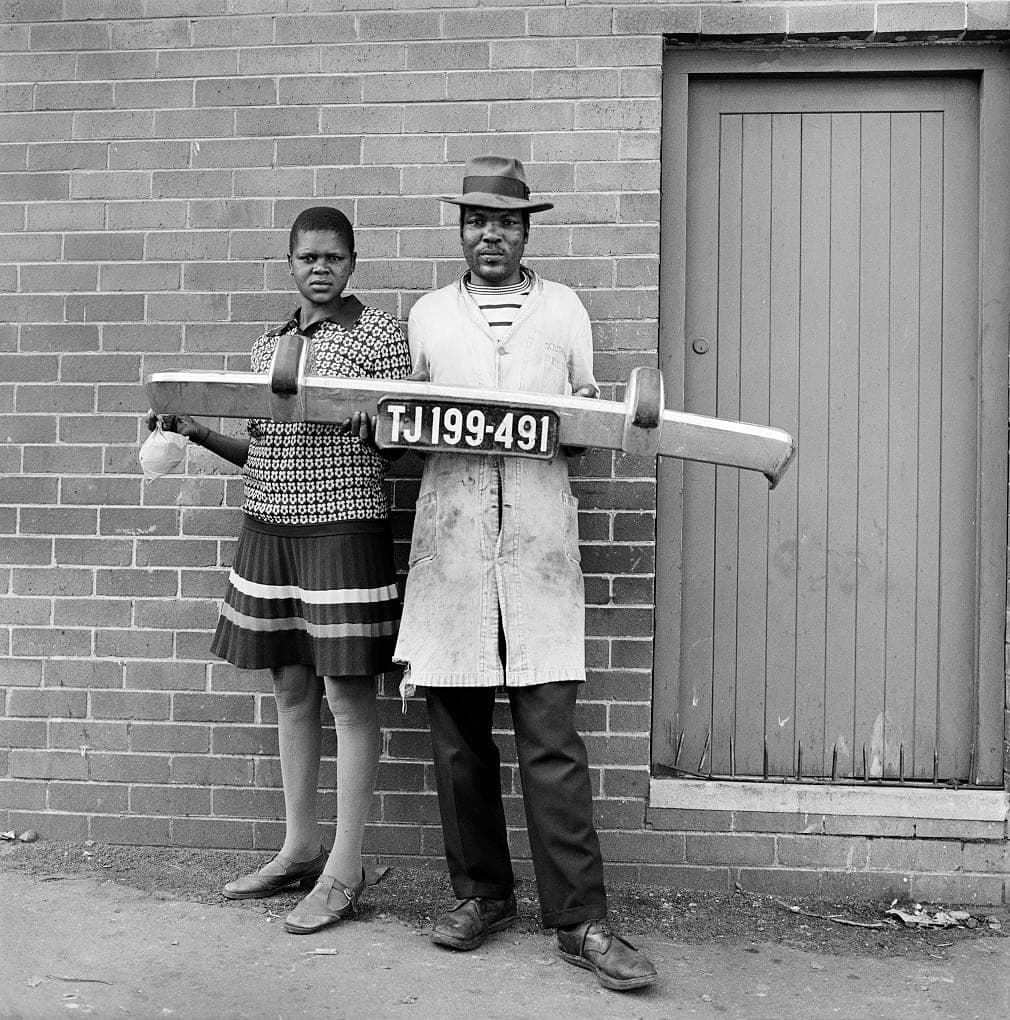
She said to him 'You be the driver and I'll be the madam,' then they picked up the fender and posed, Hillbrow. 1975 , 1975
Silver gelatin print on fibre-based paper
40 x 40cm
15.7 x 15.7 in
Edition of 8
David Goldblatt
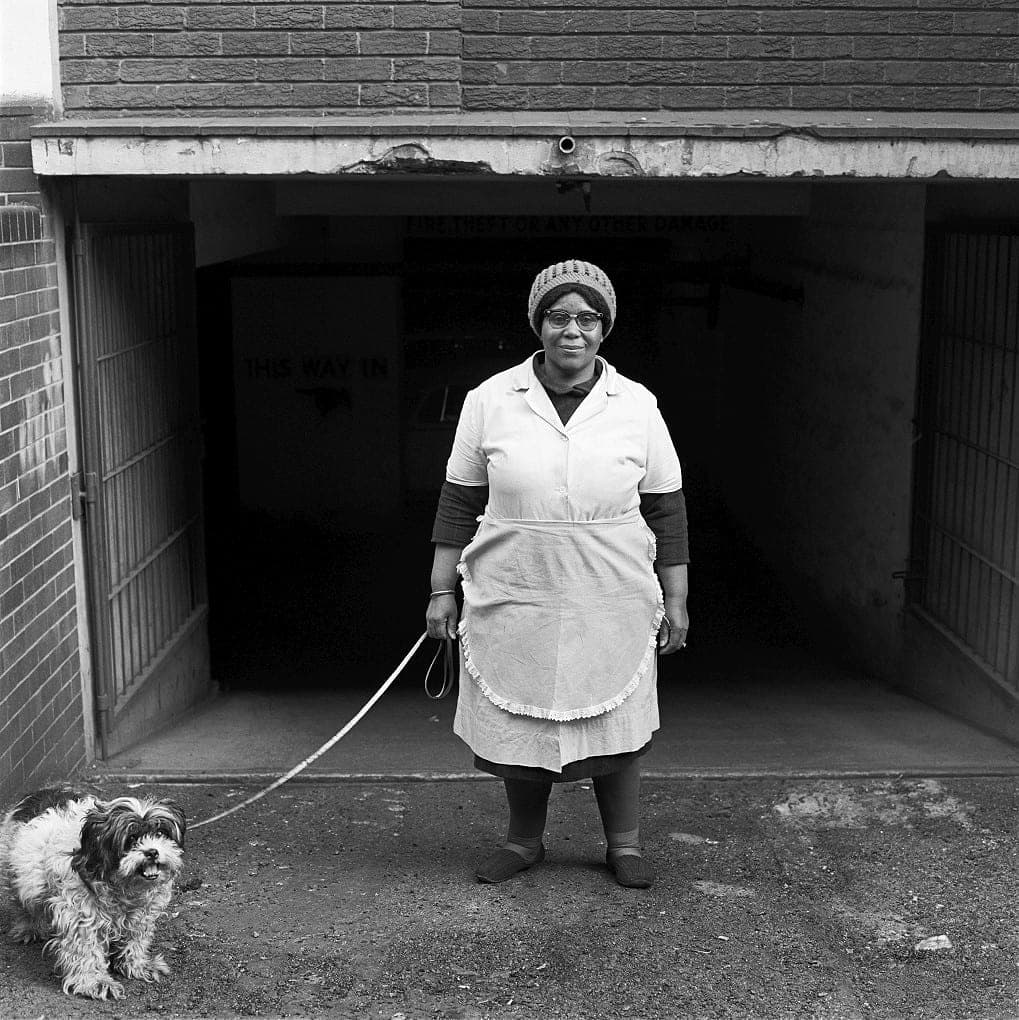
Walking the 'madam's' dog, Hillbrow , June 1972
Silver gelatin print on fibre-based paper
29.9 x 29.9 cm
11.8 x 11.8 in
Edition of 10
David Goldblatt
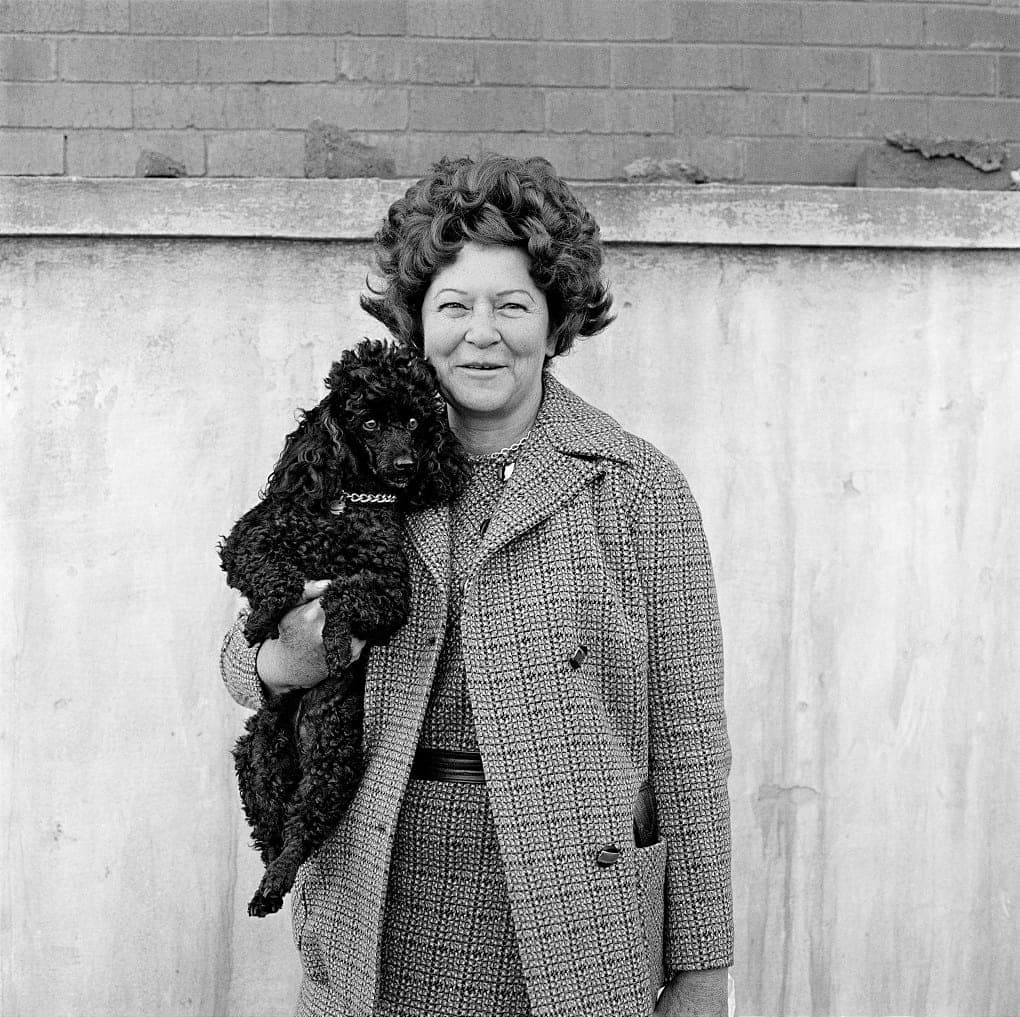
A woman and her dog, Hillbrow , 1972
Silver gelatin print on fibre-based paper, dibonded
50 x 50cm
19.7 x 19.7 in
Edition of 10
David Goldblatt
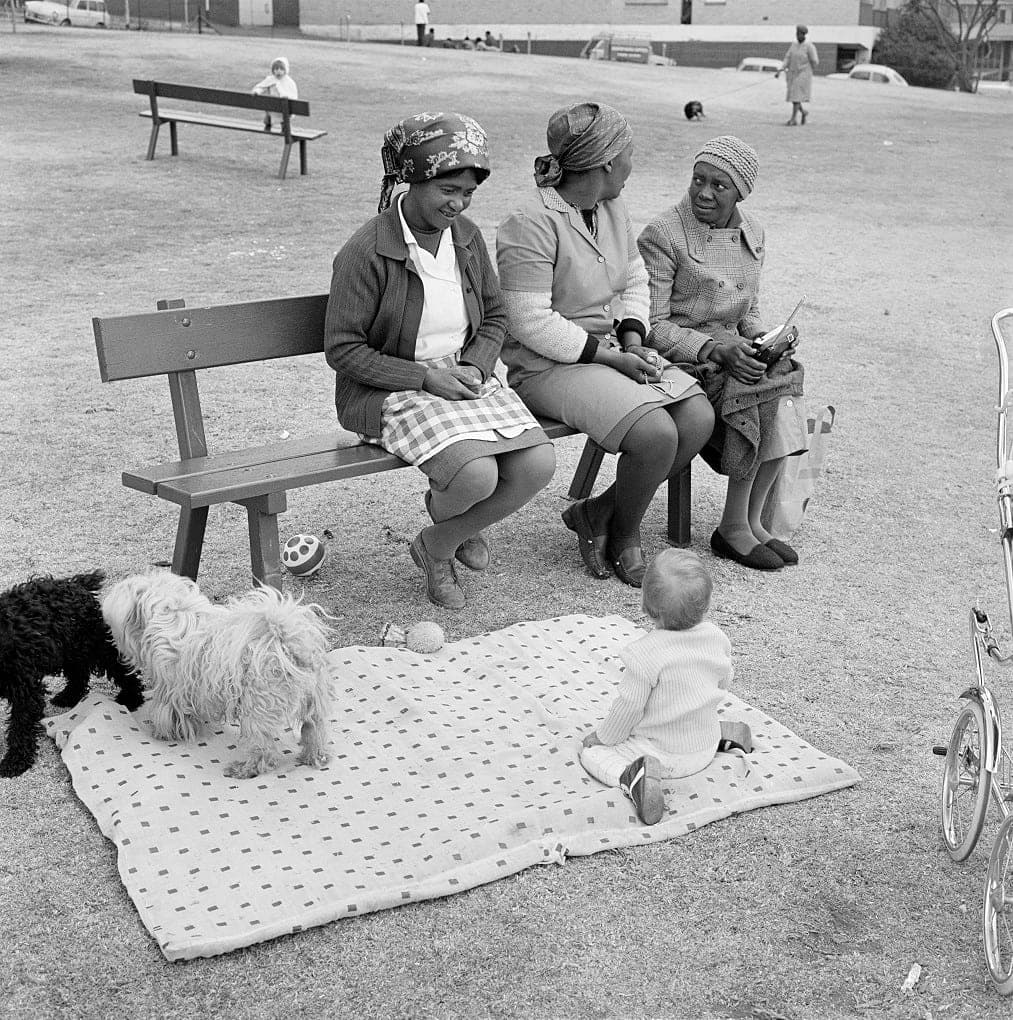
Baby with child-minders and dogs in the Alexandra Street Park, Hillbrow , 1972
Silver gelatin print on fibre-based paper
approx. 40 x 40cm
15.7 x 15.7 in
Edition of 10
David Goldblatt
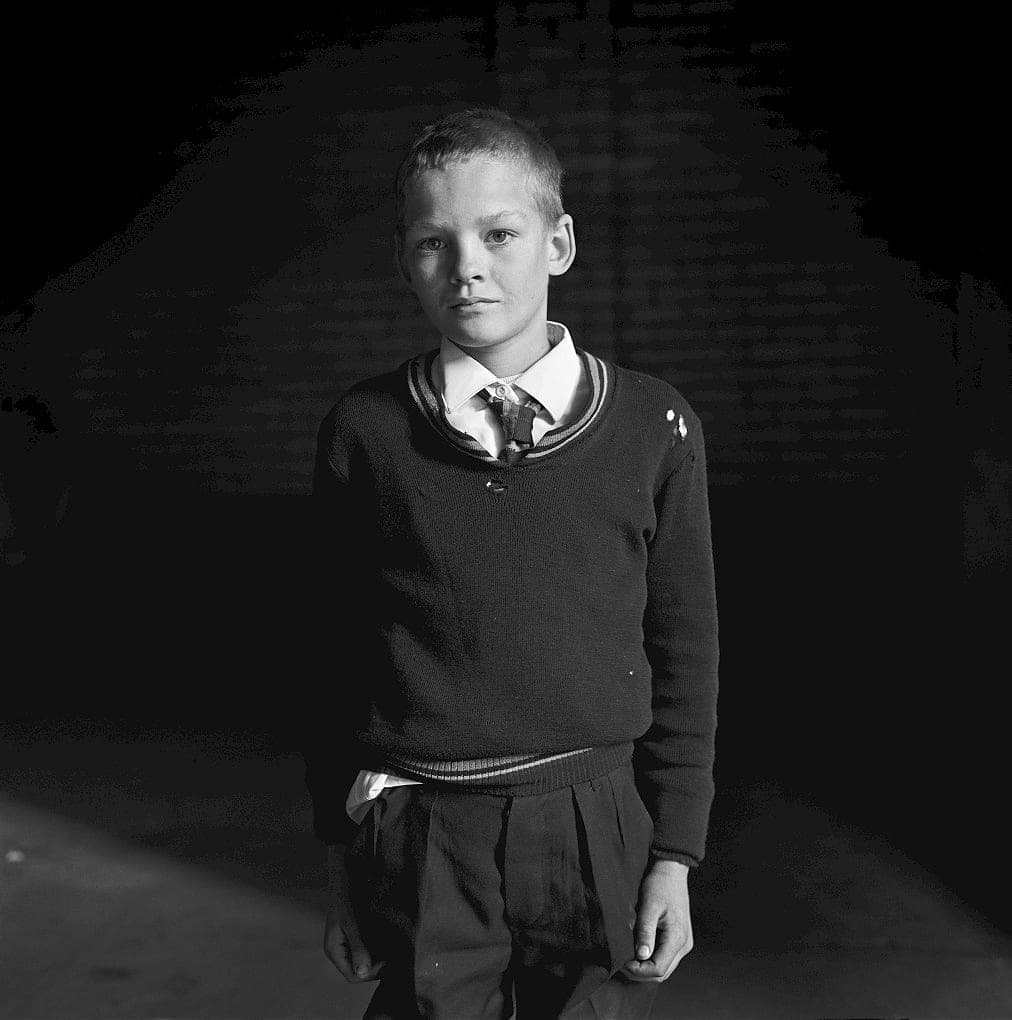
Schoolboy, Hillbrow, June 1972 , 1972
Platinum print on Arches Platine 310gm
Paper
29.5 x 22.2 in
2/4
David Goldblatt
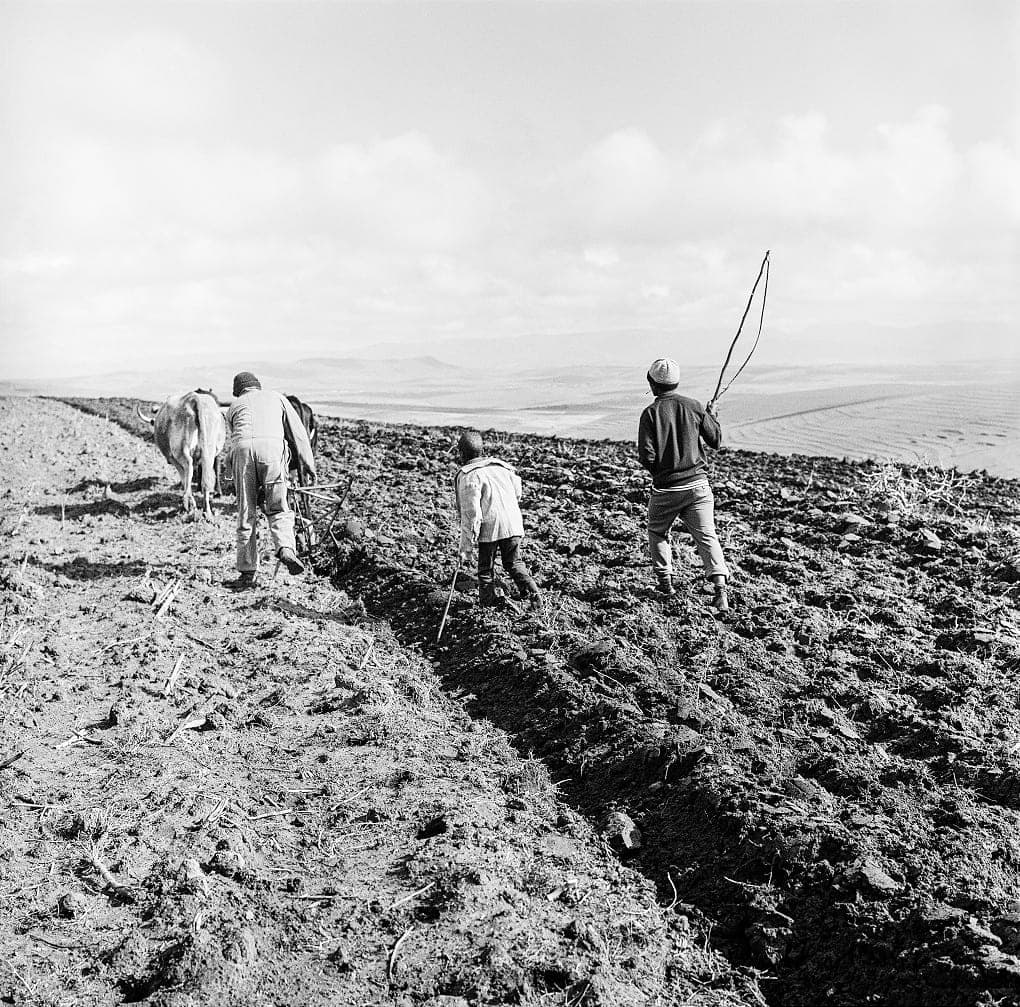
Ploughing, Transkei. 1975 , 1975
Carbon ink on Hahnemeule 315gsm
30 x 30 cm
11.8 x 11.8 in
Edition of 10
David Goldblatt
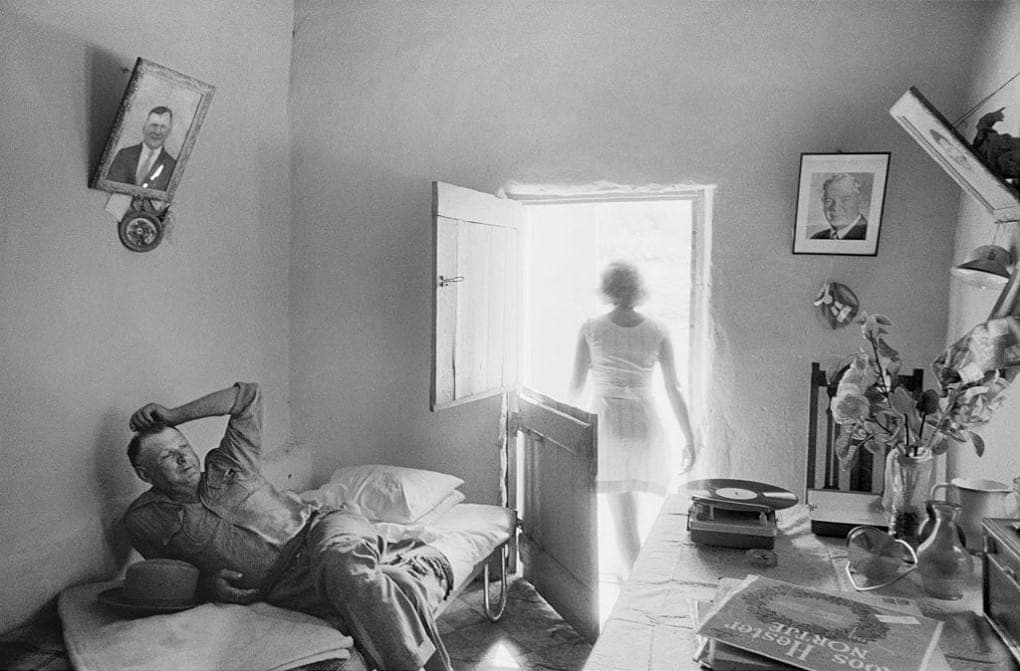
Lewies Nel in his voorkamer. On the battery-powered turntable Jeremy Taylor was singing 'Ag pleeze Deddy won't you take us to the drive-in'. Gamkaskloof, Cape Province (Western Cape) (3_C8097), 1966
Silver gelatin print on fibre-based paper
31.6 x 47.9 cm
12.4 x 18.9 in
4/10
David Goldblatt
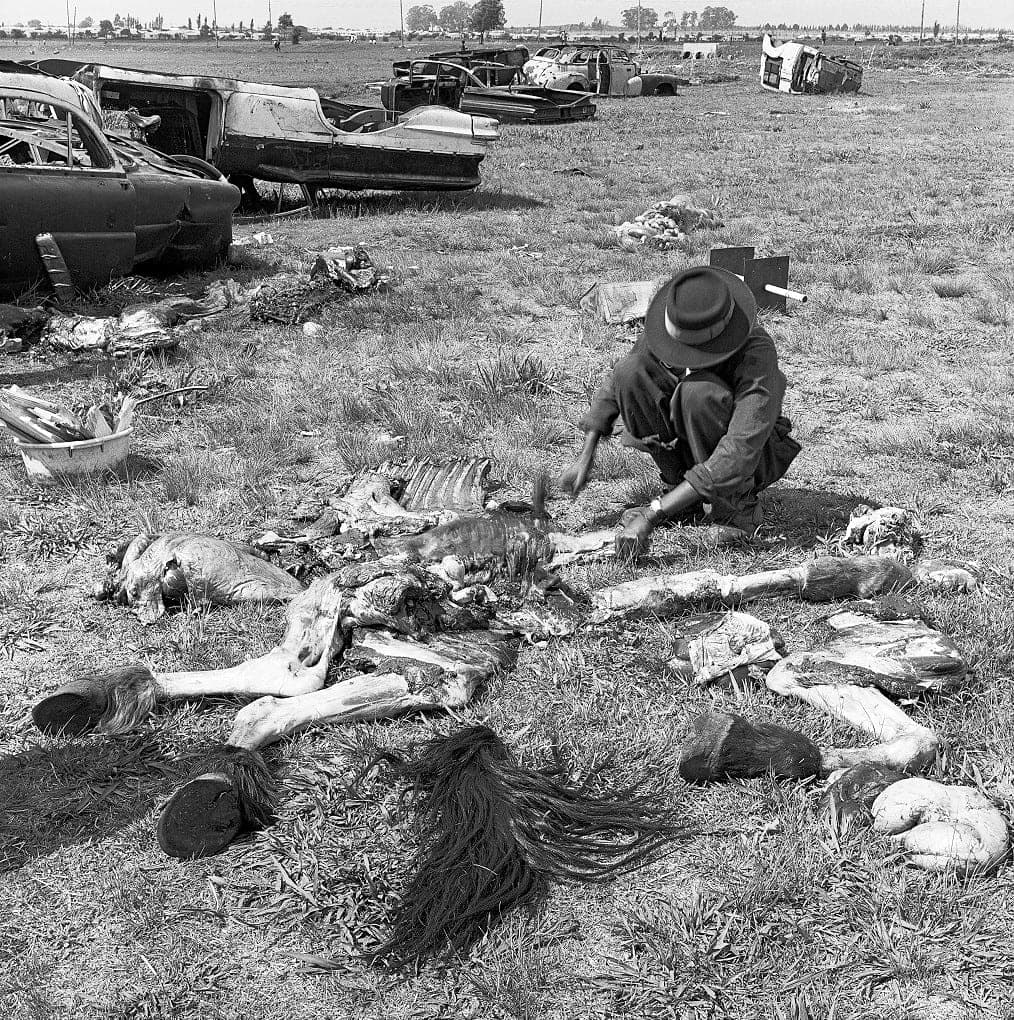
Butchering a coal merchant's horse for its meat after it had been condemned and shot by a municipal inspector, Tladi, Soweto , 1972
Silver gelatin print on fibre-based paper, dibonded
42.5 x 42.5 cm
16.7 x 16.7 in
Edition of 10
David Goldblatt
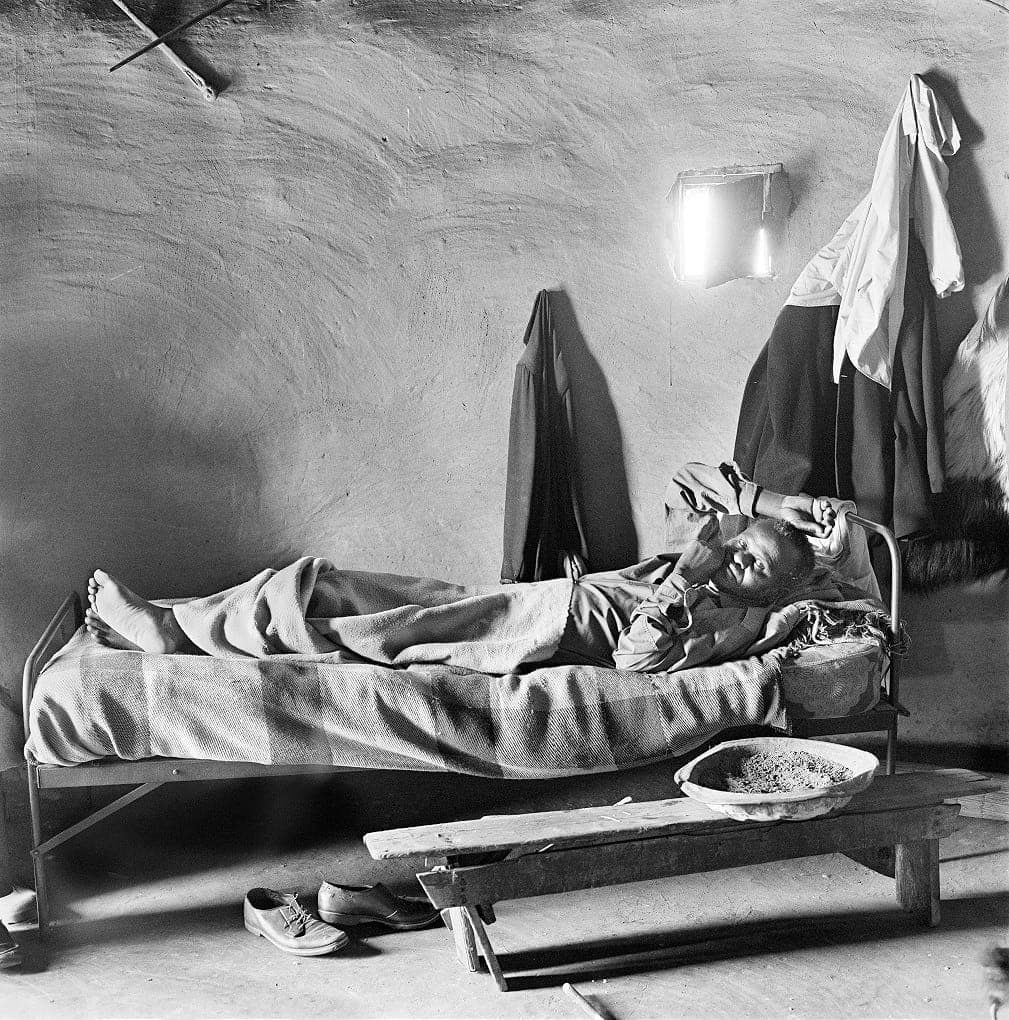
An ex-miner who coughed, Transkei , 1975
Demonstration print
A5
2 in
Edition of
David Goldblatt
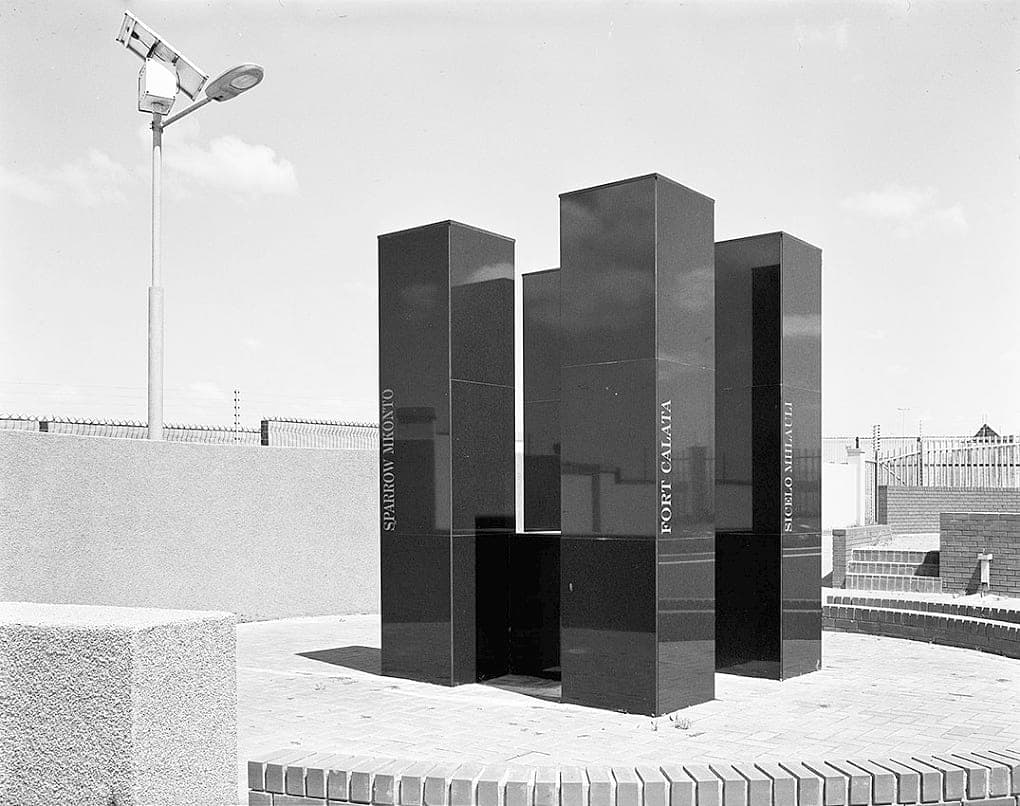
Memorial to four members of the Colesberg Youth Organisation (CYO) killed here by the police on 3 July 1985. Kuyasa Township, Colesberg. 31 March 2014 , 2014
Silver gelatin print on fibre-based paper, dibonded
A0
Edition of 10