On Practice: An Interview with Clive van den Berg
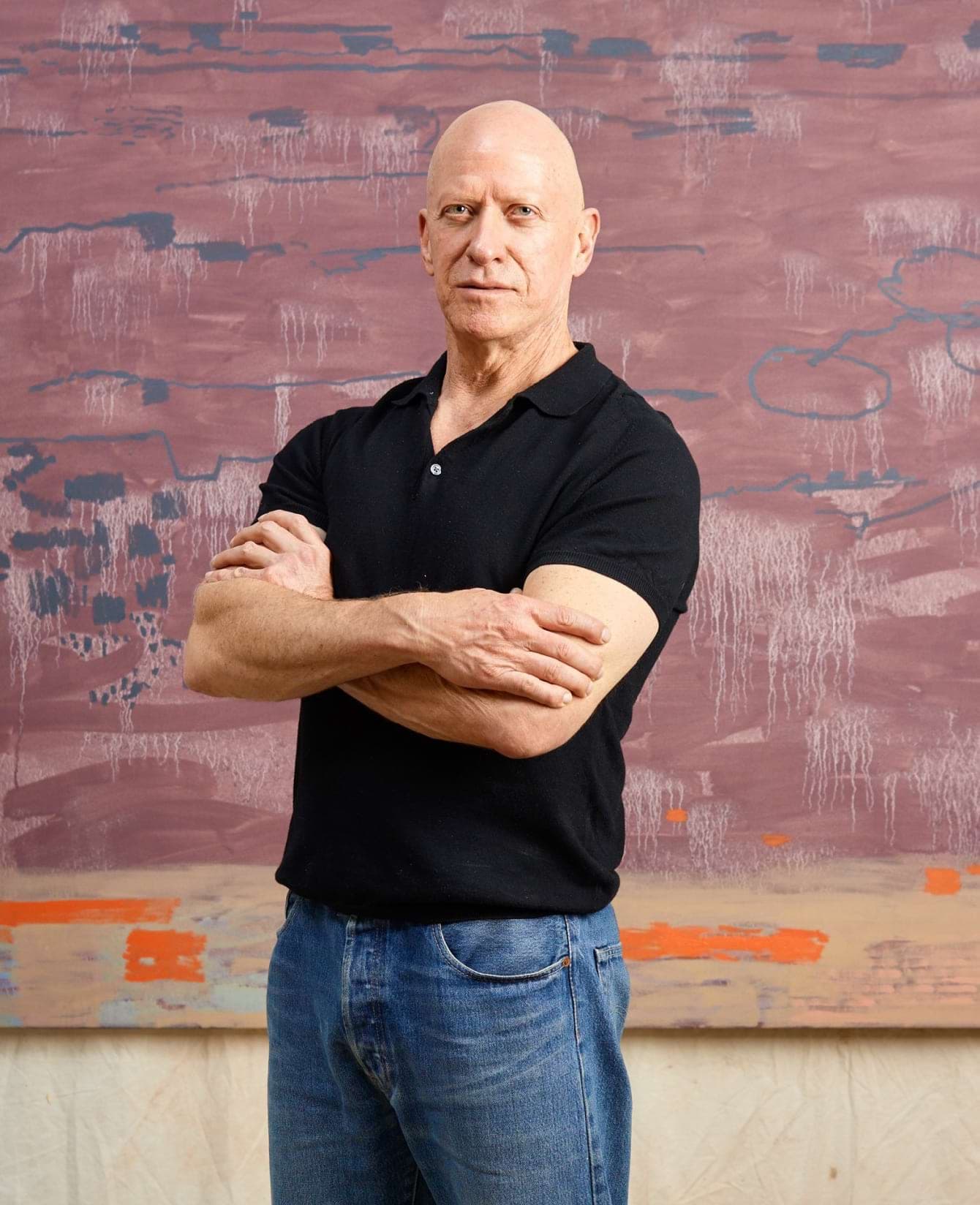
Clive van den Berg is an artist whose work spans a variety of media, primarily exploring memory, landscape, and the intersection of personal and collective histories. Born in Luanshya, a town in Zambia along the mineral-rich Copperbelt, van den Berg often recalls the vibrant red soil of his childhood, a red that remains ever-present in his large-scale oil paintings. Growing up in a mining town, and later moving to Johannesburg, a city shaped by the discovery of gold, he was compelled to reflect on the history of excavation and the worlds that exist above and below ground.
Now based in Cape Town, we caught up with the artist as he reflects on his painting practice and his recent exhibition “Remnant” at Oude Leeskamer in Stellenbosch. He speaks to the ways in which traces of the past persist in the present, informing both image and meaning.
GG Your previous studio was in your Johannesburg home. You moved to Cape Town about 2 years ago. Tell us about your new studio space and how it is a reflection of your creative process?
CVDB My Cape Town studio is in an industrial building that houses other studios and manufacturing businesses. It is larger than my Johannesburg space and noisier. I hear the woodworkers upstairs and the bamboo furniture makers next door and deliveries happen all day. I thought the constant activity both aural and kinetic would be distracting, but I have come to love it. The space is large enough for me to work on several paintings at once and there is a section for sculpture. Getting to work every day is a short drive during which I see the great bulk of the mountain and views of its flanking peaks. Woodstock, where it is situated is notoriously windy so I feel an acute consciousness of my body as it is buffeted, assaulted by cold rain, and on a few days of the year lulled into beneficence in this most beautiful of cities.


GG How would you describe the evolution of your relationship to paint throughout your career?
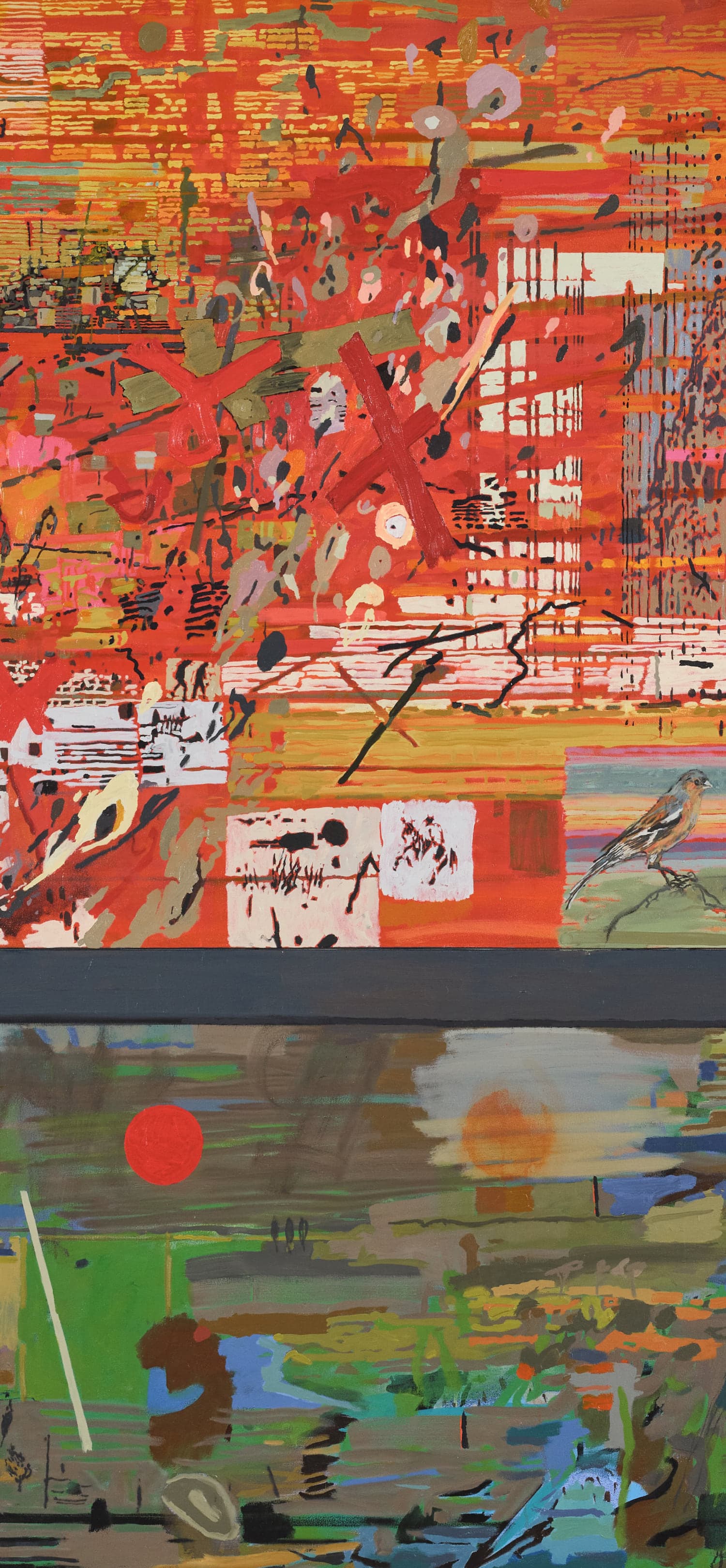
CVDB I have done large bodies of work in acrylic and pastel but now mostly work in oil paint. I revel in it. What makes painting so endlessly interesting and challenging to me is its discursive capacity. Different parts of the same composition can reference widely different sources, with varying calls to cognition; ranging from figuration to mapping, surveillance technology, ground penetrating radar, press reportage all mixed with marks blown from their reference, a disrupted syntax. Paint itself varies so much in its substance, at times seeping deeply into the weave of the canvas, at times heavy upon the thread and then again marshalled to description.
GG Your more recent work offers a more gestural and intuitive application of paint. How does this allow the paint to suggest the direction for the visual composition and emotive complexity of the work?
CVDB The paintings are begun with a provocation - a flood of colour, a division of the canvas using line, a representational gesture, or left over paint at the end of a day. I don’t give conscious thought to these provocations to self. As I finish a painting I move on to one of these canvasses and respond to what I have put down. At some point in this deliberately fluid process, I refer to my drawings.
I draw constantly, usually in sketch books. These drawings have several functions. Some are made to add to the archive of prohibited images, usually concerning the body, others are responses to something seen, often bits of landscape and others are structural speculations where I combine disparate images into a conversation. These sketches seldom initiate a painting but they are used to varying degrees in the process of making a painting. This palimpsest of marks and images is the content of the work. The shift of registers from line drawing to paint stain or brush mark, from representation to gesture is in constant negotiation and it is this process of negotiation that makes the final work.
GG Exploring what lies beneath the surface and the residue of history on the landscape are key ongoing thematic explorations for you, referring specifically to the idea of ‘fugitive marks’. Could you unpack these ideas and their significance for you.

CVDB A swelling of earth, a post, a gate or wall, a hollow or dispersed pile of stones that once marked a grave or embattlement, are the grammar of my landscape vocabulary. These vestigial mutterings of geography are the prompts that I respond to in making my work, a kind of interstitial speech, connecting the remnant to its repressed or forgotten source. Landscapes are constructed - by hunters and farmers, by archaeologists and animals, by engineers, by soldiers and surveyors, by miners, by herders, by refugees, by poets and musicians, and of course by artists, all of whom contribute languages for the understanding and usage of land. Our landscape is haunted by the efforts of these people. I respond to the traces that remain, a shaped stone, a painting, a diary entry, a tree marking a place, a trench, shaft or song. In responding to these persistent nags from the past, I am not attempting to reconcile them, rather to find an aesthetic figuring of their coexistence with the present.
GG Your latest exhibition “Remnant” at Oude Leeskamer in Stellenbosch, South Africa, is a survey of new and recent paintings, bringing together your reflections on land, landscape and memory. The exhibition text states that in these works “landscape becomes both a site and a process, a mutable field in which meaning is continuously negotiated rather than resolved.” Could you share more about that?
CVDB The painting is its own site. It is layered with markings, drawings, visual propositions, bits of naturalism, horizons, a ‘view’ or prospect, a fence post or border, a trench, references to the underground and figurative suggestions. The relationship between these disparate elements is a volatile negotiation articulated with paint, soaked, dribbled, drawn and erased, then redrawn and repainted in layers until the particularities of that site or painting find a truce.
GG How did it feel creating new work for this show following your 2024/5 retrospective ‘Porous’ at the Wits Art Museum in Johannesburg? What felt renewed, solidified or reimagined in thinking about the work for “Remnant”?
CVDB My two central subjects, land and love, developed over decades remain. The former tends to be explored in painting and the latter in sculpture. My visual language owes much to Renaissance art. I am fascinated by one of the illusions of that illusionistic language, the sense that bodily beauty, a beauty of surface and perhaps can stave off confronting the complexity and frailty of the interior body. It is that relationship, between the grace of exterior beauty and the visual languages developed for its expression, versus the linguistically less explored interior, that compels me.
My explorations of love between men were motivated by a need to make images or objects where few existed, where the archive had been distorted by prejudice compounded by the effects of a virus. These concerns remain and find new expression in sculpture and drawing and an ongoing series of watercolours titled “An Erotic History”. My paintings are changing in form, in large part responding to a landscape at the edge of the continent with a very different history, climate and ecology to that of Johannesburg. Underground has to some degree been augmented by a consciousness of precarity, borders and air as realms of exploration.