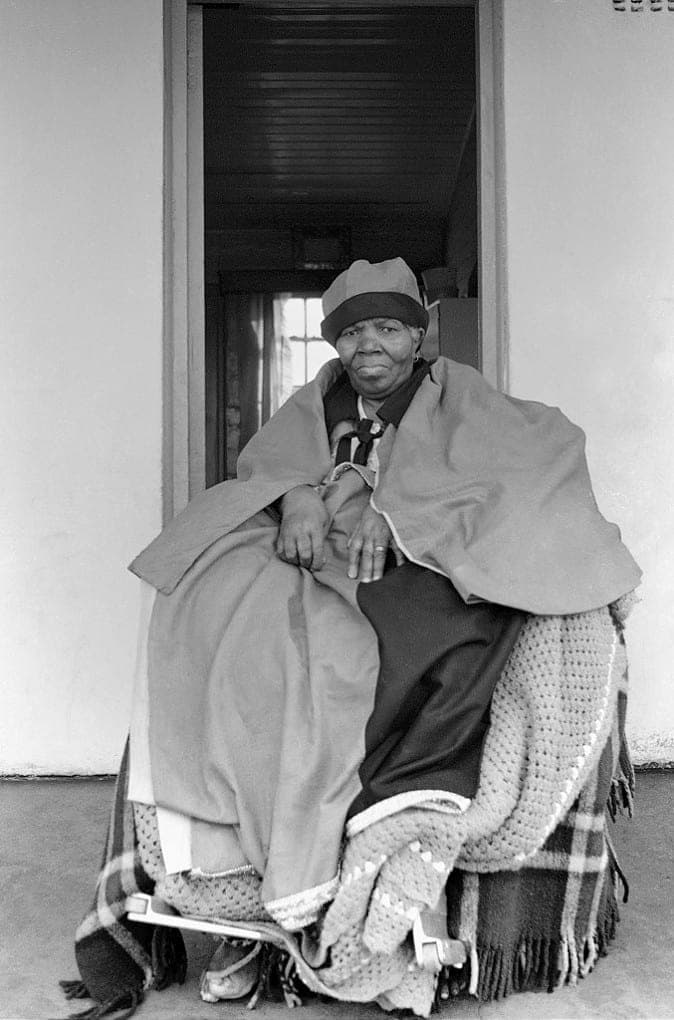
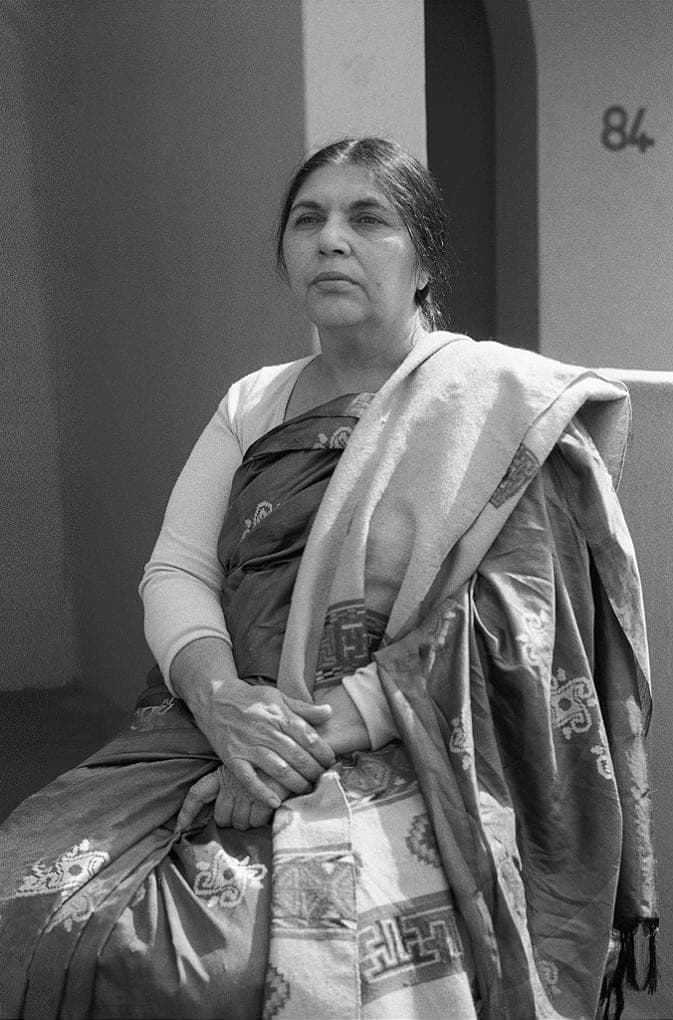
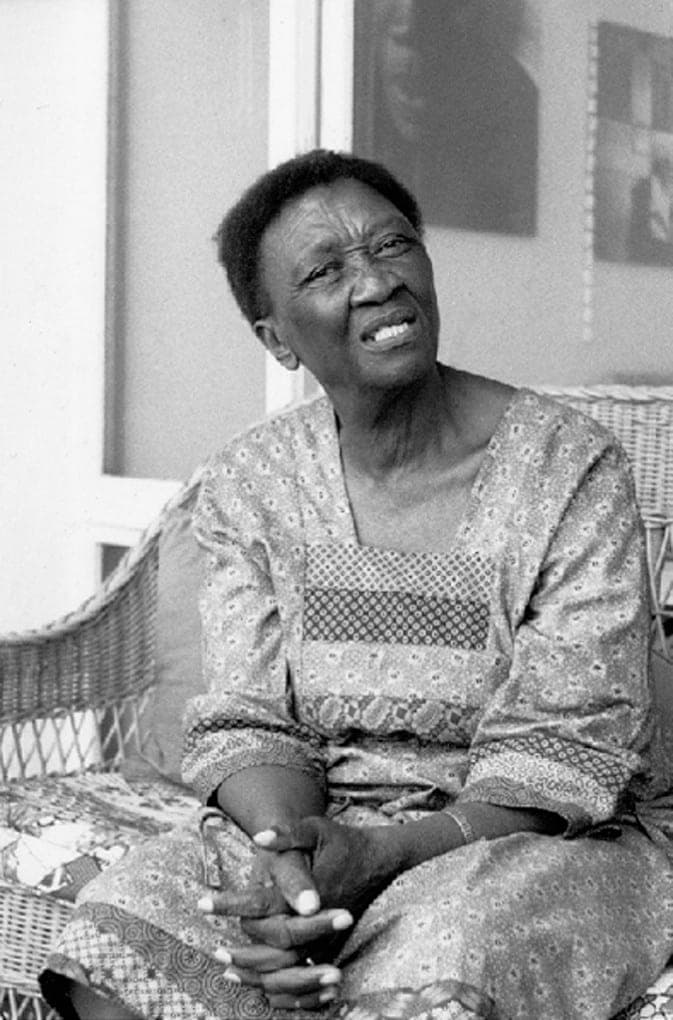
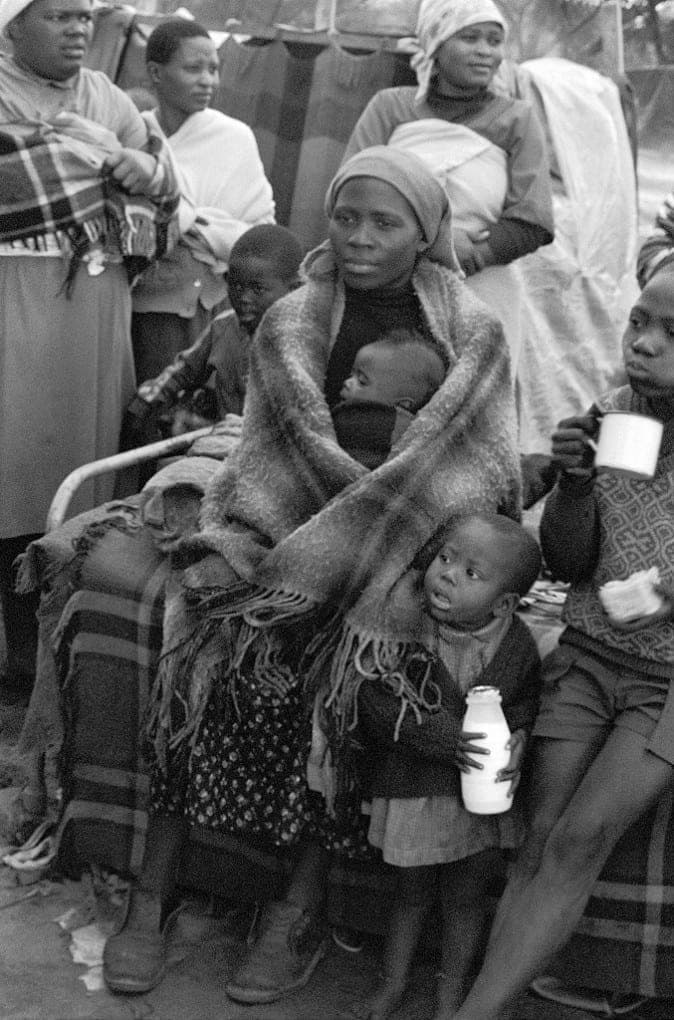
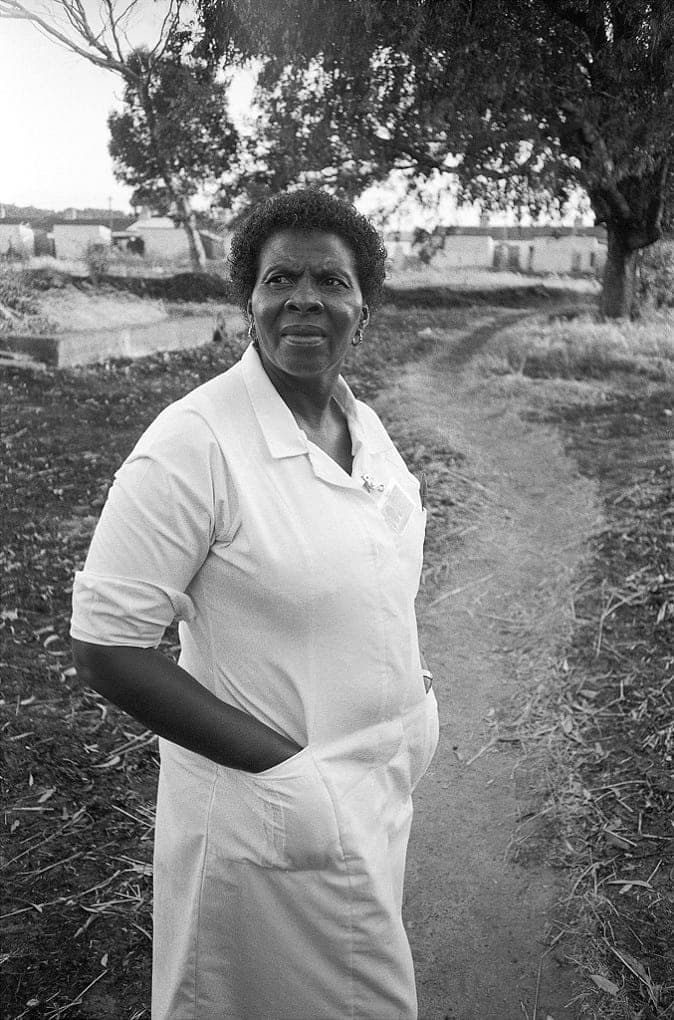
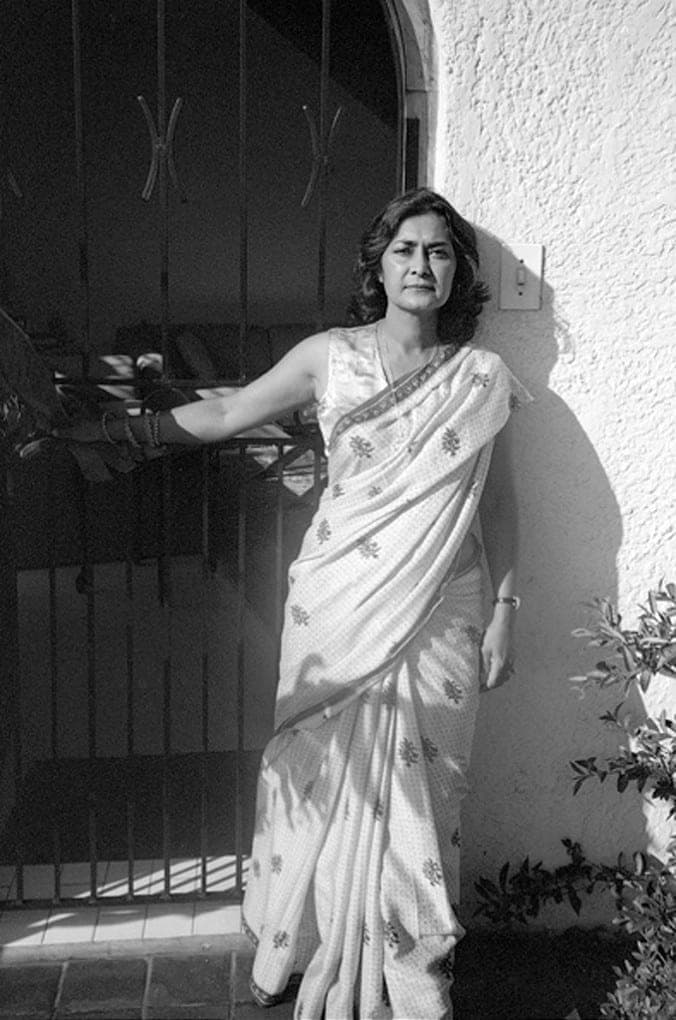
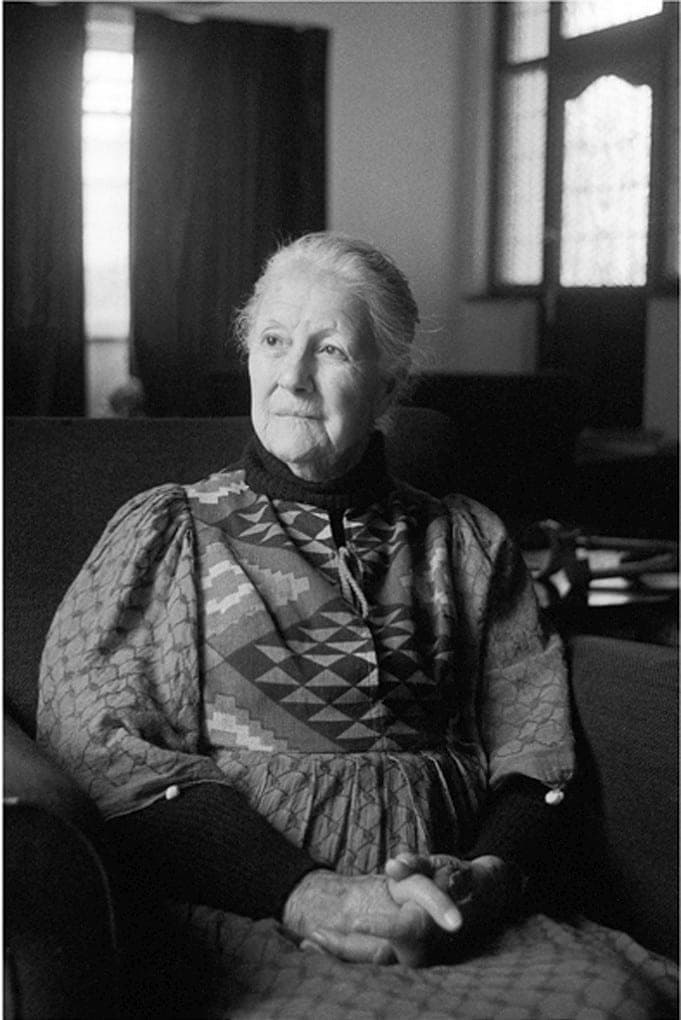

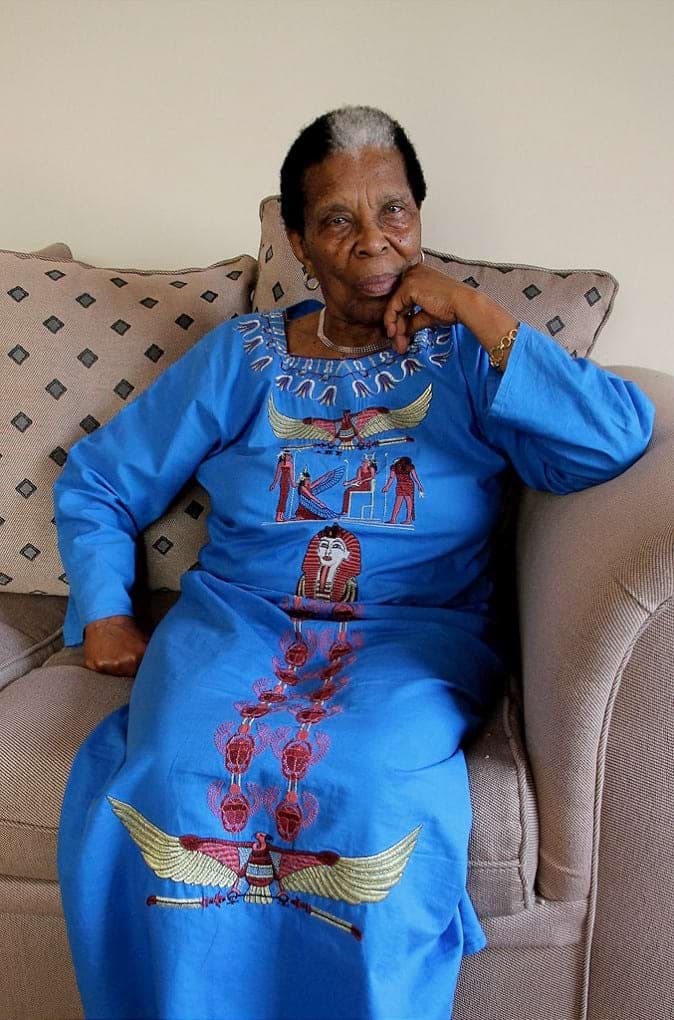
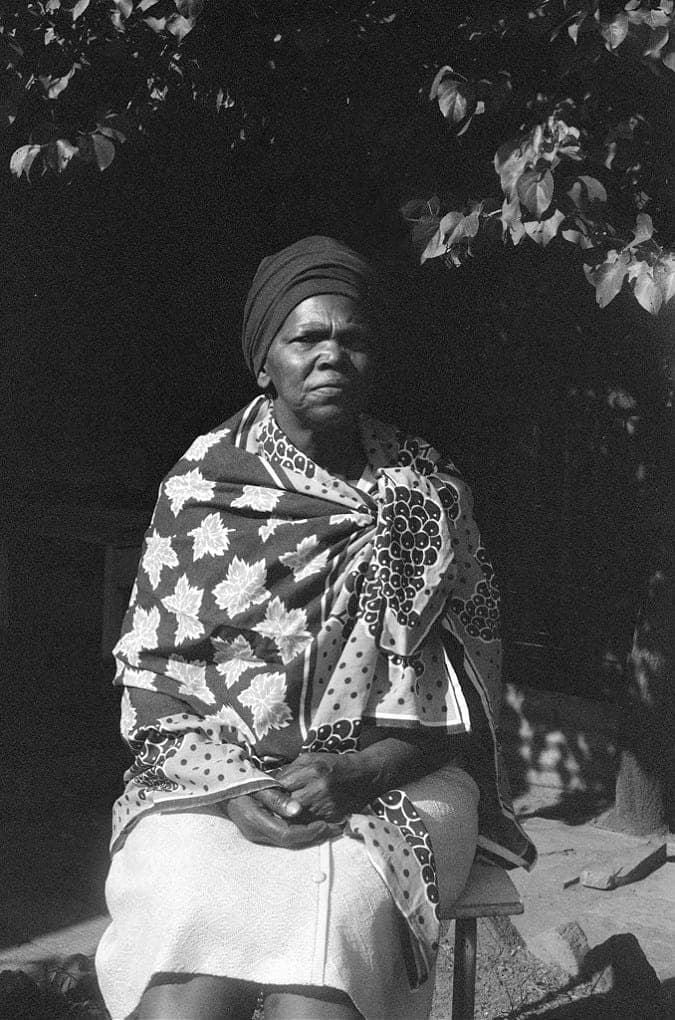
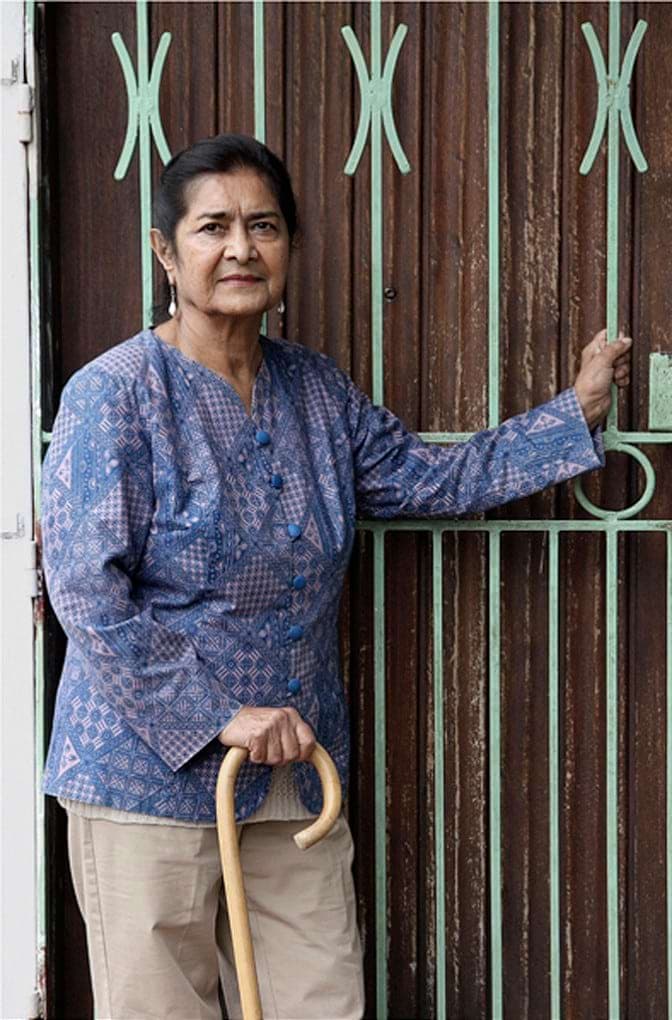
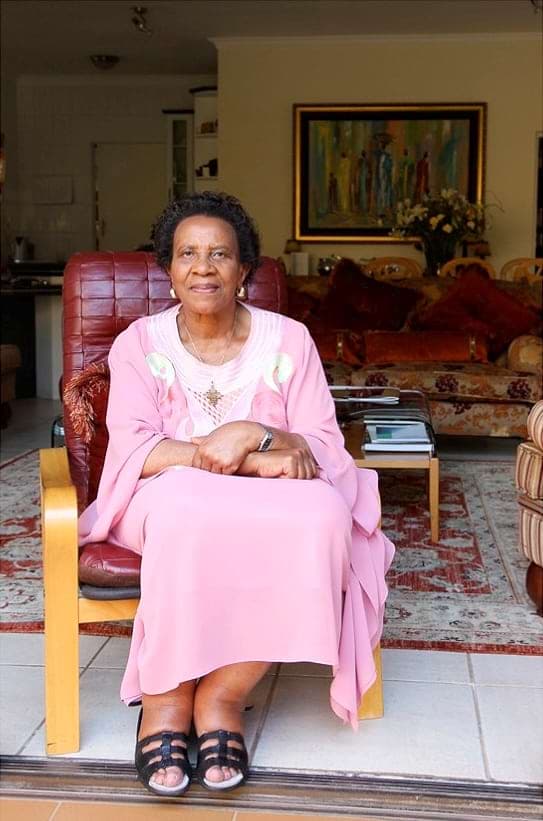
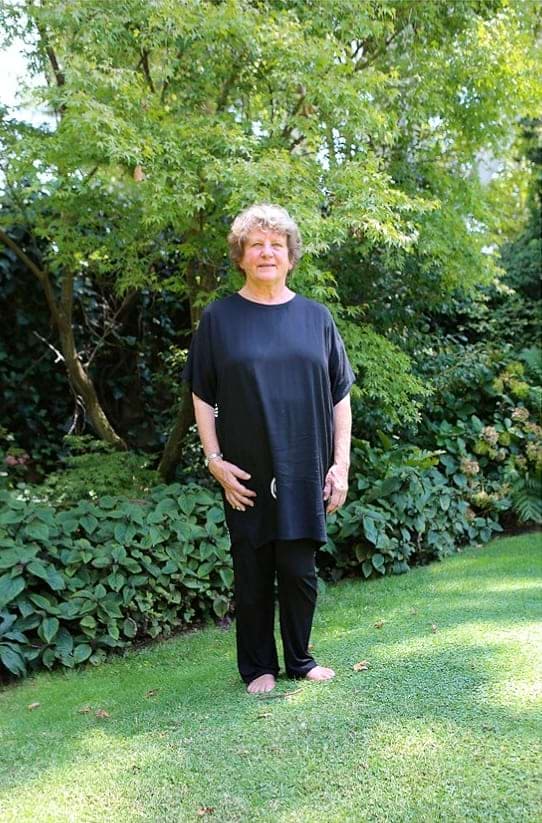
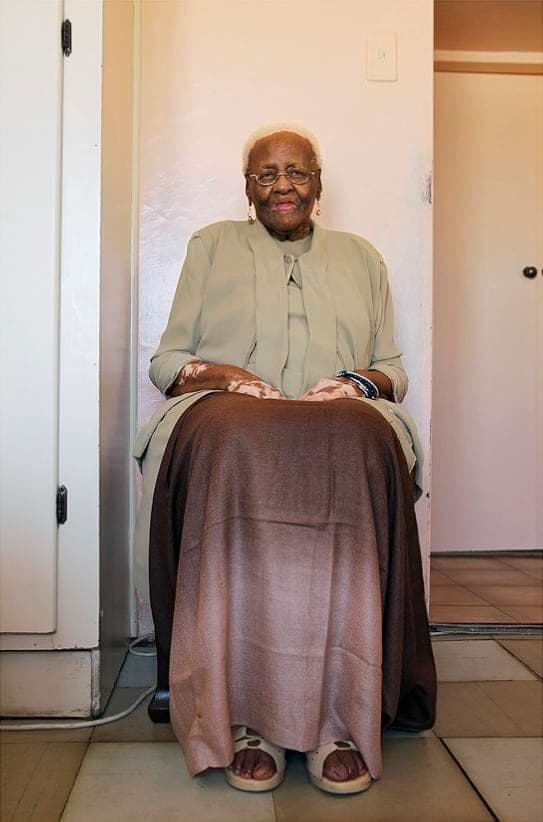
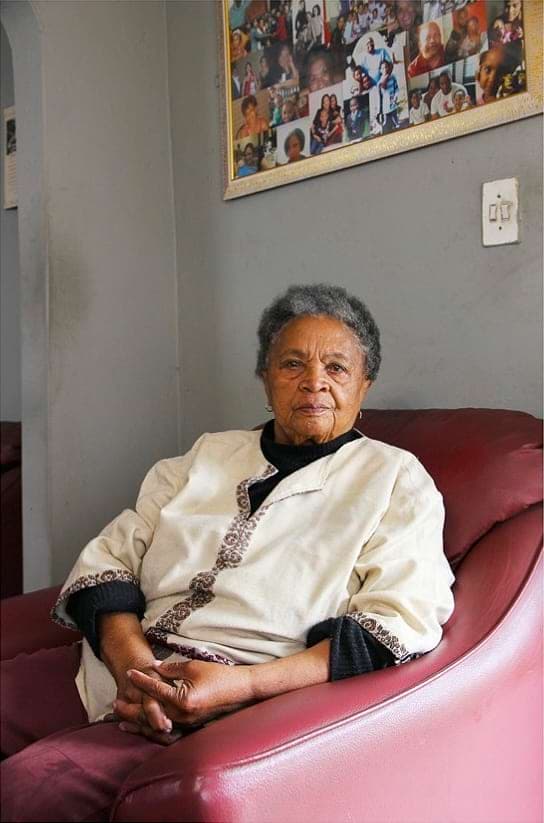
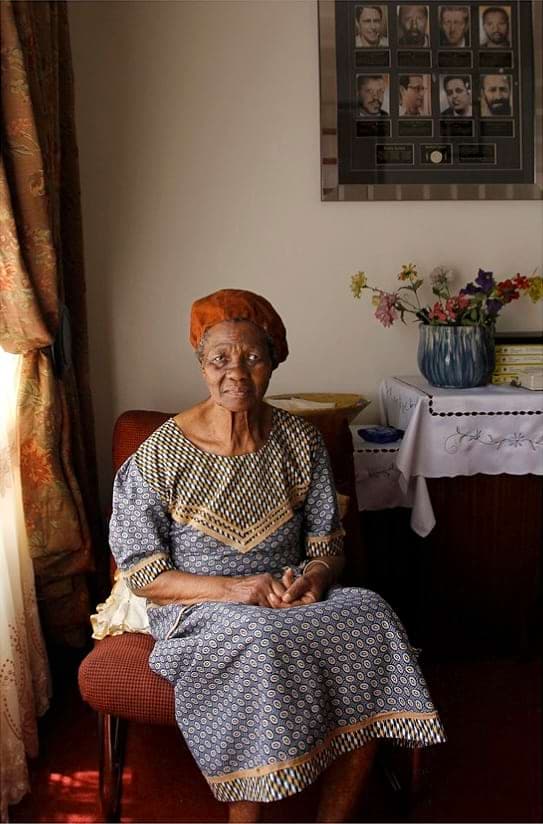
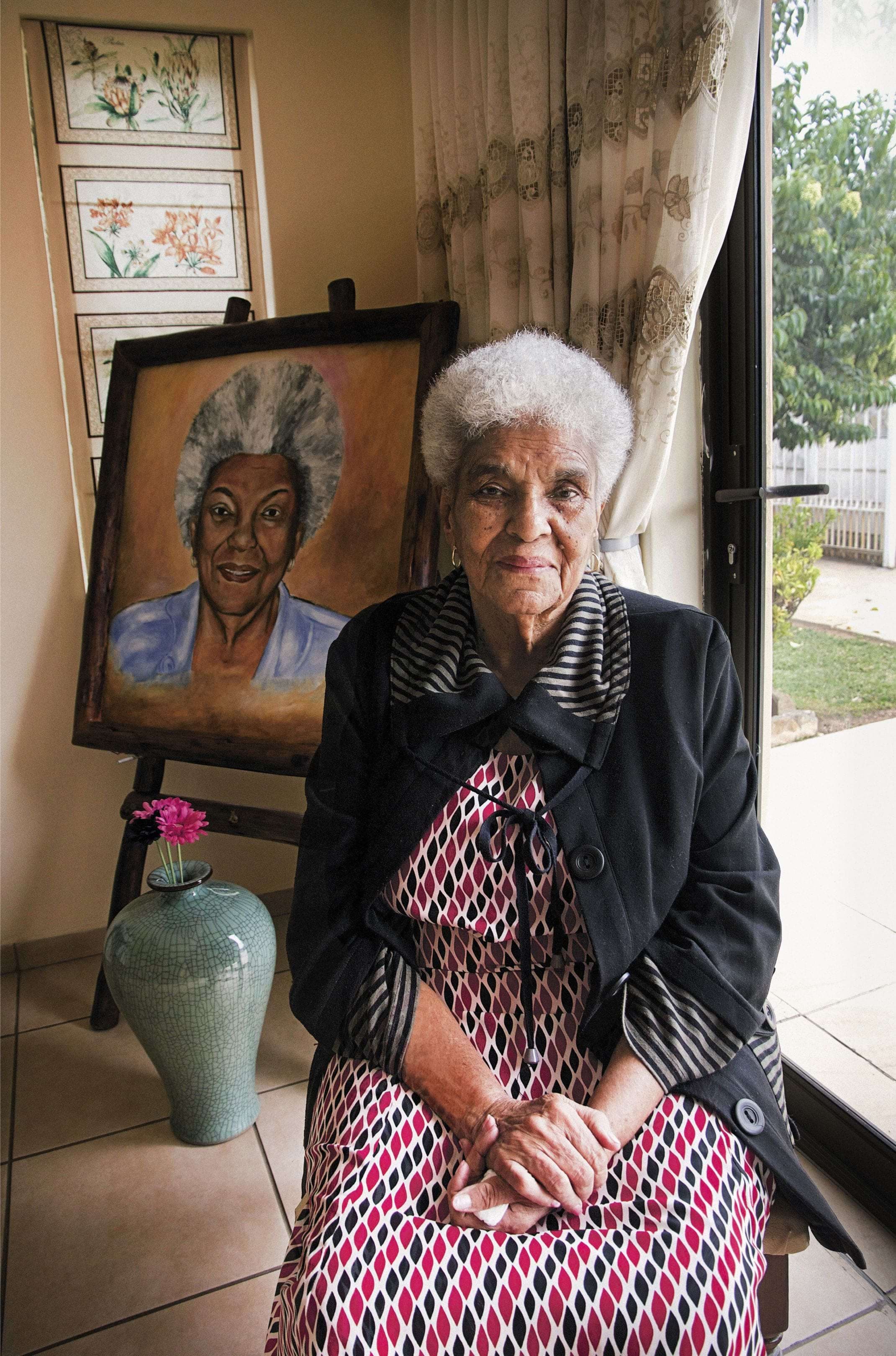
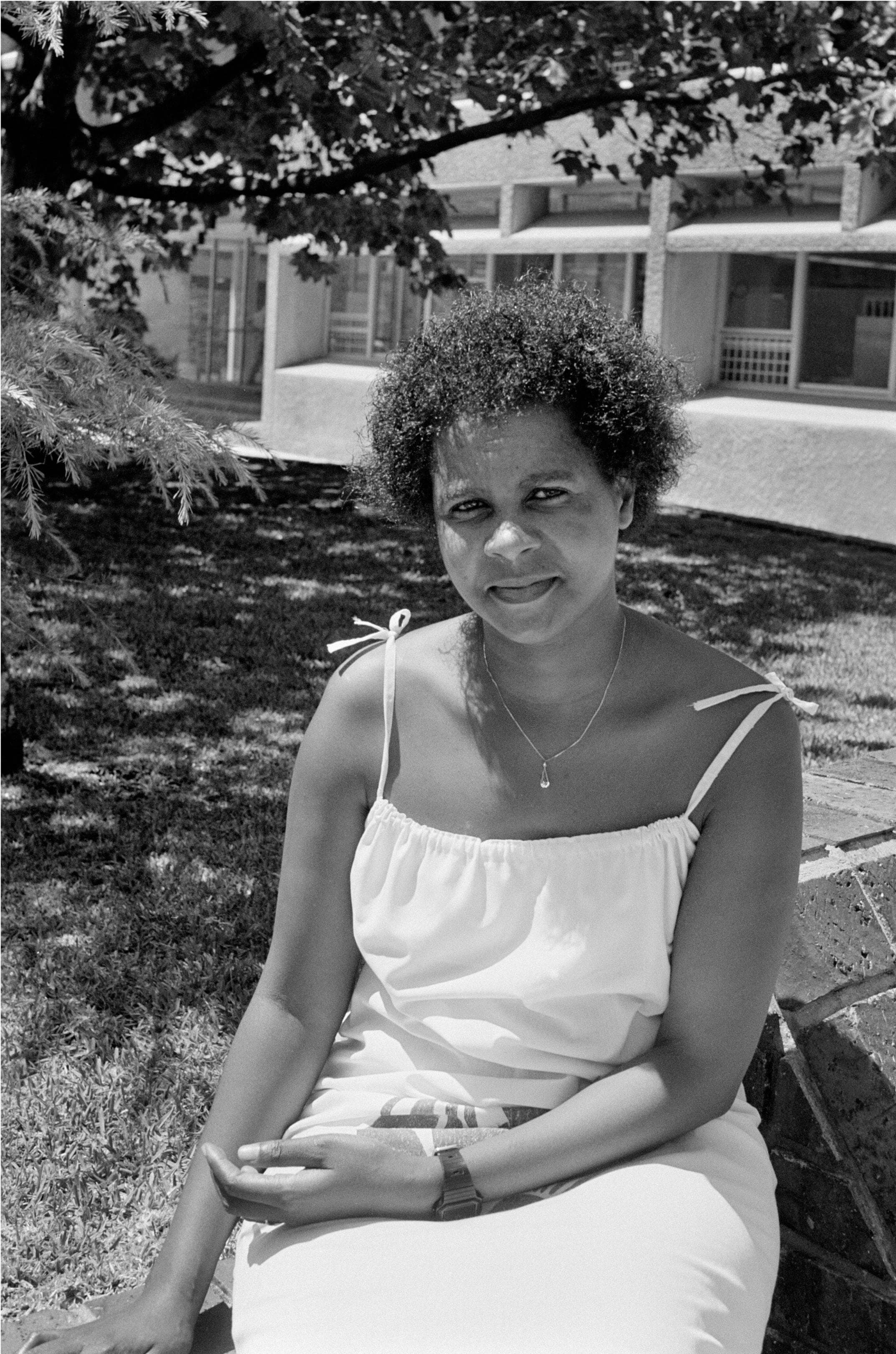
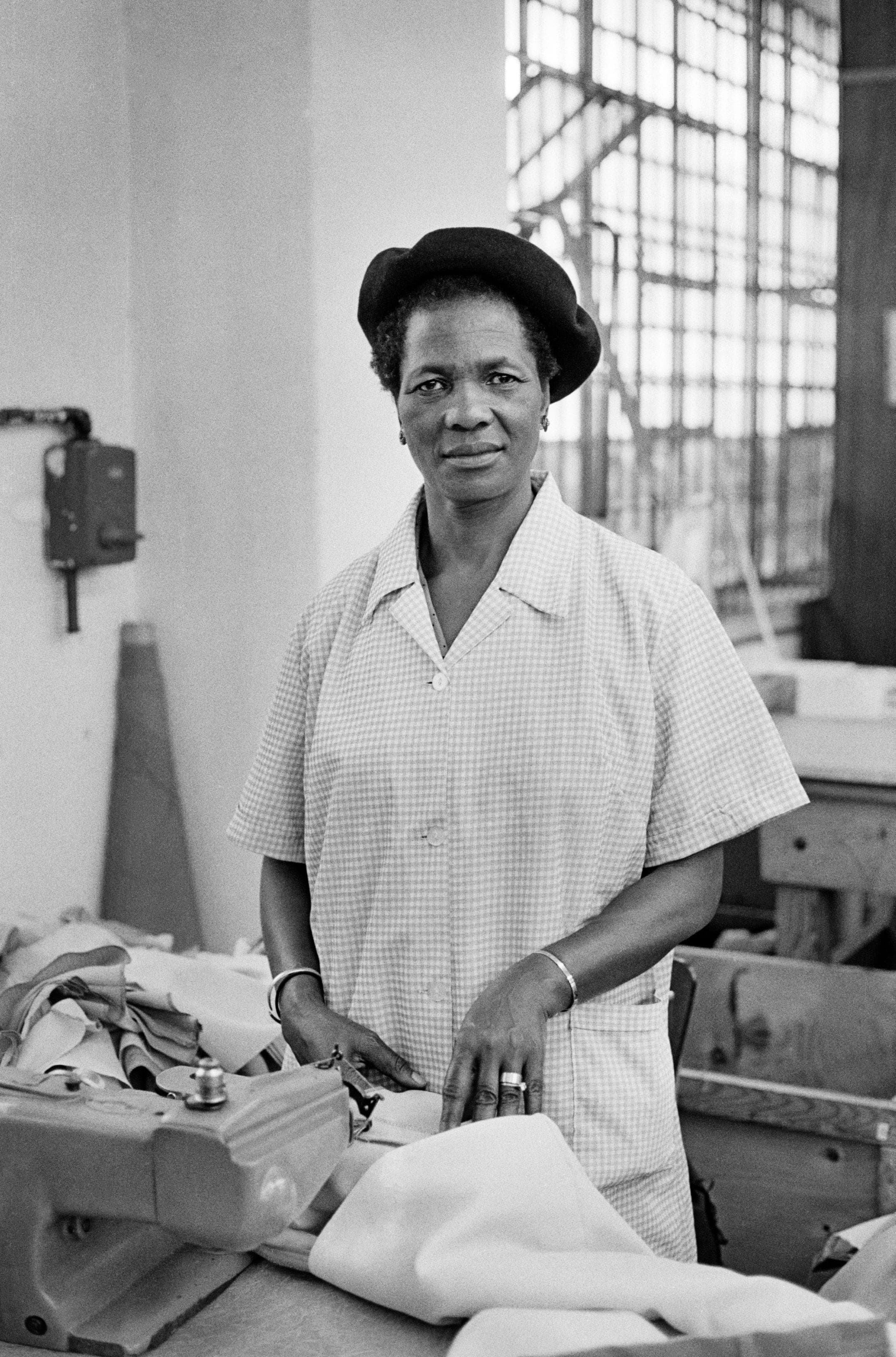
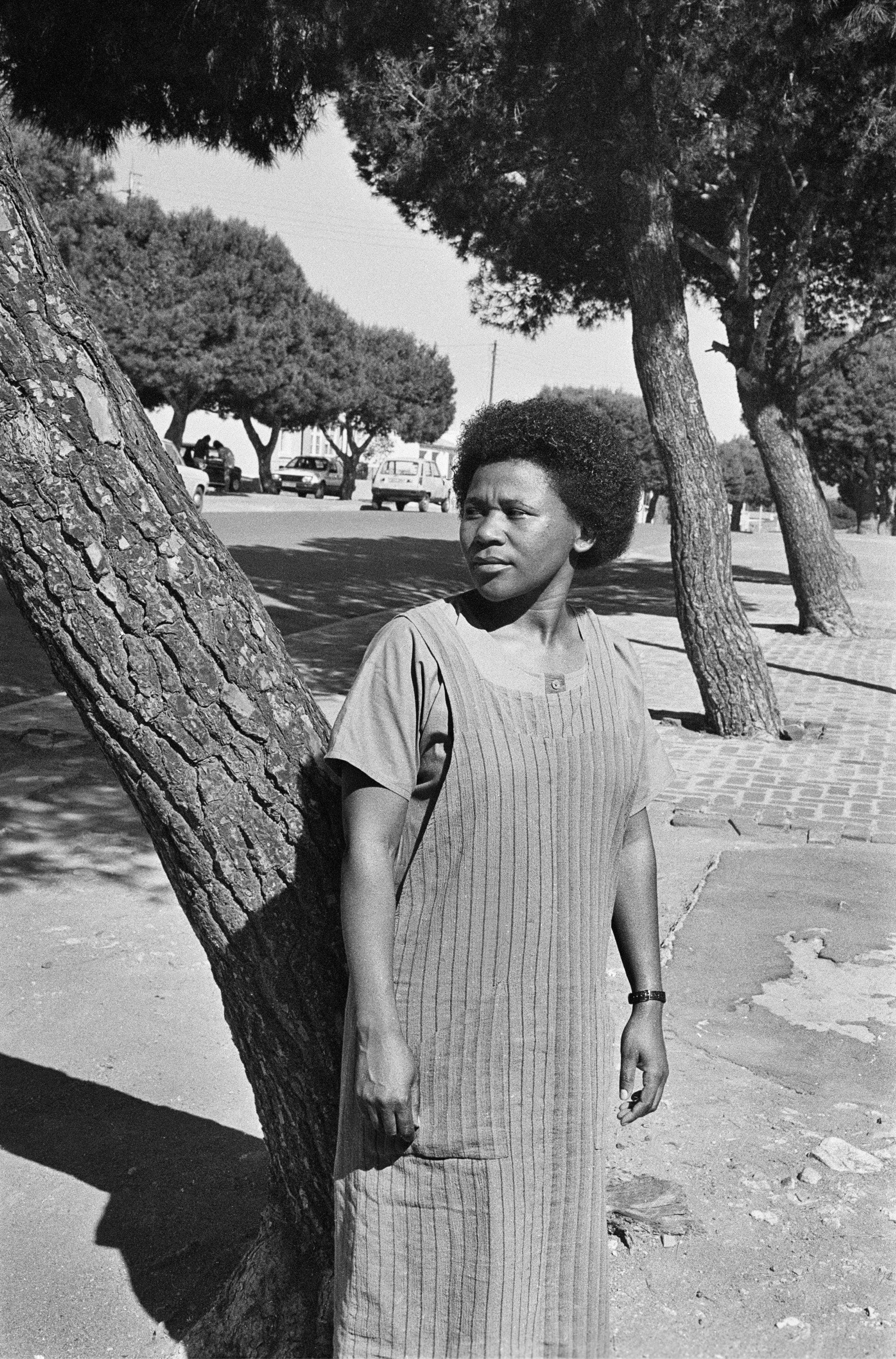
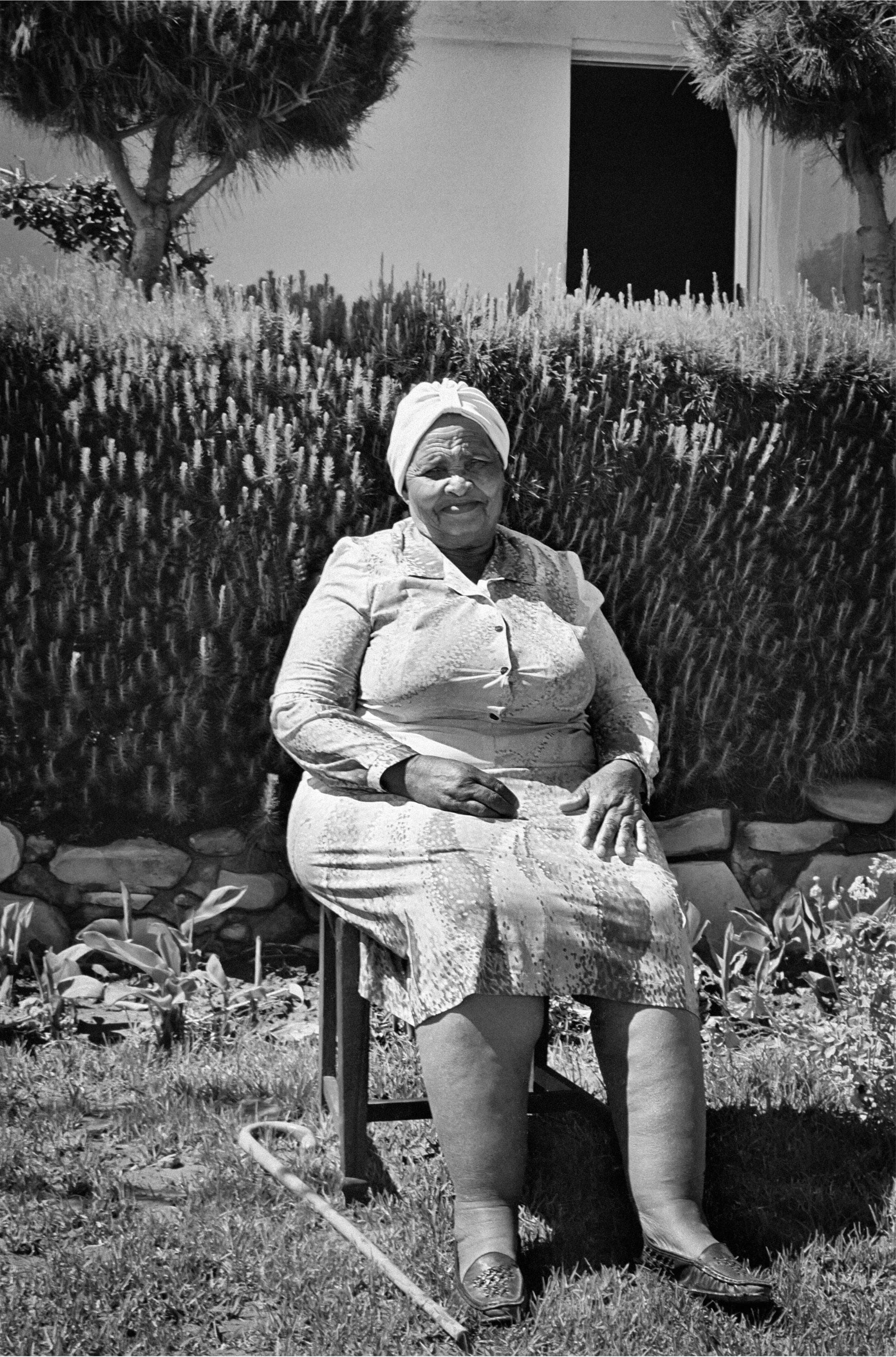
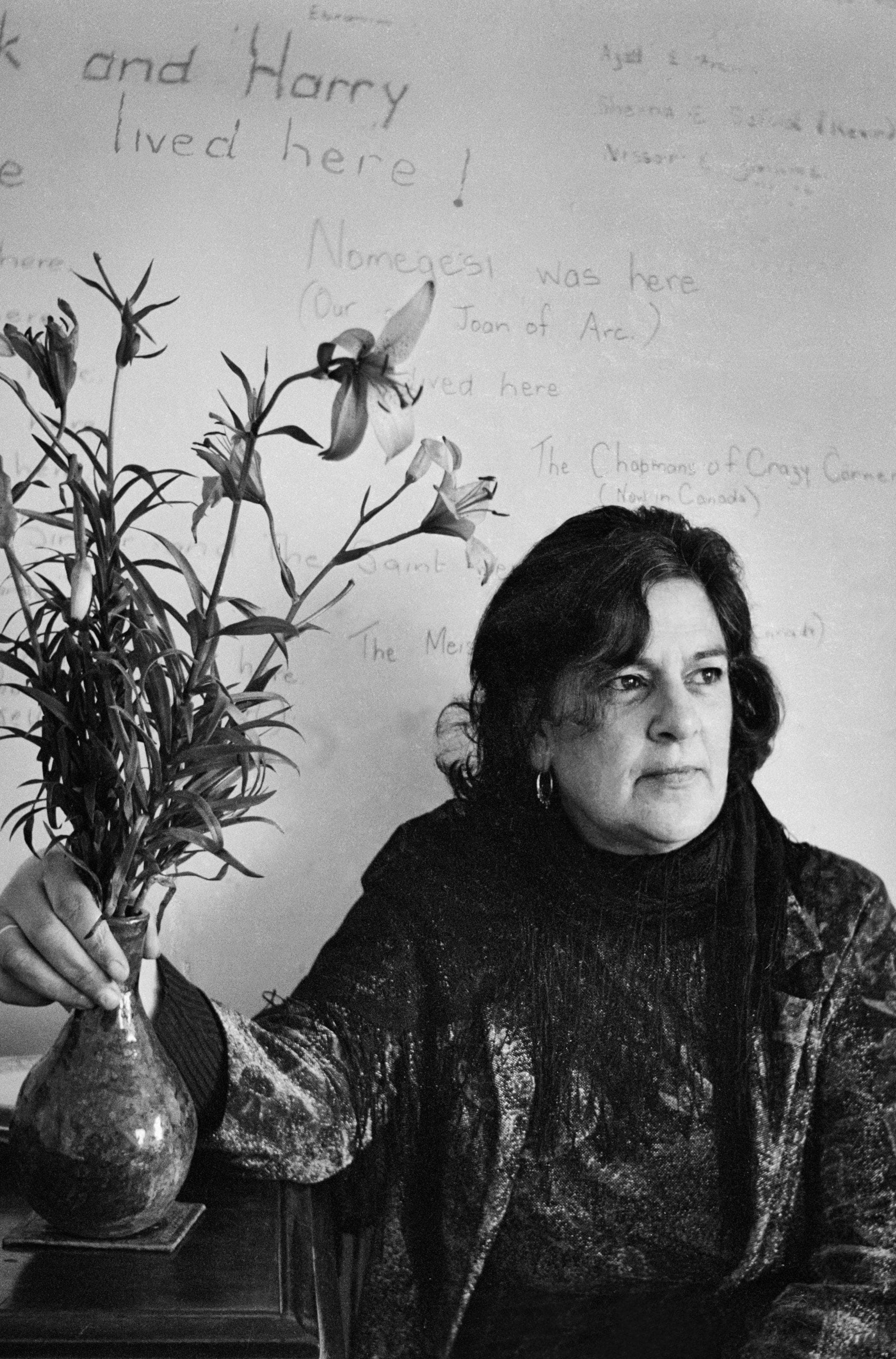
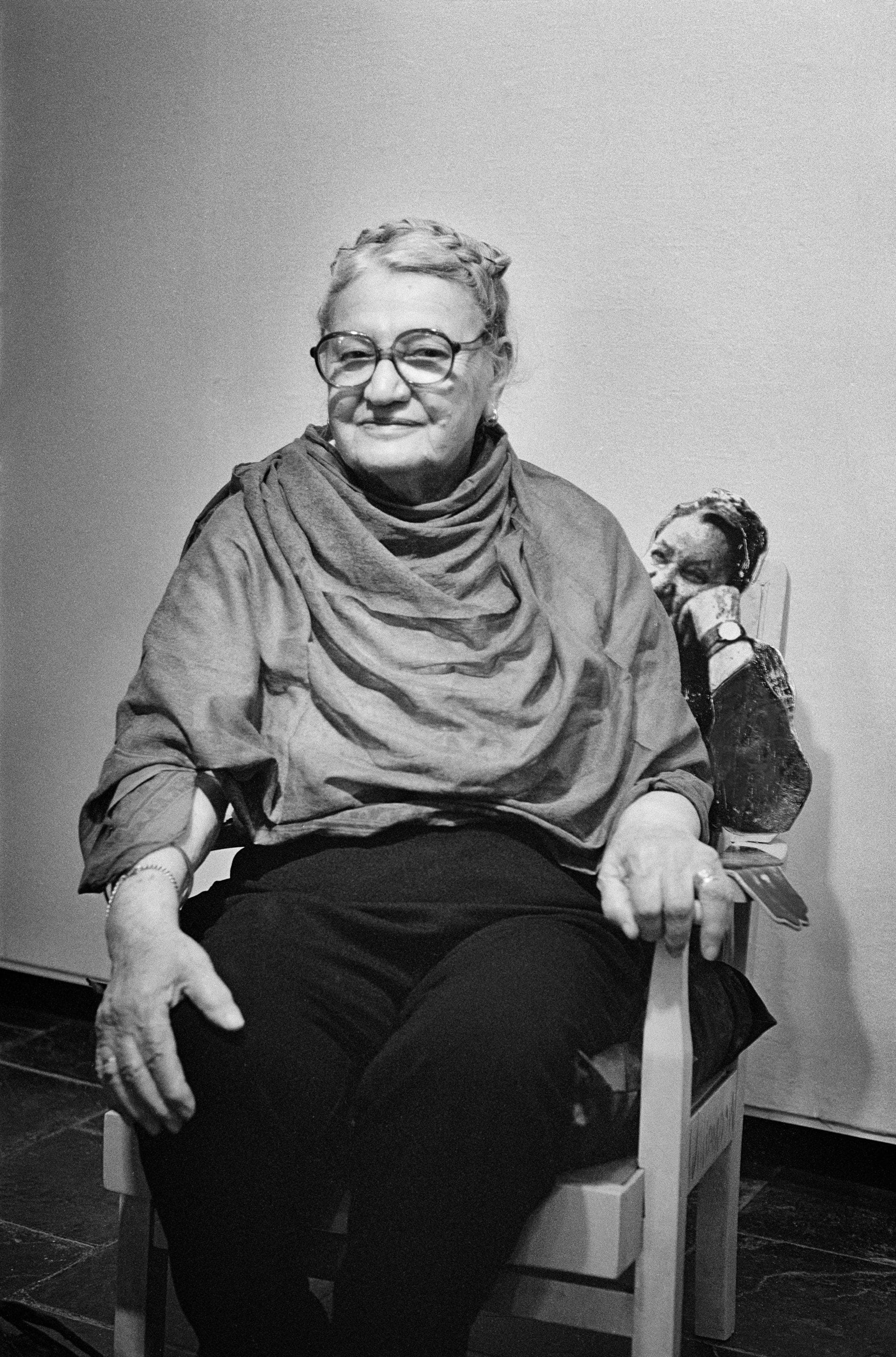
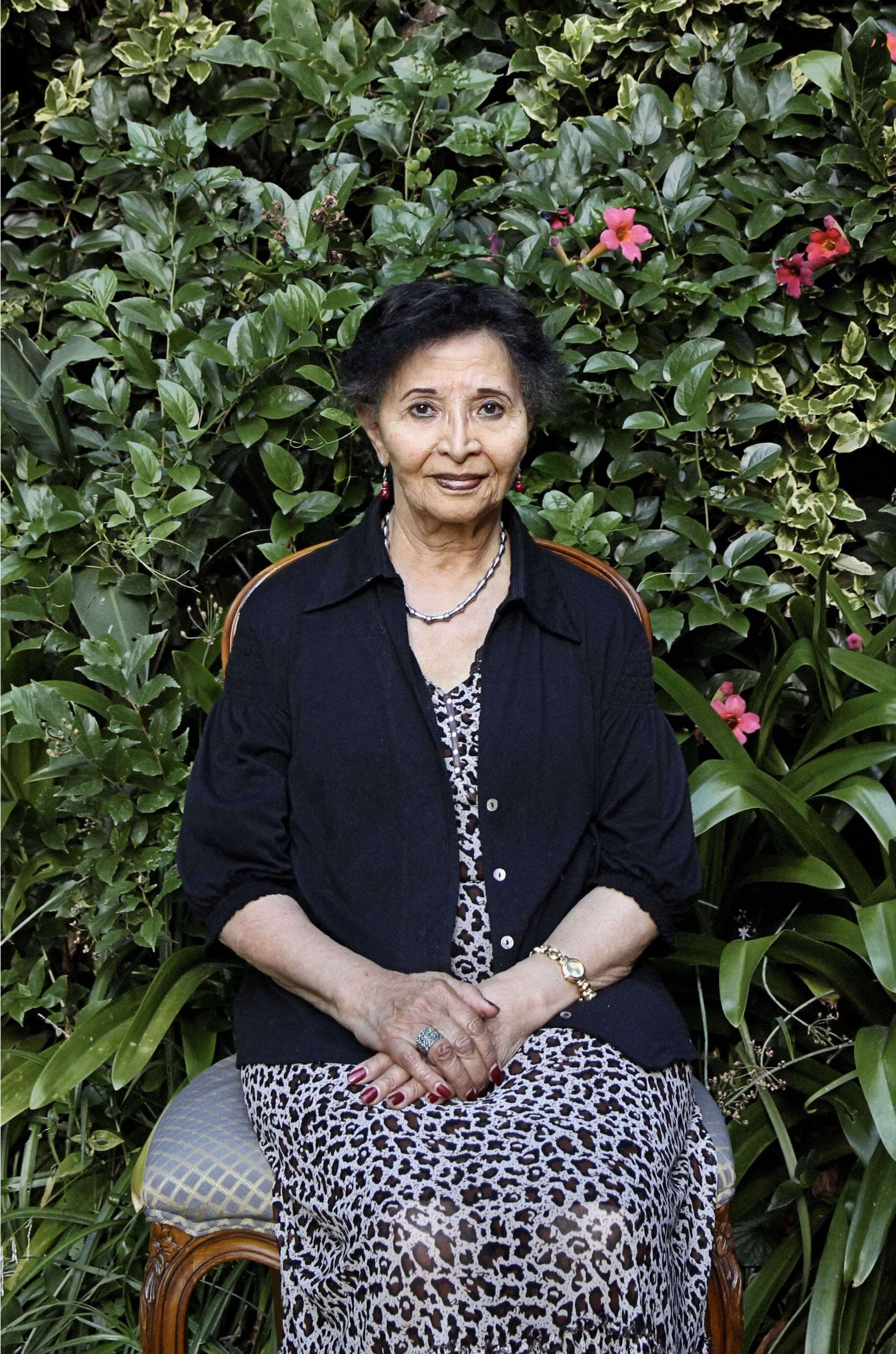
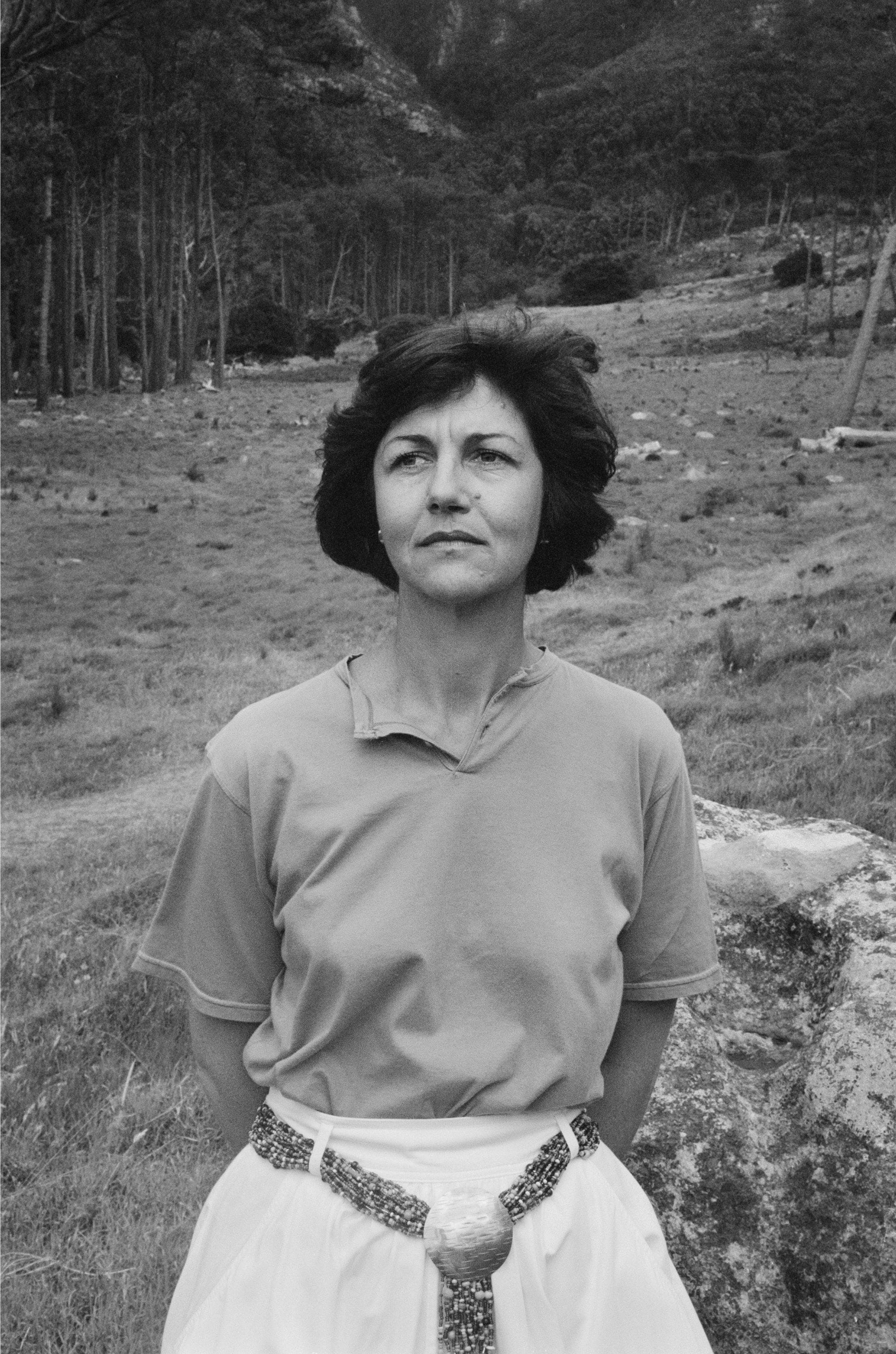
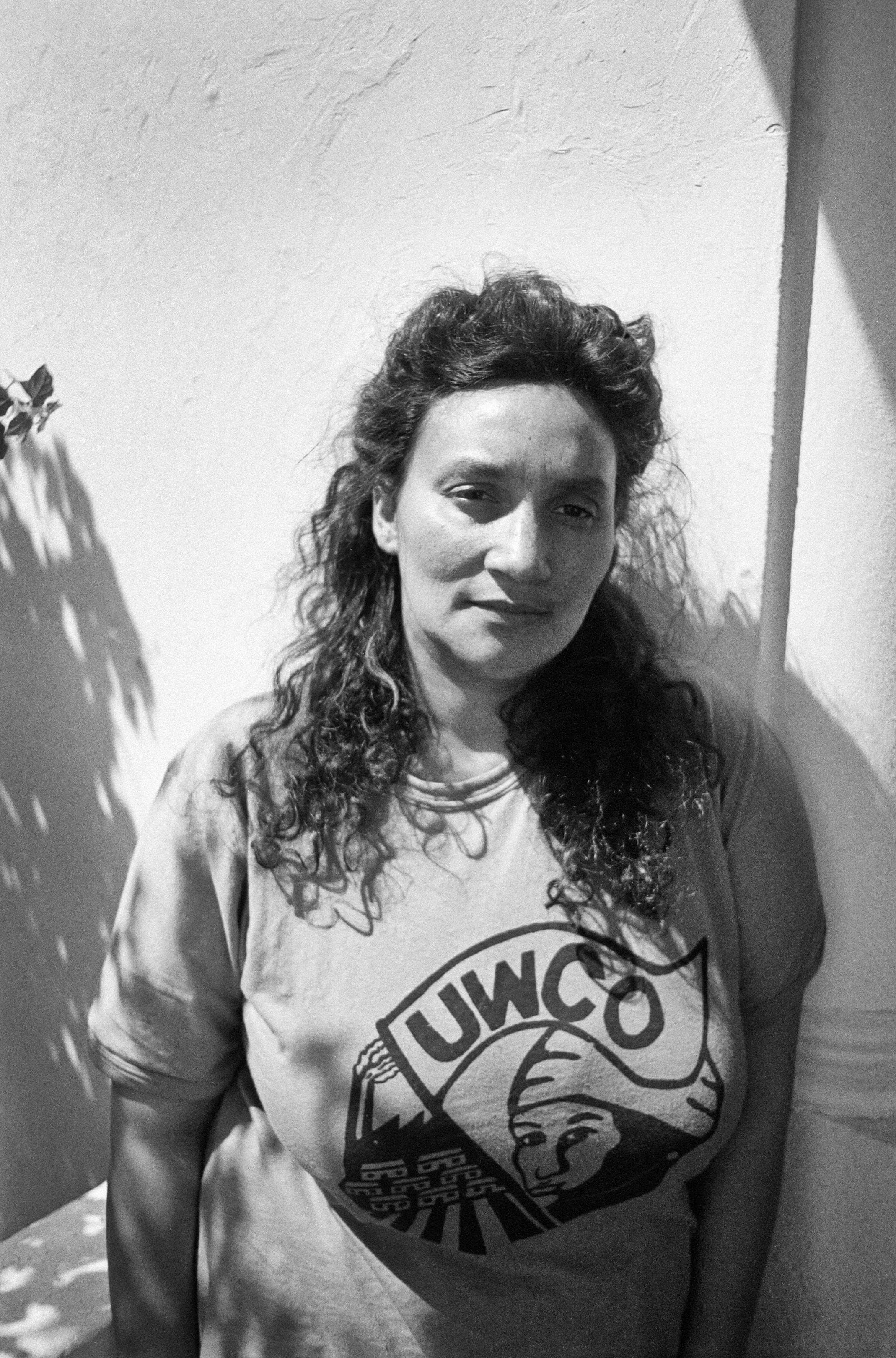
All Our Mothers is an extended series of portraits of women with whom Sue Williamson has worked with over the years, a series which grew out of the artist’s wish to make the crucial role of women in the struggle for liberation recognized and acclaimed. Some were taken as starting points for other series, like the portraits of Helen Joseph, Virginia Mngoma, Caroline Motsoaledi and Annie Silinga, to be transformed into photo etchings for the A Few South Africans series. Elizabeth and Nyameka Goniwe, mother and wife of the slain activist Matthew Goniwe, were photographed while Williamson was staying with Nyameka in Cradock, beginning work on the piece that became A Tale of Two Cradocks. Anti-apartheid artist and AIDS activist Judy Seidman was part of the From the Inside series, bringing the voices of people living with HIV to the streets.
The first photograph in the series is Naz Gool-Ebrahim, taken in her home in District Six in 1981, the year before the house was demolished. The most recent portrait, taken in 2024, shows the writer Sindiwe Magona, presiding over a table piled with the books she has written. Central to the series is the passage of time, with figures like Amina Cachalia appearing in portraits taken decades apart. The contrast between black-and-white and colour photographs underscores these temporal shifts.
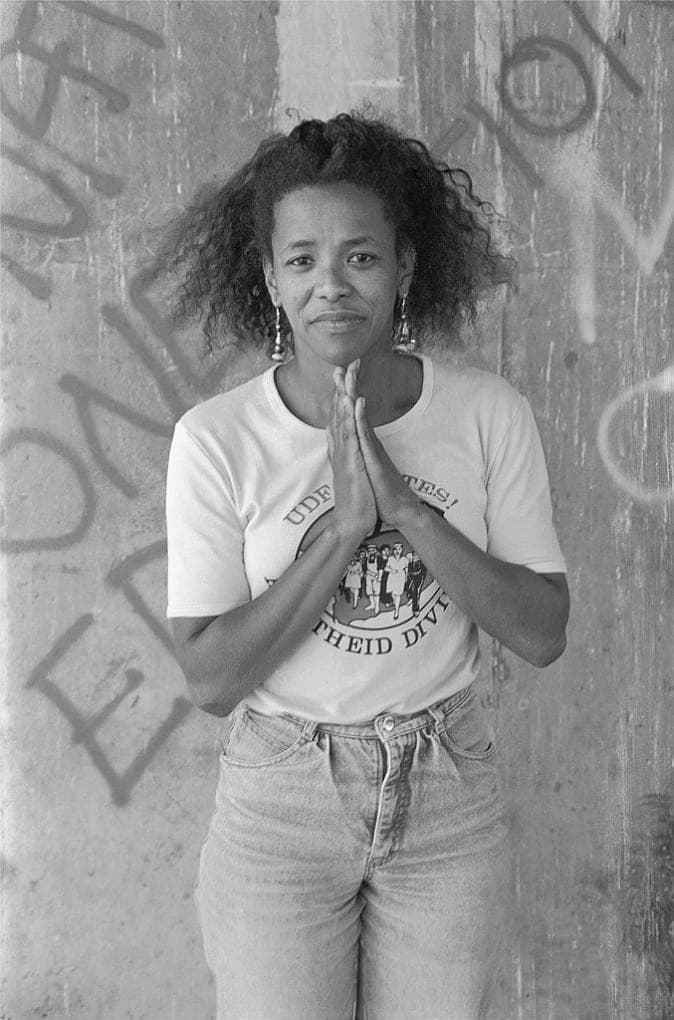
Some subjects, such as Cheryl Carolus and Annie Silinga, are depicted in clothing that denotes their political affiliations, such as the United Democratic Front insignia or the robes of the Federation of South African Women. Yet, each portrait also preserves a strong sense of individuality.
All Our Mothers is an extended series of portraits of women with whom Sue Williamson has worked with over the years, a series which grew out of the artist’s wish to make the crucial role of women in the struggle for liberation recognized and acclaimed. Some were taken as starting points for other series, like the portraits of Helen Joseph, Virginia Mngoma, Caroline Motsoaledi and Annie Silinga, to be transformed into photo etchings for the A Few South Africans series. Elizabeth and Nyameka Goniwe, mother and wife of the slain activist Matthew Goniwe, were photographed while Williamson was staying with Nyameka in Cradock, beginning work on the piece that became A Tale of Two Cradocks. Anti-apartheid artist and AIDS activist Judy Seidman was part of the From the Inside series, bringing the voices of people living with HIV to the streets.
The first photograph in the series is Naz Gool-Ebrahim, taken in her home in District Six in 1981, the year before the house was demolished. The most recent portrait, taken in 2024, shows the writer Sindiwe Magona, presiding over a table piled with the books she has written. Central to the series is the passage of time, with figures like Amina Cachalia appearing in portraits taken decades apart. The contrast between black-and-white and colour photographs underscores these temporal shifts.
Some subjects, such as Cheryl Carolus and Annie Silinga, are depicted in clothing that denotes their political affiliations, such as the United Democratic Front insignia or the robes of the Federation of South African Women. Yet, each portrait also preserves a strong sense of individuality.
All Our Mothers is an extended series of portraits of women with whom Sue Williamson has worked with over the years, a series which grew out of the artist’s wish to make the crucial role of women in the struggle for liberation recognized and acclaimed. Some were taken as starting points for other series, like the portraits of Helen Joseph, Virginia Mngoma, Caroline Motsoaledi and Annie Silinga, to be transformed into photo etchings for the A Few South Africans series. Elizabeth and Nyameka Goniwe, mother and wife of the slain activist Matthew Goniwe, were photographed while Williamson was staying with Nyameka in Cradock, beginning work on the piece that became A Tale of Two Cradocks. Anti-apartheid artist and AIDS activist Judy Seidman was part of the From the Inside series, bringing the voices of people living with HIV to the streets.
The first photograph in the series is Naz Gool-Ebrahim, taken in her home in District Six in 1981, the year before the house was demolished. The most recent portrait, taken in 2024, shows the writer Sindiwe Magona, presiding over a table piled with the books she has written. Central to the series is the passage of time, with figures like Amina Cachalia appearing in portraits taken decades apart. The contrast between black-and-white and colour photographs underscores these temporal shifts.
Some subjects, such as Cheryl Carolus and Annie Silinga, are depicted in clothing that denotes their political affiliations, such as the United Democratic Front insignia or the robes of the Federation of South African Women. Yet, each portrait also preserves a strong sense of individuality.
All Our Mothers is an extended series of portraits of women with whom Sue Williamson has worked with over the years, a series which grew out of the artist’s wish to make the crucial role of women in the struggle for liberation recognized and acclaimed. Some were taken as starting points for other series, like the portraits of Helen Joseph, Virginia Mngoma, Caroline Motsoaledi and Annie Silinga, to be transformed into photo etchings for the A Few South Africans series. Elizabeth and Nyameka Goniwe, mother and wife of the slain activist Matthew Goniwe, were photographed while Williamson was staying with Nyameka in Cradock, beginning work on the piece that became A Tale of Two Cradocks. Anti-apartheid artist and AIDS activist Judy Seidman was part of the From the Inside series, bringing the voices of people living with HIV to the streets.
The first photograph in the series is Naz Gool-Ebrahim, taken in her home in District Six in 1981, the year before the house was demolished. The most recent portrait, taken in 2024, shows the writer Sindiwe Magona, presiding over a table piled with the books she has written. Central to the series is the passage of time, with figures like Amina Cachalia appearing in portraits taken decades apart. The contrast between black-and-white and colour photographs underscores these temporal shifts.
Some subjects, such as Cheryl Carolus and Annie Silinga, are depicted in clothing that denotes their political affiliations, such as the United Democratic Front insignia or the robes of the Federation of South African Women. Yet, each portrait also preserves a strong sense of individuality.
All Our Mothers is an extended series of portraits of women with whom Sue Williamson has worked with over the years, a series which grew out of the artist’s wish to make the crucial role of women in the struggle for liberation recognized and acclaimed. Some were taken as starting points for other series, like the portraits of Helen Joseph, Virginia Mngoma, Caroline Motsoaledi and Annie Silinga, to be transformed into photo etchings for the A Few South Africans series. Elizabeth and Nyameka Goniwe, mother and wife of the slain activist Matthew Goniwe, were photographed while Williamson was staying with Nyameka in Cradock, beginning work on the piece that became A Tale of Two Cradocks. Anti-apartheid artist and AIDS activist Judy Seidman was part of the From the Inside series, bringing the voices of people living with HIV to the streets.
The first photograph in the series is Naz Gool-Ebrahim, taken in her home in District Six in 1981, the year before the house was demolished. The most recent portrait, taken in 2024, shows the writer Sindiwe Magona, presiding over a table piled with the books she has written. Central to the series is the passage of time, with figures like Amina Cachalia appearing in portraits taken decades apart. The contrast between black-and-white and colour photographs underscores these temporal shifts.
Some subjects, such as Cheryl Carolus and Annie Silinga, are depicted in clothing that denotes their political affiliations, such as the United Democratic Front insignia or the robes of the Federation of South African Women. Yet, each portrait also preserves a strong sense of individuality.
‘All Our Mothers’ is an extended series of portraits of women with whom Sue Williamson has worked with over the years, a series which grew out of the artist’s wish to make the crucial role of women in the struggle for liberation recognized and acclaimed. Some were taken as starting points for other series, like the portraits of Helen Joseph, Virginia Mngoma, Caroline Motsoale- di and Annie Silinga, to be transformed into photo etchings for the ‘A Few South Africans’ series.
Elizabeth and Nyameka Goniwe, mother and wife of the slain activist Matthew Goniwe, were photographed while Williamson was staying with Nyameka in Cradock, beginning work on the piece that became A Tale of Two Cradocks. Anti apartheid artist and AIDS activist Judy Seidman was part of the From the Inside series, bringing the voices of people living with HIV to the streets.
The first photograph in the series is Naz Gool-Ebrahim, taken in her home in District Six in 1981, the year before the house was demolished. The most recent portrait, taken in 2024, shows the writer Sindiwe Magona, presiding over a table piled with the books she has written. Central to the series is the passage of time, with figures like Amina Cachalia appearing in portraits tak- en decades apart. The contrast between black-and-white and colour photographs underscores these temporal shifts.
Some subjects, such as Cheryl Carolus and Annie Silinga, are depicted in clothing that denotes their political affiliations, such as the United Democratic Front insignia or the robes of the Federation of South African Women. Yet, each portrait also preserves a strong sense of individuality.
Amina Cachalia stands outside the home she shared with her husband, Yusuf, in Fordsburg, a multi ethnic suburb in Johannesburg. The couple were committed activists in the struggle, and in 1963, in the aftermath of the Rivonia trial, they were issued with banning orders and house arrest. This created a situation in which, although they lived in the same house, it was legally necessary for them to obtain government permission to speak to each other.
All Our Mothers is an extended series of portraits of women with whom Sue Williamson has worked with over the years, a series which grew out of the artist’s wish to make the crucial role of women in the struggle for liberation recognized and acclaimed. Some were taken as starting points for other series, like the portraits of Helen Joseph, Virginia Mngoma, Caroline Motsoaledi and Annie Silinga, to be transformed into photo etchings for the A Few South Africans series. Elizabeth and Nyameka Goniwe, mother and wife of the slain activist Matthew Goniwe, were photographed while Williamson was staying with Nyameka in Cradock, beginning work on the piece that became A Tale of Two Cradocks. Anti-apartheid artist and AIDS activist Judy Seidman was part of the From the Inside series, bringing the voices of people living with HIV to the streets.
The first photograph in the series is Naz Gool-Ebrahim, taken in her home in District Six in 1981, the year before the house was demolished. The most recent portrait, taken in 2024, shows the writer Sindiwe Magona, presiding over a table piled with the books she has written. Central to the series is the passage of time, with figures like Amina Cachalia appearing in portraits taken decades apart. The contrast between black-and-white and colour photographs underscores these temporal shifts.
Some subjects, such as Cheryl Carolus and Annie Silinga, are depicted in clothing that denotes their political affiliations, such as the United Democratic Front insignia or the robes of the Federation of South African Women. Yet, each portrait also preserves a strong sense of individuality.
All Our Mothers is an extended series of portraits of women with whom Sue Williamson has worked with over the years, a series which grew out of the artist’s wish to make the crucial role of women in the struggle for liberation recognized and acclaimed. Some were taken as starting points for other series, like the portraits of Helen Joseph, Virginia Mngoma, Caroline Motsoaledi and Annie Silinga, to be transformed into photo etchings for the A Few South Africans series. Elizabeth and Nyameka Goniwe, mother and wife of the slain activist Matthew Goniwe, were photographed while Williamson was staying with Nyameka in Cradock, beginning work on the piece that became A Tale of Two Cradocks. Anti-apartheid artist and AIDS activist Judy Seidman was part of the From the Inside series, bringing the voices of people living with HIV to the streets.
The first photograph in the series is Naz Gool-Ebrahim, taken in her home in District Six in 1981, the year before the house was demolished. The most recent portrait, taken in 2024, shows the writer Sindiwe Magona, presiding over a table piled with the books she has written. Central to the series is the passage of time, with figures like Amina Cachalia appearing in portraits taken decades apart. The contrast between black-and-white and colour photographs underscores these temporal shifts.
Some subjects, such as Cheryl Carolus and Annie Silinga, are depicted in clothing that denotes their political affiliations, such as the United Democratic Front insignia or the robes of the Federation of South African Women. Yet, each portrait also preserves a strong sense of individuality.
All Our Mothers is an extended series of portraits of women with whom Sue Williamson has worked with over the years, a series which grew out of the artist’s wish to make the crucial role of women in the struggle for liberation recognized and acclaimed. Some were taken as starting points for other series, like the portraits of Helen Joseph, Virginia Mngoma, Caroline Motsoaledi and Annie Silinga, to be transformed into photo etchings for the A Few South Africans series. Elizabeth and Nyameka Goniwe, mother and wife of the slain activist Matthew Goniwe, were photographed while Williamson was staying with Nyameka in Cradock, beginning work on the piece that became A Tale of Two Cradocks. Anti-apartheid artist and AIDS activist Judy Seidman was part of the From the Inside series, bringing the voices of people living with HIV to the streets.
The first photograph in the series is Naz Gool-Ebrahim, taken in her home in District Six in 1981, the year before the house was demolished. The most recent portrait, taken in 2024, shows the writer Sindiwe Magona, presiding over a table piled with the books she has written. Central to the series is the passage of time, with figures like Amina Cachalia appearing in portraits taken decades apart. The contrast between black-and-white and colour photographs underscores these temporal shifts.
Some subjects, such as Cheryl Carolus and Annie Silinga, are depicted in clothing that denotes their political affiliations, such as the United Democratic Front insignia or the robes of the Federation of South African Women. Yet, each portrait also preserves a strong sense of individuality.
All Our Mothers is an extended series of portraits of women with whom Sue Williamson has worked with over the years, a series which grew out of the artist’s wish to make the crucial role of women in the struggle for liberation recognized and acclaimed. Some were taken as starting points for other series, like the portraits of Helen Joseph, Virginia Mngoma, Caroline Motsoaledi and Annie Silinga, to be transformed into photo etchings for the A Few South Africans series. Elizabeth and Nyameka Goniwe, mother and wife of the slain activist Matthew Goniwe, were photographed while Williamson was staying with Nyameka in Cradock, beginning work on the piece that became A Tale of Two Cradocks. Anti-apartheid artist and AIDS activist Judy Seidman was part of the From the Inside series, bringing the voices of people living with HIV to the streets.
The first photograph in the series is Naz Gool-Ebrahim, taken in her home in District Six in 1981, the year before the house was demolished. The most recent portrait, taken in 2024, shows the writer Sindiwe Magona, presiding over a table piled with the books she has written. Central to the series is the passage of time, with figures like Amina Cachalia appearing in portraits taken decades apart. The contrast between black-and-white and colour photographs underscores these temporal shifts.
Some subjects, such as Cheryl Carolus and Annie Silinga, are depicted in clothing that denotes their political affiliations, such as the United Democratic Front insignia or the robes of the Federation of South African Women. Yet, each portrait also preserves a strong sense of individuality.
All Our Mothers is an extended series of portraits of women with whom Sue Williamson has worked with over the years, a series which grew out of the artist’s wish to make the crucial role of women in the struggle for liberation recognized and acclaimed. Some were taken as starting points for other series, like the portraits of Helen Joseph, Virginia Mngoma, Caroline Motsoaledi and Annie Silinga, to be transformed into photo etchings for the A Few South Africans series. Elizabeth and Nyameka Goniwe, mother and wife of the slain activist Matthew Goniwe, were photographed while Williamson was staying with Nyameka in Cradock, beginning work on the piece that became A Tale of Two Cradocks. Anti-apartheid artist and AIDS activist Judy Seidman was part of the From the Inside series, bringing the voices of people living with HIV to the streets.
The first photograph in the series is Naz Gool-Ebrahim, taken in her home in District Six in 1981, the year before the house was demolished. The most recent portrait, taken in 2024, shows the writer Sindiwe Magona, presiding over a table piled with the books she has written. Central to the series is the passage of time, with figures like Amina Cachalia appearing in portraits taken decades apart. The contrast between black-and-white and colour photographs underscores these temporal shifts.
Some subjects, such as Cheryl Carolus and Annie Silinga, are depicted in clothing that denotes their political affiliations, such as the United Democratic Front insignia or the robes of the Federation of South African Women. Yet, each portrait also preserves a strong sense of individuality.
All Our Mothers is an extended series of portraits of women with whom Sue Williamson has worked with over the years, a series which grew out of the artist’s wish to make the crucial role of women in the struggle for liberation recognized and acclaimed. Some were taken as starting points for other series, like the portraits of Helen Joseph, Virginia Mngoma, Caroline Motsoaledi and Annie Silinga, to be transformed into photo etchings for the A Few South Africans series. Elizabeth and Nyameka Goniwe, mother and wife of the slain activist Matthew Goniwe, were photographed while Williamson was staying with Nyameka in Cradock, beginning work on the piece that became A Tale of Two Cradocks. Anti-apartheid artist and AIDS activist Judy Seidman was part of the From the Inside series, bringing the voices of people living with HIV to the streets.
The first photograph in the series is Naz Gool-Ebrahim, taken in her home in District Six in 1981, the year before the house was demolished. The most recent portrait, taken in 2024, shows the writer Sindiwe Magona, presiding over a table piled with the books she has written. Central to the series is the passage of time, with figures like Amina Cachalia appearing in portraits taken decades apart. The contrast between black-and-white and colour photographs underscores these temporal shifts.
Some subjects, such as Cheryl Carolus and Annie Silinga, are depicted in clothing that denotes their political affiliations, such as the United Democratic Front insignia or the robes of the Federation of South African Women. Yet, each portrait also preserves a strong sense of individuality.
All Our Mothers is an extended series of portraits of women with whom Sue Williamson has worked with over the years, a series which grew out of the artist’s wish to make the crucial role of women in the struggle for liberation recognized and acclaimed. Some were taken as starting points for other series, like the portraits of Helen Joseph, Virginia Mngoma, Caroline Motsoaledi and Annie Silinga, to be transformed into photo etchings for the A Few South Africans series. Elizabeth and Nyameka Goniwe, mother and wife of the slain activist Matthew Goniwe, were photographed while Williamson was staying with Nyameka in Cradock, beginning work on the piece that became A Tale of Two Cradocks. Anti-apartheid artist and AIDS activist Judy Seidman was part of the From the Inside series, bringing the voices of people living with HIV to the streets.
The first photograph in the series is Naz Gool-Ebrahim, taken in her home in District Six in 1981, the year before the house was demolished. The most recent portrait, taken in 2024, shows the writer Sindiwe Magona, presiding over a table piled with the books she has written. Central to the series is the passage of time, with figures like Amina Cachalia appearing in portraits taken decades apart. The contrast between black-and-white and colour photographs underscores these temporal shifts.
Some subjects, such as Cheryl Carolus and Annie Silinga, are depicted in clothing that denotes their political affiliations, such as the United Democratic Front insignia or the robes of the Federation of South African Women. Yet, each portrait also preserves a strong sense of individuality.
All Our Mothers is an extended series of portraits of women with whom Sue Williamson has worked with over the years, a series which grew out of the artist’s wish to make the crucial role of women in the struggle for liberation recognized and acclaimed. Some were taken as starting points for other series, like the portraits of Helen Joseph, Virginia Mngoma, Caroline Motsoaledi and Annie Silinga, to be transformed into photo etchings for the A Few South Africans series. Elizabeth and Nyameka Goniwe, mother and wife of the slain activist Matthew Goniwe, were photographed while Williamson was staying with Nyameka in Cradock, beginning work on the piece that became A Tale of Two Cradocks. Anti-apartheid artist and AIDS activist Judy Seidman was part of the From the Inside series, bringing the voices of people living with HIV to the streets.
The first photograph in the series is Naz Gool-Ebrahim, taken in her home in District Six in 1981, the year before the house was demolished. The most recent portrait, taken in 2024, shows the writer Sindiwe Magona, presiding over a table piled with the books she has written. Central to the series is the passage of time, with figures like Amina Cachalia appearing in portraits taken decades apart. The contrast between black-and-white and colour photographs underscores these temporal shifts.
Some subjects, such as Cheryl Carolus and Annie Silinga, are depicted in clothing that denotes their political affiliations, such as the United Democratic Front insignia or the robes of the Federation of South African Women. Yet, each portrait also preserves a strong sense of individuality.
All Our Mothers is an extended series of portraits of women with whom Sue Williamson has worked with over the years, a series which grew out of the artist’s wish to make the crucial role of women in the struggle for liberation recognized and acclaimed. Some were taken as starting points for other series, like the portraits of Helen Joseph, Virginia Mngoma, Caroline Motsoaledi and Annie Silinga, to be transformed into photo etchings for the A Few South Africans series. Elizabeth and Nyameka Goniwe, mother and wife of the slain activist Matthew Goniwe, were photographed while Williamson was staying with Nyameka in Cradock, beginning work on the piece that became A Tale of Two Cradocks. Anti-apartheid artist and AIDS activist Judy Seidman was part of the From the Inside series, bringing the voices of people living with HIV to the streets.
The first photograph in the series is Naz Gool-Ebrahim, taken in her home in District Six in 1981, the year before the house was demolished. The most recent portrait, taken in 2024, shows the writer Sindiwe Magona, presiding over a table piled with the books she has written. Central to the series is the passage of time, with figures like Amina Cachalia appearing in portraits taken decades apart. The contrast between black-and-white and colour photographs underscores these temporal shifts.
Some subjects, such as Cheryl Carolus and Annie Silinga, are depicted in clothing that denotes their political affiliations, such as the United Democratic Front insignia or the robes of the Federation of South African Women. Yet, each portrait also preserves a strong sense of individuality.
All Our Mothers is an extended series of portraits of women with whom Sue Williamson has worked with over the years, a series which grew out of the artist’s wish to make the crucial role of women in the struggle for liberation recognized and acclaimed. Some were taken as starting points for other series, like the portraits of Helen Joseph, Virginia Mngoma, Caroline Motsoaledi and Annie Silinga, to be transformed into photo etchings for the A Few South Africans series. Elizabeth and Nyameka Goniwe, mother and wife of the slain activist Matthew Goniwe, were photographed while Williamson was staying with Nyameka in Cradock, beginning work on the piece that became A Tale of Two Cradocks. Anti-apartheid artist and AIDS activist Judy Seidman was part of the From the Inside series, bringing the voices of people living with HIV to the streets.
The first photograph in the series is Naz Gool-Ebrahim, taken in her home in District Six in 1981, the year before the house was demolished. The most recent portrait, taken in 2024, shows the writer Sindiwe Magona, presiding over a table piled with the books she has written. Central to the series is the passage of time, with figures like Amina Cachalia appearing in portraits taken decades apart. The contrast between black-and-white and colour photographs underscores these temporal shifts.
Some subjects, such as Cheryl Carolus and Annie Silinga, are depicted in clothing that denotes their political affiliations, such as the United Democratic Front insignia or the robes of the Federation of South African Women. Yet, each portrait also preserves a strong sense of individuality.
All Our Mothers is an extended series of portraits of women with whom Sue Williamson has worked with over the years, a series which grew out of the artist’s wish to make the crucial role of women in the struggle for liberation recognized and acclaimed. Some were taken as starting points for other series, like the portraits of Helen Joseph, Virginia Mngoma, Caroline Motsoaledi and Annie Silinga, to be transformed into photo etchings for the A Few South Africans series. Elizabeth and Nyameka Goniwe, mother and wife of the slain activist Matthew Goniwe, were photographed while Williamson was staying with Nyameka in Cradock, beginning work on the piece that became A Tale of Two Cradocks. Anti-apartheid artist and AIDS activist Judy Seidman was part of the From the Inside series, bringing the voices of people living with HIV to the streets.
The first photograph in the series is Naz Gool-Ebrahim, taken in her home in District Six in 1981, the year before the house was demolished. The most recent portrait, taken in 2024, shows the writer Sindiwe Magona, presiding over a table piled with the books she has written. Central to the series is the passage of time, with figures like Amina Cachalia appearing in portraits taken decades apart. The contrast between black-and-white and colour photographs underscores these temporal shifts.
Some subjects, such as Cheryl Carolus and Annie Silinga, are depicted in clothing that denotes their political affiliations, such as the United Democratic Front insignia or the robes of the Federation of South African Women. Yet, each portrait also preserves a strong sense of individuality.
All Our Mothers is an extended series of portraits of women with whom Sue Williamson has worked with over the years, a series which grew out of the artist’s wish to make the crucial role of women in the struggle for liberation recognized and acclaimed. Some were taken as starting points for other series, like the portraits of Helen Joseph, Virginia Mngoma, Caroline Motsoaledi and Annie Silinga, to be transformed into photo etchings for the A Few South Africans series. Elizabeth and Nyameka Goniwe, mother and wife of the slain activist Matthew Goniwe, were photographed while Williamson was staying with Nyameka in Cradock, beginning work on the piece that became A Tale of Two Cradocks. Anti-apartheid artist and AIDS activist Judy Seidman was part of the From the Inside series, bringing the voices of people living with HIV to the streets.
The first photograph in the series is Naz Gool-Ebrahim, taken in her home in District Six in 1981, the year before the house was demolished. The most recent portrait, taken in 2024, shows the writer Sindiwe Magona, presiding over a table piled with the books she has written. Central to the series is the passage of time, with figures like Amina Cachalia appearing in portraits taken decades apart. The contrast between black-and-white and colour photographs underscores these temporal shifts.
Some subjects, such as Cheryl Carolus and Annie Silinga, are depicted in clothing that denotes their political affiliations, such as the United Democratic Front insignia or the robes of the Federation of South African Women. Yet, each portrait also preserves a strong sense of individuality.
All Our Mothers is an extended series of portraits of women with whom Sue Williamson has worked with over the years, a series which grew out of the artist’s wish to make the crucial role of women in the struggle for liberation recognized and acclaimed. Some were taken as starting points for other series, like the portraits of Helen Joseph, Virginia Mngoma, Caroline Motsoaledi and Annie Silinga, to be transformed into photo etchings for the A Few South Africans series. Elizabeth and Nyameka Goniwe, mother and wife of the slain activist Matthew Goniwe, were photographed while Williamson was staying with Nyameka in Cradock, beginning work on the piece that became A Tale of Two Cradocks. Anti-apartheid artist and AIDS activist Judy Seidman was part of the From the Inside series, bringing the voices of people living with HIV to the streets.
The first photograph in the series is Naz Gool-Ebrahim, taken in her home in District Six in 1981, the year before the house was demolished. The most recent portrait, taken in 2024, shows the writer Sindiwe Magona, presiding over a table piled with the books she has written. Central to the series is the passage of time, with figures like Amina Cachalia appearing in portraits taken decades apart. The contrast between black-and-white and colour photographs underscores these temporal shifts.
Some subjects, such as Cheryl Carolus and Annie Silinga, are depicted in clothing that denotes their political affiliations, such as the United Democratic Front insignia or the robes of the Federation of South African Women. Yet, each portrait also preserves a strong sense of individuality.
All Our Mothers is an extended series of portraits of women with whom Sue Williamson has worked with over the years, a series which grew out of the artist’s wish to make the crucial role of women in the struggle for liberation recognized and acclaimed. Some were taken as starting points for other series, like the portraits of Helen Joseph, Virginia Mngoma, Caroline Motsoaledi and Annie Silinga, to be transformed into photo etchings for the A Few South Africans series. Elizabeth and Nyameka Goniwe, mother and wife of the slain activist Matthew Goniwe, were photographed while Williamson was staying with Nyameka in Cradock, beginning work on the piece that became A Tale of Two Cradocks. Anti-apartheid artist and AIDS activist Judy Seidman was part of the From the Inside series, bringing the voices of people living with HIV to the streets.
The first photograph in the series is Naz Gool-Ebrahim, taken in her home in District Six in 1981, the year before the house was demolished. The most recent portrait, taken in 2024, shows the writer Sindiwe Magona, presiding over a table piled with the books she has written. Central to the series is the passage of time, with figures like Amina Cachalia appearing in portraits taken decades apart. The contrast between black-and-white and colour photographs underscores these temporal shifts.
Some subjects, such as Cheryl Carolus and Annie Silinga, are depicted in clothing that denotes their political affiliations, such as the United Democratic Front insignia or the robes of the Federation of South African Women. Yet, each portrait also preserves a strong sense of individuality.
All Our Mothers is an extended series of portraits of women with whom Sue Williamson has worked with over the years, a series which grew out of the artist’s wish to make the crucial role of women in the struggle for liberation recognized and acclaimed. Some were taken as starting points for other series, like the portraits of Helen Joseph, Virginia Mngoma, Caroline Motsoaledi and Annie Silinga, to be transformed into photo etchings for the A Few South Africans series. Elizabeth and Nyameka Goniwe, mother and wife of the slain activist Matthew Goniwe, were photographed while Williamson was staying with Nyameka in Cradock, beginning work on the piece that became A Tale of Two Cradocks. Anti-apartheid artist and AIDS activist Judy Seidman was part of the From the Inside series, bringing the voices of people living with HIV to the streets.
The first photograph in the series is Naz Gool-Ebrahim, taken in her home in District Six in 1981, the year before the house was demolished. The most recent portrait, taken in 2024, shows the writer Sindiwe Magona, presiding over a table piled with the books she has written. Central to the series is the passage of time, with figures like Amina Cachalia appearing in portraits taken decades apart. The contrast between black-and-white and colour photographs underscores these temporal shifts.
Some subjects, such as Cheryl Carolus and Annie Silinga, are depicted in clothing that denotes their political affiliations, such as the United Democratic Front insignia or the robes of the Federation of South African Women. Yet, each portrait also preserves a strong sense of individuality.
All Our Mothers is an extended series of portraits of women with whom Sue Williamson has worked with over the years, a series which grew out of the artist’s wish to make the crucial role of women in the struggle for liberation recognized and acclaimed. Some were taken as starting points for other series, like the portraits of Helen Joseph, Virginia Mngoma, Caroline Motsoaledi and Annie Silinga, to be transformed into photo etchings for the A Few South Africans series. Elizabeth and Nyameka Goniwe, mother and wife of the slain activist Matthew Goniwe, were photographed while Williamson was staying with Nyameka in Cradock, beginning work on the piece that became A Tale of Two Cradocks. Anti-apartheid artist and AIDS activist Judy Seidman was part of the From the Inside series, bringing the voices of people living with HIV to the streets.
The first photograph in the series is Naz Gool-Ebrahim, taken in her home in District Six in 1981, the year before the house was demolished. The most recent portrait, taken in 2024, shows the writer Sindiwe Magona, presiding over a table piled with the books she has written. Central to the series is the passage of time, with figures like Amina Cachalia appearing in portraits taken decades apart. The contrast between black-and-white and colour photographs underscores these temporal shifts.
Some subjects, such as Cheryl Carolus and Annie Silinga, are depicted in clothing that denotes their political affiliations, such as the United Democratic Front insignia or the robes of the Federation of South African Women. Yet, each portrait also preserves a strong sense of individuality.
All Our Mothers is an extended series of portraits of women with whom Sue Williamson has worked with over the years, a series which grew out of the artist’s wish to make the crucial role of women in the struggle for liberation recognized and acclaimed. Some were taken as starting points for other series, like the portraits of Helen Joseph, Virginia Mngoma, Caroline Motsoaledi and Annie Silinga, to be transformed into photo etchings for the A Few South Africans series. Elizabeth and Nyameka Goniwe, mother and wife of the slain activist Matthew Goniwe, were photographed while Williamson was staying with Nyameka in Cradock, beginning work on the piece that became A Tale of Two Cradocks. Anti-apartheid artist and AIDS activist Judy Seidman was part of the From the Inside series, bringing the voices of people living with HIV to the streets.
The first photograph in the series is Naz Gool-Ebrahim, taken in her home in District Six in 1981, the year before the house was demolished. The most recent portrait, taken in 2024, shows the writer Sindiwe Magona, presiding over a table piled with the books she has written. Central to the series is the passage of time, with figures like Amina Cachalia appearing in portraits taken decades apart. The contrast between black-and-white and colour photographs underscores these temporal shifts.
Some subjects, such as Cheryl Carolus and Annie Silinga, are depicted in clothing that denotes their political affiliations, such as the United Democratic Front insignia or the robes of the Federation of South African Women. Yet, each portrait also preserves a strong sense of individuality.
All Our Mothers is an extended series of portraits of women with whom Sue Williamson has worked with over the years, a series which grew out of the artist’s wish to make the crucial role of women in the struggle for liberation recognized and acclaimed. Some were taken as starting points for other series, like the portraits of Helen Joseph, Virginia Mngoma, Caroline Motsoaledi and Annie Silinga, to be transformed into photo etchings for the A Few South Africans series. Elizabeth and Nyameka Goniwe, mother and wife of the slain activist Matthew Goniwe, were photographed while Williamson was staying with Nyameka in Cradock, beginning work on the piece that became A Tale of Two Cradocks. Anti-apartheid artist and AIDS activist Judy Seidman was part of the From the Inside series, bringing the voices of people living with HIV to the streets.
The first photograph in the series is Naz Gool-Ebrahim, taken in her home in District Six in 1981, the year before the house was demolished. The most recent portrait, taken in 2024, shows the writer Sindiwe Magona, presiding over a table piled with the books she has written. Central to the series is the passage of time, with figures like Amina Cachalia appearing in portraits taken decades apart. The contrast between black-and-white and colour photographs underscores these temporal shifts.
Some subjects, such as Cheryl Carolus and Annie Silinga, are depicted in clothing that denotes their political affiliations, such as the United Democratic Front insignia or the robes of the Federation of South African Women. Yet, each portrait also preserves a strong sense of individuality.
All Our Mothers is an extended series of portraits of women with whom Sue Williamson has worked with over the years, a series which grew out of the artist’s wish to make the crucial role of women in the struggle for liberation recognized and acclaimed. Some were taken as starting points for other series, like the portraits of Helen Joseph, Virginia Mngoma, Caroline Motsoaledi and Annie Silinga, to be transformed into photo etchings for the A Few South Africans series. Elizabeth and Nyameka Goniwe, mother and wife of the slain activist Matthew Goniwe, were photographed while Williamson was staying with Nyameka in Cradock, beginning work on the piece that became A Tale of Two Cradocks. Anti-apartheid artist and AIDS activist Judy Seidman was part of the From the Inside series, bringing the voices of people living with HIV to the streets.
The first photograph in the series is Naz Gool-Ebrahim, taken in her home in District Six in 1981, the year before the house was demolished. The most recent portrait, taken in 2024, shows the writer Sindiwe Magona, presiding over a table piled with the books she has written. Central to the series is the passage of time, with figures like Amina Cachalia appearing in portraits taken decades apart. The contrast between black-and-white and colour photographs underscores these temporal shifts.
Some subjects, such as Cheryl Carolus and Annie Silinga, are depicted in clothing that denotes their political affiliations, such as the United Democratic Front insignia or the robes of the Federation of South African Women. Yet, each portrait also preserves a strong sense of individuality.
All Our Mothers is an extended series of portraits of women with whom Sue Williamson has worked with over the years, a series which grew out of the artist’s wish to make the crucial role of women in the struggle for liberation recognized and acclaimed. Some were taken as starting points for other series, like the portraits of Helen Joseph, Virginia Mngoma, Caroline Motsoaledi and Annie Silinga, to be transformed into photo etchings for the A Few South Africans series. Elizabeth and Nyameka Goniwe, mother and wife of the slain activist Matthew Goniwe, were photographed while Williamson was staying with Nyameka in Cradock, beginning work on the piece that became A Tale of Two Cradocks. Anti-apartheid artist and AIDS activist Judy Seidman was part of the From the Inside series, bringing the voices of people living with HIV to the streets.
The first photograph in the series is Naz Gool-Ebrahim, taken in her home in District Six in 1981, the year before the house was demolished. The most recent portrait, taken in 2024, shows the writer Sindiwe Magona, presiding over a table piled with the books she has written. Central to the series is the passage of time, with figures like Amina Cachalia appearing in portraits taken decades apart. The contrast between black-and-white and colour photographs underscores these temporal shifts.
Some subjects, such as Cheryl Carolus and Annie Silinga, are depicted in clothing that denotes their political affiliations, such as the United Democratic Front insignia or the robes of the Federation of South African Women. Yet, each portrait also preserves a strong sense of individuality.
All Our Mothers is an extended series of portraits of women with whom Sue Williamson has worked with over the years, a series which grew out of the artist’s wish to make the crucial role of women in the struggle for liberation recognized and acclaimed. Some were taken as starting points for other series, like the portraits of Helen Joseph, Virginia Mngoma, Caroline Motsoaledi and Annie Silinga, to be transformed into photo etchings for the A Few South Africans series. Elizabeth and Nyameka Goniwe, mother and wife of the slain activist Matthew Goniwe, were photographed while Williamson was staying with Nyameka in Cradock, beginning work on the piece that became A Tale of Two Cradocks. Anti-apartheid artist and AIDS activist Judy Seidman was part of the From the Inside series, bringing the voices of people living with HIV to the streets.
The first photograph in the series is Naz Gool-Ebrahim, taken in her home in District Six in 1981, the year before the house was demolished. The most recent portrait, taken in 2024, shows the writer Sindiwe Magona, presiding over a table piled with the books she has written. Central to the series is the passage of time, with figures like Amina Cachalia appearing in portraits taken decades apart. The contrast between black-and-white and colour photographs underscores these temporal shifts.
Some subjects, such as Cheryl Carolus and Annie Silinga, are depicted in clothing that denotes their political affiliations, such as the United Democratic Front insignia or the robes of the Federation of South African Women. Yet, each portrait also preserves a strong sense of individuality.