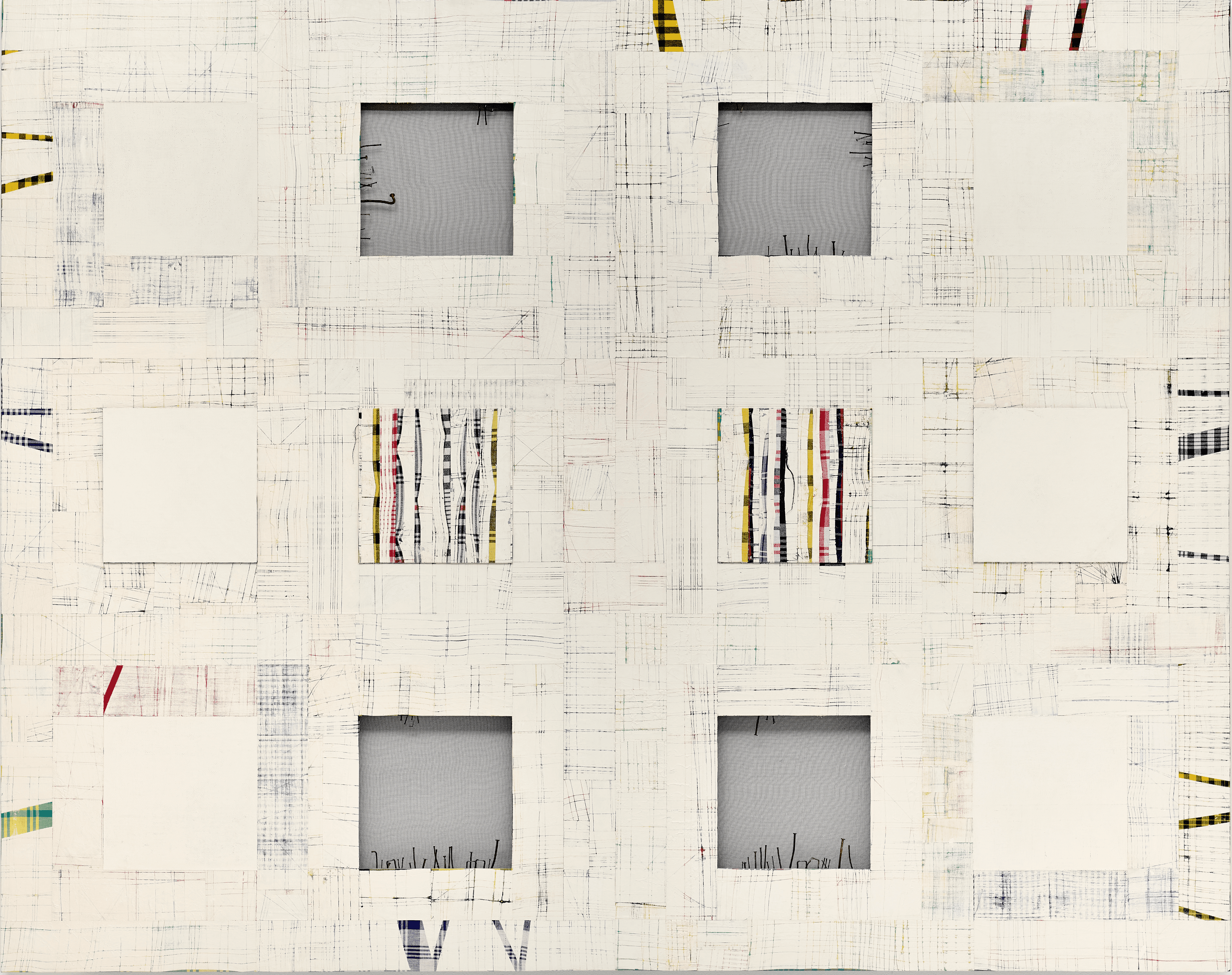
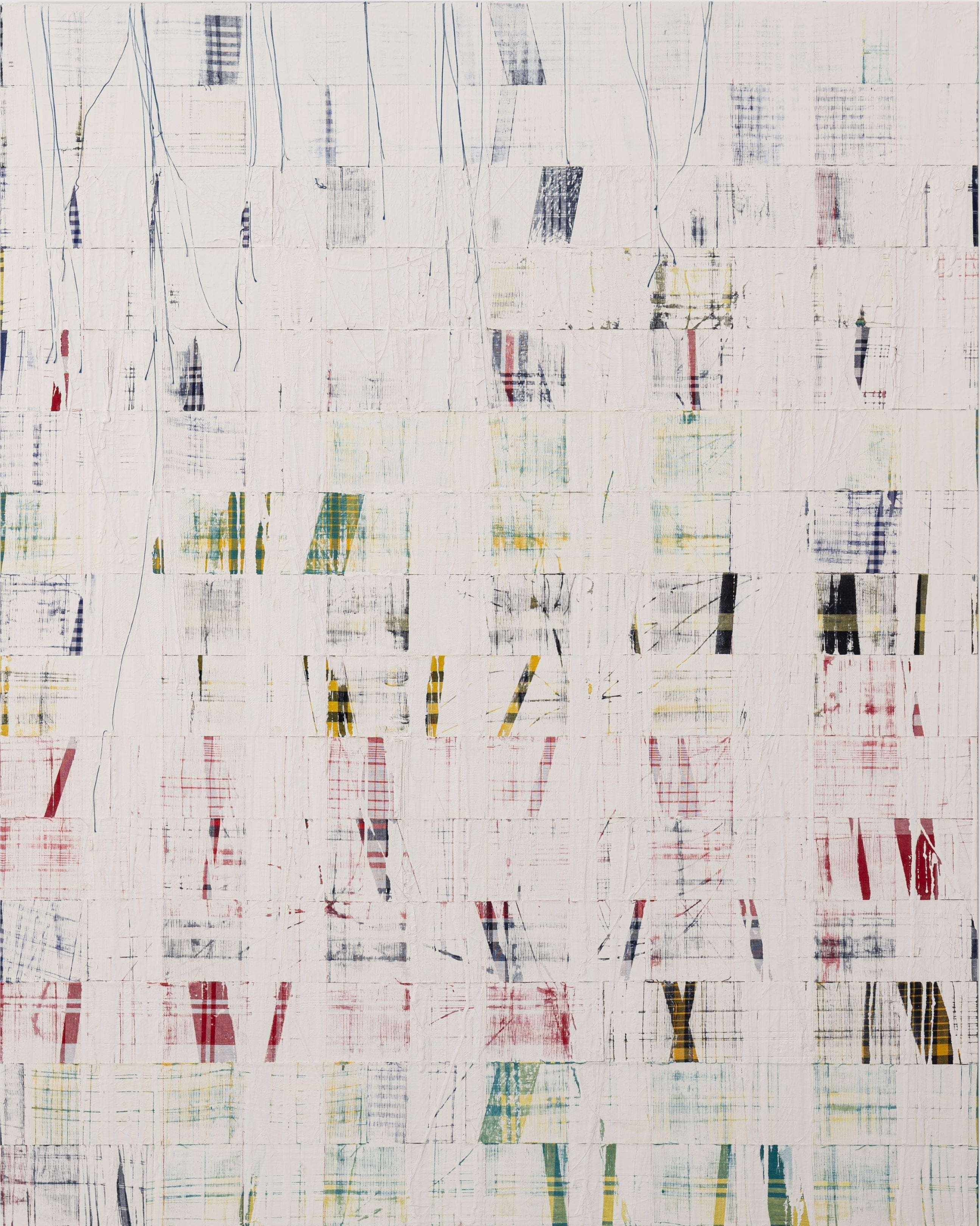
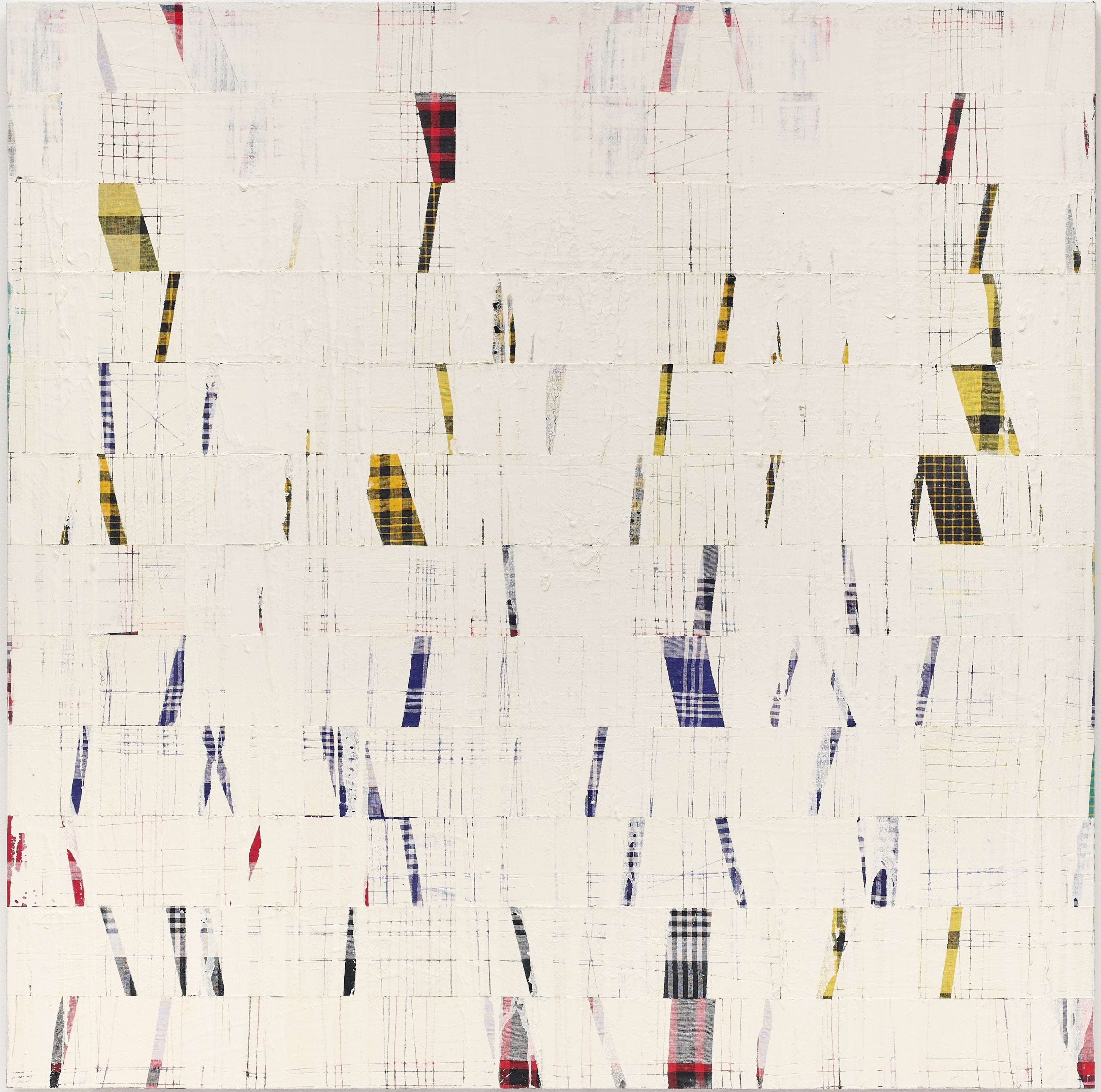
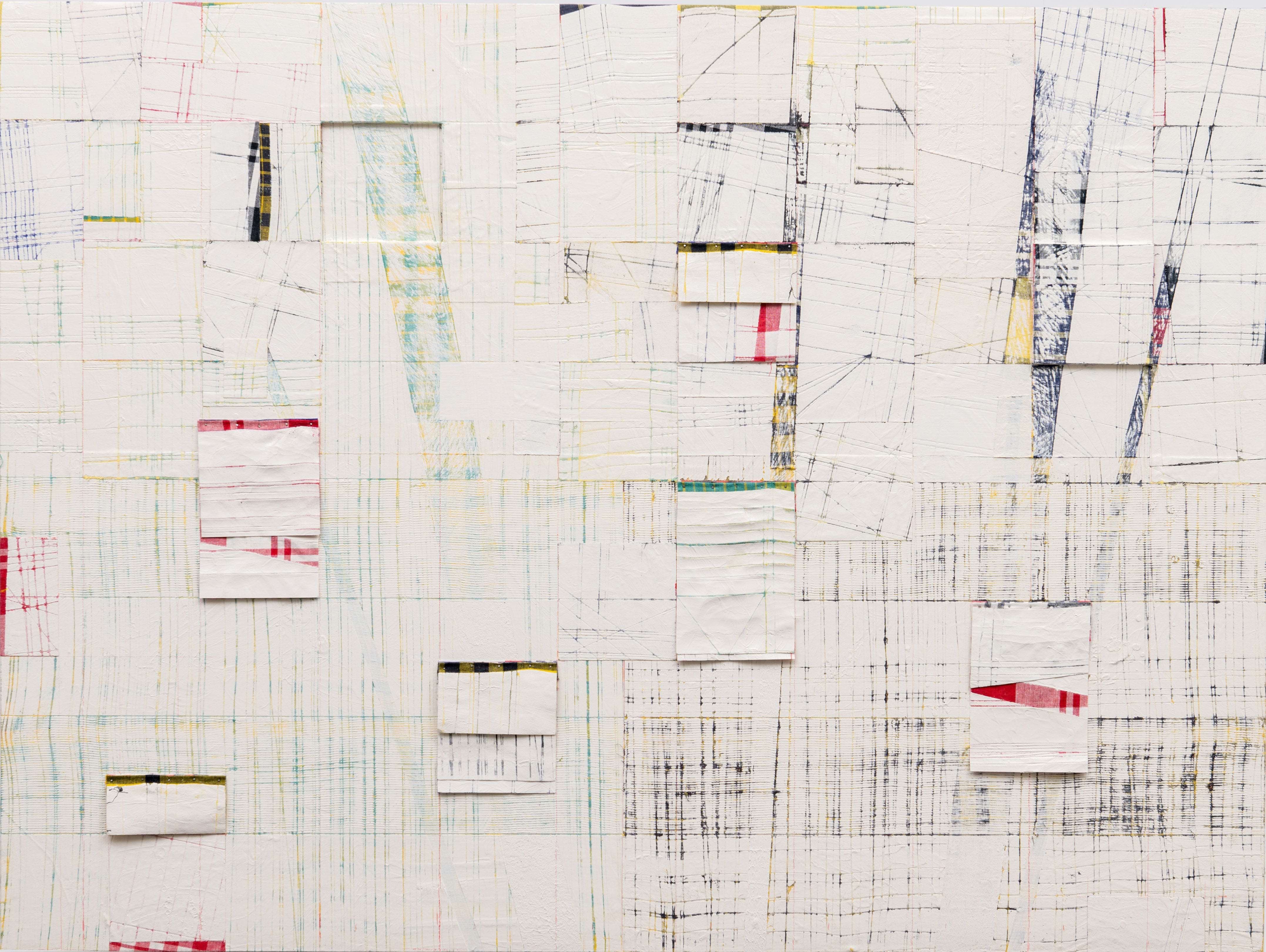
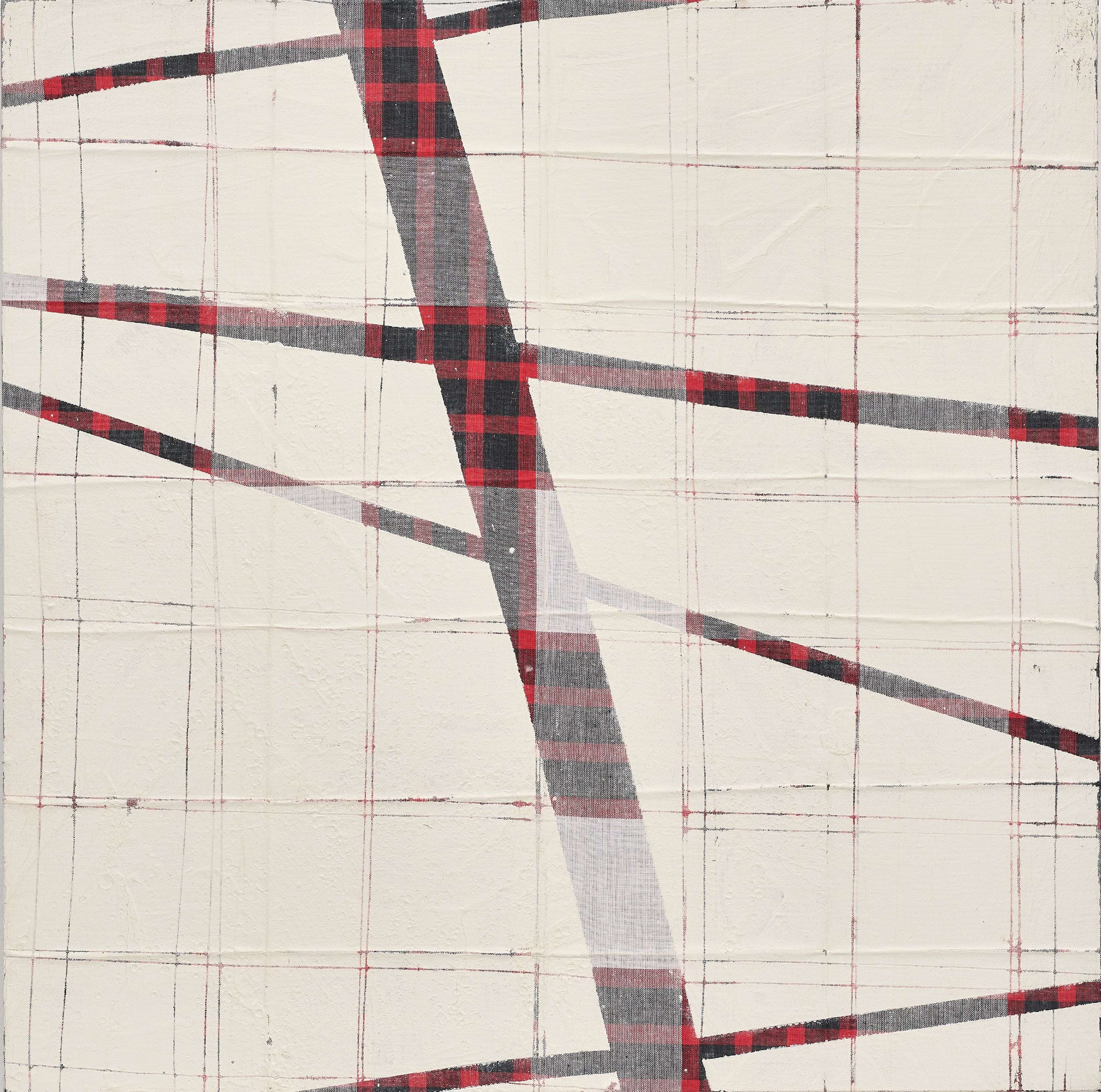
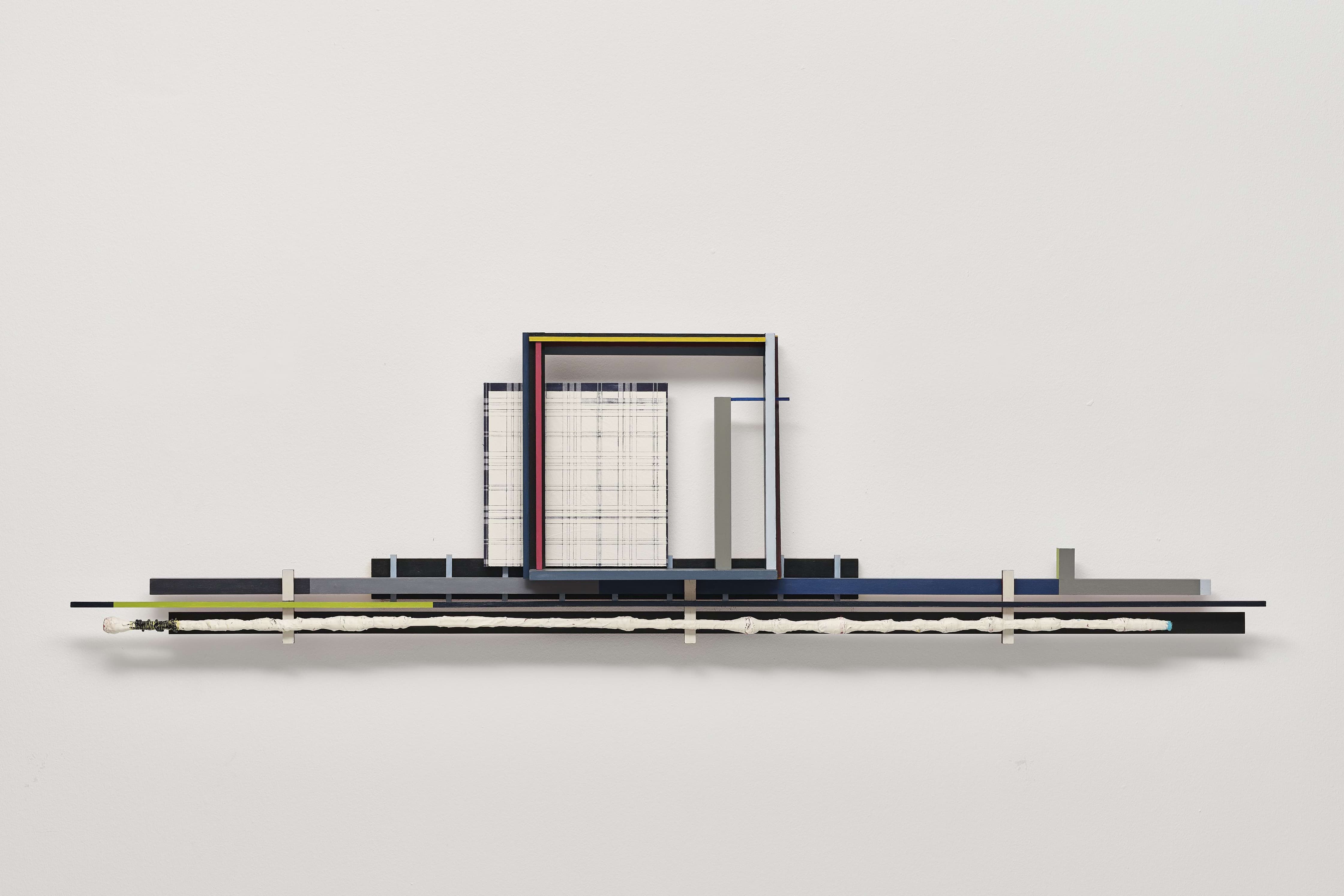
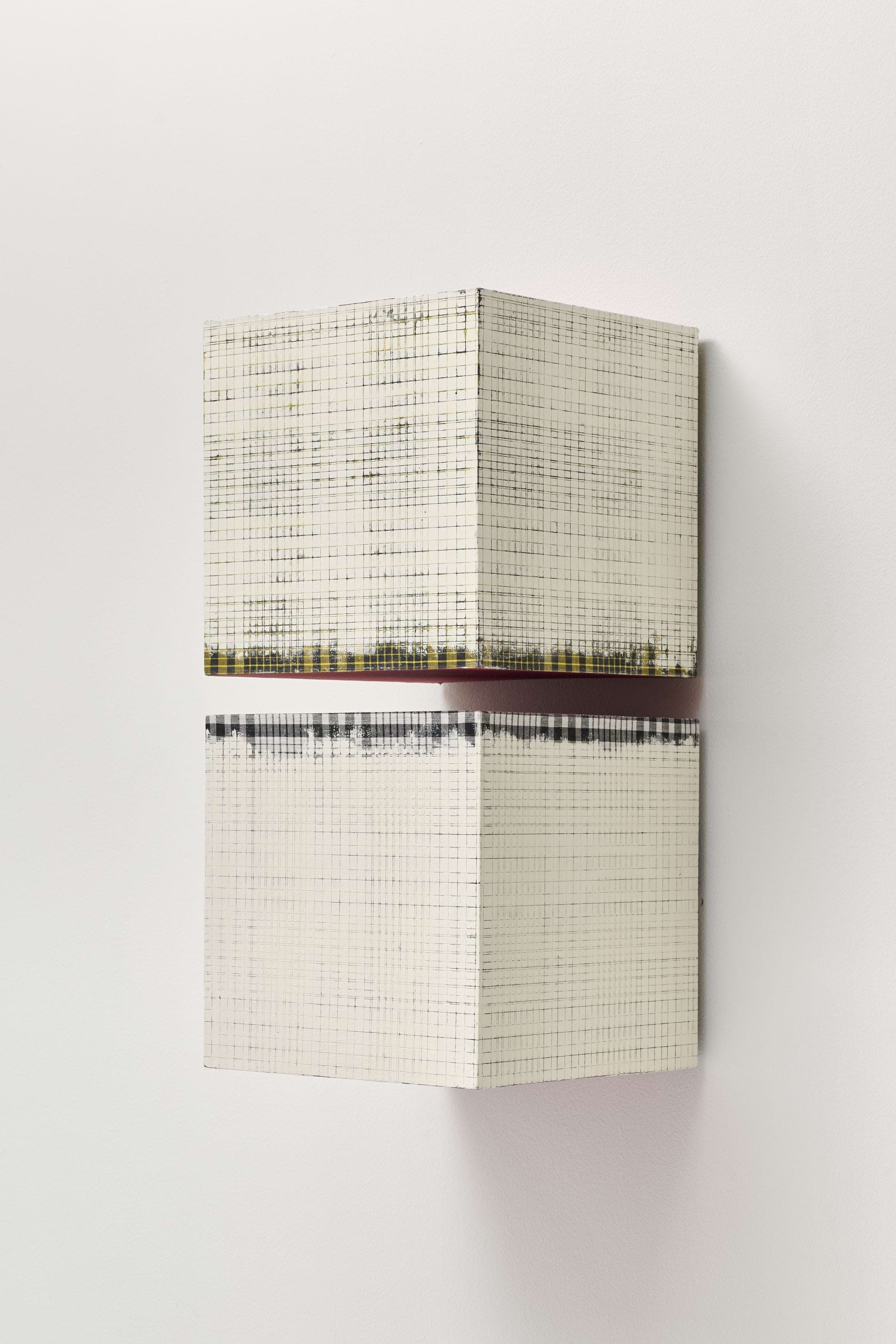
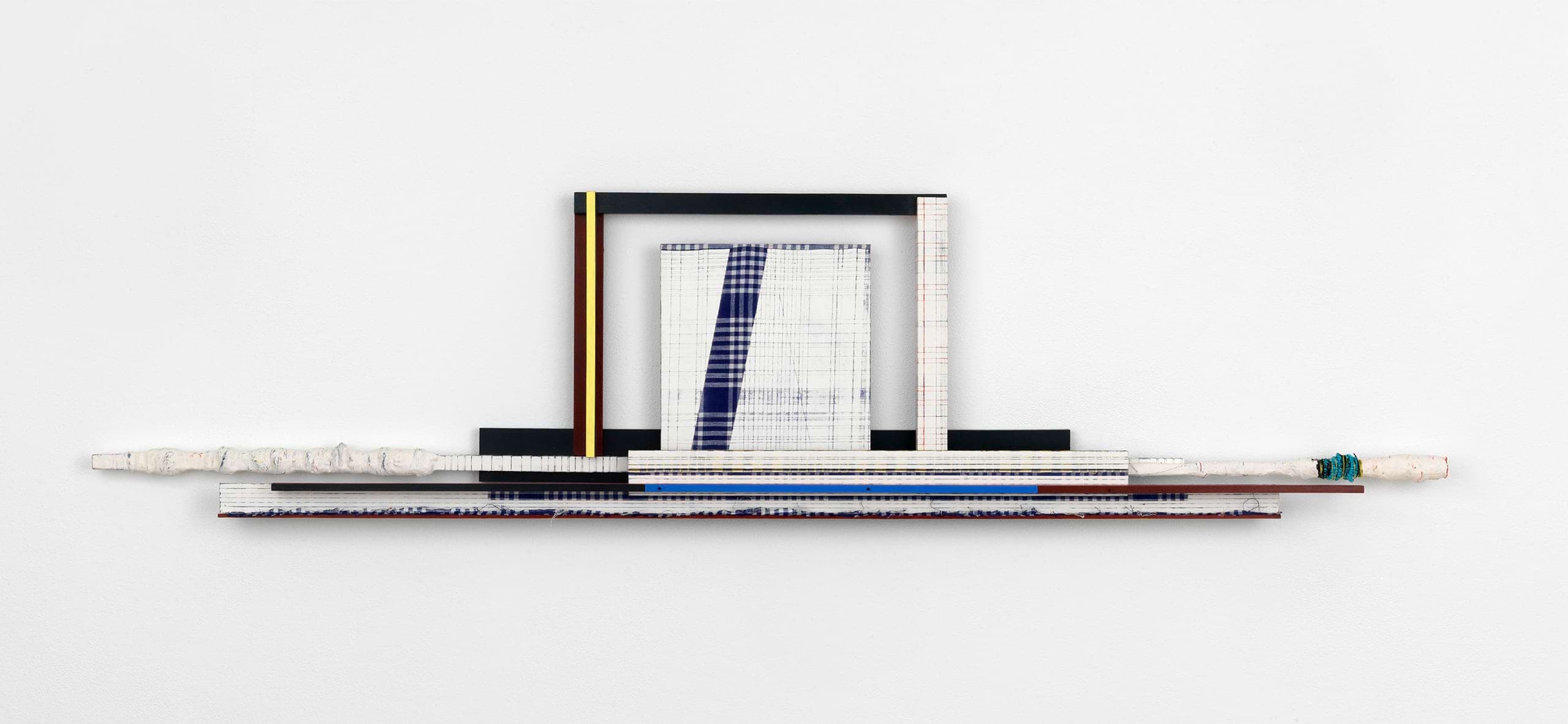
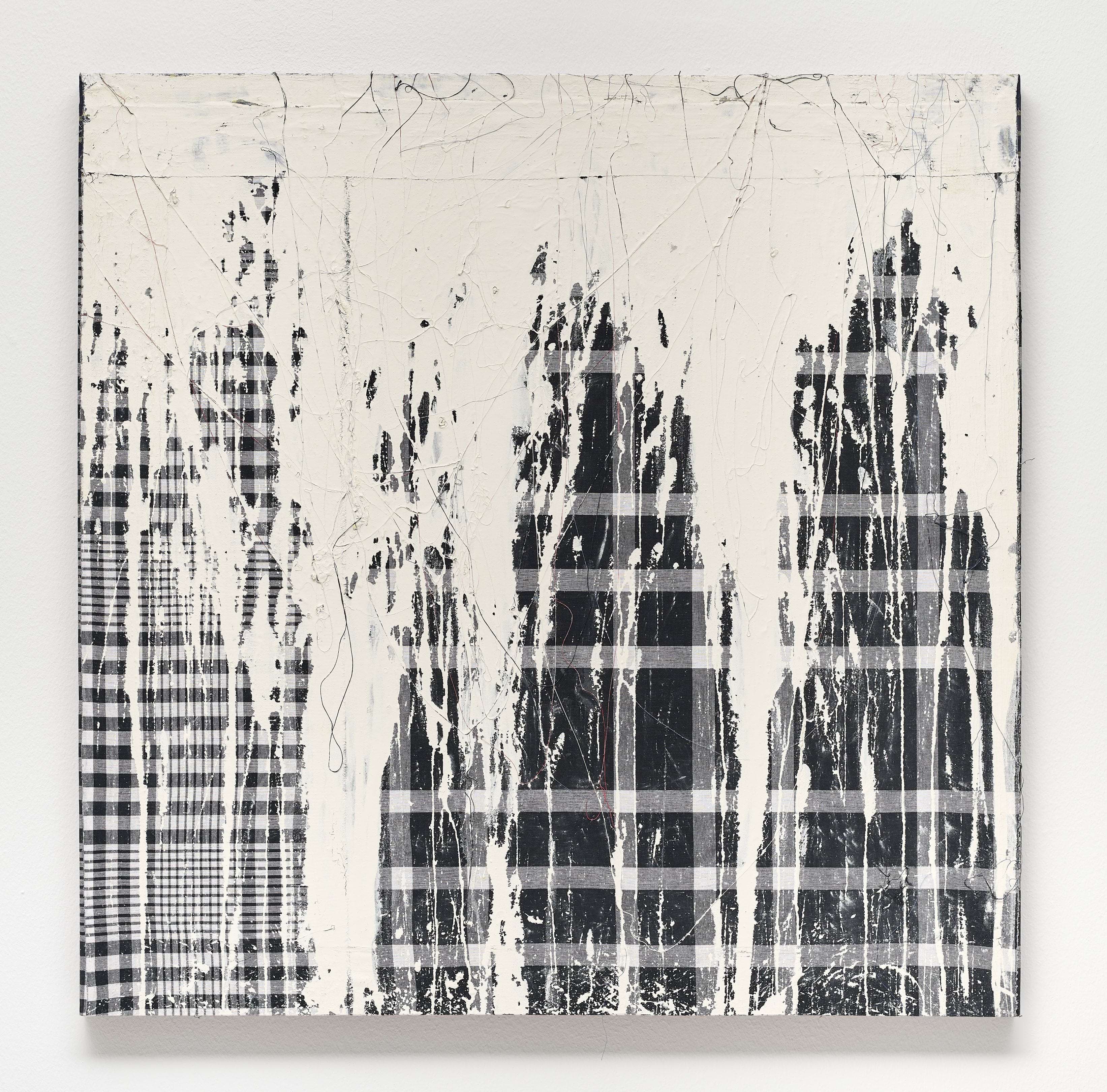
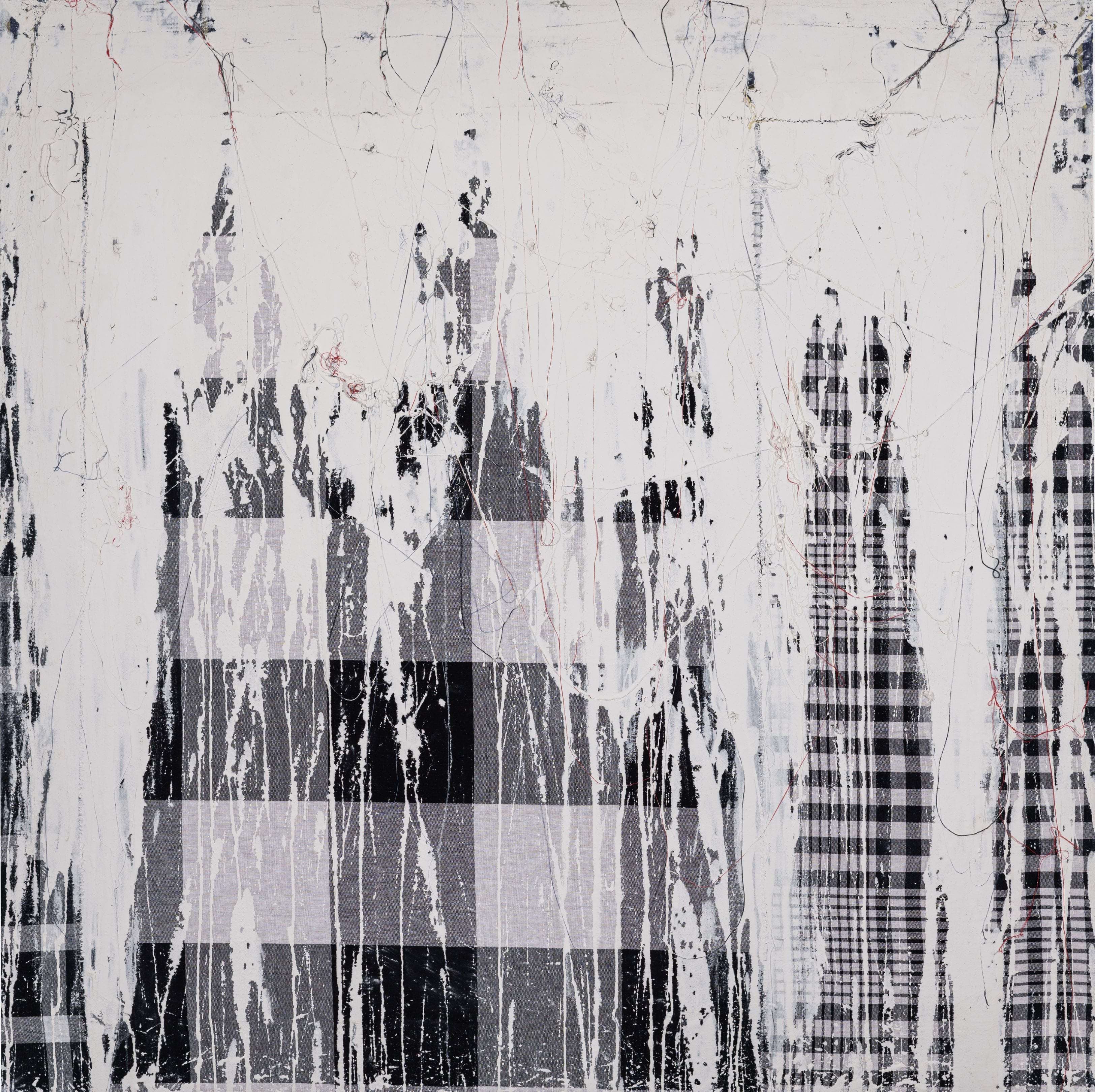
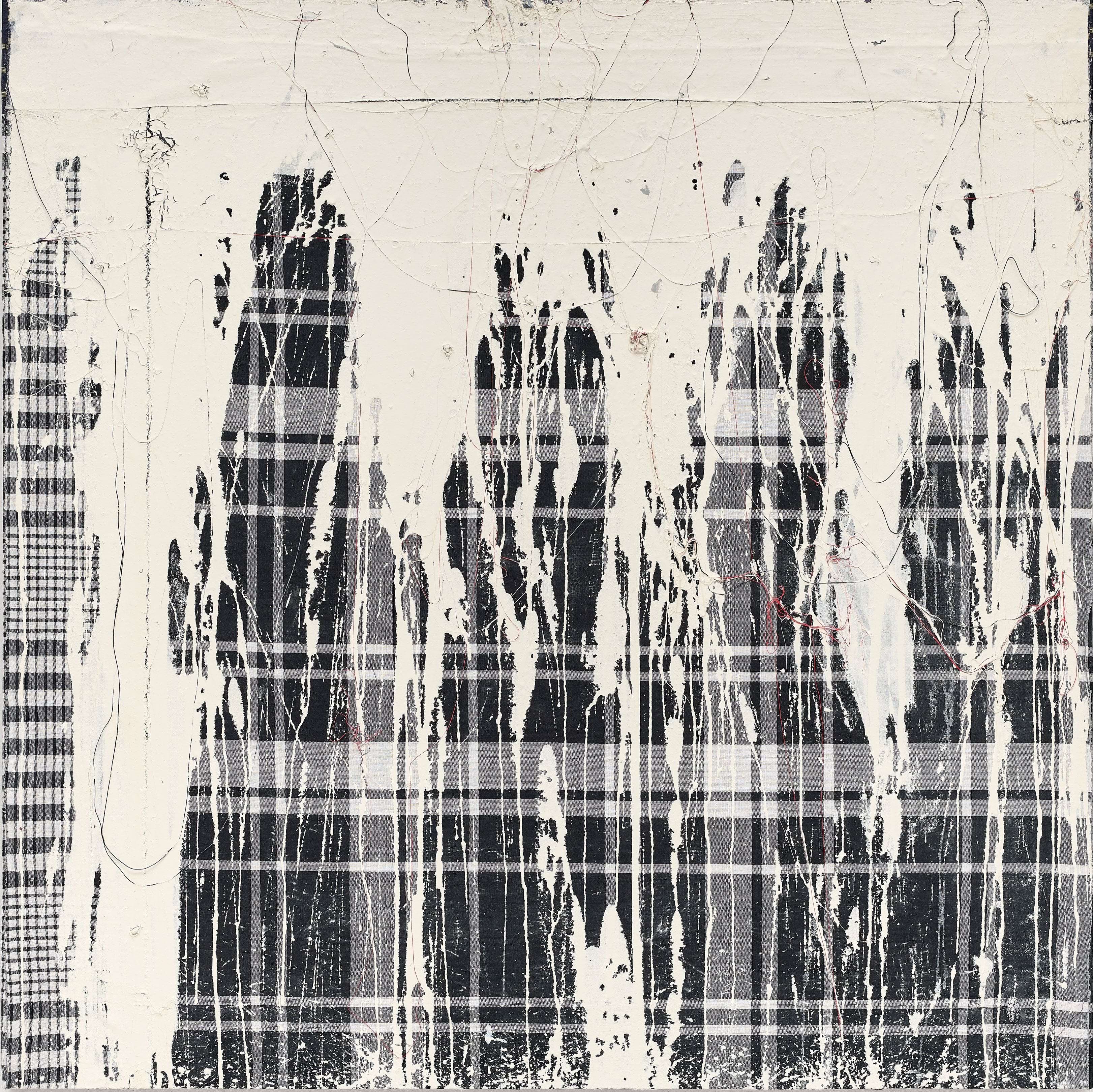
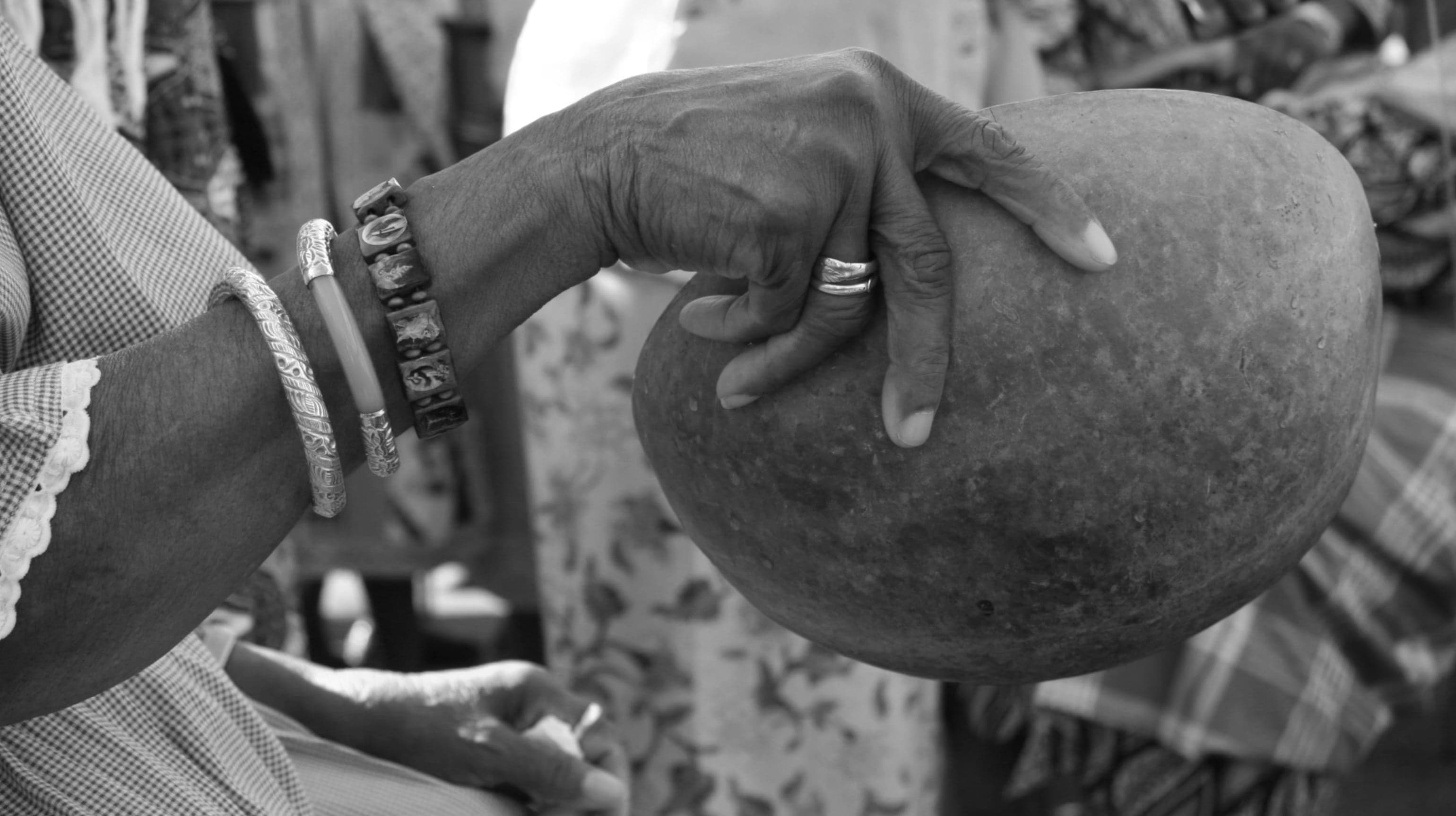
Over the past 30 years Jungerman has woven thematic threads that are deeply connected to his birthplace, Suriname, placing fragments of Maroon textiles and other materials found in the African diaspora in direct contact with materials and imagery drawn from more “established” art traditions. Through this the artist presents a peripheral vision that enriches our perspective on art history. At the core of his practice, Jungerman uses kaolin clay and gridded textiles employed for rituals in the Afro-Surinamese Winti religion, harnessing their symbolic presence in his work. Winti people use the clay on their bodies for purification and wear specific fabric colour combinations that correlate with the four key elements: water, earth, air and forest.
Titles for works come from sonic influences and geographical locations of Surinamese Maroon settlements. The 'AGIDA' series is guided by the low-tone, 2 metre-long drum that is played for a ritual that is connected to the Earth.
Jungerman’s horizontal works are inspired by the personal spaces where Winti devotees commune with their spiritual entities. Horizontals are composed of slats of varying length, width, and colour, stacked atop one another or attached with small gaps in between. No matter the variety of additional elements or seeming randomness of a stack’s composition, the works always manifest balance. This stems from the Winti tradition of striving to achieve balance with one’s surroundings.
Jungerman’s horizontal works are inspired by the personal spaces where Winti devotees commune with their spiritual entities. Horizontals are composed of slats of varying length, width, and color, stacked atop one another or attached with small gaps in between. No matter the variety of additional elements or seeming randomness of a stack’s composition, the works always manifest balance. This stems from the Winti tradition of striving to achieve balance with one’s surroundings.
Photography: Aatjan Renders
Jungerman’s horizontal works are inspired by the personal spaces where Winti devotees commune with their spiritual entities. Horizontals are composed of slats of varying length, width, and color, stacked atop one another or attached with small gaps in between. No matter the variety of additional elements or seeming randomness of a stack’s composition, the works always manifest balance. This stems from the Winti tradition of striving to achieve balance with one’s surroundings.
At the art academy in Paramaribo, Jungerman was introduced to the book Afro-American Arts of the Suriname Rain Forest (1980) by Sally and Richard Price, a report of a comprehensive study conducted in the interior region of Suriname by two American scholars. The book opened Jungerman’s eyes to the aesthetics of Maroon culture, particularly the geometric patterns of shoulder capes, and he discerned a link between the images in the book and Western modernism.
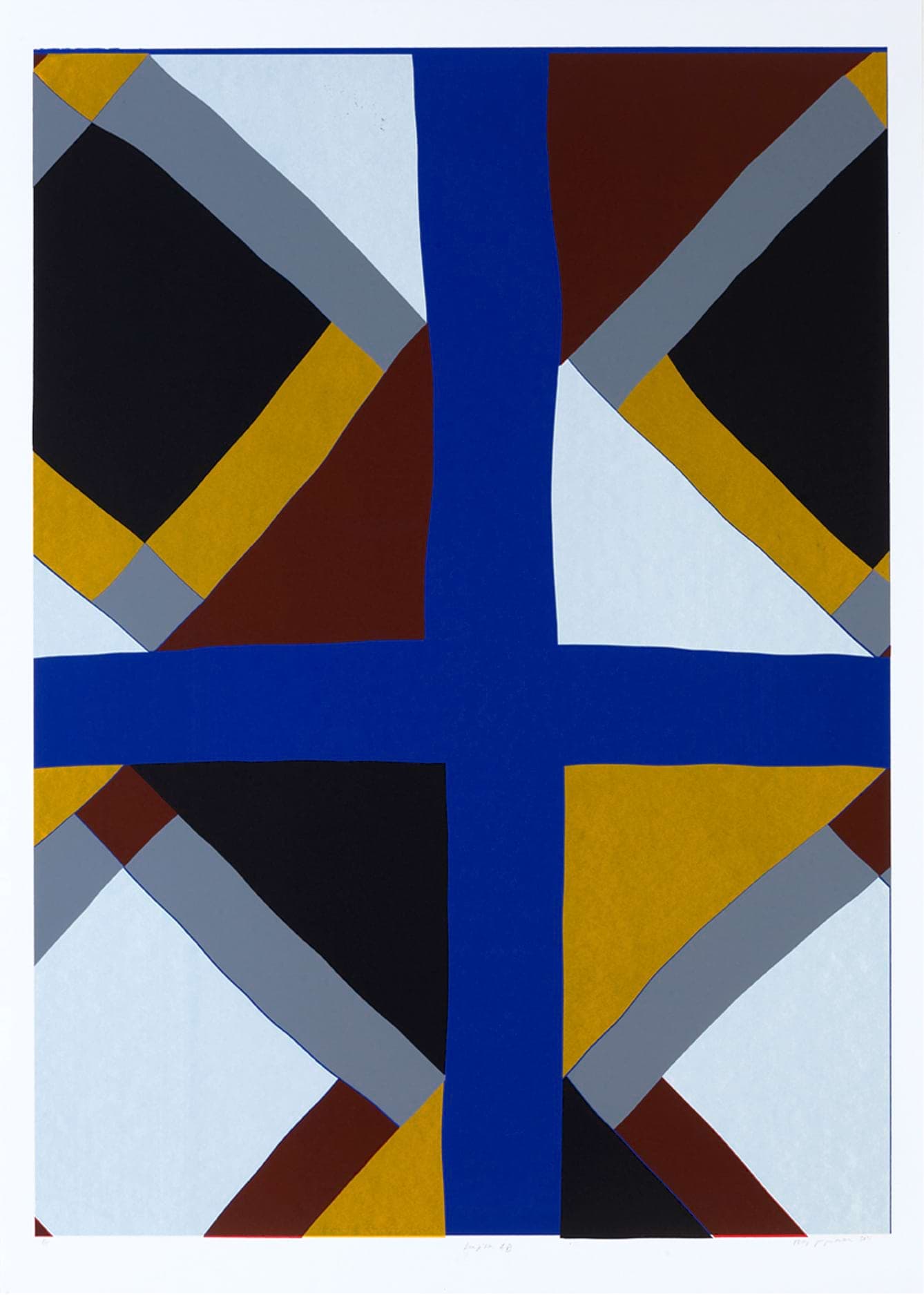
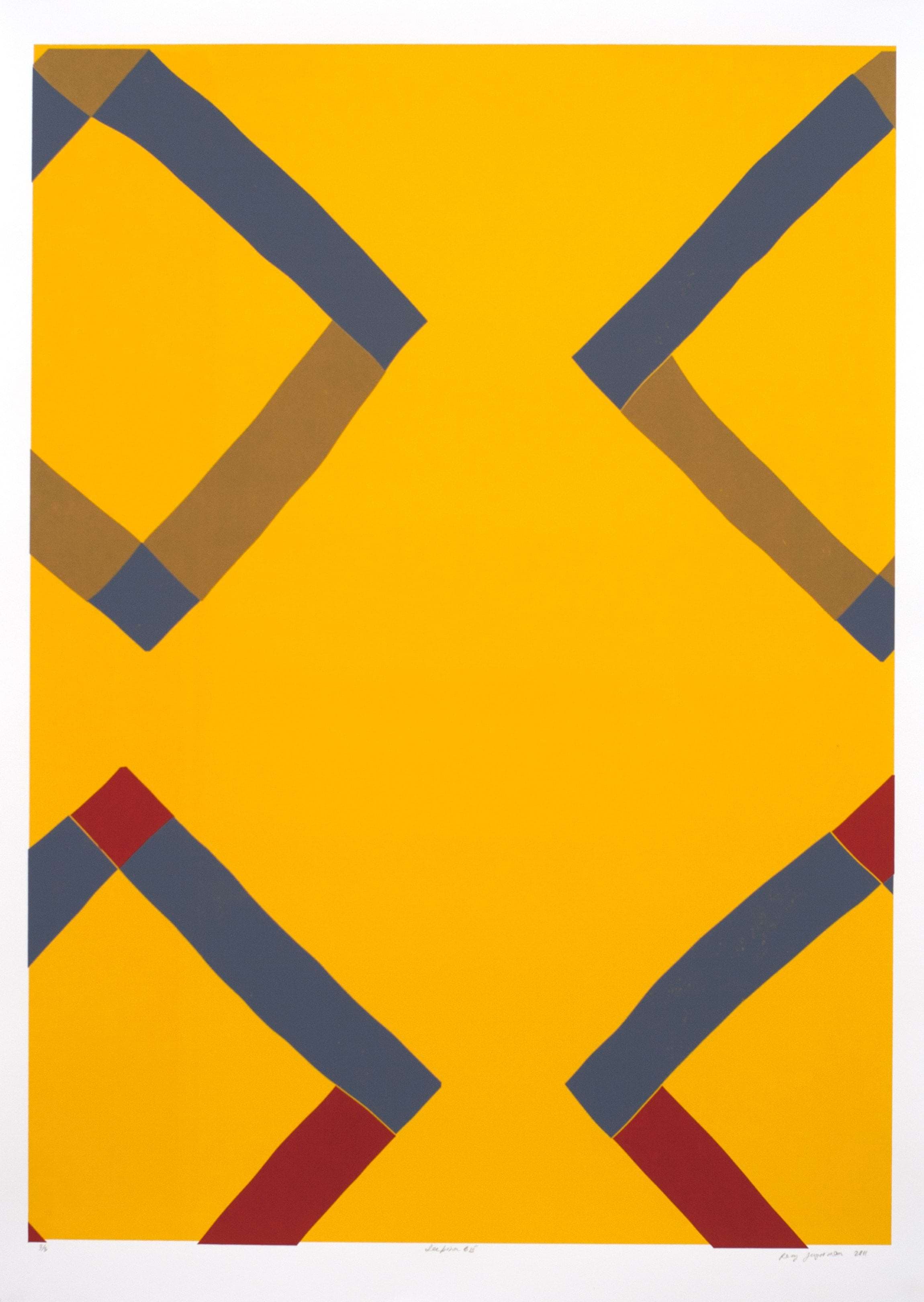
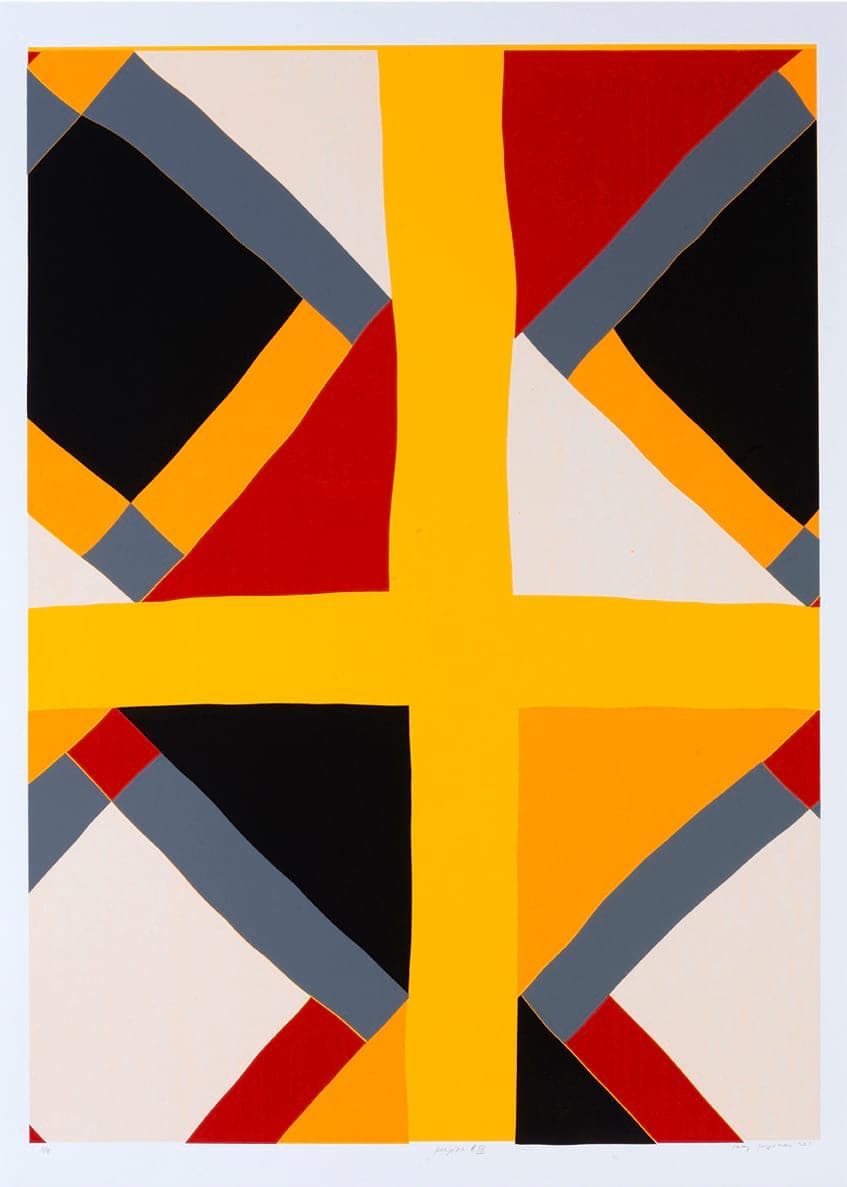
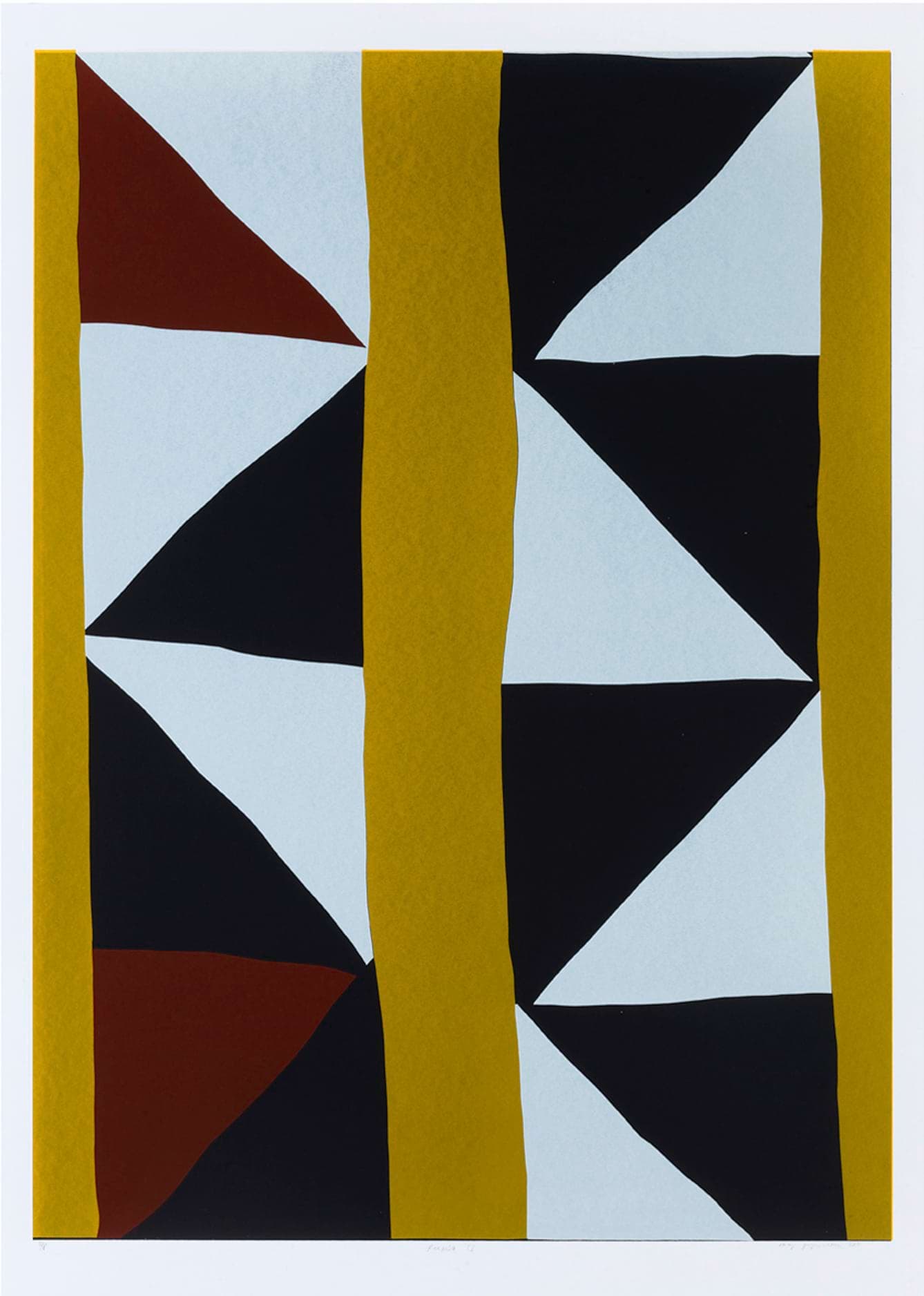
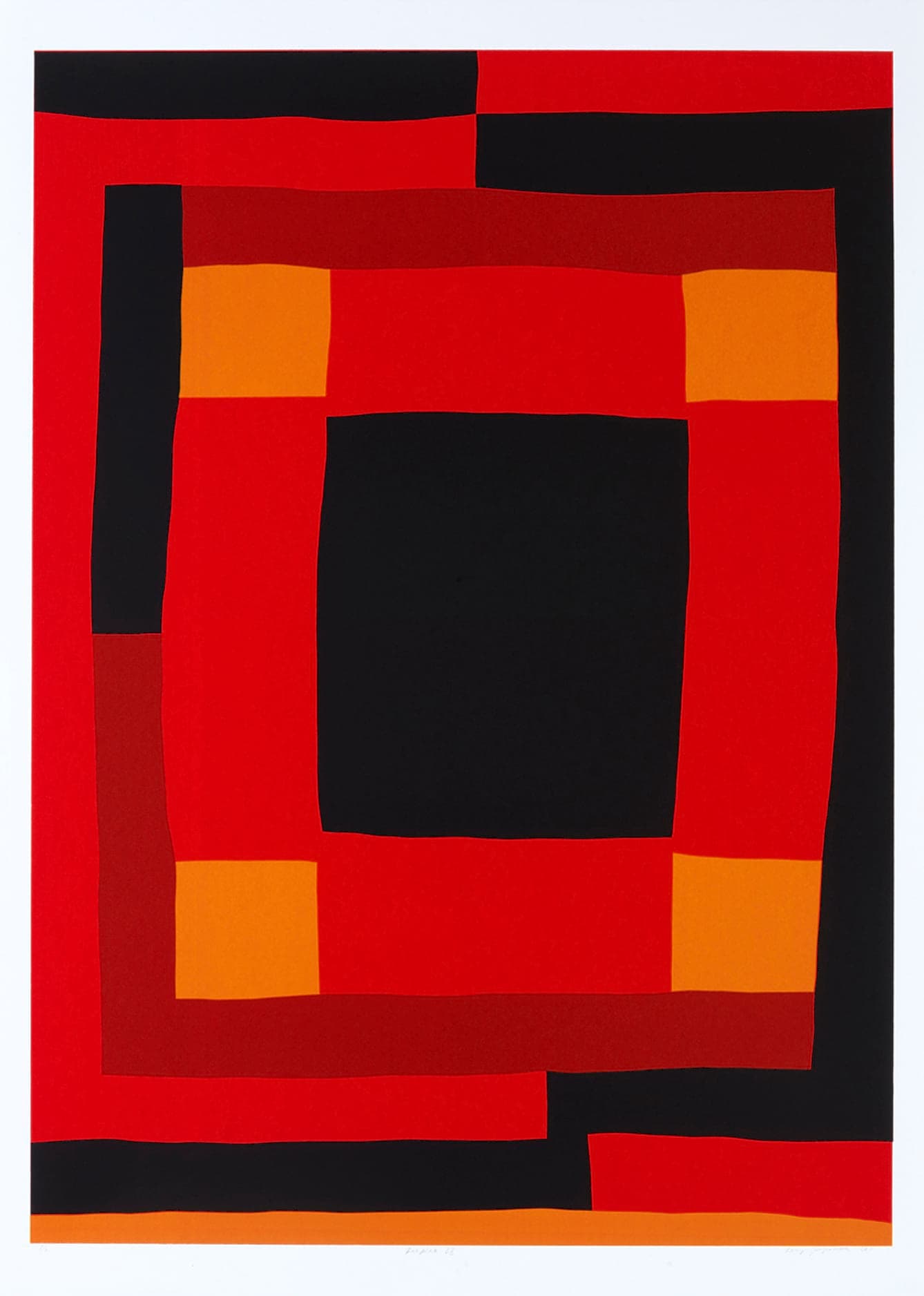
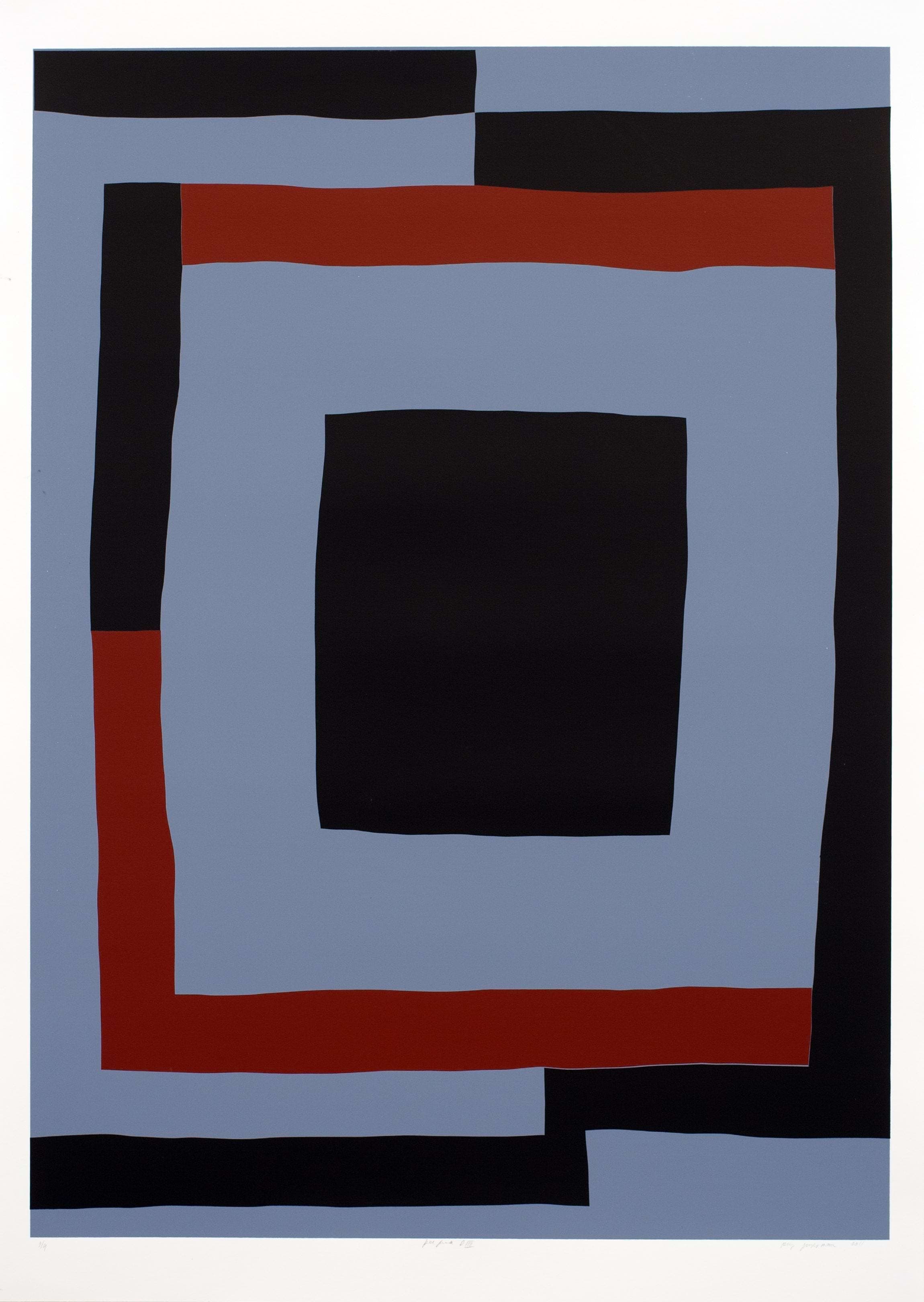
In 2011, he made a series of silkscreens based on details of shoulder capes in the book. The patterns and colors invite reference to Western abstraction while simultaneously retaining visible evidence of their origin: lines on fabric will never be mistaken for the completely straight ones found in works of Western modernism.
At the art academy in Paramaribo, Jungerman was introduced to the book Afro-American Arts of the Suriname Rain Forest (1980) by Sally and Richard Price, a report of a comprehensive study conducted in the interior region of Suriname by two American scholars. The book opened Jungerman’s eyes to the aesthetics of Maroon culture, particularly the geometric patterns of shoulder capes, and he discerned a link between the images in the book and Western modernism.
In 2011, he made a series of silkscreens based on details of shoulder capes in the book. The patterns and colors invite reference to Western abstraction while simultaneously retaining visible evidence of their origin: lines on fabric will never be mistaken for the completely straight ones found in works of Western modernism.
At the art academy in Paramaribo, Jungerman was introduced to the book Afro-American Arts of the Suriname Rain Forest (1980) by Sally and Richard Price, a report of a comprehensive study conducted in the interior region of Suriname by two American scholars. The book opened Jungerman’s eyes to the aesthetics of Maroon culture, particularly the geometric patterns of shoulder capes, and he discerned a link between the images in the book and Western modernism.
In 2011, he made a series of silkscreens based on details of shoulder capes in the book. The patterns and colors invite reference to Western abstraction while simultaneously retaining visible evidence of their origin: lines on fabric will never be mistaken for the completely straight ones found in works of Western modernism.
At the art academy in Paramaribo, Jungerman was introduced to the book Afro-American Arts of the Suriname Rain Forest (1980) by Sally and Richard Price, a report of a comprehensive study conducted in the interior region of Suriname by two American scholars. The book opened Jungerman’s eyes to the aesthetics of Maroon culture, particularly the geometric patterns of shoulder capes, and he discerned a link between the images in the book and Western modernism.
In 2011, he made a series of silkscreens based on details of shoulder capes in the book. The patterns and colors invite reference to Western abstraction while simultaneously retaining visible evidence of their origin: lines on fabric will never be mistaken for the completely straight ones found in works of Western modernism.
At the art academy in Paramaribo, Jungerman was introduced to the book Afro-American Arts of the Suriname Rain Forest (1980) by Sally and Richard Price, a report of a comprehensive study conducted in the interior region of Suriname by two American scholars. The book opened Jungerman’s eyes to the aesthetics of Maroon culture, particularly the geometric patterns of shoulder capes, and he discerned a link between the images in the book and Western modernism.
In 2011, he made a series of silkscreens based on details of shoulder capes in the book. The patterns and colors invite reference to Western abstraction while simultaneously retaining visible evidence of their origin: lines on fabric will never be mistaken for the completely straight ones found in works of Western modernism.
At the art academy in Paramaribo, Jungerman was introduced to the book Afro-American Arts of the Suriname Rain Forest (1980) by Sally and Richard Price, a report of a comprehensive study conducted in the interior region of Suriname by two American scholars. The book opened Jungerman’s eyes to the aesthetics of Maroon culture, particularly the geometric patterns of shoulder capes, and he discerned a link between the images in the book and Western modernism.
In 2011, he made a series of silkscreens based on details of shoulder capes in the book. The patterns and colors invite reference to Western abstraction while simultaneously retaining visible evidence of their origin: lines on fabric will never be mistaken for the completely straight ones found in works of Western modernism.