On Practice: An Interview with Lindokuhle Sobekwa
Lindokuhle Sobekwa is a photographer whose work presents personal stories while tracing memory, loss, migration and belonging within larger collective narratives. Introduced to photography in 2012 through the Of Soul and Joy photography education programme, the photographer has developed a practice shaped as much by lived experience as the unresolved. His images unfold as fragments that speak to the complexities of family, community, and South African history. Over the last few years, the photographer’s work has gained significant international recognition, with exhibitions across major institutions including the Museum of Modern Art.
In this interview, Sobekwa reflects on his evolving practice and the ideas underpinning his recent exhibitions.
Goodman Gallery (GG): Your photographic practice is connected to your own stories and that of your family. The most significant and well-known within your work is that of your sister Ziyanda, tied to the body of work “I carry Her photo with Me”, both a series of images and a photobook for which you won the 2025 Deutsche Börse Photography Foundation Prize. How does it feel to be exploring such intimate and contested family stories through your work, and with your audience?
Lindokuhle Sobekwa (LS): For me, the work has always come from a very personal place. Photography became a way of trying to understand my own life and the experiences of the people around me. The story of my sister Ziyanda is something that has lived with my family for many years, and working on “I carry Her photo with Me” was not only about making photographs but also about trying to process memory, loss, and the gaps that exist in family histories.
Exploring such intimate stories is complex because these memories are not only mine; they belong to my family as well. There are moments where it feels vulnerable, even uncomfortable, to share these experiences with a wider audience. At the same time, many families carry stories that are difficult, unresolved, or fragmented, and through the work I try to create space for those kinds of memories to exist.
But even though the work is personal and shared publicly, there are also parts of the story that remain within the family. Some memories and conversations are only shared among us, and others are left unspoken. That boundary is important to me because it acknowledges that the work comes from a collective experience, not just my own.
Photography allows me to approach these stories slowly and with care. The images, letters, and fragments in the project reflect the way memory works, it is not always clear or complete. When the work reaches an audience, I hope it moves beyond just my personal story and resonates with people who may recognise something of their own families, their own losses, or their own attempts to make sense of the past.
GG: In 2023 you won the FNB Art Prize enabling a solo exhibition at the historic Johannesburg Art Gallery (JAG) in September 2024 titled “Umkhondo: Going Deeper”. The title followed your first museum show in 2022 at Huis Marseille in the Netherlands — ‘Umkhondo. Tracing memory’. At the time you were the second photographer to win the award. The content of the show tied two interconnected bodies of work together for the first time — “I carry Her photo with Me” and “Ezilalini (The Country)”. Can you share the significance of that show in your career, and of visually connecting those two bodies of work together in one space?
LS: Winning the FNB Art Prize and presenting “Umkhondo: Going Deeper” at the Johannesburg Art Gallery was a very meaningful moment in my career. It allowed me to show the work in my home city and to bring together ideas and stories that have been developing in my practice over many years. Showing such a personal body of work in Johannesburg, close to the communities and landscapes that shaped it, gave the exhibition a deeper resonance for me.
The title “Umkhondo” refers to a trace or footprint, following a path through memory and history. That idea connects the two bodies of work shown together. “I carry Her photo with Me” reflects on my family history and the story of my sister, while “Ezilalini (The Country)” looks at rural life, migration, and the connection between the city and the countryside. “Ezilalini” is also deeply personal because it is where my sister Ziyanda is buried and where my family calls home. Returning there changed how I saw the landscape, it became a place where I searched for traces of her while reconnecting with my own roots.
I also showed “uMthimkhulu III”, part of my ongoing family tree project. This iteration was printed on fabric, referencing mine workers’ clothing, as many members of my family worked in the gold mines. At the centre of the tree is a photograph of my uncle Mxolisi, who followed his father to Johannesburg to work in the mines but later disappeared and never returned home. The image shows him sewing other mine workers’ clothing in the migrant hostel where he lived, and from that photograph many other stories, letters, images, and fragments of family history, branch out across the tree.
GG: Your work tackles themes related to migration, loss and resilience, particularly between Johannesburg, particularly Thokoza where you lived and your ancestral home of the Eastern Cape. In your 2025 gallery exhibition “Shifting Sands” you introduced a new body of work which looked at this quite intimately, thinking about land and belonging. Can you share more about the more recent body of work and how it continues/adds to your exploration of these themes?
LS: Many of these projects remain connected to my earlier work because they come from the same personal histories that first shaped my practice. I often return to certain places, memories and archives, not to repeat them but to see how time changes my relationship to them.
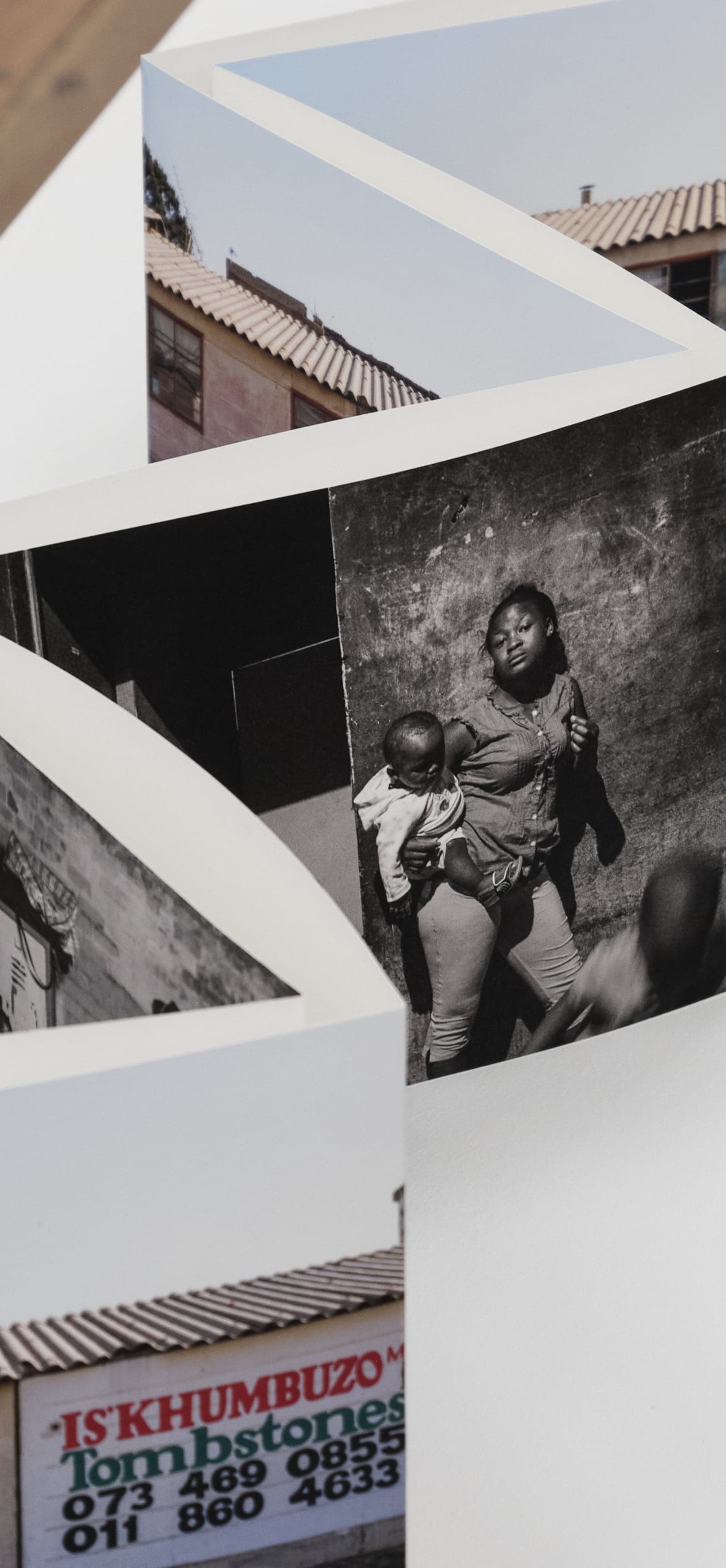
The hostel appears again in this body of work. It is a place that carries a very personal history for me, as it is where my sister was found after she had been missing for eleven years. In my earlier work I photographed these spaces very closely, mostly in black and white. In “Shifting Sands” I return to that archive while also introducing colour photographs of the hostel’s architecture, taken while passing by it in a taxi. These images are presented in an accordion book where the exterior strip of the hostel connects with interior photographs from my earlier work, allowing the place to take on new meaning.
This process of returning also extends to the Eastern Cape. I photograph these landscapes not to romanticise them but to think of them as sites of memory and knowledge shaped by oral histories and lived experience.
The title “Shifting Sands” also acknowledges the influence of Santu Mofokeng and his exhibition “Like Shifting Sands”. Like his work, I am interested in how ordinary spaces and everyday moments can carry traces of memory, absence and resilience.
GG: Connected to what you explore around migration, resilience and survival is of course memory, another important theme in your work. In reflecting on it you revisit and reimagine, thinking about how memory can betray you or open up pathways to unseen realities. You also think about the structural erasure of memory when looking at the history of South Africa. Attached to this is ideas around haunting, lingering presences, and a desire for final places of rest. How does this fixation on memory allow you to deep dive into the familial and national narratives you are concerned with?
LS: Memory is central to how I approach photography because many of the stories I’m interested in exist in fragments in what people remember, what has been forgotten, and what has been deliberately erased. In South Africa, memory is complicated because history itself has often been shaped by systems that silenced the experiences of Black families and communities. Because of this, memory can be both fragile and powerful.
In my work I’m interested in how memory shifts and sometimes betrays us. What we remember is often incomplete, and the gaps can reveal as much as what is clearly recalled. Photography allows me to explore those spaces between remembering and forgetting, not to prove a single truth but to hold different layers of memory together.
This is where ideas of haunting and lingering presences enter the work. When someone is gone, their presence remains in places, objects and landscapes. Through the images I try to acknowledge how the past continues to shape our present, connecting personal family histories with broader histories of migration, loss and survival in South Africa.
GG: In conjunction with your photographic practice is the iterative process of making the autobiographical installation of a large tree titled “uMthimkhulu”. Consisting of collage elements, the first iteration was produced during your residency at A4 Arts Foundation in 2020, the third as part of your FNB Art Prize show at JAG and the most recent as part of the 2025 MoMA show “Contemporary Photography: Lines of Belonging”. Can you share your process of making each iteration, and how this idea has developed over time?
LS: “uMthimkhulu” is an ongoing body of work that has developed slowly over time, much like the growth of a tree. The project emerged from “Ezilalini (The Country)” when I was working on connecting different members of my family. During that process, I realised how large and complex our family is, and how many oral and untold stories exist within it. I began to think of the family tree not only as a way of mapping lineage, but also as a way of holding fragmented histories that are deeply personal yet connected to the broader history of South Africa.
The family trees themselves come from a deep collaboration with my family, both in the Eastern Cape and in Johannesburg. We gather together and do this memory work collectively recalling names, stories and connections, and trying to trace what remains and what has disappeared across generations.
The installation takes the form of a tree constructed through collage, combining photographs, texts and fragments from my personal archive. The first iteration was produced during my residency at A4 Arts Foundation in 2020, where the work began as an intuitive process of assembling these materials directly onto the wall. It expanded when I presented another version as part of my FNB Art Prize exhibition at the Johannesburg Art Gallery.
The most recent iteration, “uMthimkhulu IV”, was presented in “Contemporary Photography: Lines of Belonging” at the Museum of Modern Art in 2025, becoming the fourth tree in an ongoing series. This version was printed using polymer photogravure on gampi paper, developed in collaboration with both local and international printmakers. For me, the family tree functions as a map, connecting and disconnecting, tracing what remains and what has disappeared, while revealing how memory itself is assembled rather than simply found.
GG: Looking at the evolution of your practice so far, how are you thinking about the future of your practice and your relationship to photography?
LS: As my practice evolves, I find myself thinking about photography less as a fixed medium and more as a starting point for exploring different ways of working. Many of my earlier projects were very intuitive and centred on making photographs, but over time the work has expanded to include archives, installation and different ways of presenting images.
In the future, I see the practice continuing to grow in that direction. I am interested in experimenting with other forms of storytelling that can expand or enhance photography—whether through mark-making, handwriting, moving images, or the combination of photographs with text, sound and performance. These approaches allow the work to move beyond the single photograph and open up new ways of engaging with the images.
I am also interested in revisiting earlier projects and allowing them to evolve over time, rather than seeing them as closed bodies of work. Returning to archives, reworking images, and presenting them in new forms has become an important part of my process.
Photography will always remain central to my practice, but I see it increasingly as part of a broader language that continues to grow and change as the work develops.