Grada Kilomba 'The Archive: a memorial work of art'
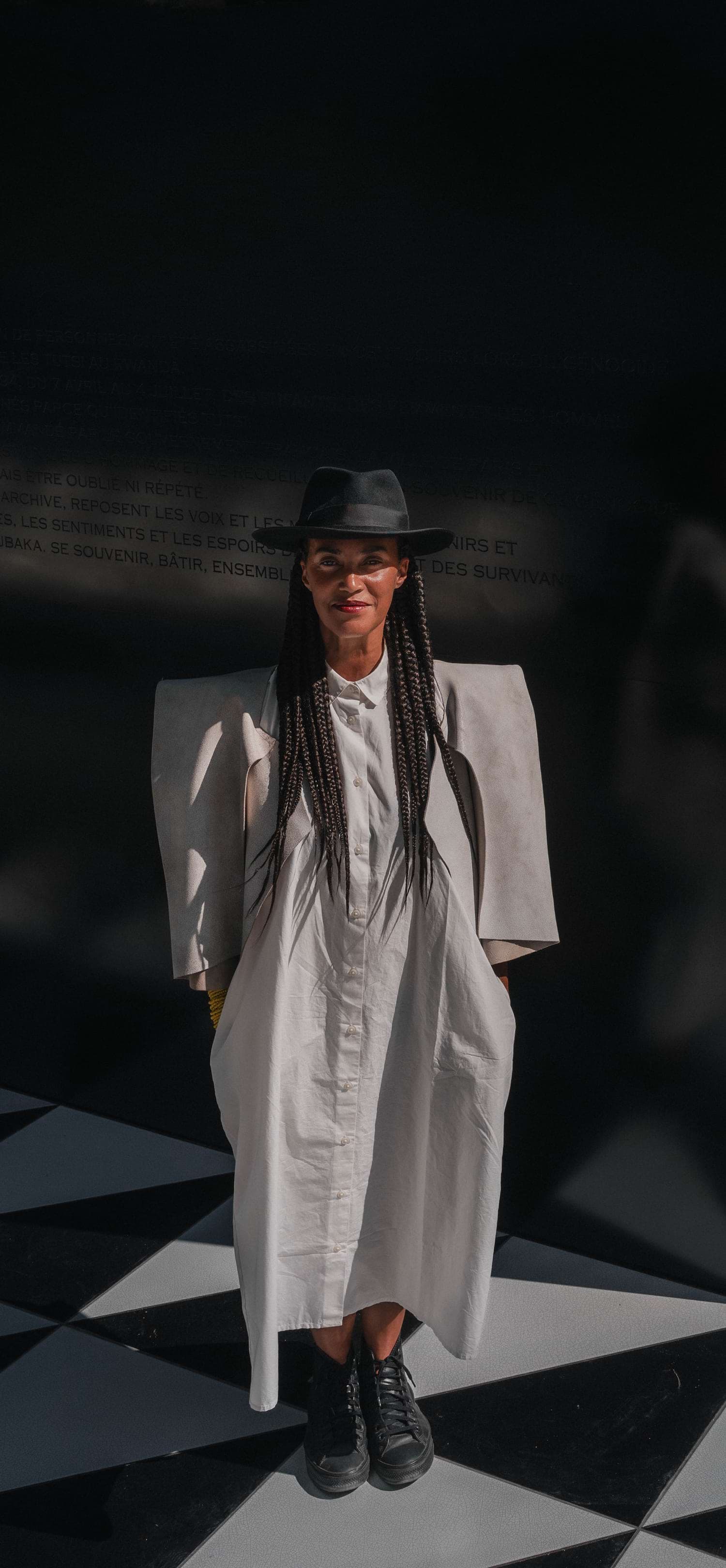
In response to the memorial commission, the artist Grada Kilomba conceived a monument with clean lines, consisting of a geometric pavement in enamelled lava supporting two solid black brass volumes erected vertically in parallel. On the four widest faces of the two parallelepiped forms, a text recalling the tragedy and calling for remembrance appears in the uniform black surface.
Addressing passers-by in French, English, Swahili, and Kinyarwanda, the monument aspires to universality, speaking equally to the Rwandan community, the city’s inhabitants, and international visitors. The four narrowest sides bear the names of the four principal memorial sites of the genocide, inscribed on the UNESCO World Heritage List — Nyamata, Murambi, Gisozi, and Bisesero — thus anchoring this symbolic space in a tangible and incontrovertible geography.
The monument’s message and proportions, at once solemn and humane, encourage passers-by to slow their pace, draw closer, and take time for reflection. Reading the text requires close proximity to the work, creating an intimate encounter conducive to introspection. Each visitor is invited to traverse the space in a form of ritual, thereby participating in the process of remembrance.
The void between the blocks embodies the absence left by the dead, as well as the risk of forgetting; to cross it is to enact a gesture of homage to both victims and survivors. This experience invites each visitor to engage with their own humanity.
Entitled The Archive, the work by Grada Kilomba, a Portuguese artist of São Toméan and Angolan descent, is presented without a pedestal; grounded in the material reality of the world, it engages directly with the present.
The pavement evokes Rwandan cultural heritage by drawing on traditional itana / amanata motifs. These triangular and serial forms recall the topography of the “land of a thousand hills”, while symbolising the multiplicity of voices that constitute a community united in memory. This artistic and decorative practice, imigongo, transmitted from mother to daughter since the eighteenth century to adorn traditional houses in south-eastern Rwanda, has served as a tool of resilience following the genocide, linking memory, transmission, and cultural renewal.
While rooted in Rwandan tradition, The Archive also draws fully on its creator’s formal vocabulary, characterised by the contrast of black and white, repetition, the use of ritual, and the deployment of minimal forms. For Grada Kilomba, black is a singular colour, capable of conveying complex emotions, experiences, and meanings, including loss, pain, memory, embrace, respect, and honour. With a strong academic background in psychoanalysis and philosophy, Grada Kilomba interrogates dominant systems of writing history, focusing on gaps, silences, and individual or collective trauma. Drawing on a wide range of media — including performance, sculpture, and installation — the artist, who is also a writer, seeks to give voice and form to narratives that are often marginalised or erased, in an approach sometimes described as “new postcolonial minimalism”.
By expressing the danger of violence that remains unacknowledged, the monument conceived by Grada Kilomba reminds us that forgetting constitutes the primary architecture of violence and dehumanisation. By adopting the language of geometric abstraction, the memorial to the victims of the genocide against the Tutsi expresses, through its minimalism, the unspeakable and the unimaginable — what neither words nor images can fully convey.
While offering a singular artistic language, Grada Kilomba’s project also engages with a lineage of memorial works now inscribed in the history of art which, in opposition to figurative, allegorical, or heroic approaches, derive their power from a dialectic between extreme formal restraint, the viewer’s embodied experience, and the use of text.
The work invites us to experience absence and to confront what cannot be seen. The Archive now takes its place among those monuments that, collectively, call upon us and stand as markers of the profound values upon which our society rests. Finally, it affirms the place now occupied by women artists within our shared public space, long dominated by the work of male European artists.